Clear quartz is one of the most commonly sourced crystals in the wholesale market, yet many buyers still struggle to understand how geographic origin connects to actual product quality and availability. The frustration compounds when a promising supplier shows beautiful photos but delivers a batch that looks nothing like what was expected. The real answer goes far beyond a simple map.
Clear quartz can be found on nearly every continent, with widely recognized sourcing regions including Brazil, Madagascar, China, the United States, and parts of Africa and Southeast Asia. However, for B2B buyers, knowing where clear quartz is found matters less than confirming the clarity, product form, batch consistency, and current availability from a specific supplier. Origin is a starting point — not a quality guarantee.
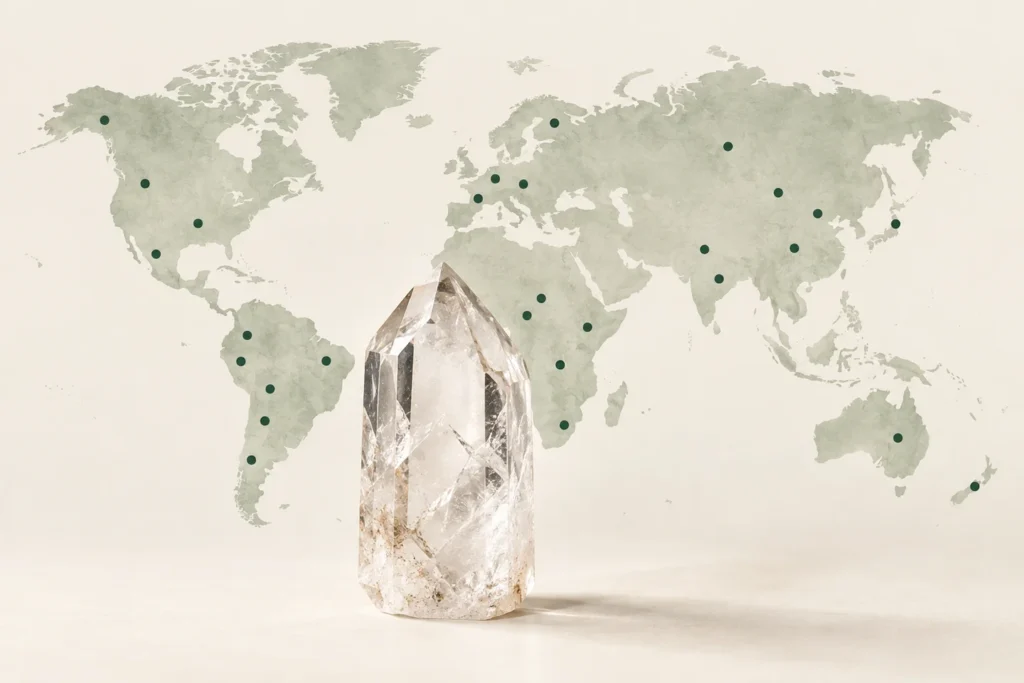
Understanding where clear quartz originates is useful context, but it is only the first chapter in a much longer sourcing story. Below, I will walk through the major regions where clear quartz is found, explain why origin alone does not predict what arrives at your door, and share what experienced wholesale buyers actually ask before placing an order.
Where in the world is clear quartz most commonly sourced?
Buyers new to crystal sourcing often begin with a simple question: which countries produce clear quartz? It seems straightforward, but the answer reveals just how widely available — and how variable — this mineral truly is.
Clear quartz (silicon dioxide, SiO₂) is among the most abundant minerals on Earth.1 It is found across multiple continents, with significant sourcing activity reported in South America, Africa, Asia, North America, and Europe.2 Brazil is frequently cited as a major source, along with Madagascar, China, India, the United States (particularly Arkansas), Namibia, and Myanmar, among others.3
Why is clear quartz so widely distributed?
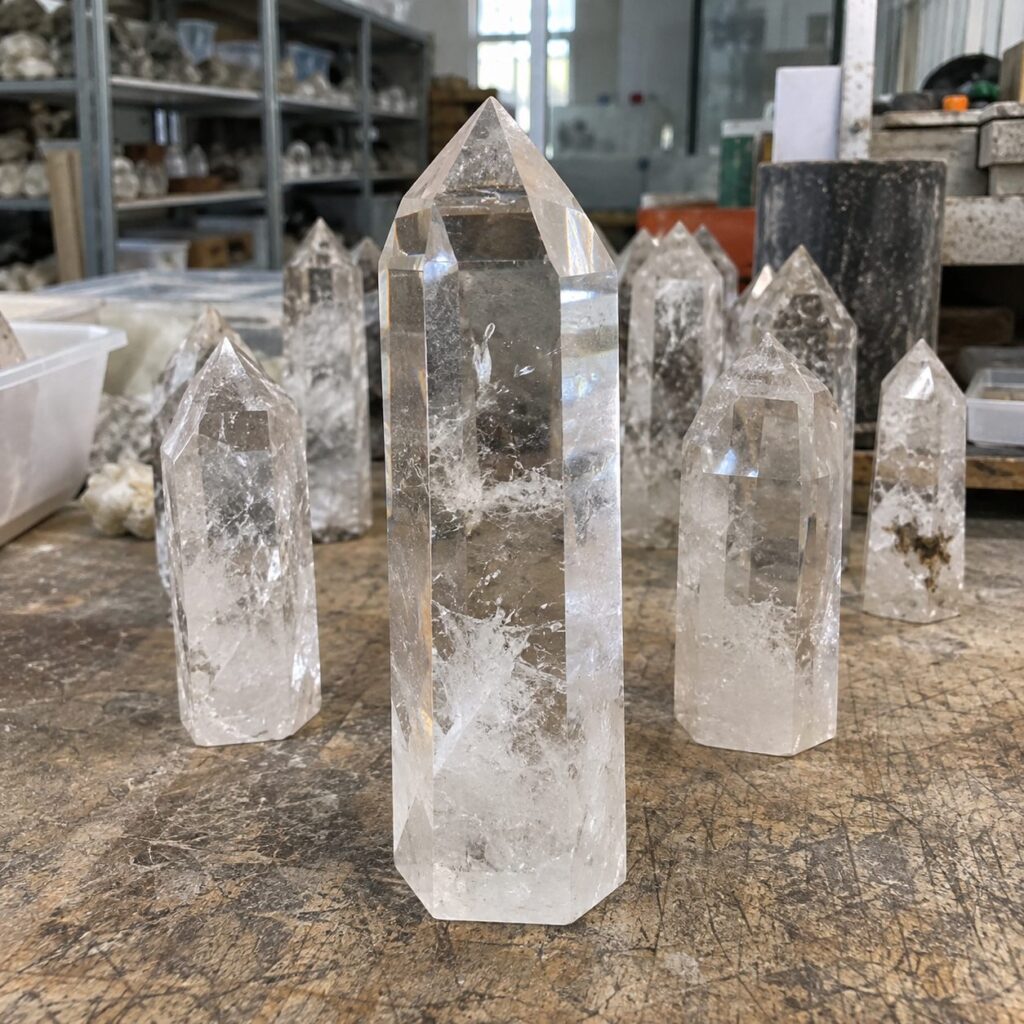
Quartz forms under a broad range of geological conditions.4 It crystallizes from silica-rich solutions in igneous, metamorphic, and sedimentary environments.5 This geological versatility means clear quartz deposits exist on virtually every continent. Unlike rarer minerals tied to very specific geological events, quartz's formation conditions are common enough that large deposits appear in many countries.
Major sourcing regions at a glance
| Region | Notes for Buyers |
|---|---|
| Brazil | Often cited as one of the largest producers; wide range of sizes and clarity levels available |
| Madagascar | Known for producing crystals with notable clarity; supply volumes can fluctuate |
| China | Significant domestic processing infrastructure; both raw material sourcing and finished product manufacturing |
| United States (Arkansas) | Well-known among collectors; commercial wholesale volumes may be limited compared to South American sources |
| India | Active in both raw crystal and processed product supply chains |
| Africa (Namibia, Mozambique, etc.) | Various deposits; availability and export logistics vary by country and season |
| Myanmar, Pakistan | Produce specimens and rough material; supply chains may be less consistent |
Important caveat: This table reflects commonly referenced sourcing regions based on industry discussions and trade information. I have not personally inspected every mine or verified production volumes at each location. Buyers should confirm specific origin claims directly with their supplier and request documentation when origin is a selling point for their retail market.
Does this list change over time?
Yes. Mining activity, export regulations, and market demand shift constantly.6 A region that was a major supplier five years ago may have reduced output today. New deposits are occasionally discovered or developed. For B2B buyers, the practical takeaway is that current batch availability matters more than a static list of countries. In sourcing discussions, we usually clarify what material is currently in stock or in production rather than referencing historical supply patterns.
Does clear quartz origin guarantee quality?
This is one of the most common misconceptions I encounter in buyer conversations. Many first-time wholesale purchasers assume that quartz from a well-known origin automatically means higher clarity, fewer inclusions, or better polish. The reality is far more nuanced — and understanding this can save a lot of disappointment and wasted budget.
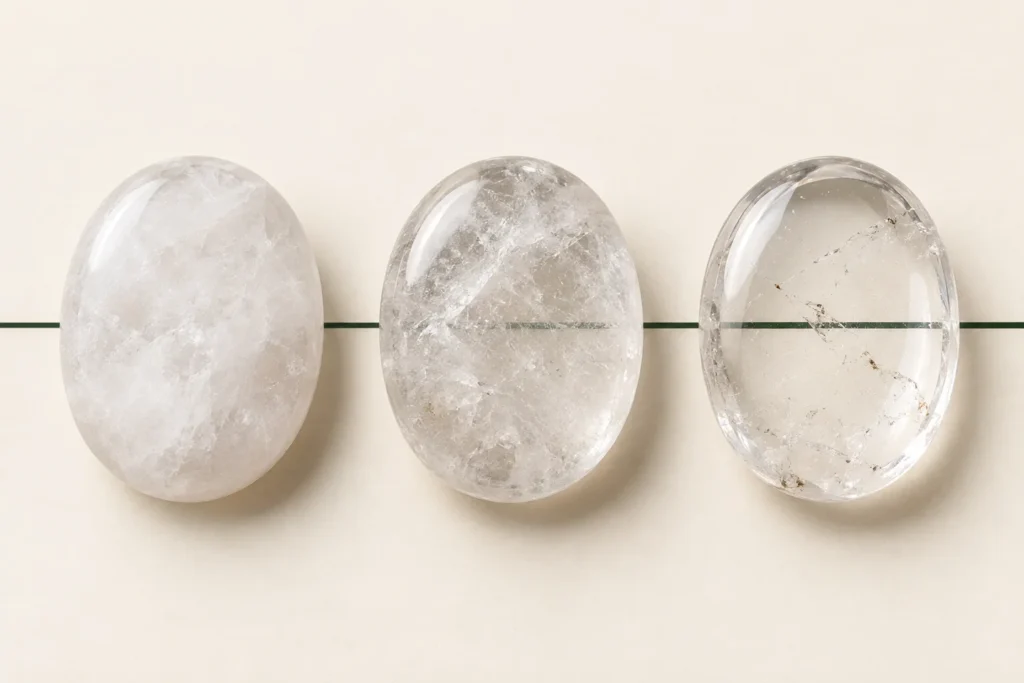
Origin does not guarantee quality.7 A crystal labeled "Brazilian clear quartz" can range from gem-grade, water-clear points to heavily included, cloudy pieces with internal fractures. Quality depends on the specific deposit, the portion of the rough material selected, the grading applied before processing, and the skill of the cutting and polishing work.8 Two batches from the same country — or even the same mine — can look dramatically different.
What actually determines clear quartz quality for resale?
When buyers evaluate clear quartz for their product lines, the factors that matter most are practical and visual:
- Transparency and clarity: Is the piece water-clear, semi-transparent, or milky? Retail customers generally prefer higher transparency for clear quartz products.
- Inclusions: Are there visible internal inclusions, veils, rainbows, or phantoms? Some inclusions add value (rainbow quartz), while others reduce it (cloudy patches, dark spots).
- Internal fractures and cracks: Surface-reaching cracks affect durability and perceived quality. Internal fractures may cause breakage during shipping or handling.9
- Color tone: True clear quartz should be colorless. A yellowish, grayish, or smoky tint may indicate a different variety or treatment.10
- Surface finish: For polished products (spheres, towers, palm stones), the quality of the polish directly affects retail appeal.
- Size and weight consistency: Wholesale buyers need to know the size range within a batch to plan pricing and product listings.
A real sourcing scenario
Buyers often ask us, "Do you have Brazilian clear quartz towers?" In practice, what matters more is: what size range, what clarity grade, what quantity, and what does the current batch actually look like? I have seen situations where two suppliers both offered "Brazilian clear quartz spheres," but one batch was beautifully transparent while the other was heavily clouded with barely visible clarity. The origin label was identical. The product was not.
How should buyers evaluate quality instead?
Rather than relying on origin alone, experienced buyers request:
- Current batch photos — not catalog images from a previous shipment
- Videos showing transparency — photos can be misleading under strong backlighting
- Sample orders — a small trial order to evaluate quality firsthand before committing to large volumes
- Clear grading criteria — ask the supplier how they define "A grade" vs. "B grade" for the specific product
- Honest disclosure of inclusions and variation — no batch is perfectly uniform
At GD Crystal, we encourage new buyers to start with trial orders precisely because photos and descriptions, no matter how detailed, cannot fully replace seeing and handling the product yourself.
Why does clear quartz vary so much between batches?
If you have ordered clear quartz more than once, you have likely noticed that the second batch does not look exactly like the first. This is not a supplier quality control failure — it is the nature of natural mineral products. But understanding why it happens helps buyers plan better.
Batch variation in clear quartz occurs because natural crystal deposits are inherently inconsistent. Different sections of the same deposit yield material with different transparency levels, inclusion patterns, and usable sizes. Processing factors — how the rough is selected, cut, and polished — add another layer of variation.11 No two wholesale batches of natural clear quartz will ever be perfectly identical.
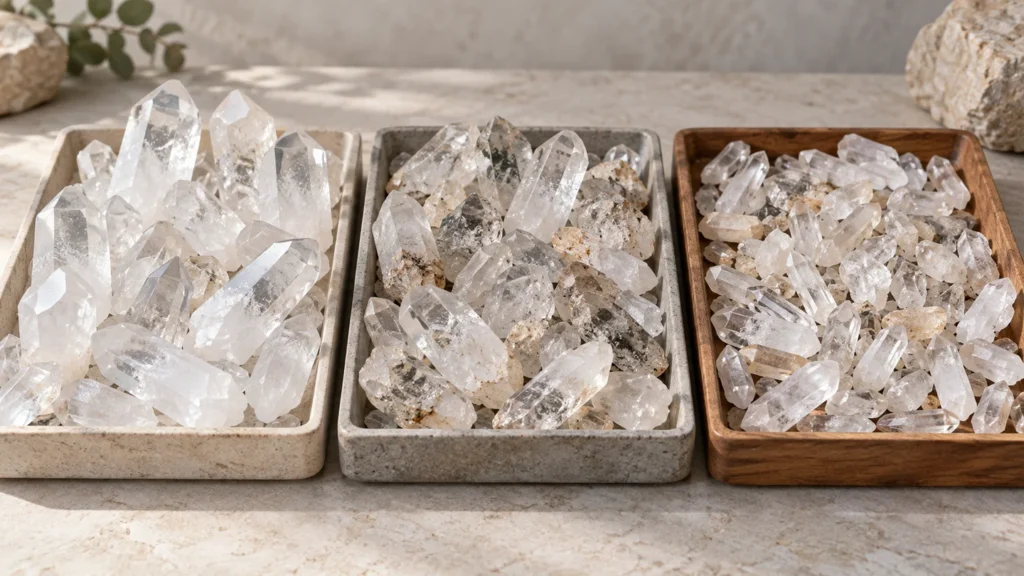
Natural causes of variation
- Geological inconsistency: Even within a single mine, quartz forms in pockets and veins with different conditions.12 One pocket may produce water-clear crystals while an adjacent pocket yields milky or included material.
- Seasonal and extraction timing: The portion of a deposit being mined at any given time affects what rough material enters the supply chain.
- Rough material grading: Before processing, rough quartz is sorted. The yield of clear, high-grade pieces from a given lot of rough determines what finished products look like.
Processing causes of variation
- Cutting decisions: How a rough piece is oriented and cut affects the final product's clarity and visible inclusions.
- Polishing quality: Different factories and workers achieve different levels of surface finish consistency.
- Shape and product form: A clear quartz tower, sphere, and palm stone from the same rough material will look different because each form reveals the internal structure differently.
What this means for buyers
| Buyer concern | Practical recommendation |
|---|---|
| "I need the exact same look as last order" | Request current batch photos; understand exact replication is rarely possible with natural products |
| "My customers expect consistency" | Define acceptable quality ranges (e.g., "minimum 70% transparency, no visible surface cracks") rather than expecting identical pieces |
| "I want to plan a product launch" | Order a sample batch first, confirm you can work with the variation range, then place the larger order from the same batch if possible |
| "Can I return a batch that looks different?" | Clarify return and quality dispute policies before ordering; communication upfront prevents conflicts |
How we handle this at GD Crystal
In daily inquiry work, we try to set clear expectations about batch variation. When a buyer references an old photo or a previous order, we explain that the current batch may differ. We provide updated images and, when possible, videos. This is not about being difficult — it is about ensuring the buyer receives what they actually see and approve, not a memory of what they ordered six months ago.
What should B2B buyers really ask when sourcing clear quartz?
Knowing where clear quartz is found provides helpful background. But in my experience, the buyers who build successful crystal product lines ask a different set of questions entirely. They focus on sourcing specifics rather than geographic trivia.
The most effective B2B sourcing questions for clear quartz center on product form, size range, clarity grade, current batch availability, MOQ, pricing structure, packaging, and shipping logistics. Asking "Where is it from?" is a starting point. Asking "What exactly can you supply right now, and what does it look like?" is what leads to a successful order.
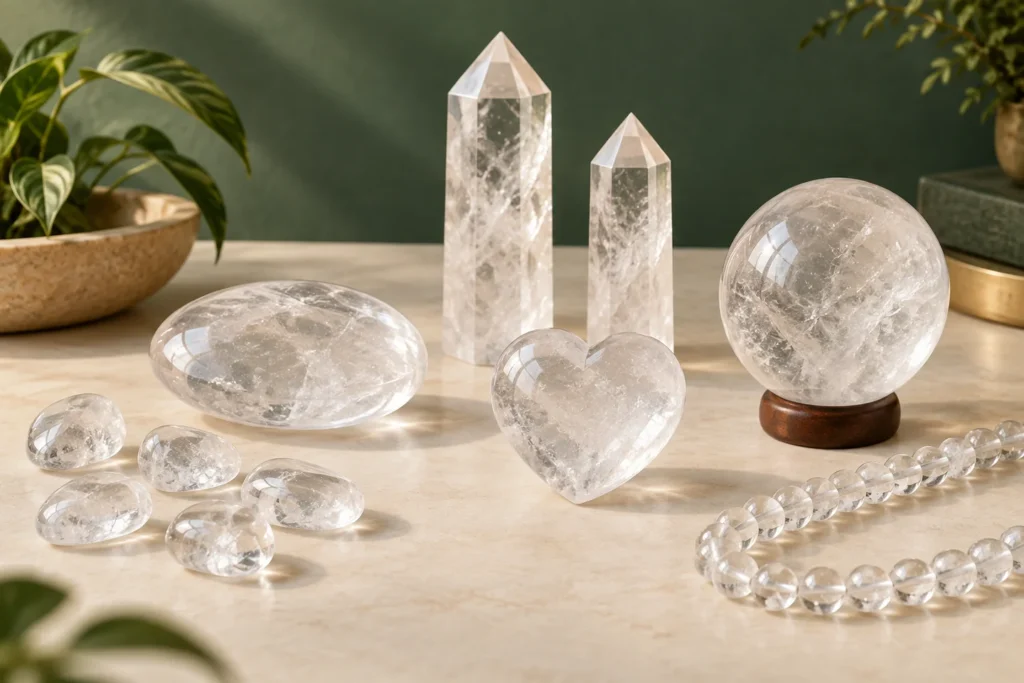
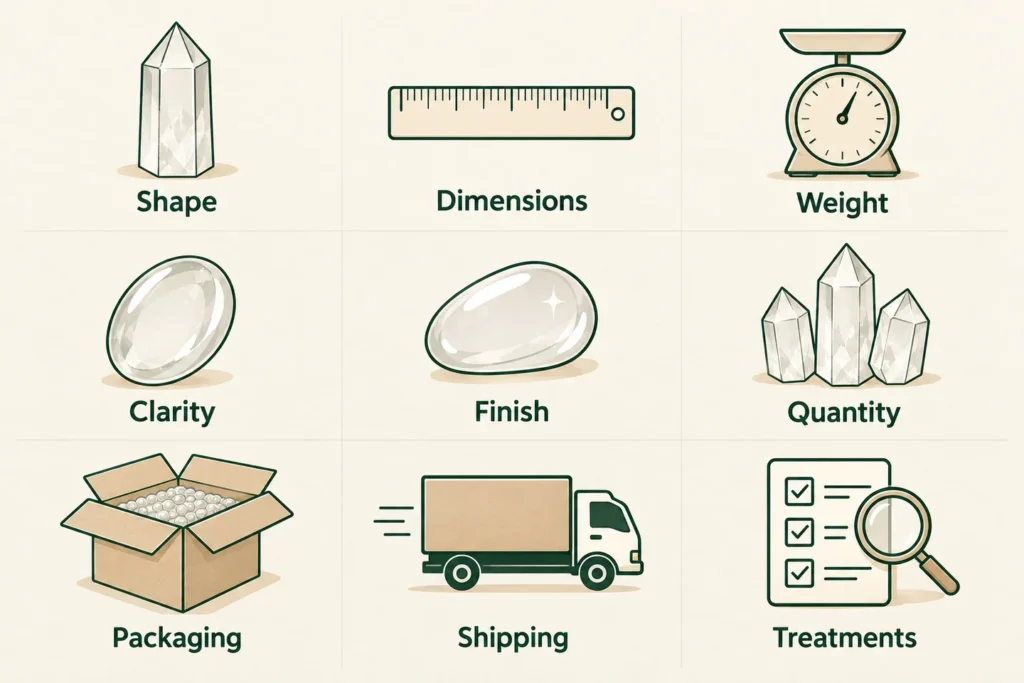
The essential sourcing checklist
Here is what experienced buyers typically confirm before placing a clear quartz wholesale order:
- Product form: Towers, spheres, palm stones, hearts, tumbled stones, raw points, carved figures, or something else?
- Size and weight range: What are the minimum and maximum dimensions or weights per piece in this batch?
- Clarity grade: What does "A grade" mean for this supplier? Is there a defined standard, or is it subjective?
- Current batch photos and/or video: Are these images from the actual batch being offered, or from a past shipment?
- Material and treatment disclosure: Is this natural, untreated clear quartz? Has it been coated, irradiated, or enhanced in any way?
- MOQ (Minimum Order Quantity): What is the minimum per SKU and per order? Can items be mixed across product forms?
- Unit pricing and price breaks: How does price change with volume? Is pricing per piece, per kilogram, or per lot?
- Packaging: How will pieces be individually wrapped or protected for international shipping?
- Shipping and lead time: What is the estimated production or preparation time? What shipping methods are available?
- Sample or trial order option: Can the buyer order a small quantity first to evaluate quality?
Why these questions matter more than origin
A buyer who orders 500 clear quartz towers without confirming the size range, clarity grade, and current batch photos is taking a much bigger risk than a buyer who skips the origin question entirely but nails every item on the checklist above. Origin tells you something about the raw material's geological background. The checklist tells you what will actually arrive at your warehouse.
How sourcing conversations typically work
When international buyers reach out to us at GD Crystal, the conversation usually follows a pattern:
- The buyer describes what they need (product type, approximate quantity, target price range).
- We confirm what is currently available or what can be produced within their timeline.
- We share current batch photos, pricing, MOQ, and shipping options.
- The buyer reviews, asks follow-up questions, and may request samples.
- Both sides agree on specifications, price, and terms before the order is placed.
This process exists because natural crystal products are not standardized industrial components. Each transaction requires confirmation of what is available right now.
How does clear quartz availability affect product-line planning?
For retailers and brand owners building a crystal product line, clear quartz is often considered a "staple" item — something that should always be in stock. But steady availability is not as automatic as many buyers assume.
Clear quartz is widely available as a raw mineral, but processed product availability in specific forms, sizes, and quality grades fluctuates based on rough material supply, factory production schedules, seasonal demand cycles, and logistics conditions. Buyers who plan restocking cycles and maintain supplier communication are better positioned to keep consistent inventory.
Factors that affect supply continuity
- Rough material supply: Even abundant minerals experience supply fluctuations. Mining disruptions, export policy changes, or demand surges can temporarily reduce the availability of certain quality grades.
- Factory production queues: During peak seasons (often before major retail holidays), processing factories may have longer lead times.
- Logistics and shipping: International shipping delays affect delivery timelines regardless of product availability.
- Quality-specific shortages: "Clear quartz" in general may be easy to find. But water-clear, large-size, well-polished towers in your preferred size range? That is a more specific request that depends on current batch composition.
Planning tips for buyers
- Do not wait until you are out of stock to begin the next sourcing inquiry. Lead times for international orders typically range from a few weeks to over a month.
- Communicate your ongoing needs to your supplier so they can flag relevant batches or allocate stock.
- Diversify product forms to reduce dependence on a single SKU that may occasionally be unavailable in your preferred grade.
- Keep records of what sold well and what quality level your customers responded to, then use those specifics in your next inquiry.
Frequently Asked Questions
Is clear quartz rare or easy to find?
Clear quartz is one of the most abundant minerals on Earth and is found across many countries. However, high-clarity, well-processed wholesale products in specific forms and sizes can be harder to source consistently. Availability depends on current batch quality, not just mineral abundance.
Does the country of origin affect clear quartz price?
Origin can influence pricing due to differences in mining costs, export logistics, and perceived market value. However, the product form, size, clarity grade, processing quality, and order volume typically have a larger impact on wholesale price than origin alone.
How can I verify the origin of clear quartz from a supplier?
Ask your supplier directly about origin and request any available documentation. Be aware that in complex supply chains, origin claims are not always independently verified. Focus on evaluating the actual product quality through current batch photos, videos, and sample orders rather than relying solely on origin labels.
Can I request clear quartz from a specific country?
You can specify origin preferences when inquiring, but availability depends on what your supplier currently has access to. Some suppliers source from multiple regions. Discuss your needs openly and ask what is available rather than limiting your options to a single origin without quality comparison.
What is the best product form for reselling clear quartz?
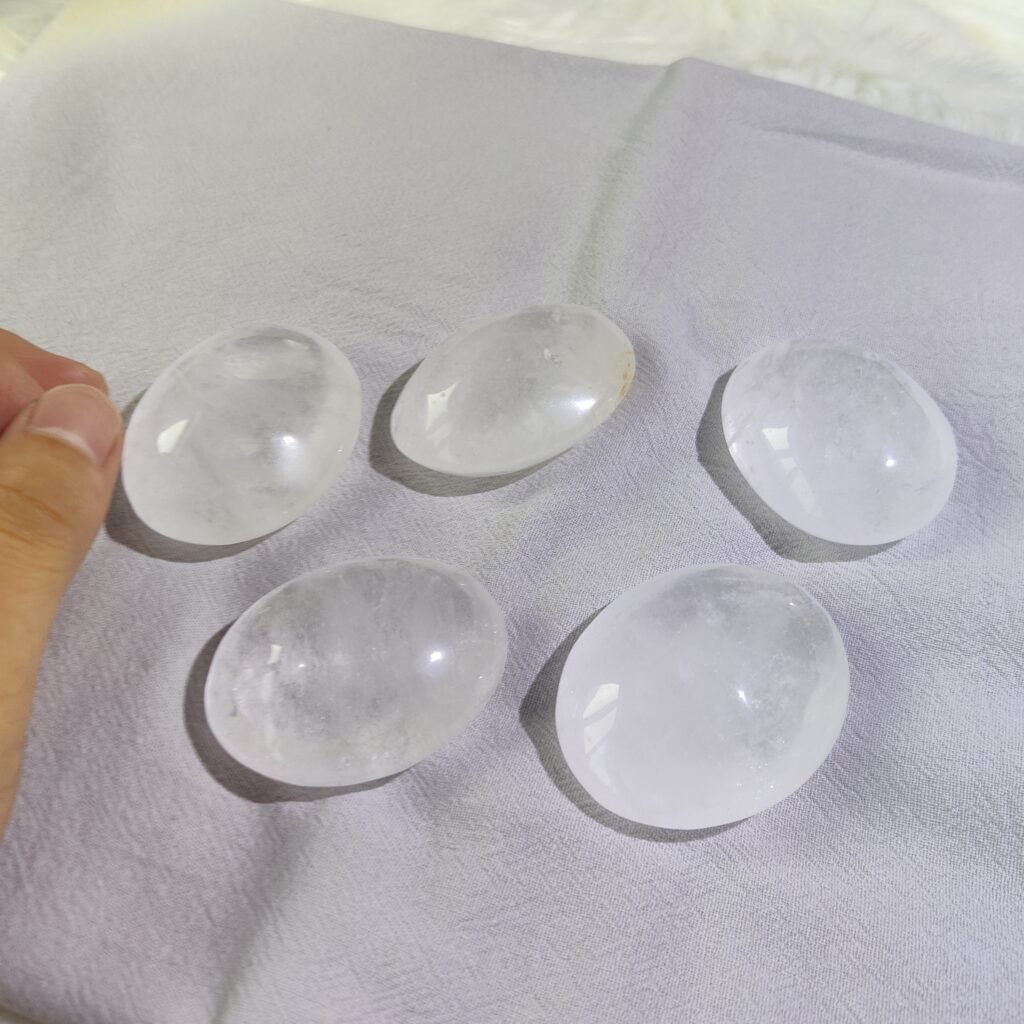
Popular resale forms include towers (points), spheres, palm stones, tumbled stones, and hearts. The best choice depends on your target market, price point, and display preferences. Many buyers stock multiple forms to serve different customer segments.
Conclusion
Clear quartz can be found across the globe — from Brazil and Madagascar to China, the United States, and many other regions. But for B2B buyers, the question of where clear quartz is found is really just the beginning. What matters most is whether a supplier can provide the specific product form, clarity grade, size range, and quantity you need from a current, verified batch. Origin is context. Quality evaluation, clear communication, and confirmed batch details are what lead to successful sourcing.
If you are planning to add clear quartz to your product line or looking for a reliable restocking source, I invite you to reach out to GD Crystal with your specific requirements. We are happy to share current batch photos, discuss available product forms and sizes, and work through the details that matter — so you can buy with confidence.
References
- "Quartz | U.S. Geological Survey", https://www.usgs.gov/media/images/quartz. A standard mineralogical reference identifies quartz as silicon dioxide and describes it as one of the most abundant minerals in Earth’s crust. Evidence role: general_support; source type: encyclopedia. Supports: Quartz is composed of silicon dioxide and is widely described as one of the most common or abundant minerals in Earth's crust.. ↩
- "Quartz", https://en.wikipedia.org/wiki/Quartz. Mineral locality records document quartz occurrences across numerous countries and continents, supporting the statement that clear quartz is geographically widespread. Evidence role: general_support; source type: institution. Supports: Quartz has documented occurrences in many countries and on multiple continents.. Scope note: Such locality records support geological occurrence, but they do not by themselves verify present-day wholesale sourcing volumes. ↩
- "The QUARTZ of ARKANSAS: Geology, History and Legend", https://scholarworks.uark.edu/cgi/viewcontent.cgi?article=1030&context=geospub. Mineral locality references list quartz occurrences in Brazil, Madagascar, China, India, Arkansas in the United States, Namibia, and Myanmar, providing contextual support for these regions as recognized quartz sources. Evidence role: case_reference; source type: institution. Supports: The named countries and Arkansas have documented quartz occurrences or recognized quartz localities.. Scope note: Locality documentation supports occurrence and recognition, but it does not prove current export availability or comparative production volume. ↩
- "Quartz – Common Minerals", https://commonminerals.esci.umn.edu/minerals-o-s/quartz. University geology materials describe quartz as a mineral that occurs in a wide range of geological environments, including igneous, metamorphic, and sedimentary settings. Evidence role: mechanism; source type: education. Supports: Quartz forms in several geological settings rather than in one narrow formation environment.. ↩
- "Igneous Rocks", http://www.columbia.edu/~vjd1/igneous.htm. Geoscience references describe quartz as crystallizing from silica-rich melts or fluids and as occurring in igneous, metamorphic, and sedimentary environments. Evidence role: mechanism; source type: education. Supports: Quartz crystallization is associated with silica-rich systems and quartz occurs in igneous, metamorphic, and sedimentary rocks.. Scope note: The source would support the general formation mechanism, not the specific commercial quality of any wholesale batch. ↩
- "The double-edged sword of export bans on critical metals", https://blogs.worldbank.org/en/developmenttalk/the-double-edged-sword-of-export-bans-on-critical-metals. Institutional analyses of mineral markets note that production conditions, trade measures, and demand shifts can alter mineral supply availability over time. Evidence role: general_support; source type: institution. Supports: Mineral markets and supply chains are affected by production changes, trade policy, and demand conditions.. Scope note: This supports the general supply-chain principle rather than documenting a specific recent change in clear quartz production. ↩
- "Diamond Quality Factors", https://www.gia.edu/diamond-quality-factor. Gemological guidance treats quality assessment as a matter of observable properties such as clarity, inclusions, color, cut, and finish, which supports the view that origin alone is not a quality guarantee. Evidence role: expert_consensus; source type: institution. Supports: Gem and mineral quality is commonly evaluated by observable characteristics such as color, clarity, inclusions, cut, and finish, not simply by geographic origin.. Scope note: The support is contextual because gemological standards may not address every wholesale clear-quartz product form directly. ↩
- "How Rough is Graded – prettyrockcom", https://prettyrock.com/pages/contact?srsltid=AU7gw4UJtXWtXSvekKWPJQhoQOApmmEEVStzyCjtcOIuclM3XcKvKrB8. Gemological and lapidary references describe finished stone quality as depending on both the characteristics of the rough material and the workmanship involved in cutting and polishing. Evidence role: mechanism; source type: research. Supports: The final appearance and quality of a mineral or gem product are affected by the properties of the rough material and by cutting and polishing practices.. Scope note: This evidence supports the mechanism generally; it may not quantify the relative importance of each factor for clear quartz specifically. ↩
- "Fracture of Brittle and Quasi-Brittle Engineering Materials", https://authors.library.caltech.edu/records/1qjkd-x1b91. Materials-science literature on brittle fracture explains that cracks and internal flaws can act as stress concentrators, increasing the likelihood of breakage under handling or impact. Evidence role: mechanism; source type: paper. Supports: Cracks and flaws in brittle materials can concentrate stress and contribute to fracture or breakage.. Scope note: The evidence supports the physical mechanism; actual shipping breakage also depends on packaging, impact forces, and handling conditions. ↩
- "Citrine Quality Factors", https://www.gia.edu/citrine-quality-factors. Gemological references define rock crystal or clear quartz as colorless quartz and distinguish colored quartz varieties, including smoky and yellow quartz, by their coloration and, in some cases, treatment history. Evidence role: definition; source type: institution. Supports: Clear quartz is described as colorless quartz, while colored varieties such as smoky quartz or citrine are distinguished by color and may sometimes be affected by treatment.. Scope note: Color alone may not establish treatment; laboratory testing may be required to determine whether a specific specimen has been enhanced. ↩
- "Gem Cutting Styles – Definitions", https://www.gia.edu/gia-news-research-value-factors-gem-cutting-styles-definitions. Lapidary references explain that rough-stone selection, cutting orientation, and polishing quality influence the appearance and surface finish of finished stone products. Evidence role: mechanism; source type: research. Supports: Lapidary choices, including orientation, cutting, and polishing, affect the visible appearance and finish of a stone.. Scope note: This is general support for processing effects and does not establish defect rates or appearance ranges for a specific quartz batch. ↩
- "Quartz Crystal Deposits of Southwestern Virginia and …", https://pubs.usgs.gov/bul/1072d/report.pdf. Geology references describe quartz as forming in veins and cavities, and variations in local fluid chemistry, temperature, and growth conditions can produce differences in crystal appearance within the same deposit. Evidence role: mechanism; source type: education. Supports: Quartz commonly occurs in veins and cavities, where variations in local growth conditions can affect crystal characteristics.. Scope note: The evidence supports geological variability, not the exact variation observed in any named supplier’s inventory. ↩