If you've searched for laser crystals, you probably noticed the results are confusing. Some pages describe optical components for scientific instruments, while others show beautiful engraved glass blocks sold as gifts. That ambiguity creates real sourcing risk—especially for B2B buyers placing their first wholesale order. Let's clear it up.
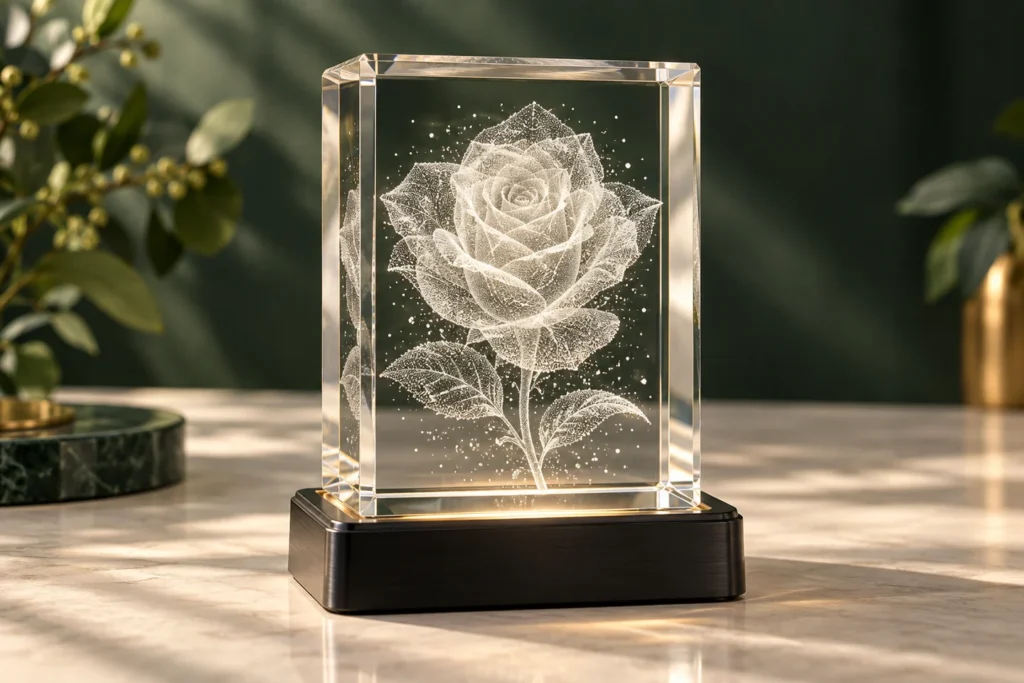
In the gift, souvenir, and decorative products market, laser crystals are primarily high-clarity crystal or glass blocks featuring internal 3D laser engravings1. They are used for resale as personalized gifts, corporate awards, home and office décor, event keepsakes, and branded promotional items. They are not the same as industrial optical crystals used inside laser systems.2
That short answer covers the basics, but it barely scratches the surface of what buyers actually need to know. Below, I'll walk through the most common use cases, explain what makes these products commercially viable for resale, and outline exactly what information you should prepare before requesting a quote. Whether you're stocking a gift shop, building an e-commerce catalog, or sourcing corporate souvenirs, this guide will help you evaluate laser crystal products like a seasoned procurement buyer.
What Does "Laser Crystal" Actually Mean in the Gift Industry?
The term laser crystal trips up buyers more often than you might expect. In our daily inquiry communications at GD Crystal, we regularly receive messages from people who aren't entirely sure which product category they're asking about. That confusion can lead to wasted time—or worse, ordering entirely the wrong product.
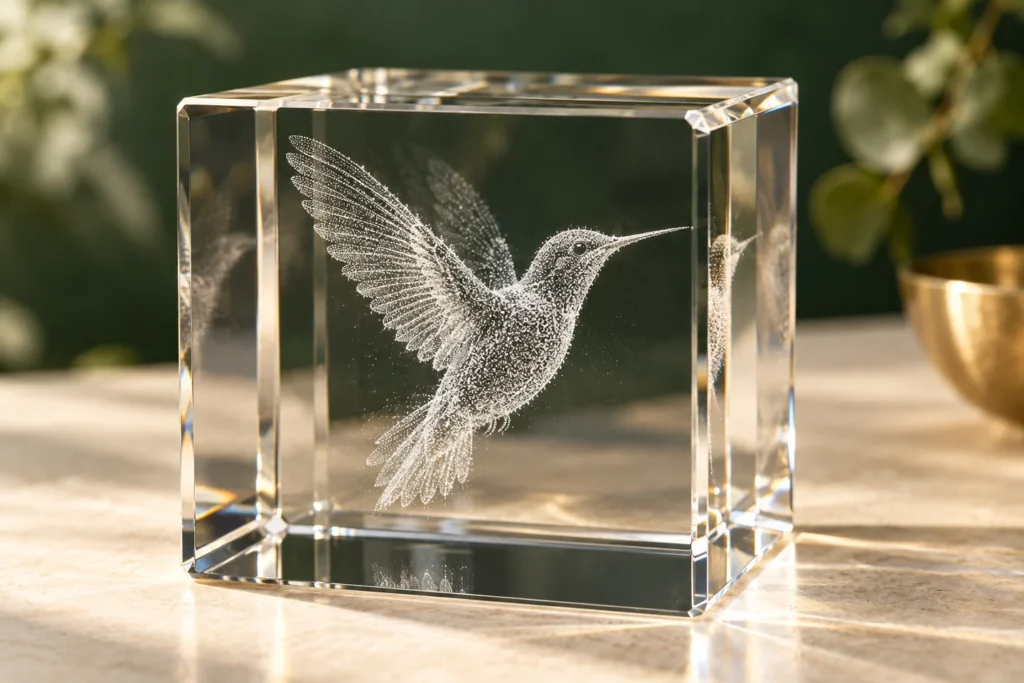
In the gift and decorative products context, a laser crystal is a block of optical-quality glass or crystal (typically K9 crystal glass) that has been internally engraved using a sub-surface laser engraving machine3. The laser creates thousands of tiny fracture points inside the material4, forming detailed 3D images, text, logos, or patterns—all visible through the crystal's transparent surface.
How Is This Different from Industrial Laser Crystals?
It's worth a brief clarification. In optics and photonics, "laser crystals" refer to solid-state gain media5—materials like Nd:YAG, Ti:Sapphire, or Yb:YAG6—that are core components inside laser systems. These are precision-engineered optical materials sold to laboratories, manufacturers, and defense contractors.
| Feature | Decorative Laser Crystals | Industrial Laser Crystals |
|---|---|---|
| Primary material | K9 crystal glass, optical glass | Nd:YAG, Ti:Sapphire, Yb:YAG, etc. |
| Main function | Display, gift, décor, branding | Generate or amplify laser light |
| Buyer profile | Gift shops, retailers, e-commerce sellers | Labs, OEMs, photonics engineers |
| Customization | Image engraving, shape, size, packaging | Doping concentration, coating, dimensions |
| Price range | Typically $2–$50+ per unit wholesale | $50–$5,000+ per component |
| Sourcing channel | Crystal product suppliers, gift wholesalers | Optical component manufacturers |
If you're reading this article as a retailer, gift shop owner, or e-commerce seller, you're almost certainly looking for the decorative category. I won't pretend to have expertise in industrial laser optics—that's a completely different field. What I can share is over 15 years of hands-on experience in crystal product processing and wholesale supply.
Why the Confusion Matters for Buyers
Getting the category wrong wastes inquiry time, delays your sourcing timeline, and can lead to awkward conversations with suppliers who don't carry what you actually need. Before you send your first inquiry, make sure you and your supplier are talking about the same product. A simple product photo or reference image eliminates 90% of this confusion instantly.
What Are the Most Common Uses for Laser Crystal Products?
Knowing that laser crystals exist as a product category is one thing. Understanding where they sell and who buys them is what turns product knowledge into profitable inventory decisions. Many retailers wonder whether laser crystal products are a niche novelty or a genuine staple—and the answer depends entirely on your target market.
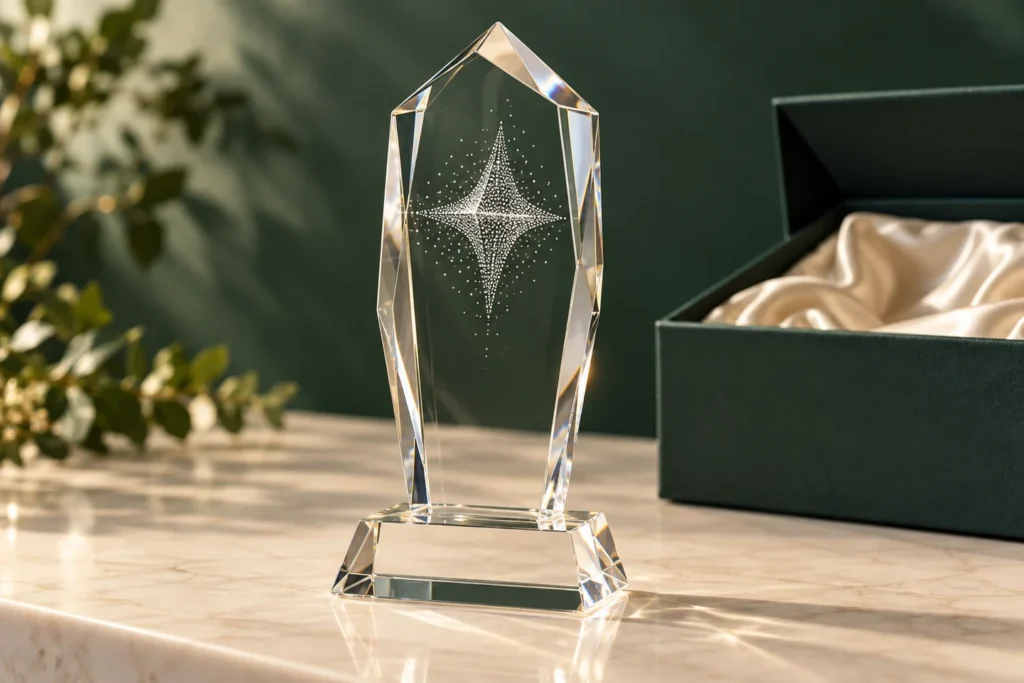
Laser crystal products are commonly used for personalized photo gifts, corporate awards and trophies, branded promotional items, wedding and event keepsakes, religious and spiritual display pieces, tourist souvenirs, and home or office decorative accents.7 Their versatility is their strongest commercial feature.
Personalized Photo Gifts
This is arguably the single largest retail use case. Consumers send a photograph—typically a family portrait, pet image, or memorial photo—and receive a crystal block with a 3D laser-engraved version of that image inside. These sell well on e-commerce platforms, especially during holiday seasons, Valentine's Day, Mother's Day, and memorial occasions.8
For B2B buyers, the question isn't just "can this be done?" but rather:
- Who handles the engraving? Some wholesalers supply blank crystal blocks, and you engrave locally. Others offer full-service engraving from submitted photos.
- What's the turnaround time per unit? Custom engraving adds production time.
- What resolution and detail level is achievable? This depends on the engraving equipment and the crystal's clarity.
Corporate Awards, Trophies, and Recognition Items
Laser crystals are a staple in the awards and recognition market.9 Companies order them for:
- Employee of the month/year awards
- Sales achievement trophies
- Retirement gifts
- Conference speaker gifts
- Partnership commemorations
Corporate buyers typically need logo engraving, text customization, and consistent quality across a batch. They also tend to require branded packaging. If you serve a B2B clientele that includes HR departments or event planners, this segment can generate repeat orders with predictable seasonality.
Branded Promotional Items and Souvenirs
Tourist attractions, museums, theme parks, and cultural institutions frequently stock laser crystal souvenirs featuring local landmarks, mascots, or logos.10 These items are compact, visually impressive, and perceived as premium—which supports a higher retail markup compared to printed souvenirs.
Wedding, Event, and Memorial Keepsakes
Laser crystals work well as:
- Wedding favors with the couple's names and date
- Memorial or remembrance pieces with portraits
- Religious items with 3D carvings of symbols, saints, or deities
- Graduation gifts
Home and Office Décor
Some buyers stock laser crystal products purely as decorative display items—abstract designs, animals, zodiac symbols, or geometric patterns. Paired with an LED light base, these items create an eye-catching glow effect that photographs well for social media marketing.
Key takeaway for buyers: The use case you're targeting directly shapes your sourcing requirements—material quality, size, engraving detail, packaging, and price point all shift depending on whether you're selling a $10 tourist souvenir or a $60 corporate award.
What Should Buyers Evaluate Before Sourcing Laser Crystals?
Listing applications is easy. The harder—and more valuable—question for wholesale buyers is: how do you evaluate whether a specific laser crystal product fits your business? Too many first-time buyers focus only on aesthetics and unit price, then encounter problems with shipping damage, inconsistent quality, or mismatched customer expectations.
Before sourcing laser crystals wholesale, buyers should evaluate material type and clarity, available shapes and sizes, engraving quality and customization capability, packaging durability, MOQ requirements, lead time, shipping logistics, and how the product's retail positioning aligns with their customer base.
Material Type and Clarity
Most decorative laser crystals are made from K9 crystal glass (also called K9 optical glass), a borosilicate glass known for its high clarity and good light refraction.11 K9 is the industry standard for this product category. Some sellers may also offer products in natural quartz crystal, but these are far less common for laser engraving due to cost and material variability.
Key material questions to ask your supplier:
- Is the material K9 crystal glass or another type?
- What level of optical clarity can I expect?
- Are there bubbles, inclusions, or cloudiness in the material?
At GD Crystal, we're transparent about material composition. If a product is K9 glass, we say so. If a buyer asks about natural crystal alternatives, we discuss the trade-offs honestly.
Shape, Size, and Weight Range
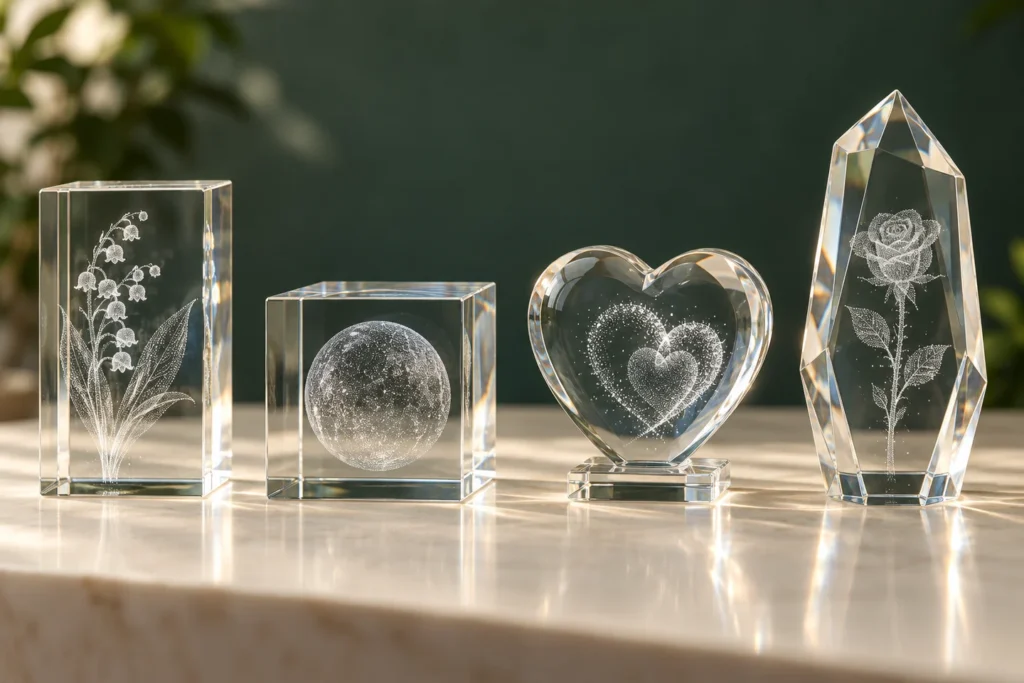
Laser crystal products come in a wide variety of forms:
| Shape | Common Uses | Typical Size Range |
|---|---|---|
| Rectangular block | Photo gifts, awards | 50mm–200mm height |
| Cube | Desk display, souvenirs | 40mm–80mm per side |
| Heart | Romantic gifts, memorials | 60mm–120mm |
| Diamond/Iceberg | Awards, décor | 60mm–150mm |
| Sphere | Display items | 40mm–100mm diameter |
| Obelisk/Tower | Awards, landmark souvenirs | 80mm–250mm height |
| Custom shapes | Brand-specific items | Varies by design |
Size and weight directly affect your shipping cost, retail price point, and packaging requirements. Heavier items need more protective packaging and cost more to ship—especially for international orders.12 Always confirm the weight range per unit before calculating your landed cost.
Engraving Quality and Customization Options
Not all laser engraving is equal. The quality of the 3D inner carving depends on:
- Engraving machine precision — measured in dots per inch or point density
- Image source quality — a low-resolution photo produces a blurry engraving
- Operator skill — converting a 2D image into a 3D point cloud requires experience
- Crystal material consistency — impurities in the glass affect engraving visibility
For buyers who want custom engraving (logos, photos, text), clarify these questions with your supplier:
- Do you offer custom engraving, or only pre-designed patterns?
- What file format and resolution do you require for custom images?
- Can I approve a sample or proof before bulk production?
- What is the additional cost and lead time for custom engraving?
Packaging and Shipping Durability
Crystal products are fragile. This sounds obvious, but I've seen countless buyer complaints that trace back to insufficient packaging rather than product defects. For laser crystals specifically:
- Inner packaging should include foam inserts, molded trays, or individual gift boxes
- Outer cartons should be reinforced for international shipping
- LED light bases (if included) should be packaged separately or securely nested
If you plan to sell the product in its packaging (as a retail gift box), then packaging becomes part of the product itself and should be evaluated for appearance, not just protection.
What Information Should You Prepare Before Requesting a Quote?
This is where the article turns directly practical. I've handled thousands of buyer inquiries over the years, and the single biggest factor that determines how quickly and accurately a quote arrives is how well-prepared the buyer's request is. Vague inquiries get vague answers. Specific inquiries get specific—and useful—pricing.
Before contacting a laser crystal supplier, prepare the following: your intended use case, target material and quality level, desired shapes and dimensions, quantity per design, customization details (images, logos, text), packaging requirements, target retail price, destination country, and your timeline.
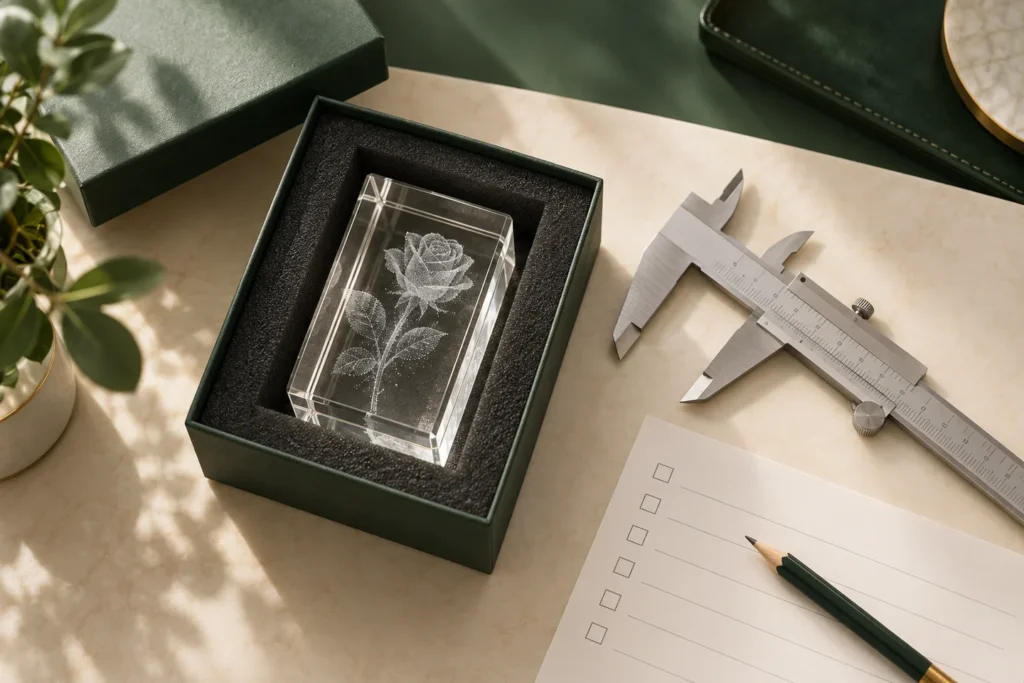
A Practical Inquiry Checklist
Here's a checklist I recommend to every new buyer. You don't need answers to every single item before reaching out, but the more you can provide upfront, the faster the quoting process goes.
| Item | What to Specify | Why It Matters |
|---|---|---|
| Use case | Gift, award, souvenir, décor, promo item | Shapes supplier recommendations |
| Material | K9 glass, natural crystal, other | Affects price and availability |
| Shape(s) | Block, cube, heart, custom, etc. | Determines mold/tooling needs |
| Dimensions | Height × width × depth, or diameter | Drives unit cost and shipping weight |
| Engraving | Stock design, custom logo, custom photo | Affects lead time and per-unit cost |
| Quantity | Per design and total order | Determines MOQ eligibility and pricing tier |
| Packaging | Bulk, individual gift box, branded box | Significant cost variable |
| LED base | Included or not, color options | Adds cost but increases retail value |
| Destination | Country and shipping method preference | Affects logistics quote |
| Timeline | Order date, required delivery date | Determines production feasibility |
Why MOQ, Price, and Lead Time Must Be Confirmed Per Order
I want to be straightforward about something: MOQ, unit price, and lead time for laser crystal products are not fixed numbers we can publish on a website. They vary depending on:
- The specific product and its complexity
- Current material availability and batch size
- Engraving customization requirements
- Packaging specifications
- Order volume
- Shipping destination and method
This is standard in B2B crystal product sourcing. Any supplier who gives you a firm price without knowing your specifications is either guessing or quoting a generic product that may not match your expectations. At GD Crystal, we quote based on actual requirements—material, size, quantity, customization, packaging, and delivery destination—so both sides know exactly what's being agreed upon.
Requesting Samples Before Committing
For first-time buyers, I always recommend requesting a sample or trial order before placing a large batch. This lets you:
- Evaluate material clarity and engraving quality firsthand
- Test packaging durability through actual shipping
- Photograph the product for your own listings or catalogs
- Assess whether the product meets your customers' expectations
Sample terms (cost, shipping, and lead time) should be discussed directly with the supplier. They vary by product and customization level.
Frequently Asked Questions
Are laser crystals made from real crystal or glass?
Most decorative laser crystal products are made from K9 crystal glass, a high-clarity optical glass—not natural quartz crystal. K9 is the industry standard for this product category due to its consistency, clarity, and suitability for laser engraving. If you need natural crystal material, discuss this specifically with your supplier, as availability and cost differ significantly.
Can I get custom photos or logos engraved inside laser crystals?
Yes, most laser crystal suppliers offer custom inner-carving services. You typically need to provide a high-resolution image file. The supplier converts it into a 3D point cloud for engraving. Always request a proof or sample before bulk production to verify engraving quality and image accuracy. Custom engraving may affect MOQ and lead time.
Do laser crystal products come with LED light bases?
Many laser crystal products are designed to be displayed on LED light bases, which illuminate the inner engraving with colored or white light. Whether the base is included depends on the supplier and the specific product configuration. Confirm this during your inquiry, as it affects unit cost, packaging size, and shipping weight.
What is the typical MOQ for laser crystal wholesale orders?
MOQ varies by product type, customization level, and supplier. Standard designs with no customization may have lower MOQs, while fully custom-engraved products typically require higher minimums. At GD Crystal, MOQ is confirmed per product and per order—there is no single number that applies to all laser crystal items.
How should I package laser crystals for resale?
For retail resale, individual gift boxes with foam inserts are most common. The box protects the product during last-mile shipping and enhances the customer unboxing experience. For bulk B2B shipments, additional outer carton reinforcement is essential. Discuss packaging options—including branded packaging—with your supplier during the quoting stage.
Conclusion
So, what are laser crystals used for? In the gift and decorative products market, they're used for personalized photo gifts, corporate awards, branded souvenirs, event keepsakes, and display décor. They're versatile, visually striking, and commercially viable across multiple retail channels. But knowing the use cases is only half the equation. Smart sourcing requires evaluating material quality, engraving capability, packaging, MOQ, and logistics before placing an order.
If you're a retailer, e-commerce seller, or crystal brand looking to add laser crystal products to your catalog, I'd encourage you to start with a clear inquiry. Define your use case, gather reference images, and specify your quantity and customization needs. At GD Crystal, we're happy to walk you through product options, provide quotes based on your actual requirements, and arrange samples.
References
- "Bubblegram", https://en.wikipedia.org/wiki/Bubblegram. Research on subsurface laser engraving in transparent materials describes the formation of visible three-dimensional patterns inside glass, supporting the description of decorative laser crystals as internally engraved transparent blocks. Evidence role: definition; source type: paper. Supports: A source should explain that focused lasers can create three-dimensional images inside transparent glass or crystal by subsurface engraving.. Scope note: Such sources usually describe the process and material behavior rather than the commercial gift-industry naming convention. ↩
- "Solid-state laser", https://en.wikipedia.org/wiki/Solid-state_laser. Reference sources in photonics define laser crystals as solid-state gain media used to generate or amplify laser light, which supports distinguishing industrial optical crystals from decorative laser-engraved glass items. Evidence role: definition; source type: encyclopedia. Supports: A source should define industrial laser crystals as gain media used in solid-state lasers, distinguishing them from decorative engraved glass products.. ↩
- "Master Subsurface Laser Engraving & 3D Crystal Art", https://mr-carve.com/blogs/featured-blog/unlock-7-secrets-master-subsurface-laser-engraving-3d-crystal-art?srsltid=AU7gw4V6BZkRmQrhd2Hg7oaRxm00probrmW8gUwnALjYMLj49S7iFDg7. Technical literature on subsurface laser engraving explains that focused laser pulses can create internal modifications in transparent glass, supporting the article's description of the machine process used for decorative crystal engraving. Evidence role: mechanism; source type: paper. Supports: A source should describe subsurface laser engraving as a process that uses focused laser energy to modify points inside transparent glass without engraving the surface.. ↩
- "Bubblegram", https://en.wikipedia.org/wiki/Bubblegram. Studies of laser-induced damage in transparent glass report that focused laser pulses can create localized internal microdamage, supporting the explanation that 3D engravings are built from many small internal points. Evidence role: mechanism; source type: paper. Supports: A source should support that focused laser pulses can create localized microfractures or damage points inside transparent glass, forming visible internal patterns.. ↩
- "Active laser medium", https://en.wikipedia.org/wiki/Active_laser_medium. Photonics reference works define laser crystals as solid-state gain media that provide optical amplification in laser systems, supporting the article's technical distinction. Evidence role: definition; source type: encyclopedia. Supports: A source should define solid-state laser crystals as gain media that amplify light in laser systems.. ↩
- "Nd:YAG laser", https://en.wikipedia.org/wiki/Nd:YAG_laser. Educational sources on solid-state lasers identify Nd:YAG, Ti:Sapphire, and Yb:YAG as laser gain media, supporting their use as examples of industrial laser crystals. Evidence role: definition; source type: education. Supports: A source should identify Nd:YAG, Ti:Sapphire, and Yb:YAG as gain media or laser crystals used in solid-state laser systems.. ↩
- "How To Choose the Right Corporate Gifts?", https://insights.ehl.edu/how-to-choose-corporate-gifts. Market and consumer research on giftware identifies personalized gifts, recognition awards, souvenirs, and decorative keepsakes as established product categories, providing contextual support for the listed uses of laser crystal products. Evidence role: general_support; source type: research. Supports: A source should provide contextual evidence that personalized gifts, awards, souvenirs, and decorative keepsakes are recognized product categories in giftware or souvenir markets.. Scope note: The source may support the broader product categories rather than proving the frequency of laser crystal use in each category. ↩
- "What Moms (and Shoppers) Want in 2025", https://spiegel.medill.northwestern.edu/what-moms-and-shoppers-want-in-2025/. Consumer-spending surveys from retail institutions document elevated gift purchasing around Valentine's Day and Mother's Day, offering contextual support for the seasonality of personalized photo-gift sales. Evidence role: statistic; source type: institution. Supports: A source should provide consumer spending or retail survey data showing increased gift purchasing around major holidays such as Valentine's Day and Mother's Day.. Scope note: Such data generally covers gift spending overall and may not isolate laser crystal products specifically. ↩
- "The impact of recognition, fairness, and leadership on … – PMC", https://pmc.ncbi.nlm.nih.gov/articles/PMC11717283/. Research on workplace recognition documents the use of tangible awards in organizational recognition programs, providing contextual support for positioning crystal awards within the recognition market. Evidence role: general_support; source type: research. Supports: A source should support the broader use of tangible awards and trophies in employee-recognition and corporate-recognition programs.. Scope note: The evidence may support tangible recognition awards generally rather than demonstrating that laser crystal awards are a dominant or staple format. ↩
- "(DOC) Museum store or a gift shop? A study of …", https://www.academia.edu/26763547/Museum_store_or_a_gift_shop_A_study_of_museum_store_from_a_merchandising_and_design_perspective. Tourism and museum-retail studies describe souvenirs as objects that often encode destination identity through landmarks, symbols, and institutional imagery, providing contextual support for the described souvenir applications. Evidence role: general_support; source type: paper. Supports: A source should show that souvenirs commonly use destination imagery, cultural symbols, landmarks, or institutional branding.. Scope note: The source may address souvenir design generally and not laser crystal souvenirs specifically. ↩
- "K9 glass", https://en.wikipedia.org/wiki/K9_glass. Optical-material references describe K9 or BK7-type optical glass as a transparent crown glass with favorable transmission and refractive properties, supporting the material-property portion of the statement. Evidence role: general_support; source type: research. Supports: A source should verify that K9 optical glass is a transparent optical glass with properties such as high transmission and refractive index suitable for optical or decorative uses.. Scope note: This would not by itself prove that K9 is the dominant material in all decorative laser crystal products. ↩
- "Universal Postal Convention", https://www.upu.int/UPU/media/upu/files/aboutUpu/acts/03-actsConventionAndFinalProtocol/conventionAndFinalProtocolAdoptedAtAbidjanEn.pdf. Postal and packaging standards note that parcel rates are commonly determined by weight or dimensional weight and that packaging must protect goods from transport stresses, supporting the link between heavier crystal items, packaging needs, and shipping cost. Evidence role: general_support; source type: institution. Supports: A source should show that parcel shipping charges depend on weight and dimensions and that heavier fragile goods require packaging designed for distribution hazards.. ↩