If you're sourcing quartz products for resale, telling the difference between real quartz and fake quartz is a genuine procurement risk — not just a curiosity. A single shipment of glass imitations sold as natural quartz can damage your brand, trigger customer returns, and erode buyer trust. The solution isn't one magic test; it's a structured screening process that starts before you even place an order.
The difference between real quartz and fake quartz comes down to four commercial categories: natural quartz, treated quartz, synthetic (lab-grown) quartz, and glass or resin imitation1. Natural quartz contains minor inclusions, subtle color variation, and cool surface feel. Glass imitations tend to show internal bubbles, perfectly uniform clarity, and unnaturally vivid color. However, no single visual check is definitive — reliable identification requires understanding material categories, asking the right supplier questions, and using professional testing for high-value orders.
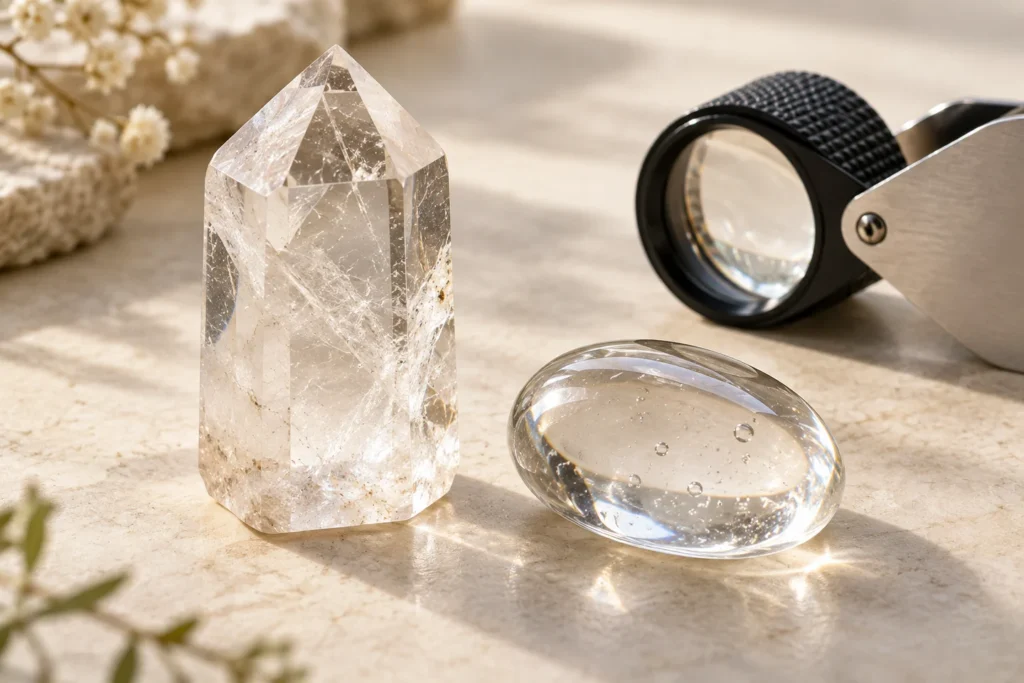
The internet is full of "one simple trick" guides for spotting fake quartz. Most of them are written for individual crystal hobbyists, not for B2B buyers evaluating bulk shipments. Below, I'll walk through what actually works at the procurement level — from visual screening and common test limitations to the supplier communication steps that reduce risk the most.
Why Is the "Real vs. Fake" Question More Complicated Than It Sounds?
Most buyers approach quartz authentication as a binary problem: it's either real or it's fake. But in the wholesale crystal trade, the actual risk landscape is far more nuanced — and oversimplifying it leads to costly mistakes.
The real issue is mislabeling, not just the existence of non-natural materials. The commercial quartz market includes four distinct material categories, each with different cost, disclosure, and resale implications. A treated amethyst isn't "fake" in the same way a glass bead is. Conflating the two leads to either overpaying or wrongly rejecting legitimate products.
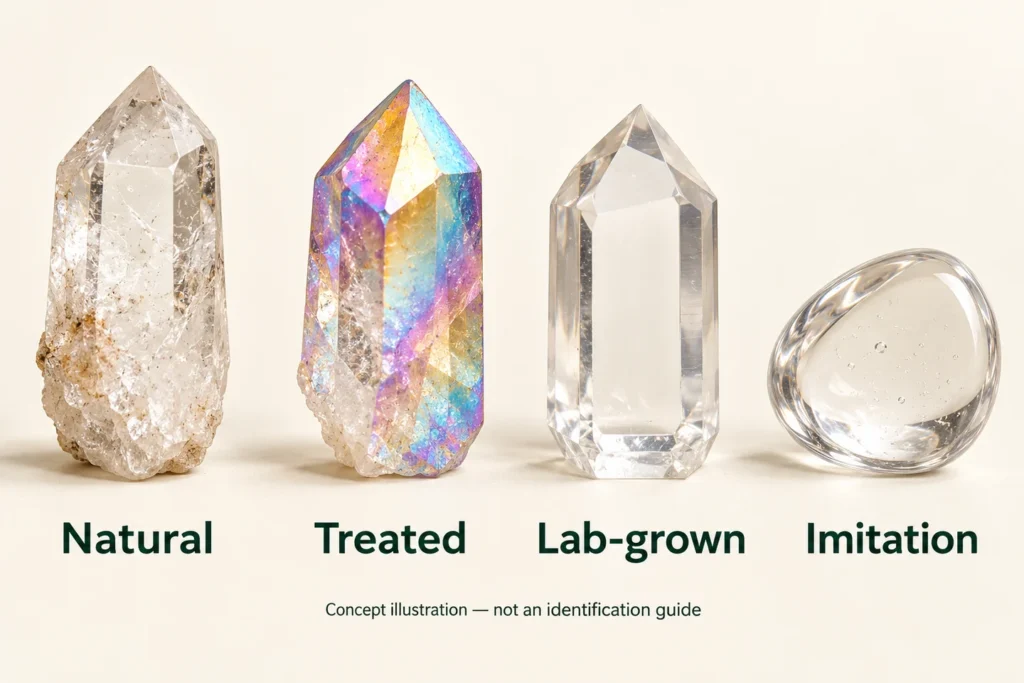
The Four Commercial Categories of Quartz
Understanding these categories is the foundation of any reliable screening process:
| Category | Description | Typical Examples | Key Buyer Concern |
|---|---|---|---|
| Natural quartz | Mined quartz with no significant human alteration beyond cutting and polishing | Clear quartz points, natural citrine, smoky quartz | Confirm origin claim; check for undisclosed treatment |
| Treated quartz | Natural quartz that has been heated, irradiated, coated, or dyed to alter appearance | Heat-treated amethyst sold as "citrine," aura-coated quartz, dyed crackle quartz | Treatment must be disclosed; buyers need to know for accurate retail labeling |
| Synthetic/lab-grown quartz2 | Quartz grown in a laboratory with identical chemical composition (SiO₂) to natural quartz | Hydrothermal synthetic quartz used in electronics and some jewelry | Rarely an issue in crystal retail, but should be disclosed if present |
| Glass or resin imitation | Non-quartz material (typically glass, resin, or plastic) made to resemble quartz | "Cherry quartz" (glass), "opalite" (glass), colored glass spheres sold as natural crystal | Highest risk — often sold at natural quartz prices without disclosure |
Where Does the Risk Actually Sit?
In my experience working with international buyers over 15 years, the most common problem isn't sophisticated synthetic quartz entering the crystal retail market. Synthetic quartz is expensive to produce and mostly serves the electronics industry.3 The real risk falls into two buckets:
-
Glass or resin imitations sold as natural quartz — This is the most damaging scenario. Products like "strawberry quartz" or "cherry quartz" are frequently glass, but they're marketed with natural-sounding names. Buyers who don't ask the right questions end up reselling glass at crystal prices.
-
Treated quartz sold without disclosure — Heat-treated amethyst relabeled as "natural citrine" is extremely common.4 The material is still real quartz, but the treatment changes its market value and the accuracy of retail descriptions. If you're selling to informed crystal consumers, undisclosed treatment creates a trust problem.
Key takeaway: Before you worry about testing methods, make sure you understand what you're testing for. The question isn't just "Is this quartz?" — it's "Is this material what the supplier says it is, and is the treatment status disclosed?"
What Visual Checks Can Help You Screen Quartz Products?
When you receive samples or review product photos, visual inspection is your first line of defense. But it's important to be honest about its limitations — visual checks are a screening tool, not a conclusive identification method.
Visual inspection can raise red flags that justify further investigation or supplier questions. Key indicators include internal bubbles, overly uniform color, suspicious perfection, and surface feel differences. However, many treated or synthetic materials will pass a basic visual check, so this step should always be combined with supplier communication and, when necessary, professional testing.
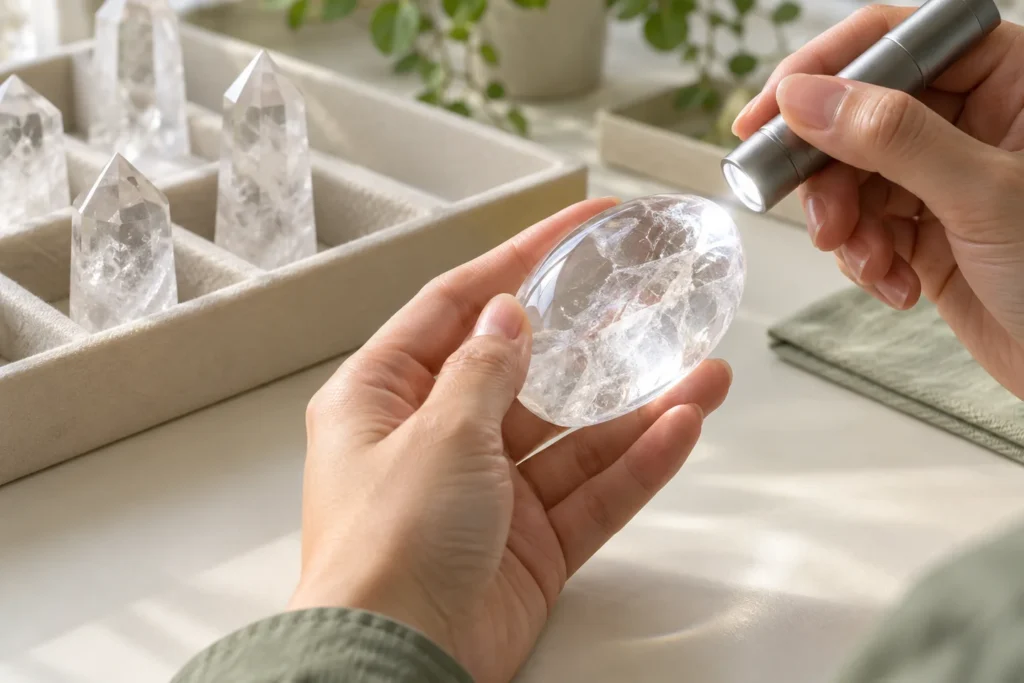
What to Look for During Visual Screening
Here's a practical checklist I share with buyers who are evaluating quartz products, whether from photos, videos, or physical samples:
Internal Structure
- Bubbles: Round, spherical air bubbles are a strong indicator of glass.5 Natural quartz can contain fluid inclusions6, but these tend to be irregularly shaped and often contain tiny mineral particles or two-phase (liquid + gas) fills — not perfectly round air pockets.
- Inclusions: Natural quartz commonly contains mineral inclusions (rutile needles, tourmaline, chlorite), veils, phantoms, or fracture planes.7 If a piece looks absolutely flawless, especially in a large specimen, that warrants questions.
- Color zoning: Natural quartz often shows uneven color distribution — darker zones, gradients, and areas where color concentrates along growth planes. Perfectly uniform, saturated color throughout a piece can indicate dye, heat treatment, or glass.
Surface and Physical Properties
- Surface temperature: Quartz feels noticeably cool to the touch due to its thermal conductivity.8 Glass also feels cool but warms up faster when held. This test is subtle and unreliable on its own, but it's a quick initial check.
- Weight: Quartz (specific gravity ~2.65) and glass (typically 2.3–2.5 for soda-lime glass, higher for lead glass) have overlapping density ranges.9 A trained hand may notice a slight difference, but this is not reliable without precise measurement.
- Surface polish and luster: Natural quartz takes a high, vitreous polish. Glass can look similar but sometimes has a slightly different "oily" surface quality. Again, this is subjective.
Color-Specific Red Flags
| Material Claim | Common Red Flag | What It Might Actually Be |
|---|---|---|
| "Cherry quartz" or "strawberry quartz" | Vivid pink/red with visible swirls or bubbles | Dyed glass |
| "Citrine" (bright yellow-orange) | Uniform deep orange, no color zoning | Heat-treated amethyst (still quartz, but treatment should be disclosed) |
| "Opalite" | Milky translucent with blue sheen | Man-made glass |
| "Aqua aura" or "angel aura" quartz | Metallic iridescent surface coating | Treated natural quartz (vapor-deposited metal coating — should be disclosed) |
| Very cheap "clear quartz" spheres in large quantities | Perfect clarity, no inclusions, extremely consistent batch | Possibly glass; request material confirmation |
Limitations of Visual Checks
I want to be direct: no visual inspection alone can prove a material is natural quartz. High-quality glass imitations can look convincing, especially in polished forms like spheres, tumbled stones, and palm stones where internal features are harder to examine. Treated quartz is chemically identical to natural quartz — you can't "see" heat treatment in most cases without gemological equipment.
Visual screening is valuable for catching obvious glass imitations, flagging suspiciously uniform batches, and identifying items that need further verification. But it's step one, not the final answer.
Do Common "Home Tests" Actually Work for Identifying Quartz?
If you've searched online for how to spot fake quartz, you've probably seen suggestions like scratching glass, using a lighter, or checking with UV light. These popular tests sound straightforward, but for B2B buyers evaluating products for resale, they can be misleading, inconclusive, or even destructive.
Most common home tests for identifying quartz have significant limitations. The scratch test can damage products and doesn't distinguish between natural, treated, and synthetic quartz. The heat test risks thermal shock. The "fog test" is subjective. These methods might occasionally catch obvious glass, but they introduce errors and product damage that make them impractical for wholesale evaluation.
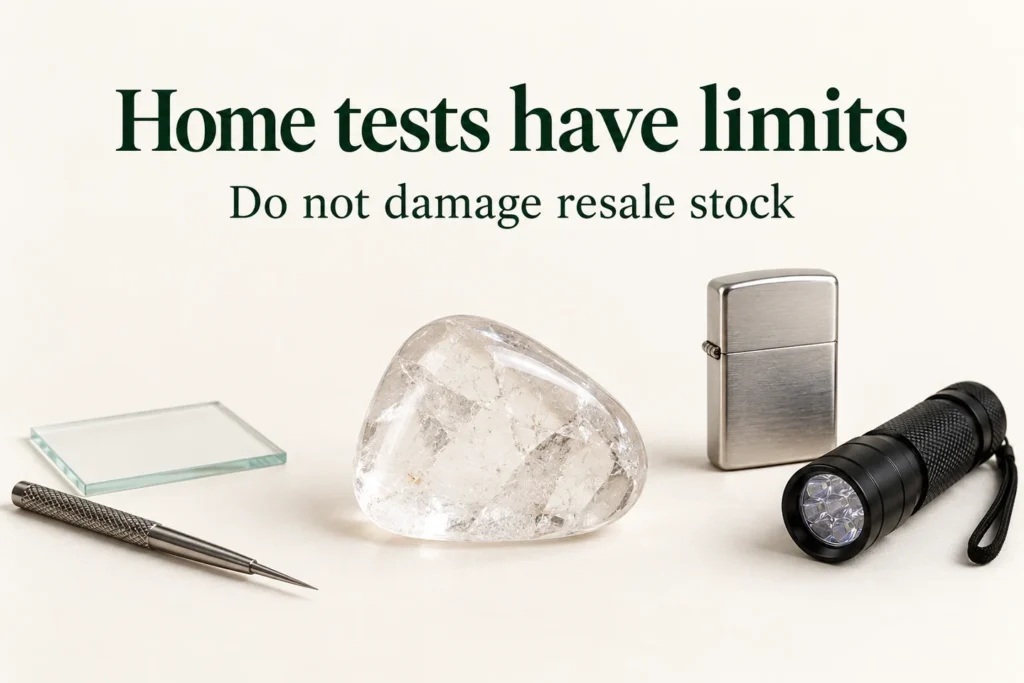
Breaking Down Popular Tests
The Scratch Test (Mohs Hardness)
- How it works: Quartz (Mohs hardness 7) should scratch glass (hardness ~5.5).10 If a specimen can't scratch glass, it's likely not quartz.
- Problems for B2B buyers:
- Scratching damages the product. You can't scratch-test a polished sphere you plan to resell.
- Many glass imitations are made with tempered or harder glass compositions that complicate results.
- Synthetic quartz has the same hardness as natural quartz — this test can't distinguish between them.
- Treated quartz is still quartz and will pass this test every time.
The Heat/Lighter Test
- How it works: Some guides suggest holding a flame to the material. Glass will heat up and may show stress marks; quartz should resist.
- Problems for B2B buyers:
- Rapid, uneven heating can cause thermal shock and crack natural quartz.11
- This test can damage or destroy the very product you're evaluating.
- It provides no information about treatment status.
- Results are ambiguous and require experience to interpret.
The "Fog" Test
- How it works: Breathe on the surface. Quartz supposedly stays clear while glass fogs up and clears slowly.
- Problems for B2B buyers:
- Results are highly subjective and affected by ambient temperature, humidity, and surface cleanliness.
- Not reliable enough to base procurement decisions on.
UV Light Test
- How it works: Some natural quartz varieties fluoresce under UV light; some treatments or glass compositions also fluoresce differently.
- Problems for B2B buyers:
- Fluorescence is inconsistent among natural quartz varieties.12 Absence of fluorescence doesn't mean "fake."
- Some dyes and coatings do fluoresce, so UV can occasionally flag treatments — but interpreting results requires gemological knowledge.
What Should B2B Buyers Do Instead?
Rather than relying on potentially destructive or inconclusive home tests, I recommend a different approach:
- Request current batch photos and videos — not stock images from a catalog, but actual images of the specific batch being offered. At GD Crystal, we provide batch-specific visuals so buyers can evaluate before ordering.
- Ask direct questions about material and treatment — A reliable supplier will confirm the material name, whether any treatment has been applied, and be transparent about what they know and don't know.
- Order a sample or trial shipment first — For new materials or new suppliers, a small trial order lets you physically inspect products before committing to a larger purchase.
- Use professional testing for high-value orders — If the order value justifies it, gemological testing through a qualified lab (such as GIA, Gübelin, or regional gemological institutes) can definitively confirm material identity and treatment status.
The bottom line: Home tests can occasionally catch obvious glass, but they are not a substitute for proper supplier vetting and professional verification when stakes are high.
What Questions Should B2B Buyers Ask Suppliers to Reduce Risk?
For wholesale and resale buyers, the most effective "test" for quartz authenticity happens before you receive the product — during supplier communication. The questions you ask, and the transparency of the answers you receive, tell you more than any scratch test.
B2B buyers should confirm the material name, treatment status, batch-specific photos or videos, size and weight ranges, and whether certificates or independent testing are available. A supplier's willingness to answer these questions directly — and honestly admit what hasn't been tested — is one of the strongest indicators of reliability.
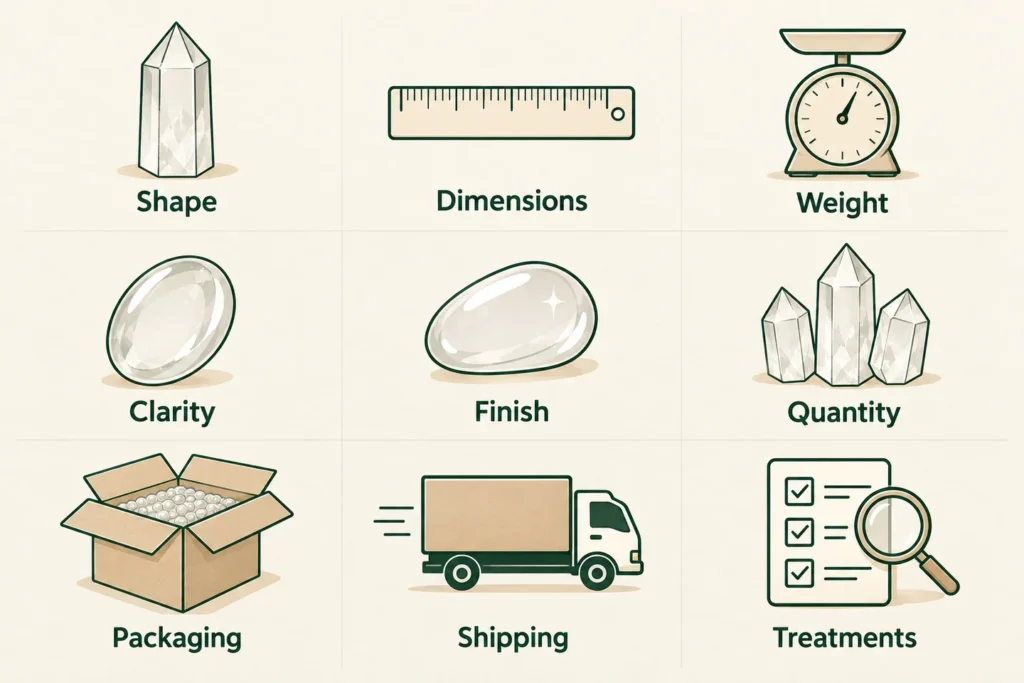
The Essential Supplier Question Checklist
Here's the framework I recommend based on the purchasing inquiries we handle regularly:
Material Identity
- "What is the exact material name for this product?" — Don't accept trade names alone. "Cherry quartz" isn't a mineral name. Push for the mineral identification (e.g., silicon dioxide / SiO₂ for quartz) and whether the material is natural, treated, or man-made.
- "Is this material natural, treated, synthetic, or an imitation?" — A transparent supplier will give you a direct answer. If the response is vague, that's a red flag.
Treatment Disclosure
- "Has this material been heated, irradiated, dyed, coated, or altered in any way?" — Treatment is common and not inherently dishonest. The issue is non-disclosure. Heat-treated amethyst sold as citrine is fine if the buyer knows. It's a problem if they don't.
- "Can you confirm the treatment status in writing (e.g., on the invoice or product description)?" — Written confirmation protects both parties.
Batch Verification
- "Can I see photos or video of the current batch?" — At GD Crystal, we emphasize current batch imagery because crystal products vary naturally between batches. Historical photos or catalog images should not be treated as representations of what you'll receive.
- "What is the size range, weight range, and grade for this batch?" — Natural materials have variation. A credible supplier will provide ranges rather than suspiciously precise specifications.
Certification and Testing
- "Do you provide any material certificates or testing reports?" — For standard wholesale orders of common quartz varieties, formal lab certificates may not be standard or cost-effective. But for higher-value materials or larger orders, professional testing may be warranted.
- "Are you willing to support third-party testing if I require it?" — A supplier confident in their materials should have no problem with independent verification.
How Supplier Responses Reveal Reliability
| Supplier Response | What It Signals |
|---|---|
| Direct material name, clear treatment disclosure, batch photos provided | Transparent, professional — lower risk |
| Vague material name ("energy crystal"), no treatment info, only stock photos | Higher risk — request clarification before ordering |
| Defensive or evasive when asked about treatment or material identity | Significant red flag — consider alternative suppliers |
| Willing to support third-party testing and provide written confirmation | Strong indicator of confidence in product authenticity |
In my experience, the suppliers who create problems for buyers aren't usually running elaborate scams — they're cutting corners on communication and disclosure. Building a purchasing relationship with a supplier who communicates clearly about what you're buying is the single most effective way to avoid fake quartz entering your inventory.
When Should You Invest in Professional Gemological Testing?
Professional testing sounds like the obvious answer, but it costs money and takes time. Not every purchase justifies it. So when does it make sense?
Gemological laboratory testing is recommended when order values are high, when you're sourcing a new or unfamiliar material, when the supplier is new and unverified, or when your retail market requires certification for consumer trust. For routine reorders of familiar materials from established suppliers, visual screening and transparent communication may be sufficient.
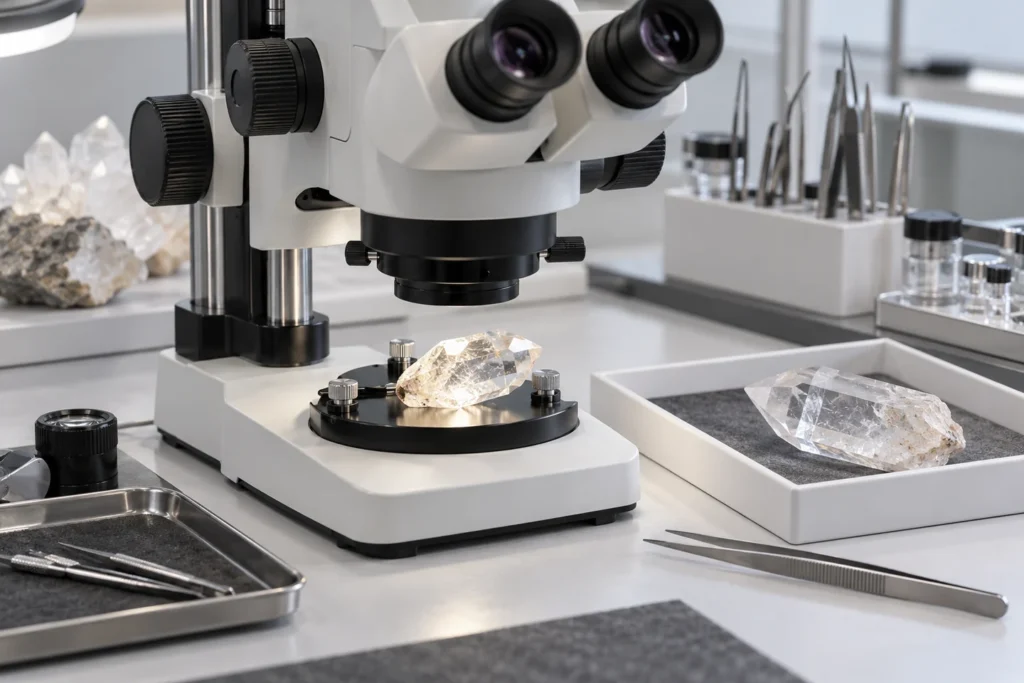
Scenarios Where Professional Testing Adds Value
-
High-value materials: If you're purchasing high-grade natural citrine, rutilated quartz, or rare included quartz in significant quantities, the cost of a lab test is small relative to the order value and the risk of receiving treated or imitation material.
-
New supplier relationships: When working with a supplier for the first time, sending a sample to a gemological lab before placing a large order is a reasonable due diligence step. At GD Crystal, we actively encourage buyers to verify samples — it builds trust for both sides.
-
Consumer-facing certification needs: Some retail markets or e-commerce platforms expect or require material verification. If your customers demand proof that a product is natural and untreated, a lab report provides that documentation.
-
Unfamiliar or "trendy" materials: When market demand surges for a particular variety — say, ‘strawberry quartz’ — confirm the exact material identity and treatment status rather than relying on the trade name alone. If the supplier’s documentation is unclear, consider independent gemological testing before committing to a larger order.
References
- "Quartz Assemblage Imitating Emerald", https://www.gia.edu/gems-gemology/summer-2025-lab-notes-quartz-assemblage-imitating-emerald. A gemological reference distinguishing natural, treated, synthetic, and imitation gem materials supports the article's commercial classification of quartz products; the source would define the categories rather than quantify their prevalence in wholesale trade. Evidence role: definition; source type: institution. Supports: A gemological source should define quartz as a mineral material and distinguish natural, treated, synthetic, and imitation gem materials.. Scope note: Contextual support only; it would not prove how often each category appears in the author's supply chain. ↩
- "Hydrothermal Synthesis of Monodisperse Single-Crystalline …", https://pmc.ncbi.nlm.nih.gov/articles/PMC4201858/. A materials-science source on hydrothermal quartz growth supports that synthetic quartz is crystalline SiO2 produced under laboratory conditions; it does not address whether such material is common in decorative crystal retail. Evidence role: definition; source type: research. Supports: A materials-science or mineralogical source should state that synthetic quartz is crystalline silicon dioxide and can be grown hydrothermally.. Scope note: Directly supports composition and production method, but not retail-market frequency. ↩
- "Crystal oscillator", https://en.wikipedia.org/wiki/Crystal_oscillator. Technical literature on synthetic quartz crystals supports their established use in electronic frequency-control applications; such literature provides contextual support and may not compare production costs with decorative crystal goods. Evidence role: general_support; source type: research. Supports: A technical source should describe synthetic quartz use in electronic oscillators, resonators, or frequency-control devices.. Scope note: Contextual support for major applications; the cost comparison would require additional market data. ↩
- "Citrine Gemstone | Natural Citrine Stone", https://www.gia.edu/citrine. Gemological sources documenting heat treatment of amethyst to produce citrine-like yellow or orange quartz support the risk of treatment-related misdescription; unless the source includes market-frequency data, it would not independently verify that the practice is 'extremely common.' Evidence role: general_support; source type: institution. Supports: A gemological source should support that amethyst can be heat-treated to produce citrine-like colors and that treatment disclosure is relevant.. Scope note: Supports the mechanism and disclosure issue, but not necessarily the article's strength of prevalence wording. ↩
- "Artificial Glass Imitating a Paraíba Tourmaline | Gems & …", https://www.gia.edu/gems-gemology/winter-2020-labnotes-glass-imitating-tourmaline. A gemological identification source describing gas bubbles as common features of glass imitations supports using rounded bubbles as a screening indicator; it would not make bubbles a conclusive test for every specimen. Evidence role: mechanism; source type: institution. Supports: A gemological identification source should explain that gas bubbles are common diagnostic features in glass imitations.. Scope note: Supports screening value, not definitive authentication. ↩
- "Fluid inclusion", https://en.wikipedia.org/wiki/Fluid_inclusion. Mineralogical literature on quartz-hosted fluid inclusions supports that natural quartz can contain liquid, vapor, and multiphase inclusions; this evidence explains a natural inclusion type but does not alone distinguish every quartz specimen from glass. Evidence role: mechanism; source type: paper. Supports: A mineralogy paper or educational source should explain the occurrence and nature of fluid inclusions in quartz.. Scope note: Directly supports the inclusion phenomenon, but not a complete authentication method. ↩
- "Quarterly Crystal: Wurtzite Phantom in Quartz | Gems & …", https://www.gia.edu/gems-gemology/summer-2018-microworld-quarterly-crystal-wurtzite-phantom-in-quartz. A mineralogical reference describing rutile, tourmaline, chlorite, phantom growth, and fracture-related features in quartz supports the statement that natural specimens may contain such inclusions; it does not imply that flawless quartz is necessarily artificial. Evidence role: general_support; source type: education. Supports: A university or museum mineralogy source should describe common inclusions and growth features in natural quartz.. Scope note: Supports possibility and common examples, not a definitive rule for all specimens. ↩
- "List of thermal conductivities", https://en.wikipedia.org/wiki/List_of_thermal_conductivities. Materials-property data for quartz support that quartz has measurable thermal conductivity relevant to perceived surface coolness; perceived touch temperature also depends on ambient conditions, sample size, and comparison material. Evidence role: mechanism; source type: research. Supports: A materials-property source should provide thermal conductivity information for quartz and explain heat transfer behavior.. Scope note: Supports the physical basis, but not the reliability of touch as an identification test. ↩
- "Quartz", https://en.wikipedia.org/wiki/Quartz. Reference data giving quartz a specific gravity near 2.65 and common glasses densities in adjacent ranges support the article's caution that weight alone is not a reliable discriminator; exact glass density varies with composition. Evidence role: general_support; source type: encyclopedia. Supports: A mineral/property reference should provide quartz specific gravity and typical density ranges for soda-lime and lead glass.. Scope note: Directly supports property ranges, with composition-dependent variation. ↩
- "Mohs Hardness Scale", https://www.nps.gov/articles/mohs-hardness-scale.htm. A mineral-hardness reference placing quartz at Mohs 7 and ordinary glass around Mohs 5 to 5.5 supports the scratch-test principle; hardness data do not distinguish natural quartz from synthetic or treated quartz. Evidence role: definition; source type: government. Supports: A mineral hardness reference should state quartz's Mohs hardness and the approximate hardness of glass.. Scope note: Supports the hardness relationship only, not broader authenticity. ↩
- "Thermal shock", https://en.wikipedia.org/wiki/Thermal_shock. Materials-science literature on quartz thermal expansion and thermal shock supports the warning that rapid, uneven heating can induce stress and cracking; the degree of risk depends on sample geometry, flaws, and heating conditions. Evidence role: mechanism; source type: research. Supports: A materials-science source should explain that quartz can fracture under thermal stress caused by rapid or uneven heating.. Scope note: Supports the mechanism, not the outcome for every individual test. ↩
- "What is ultraviolet fluorescence?", https://www.gia.edu/FAQ/gia-faq-about-gemstones-ultraviolet-fluorescence. Gemological references noting variable fluorescence among quartz varieties support the article's caution that UV response is not a standalone authenticity test; fluorescence can be influenced by impurities, treatments, and observation conditions. Evidence role: general_support; source type: institution. Supports: A gemological source should describe variability in quartz fluorescence and limitations of UV testing.. Scope note: Supports test limitation, not a complete identification protocol. ↩