Setting intentions for clear quartz is one of the most common questions end consumers ask — yet many crystal retailers struggle to explain it simply. Vague or overstated descriptions can confuse buyers or erode trust.1 The good news: intention setting is a straightforward personal practice that sellers can describe clearly, honestly, and in a way that genuinely helps their customers connect with the product.
Setting intentions for clear quartz is a simple process: hold or place the stone, choose one specific personal goal, and repeat it quietly as a moment of focused reflection. The crystal serves as a physical reminder of that intention.2 The real value lies in the clarity and mindfulness the practice encourages3 — not in any guaranteed outcome from the stone itself.4
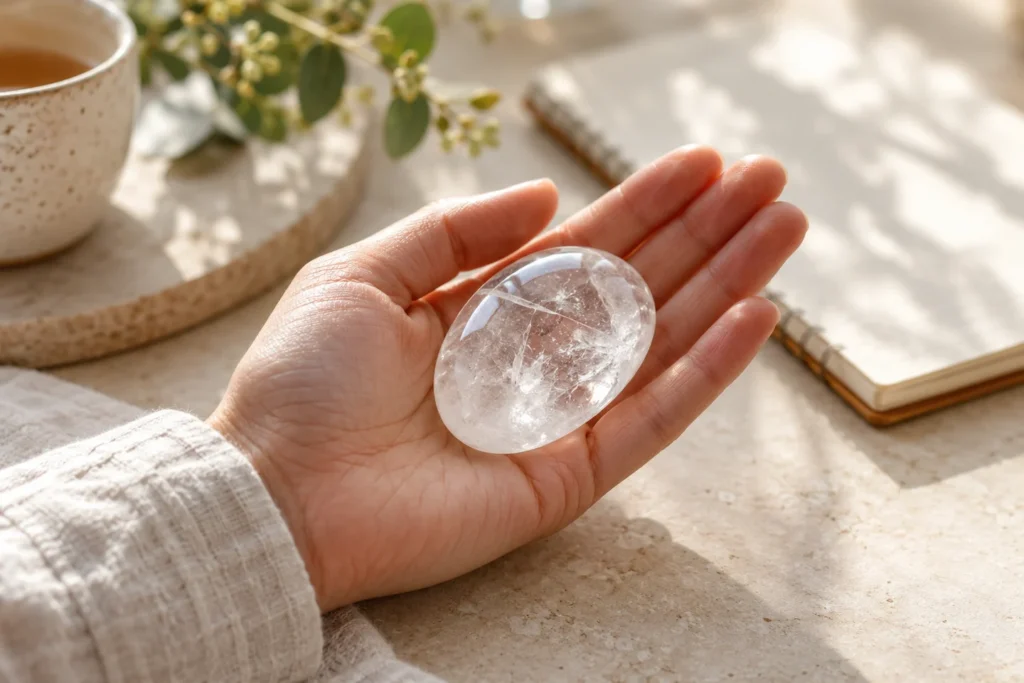
Below, I'll walk through a practical, beginner-friendly approach to intention setting, explain why language matters for retailers, and connect specific clear quartz product forms to real use cases your customers will appreciate. Whether you stock towers, palm stones, bracelets, or spheres, this guide will help you describe intention setting in a way that builds trust and supports sales.
What Does "Setting an Intention" Actually Mean for Clear Quartz?
Many crystal buyers hear about intention setting but have no idea where to start. The phrase can sound abstract or even intimidating. This leaves retailers in a tough spot: how do you explain something that feels personal and subjective in a way that's helpful and not misleading?
Setting an intention for clear quartz simply means choosing a personal goal or focus and using the crystal as a tangible reminder of that choice. It is often described as a brief moment of quiet reflection — not a ritual that requires special training or belief. The practice appeals to people who want a physical object tied to something they care about.5

Why the Word "Intention" Resonates with Consumers
In today's wellness and mindfulness culture, "intention" has become a widely used term.6 It shows up in yoga classes, journaling apps, and self-help books. For crystal consumers, the word carries a sense of purpose without demanding a particular belief system.
From a retail perspective, this is important. When your product description or in-store signage uses the word "intention," it meets customers where they already are. You don't need to invent a narrative — you just need to describe the practice clearly.
The Difference Between Intention and Promise
This is where many product descriptions go wrong. There's a meaningful gap between:
- "Use this clear quartz to set an intention for focus" (describing a personal practice)
- "This clear quartz will bring you focus and success" (making a guaranteed outcome claim)
The first is helpful guidance. The second is an overstatement that can damage credibility — especially if a customer feels disappointed.
In our experience working with B2B crystal retailers, the businesses that describe clear quartz with bounded, respectful language tend to build stronger repeat customer relationships than those relying on dramatic promises.
What Intention Setting Is Not
To keep your messaging clean and trustworthy, it helps to be explicit about boundaries:
| Intention Setting Is | Intention Setting Is Not |
|---|---|
| A moment of personal reflection | A medical or therapeutic treatment |
| Choosing a focus or goal | A guarantee of specific outcomes |
| Using a crystal as a physical reminder | A replacement for professional advice |
| A practice many people find meaningful | A scientifically proven mechanism |
This kind of clarity protects you as a seller and respects your customer's intelligence.
How Do You Actually Set Intentions for Clear Quartz Step by Step?
Retailers often tell us their customers ask, "I bought this crystal — now what do I do with it?" Having a simple, printable set of steps can make the difference between a confused buyer and a loyal one.
The process for setting intentions with clear quartz can be broken down into five straightforward steps that require no special tools, training, or prior experience. Many customers find the simplicity itself is what makes the practice appealing.
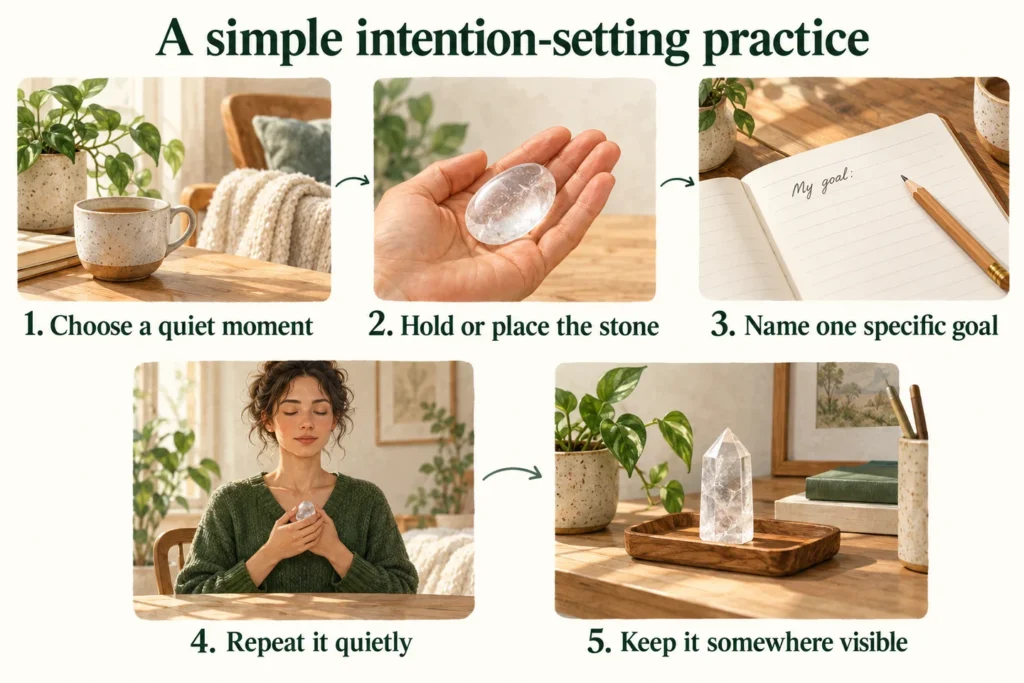
Step-by-Step Intention Setting Process
Here's a beginner-friendly sequence you can adapt for product inserts, website content, or social media:
-
Choose a quiet moment. This doesn't need to be elaborate — a few minutes in the morning, before bed, or during a break works fine. The point is minimal distraction.
-
Hold or place the clear quartz. If it's a palm stone or tumbled stone, holding it in the hand is natural. If it's a tower or sphere on a desk, simply sitting near it works. Physical proximity helps create a sense of connection to the moment.
-
Name one specific intention. Encourage customers to keep it focused. "I want to be more present during conversations" is stronger than "I want everything to be better." Specificity makes the intention feel actionable.7
-
Repeat the intention quietly. This can be said aloud, whispered, or thought silently. Some people repeat it three times; others simply sit with it for a minute. There's no strict rule — the goal is personal focus.
-
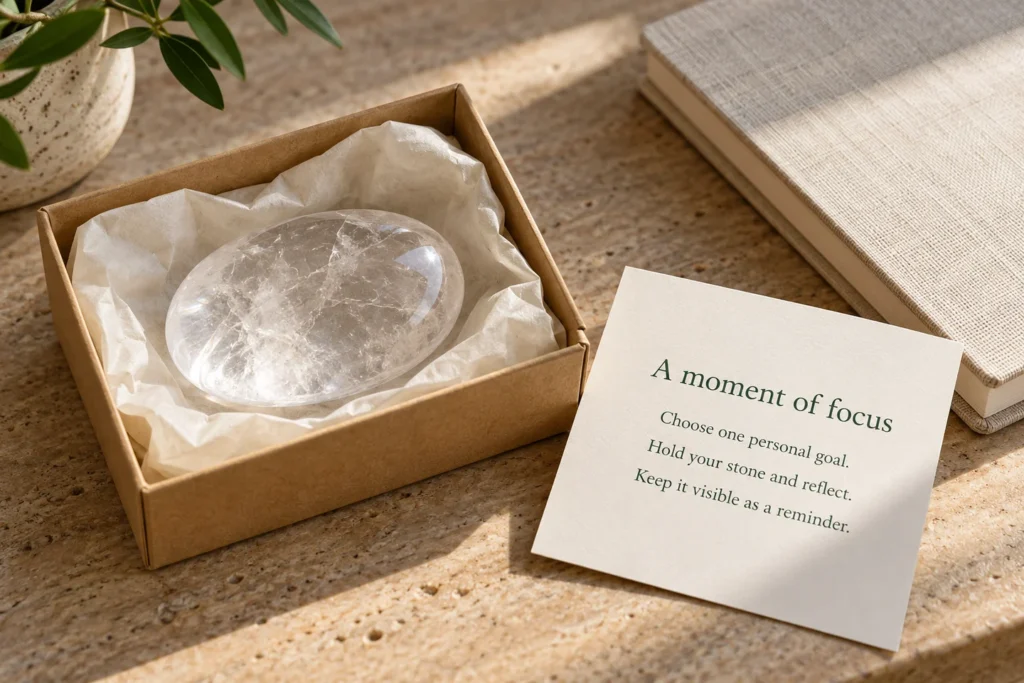
Place the clear quartz somewhere visible. This is the key follow-through step. When the customer sees the stone on their nightstand, desk, or shelf, it serves as a daily reminder of the intention they chose.8
Why These Steps Work for Retail
Notice that none of these steps require:
- Burning sage or incense
- Specific moon phases
- Prior spiritual knowledge
- Additional products
This matters commercially. A customer who feels the practice is accessible and low-pressure is more likely to actually use the product — and more likely to come back for another piece. Simplicity sells.
Adapting the Language for Product Inserts
If you're creating a small card or insert to include with clear quartz orders, consider language like:
"Many people use clear quartz as a focus stone. To set an intention, hold it in a quiet moment, name one personal goal, and keep it somewhere you'll see it daily. The stone can serve as a simple reminder of what matters to you."
This is honest, appealing, and makes no guarantees. It also positions your brand as thoughtful and customer-centered.
Which Clear Quartz Product Forms Work Best for Intention Setting?
Different product shapes lend themselves to different use cases. If you're a retailer selecting clear quartz inventory, understanding how each form connects to intention-setting practice helps you write better descriptions and guide your customers more effectively.
The most common clear quartz forms used for intention setting include palm stones for holding during reflection, points and towers for display as visual reminders, bracelets for daily wearable reminders, and spheres or decorative pieces for prominent home or retail placement.
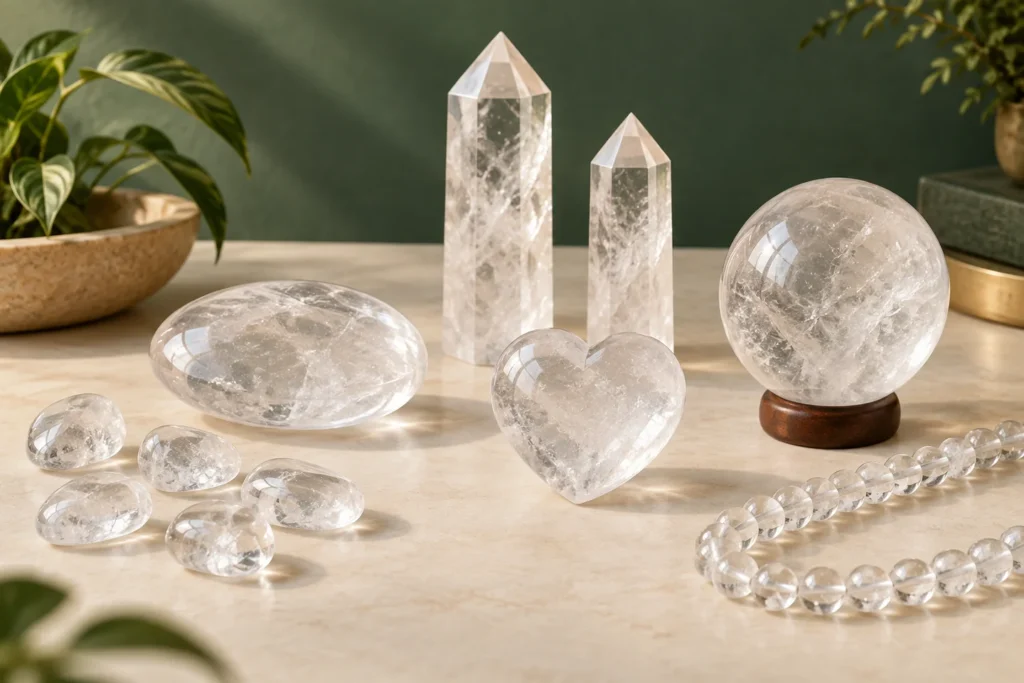
Form-by-Use-Case Breakdown
| Product Form | Intention-Setting Use | Customer Appeal |
|---|---|---|
| Palm stones / Tumbled stones | Held during quiet reflection; fits in pocket for daily carry | Tactile, affordable, beginner-friendly |
| Points / Towers | Placed on desk, shelf, or altar as a visual anchor | Decorative and functional; popular for gifting |
| Bracelets | Worn daily as a constant, subtle reminder | Wearable; strong repeat purchase category |
| Spheres | Displayed in living spaces as a calming focal point | Aesthetic appeal; works for meditation corners |
| Carved shapes (hearts, animals) | Given as gifts with a written intention card | Emotional gifting; pairs well with product inserts |
How to Describe Each Form Without Overstating
Here's a practical language guide for retailers:
- Palm stone: "Sized to fit comfortably in the hand — many customers hold it during a few minutes of quiet reflection."
- Tower/Point: "Often placed on a desk or nightstand as a daily visual reminder of a personal intention."
- Bracelet: "Worn throughout the day, it can serve as a subtle prompt to return to a chosen focus."
- Sphere: "A calming centerpiece for a shelf or meditation space — often described as grounding to look at."
Each description is accurate, appealing, and avoids claiming the product does something to the user. It describes how customers use it. This is a small but critical distinction.
Matching Inventory to Customer Segments
If your end consumers are primarily beginners exploring crystals for the first time, palm stones and tumbled stones are your safest entry point. They're low cost, easy to explain, and physically suited to intention setting.
If your audience skews toward home décor and aesthetics, towers and spheres give you more visual merchandising options and higher average order values.
For fashion-forward or younger audiences, bracelets combine wearability with the intention-setting narrative seamlessly.
Why Does Language Matter So Much When Selling Clear Quartz for Intentions?
Here's the commercial reality: crystal culture is growing, but so is consumer skepticism. Overstated claims don't just risk disappointing buyers — they can trigger platform policy violations on marketplaces like Etsy, Amazon, and Shopify9, or invite regulatory scrutiny in certain markets.10
Language matters because clear, bounded descriptions of clear quartz intention setting build more long-term trust and fewer returns than exaggerated mystical claims. Many successful crystal brands have grown specifically by being the honest, straightforward option in a market full of vague promises.
The Trust Equation for Crystal Retailers
In our years supplying B2B crystal buyers, I've noticed a pattern. The brands that grow steadily tend to share a few traits:
- They describe use cases, not outcomes. "Hold during meditation" instead of "heals anxiety."
- They use qualifying language. "Often used as…" or "Many people find it helpful for…" rather than absolute statements.
- They pair products with guidance. A small instruction card or a blog post like this one adds perceived value without adding cost.
- They respect the customer's own experience. Rather than telling people what they'll feel, they invite them to explore.
What Language to Avoid
To keep your brand safe and trustworthy, steer clear of:
- Medical claims: "Heals headaches," "reduces inflammation," "cures insomnia"
- Guaranteed outcomes: "Will bring abundance," "attracts wealth," "ensures success"
- Pseudo-scientific authority: "Proven to raise vibrational frequency," "scientifically shown to purify energy"
- Emotional promises: "Eliminates negative thoughts," "removes trauma"
None of these are appropriate for a product listing. They expose your business to liability and ultimately undermine your credibility with informed buyers.
What Language to Use Instead
Here are tested, retail-friendly phrases that describe clear quartz intention setting honestly:
- "Often chosen as a stone for personal focus and reflection"
- "Many customers describe clear quartz as their go-to stone for intention setting"
- "Can serve as a daily reminder of a goal or intention you've chosen"
- "Popularly used during quiet moments of meditation or journaling"
- "A versatile crystal that pairs well with any personal mindfulness routine"
These phrases are commercially effective because they're honest. They invite the customer into a practice rather than making promises on the product's behalf.
How Can Retailers Help Customers Get the Most from Clear Quartz Intentions?
Selling a clear quartz piece is one transaction. Helping a customer understand how to use it is what creates a relationship — and relationships drive repeat orders and referrals.
Retailers can support their customers' intention-setting practice by providing simple written guidance, suggesting placement ideas, and normalizing the idea that intentions can be updated or changed over time. This kind of after-sale support costs almost nothing but significantly increases perceived value.11
Practical Ideas for Retail Touchpoints
-
Product insert cards. A small printed card with three to five intention-setting steps. Keep it clean, short, and branded. Customers often photograph these and share them on social media — free marketing.
-
Blog or FAQ page. An article like this one on your own website answers customer questions before they ask and builds SEO traffic. Many of our B2B buyers tell us their best-performing blog content is practical "how to use" guides.
-
Social media posts. A short reel or carousel showing someone holding a clear quartz palm stone, closing their eyes, and placing it on a shelf. No elaborate production needed. Authenticity wins.
-
Bundle suggestions. Pair a clear quartz palm stone with a small journal and a simple intention card. The total cost increase is minimal, but the bundle tells a story and justifies a higher price point.
Encouraging Repeat Engagement
One insight from our customer conversations: many successful crystal retailers encourage buyers to revisit and refresh their intentions. This is both genuinely helpful and commercially smart.
- "Your intention can change whenever you're ready for a new focus."
- "Some people set a new intention with each season or month."
- "If your goals shift, your clear quartz is ready for a fresh start."
This messaging gently reminds customers that they might want additional pieces — a different form for a different intention, or a new crystal to mark a new chapter. It's respectful, not pushy, and it works.
Frequently Asked Questions
Does clear quartz actually work for intention setting?
Many people find that using a physical object like clear quartz helps them focus during moments of reflection. The value is in the practice of choosing and returning to a personal goal. Clear quartz is often described as a versatile crystal for this purpose, but no guaranteed outcomes should be expected from the stone itself.
Can you set more than one intention with the same clear quartz?
Yes. Many customers set a new intention whenever they feel ready. There are no fixed rules. Some people update their intention monthly, seasonally, or when personal priorities shift. The crystal simply serves as a reminder of whatever focus the user has chosen.
Do you need to cleanse clear quartz before setting an intention?
Some crystal users prefer to rinse or cleanse their stone before use as part of their personal routine. This is a cultural practice, not a requirement. If you sell clear quartz, you can mention cleansing as an option without presenting it as mandatory or implying it has a measurable effect.
What's the best clear quartz form for someone new to intention setting?
Palm stones and tumbled stones are often recommended for beginners. They're affordable, comfortable to hold, and naturally suited to the practice of quiet reflection. For retailers, they also serve as a low-risk entry product that introduces new customers to the category.
How should I describe clear quartz intention setting in my product listings?
Use simple, bounded language. Describe how customers use the product rather than what the product will do for them. Phrases like "often used for personal focus," "can serve as a daily reminder," and "many customers enjoy using it during quiet reflection" are honest and commercially effective.
Conclusion
Setting intentions for clear quartz is a simple, personal practice: choose a quiet moment, hold or place the stone, name a specific goal, and keep the crystal where it serves as a visible reminder. For retailers, the real commercial advantage isn't in dramatic claims — it's in clear guidance, honest descriptions, and products matched to real use cases.
The brands that explain intention setting simply and respectfully tend to earn more trust, fewer returns, and stronger repeat business. Whether you're stocking palm stones for beginners or towers for home décor enthusiasts, helping your customer understand how to use clear quartz is one of the most valuable things you can offer.
If you're looking for a reliable supply of clear quartz in forms suited for intention setting — palm stones, towers, spheres, bracelets, or carved pieces — reach out to GD Crystal for current availability, pricing, and custom options. We're happy to discuss product selection based on your retail audience and order requirements.
References
- "Truth In Advertising", https://www.ftc.gov/news-events/topics/truth-advertising. Marketing research on advertising credibility and misleading claims supports the proposition that exaggerated or ambiguous product descriptions can weaken consumer trust. Evidence role: general_support; source type: paper. Supports: Misleading, exaggerated, or ambiguous advertising claims can harm consumer trust and perceived credibility.. Scope note: The evidence is general to advertising and consumer trust, not specific to crystal retail. ↩
- "Investigating the role of cognitive load on prospective memory …", https://pmc.ncbi.nlm.nih.gov/articles/PMC13023208/. Research on prospective memory and external reminders supports the idea that visible objects can function as cues for remembering intentions, although it does not specifically test clear quartz. Evidence role: mechanism; source type: paper. Supports: External cues and reminders can help people remember intended actions or goals.. Scope note: The support is psychological and contextual, not evidence that clear quartz has special properties. ↩
- "Effects of Mindfulness on Psychological Health: A Review of …", https://pmc.ncbi.nlm.nih.gov/articles/PMC3679190/. Reviews of mindfulness research indicate that mindfulness practices are associated with attentional regulation and self-regulatory processes, supporting the article’s emphasis on reflection and clarity rather than material causation. Evidence role: general_support; source type: paper. Supports: Mindfulness and reflective attention practices are associated with attention, self-regulation, and goal-related awareness.. Scope note: The evidence supports mindfulness practices generally and does not directly evaluate crystal-based intention setting. ↩
- "Crystal healing", https://en.wikipedia.org/wiki/Crystal_healing. Neutral summaries of crystal healing describe the practice as lacking scientific evidence for specific therapeutic effects, which supports avoiding claims of guaranteed outcomes from clear quartz. Evidence role: expert_consensus; source type: encyclopedia. Supports: Crystal healing claims are generally not supported by scientific evidence and are often discussed in relation to placebo effects.. Scope note: The source would address crystal healing broadly, not every personal or symbolic use of clear quartz. ↩
- "Symbolic Meanings of Valued Personal Objects in Identity …", https://www.academia.edu/45262231/Symbolic_Meanings_of_Valued_Personal_Objects_in_Identity_Transitions_of_Late_Adulthood. Consumer research on possessions and the extended self supports the idea that physical objects can carry personal and symbolic meaning for users. Evidence role: general_support; source type: paper. Supports: People often attach identity, memory, and symbolic meaning to possessions.. Scope note: The research addresses possessions broadly and does not specifically examine crystals or intention-setting rituals. ↩
- "Meditation and Mindfulness: Effectiveness and Safety | NCCIH", https://www.nccih.nih.gov/health/meditation-and-mindfulness-effectiveness-and-safety. National survey data on yoga, meditation, and related mindfulness practices document their prevalence in contemporary wellness culture, providing context for the article’s statement about intention language. Evidence role: historical_context; source type: government. Supports: Yoga, meditation, and mindfulness practices are widely present in contemporary wellness culture.. Scope note: Such data would contextualize the wellness setting but may not directly measure use of the specific word “intention.” ↩
- "Building a Practically Useful Theory of Goal Setting and …", https://med.stanford.edu/content/dam/sm/s-spire/documents/PD.locke-and-latham-retrospective_Paper.pdf. Goal-setting theory research finds that specific goals provide clearer behavioral direction than vague aspirations, supporting the article’s advice to frame intentions in concrete terms. Evidence role: mechanism; source type: paper. Supports: Specific goals tend to guide behavior more effectively than vague goals.. Scope note: The evidence concerns goal pursuit generally and does not test crystal-related practices. ↩
- "The impact of cue and preparation prompts on attention … – PMC", https://pmc.ncbi.nlm.nih.gov/articles/PMC11288827/. Studies of environmental cues and goal-directed behavior support the claim that visible objects can prompt recall of intentions or planned actions. Evidence role: mechanism; source type: paper. Supports: Visible environmental cues can prompt recall of intended actions or goals.. Scope note: The evidence concerns cueing mechanisms generally, not clear quartz as a uniquely effective reminder. ↩
- "Medical Claims – Our House Rules", https://www.etsy.com/legal/policy/medical-claims/239976157654. Marketplace seller policies from Etsy, Amazon, and Shopify document restrictions on misleading, prohibited, or medical-style product claims, supporting the article’s warning about platform compliance. Evidence role: case_reference; source type: other. Supports: Major e-commerce platforms restrict certain misleading, medical, or unsupported claims in product listings.. Scope note: The policies vary by platform and product category, so the citation would support the general compliance risk rather than every possible crystal-related phrase. ↩
- "Health Products Compliance Guidance", https://www.ftc.gov/business-guidance/resources/health-products-compliance-guidance. Advertising guidance from consumer protection authorities states that objective product claims, especially health-related claims, require adequate substantiation, supporting the article’s warning about regulatory scrutiny. Evidence role: general_support; source type: government. Supports: Regulators require advertisers to substantiate objective product claims and may scrutinize misleading or health-related claims.. Scope note: The exact legal risk depends on jurisdiction, wording, product category, and enforcement priorities. ↩
- "Impact of Post Purchase Experiences on Customer Loyalty", https://www.academia.edu/35063598/Impact_of_Post_Purchase_Experiences_on_Customer_Loyalty_An_Empirical_Investigation. Research on customer education and post-purchase support indicates that practical guidance can increase perceived value and customer satisfaction, providing context for the article’s claim about after-sale support. Evidence role: general_support; source type: paper. Supports: Customer education and post-purchase support can improve perceived value, satisfaction, or loyalty.. Scope note: The evidence would support the value of support practices generally, not the precise cost or effect size for crystal retailers. ↩