If you have ever searched for how much quartz diamonds are worth, you likely found confusing answers — some pages quote gemstone prices, others list craft store pricing, and none seem to address what a wholesale buyer actually needs to know. The frustration is real. The truth is, there is no single number. The worth of a quartz diamond depends entirely on what you are buying, how it is made, and what you plan to do with it.
Quartz diamonds — diamond-shaped or faceted quartz crystal products used as décor, pendants, or wholesale merchandise — are not real diamonds1 and should not be valued like them. Their wholesale worth typically ranges from under $0.50 to several dollars per piece depending on size, material, cut quality, clarity, quantity ordered, and packaging. For B2B buyers, the real question is not "what is the fixed price?" but "is this batch worth buying for my resale market?"
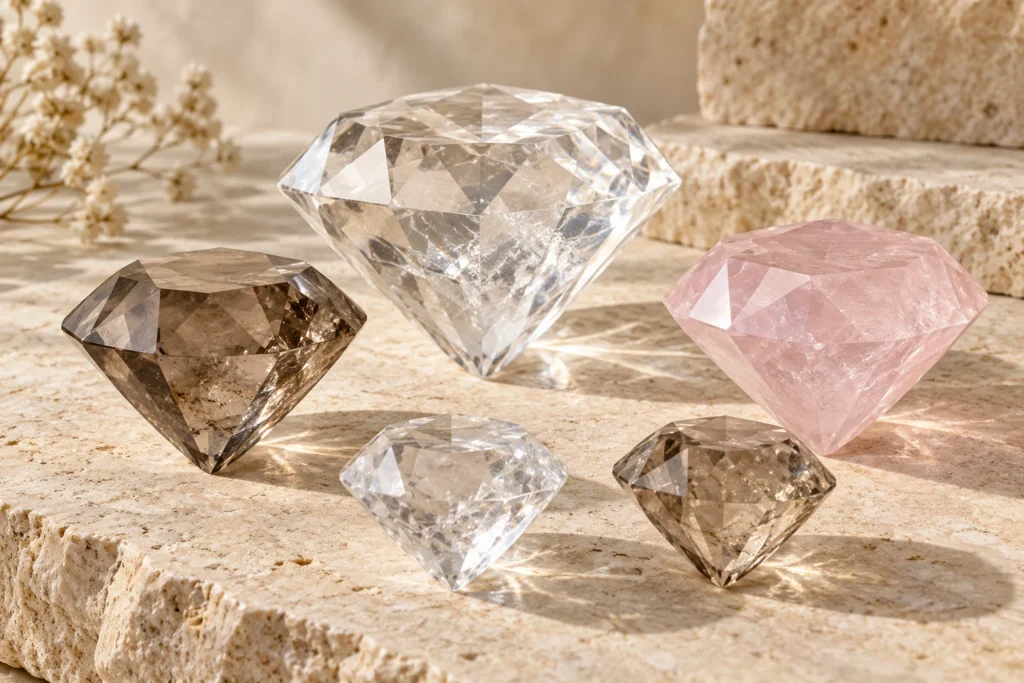
Before we dive into the variables that shape quartz diamond pricing, let me clear up a common source of confusion. The term "quartz diamond" means very different things to different people, and that misunderstanding alone can cost you money. Below, I will break down exactly what affects value, how to evaluate a batch for resale, and what questions you should ask your supplier before placing an order.
What Exactly Is a "Quartz Diamond" — and Why Does the Name Cause Confusion?
The term "quartz diamond" gets tossed around online without a clear definition, and that vagueness leads buyers to compare incomparable products. Some people think they are buying a gemstone investment. Others know they are sourcing crystal décor. This gap in understanding is where costly mistakes happen.
A quartz diamond is a diamond-shaped or faceted product made from quartz crystal — typically clear quartz, rose quartz, smoky quartz2, or similar mineral varieties. These are decorative, gift, or metaphysical retail items. They are not actual diamonds, and their value follows an entirely different logic.
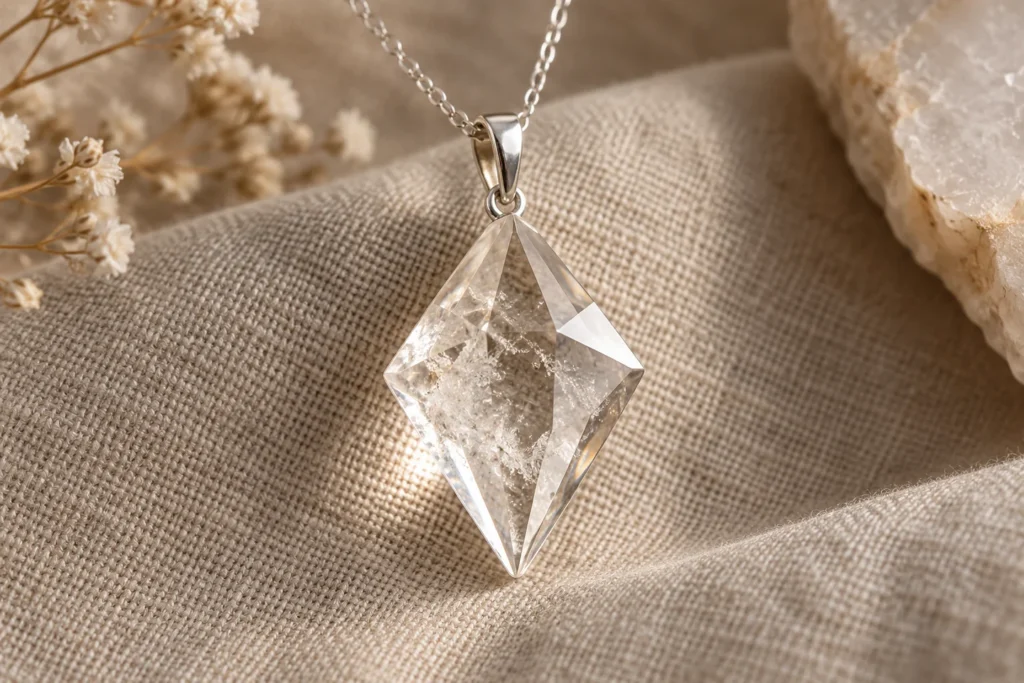
Why the Name Creates Problems for Buyers
The word "diamond" in "quartz diamond" refers to the shape or cut style, not the mineral composition. In the crystal wholesale trade, products are often named by their form: towers, spheres, hearts, skulls, and yes — diamonds. A "quartz diamond" is simply a quartz piece cut and polished into a diamond-like faceted shape.
This matters because:
- Search engines mix results. A buyer searching "quartz diamond value" may land on pages about Herkimer diamonds (a type of double-terminated quartz crystal found in New York)3 or even actual diamond pricing guides. These are completely different products.
- Pricing expectations become distorted. If a buyer mentally benchmarks against real diamond values, every quartz price will look "cheap." If they benchmark against raw tumbled stones, faceted quartz diamonds may look "expensive." Neither comparison is useful.
- Suppliers use different naming conventions. In my experience at GD Crystal, we see buyers use terms like "crystal diamond," "diamond-cut quartz," "quartz gem," or "faceted quartz point" to describe similar items. Confirming the exact product before quoting is essential.
Common Product Types Called "Quartz Diamonds"
| Product Type | Typical Use | Common Sizes | Material Examples |
|---|---|---|---|
| Small faceted crystal diamond | Décor, gift sets, party favors | 20–60 mm | Clear quartz, K9 glass, lead crystal |
| Diamond-cut pendant | Jewelry, metaphysical retail | 15–30 mm | Rose quartz, amethyst, citrine |
| Large decorative diamond | Display, photography props | 60–150 mm | Optical glass, natural clear quartz |
| Diamond-shaped tower/point | Crystal shop retail | 40–100 mm | Various natural quartz varieties |
Key takeaway: Before asking "how much is it worth," make sure you and your supplier are talking about the same product. Confirm material (natural quartz vs. glass), size, and intended use. This single step prevents the most common quoting misunderstandings I see in wholesale inquiries.
Why Is There No Universal Price for Quartz Diamonds?
Buyers often come to us expecting a price sheet — one number per product, end of story. But quartz diamond pricing does not work that way, and treating it as fixed can lead to overpaying or ordering products that do not match your market. The value genuinely shifts from batch to batch and order to order.
There is no universal price for quartz diamonds because at least ten variables affect the final cost: material type, size, weight, clarity, color saturation, cutting precision, polishing quality, current batch availability, order quantity, and packaging or shipping requirements4. A 30 mm clear quartz diamond pendant and a 30 mm rose quartz diamond pendant from the same supplier may carry different prices simply due to material cost and processing difficulty.
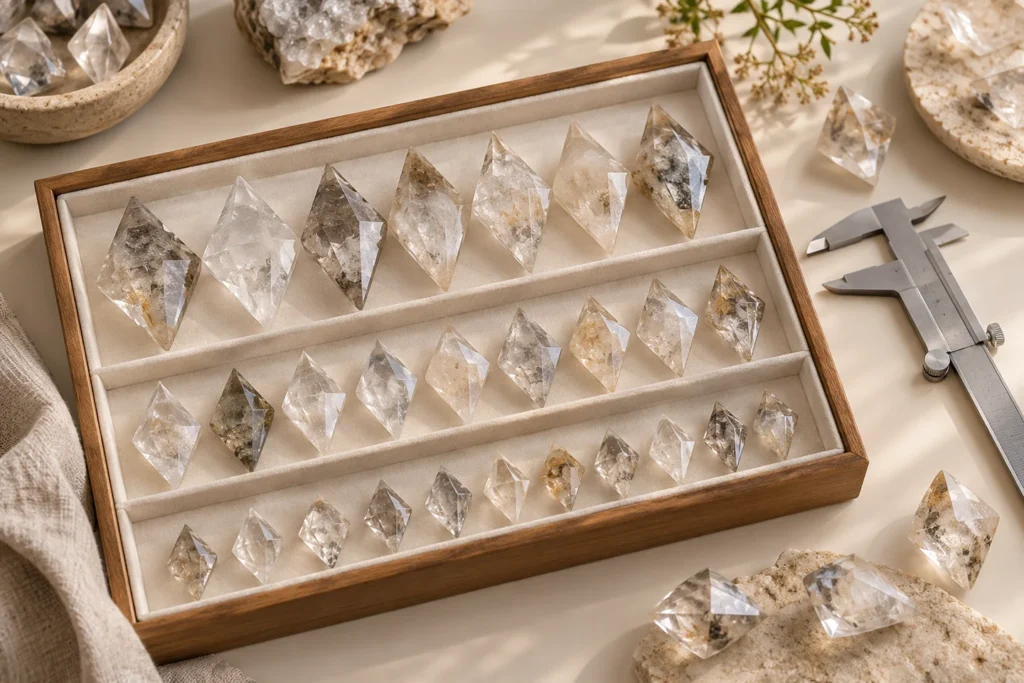
The Variables That Actually Drive Price
Let me walk through the main factors, because understanding them is the difference between smart sourcing and guesswork.
1. Material Type
Natural clear quartz, rose quartz, amethyst, smoky quartz, and citrine all have different raw material costs. Synthetic or reconstituted materials cost less. K9 optical glass5 — often sold as "crystal diamond" in décor markets — is significantly cheaper than natural stone but serves a different customer segment.
2. Size and Weight
This is the most obvious driver. A 20 mm faceted quartz diamond might cost a fraction of a 100 mm piece. But the relationship is not linear — larger pieces require more raw material, more cutting time, and have a higher rejection rate during quality control6.
3. Cut Quality and Symmetry
A cleanly faceted quartz diamond with sharp edges, symmetrical faces, and precise proportions costs more to produce than a roughly shaped piece. For resale, this matters enormously. Buyers in the gift and décor market expect visual consistency; metaphysical retail customers tolerate more variation.
4. Clarity and Inclusions
Quartz with fewer visible inclusions, cracks, or cloudiness commands a higher price.7 However, some buyers specifically want pieces with interesting inclusions (rainbow inclusions, phantoms, etc.) for their metaphysical or collector market. "Better clarity" does not always mean "more valuable to your customer."
5. Batch Size and MOQ
Larger orders typically reduce the per-piece cost.8 But at GD Crystal, we also work with buyers on smaller trial orders — the per-unit price will be higher, and that is normal. The economics of batch production mean that MOQ and price are always linked.
6. Surface Finish and Polishing
A high-gloss mirror polish requires more processing steps than a matte or semi-polished finish. The finish also affects how the product photographs for e-commerce, which directly impacts resale performance.
7. Packaging and Shipping
Individually boxed pieces cost more than bulk-packed ones. Fragile faceted quartz diamonds need proper cushioning.9 Packaging decisions affect landed cost significantly, especially for international shipments.
| Variable | Impact on Price | What to Confirm with Supplier |
|---|---|---|
| Material (natural vs. glass) | High | Exact material name and origin |
| Size range | High | Min–max dimensions in mm |
| Cut precision | Medium–High | Photos/videos of current batch |
| Clarity grade | Medium | Visual grade description |
| Order quantity | Medium–High | MOQ and price breaks |
| Polishing level | Low–Medium | Finish type |
| Packaging | Low–Medium | Per-piece vs. bulk packing options |
Bottom line: Any "price" you see online for quartz diamonds without these details specified is essentially meaningless for procurement purposes.
Are Quartz Diamonds Worth Buying for Resale?
This is the question that actually matters for B2B buyers. Knowing a product costs $1.50 per piece is only useful if you also know whether your customers will pay $5, $8, or $15 for it at retail. A low wholesale price is not a good deal if the product does not sell.
Quartz diamonds can be excellent resale products when matched to the right market segment. Their faceted shape catches light beautifully, they photograph well for e-commerce, and they appeal to gift buyers, crystal collectors, décor shoppers, and metaphysical retail customers. The key is aligning the product's quality tier with your customer's expectations and price sensitivity.
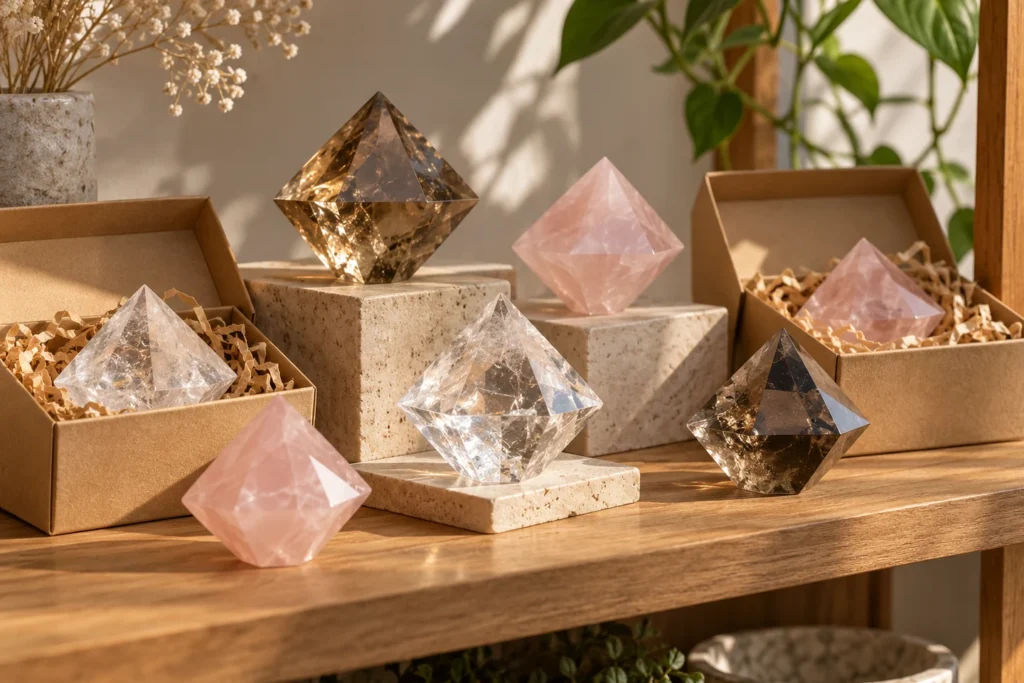
How to Evaluate a Batch for Resale Value
I have seen buyers make the mistake of ordering purely on price, only to receive products that do not fit their brand or customer base. Here is a more practical framework:
Step 1: Define your resale channel first.
Are you selling in a boutique crystal shop, on Etsy, on Amazon, at gem shows, or through a metaphysical subscription box? Each channel has different quality expectations, price ceilings, and packaging requirements.
- Boutique crystal shop: Customers expect visual consistency, pleasant tactile finish, and interesting natural features. Mid-to-high quality batches work best.
- E-commerce (Etsy, Shopify): Photography is everything. Products need to match listing photos closely.10 Batch consistency is critical.
- Gift and souvenir retail: Price sensitivity is higher. Acceptable quality can be lower, but products must look "giftable" in packaging.
- Metaphysical/spiritual market: Customers value natural material authenticity. Disclosing whether the product is natural quartz, enhanced, or synthetic is important for trust.11
Step 2: Request current batch documentation.
At GD Crystal, when a buyer asks about quartz diamonds worth stocking, I always recommend they request:
- Current batch photos and videos (not catalog images from a year ago)
- Size and weight range for the specific batch
- Material description including any treatments or enhancements
- Defect tolerance — what percentage of pieces may have minor chips, asymmetry, or cloudiness
Step 3: Calculate your landed cost, not just the unit price.
Your real cost per piece includes:
- Product unit price
- Packaging cost
- Shipping and customs fees
- Potential breakage during transit
- Quality rejection rate (pieces you cannot sell)
A $0.80 quartz diamond that arrives with 15% breakage and inconsistent sizing may cost you more in real terms than a $1.20 piece from a supplier with better quality control and packaging.
When Quartz Diamonds Are NOT Worth Buying
Be cautious if:
- The supplier cannot provide current batch photos
- Pricing seems dramatically below market without explanation
- The product is described as "diamond" without clarifying it is quartz or glass
- There is no clear MOQ, size range, or material specification
- You are buying for a high-end market but sourcing the lowest price tier
Should You Compare Quartz Diamonds to Real Diamonds?
This might seem like an obvious question, but I encounter it more often than you would expect. Some buyers — especially those new to the crystal wholesale market — wonder whether quartz diamonds hold investment value or whether their pricing should follow gemstone grading logic. The short answer: no.
Quartz diamonds are decorative and retail merchandise products. They should not be evaluated using diamond investment logic, the 4Cs grading system12, or precious gemstone appraisal standards. Their value is commercial — determined by manufacturing cost, visual appeal, market demand, and resale margin — not by scarcity or certified gemological grade.
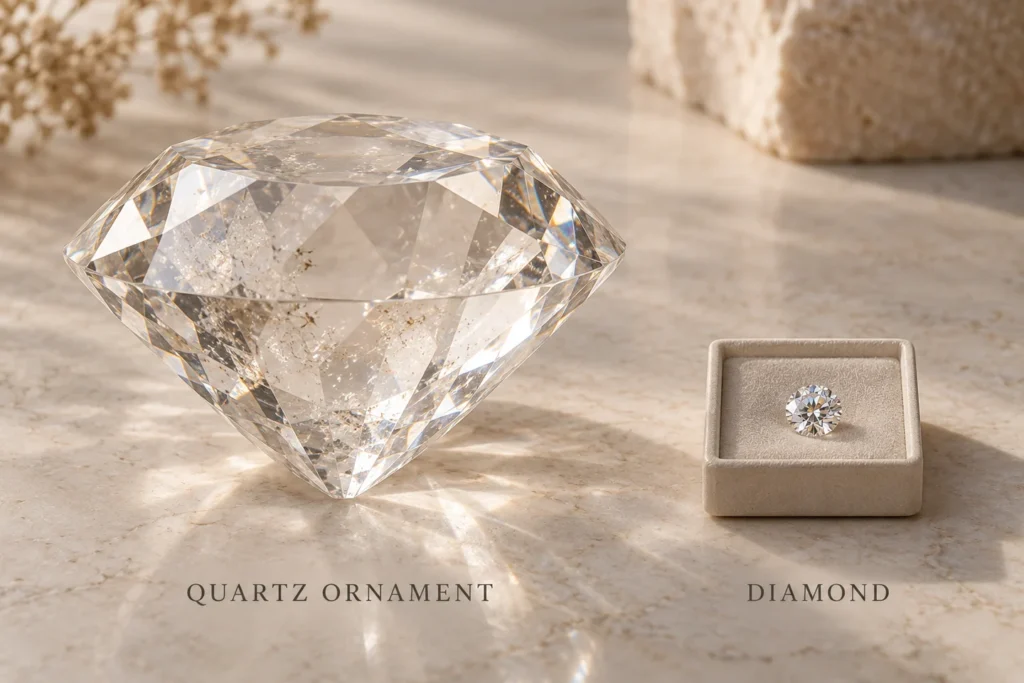
Key Differences Buyers Must Understand
| Factor | Real Diamonds | Quartz Diamonds |
|---|---|---|
| Material | Carbon (diamond mineral) | Silicon dioxide (quartz mineral) or glass |
| Rarity | Geologically rare, supply-controlled | Abundant, widely available |
| Pricing basis | 4Cs (cut, color, clarity, carat), certified | Size, material, processing, batch, quantity |
| Investment value | Established resale market | No investment resale market |
| Certification | GIA, IGI, AGS lab reports | No standard certification for shaped quartz products |
| Retail price range | $1,000–$100,000+ per carat | $0.30–$20+ per piece (wholesale) |
Why This Distinction Protects Your Business
If you are buying quartz diamonds for resale, you need to market them honestly. Describing faceted quartz as having "diamond-grade brilliance" or implying gemstone investment potential can damage customer trust and potentially violate consumer protection regulations in many markets.
Instead, quartz diamond products sell well when positioned for what they genuinely are:
- Beautiful natural crystal décor pieces
- Affordable faceted crystal gifts
- Meditation or display items for crystal enthusiasts
- Eye-catching photography props or event decorations
This honest positioning actually increases long-term customer loyalty and reduces returns. In my experience working with retail buyers at GD Crystal, the brands that perform best are those that educate their own customers about what quartz crystal products are — and let the products' genuine beauty speak for itself.
What Questions Should You Ask a Supplier Before Buying Quartz Diamonds?
Many buyers lose money not because they chose the wrong product, but because they did not ask the right questions before ordering. In wholesale, the quote you receive is only as good as the information exchanged. An incomplete inquiry leads to an inaccurate quote, which leads to a disappointing shipment.
Before purchasing quartz diamonds wholesale, you should confirm at minimum: the exact material, current batch photos or videos, size and weight range per piece, cut quality and polishing standard, MOQ, unit pricing at different quantity breaks, packaging options, estimated production or shipping lead time, and whether the quoted products match your intended resale channel.
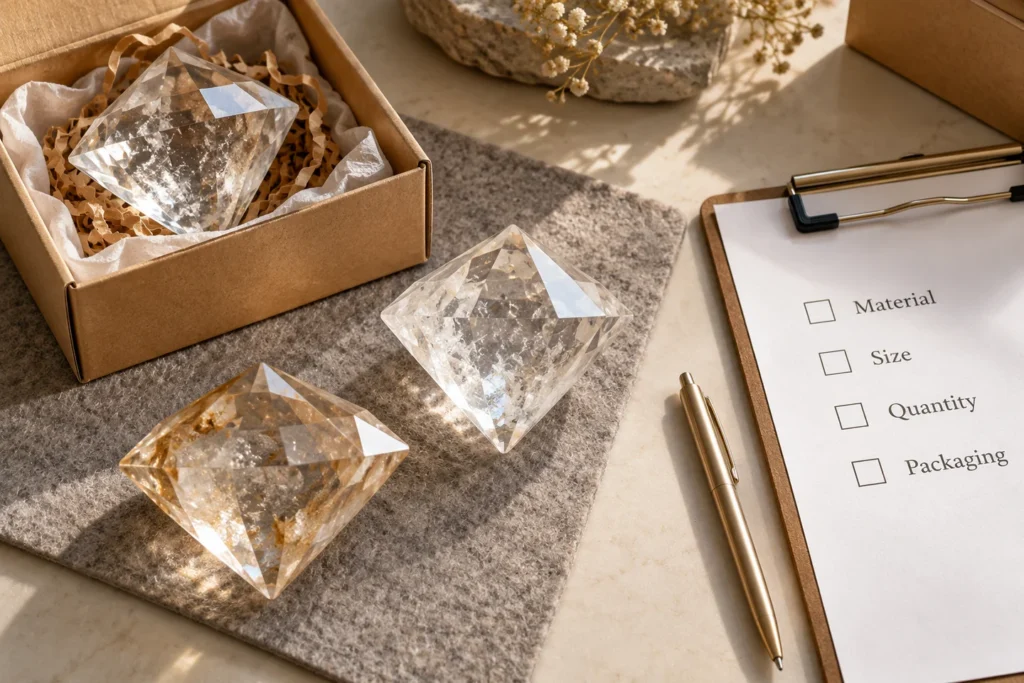
A Practical Inquiry Checklist
Here is what I recommend based on our daily experience handling wholesale inquiries at GD Crystal:
Before contacting a supplier, prepare:
- Your target product description — shape, approximate size, material preference
- Your order quantity range — even a rough estimate helps the supplier quote accurately
- Your resale context — telling the supplier whether you sell online, in a boutique, or at shows helps them recommend appropriate quality tiers
- Your packaging needs — individual boxes, pouches, bulk packing, or custom packaging
- Your shipping destination — this affects logistics quotes and delivery timeline
Questions to ask the supplier:
- "Can you send photos or videos of the current available batch, not catalog images?"
- "What is the material — natural clear quartz, rose quartz, synthetic, glass, or other?"
- "What is the size and weight range per piece in this batch?"
- "What is the MOQ, and are mixed-item orders possible?"
- "What quality grading or sorting do you apply? What is the typical defect or rejection rate?"
- "What are the packaging options and their cost difference?"
- "What is the estimated lead time for production and shipping?"
- "Are there price breaks at different quantity levels?"
Red Flags to Watch For
- A supplier who quotes a price without asking about size, material, or quantity
- Prices that seem too good to be true with no explanation
- Only professional studio photos available, no real batch images
- No clear MOQ or delivery timeline
- Reluctance to discuss material type or treatment
My advice: A good supplier will ask you questions too. At GD Crystal, we typically need to confirm several details before providing an accurate quote. That back-and-forth is not inefficiency — it is the sign of a supplier who takes accuracy seriously.
Frequently Asked Questions
Are quartz diamonds real diamonds?
No. Quartz diamonds are diamond-shaped or faceted products made from quartz crystal or glass. They are decorative and retail items, not precious gemstones. The "diamond" in the name refers to the cut shape, not the mineral. Always confirm the exact material with your supplier before purchasing.
How much do quartz diamonds cost wholesale?
Wholesale quartz diamond prices vary widely — from under $0.50 to several dollars per piece — depending on material, size, cut quality, order quantity, and packaging. There is no fixed universal price. Request a quote based on your specific product requirements and current batch availability.
Can I resell quartz diamonds at a good margin?
Yes, quartz diamonds can offer healthy resale margins when matched to the right market. Faceted crystal products are popular in gift shops, crystal boutiques, e-commerce, and metaphysical retail. The key is sourcing the right quality tier for your customer base and pricing your products honestly.
What is the difference between quartz diamonds and Herkimer diamonds?
Quartz diamonds usually refers to quartz shaped or polished into a diamond-like form. Herkimer diamonds are naturally double-terminated quartz crystals associated with Herkimer County, New York. Neither is a true diamond; confirm the material and origin with your supplier.
References
- "Quartz", https://en.wikipedia.org/wiki/Quartz. An authoritative mineral reference distinguishes quartz as silicon dioxide from diamond as crystalline carbon, supporting the statement that faceted quartz products are not diamonds. Evidence role: definition; source type: encyclopedia. Supports: Quartz is silicon dioxide, while diamond is crystalline carbon, so a quartz object is not a diamond mineral.. ↩
- "Smoky quartz", https://en.wikipedia.org/wiki/Smoky_quartz. Mineralogical references list rock crystal or clear quartz, rose quartz, and smoky quartz among recognized quartz varieties, supporting the material examples given here. Evidence role: definition; source type: encyclopedia. Supports: Clear quartz, rose quartz, and smoky quartz are recognized varieties or forms of quartz.. ↩
- "Minerals of New York | The New York State Museum", https://nysm.nysed.gov/exhibitions/ongoing/minerals-new-york. Geological sources describe Herkimer diamonds as double-terminated quartz crystals from the Herkimer County region of New York, supporting the distinction from manufactured or cut quartz products. Evidence role: definition; source type: institution. Supports: Herkimer diamonds are double-terminated quartz crystals historically associated with deposits in New York.. ↩
- "Colored Gemstone Value Factors", https://www.gia.edu/gia-news-research/value-factors-design-cut-quality-colored-gemstone-value-factors. Gemological references describe material identity, size, color, clarity, cut quality, treatment, and market conditions as factors in gem value, providing contextual support for the pricing variables listed for faceted quartz products. Evidence role: general_support; source type: institution. Supports: Gem and lapidary product value is commonly influenced by material identity, size, color, clarity, cut or workmanship, and market factors.. Scope note: The source would support general valuation principles rather than proving the exact cost structure of a specific wholesale supplier or batch. ↩
- "K9 glass", https://en.wikipedia.org/wiki/K9_glass. Optical-material references identify K9 as a crown-type optical glass with defined refractive and transmission properties, supporting the article's distinction between glass products and natural quartz items. Evidence role: definition; source type: research. Supports: K9 optical glass is an optical glass material rather than natural quartz.. Scope note: Such sources support the material distinction, but they may not directly document wholesale pricing differences in decorative crystal markets. ↩
- "9+ Tips: How to Cut Large Lapidary Stones Faster", https://bigblue.atlantisuniversity.edu/how-to-cut-large-lapidary-quality-stones/. Lapidary and gem-cutting educational sources explain that cutting and polishing stones involve material loss, labor, and yield considerations, giving contextual support to the cost mechanism described for larger faceted quartz pieces. Evidence role: mechanism; source type: education. Supports: Cutting and polishing stones can involve material loss and labor, and larger pieces generally require more input material and processing attention.. Scope note: This supports the production mechanism in general and may not quantify rejection rates for quartz diamond products specifically. ↩
- "Colored Gemstone Value Factors", https://www.gia.edu/gia-news-research/value-factors-design-cut-quality-colored-gemstone-value-factors. Gemological sources identify clarity, inclusions, fractures, and visual appearance as factors affecting gem quality and value, supporting the article's statement that clearer quartz pieces often command higher prices. Evidence role: general_support; source type: institution. Supports: Clarity and visible inclusions are recognized quality factors affecting gemstone or mineral specimen value.. Scope note: The evidence is general to gem and mineral valuation and does not establish a universal price premium for every quartz wholesale batch. ↩
- "Economies of scale", https://en.wikipedia.org/wiki/Economies_of_scale. Economics references describe economies of scale as reductions in average cost associated with larger production volumes, providing general support for the statement that larger wholesale orders can reduce per-piece cost. Evidence role: mechanism; source type: education. Supports: Economies of scale and quantity discounts can reduce average or per-unit costs as order or production volume increases.. Scope note: This supports the economic mechanism, not a guaranteed discount from any particular supplier. ↩
- "How to Pack a Box or Pallet for Shipping", https://www.ups.com/us/en/support/shipping-support/packaging-tips. Carrier packaging guidelines advise using adequate cushioning and immobilization for fragile items, supporting the article's recommendation that faceted quartz products require protective packaging. Evidence role: general_support; source type: institution. Supports: Fragile shipped items should be cushioned and packed to reduce movement and breakage.. Scope note: Carrier guidance addresses fragile shipments generally rather than quartz diamond products specifically. ↩
- "Why review images help reduce online shopping returns", https://giesbusiness.illinois.edu/news/2026/05/18/why-review-images-help-reduce-online-shopping-returns. Research on online retailing finds that product images and presentation affect consumer expectations and purchase behavior, providing contextual support for the need for e-commerce products to resemble their listing photos. Evidence role: general_support; source type: paper. Supports: Online product images influence consumer expectations, trust, satisfaction, and purchase decisions.. Scope note: The evidence is about e-commerce behavior broadly and may not study quartz or crystal products directly. ↩
- "In the Loupe: Advertising Diamond, Gemstones and Pearls", https://www.ftc.gov/business-guidance/resources/loupe-advertising-diamond-gemstones-pearls. The FTC Jewelry Guides address disclosures for gemstone identity, treatments, synthetic stones, and imitation products, supporting the article's emphasis on transparent material descriptions. Evidence role: expert_consensus; source type: government. Supports: Consumer-protection guidance requires or encourages accurate disclosure of gemstone identity, treatments, synthetic origin, and imitation status.. Scope note: The FTC guidance applies directly to U.S. marketing claims; requirements may differ in other jurisdictions. ↩
- "Understanding the 4Cs of Diamond Quality", https://4cs.gia.edu/en-us/4cs-of-diamond-quality/. The Gemological Institute of America defines the 4Cs—cut, color, clarity, and carat weight—as the standard framework for describing diamond quality, supporting the article's distinction between diamond grading and decorative quartz valuation. Evidence role: definition; source type: institution. Supports: The 4Cs are a diamond quality framework based on cut, color, clarity, and carat weight.. ↩