Figuring out how much you can sell your quartz for is one of the most common — and most misunderstood — questions in the crystal resale business. Without a clear framework, sellers either underprice their inventory and erode margins, or overprice and watch stock collect dust. The answer is not a single number. It is a pricing decision shaped by multiple variables unique to your product and your channel.
The price you can sell quartz for depends on the specific quartz type, product form (raw, tower, sphere, tumble, carving, bracelet, etc.), size, workmanship quality, your sales channel, and your total landed cost plus target margin. There is no universal quartz price. A polished rose quartz sphere and a raw clear quartz cluster are entirely different products with entirely different resale values. Profitable pricing starts with understanding your cost structure and your customer's willingness to pay.
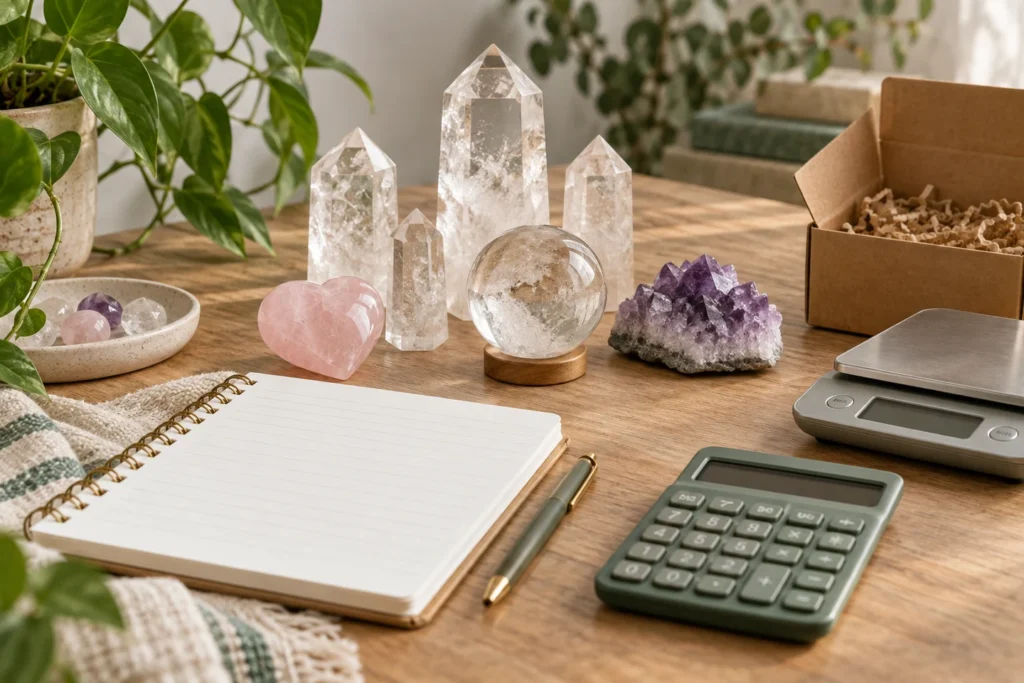
Below, I will break down every variable that affects quartz resale pricing — from product form and size to hidden costs most new sellers overlook. Whether you run an independent crystal shop, sell on Etsy, or do live-selling sessions, this framework will help you set prices that actually work.
Why Is "Quartz" Too Broad for a Single Price?
When someone asks me for "a quartz price," my first question is always: which quartz, and in what form? Without that clarity, any number I give is meaningless. Yet this is exactly how many new resellers approach pricing — searching for one reference price and applying it across their entire quartz inventory.
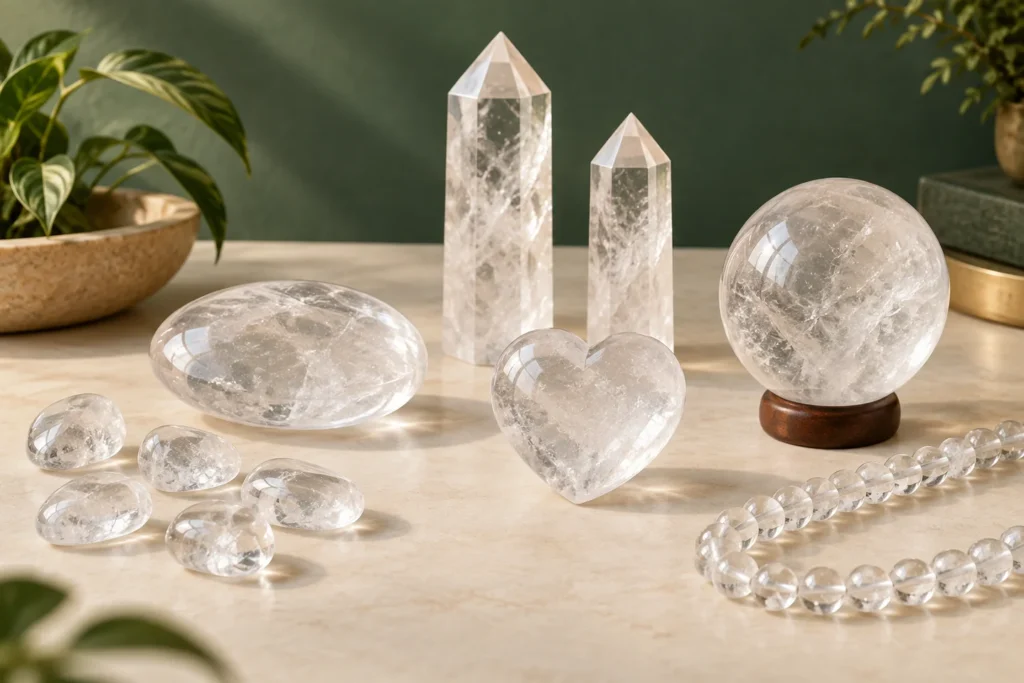
The reason a single quartz price does not exist is that "quartz" covers dozens of mineral varieties and hundreds of product forms.1 A tumbled amethyst stone, a smoky quartz tower, a clear quartz sphere, and a citrine bracelet are all "quartz," but they occupy completely different price ranges and serve different customer segments.
Quartz Varieties and Their Market Positioning
In my experience handling wholesale inquiries over the past 15 years, buyers who treat all quartz equally tend to misprice at least half their products. Here is a simplified overview of how quartz variety alone shifts the pricing conversation:
| Quartz Variety | Typical Product Forms | Relative Market Demand | Price Sensitivity |
|---|---|---|---|
| Clear Quartz | Points, towers, spheres, clusters, raw | Very high | Moderate — quality and clarity matter |
| Rose Quartz | Spheres, hearts, palm stones, towers | High | Moderate — color saturation matters |
| Amethyst | Clusters, geodes, towers, tumbles | Very high | Wide range — from budget tumbles to premium deep-purple geodes |
| Smoky Quartz | Towers, points, free-forms | Moderate | Higher for naturally smoky vs. treated |
| Citrine | Points, towers, tumbles, bracelets | High | Very sensitive — natural vs. heat-treated distinction is crucial |
| Rutilated Quartz | Cabochons, bracelets, spheres | Niche but strong | High — inclusion patterns drive value |
| Phantom Quartz | Points, display specimens | Niche | Premium pricing for visible phantoms |
Product Form Changes Everything
Beyond the mineral variety, the product form dramatically alters what you can charge. A kilogram of raw rose quartz rough might cost a fraction of what the same weight would cost as polished spheres. Why? Because spheres require significant material loss during shaping, skilled labor, and quality control for symmetry and surface finish.2
Here is how product form generally affects pricing, from lowest to highest per-unit cost:
- Raw rough and crushed stone — lowest cost, sold by weight
- Tumbled stones — low per-piece cost, high volume
- Palm stones and worry stones — moderate, depends on size and polish
- Hearts and simple shapes — moderate, shape consistency matters
- Towers and points — moderate to high, height and symmetry are key
- Spheres — high, due to material waste and polishing precision
- Carvings and decorative items — variable, complexity drives cost
- Bracelets and jewelry — variable, bead quality and stringing matter
Key takeaway: Never price a quartz sphere using a tumbled stone reference. They are fundamentally different products, even if they come from the same raw material.
When I receive wholesale inquiries, one of the most common misunderstandings is a buyer who references a price they saw online for a tumbled stone and expects the same per-gram rate for a hand-carved figurine. The processing, labor, and material loss involved are not comparable.
How Do Size, Weight, and Quality Affect Quartz Resale Value?
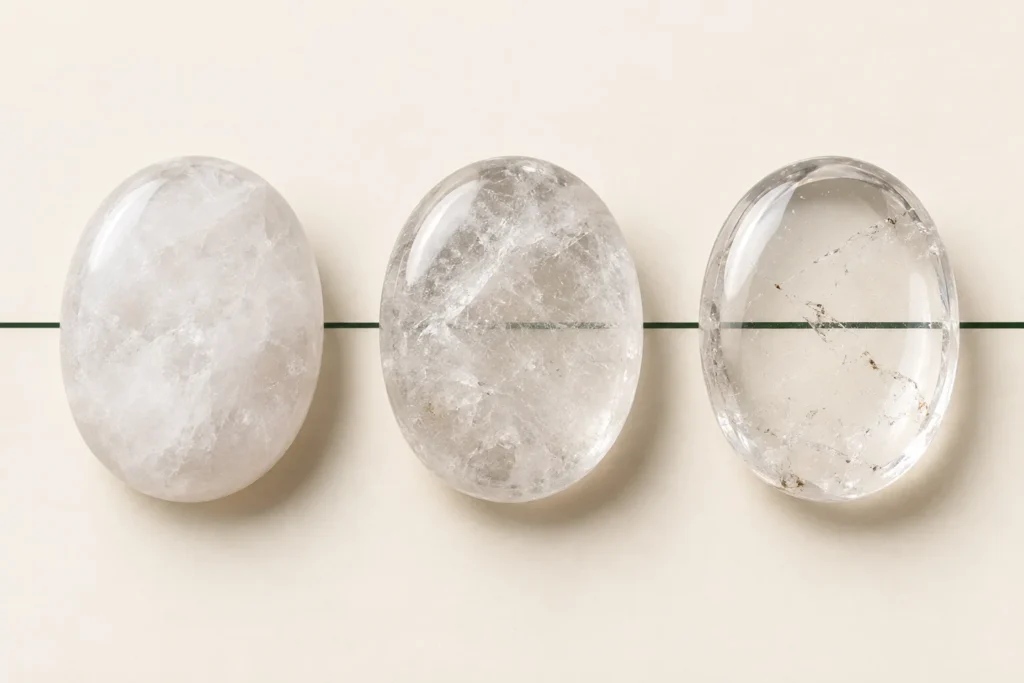
Size and weight are the first variables most sellers think about. Bigger should mean more expensive, right? In general, yes — but the relationship is not linear, and size alone does not determine what your customers will pay. A flawless 3-inch clear quartz sphere can outsell a heavily included 5-inch sphere by a wide margin.
Size and weight establish a baseline, but quality factors — clarity, color saturation, surface finish, visible flaws, and overall visual appeal — often matter more to the end buyer. A well-polished, vibrant smaller piece frequently commands a higher per-gram price than a larger piece with dull color or visible cracks.
The Size-Price Relationship Is Not Linear
In the wholesale quartz market, prices generally increase with size, but the rate of increase depends on rarity at that size.3 Small rose quartz hearts are abundant and inexpensive. A 10 cm rose quartz heart with deep, even color becomes significantly more expensive per unit — not just because it uses more material, but because finding clean, uniformly colored rose quartz at that size is harder.
For towers and points, the math looks something like this (illustrative, not a fixed price list):
| Tower Height Range | Relative Price Behavior |
|---|---|
| 5–8 cm | Budget-friendly, high availability, competitive pricing |
| 8–12 cm | Mid-range, steady demand, moderate margin potential |
| 12–18 cm | Higher price point, fewer per batch, quality variance increases |
| 18 cm+ | Premium segment, supply is limited, single-piece pricing common |
Quality Variables That Drive Price Up or Down
From our factory experience, these are the quality factors buyers should evaluate when setting resale prices:
- Clarity and transparency — especially for clear quartz, smoky quartz, and citrine. Pieces with fewer visible inclusions or cloudiness typically sell for more.4
- Color saturation — deep purple amethyst, vivid pink rose quartz, and rich golden citrine consistently fetch higher retail prices.5
- Surface finish and polish — a high-gloss, scratch-free polish signals professional processing. Dull or uneven polish lowers perceived value.
- Shape symmetry — for towers, spheres, and hearts, symmetry matters. Lopsided shapes are harder to sell at full price.
- Natural features vs. flaws — some natural features (rainbows, phantoms, interesting inclusions) add value. Chips, cracks, and repairs reduce it.
- Batch consistency — if you are selling sets, matching pieces, or listing multiple units under one SKU, consistency across the batch affects your pricing power.
A Note on Treatment and Disclosure
Some quartz varieties commonly undergo treatment. Citrine, for example, is frequently produced by heat-treating amethyst or smoky quartz.6 Smoky quartz can be irradiated.7 For resale, your customers increasingly expect transparency about treatment.8 Mispricing treated citrine as "natural citrine" can damage your reputation and invite returns.
I always recommend asking your supplier directly about treatment status for each batch. At GD Crystal, we communicate material and processing details per inquiry. If you need to verify claims about rare or high-value specimens, professional gemological identification is the appropriate step — that is outside the scope of what a wholesale supplier should promise.
What Costs Should You Include Before Setting a Resale Price?
This is where many new crystal sellers lose money without realizing it. They see their wholesale unit cost, apply a 2x or 3x markup, and call it their retail price. But between purchasing and selling, there are real costs that silently eat into margins. If you do not account for them, your "profitable" price may actually be breaking even — or worse.
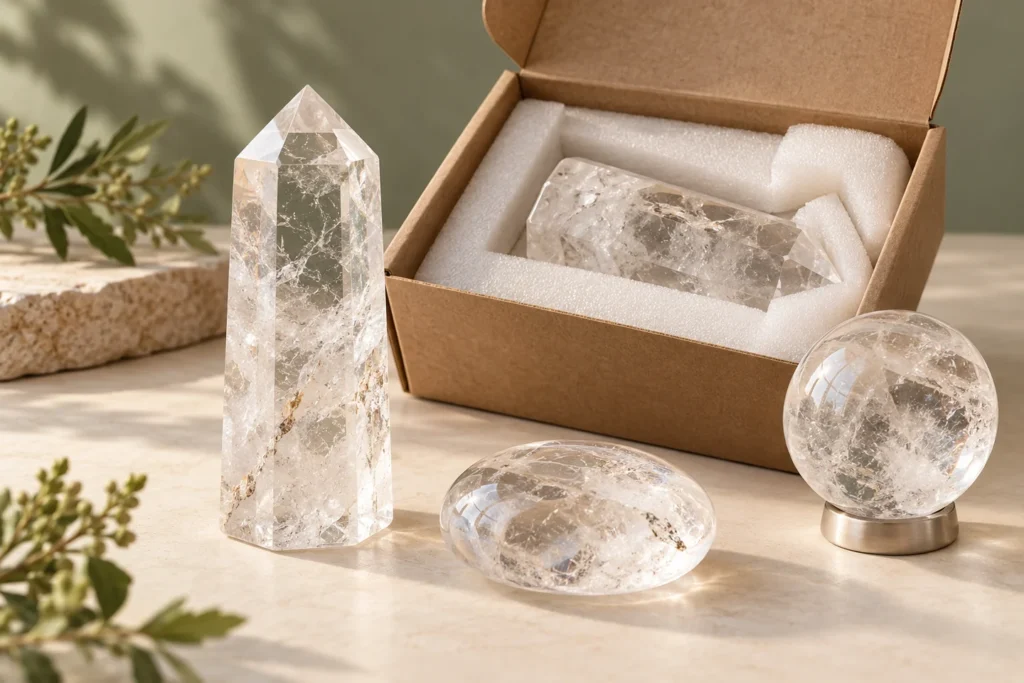
Before setting your quartz resale price, calculate your true landed cost per unit by adding: wholesale product cost, international shipping and freight, customs duties and taxes, domestic shipping to your warehouse, packaging materials, platform or marketplace fees, payment processing fees, and your labor time9 for listing, photographing, packing, and customer service.
Building Your True Landed Cost
Let me walk through a realistic cost buildup for a B2B buyer purchasing quartz towers from a China-based supplier like us:
- Product cost (FOB or EXW): The quoted wholesale price per piece or per kilogram. This is your starting point, not your total cost.
- Freight and shipping: International shipping (sea, air, or express courier) varies significantly by weight, volume, and destination. A heavy shipment of quartz spheres costs more to ship per unit than a light shipment of tumbled stones.
- Customs duties and import taxes: Depending on your country, quartz products may incur duties. In the US, for example, certain worked stone products fall under specific HTS codes with applicable tariff rates.10 Check with a customs broker.
- Domestic logistics: Getting the shipment from port or courier hub to your storage location.
- Packaging materials: Tissue paper, bubble wrap, boxes, branded packaging, inserts — these add up, especially for fragile items like spheres and carvings.
- Breakage and loss allowance: Crystal products can break in transit. Factor in a small percentage for damaged goods that cannot be resold at full price.
Platform and Selling Costs
Your selling channel adds another layer of cost:
| Selling Channel | Typical Fee Structure |
|---|---|
| Etsy11 | Listing fee + 6.5% transaction fee + payment processing (~3%) |
| Shopify (own store) | Monthly subscription + payment processing (~2.9% + $0.30) |
| Amazon | Referral fee (8–15%) + FBA fees if applicable |
| Instagram / TikTok live selling | Payment processing + shipping supplies + time investment |
| Physical retail shop | Rent, utilities, staffing, insurance, point-of-sale costs |
| Wholesale to other retailers | Lower margin but higher volume, fewer per-unit selling costs |
The Margin Calculation
Once you have your total landed cost per unit (product + freight + duties + packaging + platform fees), you can set a retail price:
Retail price = Total landed cost ÷ (1 − Target margin percentage)
For example, if your total landed cost for a rose quartz tower is $6.00 and you want a 60% gross margin:
$6.00 ÷ (1 − 0.60) = $6.00 ÷ 0.40 = $15.00 retail price
That $15.00 needs to make sense in your market. If competitors sell comparable towers for $12.00, you either need to differentiate (better quality, better branding, better customer experience) or accept a lower margin. If the market supports $20.00, you have more room.
The point is: do not start with a retail price you saw somewhere and assume it represents your margin. Start with your actual costs and work forward.
How Do You Price Quartz Differently by Sales Channel?
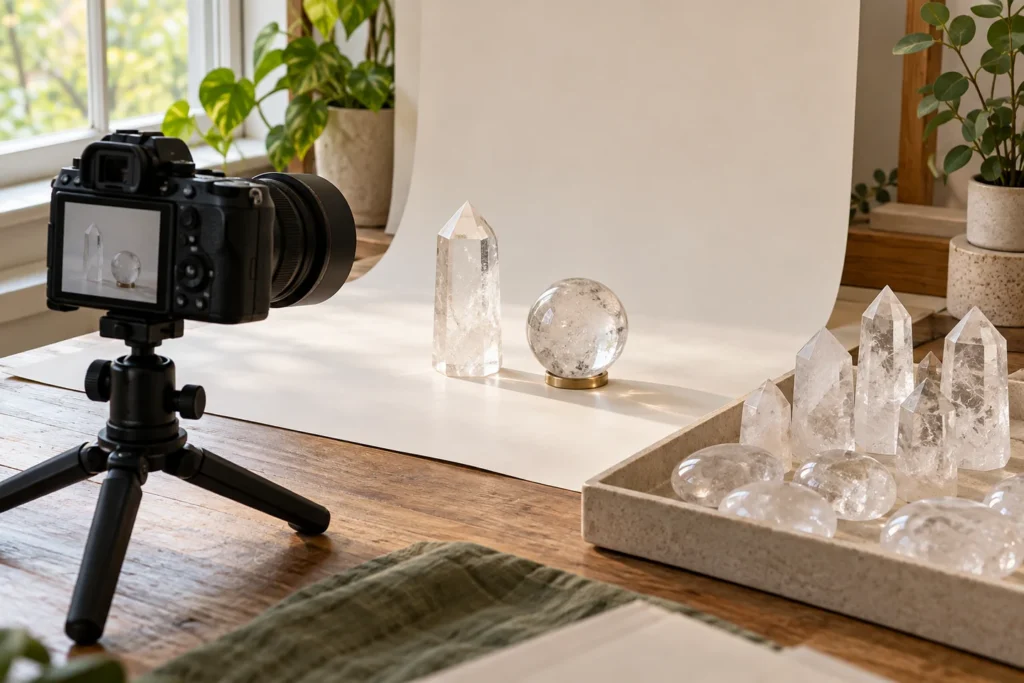
The same quartz tower that sells for $18 in a curated boutique crystal shop might move for $11 on a high-volume Etsy store or $8 in a TikTok live sale. Your channel determines your customer's expectations, your cost structure, and ultimately, the price the market will bear. Pricing quartz without considering your specific sales channel is like navigating without a map.
Your quartz resale price should reflect your channel's cost structure, customer expectations, and competitive landscape. Physical retail supports higher per-unit prices due to the in-person experience. E-commerce platforms require competitive pricing but reach more buyers. Live-selling often uses lower per-item prices offset by volume and impulse buying. Wholesale-to-retail requires the lowest per-unit price but the largest order quantities.
Channel-Specific Pricing Strategies
Physical Crystal Shops
Brick-and-mortar crystal stores can command higher prices because customers touch, feel, and connect with pieces in person. The sensory experience justifies a premium. Overhead is also higher (rent, staffing, utilities), so your margins need to cover these costs.
- Typical markup: 2.5x to 4x landed cost, depending on location and clientele
- Pricing tip: Group products into clear price tiers ($5, $10, $15, $25, $50+) to simplify the buying decision
- Advantage: Customers rarely comparison-shop on their phones while standing in your store
Online Marketplaces (Etsy, Amazon, Shopify)
E-commerce is more price-transparent. Customers can search, compare, and read reviews within seconds. Your photography, descriptions, and brand story matter as much as price.
- Typical markup: 2x to 3x landed cost, after accounting for platform fees
- Pricing tip: Offer size ranges or bundles to capture different budget levels
- Advantage: Wider audience reach, lower overhead than physical retail
Live Selling (Instagram, TikTok, Facebook)
Live selling creates urgency and entertainment value. Prices tend to be lower per item, but sellers move high volume in short sessions. The energy and personality of the seller drive purchases.
- Typical markup: 1.5x to 2.5x landed cost
- Pricing tip: Use "grab bags," mystery bundles, and flash deals to increase average order value
- Advantage: Direct customer interaction, impulse buying, community building
Wholesale to Other Retailers
If you are buying from a supplier like GD Crystal and reselling to smaller shops, your margin will be thinner per unit but your volume should be higher.
- Typical markup: 1.3x to 1.8x landed cost
- Pricing tip: Offer tiered pricing by quantity to incentivize larger orders from your buyers
- Advantage: Predictable volume, fewer individual customer service interactions
How Do You Avoid Common Quartz Pricing Mistakes?
Even experienced sellers sometimes fall into pricing traps that quietly drain profitability. The quartz market moves fast — new sellers enter constantly, social media trends shift demand overnight, and supply fluctuations from producing regions affect availability. Avoiding common mistakes is as important as getting the initial price right.
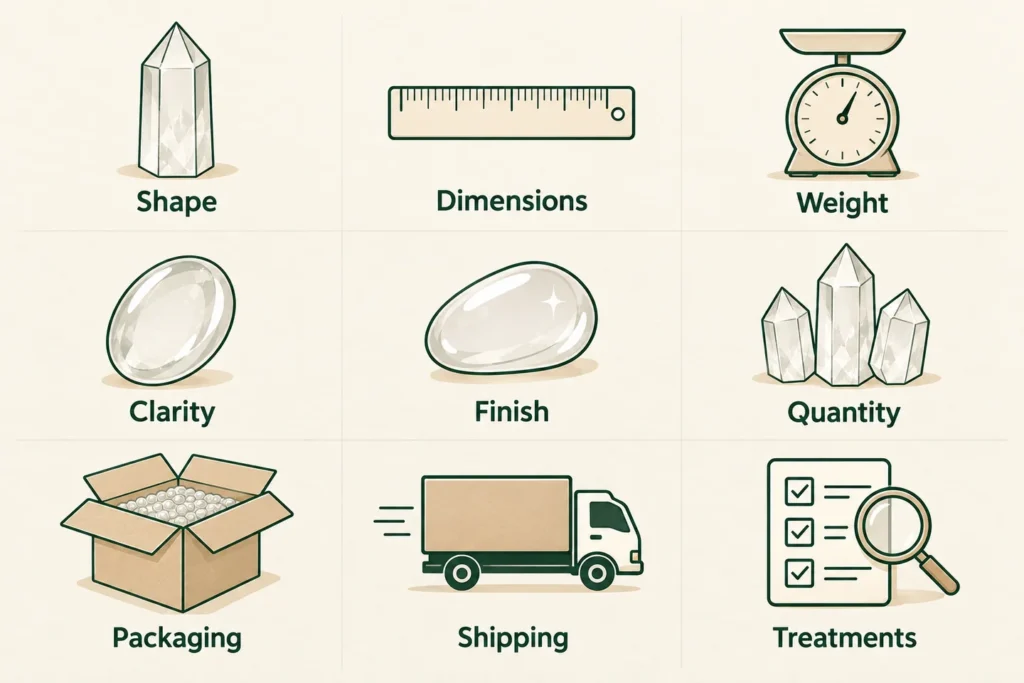
The most common quartz pricing mistakes include: copying a competitor's retail price without knowing their cost structure, treating all quartz forms equally, ignoring hidden costs like packaging and platform fees, pricing based on what you paid rather than what the market values, and failing to adjust prices when your supply cost or market conditions change.
Mistake 1: Using One Reference Price for All Quartz
I see this regularly in wholesale inquiries. A buyer tells me, "I can get quartz for $2 a piece." When I ask what type, what size, and what form, it turns out they are comparing small tumbled clear quartz to the polished amethyst towers they are trying to order. These are not the same product category.
Fix: Always compare like for like. A price reference is only useful if it matches the same variety, form, size range, quality grade, and quantity.
Mistake 2: Ignoring Material Loss in Processing
A 500-gram raw quartz chunk does not produce a 500-gram sphere. Depending on the original shape and the target product, material loss during cutting and shaping can be 40–70%.12 This is a major reason why spheres and complex carvings cost more than raw pieces of the same weight.
Fix: When evaluating wholesale prices for processed quartz, understand that the price reflects labor, skill, equipment, and significant raw material loss — not just the finished weight.
Mistake 3: Pricing Emotionally
You fell in love with a piece and paid a premium for it. Now you need to sell it at an even higher premium to justify the purchase. But your customers do not share your emotional attachment. They compare your price to every other listing they see.
Fix: Price based on market value and your cost structure, not on personal attachment. If you overpaid for a piece, accept the lesson.
References
- "Quartz", https://en.wikipedia.org/wiki/Quartz. An encyclopedic mineralogical source classifies amethyst, citrine, smoky quartz, and rose quartz as varieties of quartz, supporting the article's use of quartz as a broad category rather than a single uniform product. Evidence role: definition; source type: encyclopedia. Supports: A neutral mineralogical source should define quartz and identify common named varieties such as amethyst, citrine, smoky quartz, and rose quartz.. Scope note: This supports the mineral classification, not the number of commercial product forms or their resale prices. ↩
- "Lapidary", https://en.wikipedia.org/wiki/Lapidary. Lapidary references describe cutting and polishing as subtractive processes requiring shaping, grinding, and finishing, which supports the article's explanation that quartz spheres carry processing costs beyond the value of the rough stone. Evidence role: mechanism; source type: education. Supports: A lapidary or gem-processing source should explain that cutting and polishing stone into symmetrical forms removes material and requires skilled finishing.. Scope note: Such sources generally describe lapidary mechanics and may not quantify quartz-sphere production costs specifically. ↩
- "Colored Gemstone Value Factors", https://www.gia.edu/gia-news-research/value-factors-design-cut-quality-colored-gemstone-value-factors. Gemological pricing discussions note that size interacts with rarity and quality, so larger high-quality stones can command higher unit values than smaller or lower-quality examples. Evidence role: general_support; source type: institution. Supports: A gemological source should explain that size affects value and that larger high-quality stones can command disproportionately higher prices because they are less common.. Scope note: This is contextual support from general gem pricing principles and does not prove a specific quartz resale price curve. ↩
- "Colored Gemstone Value Factors", https://www.gia.edu/gia-news-research/value-factors-design-cut-quality-colored-gemstone-value-factors. Gemological sources identify clarity, transparency, and visible inclusions as quality factors used in evaluating gemstones, supporting the article's claim that clearer quartz pieces can command higher prices. Evidence role: expert_consensus; source type: institution. Supports: A gemological source should support that clarity, transparency, and visible inclusions are standard quality factors affecting gemstone value.. Scope note: The support is based on general gemstone evaluation principles and may not directly measure retail resale outcomes for every quartz product form. ↩
- "Amethyst Quality Factors", https://www.gia.edu/amethyst-quality-factor. Gemological quality guides describe color as a primary determinant of value in colored gemstones, including quartz varieties such as amethyst and citrine, supporting the article's emphasis on saturated color as a pricing factor. Evidence role: expert_consensus; source type: institution. Supports: A gemological source should support that color saturation and hue are major value factors for colored quartz varieties, including amethyst and citrine.. Scope note: The source may support amethyst and citrine more directly than rose quartz, and it does not establish exact retail premiums. ↩
- "Citrine Gemstone | Natural Citrine Stone", https://www.gia.edu/citrine. Gemological references describe citrine as commonly produced or enhanced by heating amethyst or smoky quartz, supporting the article's warning that natural and treated citrine should be distinguished in resale descriptions. Evidence role: mechanism; source type: institution. Supports: A gemological source should state that citrine can be created or color-enhanced by heating amethyst or smoky quartz.. Scope note: This supports the general treatment practice and does not determine whether any individual citrine item is natural or treated. ↩
- "Ametrine with Layers of Smoky Quartz | Gems & Gemology", https://www.gia.edu/gems-gemology/ametrine-smoky-quartz. Gemological sources describe irradiation as a treatment that can create or intensify smoky coloration in quartz, supporting the article's statement that smoky quartz may be treated. Evidence role: mechanism; source type: institution. Supports: A gemological or mineralogical source should explain that irradiation can produce or alter smoky coloration in quartz.. Scope note: This does not establish treatment status for any particular specimen or batch. ↩
- "In the Loupe: Advertising Diamond, Gemstones and Pearls", https://www.ftc.gov/business-guidance/resources/loupe-advertising-diamond-gemstones-pearls. The FTC Jewelry Guides address disclosure of gemstone treatments when such treatments are not permanent, require special care, or significantly affect value, supporting the article's emphasis on transparency in treated quartz sales. Evidence role: general_support; source type: government. Supports: A consumer-protection source should support that gemstone treatments should be disclosed when they affect value, care, or consumer expectations.. Scope note: The source establishes regulatory disclosure principles rather than measuring customer expectations in the crystal resale market. ↩
- "Import Tariffs & Fees Overview and Resources", https://www.trade.gov/import-tariffs-fees-overview-and-resources. Accounting and trade references define landed cost as the full cost of acquiring and bringing goods to their destination, including purchase price, freight, duties, taxes, and related charges, supporting the article's cost-based pricing framework. Evidence role: definition; source type: education. Supports: An accounting or international trade source should define landed cost as the total cost to bring goods to the buyer, including product cost, freight, duties, taxes, and related charges.. Scope note: The source may not include every selling-channel cost listed in the article, such as photography labor or marketplace fees. ↩
- "Harmonized Tariff Schedule – United States International …", https://hts.usitc.gov/. The U.S. Harmonized Tariff Schedule classifies worked stone articles under specific tariff headings with associated duty rates, supporting the article's statement that imported quartz products may incur duties based on HTS classification. Evidence role: general_support; source type: government. Supports: An official U.S. tariff source should show that worked stone articles are classified under Harmonized Tariff Schedule headings with specified duty rates.. Scope note: The exact tariff code and rate depend on the product's material, form, processing, and country of origin. ↩
- "What are Payment Processing Fees for Selling on Etsy?", https://help.etsy.com/hc/en-us/articles/115015628847-What-are-Payment-Processing-Fees-for-Selling-on-Etsy. Etsy's seller-fee documentation lists a per-listing fee, a transaction fee, and payment-processing fees, supporting the article's inclusion of Etsy platform costs in resale price calculations. Evidence role: statistic; source type: other. Supports: An official Etsy fee source should verify the listing fee, transaction fee, and payment processing structure for sellers.. Scope note: Marketplace fee schedules can change, and payment-processing rates vary by country and transaction circumstances. ↩
- "Rough to Ring Yield Ratio: How Much Rough Gemstone …", https://www.folkmarketgems.com/blogs/gems-and-mineral-information/learn-rough-gems-yields-ratio?srsltid=AU7gw4UnMFlSrymVCSaPvjqtvbGMKMH8CEq6DoTPKSyJ_ozBhA-kq7Fn. Lapidary yield discussions show that finished stone products may represent only a fraction of the starting rough because cutting, grinding, and shaping remove substantial material, supporting the article's explanation that processed quartz carries waste-related costs. Evidence role: statistic; source type: research. Supports: A lapidary or gemstone manufacturing source should provide typical yield or waste ranges for cutting rough stone into finished forms.. Scope note: Available sources may provide general lapidary yield ranges rather than a quartz-specific 40–70% loss figure for every product form. ↩