Choosing which wrist to wear a clear quartz bracelet on is one of the most common questions crystal shop owners hear from their customers. The worry is real: people fear that picking the "wrong" wrist will cancel the bracelet's meaning or invite bad luck. The good news is the answer is far simpler and more forgiving than most guides suggest.
There is no single mandatory wrist for a clear quartz bracelet. You can wear it on either wrist without doing anything "wrong." Many people choose based on personal intention or cultural tradition, but comfort, daily activity, and bracelet protection matter just as much. The best wrist is whichever feels natural and keeps the bracelet safe during your routine.
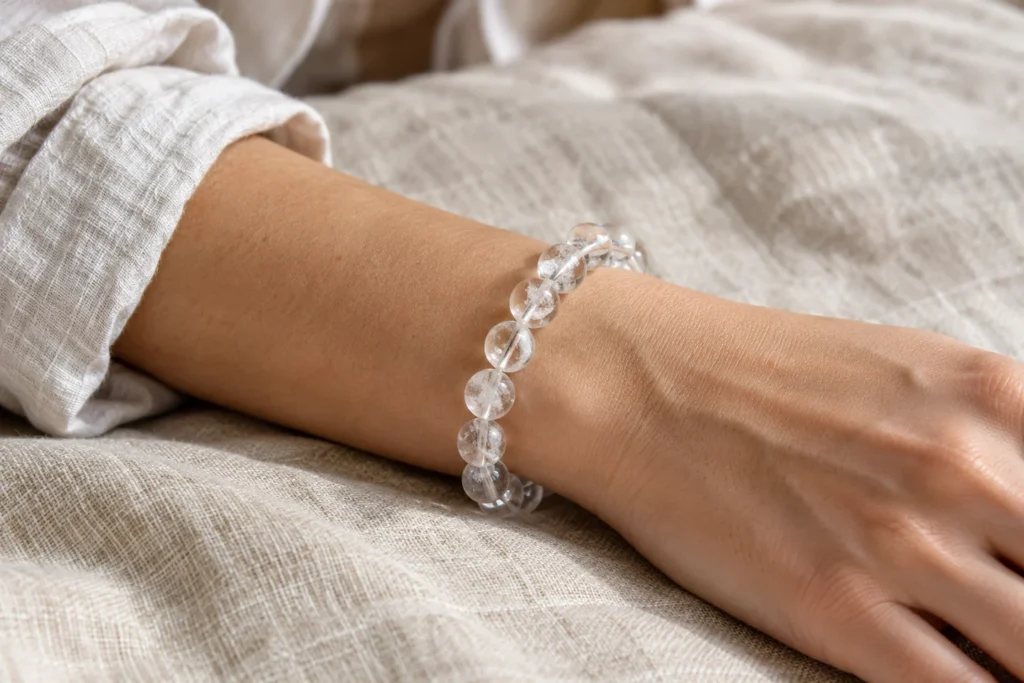
At GD Crystal, we supply clear quartz bracelets to retailers and crystal brands across many markets. Through years of customer communication, we have noticed the same question surfaces repeatedly — and the anxiety behind it is often stronger than it needs to be. Below, we break down every angle so you can make a confident, informed choice.
Why Do People Worry About Which Wrist to Wear a Clear Quartz Bracelet On?
The fear of wearing a crystal bracelet on the "wrong" wrist is surprisingly widespread. Online forums, social media posts, and crystal community discussions often present conflicting rules, leaving new wearers confused and anxious.
This worry usually comes from encountering rigid claims about left-hand versus right-hand energy flow. Some sources state one wrist "absorbs" energy while the other "releases" it, presenting these ideas as strict laws. When different sources disagree, readers naturally wonder if they have been doing it wrong all along.
Where Does the Left-Hand / Right-Hand Rule Come From?
In several crystal-culture traditions, there is a popular concept that the left hand is the "receiving" hand1 and the right hand is the "projecting" hand2. Under this framework, wearing a clear quartz bracelet on your left wrist is said to invite clarity or calm energy inward, while wearing it on the right is said to project those qualities outward.
It is important to understand the context:
- This concept is rooted in certain metaphysical and cultural traditions3, not in peer-reviewed science4.
- Different cultures and crystal communities may reverse these associations or define them differently.
- There is no universal authority that enforces a single correct wrist for any crystal bracelet.
Many customers ask us — through the retailers and brands we supply — whether they need to follow this rule strictly. Our answer is always the same: treat it as a personal preference, not a pass/fail test. If the left-hand/right-hand idea resonates with you, feel free to follow it. If it does not, that is equally fine.
The Anxiety Is Often Worse Than the "Problem"
From our experience communicating with crystal shop owners and brand founders, we have noticed something consistent: the strongest value an article like this can provide is reassurance, not stricter rules. People rarely need more restrictions. They need permission to relax and enjoy wearing their bracelet.
Here is what we often relay to our retail customers when they ask how to advise their shoppers:
| Common Worry | Reality |
|---|---|
| "I wore it on the wrong wrist for months." | There is no evidence this causes harm or cancels meaning. |
| "Different websites say different things." | That is because there is no single universal rule. |
| "Will it bring bad luck on my right hand?" | No credible tradition claims a clear quartz bracelet causes bad luck on either wrist. |
| "I need to switch wrists at certain times." | You can if you want to, but it is not a requirement. |
The bottom line: the "wrong" wrist does not exist. Choose with intention, comfort, or simply habit — all are valid.
What Does Common Crystal Culture Say About Wearing a Clear Quartz Bracelet?
If you have spent any time in crystal communities, you have probably encountered several traditions about bracelet placement. Understanding these traditions helps, as long as you treat them as optional cultural frameworks rather than absolute rules.
In common crystal culture, clear quartz is often described as an "amplifier" or "master healer" stone5. Some practitioners suggest wearing it on the left wrist to "receive" clarity and focus, while others recommend the right wrist to "share" positive energy with the world around you.
The "Receiving" and "Projecting" Framework
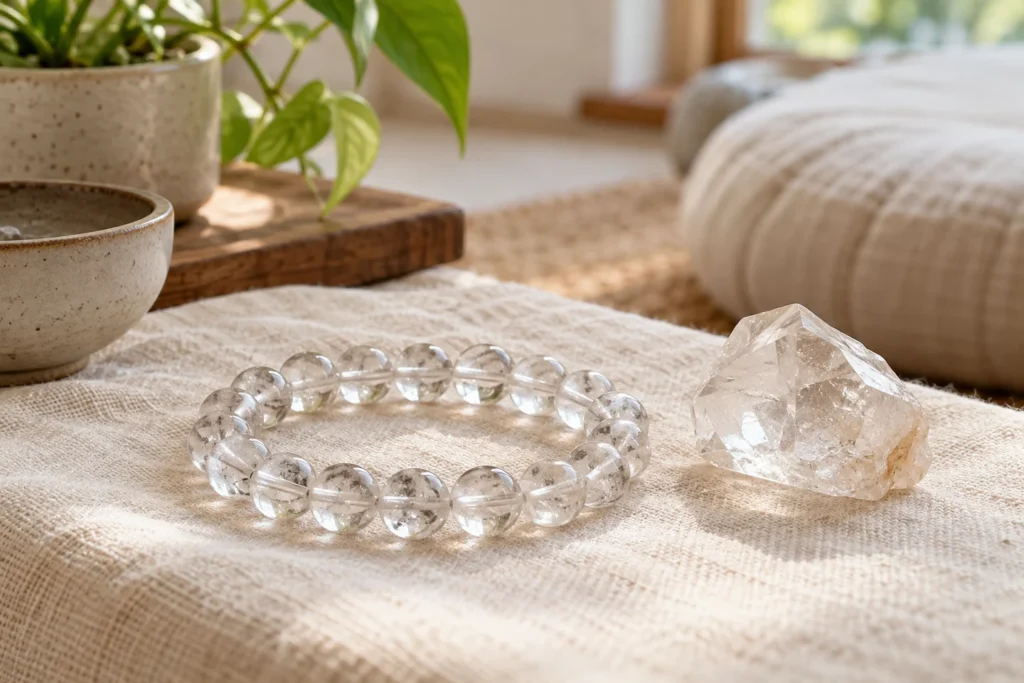
This is the most commonly cited system. Here is how it is typically described:
- Left wrist (receiving): Some people prefer wearing their clear quartz bracelet on the left because they see it as drawing desired qualities — such as mental clarity, calm focus, or openness — toward themselves.
- Right wrist (projecting): Others choose the right wrist with the intention of putting certain qualities outward into their interactions, work, or environment.
Important note: These descriptions come from popular crystal-culture interpretation. They are not medical claims, scientific findings, or guaranteed outcomes. At GD Crystal, we present them because our retail customers frequently encounter these ideas and want to explain them accurately to their shoppers.
Cultural and Regional Variations
It is worth noting that different cultural backgrounds may interpret wrist placement differently:
- Chinese crystal-wearing tradition sometimes references the concept of 左进右出 (left in, right out)6, suggesting the left hand absorbs and the right hand releases. This is a cultural guideline, not a universal law.
- Western metaphysical traditions often follow a similar left-receive, right-project model, but individual practitioners may adapt it.
- Some traditions make no wrist distinction at all, focusing instead on the wearer's intention regardless of placement.
What If You Are Left-Handed?
This is a practical question that many crystal guides overlook. Some left-handed wearers find the "receiving hand" concept confusing because their dominant hand is the left one. In practice:
- Some left-handed people reverse the rule7, considering their dominant (left) hand the projecting one.
- Others ignore the framework entirely and choose based on comfort.
- Neither approach is wrong.
The key takeaway for anyone selling or wearing a clear quartz bracelet: these cultural traditions can add personal meaning to your wearing habit, but they are not mandatory instructions.
Which Wrist Is More Practical for Wearing a Clear Quartz Bracelet?
Beyond cultural traditions and personal intention, there is a very practical side to this question that does not get enough attention. Choosing the right wrist for your clear quartz bracelet often comes down to comfort, daily activity, and bracelet longevity.
The most practical wrist is usually your non-dominant hand. This simple choice reduces the risk of impact damage, keeps the bracelet out of the way during work, and generally feels more comfortable throughout the day.

Dominant Hand Considerations
Your dominant hand does more work8. It writes, types, lifts, reaches, and gestures more frequently. Wearing a bracelet on this hand means:
- More frequent contact with hard surfaces like desks, keyboards, and countertops
- Higher risk of scratching or chipping the beads, especially if you work with your hands
- Potential discomfort during repetitive tasks like mouse use or cooking
For these reasons, many customers — regardless of any energy-based reasoning — naturally gravitate toward their non-dominant wrist. From a product care standpoint, this is also better for the bracelet.
Workplace and Activity Factors
Different jobs and lifestyles create different wearing needs. Here is a quick reference:
| Activity / Occupation | Recommended Wrist | Reason |
|---|---|---|
| Office / desk work | Non-dominant hand | Avoids mouse and keyboard interference |
| Manual labor | Consider removing the bracelet | Reduces breakage risk and safety hazard |
| Retail / customer-facing | Either wrist | Low physical impact; choose based on comfort |
| Cooking / kitchen work | Non-dominant hand, or remove | Avoids heat, moisture, and impact |
| Exercise / sports | Remove during intense activity | Prevents bead damage and skin irritation from sweat |
Bracelet Care Tips Related to Wrist Choice
Choosing the right wrist is actually a bracelet care decision as much as a style or intention decision. Clear quartz is a durable mineral (7 on the Mohs hardness scale)9, but the elastic cord and bead finish can still suffer from daily wear. Some practical tips:
- If you notice your bracelet cord frays faster on one wrist, switch to the other. Repeated impact from a dominant hand accelerates cord wear.
- Remove your clear quartz bracelet before showering, swimming, or heavy exercise. Prolonged moisture weakens elastic cord10 and can dull polished surfaces over time.
- Store the bracelet flat when not wearing it. Hanging it can stretch the cord unevenly.
These practical considerations are things we discuss regularly with our B2B customers — crystal shop owners and brand founders — who want to help their end consumers enjoy their bracelets for as long as possible.
Can You Wear a Clear Quartz Bracelet on Both Wrists or Switch Between Them?
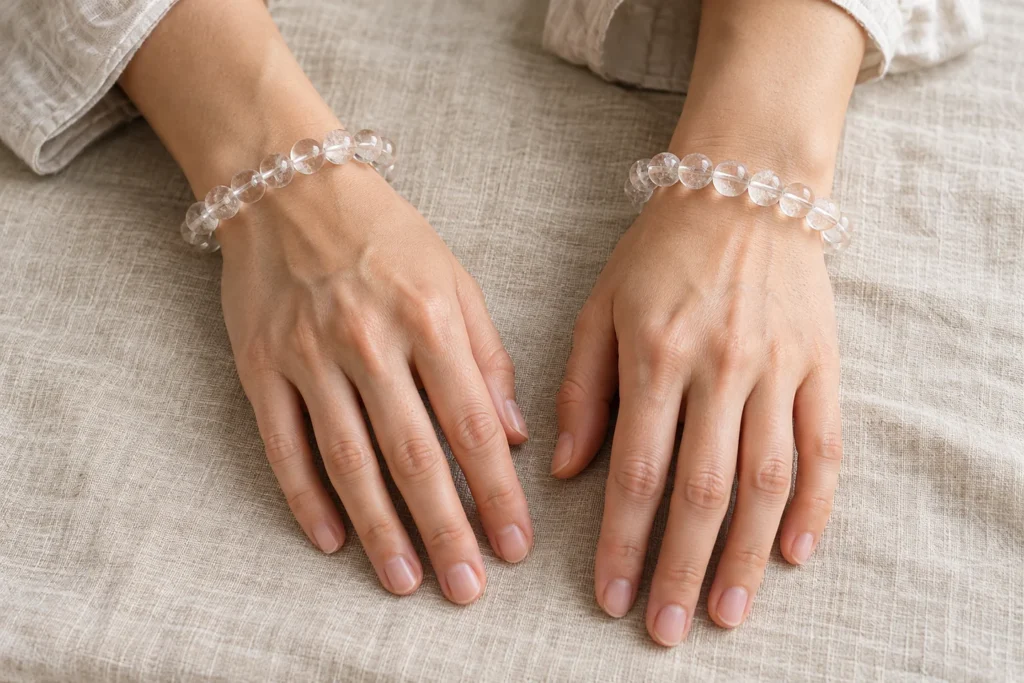
Some wearers wonder if switching wrists — or wearing bracelets on both wrists simultaneously — is acceptable. The short answer: absolutely. There is no credible tradition or practical reason that forbids switching or double-wearing.
Switching wrists throughout the day or week is perfectly fine. Many people rotate based on what feels comfortable in the moment. Wearing clear quartz bracelets on both wrists at the same time is also common, especially among people who enjoy stacking crystals.
Why Some People Switch Wrists
There are several everyday reasons people change wrists:
- Comfort rotation: If one wrist feels tired or if the bracelet has been pressing against a desk edge, switching gives relief.
- Activity-based switching: You might wear the bracelet on your left wrist during office hours and switch to the right during a relaxed evening.
- Skin sensitivity: Some people develop mild irritation from constant bracelet contact on one wrist. Alternating helps.
- Intentional variation: Those who follow the receiving/projecting framework may switch based on their mood or the day's activities.
Wearing Multiple Crystal Bracelets
If you sell or wear multiple crystal bracelets, you might wonder about combining clear quartz with other stones. Common questions include:
- Can clear quartz go on the same wrist as other crystal bracelets? Yes. Clear quartz is widely considered compatible with other stones in crystal-culture tradition.
- Does stacking weaken any bracelet's "purpose"? In common crystal culture, clear quartz is often described as amplifying other stones, so stacking is generally viewed positively. This is a cultural interpretation, not a guaranteed effect.
- Will stacking damage the bracelets physically? Potentially, if the beads rub together constantly. Softer stones (like fluorite or selenite) may scratch when stacked against quartz11. Advising customers to separate softer-stone bracelets with a spacer or wear them on different wrists is a practical product-care recommendation.
A Note for Retailers and Brand Owners
If you run a crystal shop or ecommerce store, you will encounter this question from customers often. Having a calm, clear explanation ready — one that reduces anxiety rather than creating more rules — builds trust and repeat business. We have seen this firsthand through our retail partners: the shops that give practical, grounded advice tend to earn stronger customer loyalty than those that pile on complicated restrictions.
How Should You Decide Which Wrist to Wear Your Clear Quartz Bracelet On?
With all the options and traditions laid out, how do you actually make the choice? The decision framework is simpler than it seems.
Start by asking yourself three questions: Which wrist feels more comfortable? Which wrist keeps the bracelet safer during your daily routine? And does any cultural or personal tradition resonate with you? Your answer to these three questions is your answer.
A Simple Decision Framework
Here is a step-by-step approach we often recommend to our retail customers for their end shoppers:
- Try both wrists for a day or two each. Notice which feels more natural.
- Consider your dominant hand. If you are right-handed, the left wrist often feels less obstructive, and vice versa.
- Think about your daily activities. Will the bracelet get in the way of your work on one wrist more than the other?
- If a cultural tradition resonates with you, let it guide your choice — but do not stress if you need to switch for practical reasons.
- Give yourself permission to change. Your preference may shift over time, and that is normal.
What Not to Worry About
Let us be direct about what you can safely ignore:
- "You must never switch wrists." — Not true. Switch freely.
- "Wearing it on the wrong wrist cancels its energy." — No credible tradition makes this claim about clear quartz.
- "You have to cleanse the bracelet if you accidentally wear it on the wrong hand." — There is no "wrong" hand to correct for.
- "Men must wear it on one wrist and women on the other." — This is not a universal rule. Some cultural traditions suggest gendered wrist preferences, but these are optional customs, not requirements.
The best wrist for your clear quartz bracelet is the one that makes you feel good wearing it. That is genuinely the most useful answer anyone can give.
Frequently Asked Questions
Does wearing a clear quartz bracelet on the right wrist bring bad luck?
No. There is no credible tradition or evidence that wearing a clear quartz bracelet on the right wrist causes bad luck. Some cultural frameworks assign different meanings to each wrist, but these are optional interpretations. Wear your bracelet on whichever wrist you prefer without worry.
Can I sleep with my clear quartz bracelet on?
You can, but many people find it more comfortable to remove bracelets during sleep. Sleeping with a bracelet on can press the beads into your skin and stress the elastic cord. For bracelet longevity and comfort, taking it off at bedtime is a practical choice.
Should I wear my clear quartz bracelet on the left or right wrist for meditation?
This depends on personal preference. Some practitioners choose the left wrist during meditation, following the "receiving" tradition. Others wear it on the right or hold the bracelet in their hands. There is no mandatory rule — choose what feels most meaningful to you.
How tight should a clear quartz bracelet fit on my wrist?
A well-fitting clear quartz bracelet should slide over your hand and sit comfortably without being too loose or too tight. You should be able to fit one finger between the bracelet and your wrist. If it is too tight, it can restrict circulation12; too loose, and it risks slipping off or catching on objects.
Can I wear a clear quartz bracelet with a watch?
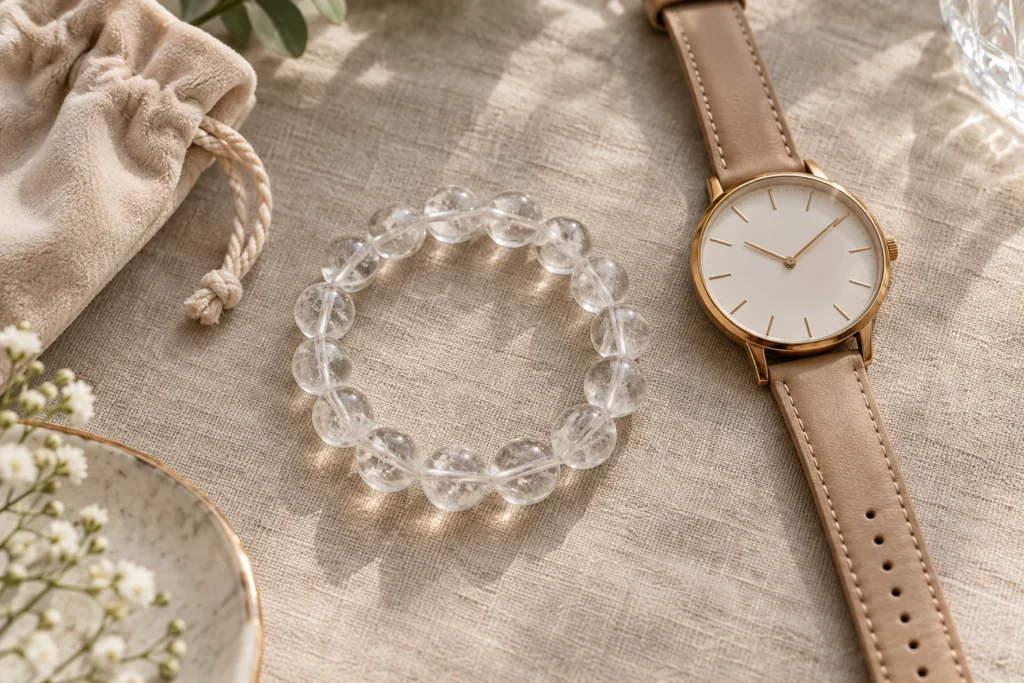
Yes, many people wear a crystal bracelet alongside a watch. To protect both items, consider wearing them on opposite wrists or leaving a small gap between them. Constant rubbing between a watch case and quartz beads can scratch the watch finish or dull the bead surface over time.
Conclusion
The question of which wrist to wear a clear quartz bracelet on does not have a single mandatory answer — and that is genuinely good news. Cultural traditions like the left-receive, right-project framework can add personal meaning to your choice, but they are optional, not obligatory. Practical factors — comfort, dominant hand, daily activity, and bracelet care — matter just as much, if not more. The best wrist is the one that feels right for your lifestyle.
At GD Crystal, we supply clear quartz bracelets and other crystal products to retailers, ecommerce sellers, and growing crystal brands worldwide. If you are looking for a reliable B2B supplier with over 15 years of crystal processing experience, we welcome you to reach out for product details, sample orders, or custom bracelet inquiries. Let us help you stock products your customers will love wearing — on whichever wrist they choose.
References
- "Which Hand To Wear Crystal Bracelet – Left Or Right Wrist?", https://www.healingauracrystals.com/blogs/crystalpedia/which-hand-to-wear-crystal-bracelet-left-or-right-wrist. Descriptions in contemporary metaphysical literature commonly associate the left hand with receiving or receptive energy, which supports the article's account of this belief as a tradition-based convention. Evidence role: historical_context; source type: other. Supports: A non-vendor overview or primary esoteric text should show that the left hand is described in some metaphysical systems as receptive.. Scope note: This would document the existence of the belief, not verify that such energy flow occurs. ↩
- "Left-hand path and right-hand path", https://en.wikipedia.org/wiki/Left-hand_path_and_right-hand_path. Contemporary metaphysical sources often describe the right hand as outward-projecting, supporting the article's statement that this is a recognized interpretive framework in crystal culture. Evidence role: historical_context; source type: other. Supports: A non-commercial source or primary metaphysical text should document that the right hand is sometimes described as outward-projecting in energy-healing contexts.. Scope note: The source would substantiate the tradition's terminology, not provide scientific evidence for an energy mechanism. ↩
- "Crystal healing", https://en.wikipedia.org/wiki/Crystal_healing. A neutral overview of crystal healing describes such practices as contemporary metaphysical or New Age belief systems, supporting the article's framing of wrist-placement rules as cultural context rather than scientific instruction. Evidence role: historical_context; source type: research. Supports: A neutral source should document that crystal healing and related placement practices are part of contemporary metaphysical, New Age, or cultural belief systems rather than established scientific practice.. Scope note: Such a source may support the broader cultural classification of crystal practices without documenting this exact bracelet-wrist rule. ↩
- "National Center for Complementary and Integrative Health", https://www.nccih.nih.gov/. Public health and scientific reviews of complementary practices do not identify peer-reviewed evidence that crystals direct measurable 'receiving' or 'projecting' energy through a particular wrist. Evidence role: expert_consensus; source type: government. Supports: A reputable health or science source should state that crystal healing has not been shown by scientific evidence to produce specific health or energy effects beyond belief or placebo contexts.. Scope note: This supports the lack of scientific validation for the mechanism, not the cultural meaning individual wearers may assign to the practice. ↩
- "Clear Quartz Angel (Master Healer and Amplifier)", https://talktocrystals.com/products/angel-clear-quartz?srsltid=AU7gw4U1gY_rocpNdi1IKsld0bSwXIDu1eTmxoZXG5IF1mWe9lvbA5Db. Accounts of contemporary crystal-healing symbolism frequently identify clear quartz as an 'amplifier' or 'master healer,' supporting the article's description of common crystal-culture terminology. Evidence role: definition; source type: other. Supports: A neutral or primary descriptive source should show that clear quartz is commonly labeled an amplifier or master healer within crystal-healing belief systems.. Scope note: This supports usage of the labels within the belief system, not the efficacy of the claimed effects. ↩
- "水晶手鍊戴左手還是右手?完整解析左進右出與脈輪能量", https://www.livinn.store/blogs/gemstone-knowledge/crystal-bracelet-left-or-right-hand?srsltid=AU7gw4Xa1zmB4IS3n1LJP6llX1iMpY1kfpmsUBEu70k1e2qbs60lTM5C. Chinese-language discussions of crystal-wearing customs use the phrase 左进右出, literally 'left in, right out,' supporting the article's characterization of this as a cultural guideline. Evidence role: historical_context; source type: other. Supports: A Chinese-language cultural source or non-commercial explanatory source should document the phrase 左进右出 and its association with crystal or bracelet wearing.. Scope note: Available sources may reflect popular custom rather than a formally codified or universally followed Chinese tradition. ↩
- "Which Hand to Hold Crystals in During Meditation?", https://crystaltyche.com/blog/which-hand-to-hold-crystals-meditation/. Practitioner-oriented discussions of hand symbolism sometimes adapt receiving/projecting roles according to hand dominance, providing contextual support for the article's note that left-handed wearers may reverse the convention. Evidence role: general_support; source type: other. Supports: A source should show that some practitioners adapt hand-energy rules according to dominant hand or left-handedness.. Scope note: This supports the existence of the interpretive variation, not any physiological or energetic effect. ↩
- "Hand Dominance: Nature, Nurture, and Relevance for … – PMC", https://pmc.ncbi.nlm.nih.gov/articles/PMC8898159/. Studies of handedness and motor behavior show that people preferentially use their dominant hand for many skilled daily tasks, supporting the article's practical concern that jewelry on that wrist may experience more contact and interference. Evidence role: general_support; source type: paper. Supports: Research on handedness should show that dominant hands are preferentially used for many skilled or frequent daily actions.. Scope note: The research supports dominant-hand use generally; it does not directly measure wear patterns of clear quartz bracelets. ↩
- "Mohs Hardness Scale", https://www.nps.gov/articles/mohs-hardness-scale.htm. Mineralogical references list quartz at 7 on the Mohs hardness scale, supporting the article's statement that clear quartz beads are relatively hard among common bracelet minerals. Evidence role: definition; source type: education. Supports: A geology reference should state that quartz has Mohs hardness 7.. Scope note: Mohs hardness indicates scratch resistance, not resistance to all forms of breakage, cord failure, or surface wear. ↩
- "Studying the Degradation of Three Polymers under Different …", https://pmc.ncbi.nlm.nih.gov/articles/PMC10574910/. Materials studies show that elastomeric polymers can lose mechanical properties through moisture exposure and hydrolytic degradation, providing a mechanism for why repeated wetting may shorten elastic bracelet-cord life. Evidence role: mechanism; source type: paper. Supports: A materials-science source should explain that moisture, hydrolysis, or repeated wetting can degrade common elastic polymers used in cords.. Scope note: The source may address elastomers generally rather than the exact cord formulation used in a specific bracelet. ↩
- "Mineral Gemstones", https://pubs.usgs.gov/gip/gemstones/mineral.html. Mineral-hardness tables place quartz at Mohs 7, fluorite at about 4, and selenite/gypsum at about 2, supporting the article's warning that quartz beads can abrade softer stones when stacked together. Evidence role: mechanism; source type: education. Supports: A geology source should show that quartz is harder than fluorite and selenite/gypsum, explaining why contact abrasion can scratch softer beads.. Scope note: Mohs hardness predicts relative scratch potential, while actual damage also depends on polish, pressure, grit, and frequency of contact. ↩
- "What To Engrave On Your Medical ID Bracelet", https://www.laurenshope.com/customer-resources/what-to-engrave?srsltid=AU7gw4V2A-SNi44GYT6nVAuhNPCEQnbVKqBb1tiNnMz6a6_bv8-CBO6g. Medical guidance on constrictive jewelry notes that items worn too tightly can cause pressure, swelling, numbness, or impaired blood flow, supporting the article's recommendation that a bracelet should not fit tightly. Evidence role: general_support; source type: government. Supports: A medical or public-health source should explain that tight jewelry can cause constriction, swelling, numbness, or circulation-related problems.. Scope note: Most medical sources discuss rings or general constriction rather than clear quartz bracelets specifically. ↩