If you sell or source crystals, you have probably heard customers — or even fellow buyers — ask whether you can put amethyst and clear quartz together without some kind of energy conflict. The worry sounds reasonable on the surface. But for retailers and brands building product lines, an unclear answer here can stall SKU decisions, delay set curation, and leave money on the table.
Yes, amethyst and clear quartz can be put together. From a product selection and merchandising perspective, the combination is one of the most visually harmonious and commercially versatile crystal pairings available. There is no widely agreed-upon technical or mineralogical reason to avoid it. The real question for B2B buyers is whether the pairing fits your target customer, product form, price point, and sales narrative.
So if the answer is a confident yes, why does the question keep coming up — and what should you actually think about before committing to a combined purchase order? Below, I break down the practical considerations that matter most when you are buying amethyst and clear quartz together for resale, gift sets, display, or mixed-product sourcing.
Why Do People Ask if Amethyst and Clear Quartz Can Go Together?
The question usually starts in the consumer space. Customers read conflicting blog posts or social media advice about crystal "energy conflicts," then bring those concerns into retail stores. When enough customers ask, shop owners start wondering too — and the doubt trickles up to procurement decisions.
Many buyers I speak with are not asking because they personally believe the two stones clash. They are asking because they need to know how to respond when their own customers raise the concern. A confident, well-framed answer helps staff close a sale; a hesitant one creates doubt and lost revenue.
The Mineralogical Reality
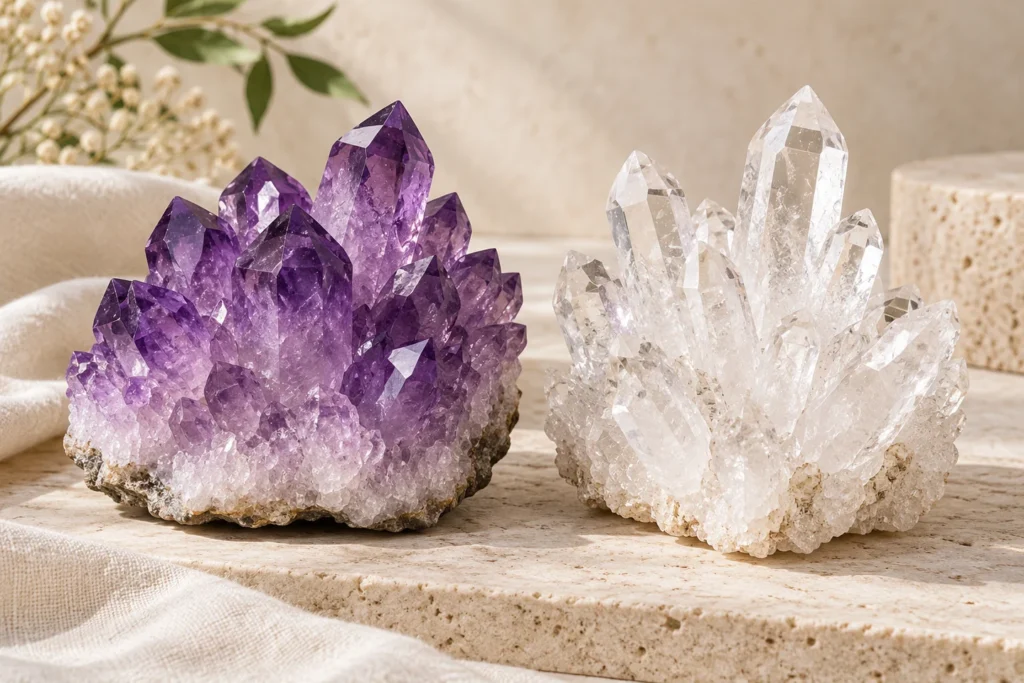
Let me start with something straightforward. Amethyst is quartz.1 It is silicon dioxide (SiO₂) with trace iron impurities and irradiation that produce its purple color.2 Clear quartz is the same mineral without those color-causing inclusions.3 Mineralogically, they are members of the same family. There is no physical or chemical incompatibility.4
The "Energy Conflict" Narrative
In metaphysical and wellness communities, some writers suggest that certain stones amplify, cancel, or interfere with each other.5 Amethyst is often described as calming, while clear quartz is called an amplifier. A small subset of content creators warn that the amplifying property of clear quartz might "overwhelm" amethyst's calming quality.
Important framing for retailers: this is a narrative preference, not a verified technical claim.6 Many other sources in the same community describe clear quartz as enhancing whichever stone it is paired with — including amethyst. There is no consensus, and there is certainly no laboratory standard.
What This Means for Procurement
From a buying standpoint, the takeaway is simple:
- There is no technical barrier to putting amethyst and clear quartz together in the same product, display, or set.
- There is a communication task. Your staff or product descriptions need a brief, believable explanation for the pairing.
- The risk is not the combination itself — it is offering a combination without a clear story.
Many buyers I work with find that a one-sentence explanation like "Amethyst and clear quartz are both quartz family stones, commonly paired for a calm, clean, balanced look" is enough to satisfy most customer questions.
What Product Forms Work Best for Amethyst and Clear Quartz Together?
Not every product form benefits equally from this pairing. A crystal tower set and a chip bracelet have different visual dynamics, price structures, and customer expectations. Choosing the right SKU format is often more important than debating whether the two stones "match."
The best product forms for an amethyst and clear quartz combination are those where color contrast is visible, the price point supports a two-stone set, and the customer can immediately understand why the two are together — such as tumble sets, display bowls, gift boxes, bracelets, and paired tower arrangements.
Bracelets and Wearables
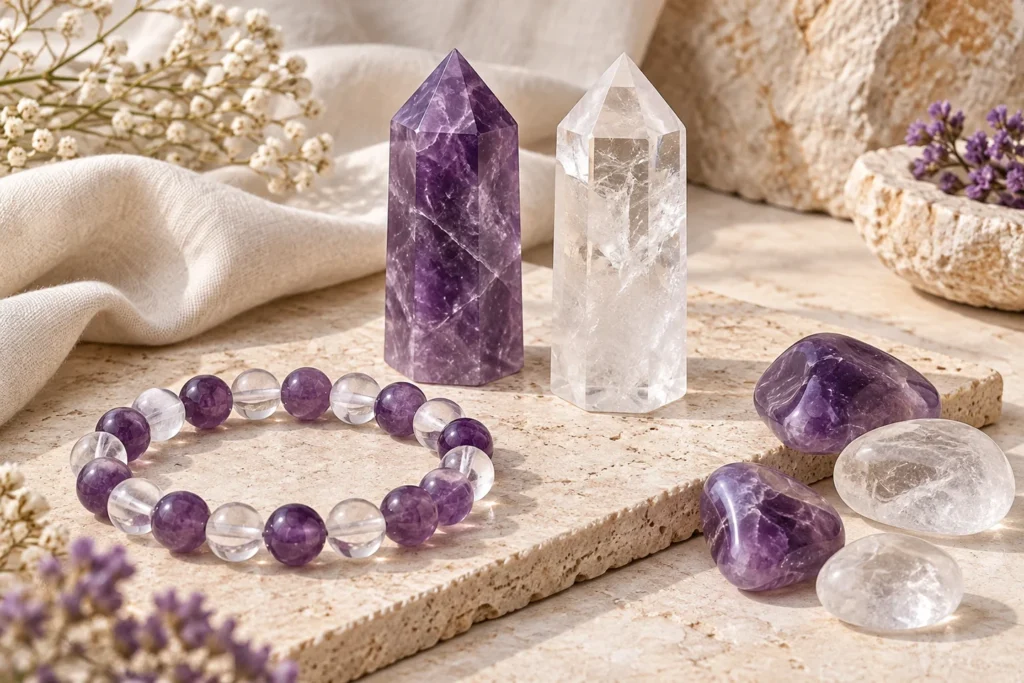
Alternating amethyst and clear quartz beads is one of the most popular bead bracelet designs in the mid-market segment. The purple-to-transparent pattern is clean, gender-neutral, and photographs well for e-commerce. Buyers should pay attention to:
- Bead grade consistency: Ensure amethyst beads have reasonably uniform saturation; mixing deep and pale amethyst beads with clear quartz can look unintentional.
- Clarity of the clear quartz: Low-grade clear quartz with heavy inclusions can read as "dirty" next to vivid amethyst. Specify your clarity expectations when requesting quotes.
- Bead size matching: Both stone types should be the same millimeter diameter in a single bracelet. This sounds obvious, but slight calibration differences between stone types do occur.
Towers and Points
Paired tower sets — one amethyst tower alongside one clear quartz tower — are a growing category for gift retail and subscription boxes. Key procurement points:
| Consideration | What to Specify |
|---|---|
| Height matching | Both towers within ±5 mm of each other |
| Base stability | Both should stand without a holder |
| Color saturation | Medium-to-deep amethyst reads better next to transparent quartz |
| Packaging | Side-by-side foam insert or shared box |
Tumbled Stones and Display Bowls
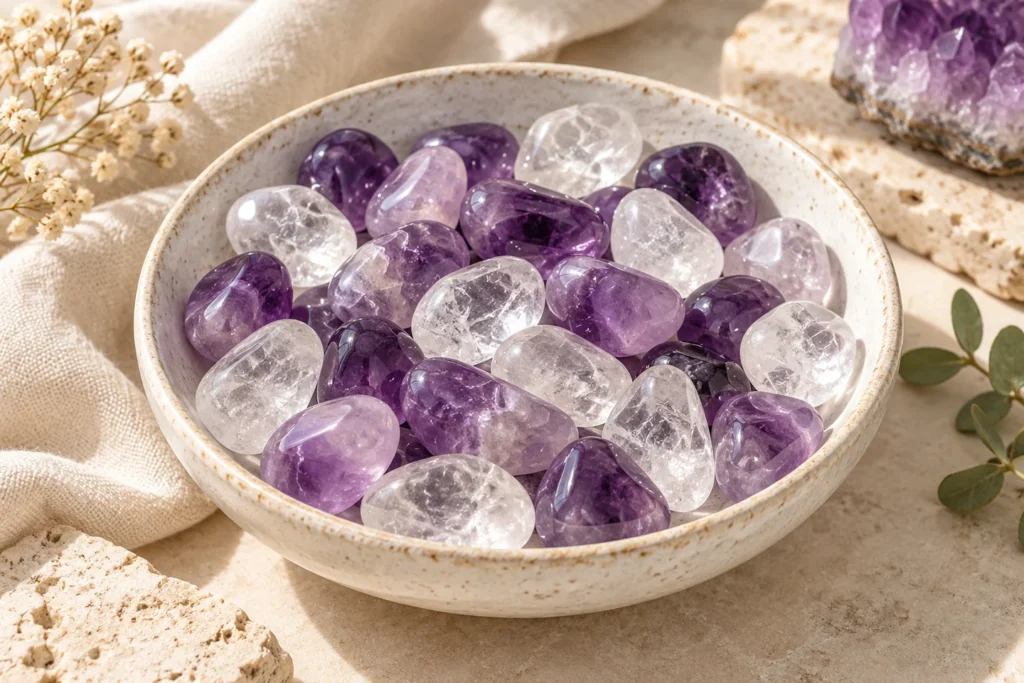
Mixed tumble bags and display bowls are a low-barrier entry product. The amethyst-and-clear-quartz combination is popular in "beginner crystal kits" and "calm and clarity" themed sets. From a merchandising perspective, this pairing also avoids the problem of too many colors competing in a small container — two-stone bowls look intentional rather than random.
Chips, Gravel, and Decorative Fills
Amethyst and clear quartz chips mixed together create a visually appealing decorative fill for candle surrounds, terrarium bases, and display trays. Buyers sourcing chips should confirm:
- Chip size range (e.g., 5–9 mm vs. 9–12 mm) — mismatched sizes look careless.
- Mix ratio — a 50/50 blend is standard, but some sellers prefer 60% amethyst / 40% clear quartz for a stronger purple impression.
- Pre-mixed vs. separate bags — ordering them separately gives you blending control; pre-mixed saves labor.
Gift Sets and Curated Kits
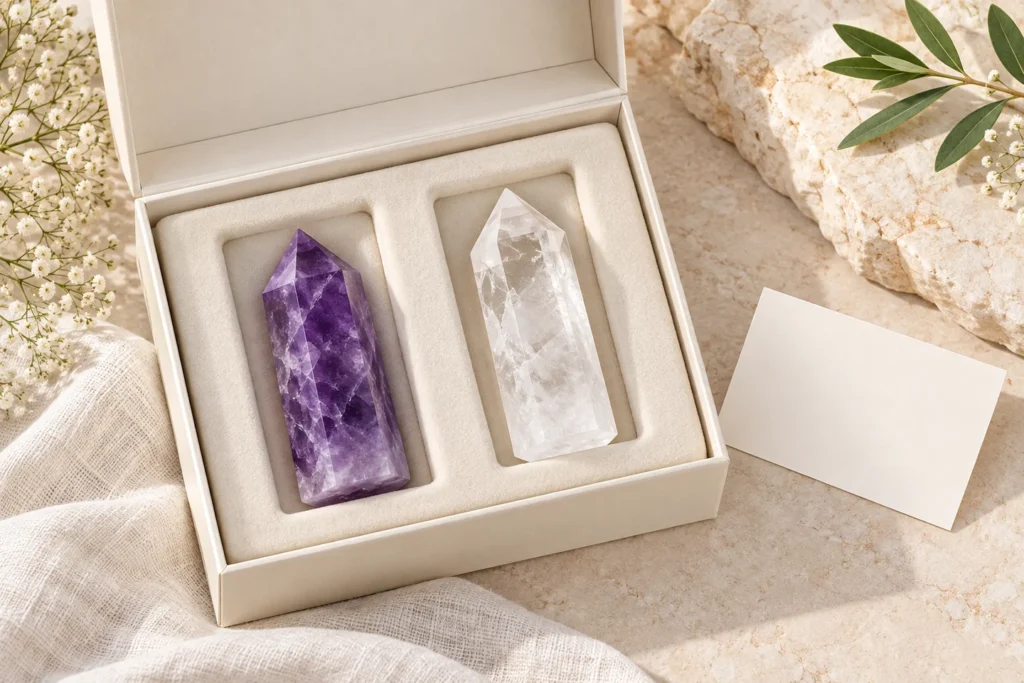
This is where the pairing shines most for brand-building retailers. A two-stone gift set with a printed card explaining the pairing can command a premium over selling the same two stones individually. The card does the communication work for you — it tells the customer why these two stones are together, so your staff does not need to answer the "can they go together?" question at checkout.
How Should You Explain This Pairing to Your Customers?
The biggest sales risk with any crystal pairing is not the pairing itself — it is a weak or forced story. If your product card says "these two stones create unstoppable cosmic synergy," some customers will love it, but many others will find it unbelievable. If your card says nothing at all, customers who are uncertain will hesitate.
A simple, honest explanation works best.7 Frame the amethyst and clear quartz pairing around visual harmony, the quartz family connection, and a general theme that your target market relates to. Avoid promising specific outcomes.8
Effective Explanation Approaches
Here are framing options that many crystal retailers use successfully. Choose the one that fits your brand voice:
- Mineralogical family angle: "Amethyst and clear quartz are both members of the quartz family. Pairing them together is a natural combination — like siblings in a set."
- Color and design angle: "The deep purple of amethyst paired with the transparency of clear quartz creates a calm, balanced, and visually clean arrangement."
- General theme angle: "Many crystal enthusiasts associate amethyst with calm and clear quartz with clarity. Together, they make a popular pairing for those drawn to both qualities."
Notice what these have in common: they describe what people associate with the stones, not what the stones medically or scientifically do. Phrases like "many enthusiasts associate," "commonly paired for," and "a popular choice among" are accurate without overpromising.
What to Avoid
| ❌ Avoid | ✅ Better Alternative |
|---|---|
| "Clear quartz amplifies amethyst's healing power" | "Clear quartz is often described as complementing amethyst in a set" |
| "This combination will reduce anxiety" | "Many customers choose this pairing for a calming visual theme" |
| "These stones must always be together" | "These stones are frequently paired and work well as a set" |
| "Scientifically proven to balance energy" | "A popular combination among crystal collectors" |
Translating the Story into Product Descriptions
For e-commerce sellers, the explanation goes straight into your listing copy. For brick-and-mortar retailers, it goes on shelf cards, product tags, or staff training sheets. The format changes, but the principle is the same: give the customer just enough context to feel good about the purchase, without making claims you cannot support.
What Should B2B Buyers Consider When Sourcing This Combination?
Once you have decided to stock amethyst and clear quartz together, the procurement side has its own set of practical questions. The pairing decision is a merchandising judgment; the sourcing decision is an operational one.
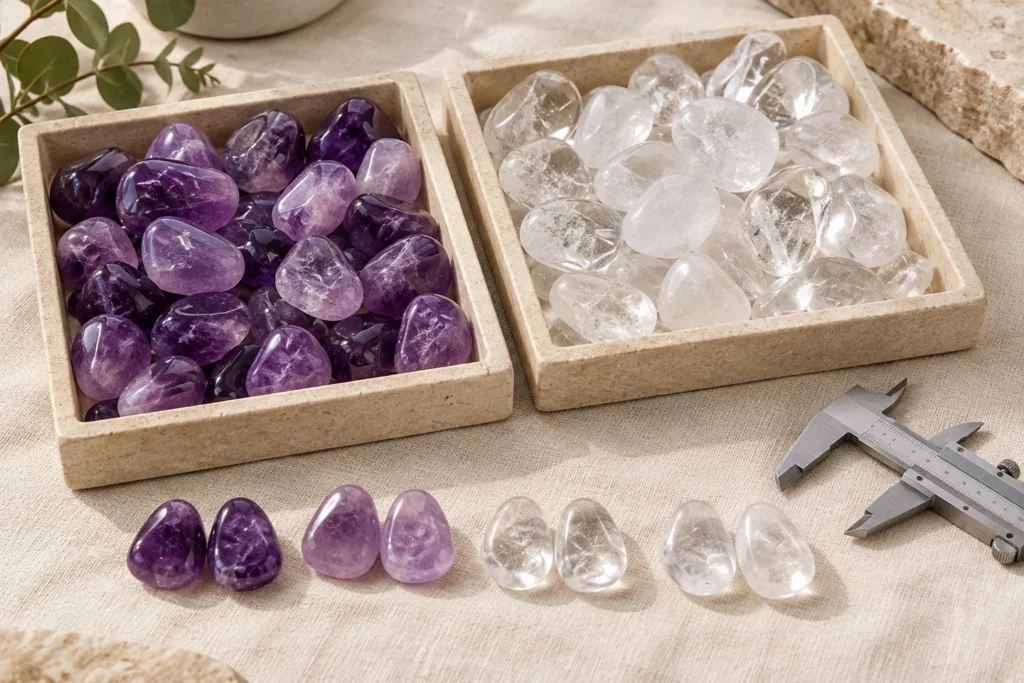
For B2B buyers sourcing amethyst and clear quartz as a paired product, the main considerations are grade consistency between the two stones, visual matching within a batch, MOQ and mix flexibility, packaging design, and the supplier's ability to fulfill reorders with similar quality.
Grade and Visual Consistency
This is the most common issue I see in paired sourcing. Amethyst and clear quartz are graded differently. A buyer might order "A grade" for both, but the visual result can be inconsistent because the grading criteria emphasize different features for each stone (color saturation for amethyst, clarity and transparency for clear quartz).9
My recommendation: rather than relying solely on grade labels, request approval photos or sample batches before committing to a large order. Confirm that the specific amethyst lot and the specific clear quartz lot look good side by side, not just individually.
MOQ and Mix Flexibility
Some suppliers require separate MOQs for each stone type. Others allow mixed-stone orders where amethyst and clear quartz count toward the same MOQ. This matters if you want to order a smaller trial quantity of a paired set before scaling up.
At GD Crystal, we are open to discussing mixed-stone MOQs and trial order conditions for buyers evaluating new combinations. The key is to communicate your intended product form and pairing early in the inquiry, so we can advise on what is practical for both sides.
Packaging for Paired Products
If you want the two stones delivered as a ready-to-sell set (e.g., a two-tower gift box), you will need to specify packaging requirements at the sourcing stage. Key details include:
- Box or pouch type — shared box, individual wrapping within a shared box, or separate pouches bundled together
- Insert or card — whether you provide the print file or need the supplier to accommodate a card insert
- Labeling — any stone identification or SKU labeling on or inside the packaging
Planning packaging at the procurement stage — rather than repackaging after import — saves labor cost and speeds up your go-to-market timeline.
Reorder Consistency
Paired products create an implicit visual promise. If your first batch has deep purple amethyst and your reorder arrives with pale lavender, the set looks different — and your repeat customers will notice. Specify your color and clarity expectations in writing, and ask for batch photos before each shipment. Natural stone will always have variation10, but establishing a visual standard upfront reduces surprises.
Frequently Asked Questions
Is there a scientific reason amethyst and clear quartz should not be together?
No. Amethyst is a variety of quartz — they share the same mineral composition (SiO₂). There is no chemical, physical, or geological reason they cannot be placed, stored, displayed, or sold together. Concerns about "energy conflict" are part of metaphysical belief systems, not verified scientific claims.
What is the most popular product form for this pairing?
Beaded bracelets with alternating amethyst and clear quartz beads are the single most requested paired product form in our experience. Tumbled stone sets, paired towers, and curated gift kits are also strong sellers, especially for shops that serve beginners or gift buyers.
Can I mix amethyst and clear quartz in a single wholesale order?
Yes, many suppliers — including GD Crystal — can accommodate mixed-stone orders. The key is to specify the product form, size range, grade expectations, and whether you need the stones pre-paired or shipped separately. Discussing this upfront helps avoid MOQ or packaging complications.
How should I price an amethyst and clear quartz set compared to individual stones?
A curated set typically commands a 15–30% premium over selling the two stones individually11, depending on packaging quality and brand positioning. The added value comes from the curation, the pairing story, and the convenience — not from the raw material cost alone.
Do I need to disclose that amethyst is a type of quartz?
It is not legally required in most markets, but transparency builds trust.12 Many successful crystal brands include a brief note like "Both stones belong to the quartz mineral family" on their product card. This educates the customer, reinforces the pairing logic, and positions your brand as knowledgeable.
Conclusion
Putting amethyst and clear quartz together is not only safe — it is one of the most commercially sound crystal pairings available. The two stones share a mineral family, create strong visual contrast, and fit naturally into a wide range of product forms from bracelets to gift sets. The real challenge is not whether to pair them, but how to present the combination with a clear, believable story and how to source them with consistent quality across batches.
If you are a retailer, e-commerce seller, or crystal brand exploring whether amethyst and clear quartz belong in your product line together, the answer is a practical yes. Focus your energy on choosing the right product form, establishing a visual standard, and writing honest product descriptions.
At GD Crystal, we work with buyers to source amethyst, clear quartz, and other crystal products with the flexibility to discuss paired sets, mixed-stone MOQs, and custom packaging. If you are considering this combination for your store or brand, reach out with your product idea and quantities — we are happy to share current availability and provide approval photos so you can evaluate the pairing before you commit.
References
- "Quartz", https://en.wikipedia.org/wiki/Quartz. A mineralogical reference identifies amethyst as the violet or purple variety of quartz, supporting the statement that amethyst belongs to the quartz mineral group. Evidence role: definition; source type: encyclopedia. Supports: A neutral mineralogical source should confirm that amethyst is a purple variety of quartz.. ↩
- "An Introduction to Gem Treatments", https://www.gia.edu/gem-treatment. Gemological literature describes amethyst as SiO₂ quartz whose purple color is produced by iron-related color centers formed or modified by irradiation. Evidence role: mechanism; source type: education. Supports: A gemological or mineralogical source should explain that quartz is SiO₂ and that amethyst coloration is linked to iron-related color centers affected by irradiation.. Scope note: The source may explain the accepted mechanism generally rather than testing the specific stones discussed in the article. ↩
- "Quartz", https://en.wikipedia.org/wiki/Quartz. Mineralogical references classify both colorless quartz and amethyst within the quartz species, with amethyst distinguished by its purple coloration. Evidence role: definition; source type: encyclopedia. Supports: A mineral reference should support that clear quartz and amethyst are both quartz, differentiated primarily by coloration.. Scope note: This supports the mineral-family comparison but does not evaluate commercial quality differences between individual specimens. ↩
- "Quartz | Common Minerals – University of Minnesota", https://commonminerals.esci.umn.edu/minerals-o-s/quartz. Geological references list quartz as silicon dioxide with consistent physical properties across common varieties, providing general support for the absence of a mineralogical incompatibility between amethyst and clear quartz. Evidence role: general_support; source type: government. Supports: A geological source should confirm that quartz varieties share the same basic composition and physical properties, making ordinary contact between amethyst and clear quartz unproblematic.. Scope note: The source would support ordinary storage and display compatibility, not every possible industrial or chemical exposure condition. ↩
- "The role of performance in enhancing the effectiveness …", https://pubmed.ncbi.nlm.nih.gov/23206175/. Studies and reference works on crystal healing describe a belief system in which stones are attributed energetic or symbolic properties, contextualizing customer concerns about interactions between crystals. Evidence role: historical_context; source type: research. Supports: A neutral descriptive source should document that crystal healing traditions attribute energetic or symbolic properties to stones.. Scope note: Such sources document the existence of the belief rather than validating the claimed energetic effects. ↩
- "Placebo effects in alternative medical treatments for anxiety", https://pmc.ncbi.nlm.nih.gov/articles/PMC13064771/. Scientific discussions of crystal healing generally find insufficient empirical evidence for specific therapeutic or energetic mechanisms, supporting the characterization of crystal energy-conflict claims as unverified. Evidence role: expert_consensus; source type: paper. Supports: A scientific or medical source should indicate that crystal healing claims lack robust empirical support and are generally not accepted as established technical mechanisms.. Scope note: This does not disprove individual spiritual interpretations; it addresses the absence of verified technical evidence. ↩
- "The Influence of Price Transparency on Consumer Perceptions", https://digitalcommons.bryant.edu/cgi/viewcontent.cgi?article=1051&context=honors_marketing. Consumer-behavior research links transparent product information with higher perceived credibility and trust, providing contextual support for using simple and honest explanations in product copy. Evidence role: general_support; source type: paper. Supports: Consumer-behavior research should support that transparent and credible product information is associated with trust or purchase confidence.. Scope note: The evidence is likely general to consumer communication and may not be specific to crystal retail. ↩
- "FTC Policy Statement Regarding Advertising Substantiation", https://www.ftc.gov/legal-library/browse/ftc-policy-statement-regarding-advertising-substantiation. Advertising regulators state that objective health-related claims require competent and reliable evidence, supporting caution against promising specific outcomes for crystal products. Evidence role: expert_consensus; source type: government. Supports: A regulator should explain that objective health or therapeutic claims in advertising require adequate substantiation.. Scope note: Regulatory details vary by jurisdiction, so the source provides a general compliance rationale rather than market-specific legal advice. ↩
- "Amethyst Quality Factors", https://www.gia.edu/amethyst-quality-factor. Gemological education sources describe amethyst quality in terms that emphasize purple color strength and evenness, while colorless quartz is commonly discussed through clarity and transparency. Evidence role: general_support; source type: education. Supports: A gemological source should support that amethyst value or quality is strongly tied to color, while colorless quartz is assessed more visibly through clarity and transparency.. Scope note: Commercial grading labels are not universally standardized, so the source supports the general evaluation criteria rather than a single global grading system. ↩
- "Inclusions in Gemstones", https://www.gia.edu/gems-gemology/summer-2022-colored-stones-unearthed. Gemological references explain that natural stones commonly vary in color, inclusions, and clarity, supporting the expectation of batch-to-batch visual variation. Evidence role: general_support; source type: education. Supports: A geological or gemological source should confirm that natural minerals and gemstones vary in color, inclusions, and appearance.. Scope note: This supports the general principle of natural variability, not the degree of variation in any particular supplier batch. ↩
- "Factors Forming the Consumers' Willingness to Pay a Price …", https://pmc.ncbi.nlm.nih.gov/articles/PMC6427680/. Research on product bundling and perceived value shows that curated combinations can increase consumer willingness to pay relative to separately presented items, providing contextual support for a set premium. Evidence role: statistic; source type: paper. Supports: A pricing or consumer-behavior source should support that product bundling or curated sets can increase perceived value or willingness to pay.. Scope note: The source may support bundling premiums generally rather than verifying the article’s specific 15–30% range for crystal sets. ↩
- "Navigating Brand Trust in Modern Marketing", https://som.yale.edu/story/2023/navigating-brand-trust-modern-marketing. Marketing research associates brand or product-information transparency with increased consumer trust, supporting the claim that clear disclosure can strengthen customer confidence. Evidence role: general_support; source type: paper. Supports: A peer-reviewed marketing or consumer-behavior study should support the relationship between transparency and consumer trust.. Scope note: The evidence is general to consumer markets and does not specifically measure trust in crystal retail. ↩