Choosing the best quartz for jewelry is one of the most common questions I hear from B2B buyers — and it's almost always the wrong question to start with. The real issue isn't which variety tops a ranking. It's which quartz fits your specific jewelry format, target customer, price band, and reorder needs. A mismatch here means dead stock, returns, or margin erosion.
There is no single "best" quartz for jewelry. The best choice depends on the jewelry type you're producing or sourcing (beads, pendants, rings, earrings), your target retail customer, the price point you need to hit, treatment disclosure requirements, and whether the supplier can deliver consistent batches for replenishment. Clear quartz, amethyst, rose quartz, citrine, smoky quartz, and rutilated quartz are all strong candidates — each for different reasons and different product strategies.
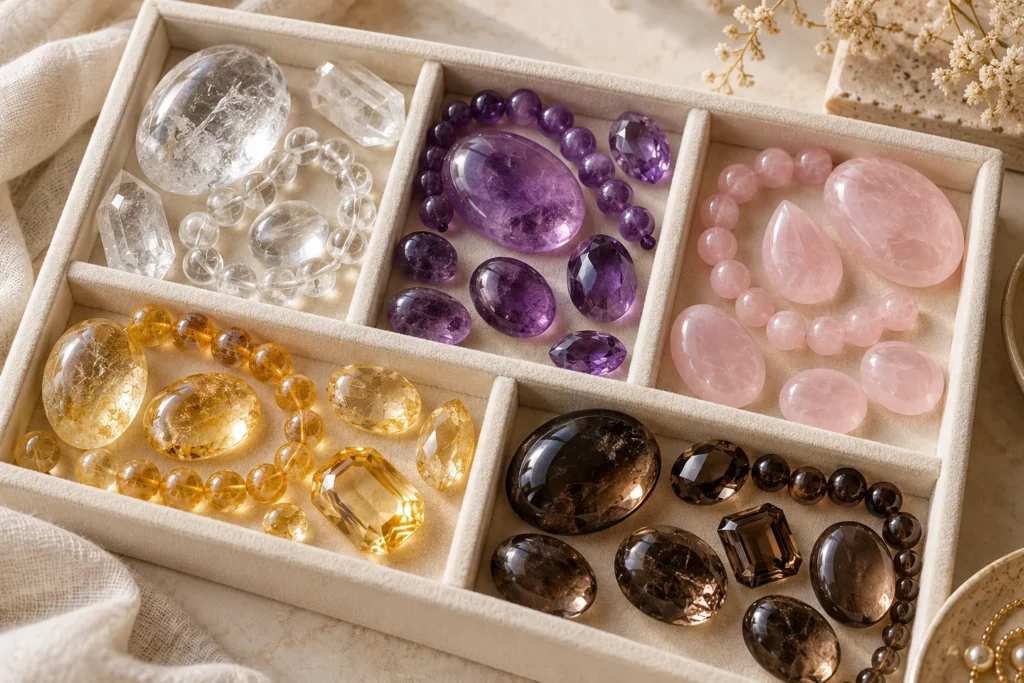
The challenge is that "best" means something completely different depending on whether you sell beaded bracelets on Etsy or stock cabochon pendants in a brick-and-mortar crystal shop. Below, I'll break down how to evaluate quartz for jewelry by use case, variety, sourcing risk, and treatment transparency — all from the supplier side of the conversation.
Why Does the Jewelry Type Change Which Quartz Is Best?
Most buyers come to us with a favorite quartz variety in mind but haven't fully considered how the jewelry format shapes their sourcing requirements. A beautiful rutilated quartz cabochon that looks stunning in a pendant can be a nightmare in a drilled bead bracelet. The format dictates the specs.
The jewelry type determines the critical quality parameters — size consistency, drilling precision, weight, durability, and pair matching — which in turn narrow down which quartz varieties are practical, cost-effective, and replenishable for your product line.
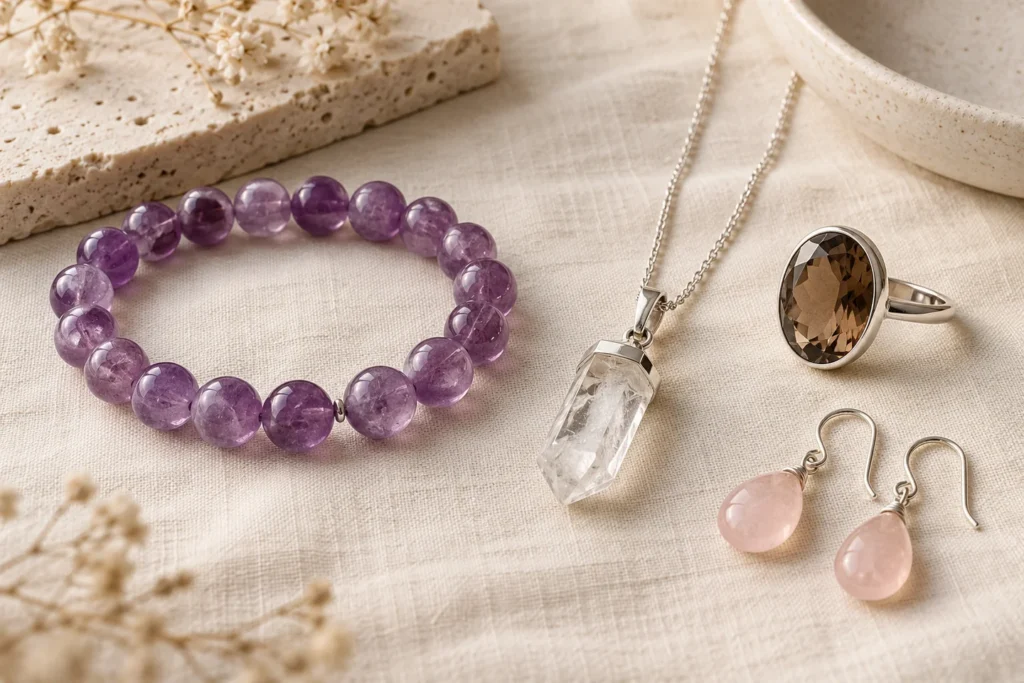
Beads and Bracelets
Beaded bracelets are the highest-volume quartz jewelry category I see in B2B orders. They're also where batch consistency matters most. When a buyer reorders 500 strands of 8mm rose quartz beads and the new batch is noticeably lighter or darker than what their customers already own, the complaints start immediately.
For beads and bracelets, the "best" quartz is one where:
- Color consistency across a production batch is achievable
- Size tolerance is tight (e.g., ±0.3mm on bead diameter)
- Drilling quality is clean, centered, and free of chips
- Replenishment is reliable — the material must be available in steady supply
- Price per strand fits the retail margin after shipping and packaging
Varieties like clear quartz, rose quartz, amethyst, and smoky quartz work well here because the raw material supply is relatively stable and color grading within a batch is manageable. Rutilated quartz beads are popular for differentiation but require more sorting — every bead looks different, which can be a selling point or a quality-control headache depending on your customer expectations.
Pendants and Necklaces
Pendants shift the evaluation toward visual impact and individuality. A pendant is a single focal piece, so buyers often want more dramatic inclusions, higher clarity, or unique color zoning. This is where varieties like garden quartz (phantom quartz), rutilated quartz, and high-clarity amethyst points shine.
Key sourcing considerations for pendants include:
| Factor | What to Evaluate |
|---|---|
| Visual appeal | Clarity, inclusion patterns, color depth |
| Shape and cut | Cabochon, faceted, free-form, point |
| Setting compatibility | Flat back for bezel, drilled for bail, wire-wrap friendly |
| Weight | Affects shipping cost and wearability |
| Price per piece | Higher unit cost acceptable if visual value supports retail markup |
Rings
Rings demand the most caution. Quartz sits at 7 on the Mohs hardness scale1 — adequate for jewelry but not invulnerable. Ring stones face daily impact, abrasion, and exposure.2 I always suggest buyers consider whether the setting design protects the stone adequately. A bezel-set smoky quartz is far more practical than a high-prong clear quartz for everyday wear.
For ring applications, faceted clear quartz, amethyst, and citrine are the most common choices because they offer good optical performance and are available in calibrated sizes that fit standard ring settings.
Earrings
Earrings introduce weight control and pair matching as the dominant constraints. Heavy stones cause discomfort and returns. Mismatched pairs — in color, size, or inclusion pattern — look unprofessional at retail.
Lighter quartz varieties or smaller calibrated stones work best. Rose quartz, amethyst, and clear quartz in 6–10mm rounds or small drops are reliable earring staples. If you're sourcing hand-carved quartz earrings, expect higher per-pair sorting time and cost.
Which Quartz Varieties Should B2B Jewelry Buyers Consider?
With dozens of quartz varieties on the market, buyers often feel overwhelmed. The temptation is to chase whatever is trending on social media. But trend-chasing without considering supply stability, price sustainability, and your brand positioning can lead to sourcing dead ends.
Rather than ranking quartz varieties from "best" to "worst," it's more useful to categorize them by their commercial role in a jewelry product line: foundational staples, recognizable color sellers, and differentiation pieces.
Foundational Staples
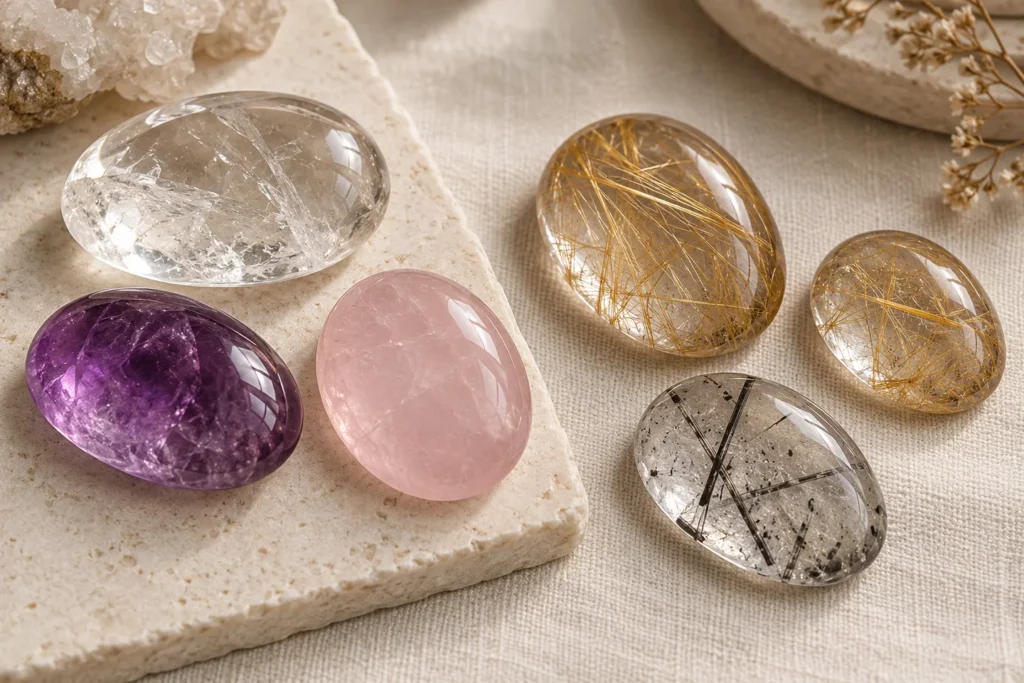
Clear quartz (rock crystal) is the most versatile quartz for jewelry. It pairs with any metal color, suits every jewelry format, and is consistently available in large quantities. From a sourcing perspective, clear quartz offers the most predictable supply and the lowest raw material cost — but it also has the slimmest retail margin unless you add value through cuts, shapes, or design.
Sourcing tip: Clear quartz quality varies enormously. "Clear" can mean anything from ice-transparent AAA grade to cloudy material with visible fractures. Always confirm the grade standard your supplier uses and request current batch photos.
Recognizable Color Sellers
These are the quartz varieties that customers recognize by name and color. They are the workhorses of most crystal jewelry lines:
| Variety | Color | Key Strength | Common Jewelry Use |
|---|---|---|---|
| Amethyst | Purple (light to deep) | High brand recognition, wide price range | Beads, pendants, rings, earrings |
| Rose quartz | Pink (pale to medium) | Emotional appeal, strong demand | Beads, bracelets, hearts, pendants |
| Citrine | Yellow to orange-brown | Warm tones, retail-friendly name | Faceted rings, pendants, beads |
| Smoky quartz | Brown to grey-black | Neutral palette, pairs with silver | Pendants, faceted stones, beads |
A few important notes from the supplier side:
- Citrine in the market is frequently heat-treated amethyst. Natural citrine exists but is less common and typically lighter in color.3 This matters for your product descriptions and customer trust. If you're unsure about treatment status, request documentation or consider third-party testing.
- Rose quartz in bead form almost always appears translucent to opaque. Transparent rose quartz (sometimes called "pink quartz" in gemological contexts) is rare and significantly more expensive.4 Know which you're buying.
- Amethyst color depth varies by source region and batch.5 Deep "Uruguayan" colors command higher prices than lighter "Bahian" tones, but color-grade naming isn't standardized across suppliers. Always confirm with photos of the actual batch.
Differentiation Pieces
These varieties help a jewelry brand stand out from competitors who all carry the same amethyst and rose quartz basics:
- Rutilated quartz — Golden or silver needle-like inclusions create unique, one-of-a-kind patterns.6 Excellent for pendants and statement rings. Sourcing challenge: every piece is different, so batch uniformity is inherently limited. Buyers should expect to sort or accept mixed inclusion density.
- Garden quartz / phantom quartz — Green, brown, or multi-colored inclusions resembling landscapes or "gardens" inside the crystal. Growing in popularity on social media. Higher visual uniqueness supports higher retail prices but also means more variation per batch.
- Strawberry quartz — Reddish inclusions (typically lepidocrocite or goethite) in a translucent quartz matrix.7 Buyer caution: the name "strawberry quartz" is used loosely in the market, and some material sold under this name may be dyed or may be a different mineral entirely. Verify material composition if accuracy matters to your brand.
- Tourmalinated quartz — Black tourmaline needles in clear quartz.8 Visually striking, moderate availability.
For differentiation pieces, I recommend B2B buyers start with small trial orders to test customer reception before committing to large quantities. These materials often have less predictable replenishment cycles than staple varieties.
What Are the Real Sourcing Risks When Choosing Quartz for Jewelry?
The biggest risk in quartz jewelry sourcing isn't choosing the "wrong" variety. It's making purchasing decisions based on incomplete information — buying from a photo without confirming grade, treatment, batch variation, size tolerance, drilling quality, MOQ, and replenishment feasibility.
The real sourcing risks for B2B quartz jewelry buyers are grade misalignment (what you see in photos vs. what ships), undisclosed treatments (heat, dye, coating), batch inconsistency between orders, dimensional tolerance failures (beads that don't fit settings or string properly), and supply discontinuity (a variety you build a product line around that suddenly becomes unavailable or jumps in price).
Grade and Photo Discrepancies
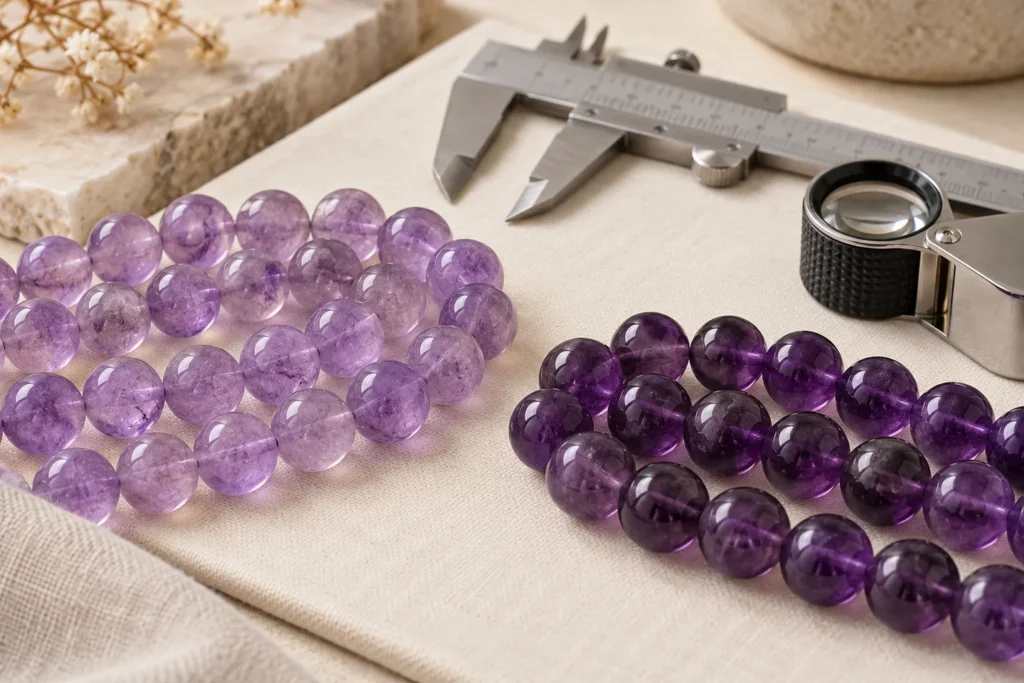
In my experience, the most frequent complaint from first-time buyers is that the delivered product doesn't match the photos they approved. This happens because:
- Sample photos may represent the best pieces from a previous batch, not the average quality of the current batch
- Grading terminology (AAA, AA, A, AB) is not standardized across the quartz industry9 — one supplier's "AA" can be another's "A"
- Lighting and photography dramatically affect how quartz appears, especially for transparent and translucent varieties
What helps: Request photos and/or video of the actual current batch you'd be purchasing from. Discuss grading criteria explicitly — clarity percentage, inclusion tolerance, color range. If possible, order a small sample lot before committing to a large order.
Treatment and Disclosure
Treatment disclosure is not just an ethical issue. It's a commercial risk management issue.10 If your end customers discover that your "citrine" is heat-treated amethyst and you didn't disclose it, you face returns, negative reviews, and brand damage.
Common treatments in quartz jewelry materials include:
| Treatment | Varieties Affected | What to Know |
|---|---|---|
| Heat treatment | Citrine (from amethyst), smoky quartz, some amethyst | Very common, industry-accepted, but should be disclosed |
| Dyeing | Various "aura" quartz, some colored agates sold as quartz | Affects durability, color permanence, and customer trust |
| Irradiation | Some smoky quartz | Can produce deep colors that may not occur naturally at stated origin11 |
| Coating | "Aura" or "angel aura" quartz | Surface coating can wear off; not a permanent treatment |
Important: I share this from our processing and wholesale experience, not as a gemological authority. For definitive identification and treatment verification, especially for higher-value lots, I recommend buyers use accredited gemological laboratories. This protects both your business and your customers.
Batch Consistency and Replenishment
Building a jewelry product line around a quartz variety that can't be consistently resupplied is a strategic error I've watched buyers make multiple times. Natural materials inherently vary. But some varieties vary more than others.
Higher consistency (easier to reorder): Clear quartz, amethyst, rose quartz, smoky quartz
Lower consistency (expect variation): Rutilated quartz, phantom quartz, strawberry quartz, rare inclusion types
If consistent replenishment is critical to your business — for example, you run a subscription box or maintain a "signature" bracelet line — build your core offering around the high-consistency materials and use the variable ones as limited editions or seasonal specials.
How Should B2B Buyers Evaluate a Quartz Jewelry Supplier?
Finding the right quartz variety is only half the equation. The supplier you work with determines whether that variety actually arrives in your warehouse at the right quality, price, and timeline. Supplier evaluation for quartz jewelry components involves specific checkpoints that go beyond a nice website and low prices.
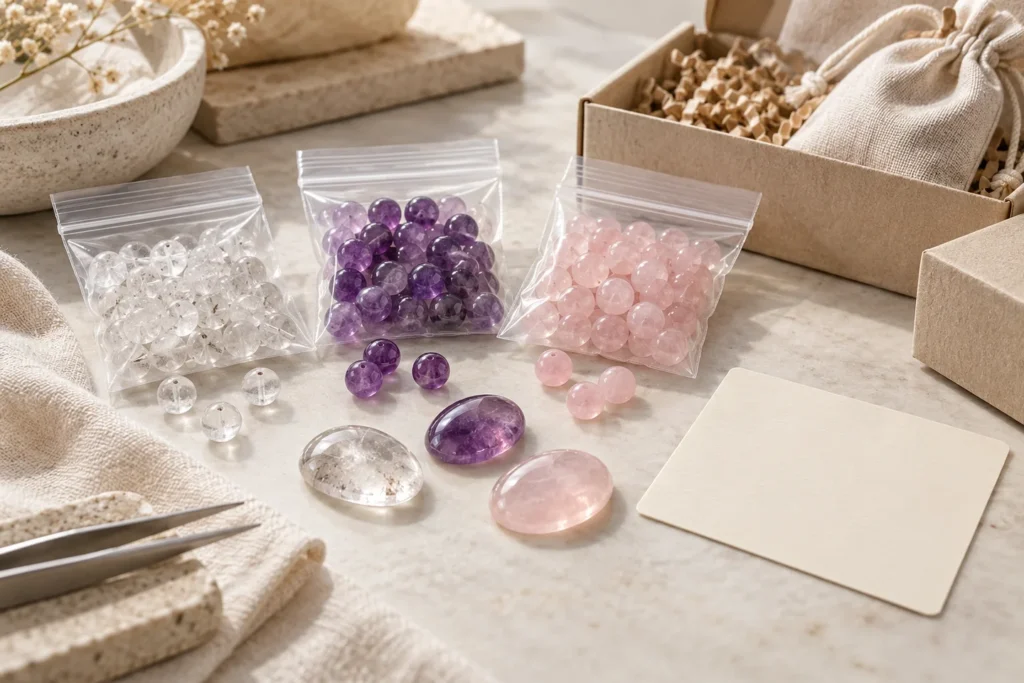
B2B buyers should evaluate quartz jewelry suppliers on product photo authenticity (current batch photos, not stock images), transparent grading and treatment communication, sample availability, MOQ flexibility for trial orders, dimensional and drilling tolerances, packaging quality for transit, and communication responsiveness when issues arise.
Key Evaluation Criteria
Here's a practical checklist I recommend based on the questions our buyers typically ask during first conversations:
- Can I see photos of the current batch? — Not catalog photos, not old photos. The actual inventory or production batch available now.
- What is the grading system? — How does the supplier define their quality tiers? Can they explain the difference between their grades?
- What treatments have been applied? — A trustworthy supplier will disclose known treatments. If they can't answer, that's a red flag.
- What are the size tolerances? — For beads: diameter tolerance, hole size, hole centering. For cabochons: calibrated vs. free-size.
- What is the MOQ, and is a trial order possible? — First-time buyers should be able to test before committing to large volumes.
- What happens if there's a quality issue? — Understanding the resolution process before it's needed prevents painful surprises later.
- Can they replenish this material? — If you reorder in 3 months, will comparable quality be available?
The Communication Test
Beyond specifications, I believe the quality of communication during the inquiry phase tells you a lot about the long-term working relationship. A supplier who asks detailed questions about your requirements — jewelry type, target size, color preference, treatment tolerance, packaging needs — is more likely to deliver what you actually need than one who simply quotes the lowest price.
Frequently Asked Questions
Is quartz durable enough for everyday jewelry?
Quartz rates 7 on the Mohs hardness scale, making it suitable for most jewelry types. However, rings and bracelets face more daily wear. Protective settings like bezels help. For high-wear applications, discuss stone thickness and setting design with your jewelry manufacturer to minimize chipping risk.
What is the most popular quartz for jewelry resale?
Amethyst, rose quartz, and clear quartz are consistently the highest-volume quartz varieties in B2B jewelry orders. They offer strong name recognition, broad color appeal, and reliable supply. Citrine and smoky quartz follow closely, particularly in faceted jewelry and autumn-themed collections.
How can I tell if quartz has been treated or dyed?
Visual inspection alone is often insufficient for confirming treatments. Very saturated or uniform colors in varieties that naturally show variation can be an indicator. For commercial assurance, request treatment disclosure from your supplier and consider third-party gemological testing for high-value or treatment-sensitive product lines.
Should I source quartz beads or finished quartz jewelry?
This depends on your business model. Sourcing loose beads, cabochons, or drilled stones gives you flexibility to assemble your own designs and control quality at each step. Sourcing finished jewelry saves time but reduces customization. Many of our buyers start with loose components and move to custom-finished pieces as their product line matures.
What MOQ should I expect for quartz jewelry components?
MOQ varies significantly by product type, variety, and supplier. Common bead strands may have lower MOQs (sometimes 5–20 strands per variety), while custom-cut or calibrated stones may require larger commitments. Always confirm MOQ, mixed-variety options, and trial order policies before committing.
Conclusion
The best quartz for jewelry is never a universal answer — it's the variety that aligns with your jewelry format, customer expectations, price strategy, treatment disclosure comfort, and supply reliability. Clear quartz, amethyst, rose quartz, citrine, smoky quartz, and inclusion varieties like rutilated quartz all serve different commercial roles. The real competitive advantage comes from understanding those roles and sourcing accordingly, not from chasing a single "best" stone name.
At GD Crystal, we work with B2B buyers every day to navigate exactly these decisions — matching quartz varieties to jewelry applications, discussing batch quality and treatment transparency, and supporting trial orders that reduce procurement risk. If you're building or expanding a quartz jewelry line and want to discuss product selection, reach out to our team for a consultation and current batch availability.
References
- "More than the Mohs Scale | Understanding Gem Durability", https://4cs.gia.edu/en-us/blog/more-than-mohs-scale-gem-durability/. Gemological and mineralogical references list quartz at Mohs hardness 7, supporting its use as a mid-to-hard jewelry material; hardness does not by itself establish resistance to chipping or breakage. Evidence role: definition; source type: education. Supports: A neutral gemological or mineralogical source should confirm that quartz is rated 7 on the Mohs hardness scale.. Scope note: The source supports hardness, not overall durability in every jewelry setting. ↩
- "Buying Guide: Colored Gemstone Engagement Rings", https://4cs.gia.edu/en-us/blog/colored-gemstone-engagement-rings-buying-guide/. Gemological durability guidance commonly treats rings as high-wear jewelry because stones are exposed to frequent contact, abrasion, and impact during daily use; this supports the article's caution but does not quantify return or damage rates for quartz rings. Evidence role: mechanism; source type: education. Supports: A gemological education source should explain that rings are exposed to abrasion and impact in normal wear, making hardness, toughness, and setting protection relevant.. Scope note: The support is contextual durability guidance rather than a quartz-specific failure-rate study. ↩
- "Citrine Gemstone | Natural Citrine Stone", https://www.gia.edu/citrine. Gemological references describe much commercial citrine as heat-treated amethyst and note that natural citrine is comparatively uncommon, supporting the need for treatment-aware product descriptions; the source may not provide a precise percentage for the current market. Evidence role: expert_consensus; source type: education. Supports: A gemological source should support that heat treatment of amethyst can produce citrine colors and that natural citrine is comparatively uncommon.. Scope note: The source is likely to support prevalence qualitatively rather than with current market-share statistics. ↩
- "Rose Quartz Description", https://www.gia.edu/rose-quartz-description. Gemological sources distinguish common translucent rose quartz from rarer transparent pink quartz occurrences, supporting the article's warning that visually similar trade names can describe materials of different rarity and value; pricing differences still depend on size, quality, and market conditions. Evidence role: definition; source type: education. Supports: A gemological source should explain the distinction between typical rose quartz and rarer transparent pink quartz material.. Scope note: The source can support rarity and terminology, but not a universal price premium. ↩
- "Amethyst Quality Factors", https://www.gia.edu/amethyst-quality-factor. Gemological references describe amethyst as occurring in a range of purple hues and saturation levels, with locality and crystal growth conditions contributing to variation; this supports the article's sourcing caution without proving that every named regional trade grade is standardized. Evidence role: general_support; source type: education. Supports: A gemological reference should support that amethyst occurs in a range of purple tones and that locality and geologic conditions can affect appearance.. Scope note: The support is general to amethyst color variation and may not validate specific trade labels used by suppliers. ↩
- "Varieties of Rutilated Quartz – Tucson 2014", https://www.gia.edu/gems-gemology/spring-2014-gemnews-tucson-rutilated-quartz. Mineralogical references define rutilated quartz as quartz containing acicular rutile inclusions, often visible as needle-like internal features; this supports the material description but not any specific retail demand claim. Evidence role: definition; source type: encyclopedia. Supports: A mineralogical or gemological reference should define rutilated quartz as quartz containing needle-like rutile inclusions.. Scope note: The source supports the inclusion description, not the commercial popularity of the material. ↩
- "Pink Aventurine Quartz with Alurgite Inclusions", https://www.gia.edu/gems-gemology/fall-2021-gemnews-pink-aventurine-quartz-algurite-inclusions. Gemological discussions of strawberry quartz describe red-to-pink quartz materials whose color may derive from included iron-bearing minerals such as lepidocrocite or goethite, while also noting inconsistent trade usage; this supports the article's identification caution rather than proving that all sold material has the same composition. Evidence role: definition; source type: research. Supports: A gemological source should explain that materials sold as strawberry quartz may owe their red appearance to mineral inclusions and that the trade name can be inconsistently applied.. Scope note: The support is contextual because the trade name can cover different materials. ↩
- "Black Tourmalinated Quartz 6mm Round Faceted Gemstone", https://www.riogrande.com/product/black-tourmalinated-quartz-round-faceted-stones/79245GP/?srsltid=AU7gw4U8pXRIKOLebBMYgSPcvmYeLyr4BOr71qM3FZNOzH7skPpU3C6J. Mineralogical references describe tourmalinated quartz as quartz containing tourmaline inclusions, commonly black acicular schorl, supporting the article's identification of this variety; the source does not establish supply availability. Evidence role: definition; source type: encyclopedia. Supports: A mineral reference should define tourmalinated quartz as quartz with tourmaline inclusions, commonly black schorl needles.. Scope note: The source supports composition and appearance, not market availability. ↩
- "Why doesn't GIA issue grading reports for colored stones?", https://www.gia.edu/FAQ/gia-faq-analysis-gradinggrading-report-colored-stone. Gemological education sources note that colored-gemstone quality grades and commercial labels are often not governed by a universal grading system, supporting the article's caution about supplier-defined AAA/AA terminology; the source may address colored stones broadly rather than quartz alone. Evidence role: expert_consensus; source type: education. Supports: A gemology education source should support that many colored-stone commercial quality grades are seller-defined rather than universally standardized.. Scope note: The evidence is likely general to colored gemstones and trade grading, not a quartz-industry standard audit. ↩
- "In the Loupe: Advertising Diamond, Gemstones and Pearls", https://www.ftc.gov/business-guidance/resources/loupe-advertising-diamond-gemstones-pearls. The U.S. Federal Trade Commission's Jewelry Guides address disclosure of gemstone treatments when they significantly affect value, care, or durability, supporting the article's treatment-disclosure risk framing; the rule is jurisdiction-specific and may not cover all international sales contexts. Evidence role: general_support; source type: government. Supports: A government consumer-protection source should support that gemstone treatments must be disclosed when they affect value, care, durability, or purchaser expectations.. Scope note: The source directly supports U.S. disclosure expectations but may not represent every market's legal requirements. ↩
- "Ametrine with Layers of Smoky Quartz | Gems & Gemology", https://www.gia.edu/gems-gemology/ametrine-smoky-quartz. Mineralogical research attributes smoky quartz coloration to radiation-related color centers in quartz, supporting the article's statement that irradiation can produce or intensify smoky colors; such evidence explains the mechanism but does not verify the origin of any particular commercial lot. Evidence role: mechanism; source type: paper. Supports: A mineralogical or gemological paper should explain that smoky quartz color is associated with radiation-induced color centers and can be produced or modified by irradiation.. Scope note: The source supports the mechanism, not the treatment status of specific goods. ↩