If you've ever compared supplier catalogs and stumbled over the terms "crystal quartz" versus "clear quartz," you're not alone. The inconsistent naming creates real confusion during sourcing — buyers worry they're comparing two different minerals when they might be looking at the same stone under two labels. The solution starts with understanding what each term actually communicates in a wholesale context.
In most B2B and retail contexts, crystal quartz and clear quartz are not two separate minerals. Both refer to silicon dioxide (SiO₂) in its macrocrystalline form.1 "Clear quartz" is simply the more specific trade name for colorless, transparent quartz2, while "crystal quartz" is a broader, less standardized term that can describe any well-formed quartz crystal — clear or otherwise. The real purchasing difference lies not in the name, but in clarity, batch quality, processing, and how you list the product for resale.
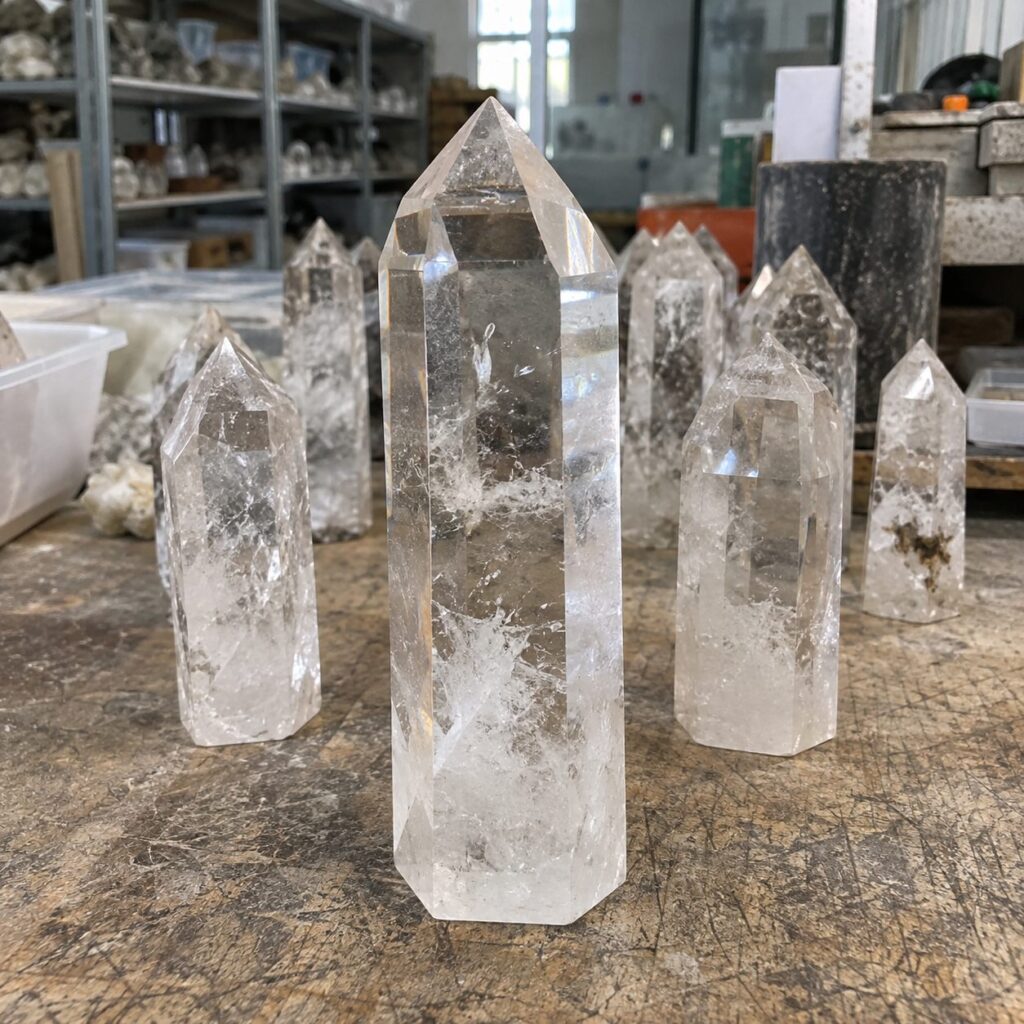
Understanding this naming distinction matters far more than it might seem at first. The label on a quote doesn't guarantee a specific grade, transparency level, or price tier. Below, I'll break down exactly how these terms function in real sourcing conversations, what drives the actual price differences, and how to use the right name on your product listings. Every section draws on what we see daily at GD Crystal when processing buyer inquiries and shipping quartz products worldwide.
Are Crystal Quartz and Clear Quartz the Same Mineral?
Many buyers reach out to us asking whether they need to source "crystal quartz" and "clear quartz" as two separate SKUs. The worry is understandable — two names suggest two products, and ordering the wrong one could mean mismatched inventory or inaccurate listings.
The short answer: mineralogically, crystal quartz and clear quartz are the same material — silicon dioxide in its macrocrystalline form. "Clear quartz" specifies that the stone is colorless and largely transparent. "Crystal quartz" is a looser term that may or may not imply transparency, depending on who's using it.
What Do Mineralogical References Say?
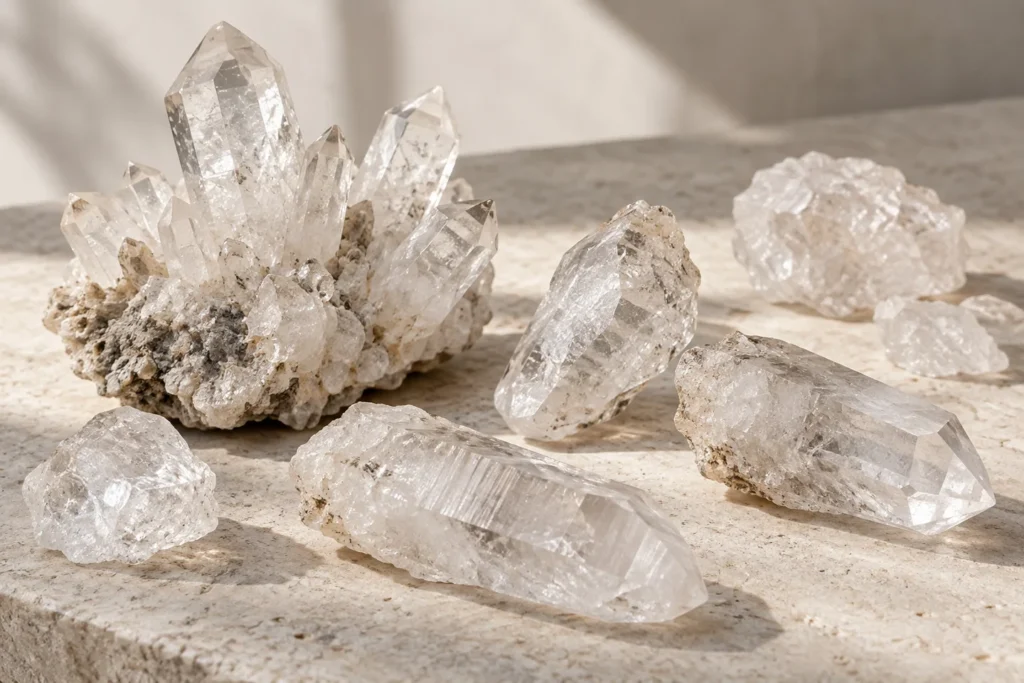
According to widely cited mineralogical references (such as Mindat.org and the Gemological Institute of America), quartz is a single mineral species. Its varieties are classified by color, transparency, and crystal habit — not by separate mineral formulas.3 Here's a simplified breakdown:
| Term | What It Typically Means | Standardized? |
|---|---|---|
| Quartz | The mineral species SiO₂ (macrocrystalline) | Yes |
| Clear quartz | Colorless, transparent to translucent quartz | Widely used, fairly specific |
| Crystal quartz | Any well-formed quartz crystal; may or may not be clear | Not standardized — context-dependent |
| Rock crystal | Traditional gemological term for colorless transparent quartz | Yes (gemological literature) |
The confusion arises because "crystal quartz" is not a formally standardized trade term. Some suppliers use it interchangeably with "clear quartz." Others use it to describe any natural quartz crystal point — including milky, smoky, or slightly included pieces. I've seen both usages across hundreds of buyer inquiries.
Why the Naming Confusion Persists
In practice, the naming inconsistency comes from three sources:
-
Translation gaps. Many product names originate in Chinese supplier catalogs and are translated into English. The Chinese term 水晶 (shuǐjīng) literally means "water crystal" and is commonly used for transparent quartz4, but it gets translated variably as "crystal," "crystal quartz," or "clear quartz."
-
Platform listing habits. On marketplaces like Alibaba, Etsy wholesale, or Amazon, sellers optimize titles for search traffic. "Crystal quartz" and "clear quartz" both generate keyword hits, so both get used — sometimes on the same product.
-
Supplier-side shorthand. In bulk quartz processing facilities, workers and sales teams often use "crystal" as shorthand for any transparent quartz product. Without further specification, this can mean anything from an AAA-grade perfectly transparent tower to a milky, inclusion-heavy tumbled stone.
Buyer takeaway: Never assume the name alone tells you the transparency, grade, or quality. Always confirm with batch photos or a video call.
How We Handle This at GD Crystal
When a buyer asks us for "crystal quartz towers" or "clear quartz spheres," our first step is always clarification. We ask: What transparency level do you need? Do you want minimal inclusions or are some natural features acceptable? What's your target price range? These questions matter far more than which of the two names appeared in the initial inquiry. Over 15 years of processing quartz in Suzhou, I've learned that aligning on visual expectations — not just labels — prevents most order disputes.
Does the Name Affect Wholesale Pricing?
This is where things get commercially important. Some buyers suspect that "clear quartz" commands a premium over "crystal quartz" simply because the name sounds more specific. Others worry they're overpaying if a supplier labels the same stone differently across catalogs.
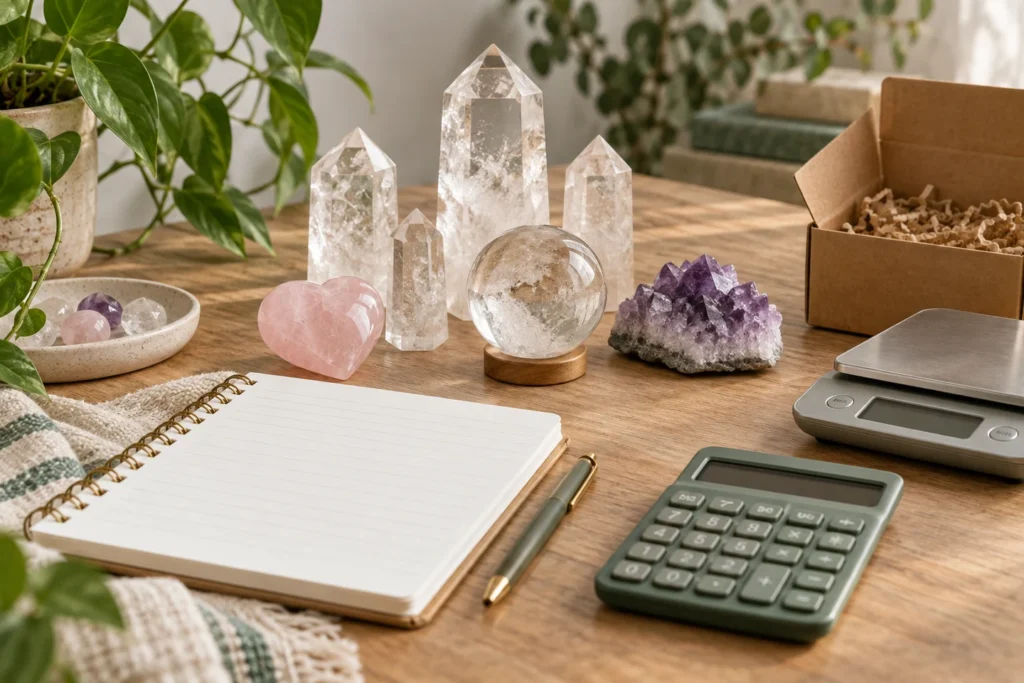
A different name does not automatically justify a different price. The actual cost drivers for quartz products are clarity, inclusions, cracks, size, shape, polishing quality, carving complexity, batch consistency, MOQ, and packaging — not the label printed on the invoice.
What Actually Drives Quartz Product Pricing?
Let me break down the real variables we consider when quoting quartz products:
| Pricing Factor | How It Affects Cost | Notes |
|---|---|---|
| Clarity/Transparency | Higher transparency = higher cost | AAA-grade clear quartz can cost 3–5× more than milky quartz of similar size |
| Inclusions & Cracks | Fewer flaws = higher cost | Some inclusions (rainbows, phantoms) may add value for certain retail markets |
| Size & Weight | Larger pieces = higher unit cost | Pricing often scales non-linearly — a 10 cm tower is not simply 2× the price of a 5 cm tower |
| Shape & Processing | Complex carvings > simple towers > tumbled stones | Skull carvings or detailed figurines require more labor and material waste |
| Polishing Quality | Mirror polish > matte or rough finish | High-gloss finish requires additional processing steps |
| Batch Consistency | Uniform batches cost more to sort | If you need 200 spheres within ±2 mm and matching clarity, expect a premium |
| MOQ | Higher quantity = lower per-unit cost | Mixing multiple quartz varieties in one order can also affect pricing |
| Packaging | Individual boxes, foam inserts, branded bags | Custom packaging adds per-unit cost |
A Real-World Example
A common scenario: a buyer requests a quote for "crystal quartz towers, 8–10 cm, 500 pieces." Without clarification, we could quote anything from translucent milky towers (lower cost) to gem-grade, nearly glass-clear towers (significantly higher cost). Both could legitimately be called "crystal quartz." The name didn't set the price — the visual specification did.
This is why we always recommend that buyers:
- Request current batch photos or videos before confirming an order
- Specify an acceptable clarity range (e.g., "at least 70% transparent," or "some cloudiness acceptable")
- Ask about the grading system the supplier uses — there is no universal AAA/AA/A grading standard for quartz across all suppliers5
- Compare quotes on the same specifications, not just the same name
When a Name Does Affect Price
There's one scenario where naming legitimately affects pricing: if a supplier is marketing a specific proprietary grade or brand. Some larger suppliers create their own grading labels — "Premium Clear," "Ice Crystal," "Water Clear." These names often correspond to genuine quality tiers within that supplier's inventory. But you should always ask what the label means in measurable terms (transparency percentage, maximum inclusion size, etc.) rather than taking the name at face value.
Is Natural Clear Quartz Always Perfectly Transparent?
This question comes up frequently, especially from buyers who are newer to crystal sourcing. They see polished, perfectly clear quartz in professional product photos and expect every piece in their shipment to look identical. Then reality arrives — literally, in a shipping crate — and the batch looks different.
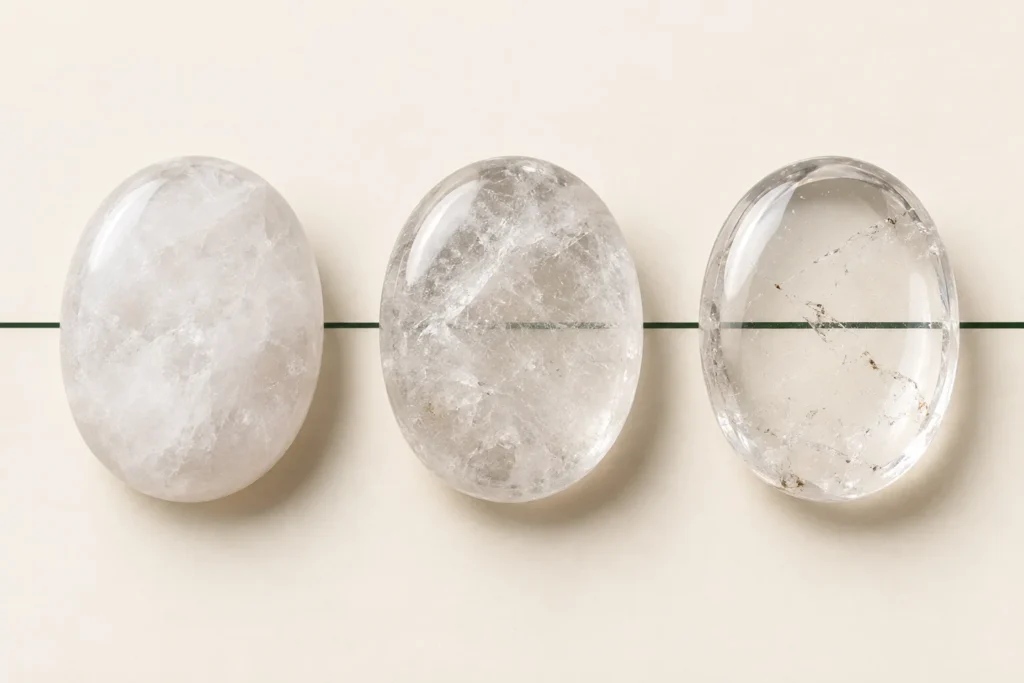
Natural clear quartz is not always perfectly transparent.6 Even high-quality batches will contain pieces with varying degrees of internal features — veils, tiny inclusions, cloudiness, or natural fractures. Expecting glass-like perfection in every piece of a natural stone order is setting yourself up for disappointment.
What Causes Variation in Clear Quartz?
Clear quartz forms over millions of years in geological environments that are never perfectly uniform.7 As a result, even material sourced from the same mine — or even the same pocket — can show variation. Here are the most common natural features:
- Veils and wispy inclusions: Thin, cloud-like internal features caused by fluid inclusions or micro-fractures during crystal growth8
- Phantoms: Ghost-like outlines inside the crystal showing earlier growth stages9
- Rainbows: Internal fractures that refract light into spectral colors — often considered desirable by end consumers
- Cloudiness or milkiness: Areas of reduced transparency, particularly near the base of tower points or the core of spheres
- Surface pitting or natural etch marks: Visible on less-polished surfaces or raw crystal faces
How Batch Quality Works in Practice
When we process and sort clear quartz at our Suzhou facility, we grade pieces within each batch. A typical sorting might look like this:
| Grade (Internal) | Description | Approximate % of Raw Batch |
|---|---|---|
| Top / AAA | Near-transparent, minimal inclusions, no visible cracks | 10–20% |
| A / Good | Mostly transparent, some veils or small inclusions | 30–40% |
| Standard | Noticeable cloudiness, visible inclusions, minor fractures | 30–40% |
| Low / Utility | Significant milkiness or fractures; suitable for tumbling or chips | 10–20% |
These percentages shift depending on the raw material source and the season's mining output. A buyer requesting "all AAA clear quartz" should understand that this typically represents a small fraction of any natural batch — and pricing reflects that scarcity.
Practical Advice for Buyers
- Always ask for current batch photos or video. Not photos from six months ago. Not a single cherry-picked "hero" shot. Ask for a spread of pieces from the actual batch you'll receive.
- Discuss acceptable variation upfront. Tell your supplier: "I need at least 80% of pieces to be mostly transparent, and I can accept up to 20% with light cloudiness." This gives the sorting team clear guidance.
- Understand that higher clarity demands higher prices and potentially longer lead times. If the current batch doesn't meet your clarity requirements, the supplier may need to wait for new raw material.
- Don't use old photos or old price tags as current commitments. Material availability and quality fluctuate. We always recommend re-confirming specs and pricing for each new order.
A note from our experience: Some of our most successful retail customers actually embrace natural variation. They market features like rainbows and phantoms as unique selling points. "No two pieces alike" is a genuine advantage in the crystal retail market — if you frame it correctly.
How Should You Name Quartz Products for Resale?
For retailers, ecommerce sellers, and crystal brands, the naming decision carries commercial weight. The wrong product name can attract the wrong customer, trigger returns, or create trust issues. The right name sets clear expectations and supports healthy repeat business.
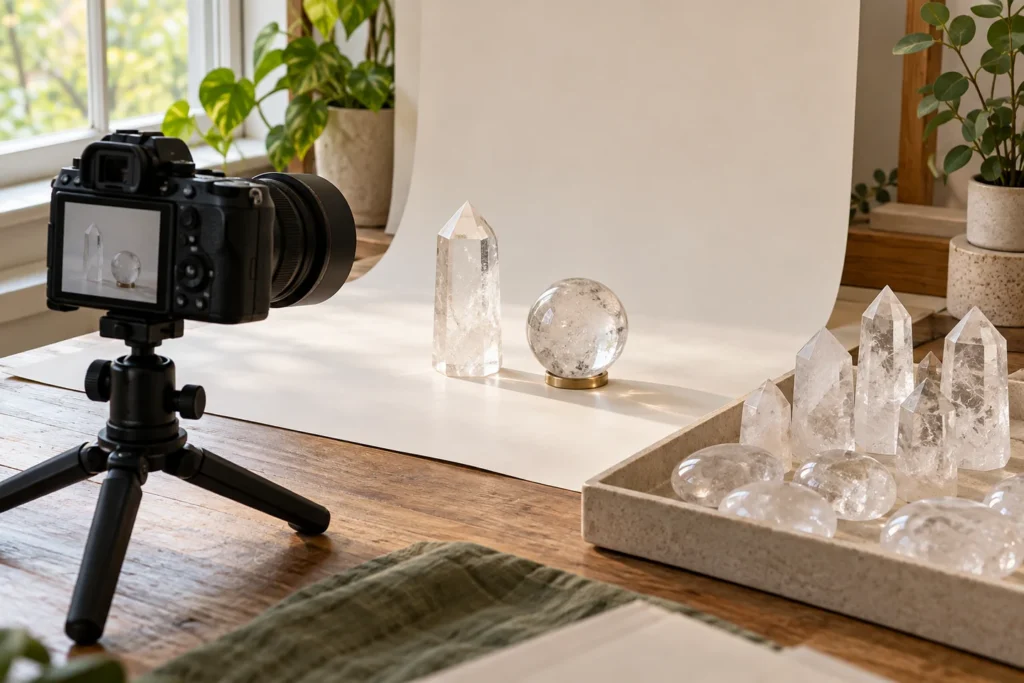
For most retail and ecommerce contexts, "clear quartz" is the safer, more specific product listing name when selling colorless transparent quartz. It accurately communicates what the buyer will receive. "Crystal quartz" is acceptable but should be paired with clear photos and descriptions of actual transparency to avoid ambiguity.
Naming Best Practices for B2B Resellers
Here's a practical framework based on what we've seen work well for our customers' downstream sales:
Use Specific, Descriptive Names
- ✅ "Natural Clear Quartz Tower, 8–10 cm" — specific, searchable, sets expectations
- ✅ "Clear Quartz Sphere, AAA Grade, 6 cm" — includes grade claim (make sure your photos back it up)
- ⚠️ "Crystal Quartz Tower" — acceptable, but vague about transparency
- ❌ "Pure Crystal Quartz, Flawless" — overstates natural product; invites returns and disputes
Match Names to Visual Evidence
Every product listing should include:
- Multiple angles of the actual product or representative batch pieces
- Close-up shots showing internal features, not just glamour shots with backlighting
- Honest description of inclusions ("may contain minor natural veils or rainbows")
- Size and weight ranges, not just a single measurement
Consider Your Target Market's Language
Different markets use different terminology:
| Market Segment | Preferred Term | Why |
|---|---|---|
| Metaphysical / wellness shops | "Clear quartz" or "rock crystal" | Recognized terminology in this niche |
| Mineral collectors | "Rock crystal" or "quartz var. crystal" | More traditional/geological naming |
| Home décor / gift shops | "Crystal quartz" or "clear crystal" | Broader appeal, less niche |
| General ecommerce | "Clear quartz" | Highest search volume for transparent quartz |
Avoid Overstating Rarity or Grade
One common mistake we see: retailers labeling standard-grade clear quartz as "rare" or "museum quality." This erodes buyer trust quickly. Clear quartz is one of the most abundant minerals on Earth.10 Its value in retail comes from quality of processing, aesthetic appeal, size, and presentation — not from scarcity of the raw material itself.
If you're selling a particularly high-clarity piece or an unusually large specimen, it's fine to highlight that. Just be specific: "Exceptionally transparent, minimal inclusions" is more credible and verifiable than "ultra-rare crystal."
Frequently Asked Questions
Is crystal quartz more expensive than clear quartz?
Not inherently. The names don't determine price. Cost depends on transparency, inclusions, size, processing complexity, batch quality, MOQ, and packaging. A milky "crystal quartz" piece can cost less than a highly transparent "clear quartz" piece of the same size — because the actual quality differs, not the label.
Can I use "crystal quartz" and "clear quartz" interchangeably on product listings?
You can, but "clear quartz" is more specific and sets clearer buyer expectations for transparent, colorless quartz. If you use "crystal quartz," include photos and descriptions that show the actual transparency level, so customers know exactly what they're purchasing.
How do I verify that my clear quartz is natural and not synthetic?
Request documentation from your supplier about material origin and any treatments. For high-value purchases, consider third-party gemological testing. At GD Crystal, we communicate material type and any known treatments per batch, but we recommend buyers consult qualified gemological labs for formal certification when needed.
Should I expect every piece in a clear quartz order to look the same?
No. Natural clear quartz varies in transparency, inclusions, and internal features from piece to piece — even within a single batch. Discuss acceptable variation ranges with your supplier before ordering, and always review current batch photos or videos.
What's the difference between clear quartz and rock crystal?
"Rock crystal" is the traditional gemological term for colorless, transparent quartz.11 It means essentially the same thing as "clear quartz." You may see "rock crystal" used more often in European markets, museum contexts, or formal gemological descriptions.
Conclusion
The difference between crystal quartz and clear quartz is primarily one of naming precision, not mineral identity. Both terms refer to the same silicon dioxide mineral. "Clear quartz" is the more specific, widely understood name for colorless transparent quartz, while "crystal quartz" is broader and less standardized. For B2B buyers, the key takeaway is this: don't let the name alone drive your sourcing decisions. Focus instead on confirming clarity, batch quality, processing specifications, and current photos — then choose the product listing name that best matches what your customers will actually receive.
At GD Crystal, we work through these naming and specification questions with buyers every day. If you're sourcing clear quartz towers, spheres, carvings, or any other quartz product, reach out with your target specs. We'll provide current batch photos, transparent pricing based on real product variables, and honest guidance on what's available. Let's make your next quartz order straightforward.
References
- "Quartz", https://en.wikipedia.org/wiki/Quartz. A mineralogical reference identifies quartz as crystalline silicon dioxide, SiO₂, and classifies ordinary crystal specimens as macrocrystalline quartz. Evidence role: definition; source type: encyclopedia. Supports: A mineralogical source should define quartz as crystalline silicon dioxide and distinguish macrocrystalline quartz from cryptocrystalline varieties.. ↩
- "Quartz", https://en.wikipedia.org/wiki/Quartz. Gemological references describe the colorless, transparent variety of quartz as clear quartz or rock crystal, supporting the article's use of clear quartz as a descriptive term. Evidence role: definition; source type: institution. Supports: A gemological or mineralogical source should support that colorless transparent quartz is commonly described as clear quartz or rock crystal.. ↩
- "Quartz", https://en.wikipedia.org/wiki/Quartz. Mineralogical references classify amethyst, smoky quartz, rose quartz, and rock crystal as varieties of quartz with the same SiO₂ composition, distinguished primarily by optical and habit-related properties. Evidence role: definition; source type: research. Supports: A mineralogical database or reference should support that varieties of quartz retain the SiO₂ composition and are named according to properties such as color, transparency, or crystal habit.. ↩
- "Quartz", https://en.wikipedia.org/wiki/Quartz. Chinese-English lexical sources translate 水晶 (shuǐjīng) as crystal or rock crystal, with the characters literally denoting water and crystal, supporting the article's explanation of translation variation. Evidence role: historical_context; source type: education. Supports: A Chinese-English dictionary or educational language source should verify the literal components of 水晶 and its translation as crystal, rock crystal, or quartz.. Scope note: This supports the linguistic basis of the term, but not the frequency of each English translation in supplier catalogs. ↩
- "Analysis & Grading – GIA.edu", https://www.gia.edu/gem-lab. Gemological guidance notes that many commercial colored-stone quality terms and letter grades are seller-defined rather than governed by a universal grading scale, providing contextual support for caution with AAA/AA/A quartz labels. Evidence role: expert_consensus; source type: institution. Supports: A gemological institution should support that commercial grade labels for many colored stones and ornamental materials are not governed by a single universal grading system.. Scope note: The support is contextual unless the source discusses quartz grading specifically. ↩
- "Fluid inclusion", https://en.wikipedia.org/wiki/Fluid_inclusion. Mineralogical studies of quartz describe fluid inclusions, fractures, and other internal features that can reduce optical clarity, supporting the point that natural clear quartz is not necessarily glass-clear. Evidence role: general_support; source type: research. Supports: A mineralogical or gemological source should document that natural quartz commonly contains inclusions, fractures, or clouding that affect transparency.. ↩
- "Trace elements in hydrothermal quartz: Relationships to …", https://www.usgs.gov/publications/trace-elements-hydrothermal-quartz-relationships-cathodoluminescent-textures-and. Geology references describe quartz crystal growth in hydrothermal and other geological environments where temperature, pressure, chemistry, and fluid flow vary over time, explaining why crystals from the same source can differ internally. Evidence role: mechanism; source type: education. Supports: A geology source should explain that quartz crystals form in natural geological settings such as hydrothermal veins and that growth conditions vary over time.. Scope note: The source may support geological variability more directly than a fixed 'millions of years' timeframe, which can vary by deposit. ↩
- "Unusual Purple Fluid in Quartz", https://www.gia.edu/gems-gemology/fall-2022-microworld-unusual-purple-fluid-in-quartz. Studies of quartz microstructures describe fluid inclusions and healed microfractures as internal features that can produce veil-like or wispy appearances in crystals. Evidence role: mechanism; source type: paper. Supports: A mineralogy paper should explain that fluid inclusions and healed fractures in quartz can appear as veils, wisps, or cloud-like internal features.. ↩
- "What is a crystal phantom? Crystal phantoms are some of the …", https://www.facebook.com/Saltshac/videos/what-is-a-crystal-phantom-crystal-phantoms-are-some-of-the-most-fascinating-feat/1680828433007749/. Mineralogical references define phantom quartz as quartz in which earlier crystal growth surfaces are preserved as visible internal outlines, supporting the article's description of phantoms. Evidence role: definition; source type: research. Supports: A mineralogical source should define phantom quartz as a crystal containing visible outlines of earlier growth stages.. ↩
- "Quartz | U.S. Geological Survey", https://www.usgs.gov/media/images/quartz. Geological references, including government mineral resources, identify quartz as one of the most abundant minerals in Earth's crust, supporting the article's statement that ordinary quartz is not scarce as a raw mineral. Evidence role: statistic; source type: government. Supports: A government or geology source should support that quartz is one of the most abundant minerals in Earth's crust.. Scope note: The source supports the abundance of quartz generally; abundance of high-clarity, marketable clear quartz may differ by deposit and quality grade. ↩
- "Quarterly Crystal: Panasqueira Quartz", https://www.gia.edu/gems-gemology/fall-2022-microworld-quarterly-crystal-panasqueira-quartz. Gemological references define rock crystal as the colorless, transparent variety of quartz, supporting its equivalence to clear quartz in formal descriptions. Evidence role: definition; source type: institution. Supports: A gemological reference should define rock crystal as colorless transparent quartz.. ↩