Clear quartz is one of the most searched crystal products online1 — and one of the most misunderstood in the wholesale market. Many buyers start with a vague idea that it's a "healing stone" or "energy amplifier," but when it comes time to place an order, they realize they don't know which form of clear quartz actually fits their store, their customers, or their price point. The gap between consumer marketing language and real purchasing decisions is where costly mistakes happen.
Clear quartz is used for a wide range of retail purposes — from home décor and meditation accessories to jewelry, gifting, collection displays, and DIY crafting2 — but its actual use depends entirely on the product form, size, visual clarity, and the end customer it must serve. Towers, spheres, tumbled stones, raw specimens, bracelets, and carvings each target different buyers, different price tiers, and different selling scenarios. There is no single "use" for clear quartz; there is only the right SKU for the right market.
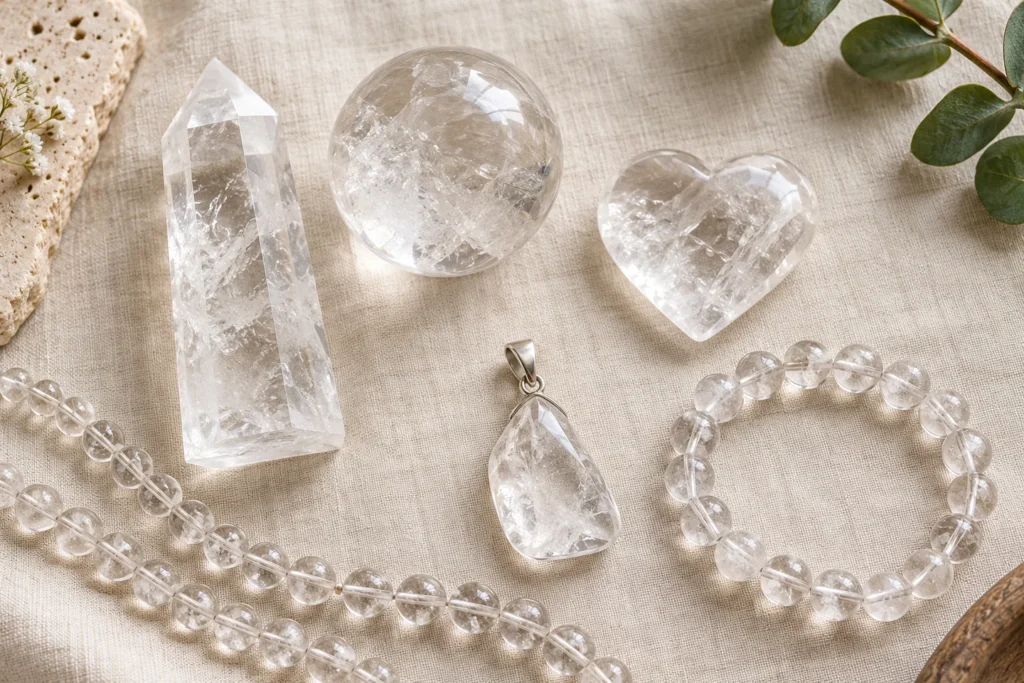
Understanding what clear quartz is used for is the starting point. But the real question for retailers and resellers is: which clear quartz products should I stock, and how do I evaluate them before ordering? Below, I'll break down the main use categories by product form, explain what buyers actually need to check, and share observations from years of working with independent crystal shops and ecommerce sellers.
What Are the Main Retail Uses of Clear Quartz by Product Form?
If you search "what is clear quartz used for," most results give you a flat list: healing, meditation, decoration, jewelry. That's not wrong, but it's not useful for a buyer placing a wholesale order. A clear quartz tumbled stone and a clear quartz sphere serve completely different customers, and confusing them leads to dead stock.
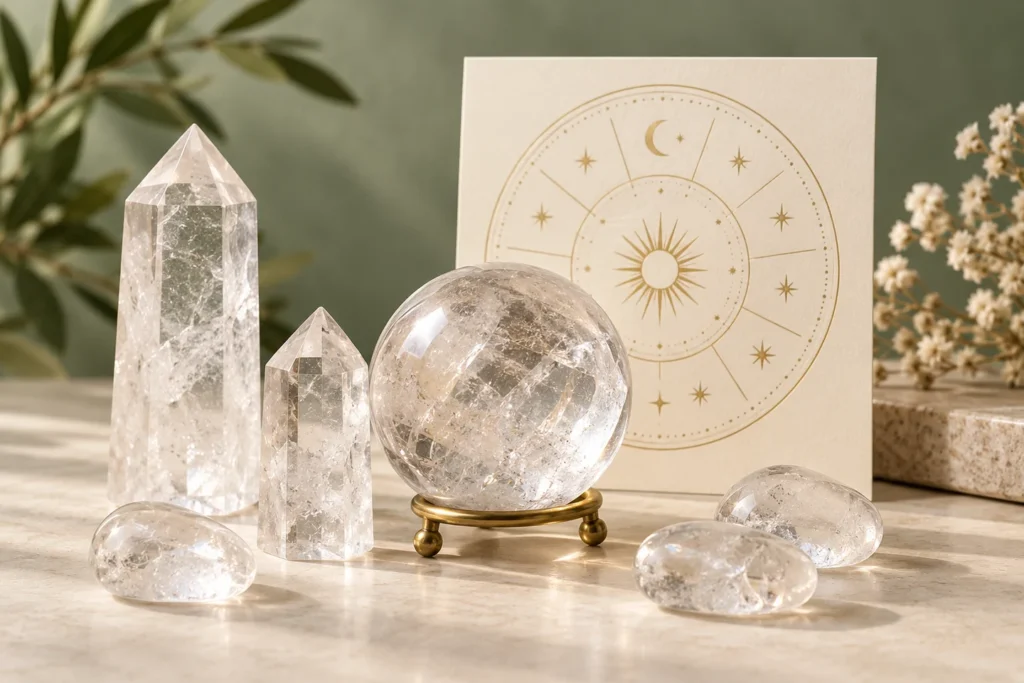
The main retail uses of clear quartz map directly to product forms. Each form fits a specific selling scenario — display pieces for home décor buyers, pocket stones for wellness shoppers, bracelets for fashion-adjacent customers, raw specimens for collectors, and chips or tumbled stones for DIY or bulk gifting. Choosing the right form is the first purchasing decision, not an afterthought.
Matching Product Form to Retail Scenario
Here's how I typically walk buyers through the product-form decision during sourcing conversations:
| Product Form | Primary Retail Use | Typical Buyer | Price Tier | Key Visual Factor |
|---|---|---|---|---|
| Towers / Points | Display, meditation props, décor | Crystal shop visitors, home décor buyers | Mid–High | Clarity, tip sharpness, polish |
| Spheres | Display, gifts, photography props | Gift shoppers, décor-focused buyers | Mid–High | Transparency, inclusion pattern |
| Tumbled Stones | Pocket stones, bulk retail, starter kits | Wellness shoppers, impulse buyers | Low–Mid | Surface polish, size consistency |
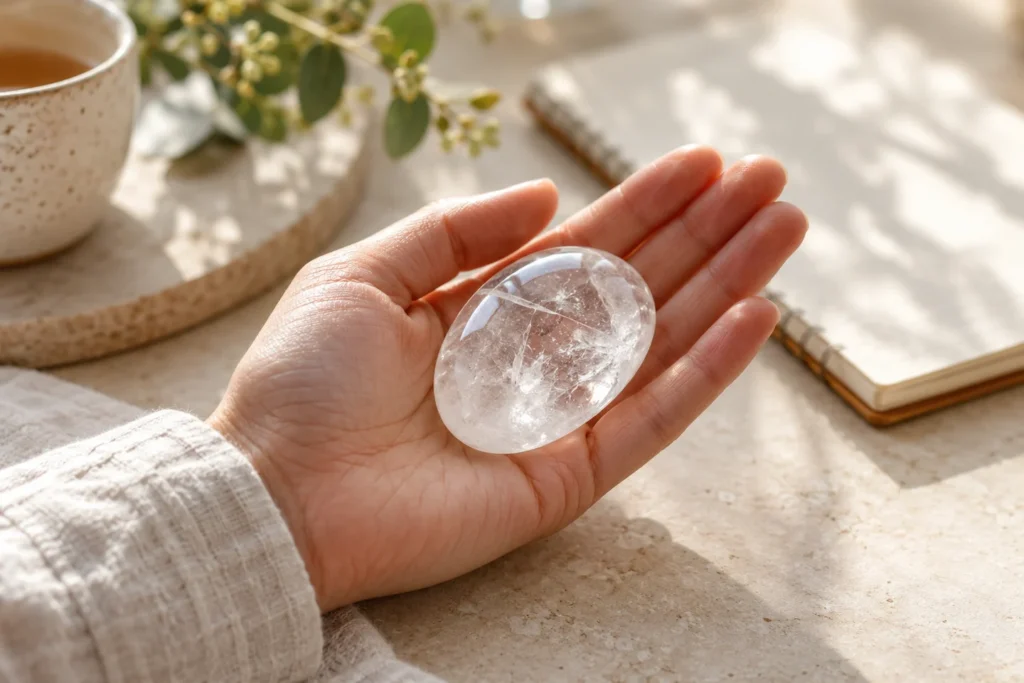
| Palm Stones | Meditation accessories, personal gifts | Wellness-curious consumers | Mid | Hand feel, thickness, clarity |
| Hearts | Gifting, Valentine's / seasonal promos | Gift retailers, ecommerce seasonal sellers | Mid | Symmetry, polish, size range |
| Bracelets | Fashion jewelry, wellness accessories | Jewelry buyers, ecommerce accessory shops | Mid | Bead clarity, elastic quality, sizing |
| Carvings (animals, skulls, etc.) | Collectibles, novelty gifts, themed displays | Gift shops, niche ecommerce sellers | Mid–High | Carving detail, finish, uniqueness |
| Raw Points / Clusters | Specimen collection, natural décor | Collectors, mineral enthusiasts | Variable | Natural formation, damage-free tips |
| Chips & Crushed Stones | DIY crafting, vase filler, candle making | Craft suppliers, DIY ecommerce sellers | Low | Size uniformity, cleanliness |
Why This Matters for Your First Order
I've seen new buyers order 200 pieces of clear quartz towers because a competitor's Instagram looked good — only to discover their actual foot traffic is impulse-buy shoppers who spend under $15. Those buyers needed tumbled stones or small palm stones, not 8-inch polished points priced at $25+ retail.
The lesson: start with your customer's behavior, not the product that photographs best. If your shoppers browse for gifts under $20, hearts and tumbled stones move faster. If your online store attracts collectors, raw clusters and high-clarity spheres justify higher price points.
Another common pattern I see: ecommerce sellers underestimate how much size and weight variation matters when listing clear quartz. A "clear quartz tower" listing with no size range will attract returns if pieces arrive 30% smaller than what the customer imagined. In wholesale, we ship within a size and weight range — it's the seller's job to communicate that range accurately.
How Is Clear Quartz Used in Consumer Markets — and What Should Buyers Understand?
If you sell crystals, you already know: consumer-facing marketing is full of language about "energy amplification," "chakra cleansing," and "spiritual clarity." These phrases drive real search traffic and real sales. But as a supplier, I want to be transparent about where product claims end and marketing language begins.
Clear quartz is widely associated in consumer markets with meditation, energy work, and holistic wellness practices.3 These associations drive significant retail demand. However, these are cultural and lifestyle associations, not verified medical or scientific claims4. Buyers should understand the language their customers respond to, while avoiding promises that could create liability or erode trust.
The Consumer Language Landscape
Here's what I consistently hear from retailers about how their customers talk about clear quartz:
- "Master healer" — the most common consumer-facing label, used across crystal blogs, TikTok, and retail signage
- "Energy amplifier" — frequently paired with other crystals in curated sets or gift boxes
- "Clarity and focus" — popular in productivity-adjacent or minimalist lifestyle markets
- "Chakra alignment" — especially crown chakra, common in yoga and meditation retail
- "Programmable crystal" — used in intentional-living and manifestation communities
These labels are marketing conventions in the crystal retail industry. They are not medical claims, and responsible retailers present them accordingly — often with disclaimers like "for spiritual or decorative use only."
Why This Matters for B2B Buyers
Understanding consumer language helps you write better product listings and choose the right product forms. For example:
- If your customers search for "meditation crystals," palm stones and tumbled stones are the natural match — they're sized for hand-holding and priced for the wellness-curious buyer.
- If your audience responds to "home energy" or "feng shui" language, spheres, towers, and raw clusters serve that display-focused use case.
- If you're building "crystal starter kits," tumbled stone assortments with clear quartz as a core item are the industry standard.
The important distinction: you're selecting products to match a retail narrative, not endorsing a health outcome. This keeps your brand credible and your sourcing decisions grounded.
Practical note: I recommend buyers review how their competitors describe clear quartz products. If the dominant language in your market is wellness-oriented, your product descriptions should speak that language — but your sourcing criteria should focus on clarity, polish, size, and batch quality, not metaphysical grading.
What Should Buyers Check Before Ordering Clear Quartz Wholesale?
This is where most sourcing mistakes happen. A product photo looks beautiful. The price per piece seems reasonable. You place the order — and receive stones that are cloudier than expected, inconsistently sized, or scratched in transit. Clear quartz is especially prone to this problem because "clear" is relative, and every buyer has a different expectation of what transparency means.
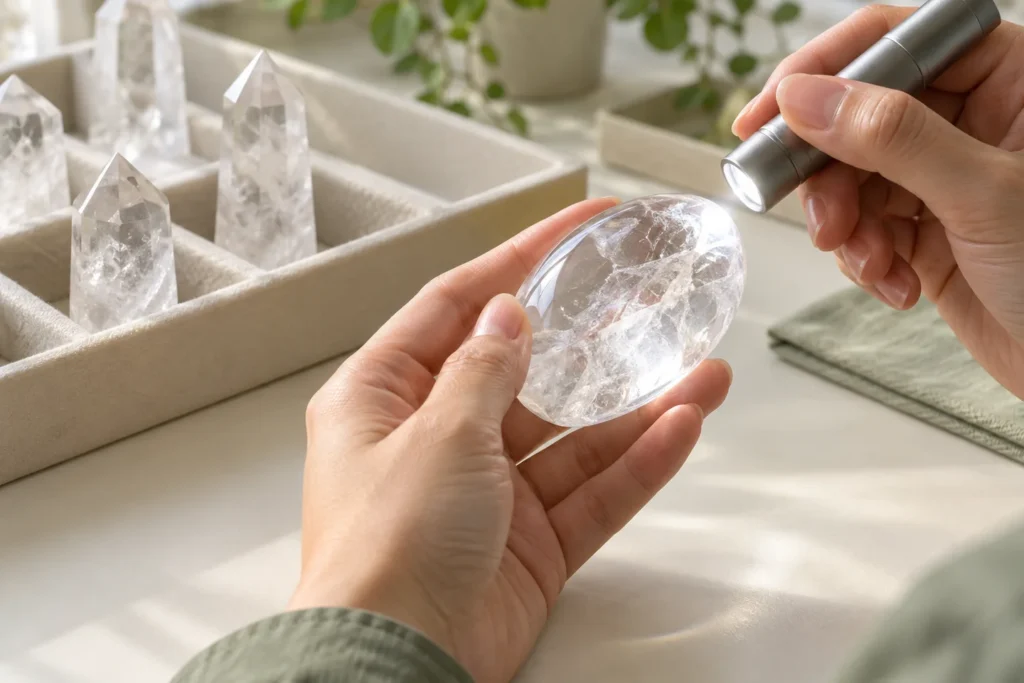
Before ordering clear quartz wholesale, buyers should verify clarity grade, inclusion level, size and weight range, surface finish quality, batch consistency, packaging method, MOQ, and lead time. These factors vary by product form and by batch. Requesting current photos or video of the actual batch — not relying on catalog images — is essential for managing quality expectations.
Clarity and Inclusions: The Most Misunderstood Factor
"Clear" quartz is not always clear. Natural clear quartz exists on a spectrum5:
- Water-clear (AAA grade): Highly transparent, minimal inclusions. Commands premium pricing. Often limited in supply for larger sizes.
- Semi-clear (AA grade): Some cloudiness, visible inclusions, but still attractive. The workhorse grade for most retail.
- Milky or included (A grade): Significant cloudiness or rainbow inclusions. Lower price, but can still sell well for certain uses (e.g., "rainbow quartz" or rustic-style décor).
The grade names (AAA, AA, A) are not standardized across the industry.6 My AAA may differ from another supplier's AAA. This is why I always recommend requesting photos or video of the current batch, not referencing old product images.
Surface Finish and Polish
For polished products — towers, spheres, hearts, palm stones, tumbled stones — the quality of the surface finish directly affects retail value. Things to check:
- Scratch marks from polishing equipment
- Flat spots or uneven curves on spheres
- Chipped tips on towers and points
- Dull patches where polish didn't reach
These issues are sometimes visible only in video or under certain lighting. I encourage buyers to ask for close-up media, especially on first orders.
Batch Consistency
If you're listing products online with a single photo representing an entire SKU, your customers expect every piece to look similar. But natural clear quartz varies. Key consistency factors include:
- Size range (e.g., 5–7 cm vs. 5–9 cm — the tighter the range, the better for standardized listings)
- Weight range per piece
- Clarity distribution within a batch (what percentage is water-clear vs. milky?)
- Shape regularity for carved items
From experience: The number one complaint I hear from ecommerce sellers after their first clear quartz order is "the pieces look different from each other." This isn't a defect — it's natural variation. But if your listing doesn't account for it, your return rate will.
Packaging and Shipping Considerations
Clear quartz is hard (7 on the Mohs scale)7, but polished surfaces scratch easily against each other, and tips chip in transit8. Key packaging questions:
- Are pieces individually wrapped?
- Is foam or bubble wrap used between layers?
- Are towers packed point-up or nested?
- What's the breakage policy if items arrive damaged?
For spheres especially, I've seen entire shipments arrive with micro-scratches because pieces were packed touching each other. Packaging quality is a sourcing decision, not an afterthought.
Which Clear Quartz Products Are Best for First-Time Wholesale Buyers?
If you're a new crystal shop owner or an ecommerce seller testing the category, the sheer variety of clear quartz products can feel overwhelming. Towers? Spheres? Tumbled stones? Raw points? The temptation is to order a little of everything — but that spreads your budget thin and makes quality control harder.
For first-time wholesale buyers, the safest clear quartz products to start with are tumbled stones, small towers (6–10 cm), and palm stones. These forms have broad retail appeal, manageable per-piece cost, forgiving quality tolerances, and high turnover potential. They let you test customer response before committing to higher-value items like large spheres or premium carvings.
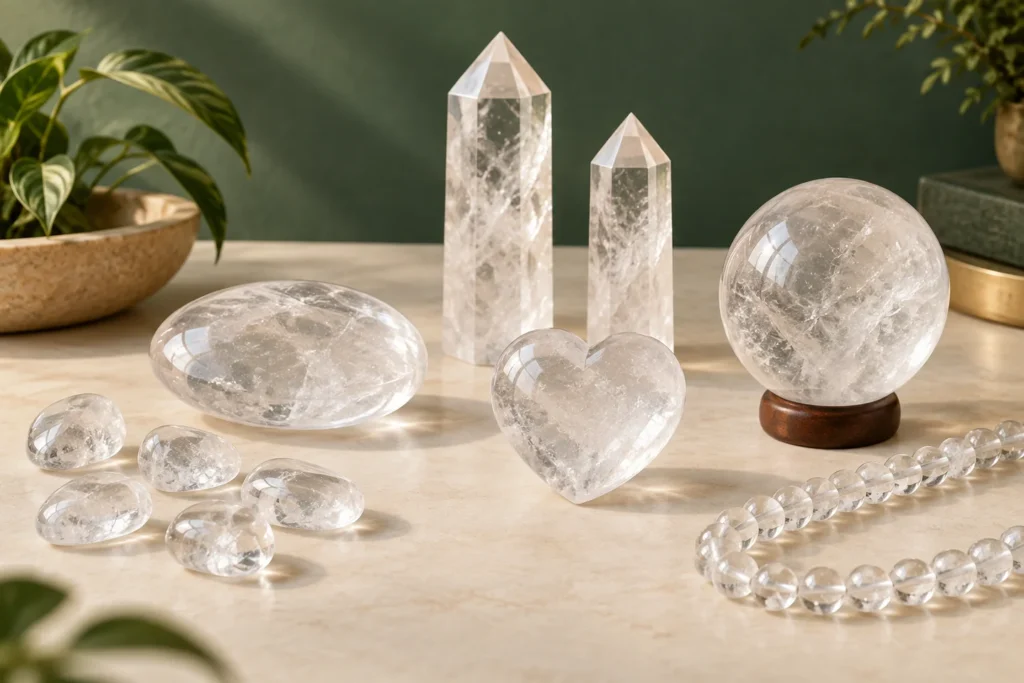
A Starter Selection Framework
Here's the logic I walk new buyers through:
1. Tumbled Stones (Clear Quartz)
- Low per-piece cost, easy to display in bowls or bins
- Sell well as add-ons, impulse buys, or components in curated kits
- Forgiving on clarity — slight cloudiness is expected and accepted by consumers
- Easy to list online with a "you will receive a similar piece" disclaimer
- Typical MOQ: 1–5 kg or a minimum piece count (varies by supplier)
2. Small Towers / Points (6–10 cm)
- Strong visual appeal for Instagram and product photography
- Mid-range pricing supports healthy retail margins
- Easy for consumers to understand ("a crystal tower for my desk")
- Check tip condition carefully — chipped points are the most common defect
- Typical MOQ: 20–50 pieces
3. Palm Stones
- Growing demand in the wellness and self-care market
- Comfortable in the hand, which matters for in-store selling
- Moderate clarity expectations — some cloudiness adds character
- Typical MOQ: 30–50 pieces
What to Postpone Until You Know Your Market
- Large spheres (8 cm+): High per-piece cost, slow turnover for new shops, breakage risk in shipping
- Premium carvings: Niche audience, harder to move in volume, higher MOQ for custom designs
- Raw clusters: Highly variable in appearance, harder to photograph consistently, can disappoint online buyers
- Chips and crushed stones: Low margin, requires volume to be profitable, best for established DIY-supply sellers
My recommendation: Start with 2–3 product forms. Get customer feedback. Then expand based on what actually sells — not what looks best on Pinterest.
How Do You Evaluate a Clear Quartz Supplier for Ongoing Restocking?
Finding a supplier for your first order is one challenge. Finding one you can restock from reliably — with consistent quality, reasonable lead times, and clear communication — is a different, harder problem. Many buyers switch suppliers after 2–3 orders because of quality drift, slow responses, or unexpected MOQ changes.
To evaluate a clear quartz supplier for restocking, check their batch consistency across orders, communication responsiveness, willingness to send updated batch photos, transparency about material treatment or enhancement, lead time reliability, and flexibility on mixed-item orders. A good long-term supplier makes your purchasing predictable, not stressful.
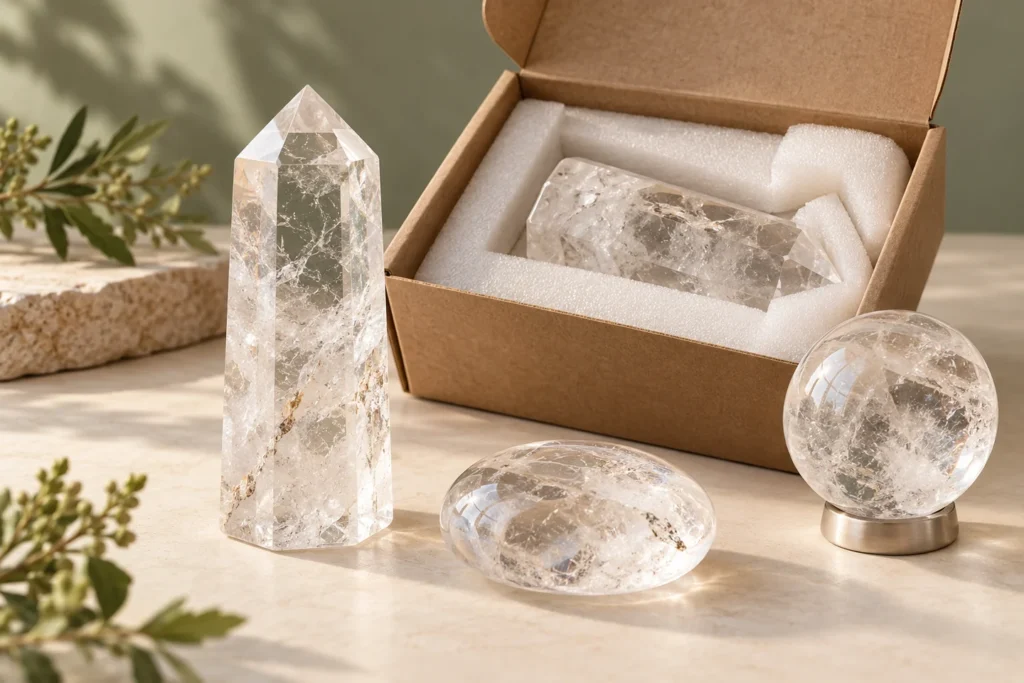
Key Evaluation Criteria
| Factor | What to Check | Red Flag |
|---|---|---|
| Batch photos | Does the supplier send images of the current batch before you order? | Only shows catalog photos from months ago |
| Clarity grading | Do they explain their grading criteria, or just say "AAA"? | Uses grade labels without defining them |
| Treatment disclosure | Are any pieces coated, irradiated, or enhanced? | Avoids the question or gives vague answers |
| Size/weight specs | Do they provide a measured range per SKU? | Lists single numbers with no range |
| MOQ flexibility | Can you mix items within a minimum order value? | Rigid per-SKU MOQs with no negotiation |
| Lead time | Is the quoted lead time realistic and met? | Promises fast delivery, then delays without notice |
| Packaging | Do they describe or show their packing method? | Ships without individual wrapping |
| Communication | Do they respond within 24–48 hours? | Goes silent for days after you send payment |
Treatment and Enhancement: A Critical Transparency Issue
Some clear quartz on the market is treated or enhanced.9 Common practices include:
- Coating with a clear resin to enhance surface shine
- Irradiation (less common for clear quartz, more common for smoky quartz)
- Bonding (assembled pieces presented as natural formations)
These treatments aren't inherently bad, but buyers need to know about them to represent their products honestly. A responsible supplier will disclose treatment when asked directly. If they don't, consider it a reliability signal.
Building a Restocking Relationship
From my side of the supply chain, the buyers who get the best service and consistency are those who:
- Communicate their quality expectations before the first order (with reference photos if possible)
- Provide feedback after receiving shipments — both positive and negative
- Plan orders in advance rather than requesting urgent last-minute shipments
- Are open about their retail use case so we can recommend appropriate grades and forms
Wholesale crystal sourcing works best as a relationship, not a transaction. The more context I have about what you're selling and who you're selling to, the better I can match products to your needs.
Frequently Asked Questions
Is clear quartz the same as glass or synthetic quartz?
No. Natural clear quartz is a mineral (silicon dioxide, SiO₂) formed in the earth.10 Glass and synthetic quartz are manufactured. In wholesale, always confirm with your supplier that products are natural quartz, not glass. Genuine clear quartz typically contains minor natural inclusions or internal features that distinguish it from glass.11
What is the most popular clear quartz product form for retail?
Tumbled stones and small towers are consistently the highest-volume sellers across independent crystal shops and ecommerce stores. They offer accessible price points, broad customer appeal, and manageable sourcing complexity. Spheres and hearts are also strong, especially for gifting-oriented retailers.
Can I mix different clear quartz product forms in one wholesale order?
Many suppliers, including us at GD Crystal, allow mixed-item orders within a minimum order value. This lets you test multiple product forms — towers, tumbled stones, palm stones — without committing to large quantities of a single SKU. Confirm mixing terms and any per-item minimums before ordering.
How should I describe clear quartz in my product listings without making false claims?
Focus on physical attributes (clarity, size, polish, natural formation) and cultural associations ("widely used in meditation practices," "popular as a décor accent"). Avoid language that promises medical benefits or guaranteed metaphysical outcomes. Many successful retailers include a disclaimer that crystals are sold for decorative or spiritual use, not as medical treatments.
How do I handle natural variation when selling clear quartz online?
Use language like "you will receive a piece similar to the one pictured" and show multiple examples. Provide measured size and weight ranges. If possible, offer an "exact piece" option for higher-priced items like large spheres or premium towers. Setting accurate expectations reduces returns significantly.
Conclusion
Understanding what clear quartz is used for goes far beyond a list of metaphysical properties. For wholesale buyers — crystal shop owners, ecommerce sellers, gift retailers, and emerging crystal brands — the real question is which product form, grade, and size matches your customers and your selling scenario. Towers serve display buyers. Tumbled stones serve impulse shoppers. Spheres serve gift-givers. Raw specimens serve collectors. Each requires different sourcing criteria, different quality checks, and different supplier conversations.
The most successful buyers I work with treat clear quartz not as a single product, but as a category with dozens of SKU decisions — each one shaped by clarity, finish, batch consistency, packaging, and end-use context.
If you're evaluating clear quartz products for your shop or online store, I'd encourage you to start with a focused trial order, request current batch photos, and communicate your retail use case to your supplier. At GD Crystal, we're set up for exactly this kind of conversation — factory-direct sourcing from Suzhou with 15+ years of crystal processing experience, flexible MOQs for trial orders, and transparent communication about what's available now. Reach out with your product interest, and let's match the right clear quartz SKUs to your market.
References
- "Collection – All Sorts of Quartz", https://naturalhistory.si.edu/education/teaching-resources/featured-collections/all-sorts-quartz. Google Trends comparison data show the relative search interest of “clear quartz” against other crystal-product terms over time; the data support search visibility, not wholesale sales volume. Evidence role: statistic; source type: other. Supports: Relative online search interest for clear quartz compared with other crystal-related terms.. Scope note: Google Trends reports indexed relative interest, so it cannot directly prove total product searches or purchases. ↩
- "Massive Slab of Quartz Crystals Goes on Public View at …", https://www.si.edu/newsdesk/releases/massive-slab-quartz-crystals-goes-public-view-smithsonian. Educational mineral references describe quartz as a common mineral used in gemstones, ornamental objects, and collections; this supports the article’s broad retail-use framing but does not verify each listed product category individually. Evidence role: general_support; source type: education. Supports: Quartz is commonly used as an ornamental, collectible, and jewelry material, providing context for its retail applications.. Scope note: The support is contextual because mineral references document common uses of quartz rather than wholesale SKU-level retail behavior. ↩
- "Placebo effects in alternative medical treatments for anxiety", https://pmc.ncbi.nlm.nih.gov/articles/PMC13064771/. Scholarly work on crystal healing and New Age wellness documents the use of quartz crystals in meditation and energy-oriented practices; this supports the cultural association, not the efficacy of the practices. Evidence role: general_support; source type: paper. Supports: Crystal healing and quartz use appear in studies of New Age, complementary, and holistic wellness practices.. Scope note: The source would support social and cultural association rather than scientific validation of metaphysical effects. ↩
- "Complementary, Alternative, or Integrative Health: What's In a …", https://www.nccih.nih.gov/health/complementary-alternative-or-integrative-health-whats-in-a-name. Government health and consumer-protection guidance states that health claims require reliable scientific evidence and does not recognize crystal healing as a proven medical treatment. Evidence role: expert_consensus; source type: government. Supports: Health-related claims require scientific substantiation, and crystal healing is not established as a medical treatment.. ↩
- "Quartz | Common Minerals – University of Minnesota", https://commonminerals.esci.umn.edu/minerals-o-s/quartz. University mineralogy references describe quartz as occurring in transparent, translucent, and milky varieties with inclusions and internal features, supporting the statement that natural clear quartz varies in appearance. Evidence role: definition; source type: education. Supports: Quartz specimens vary in clarity and can contain inclusions, fractures, or cloudiness.. ↩
- "Analysis & Grading – GIA.edu", https://www.gia.edu/gem-lab. Gemological-institute guidance notes that commercial quality terms and letter grades for colored stones are not universally standardized; this supports caution about quartz grade labels, although it addresses gemstone grading broadly rather than clear quartz alone. Evidence role: expert_consensus; source type: institution. Supports: Commercial letter grades such as AAA are not universally standardized across gemstone sellers.. Scope note: The support is contextual if the source discusses colored gemstones generally rather than clear quartz specifically. ↩
- "Mohs scale", https://en.wikipedia.org/wiki/Mohs_scale. Mineralogical reference works identify quartz as having a Mohs hardness of 7, supporting the article’s material-property statement. Evidence role: definition; source type: encyclopedia. Supports: Quartz has a Mohs hardness value of 7.. ↩
- "Conchoidal fracture", https://en.wikipedia.org/wiki/Conchoidal_fracture. Mineralogy sources describe quartz as hard but brittle with conchoidal fracture, which explains why pointed or polished pieces may chip under impact during handling or transit. Evidence role: mechanism; source type: education. Supports: Quartz is hard but brittle and can fracture or chip under impact, especially at sharp edges or tips.. ↩
- "An Introduction to Gem Treatments", https://www.gia.edu/gem-treatment. Gemological references document that quartz varieties may be treated or enhanced and that such treatments are relevant to disclosure; this supports the article’s transparency concern without establishing how common treatment is in any specific wholesale batch. Evidence role: general_support; source type: institution. Supports: Quartz and quartz products can be subject to treatments such as coating, irradiation, dyeing, or other enhancement methods.. Scope note: The source would support the existence of treatments, not their prevalence in the current clear-quartz market. ↩
- "Quartz", https://en.wikipedia.org/wiki/Quartz. Standard mineral references define quartz as a naturally occurring crystalline form of silicon dioxide, SiO₂, supporting the article’s distinction between natural quartz and manufactured materials. Evidence role: definition; source type: encyclopedia. Supports: Quartz is a naturally occurring mineral composed of silicon dioxide.. ↩
- "Inclusions in Gemstones", https://www.gia.edu/gems-gemology/summer-2022-colored-stones-unearthed. Gemological identification references note that inclusions, internal growth features, and optical properties can help distinguish natural quartz from glass imitations; the presence of inclusions is helpful but not a standalone proof of natural origin. Evidence role: mechanism; source type: institution. Supports: Internal inclusions, growth features, optical properties, and other observations can help separate natural quartz from glass imitations.. Scope note: Some natural quartz can be very clean and some glass can contain bubbles or inclusions, so the criterion is indicative rather than definitive. ↩