If you search "amethyst every day," you will find alarming warnings about negative energy buildup, sleep disruption, and spiritual overload. These claims can make you afraid to enjoy a piece of jewelry you genuinely love. The truth is far more practical — and far less dramatic — than most of those posts suggest.
You can wear amethyst every day. There is no proven reason to avoid daily wear as a general rule. The real question is situational: when should you remove your amethyst piece to prevent physical damage, surface degradation, or discomfort? Amethyst is a durable quartz variety (7 on the Mohs scale)1, but it still needs protection from impact, chemicals, extreme heat, and prolonged UV exposure2.
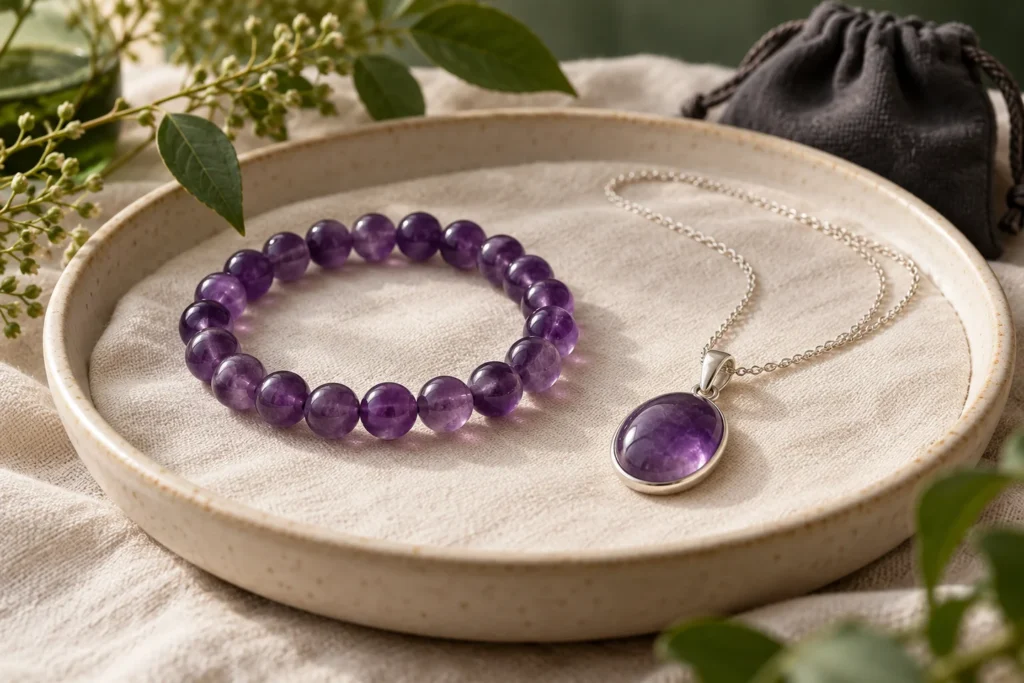
So where do all the "don't wear amethyst every day" warnings actually come from? And which ones have a practical basis? Below, I break down the real wear scenarios, product forms, care routines, and belief-based claims — so you can make your own informed decision about wearing amethyst daily.
Is amethyst durable enough for everyday wear?
Many people worry that amethyst is too fragile for daily use. After all, if a stone can't handle regular contact, daily wear genuinely becomes a problem. But fragility is not actually amethyst's weakness.
Amethyst is a variety of quartz with a Mohs hardness of 7, which makes it harder than most common surfaces it would contact during a typical day. For most wearers, amethyst is durable enough for daily jewelry use — provided the piece is designed for everyday wear and handled with basic care.
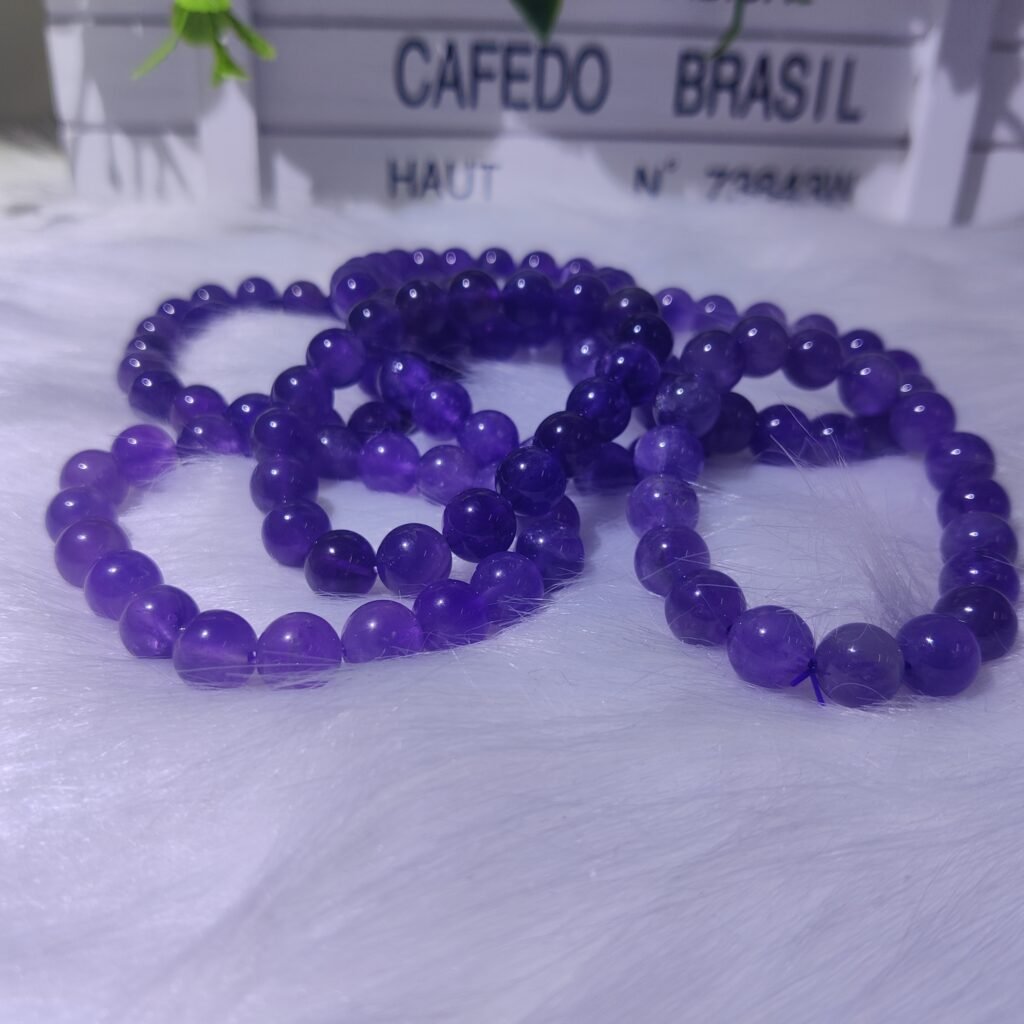
How does amethyst compare to other daily-wear stones?
To put amethyst's durability in context, here is a quick comparison with stones commonly worn every day:
| Gemstone | Mohs Hardness | Daily Wear Suitability |
|---|---|---|
| Diamond | 10 | Excellent |
| Sapphire / Ruby | 9 | Excellent |
| Topaz | 8 | Very good |
| Amethyst (Quartz) | 7 | Good with care |
| Moonstone | 6–6.5 | Fair — scratches more easily |
| Opal | 5.5–6.5 | Fair — vulnerable to impact and drying |
| Pearl | 2.5–4.5 | Poor — very sensitive to chemicals and abrasion |
At a hardness of 7, amethyst sits comfortably above many popular jewelry stones. It resists most casual scratching. Dust and sand particles — which contain quartz — are the main scratch risk, because they match amethyst's hardness.3
What actually damages amethyst in daily life?
From a care perspective, the threats to amethyst during daily wear are not mysterious. They are physical and chemical:
- Impact and pressure. Dropping an amethyst ring on a tile floor, knocking it against a countertop, or banging it during exercise can chip or crack the stone. Quartz has a conchoidal fracture pattern, meaning it can chip in a shell-like shape on impact.4
- Prolonged UV and heat exposure. Amethyst gets its purple color from trace iron and irradiation within the crystal lattice.5 Extended exposure to direct sunlight or high heat can cause gradual color fading.6 This is a slow process — a walk outside won't ruin your stone — but leaving amethyst on a sunny windowsill for weeks can visibly lighten it.
- Chemical contact. Household cleaners, chlorine in swimming pools, perfume, lotion, and hair products can dull the surface polish or leave residues that cloud the stone over time.
- Abrasion from harder materials. If your amethyst piece sits in a jewelry box alongside diamonds, sapphires, or topaz, those harder stones can scratch it.
In daily product handling — whether we are polishing amethyst beads, inspecting finished bracelets, or packing wholesale orders — we see the practical evidence of these risks. Stones that arrive with micro-chips almost always show impact damage, not some inherent fragility. The material itself is sound. The damage comes from how and where it is worn.
When should you remove amethyst to avoid damage?
Knowing that amethyst is reasonably durable is only half the answer. The more useful question is: which specific daily situations pose a real risk? This is where the "don't wear it every day" advice has a grain of truth — not because the stone is cursed, but because certain activities accelerate wear.
Removing your amethyst piece in specific situations is the single most effective way to keep it looking good for years. Here is a practical list of when to take it off.
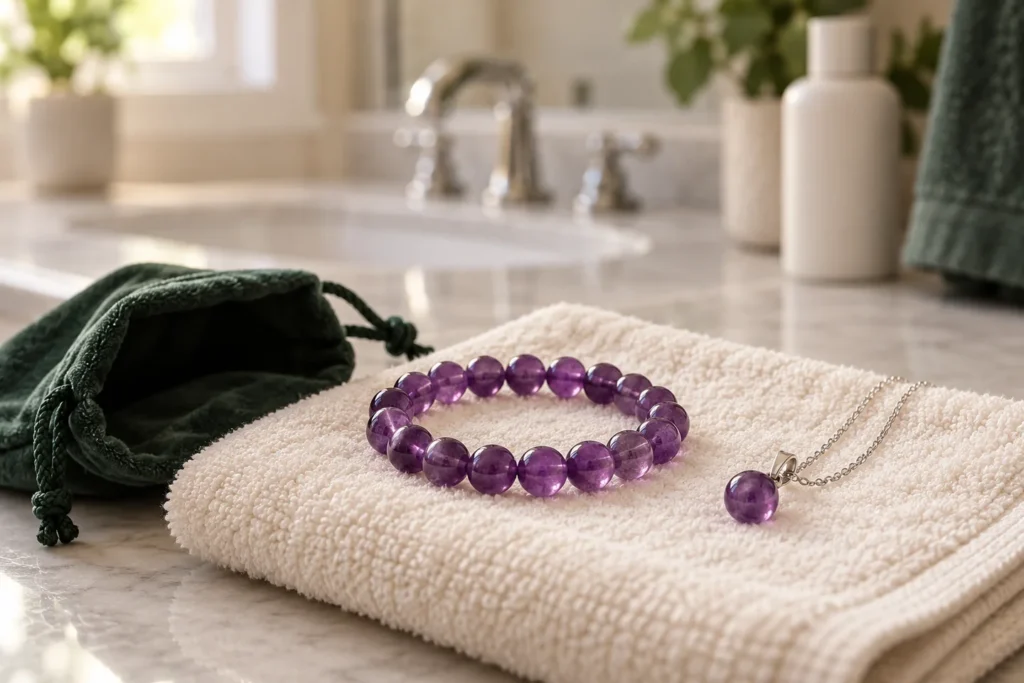
Situations where removal is recommended
-
Showering and bathing. Soap, shampoo, and conditioner leave film on the stone surface. Hot water and sudden temperature changes can damage amethyst, especially if it has inclusions or fractures. Repeated soap buildup dulls the polish gradually.
-
Swimming. Chlorinated pools and saltwater are both problematic.7 Chlorine can react with metal settings and leave chemical residue on the stone. Salt can be abrasive and corrosive to findings.
-
Exercising and sports. Gym equipment, weights, and impact sports put direct mechanical stress on stones and settings. Sweat — mildly acidic — adds a chemical element over time.
-
Housework and cleaning. Bleach, ammonia-based cleaners, dish soap, and abrasive pads are all enemies of polished gemstone surfaces.8 Even natural cleaning solutions like vinegar are acidic enough to affect surface luster with repeated exposure.
-
Applying cosmetics, perfume, and lotion. These products contain oils, alcohols, and chemical compounds that can coat or react with the stone surface. A good rule: put your amethyst jewelry on last, after all products have been applied and absorbed.
-
Sleeping. This one is less about the stone and more about the jewelry. Rolling onto a beaded bracelet can stress the elastic cord. A pendant chain can tangle or press uncomfortably against skin. A ring prong can catch on bedding. From a product longevity standpoint, sleeping without jewelry reduces mechanical stress on findings and cords.
-
Cooking and food preparation. Grease splatter, acidic foods (citrus, tomato), and handwashing with dish soap all contribute to surface buildup.
A simple daily routine
For most wearers, the routine is straightforward:
Put amethyst on after your morning routine (shower, skincare, makeup). Remove it before bed, before exercise, and before any cleaning or water-intensive task. Wipe it with a soft, dry cloth before storing.
This approach is not specific to amethyst — it applies to almost all gemstone jewelry. The point is that daily wear is perfectly fine. Daily wear without ever removing the piece is where problems start.
Does the product form affect how well amethyst handles daily wear?
Not all amethyst jewelry is created equal when it comes to everyday durability. A smooth, bezel-set amethyst pendant behaves very differently from a raw amethyst cluster ring during a normal day. Product form matters significantly.
From our experience supplying different amethyst product forms to retailers, the shape, setting, and construction of a piece directly determine how much daily handling it can tolerate. Buyers who understand this can choose — or recommend to their customers — the right piece for everyday use.
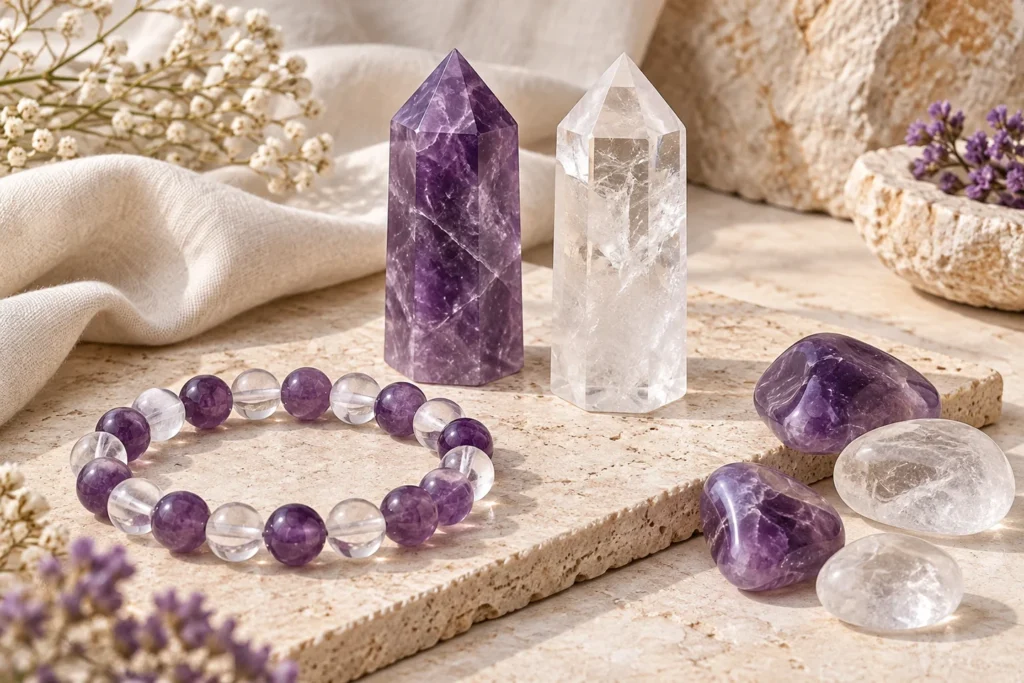
Comparing amethyst product forms for daily wear
| Product Form | Daily Wear Tolerance | Key Risk |
|---|---|---|
| Beaded bracelet (polished round beads) | Good — smooth surface distributes contact | Elastic cord stretching or breaking over time |
| Simple pendant (cabochon or tumbled) | Good — low exposure, protected by clothing | Chain tangling, clasp wear |
| Stud earrings | Very good — minimal contact during activities | Small risk of loss if backs loosen |
| Prong-set ring | Fair — prongs expose stone edges | Prongs catching, stone chipping on impact |
| Raw/rough amethyst ring | Poor — uneven surfaces catch and chip easily | Snagging on fabric, breaking points or tips |
| Statement necklace with multiple stones | Fair — more weight, more contact points | Stones clicking together, clasp fatigue |
Why beaded bracelets and simple pendants work best
In daily product handling and wholesale communication, the most common amethyst products our retail customers reorder for "everyday wear" positioning are polished beaded bracelets and simple pendant necklaces. There are good practical reasons for this:
- Polished round beads have no sharp edges or protruding points. Contact with surfaces results in sliding friction, not concentrated impact. The risk profile is low.
- Bezel settings (where metal wraps around the stone's edge) protect the girdle — the most chip-prone area — far better than prong settings.
- Tumbled or cabochon-cut stones in pendants hang freely and rarely contact hard surfaces during normal movement.
Rings, by contrast, take the most abuse of any jewelry form. Your hands touch everything: doors, keyboards, countertops, steering wheels. A prong-set amethyst ring is not a bad product, but it requires more awareness. If someone asks "can I wear amethyst every day?" and they mean a ring, the care advice becomes more specific and more important.
A note on elastic cord bracelets
Beaded amethyst bracelets strung on elastic cord are among the most popular everyday amethyst products globally. The stone beads themselves hold up well. The weak point is the cord. Elastic degrades with repeated stretching, chemical exposure (lotions, hand sanitizer), and friction.9 For daily wearers, I generally mention that the cord is a consumable part — expect to re-string every 6 to 12 months with regular use. This is normal maintenance, not a defect.
What about the energy, sleep, and mood claims?
This is the section that probably brought you here. The internet is full of claims that wearing amethyst every day can cause energy overload, insomnia, emotional instability, or spiritual interference. These claims are the primary reason people ask "why can't you wear amethyst every day?"
From a supplier perspective, I want to be straightforward: energy, sleep, and mood effects attributed to amethyst are matters of personal belief and subjective experience, not established scientific or medical fact.10 We process, shape, and supply amethyst. We do not perform clinical studies, and we are not qualified to make health claims.
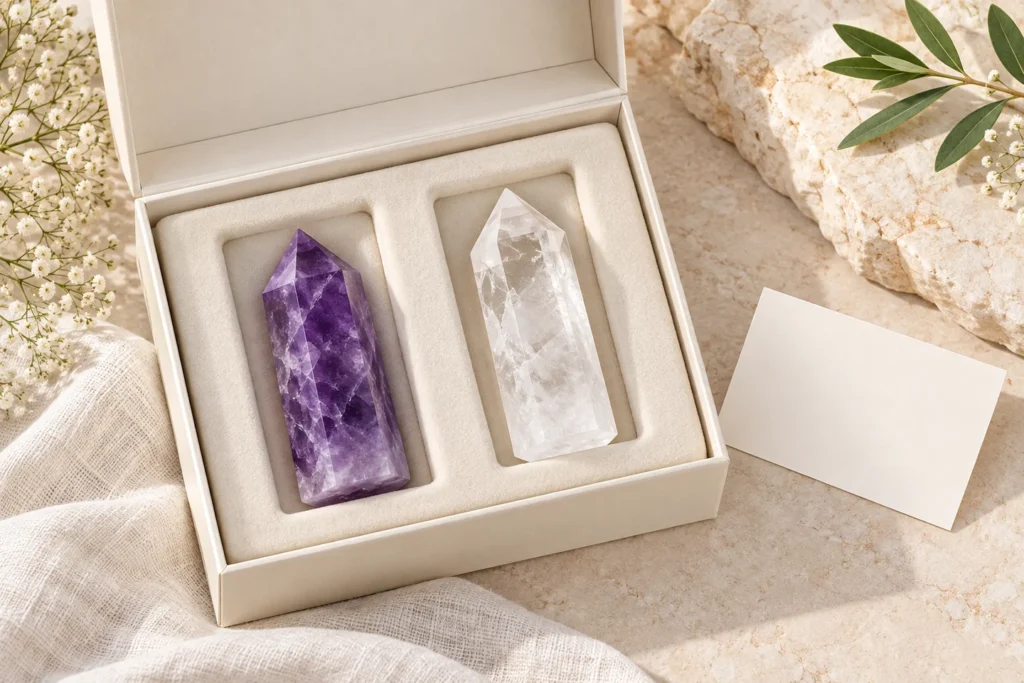
Where do these claims come from?
Most "don't wear amethyst every day" warnings originate from crystal healing and metaphysical wellness communities. In these traditions, amethyst is associated with the third eye and crown chakras, calming energy, and spiritual awareness. Some practitioners believe that constant contact with a "high-vibration" stone can overstimulate sensitive individuals — leading to vivid dreams, headaches, or restlessness.
These beliefs are widely held and deeply meaningful to many people. I respect that. However, they are not the same as verified, peer-reviewed scientific evidence.
A practical approach to subjective discomfort
Here is what I think is the most honest guidance:
- If you feel uncomfortable wearing amethyst for long periods — trouble sleeping, headaches, restlessness — simply wear it for shorter durations. There is no risk in reducing wear time. You do not need a metaphysical framework to justify a practical comfort adjustment.
- If you feel perfectly fine wearing amethyst all day, there is no evidence-based reason to stop. Enjoy it.
- Correlation is not causation. If you started wearing amethyst and also started sleeping poorly, consider other variables first: stress, screen time, caffeine, a new mattress, seasonal changes. Removing the bracelet is a fine experiment, but don't assume the stone is the cause without considering simpler explanations.
- Do not let fear-based content override your own experience. Some articles frame amethyst as dangerous or overpowering. This language sells clicks, not accurate information.
What we tell our retail customers
When B2B buyers ask us about energy claims — often because their end customers are asking — we suggest they:
- Acknowledge the belief without endorsing it as medical fact.
- Focus on care and wear instructions as the primary daily-wear guidance.
- Avoid health claims in product listings, as these can create regulatory issues and erode consumer trust.
- Let the customer decide their comfort level with daily wear based on their own experience.
This approach protects both the retailer and the consumer. It keeps the focus on the product — its beauty, durability, and craftsmanship — rather than unverifiable promises.
How should you clean and care for amethyst you wear daily?
If you do wear amethyst every day — or most days — a simple care routine makes the difference between a piece that stays vibrant and one that gradually dulls. Cleaning amethyst is not complicated, but doing it consistently matters.
The best daily care routine for amethyst jewelry involves gentle wiping after each use, periodic warm-water cleaning, and proper storage. No ultrasonic cleaners, no steam cleaners, no harsh chemicals.
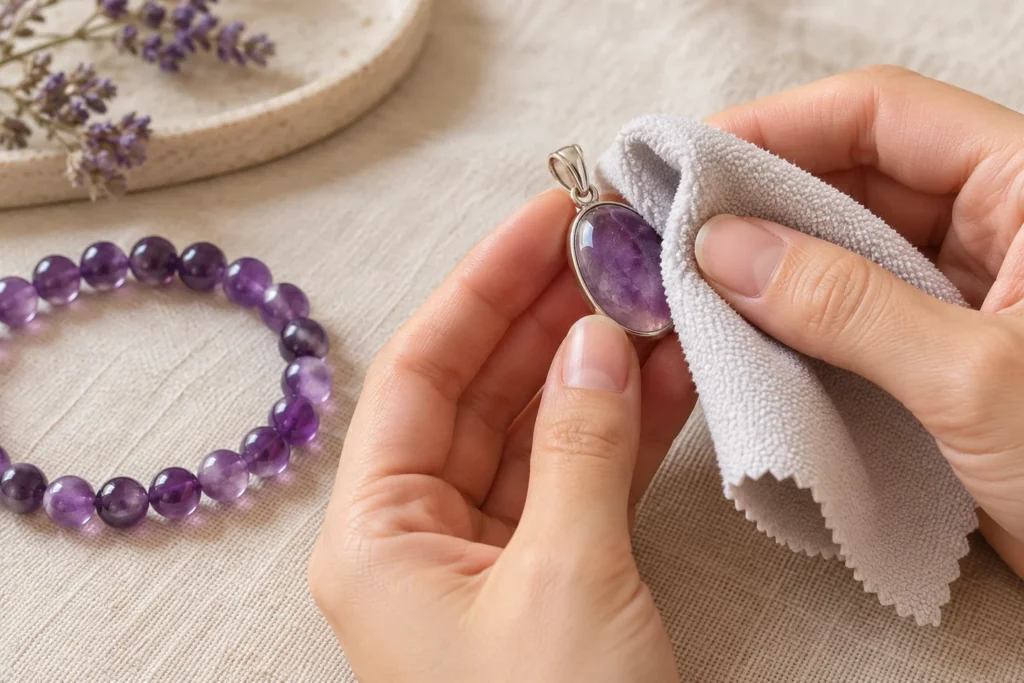
Step-by-step amethyst cleaning
- After each wearing: Wipe the piece with a soft, lint-free cloth (microfiber works well) to remove skin oils, sweat, and surface dust.
- Weekly deep clean: Soak in lukewarm water with a few drops of mild dish soap for 10–15 minutes. Use a soft-bristle brush (a clean toothbrush works) to gently scrub around settings and bead holes. Rinse with clean water and pat dry.
- Avoid:
- Hot water (thermal shock risk, especially if the stone has inclusions)
- Ultrasonic cleaners (can exploit internal fractures)
- Steam cleaners (heat and pressure combined)
- Bleach, ammonia, acetone, or alcohol-based solutions
Storage tips
- Store amethyst separately from harder stones (diamonds, sapphires, topaz) to prevent scratching.
- Keep it away from prolonged direct sunlight — a jewelry box or pouch is ideal.
- For beaded bracelets, store them flat rather than hanging, to reduce elastic tension.
When to seek professional help
If your amethyst has visible chips, a loosening setting, or significant surface cloudiness that home cleaning doesn't resolve, take it to a local jeweler. Re-polishing and re-setting are routine services. Do not attempt to buff out damage with abrasive materials at home — you may worsen the scratch pattern.
Frequently Asked Questions
Can amethyst fade if I wear it outside every day?
Amethyst can fade with prolonged, sustained UV exposure — but normal daily outdoor wear (commuting, errands, short walks) will not cause noticeable color loss. The risk is extended direct sunlight over weeks or months, such as leaving a piece on a sunny dashboard. For typical daily wear, fading is minimal.
Is it bad luck to wear amethyst every day?
There is no evidence-based reason to believe wearing amethyst daily causes bad luck. This idea comes from certain spiritual traditions and is a matter of personal belief, not established fact. If you enjoy wearing amethyst, daily wear is perfectly fine from a material and practical standpoint.
Should I take off my amethyst bracelet to sleep?
Yes — but for practical reasons, not metaphysical ones. Sleeping with a beaded bracelet stresses the elastic cord and increases the risk of breakage. Rings and pendants can catch on bedding or press uncomfortably against skin. Removing jewelry before bed extends its lifespan.
Can I wear amethyst in the shower?
It is best to remove amethyst before showering. The stone itself is water-safe, but soap, shampoo, and conditioner leave residues that dull the surface over time. Repeated exposure also degrades elastic cords on bracelets and can affect certain metal findings.
How often should I clean amethyst I wear daily?
Wipe it with a soft cloth after each wearing. Do a gentle warm-water soak with mild soap once a week. This routine keeps the stone polished and free of buildup without risking damage from harsh methods.
Conclusion
The claim that you can't wear amethyst every day is largely based on belief-based warnings, not material science or practical evidence. Amethyst is a durable quartz gemstone rated 7 on the Mohs scale — it handles daily wear well when you follow basic care habits. The real guidance is situational: remove your amethyst piece before showering, swimming, exercising, cleaning, and sleeping. Choose product forms suited to everyday use — polished beaded bracelets and simple pendants are the most forgiving. Clean it regularly with gentle methods. And if energy or mood claims concern you, trust your own experience over fear-driven internet advice.
At GD Crystal, we supply a wide range of amethyst products — from polished beads and tumbled stones to carved forms and tower points — to retailers and brand owners who want to offer their customers quality they can wear and enjoy. If you are sourcing amethyst products for your store and want to discuss materials, product forms, or wholesale terms, reach out to our team for a quote tailored to your needs.
References
- "Amethyst Care and Cleaning Guide", https://www.gia.edu/amethyst-care-cleaning. An authoritative gemological reference identifies amethyst as the purple variety of quartz and lists quartz at 7 on the Mohs hardness scale, supporting the material basis for describing amethyst as moderately durable in jewelry. Evidence role: definition; source type: institution. Supports: The source should identify amethyst as a variety of quartz and give quartz or amethyst a Mohs hardness of 7.. Scope note: Mohs hardness indicates scratch resistance, not resistance to chipping, heat, chemicals, or setting failure. ↩
- "Amethyst Care and Cleaning Guide", https://www.gia.edu/amethyst-care-cleaning. Gemological care guidance notes that amethyst, while relatively hard, should be protected from sharp blows, harsh chemicals, and extended heat or light exposure, which contextualizes the article's daily-wear precautions. Evidence role: general_support; source type: institution. Supports: The source should support that amethyst jewelry requires protection from harsh chemicals, excessive heat or light, and physical blows.. Scope note: Such guidance supports prudent care practices but does not quantify the likelihood of damage under ordinary daily conditions. ↩
- "Silica Statistics and Information | U.S. Geological Survey", https://www.usgs.gov/centers/national-minerals-information-center/silica-statistics-and-information. Geological teaching materials commonly identify quartz as a major constituent of sand and place quartz at 7 on the Mohs scale, supporting the explanation that quartz-bearing grit can abrade amethyst surfaces. Evidence role: mechanism; source type: education. Supports: The source should show that quartz is common in sand or dust and has Mohs hardness 7, making it capable of abrading materials of similar or lower hardness.. Scope note: The source would support the abrasion mechanism generally, not prove that dust or sand is the main scratch risk in every jewelry-use scenario. ↩
- "Conchoidal fracture", https://en.wikipedia.org/wiki/Conchoidal_fracture. Mineralogical references describe quartz as having conchoidal fracture, a shell-like breakage pattern, supporting the article's explanation that amethyst can chip when struck despite its hardness. Evidence role: definition; source type: education. Supports: The source should describe quartz as having conchoidal fracture and explain the shell-like fracture pattern.. Scope note: Fracture habit explains a possible damage mode but does not predict whether a particular jewelry piece will chip under a specific impact. ↩
- "Iron oxidation states and their influence on amethyst color", http://ui.adsabs.harvard.edu/abs/2026RaPC..23913406D/abstract. Research on amethyst color centers attributes the purple coloration of quartz to iron-related defects modified by irradiation, supporting the article's mechanism for amethyst's color. Evidence role: mechanism; source type: paper. Supports: The source should explain that amethyst coloration is associated with iron impurities and irradiation-induced color centers in quartz.. Scope note: The source supports the mineralogical mechanism of color formation, not the durability of any finished jewelry item. ↩
- "Amethyst Care and Cleaning Guide", https://www.gia.edu/amethyst-care-cleaning. Gemological and mineralogical literature reports that amethyst color can be modified by heating and may be affected by prolonged light exposure, supporting the precaution against sustained sun or heat exposure. Evidence role: mechanism; source type: research. Supports: The source should support that amethyst color can be altered or reduced by heat and/or prolonged light exposure.. Scope note: This support is contextual; fading rates depend on the stone's origin, color-center chemistry, exposure intensity, and duration. ↩
- "Tips on Caring for Jewelry", https://www.gia.edu/gia-news-research-tips-caring-jewelry. Jewelry-care guidance from gemological institutions warns that chlorine and saltwater exposure can damage or corrode jewelry components, supporting the recommendation to remove amethyst pieces before swimming. Evidence role: general_support; source type: institution. Supports: The source should support that chlorine and saltwater exposure can harm jewelry materials or settings and that removal before swimming is prudent.. Scope note: The evidence applies broadly to jewelry materials and settings rather than isolating amethyst as the most vulnerable component. ↩
- "Holiday Buying Guide: How to Clean Jewelry", https://4cs.gia.edu/en-us/blog/holiday-buying-guide-clean-jewelry/. Gemstone-care references advise avoiding harsh household chemicals and abrasive cleaning methods on jewelry, supporting the article's warning that such exposures can dull or damage polished gemstone surfaces. Evidence role: general_support; source type: institution. Supports: The source should support avoiding harsh chemicals and abrasives when cleaning gemstone jewelry.. Scope note: The source would support the general care principle; specific effects may vary by gemstone, polish, treatment, and metal setting. ↩
- "Elastic polymer that is both stiff and tough, resolves long- …", https://seas.harvard.edu/news/2021/10/elastic-polymer-both-stiff-and-tough-resolves-long-standing-quandary. Materials-science literature on elastomers describes degradation from cyclic strain, chemical exposure, and abrasion, supporting the article's explanation that bracelet elastic can fail before amethyst beads do. Evidence role: mechanism; source type: paper. Supports: The source should support that elastomeric materials degrade under repeated mechanical strain, chemical exposure, and abrasive wear.. Scope note: The evidence is general to elastomeric materials and may not directly test the specific elastic cords used in gemstone bracelets. ↩
- "Sleep Disorders and Complementary Health Approaches", https://www.nccih.nih.gov/health/sleep-disorders-and-complementary-health-approaches. Public health and medical-evidence sources do not recognize crystal healing as an established treatment for sleep, mood, or energy-related conditions, supporting the article's distinction between personal belief and medical fact. Evidence role: expert_consensus; source type: government. Supports: The source should support that crystal-healing claims lack established clinical evidence for effects on sleep, mood, or health outcomes.. Scope note: The source can address the absence of established clinical evidence but cannot disprove every individual subjective experience. ↩