Every crystal retailer has faced this moment: a customer holds up a perfectly transparent point and asks, "Is this real?" If you can't answer confidently, you risk losing a sale — or worse, selling mislabeled stock. Knowing how to tell if it's real clear quartz starts not with a single magic test, but with a layered approach to purchasing risk control.
Real clear quartz is identified through a combination of visual observation, preliminary physical checks, supplier transparency, and — when stakes are high — professional gemological testing. No single home test guarantees authenticity.1 For B2B buyers, verification is less about one dramatic moment and more about building a reliable process: inspecting batch photos, asking the right supplier questions, understanding natural characteristics, and confirming material descriptions before you order.
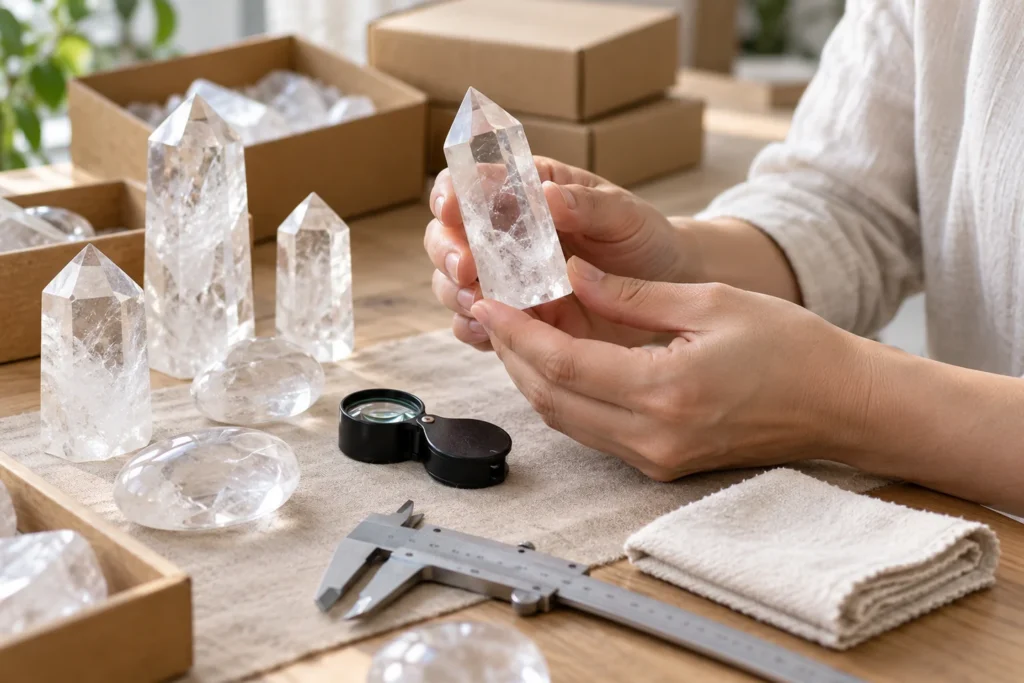
The truth is, distinguishing genuine clear quartz from glass or synthetic lookalikes involves more nuance than most online guides admit. Below, I'll walk you through the visual clues, common tests, their real limitations, and — most importantly — the supplier communication strategies that actually protect your business.
Why Should You Reframe "Is It Real?" as a Risk Question?
Most buyers approach clear quartz authentication looking for a yes-or-no answer. But the real question hiding underneath is: What purchasing risk am I actually trying to reduce?
When you reframe authenticity as a risk-control decision, you stop chasing a single definitive test and start building a verification process that protects your inventory, your reputation, and your customer relationships. For resale buyers, the risks include receiving glass or synthetic material sold as natural quartz, relying on unreliable home tests, or being unable to explain product features to end customers.
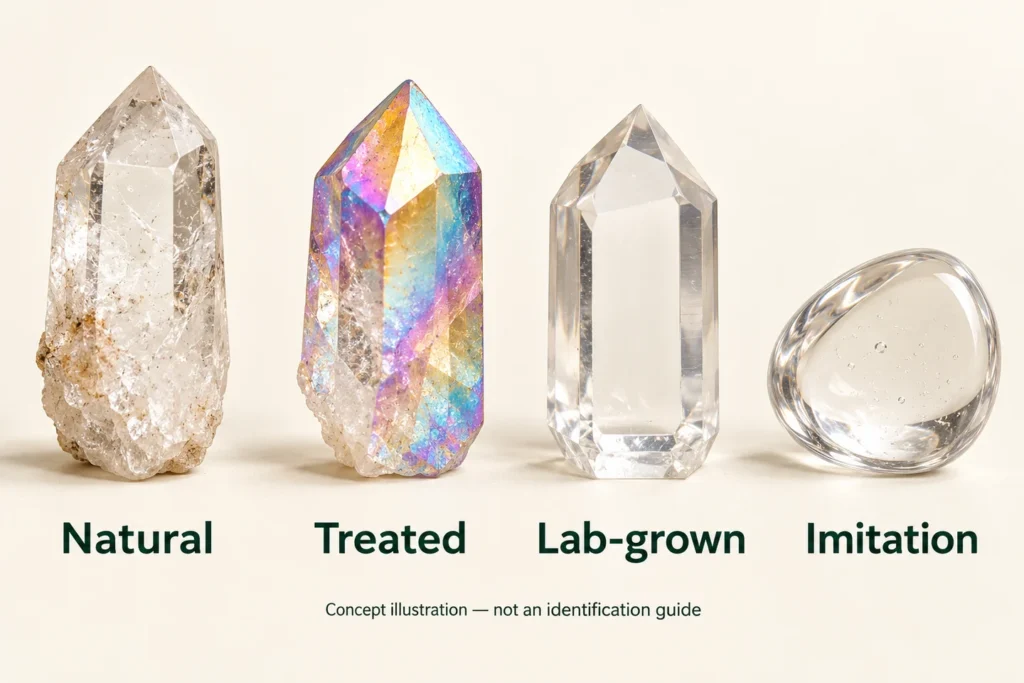
The Three Risks You're Really Managing
In wholesale conversations, buyers often tell me they want to "make sure it's real." When I dig deeper, their concerns usually fall into three distinct categories:
- Material risk — Am I actually receiving natural clear quartz, or could this be glass, synthetic quartz, or a different mineral entirely?
- Testing risk — Am I relying on a home method that sounds convincing online but isn't actually reliable?
- Resale risk — Can I confidently describe this product to my customers, explain its natural features, and stand behind what I'm selling?
Each of these risks requires a different mitigation strategy. Material risk is addressed through supplier communication and, where necessary, professional testing. Testing risk is managed by understanding the limitations of common checks. Resale risk is reduced by learning what natural clear quartz actually looks like — including its imperfections.
Why "Perfect" Doesn't Mean "Fake"
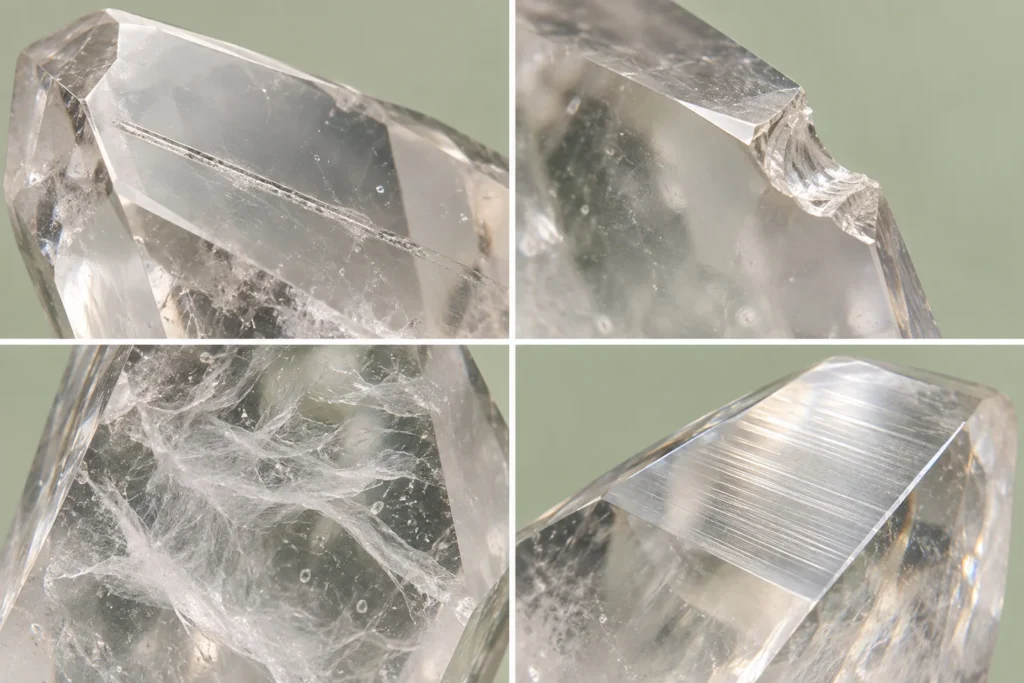
One of the most common misconceptions I encounter is that extremely clear, flawless-looking quartz must be glass or synthetic. This isn't necessarily true. Some natural clear quartz — particularly higher-grade material — can be remarkably transparent.2 Conversely, natural clear quartz frequently contains:3
- Internal veils (wispy, cloud-like formations)
- Ice cracks (internal fractures that create rainbow effects)
- Mineral inclusions (tiny trapped minerals or phantoms)
- Cloudy zones mixed with transparent areas
Key takeaway: Perfection should prompt better questions to your supplier — not instant trust or automatic rejection. Ask about the source, grade, and whether any treatment or selection process was applied.
The point isn't to become suspicious of every clean piece. It's to develop enough familiarity with natural variation that you know when to ask follow-up questions.
What Do Common Visual Checks Actually Tell You?
Visual inspection is the first step most buyers take when evaluating clear quartz. But how much can you really learn just by looking?
Visual checks provide useful preliminary clues about whether clear quartz is natural, but they are not definitive. They work best when combined with other observations and supplier information. Relying on a single visual cue — like the presence or absence of bubbles — can lead to false confidence in either direction.
Bubbles
Round, perfectly spherical bubbles trapped inside a transparent piece are often cited as a sign of glass. This is generally useful as a preliminary clue — glass manufacturing commonly produces gas bubbles, while natural quartz does not typically contain perfectly round air pockets.4 However:
- Some fluid inclusions in natural quartz can superficially resemble bubbles to an untrained eye.
- The absence of bubbles does not confirm that a piece is natural quartz.
- High-quality glass or synthetic quartz may contain no visible bubbles at all.5
Clarity and Internal Features
| Feature | Natural Clear Quartz | Glass | Synthetic Quartz |
|---|---|---|---|
| Internal veils/clouds | Common, especially in mid-grade | Absent | Usually absent |
| Rainbow fractures (ice cracks) | Common | Rare (may appear if chipped) | Rare |
| Mineral inclusions | Possible (rutile, chlorite, etc.) | Absent | Usually absent |
| Perfect uniform clarity | Possible in high-grade, but less common | Very common | Very common |
| Growth lines or phantoms | Possible | Absent | May show different growth patterns |
This table is a starting point, not a diagnostic chart. The key lesson for buyers: if a batch of "clear quartz" is uniformly flawless with zero internal features across every single piece, it warrants closer inspection and direct supplier questions.
Surface and Polish Quality
Natural quartz polished into spheres, towers, or palm stones will typically show consistent polish quality appropriate to the material's hardness. Glass is softer and may polish differently. However, surface finish alone is not a reliable differentiator for most buyers without a side-by-side comparison and some hands-on experience.
How Reliable Are Popular Home Tests for Clear Quartz?
Search online and you'll find dozens of "easy tests" to check if clear quartz is real. The problem? Most are oversimplified, and some are misleading. Understanding their limitations is essential for any resale buyer.
Popular home tests — including the scratch test, temperature test, and light test — can offer supporting clues but should never be treated as standalone authentication methods. Each has specific limitations that are rarely discussed in consumer-facing articles.
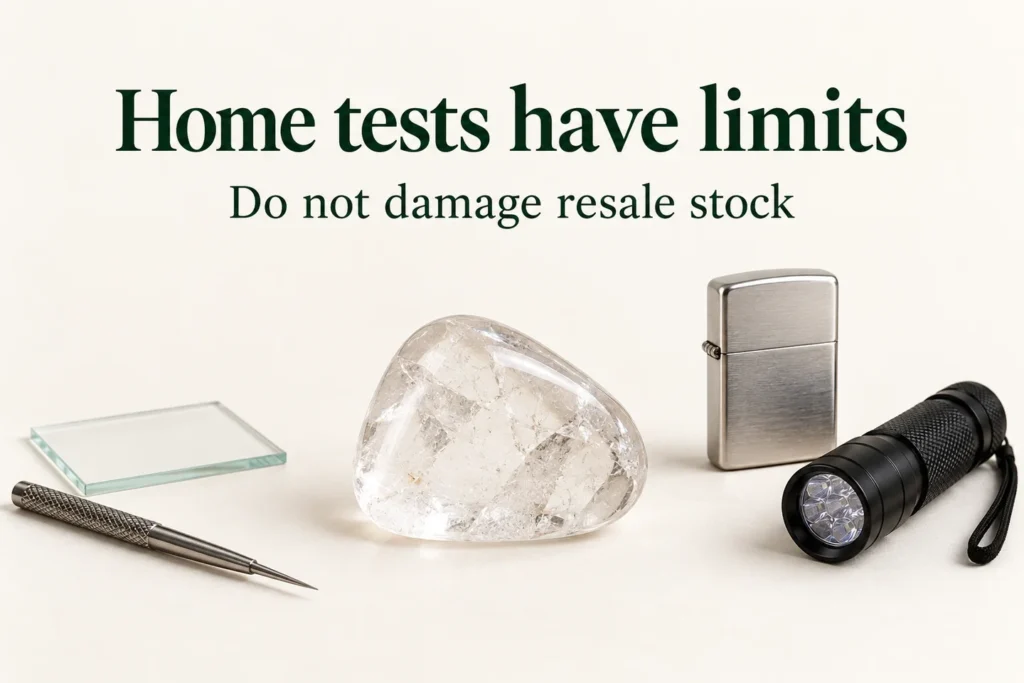
The Scratch (Hardness) Test
Natural quartz has a Mohs hardness of approximately 7, which means it should scratch glass (hardness ~5.5).6 This is general mineralogical knowledge that buyers can verify through standard gemological references.
What it tells you:
- If a piece cannot scratch glass, it is likely not quartz.
- If it can scratch glass, it is consistent with quartz — but also consistent with many other minerals and some synthetic materials at similar or higher hardness.
Limitations:
- This test can damage the product and is impractical for finished retail items like polished spheres or carved pieces.
- It does not distinguish natural quartz from synthetic quartz, which has the same hardness.7
- Results can be misread without practice.
The Temperature Test
Quartz is sometimes described as feeling cool to the touch compared to glass because of its thermal conductivity.8 There is some basis for this, but:
- The difference is subtle and depends heavily on ambient conditions.
- After a piece has been sitting in a warm room or handled, temperature cues disappear.
- This test is extremely unreliable as a standalone method.
The Light Test
Holding clear quartz up to a light source and looking for inclusions, rainbows, or uneven clarity can reveal natural characteristics. This is a reasonable first-pass observation, but it requires some experience to interpret correctly.
Honest Assessment of Home Tests
| Test | Usefulness | Reliability as Sole Method | Practical for Finished Products? |
|---|---|---|---|
| Scratch test | Moderate | Low | No (damages product) |
| Temperature feel | Low | Very Low | Yes, but unreliable |
| Light/inclusion check | Moderate | Low–Moderate | Yes |
| Bubble check | Moderate (for ruling out glass) | Low | Yes |
| Weight/heft comparison | Low | Very Low | Only with reference pieces |
My honest recommendation: Use these tests as supporting evidence within a broader evaluation process. If you need certainty for a high-value purchase, professional gemological testing from a qualified laboratory is the only truly reliable method.
What Should B2B Buyers Ask Suppliers Before Ordering?
For wholesale or resale buyers, the most practical authentication step happens before the product ships — during supplier communication. This is where you reduce the majority of your purchasing risk.
B2B buyers should request current batch photos and videos, ask for explicit material descriptions including any treatment disclosure, confirm size and weight ranges, understand the product form and grade, and clarify consistency expectations across the batch. These questions do more to protect your business than any home test.
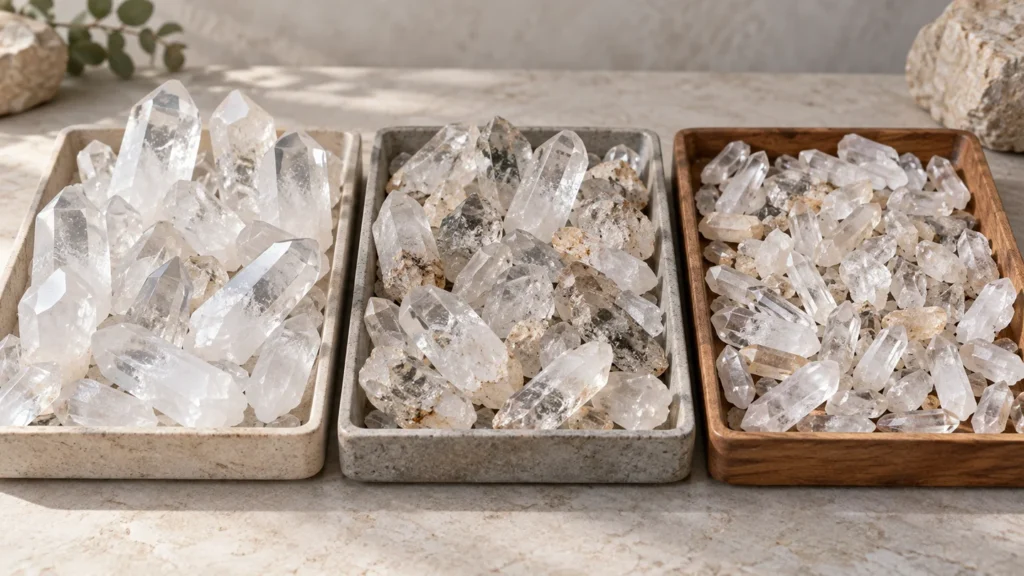
Essential Questions for Your Supplier
Based on years of handling purchasing inquiries from crystal retailers and ecommerce sellers, here is the checklist I recommend for any buyer evaluating a clear quartz order:
-
Current batch photos and video — Not recycled catalog images. Ask for photos of the actual batch available now, ideally with a ruler or reference object for scale. Video is especially helpful for showing clarity, inclusions, and surface quality.
-
Material description — Is this described as natural clear quartz? What is the source region, if known? Is the supplier willing to put the material description in writing on the invoice or packing list?
-
Treatment disclosure — Has the material been treated in any way (coating, irradiation, bonding, reconstitution)? For natural clear quartz, significant treatments are uncommon, but asking the question signals that you are an informed buyer and sets expectations.
-
Size and weight range — What is the expected size and weight range for the batch? Natural products vary, so understanding the spread helps you plan pricing and product listings.
-
Product form and grade — Are these rough pieces, polished points, spheres, tumbled stones? What grade designation does the supplier use, and what does it mean in practical terms (e.g., clarity level, inclusion density)?
-
Batch consistency — How consistent will the pieces be in terms of clarity, size, and appearance? This is particularly important for ecommerce sellers who need to photograph representative samples.
-
Sample or trial order availability — For first-time orders, can you start with a smaller quantity to evaluate before committing to a larger batch?
Why Supplier Communication Matters More Than Home Tests
Here is the reality for resale buyers: by the time you are holding product in your hands and running a scratch test, the purchasing decision is already made. Your money is spent. Returns may or may not be an option depending on the supplier's terms.
The most effective risk reduction happens upstream — in the conversation before you place the order. A supplier who willingly provides batch-specific photos, clear material descriptions, and honest answers about what to expect is giving you far more authentication value than a temperature test ever could.
This doesn't mean you should skip physical inspection when product arrives. It means the supplier conversation is your first and most important line of defense.
How Can You Explain Natural Features to Your Customers?
Even after you've verified your clear quartz and feel confident in your supplier, there's one more risk to manage: the conversation with your end customer. Natural features that are perfectly normal can look like "flaws" to an uninformed buyer.
Educating your customers about the natural characteristics of real clear quartz — including veils, ice cracks, inclusions, and clarity variations — builds trust, reduces returns, and actually becomes a selling point. Customers who understand natural variation are more loyal and less likely to question authenticity.
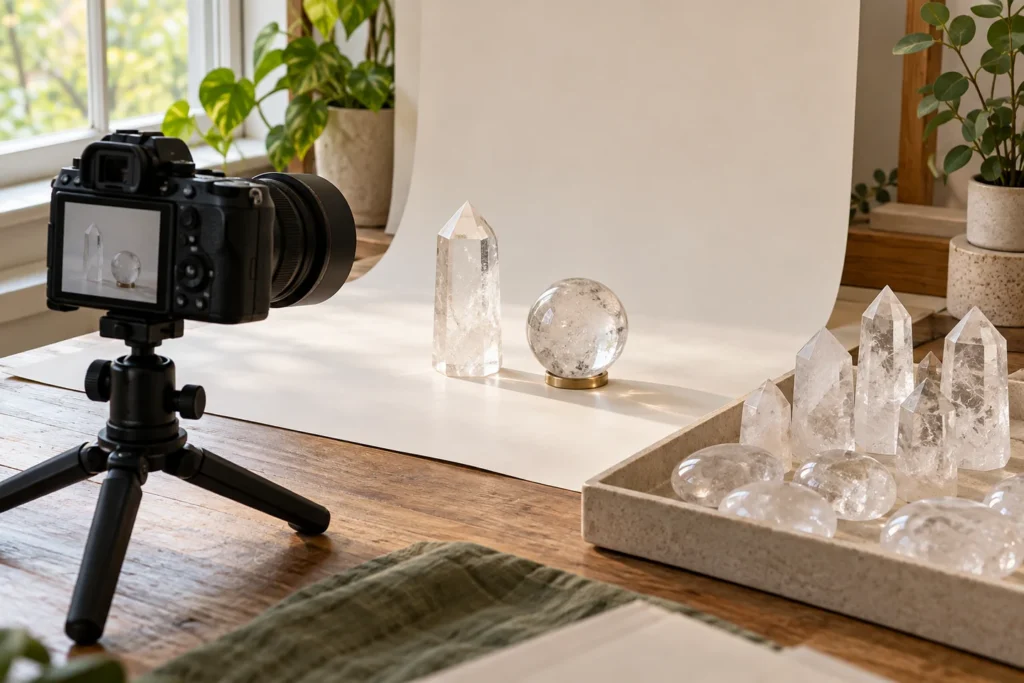
Turning "Imperfections" Into Selling Points
I've seen many retailers struggle with this: a customer notices a small cloud or an internal fracture and assumes the product is low quality or fake. In reality, these features are often evidence that the piece is genuinely natural.
Here's a framework for talking about common natural features:
-
Veils and clouds: "These wispy internal formations are natural growth features. They formed over thousands of years as the crystal grew. They're actually a good sign that you're looking at natural quartz, not glass or synthetic material."
-
Ice cracks with rainbows: "These internal fractures create beautiful rainbow effects when light passes through them. They're one of the most sought-after natural features in clear quartz."
-
Mineral inclusions: "The tiny formations you see inside are other minerals that were trapped during the crystal's growth. Each one makes your piece unique."
-
Clarity variation: "Natural clear quartz ranges from water-clear to slightly milky. Variation within a single piece is completely normal and reflects natural growth conditions."
Product Descriptions for Ecommerce Sellers
If you sell online, your product listings should proactively address natural features:
- Photograph pieces honestly, showing inclusions and variations.
- Include a line in your description noting that natural quartz may contain internal features.
- Specify whether your listing represents the exact piece (for one-of-a-kind items) or a representative sample (for batch listings).
- Avoid describing natural features as "flaws" or "damage" in your copy.
This approach not only reduces returns and disputes — it positions your brand as knowledgeable and transparent, which builds long-term customer loyalty.
Frequently Asked Questions
Can you tell if clear quartz is real just by looking at it?
Visual inspection provides useful preliminary clues — such as the presence of natural inclusions, veils, or the absence of perfectly spherical bubbles — but it cannot confirm authenticity with certainty. For definitive identification, professional gemological testing is recommended.9 Visual checks are best used alongside supplier communication and other observations.
Does real clear quartz always have inclusions or cloudiness?
No. High-grade natural clear quartz can be remarkably transparent with minimal visible inclusions. The absence of inclusions does not automatically mean a piece is fake, just as their presence doesn't guarantee it's natural. When evaluating very clean material, ask your supplier about the source and grade rather than assuming the worst.
Is synthetic quartz the same as fake quartz?
Synthetic quartz is chemically identical to natural quartz — it is silicon dioxide grown in a laboratory.10 Whether it is "fake" depends on context. If synthetic quartz is sold as natural without disclosure, that is mislabeling.11 For B2B buyers, the key is to confirm with your supplier whether material is natural or synthetic and ensure your product descriptions reflect what you're actually selling.
What is the most reliable way to verify clear quartz for wholesale purchases?
The most reliable approach combines pre-purchase supplier communication (batch photos, material descriptions, treatment disclosure) with physical inspection upon arrival and, for high-value or high-volume orders, professional gemological testing from a qualified laboratory. No single home test replaces this layered process.
Should I test every piece of clear quartz I buy for resale?
Testing every individual piece is impractical for most resale businesses. A more realistic approach is to evaluate representative samples from each batch, establish trust with your supplier through consistent communication and trial orders, and invest in professional testing only when you have specific concerns or are evaluating a new supplier.
Conclusion
Learning how to tell if it's real clear quartz is ultimately about building a reliable verification process — not finding one quick trick. For B2B buyers, this means combining visual observation with an honest understanding of home test limitations, proactive supplier communication, and professional testing when the stakes justify it. Natural clear quartz contains a range of internal features that are normal, not defective, and learning to recognize and explain them is a business asset.
The most effective authentication happens before you place your order: by asking your supplier the right questions, requesting current batch documentation, and starting with trial quantities when working with a new source. If you're sourcing clear quartz for your retail shop, ecommerce store, or crystal brand, I encourage you to reach out with your specific requirements. At GD Crystal, we're happy to provide batch photos, material descriptions, and transparent communication to help you buy with confidence.
References
- "How GIA Analyzes Colored Stones from Start to Finish", https://www.gia.edu/gia-news-research/guide-how-gia-analyzes-colored-stones. Gemological identification references describe quartz authentication as a process based on multiple physical and optical observations, with laboratory testing required when a definitive distinction from simulants or synthetic material is needed. Evidence role: expert_consensus; source type: institution. Supports: A gemological authority should support that mineral identification normally relies on multiple observations and, when certainty is needed, laboratory methods rather than a single informal home test.. Scope note: The source would support the general identification principle, not authenticate any particular quartz item discussed in the article. ↩
- "Synthetic Rock Crystal Quartz Cluster with Natural-Looking …", https://www.gia.edu/gems-gemology/winter-2022-gemnews-synthetic-rock-crystal-quartz. Standard mineralogical references define rock crystal as the transparent, colorless variety of quartz, supporting the point that high transparency alone is not evidence of imitation. Evidence role: definition; source type: encyclopedia. Supports: A mineral reference should support that rock crystal is the transparent, colorless variety of quartz.. Scope note: This supports the possibility of transparent natural quartz, not the authenticity of any specific flawless-looking specimen. ↩
- "Unusual Purple Fluid in Quartz", https://www.gia.edu/gems-gemology/fall-2022-microworld-unusual-purple-fluid-in-quartz. Mineralogical descriptions of quartz note that natural crystals may contain inclusions, fractures, growth zoning, and phantom structures, providing context for why internal features can occur in genuine clear quartz. Evidence role: general_support; source type: education. Supports: A university or gemological source should support that natural quartz may contain inclusions, internal fractures, growth zoning, or phantom features.. Scope note: The presence of such features is contextual evidence only; it does not by itself prove that a specimen is natural quartz. ↩
- "Quartz Assemblage Imitating Emerald", https://www.gia.edu/gems-gemology/summer-2025-lab-notes-quartz-assemblage-imitating-emerald. Gemological identification guides commonly treat rounded gas bubbles as evidence consistent with glass manufacture, whereas natural quartz is characterized by mineral, fluid, or fracture-related inclusions rather than trapped spherical air bubbles. Evidence role: mechanism; source type: institution. Supports: A gemological or materials source should support that gas bubbles can form during glass manufacture and are used as a clue for glass simulants.. Scope note: Bubble appearance is a preliminary clue and cannot conclusively identify the material without additional testing. ↩
- "TIE-28: Bubbles and Inclusions in Optical Glass", https://wp.optics.arizona.edu/optomech/wp-content/uploads/sites/53/2016/10/tie-28_bubbles_and_inclusions_us.pdf. Materials references on optical glass and synthetic quartz describe manufacturing controls that can yield highly transparent material with few or no visible internal bubbles, supporting the caution that bubble absence is not proof of natural origin. Evidence role: general_support; source type: research. Supports: A materials science or gemological source should support that high-quality glass and synthetic quartz can be produced with high optical clarity and without visible bubbles.. Scope note: This provides contextual support about manufacturing capability rather than a direct test for a specific object. ↩
- "Mineral Gemstones", https://pubs.usgs.gov/gip/gemstones/mineral.html. Geological hardness references list quartz at Mohs hardness 7 and common glass at roughly 5 to 5.5, supporting the use of a scratch check as a preliminary consistency test. Evidence role: definition; source type: government. Supports: A geological reference should support quartz's Mohs hardness and the relative softness of common glass.. Scope note: Hardness data support material compatibility with quartz but do not prove natural origin. ↩
- "Quartz", https://en.wikipedia.org/wiki/Quartz. References on hydrothermal synthetic quartz state that it is crystalline silicon dioxide with physical properties comparable to natural quartz, explaining why a hardness scratch test cannot distinguish natural from synthetic material. Evidence role: mechanism; source type: institution. Supports: A gemological or materials source should support that synthetic quartz and natural quartz share the same basic mineral composition and comparable hardness.. Scope note: The support concerns physical-property overlap; specialized laboratory observations may still distinguish growth origin. ↩
- "Fused quartz", https://en.wikipedia.org/wiki/Fused_quartz. Thermal perception studies show that the sensation of a material feeling cool depends on heat-transfer properties such as thermal conductivity and effusivity, so touch temperature can vary with material and environmental conditions. Evidence role: mechanism; source type: paper. Supports: A physics or materials source should support that perceived coolness depends on heat transfer properties such as thermal conductivity or effusivity.. Scope note: This supports the physical basis of the claim only contextually and does not validate touch as a reliable quartz authentication test. ↩
- "How GIA Analyzes Colored Stones from Start to Finish", https://www.gia.edu/gia-news-research/guide-how-gia-analyzes-colored-stones. Gemological laboratory references describe professional identification as relying on controlled optical, microscopic, and instrumental testing to distinguish natural gems from synthetics and imitations, supporting the recommendation for laboratory testing when certainty is required. Evidence role: expert_consensus; source type: institution. Supports: A gemological institution should support that professional testing uses controlled optical, microscopic, and instrumental methods to identify gemstones and distinguish natural, synthetic, and imitation materials.. Scope note: The source supports the role of laboratory testing generally, not the reliability of any single named laboratory or service. ↩
- "Quartz", https://en.wikipedia.org/wiki/Quartz. Materials references describe synthetic quartz as laboratory-grown crystalline silicon dioxide, typically produced by hydrothermal growth methods, establishing that its chemical composition corresponds to natural quartz. Evidence role: definition; source type: research. Supports: A materials science or mineralogical source should support that synthetic quartz is laboratory-grown crystalline SiO2.. Scope note: Chemical identity does not mean natural origin; growth features and trace characteristics may still differ. ↩
- "Guides for the Jewelry, Precious Metals, and Pewter …", https://www.federalregister.gov/documents/2018/08/16/2018-17454/guides-for-the-jewelry-precious-metals-and-pewter-industries. The U.S. Federal Trade Commission's jewelry marketing guidance treats undisclosed laboratory-created origin as potentially deceptive when a product is represented as natural, supporting the statement that synthetic quartz sold as natural is mislabeling. Evidence role: general_support; source type: government. Supports: A consumer-protection source should support that representing a laboratory-created gemstone or mineral as natural without clear disclosure can be misleading.. Scope note: Regulatory wording and applicability vary by jurisdiction and product category; the source provides consumer-protection context rather than legal advice. ↩