Figuring out what real clear quartz looks like is one of the most common challenges for buyers sourcing crystal products for resale. A piece that's too perfect raises suspicion. A piece with visible inclusions sparks doubt. This uncertainty makes procurement decisions harder — especially when you're evaluating photos from overseas suppliers.
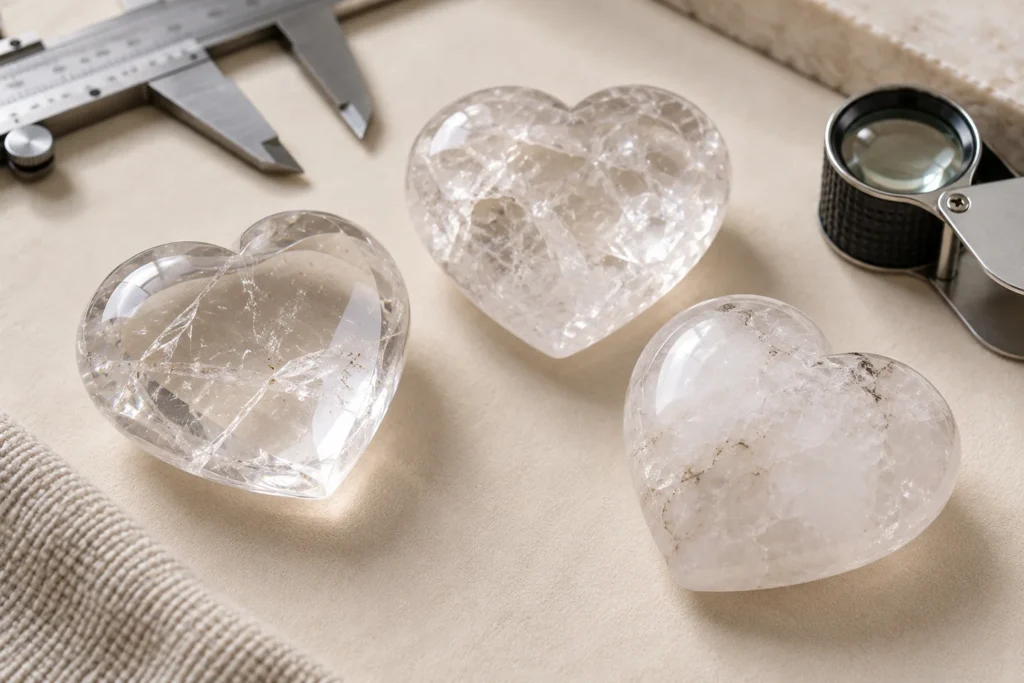
Real clear quartz ranges from highly transparent to slightly cloudy, and it almost always contains some internal features — subtle veils, ice-like fractures, wisps, tiny inclusions, or faint cloudiness. A piece that looks absolutely flawless and glass-like is not automatically more authentic; in fact, perfect clarity with zero internal character can sometimes indicate glass, synthetic material, or heavily edited product photography1. The most reliable approach combines visual assessment with transparent supplier communication and, when stakes are high, professional testing.
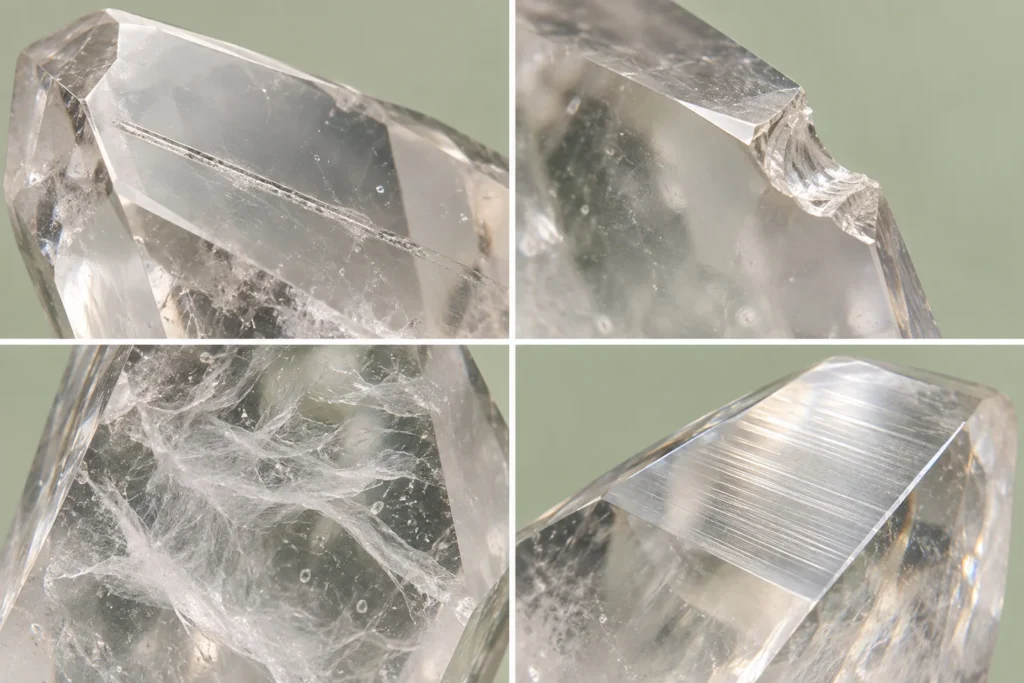
But visual appearance alone only gets you partway there. Below, I'll break down the specific features you should look for, the red flags to watch out for, why batch photos matter more than polished listings, and how to fold all of this into a practical sourcing workflow. Whether you stock crystal towers, spheres, palm stones, or tumbled stones, these guidelines apply across product forms.
What are the natural visual features of real clear quartz?
Many buyers assume that "clear quartz" should look like a perfectly transparent piece of glass. When their shipment arrives with wisps, veils, or faint cloudiness, they worry something is wrong. In reality, these internal characteristics are among the strongest visual indicators that a piece is natural.
Natural clear quartz is a macrocrystalline variety of silicon dioxide (SiO₂)2 that forms over thousands to millions of years underground3. Because of this slow, imperfect growth process, it almost always carries some internal signatures4 — and those signatures vary from piece to piece and batch to batch.
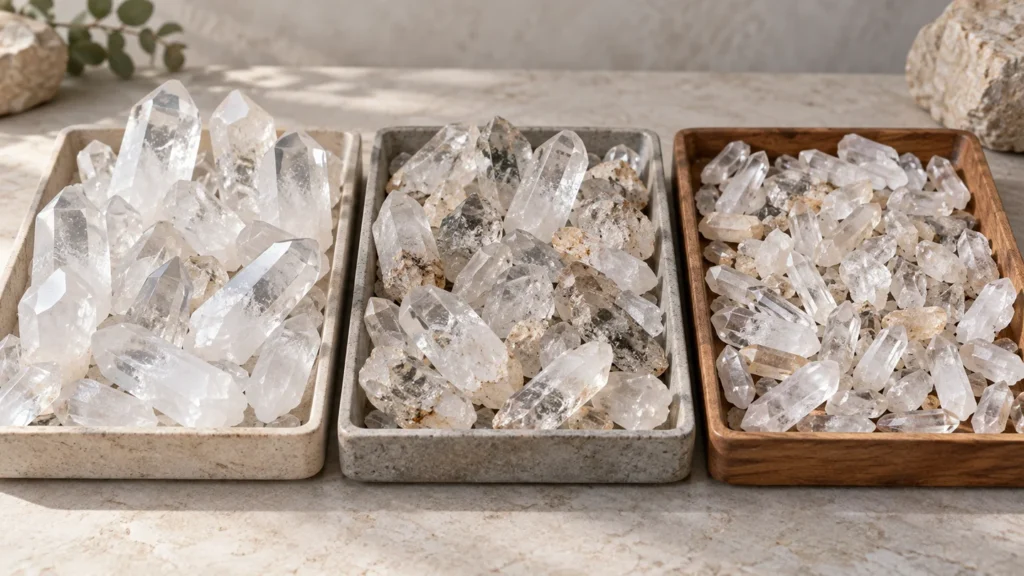
Common Internal Features
In sourcing and product selection, we often see the following features inside natural clear quartz products:
- Ice-like fractures (sometimes called "rainbow fractures"): These are internal fracture planes that catch light and sometimes produce faint rainbow reflections5. They are extremely common in natural quartz and difficult to replicate convincingly in glass.
- Veils and wisps: Thin, cloud-like formations that appear to float inside the stone. These often form along growth planes and can look like translucent curtains or gentle fog.
- Tiny inclusions: Small mineral inclusions, fluid inclusions, or microscopic gas bubbles trapped during formation.6 These can appear as specks, fine threads, or small clustered points.
- Growth lines or phantoms: Faint outlines within the crystal that trace earlier stages of growth.7 In some pieces, you can see a ghostly inner shape — a "phantom" — where the crystal paused and resumed growing.
- Variable transparency: Even within a single piece, clarity can shift. One end of a clear quartz tower may be highly transparent while the base is slightly milky or cloudy.
How Much Variation Is Normal?
The amount of variation depends heavily on the source material and the grade. Here is a general framework we use when discussing batch quality with buyers:
| Grade Description | Typical Appearance | Internal Features |
|---|---|---|
| AAA / Top clarity | Highly transparent, minimal cloudiness | Few but some veils, occasional tiny inclusions |
| AA / Good clarity | Transparent with visible internal texture | Noticeable veils, light fractures, minor cloudiness |
| A / Standard | Semi-transparent to slightly cloudy | Prominent veils, fractures, inclusions, variable clarity |
| B / Lower grade | Cloudy to milky in many areas | Heavy inclusions, significant cloudiness, limited transparency |
The key takeaway: even top-grade natural clear quartz is not typically 100% flawless. If a batch looks uniformly perfect with no internal character at all, that deserves closer scrutiny — not automatic praise.
One thing I've noticed across years of processing clear quartz products is that many retail buyers actually prefer pieces with some internal texture. Rainbow fractures and interesting veils make each piece feel unique. Perfectly glass-clear pieces sometimes look "too clean" for customers who value the natural aesthetic. So from a resale perspective, some internal features can be a selling point, not a defect.
Does perfectly clear quartz mean it's definitely real?
This is one of the most persistent misconceptions in the crystal trade. Many buyers — especially those early in their sourcing journey — equate "clearer" with "more authentic." The logic seems intuitive: if it's supposed to be clear quartz, shouldn't the best pieces be the clearest? But this assumption can actually increase procurement risk.
Perfect clarity is not proof of authenticity. Glass, lead crystal, and synthetic quartz can all appear flawlessly transparent with no inclusions whatsoever.8 A piece that is uniformly glass-like, with no internal veils, fractures, or texture of any kind, should prompt additional questions — not immediate confidence.
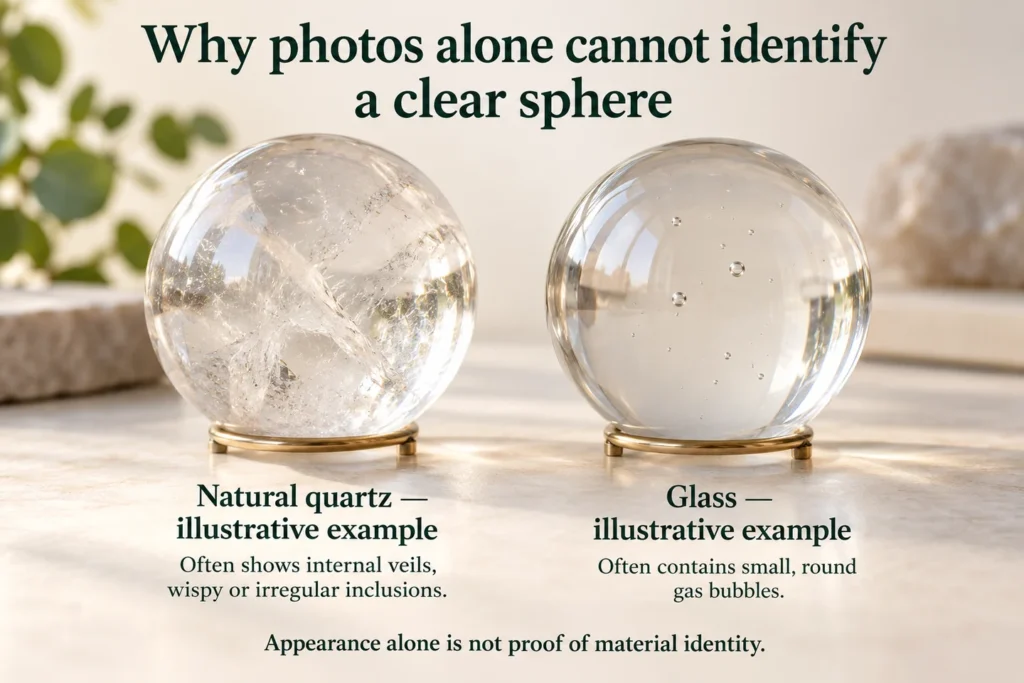
Why Flawless Clarity Raises Questions
There are several reasons why an exceptionally clean piece might not be natural clear quartz:
- Glass imitations: Ordinary glass or optical glass can be molded or cut into crystal shapes (towers, spheres, hearts). Glass is typically free of natural inclusions and has a very uniform clarity. It's one of the most common substitutes on the low end of the market.
- Synthetic quartz: Lab-grown quartz does exist and is used extensively in industrial applications.9 While it's chemically identical to natural quartz10, it often lacks the natural growth features described above.
- Lead crystal (leaded glass): Sometimes used for decorative items, lead crystal has high clarity and strong light refraction. It can mimic the brilliance of quartz but is a fundamentally different material.
- Photo enhancement: Even when the material is natural, some supplier photos are taken under carefully controlled lighting, post-processed for brightness and contrast, or shot through selective angles that hide internal features. The product that arrives may look noticeably different from the listing.
What to Look for When Clarity Seems "Too Good"
If a supplier's product looks uniformly flawless in photos, consider these screening steps:
- Request natural-light photos or a short video. Internal features are much more visible under natural or diffused lighting than under bright studio lights.
- Ask directly: "Is this natural clear quartz? Has it been treated, coated, or enhanced in any way?" A straightforward supplier will answer plainly.
- Check the price. Genuine high-clarity natural clear quartz in larger sizes commands a meaningful premium. If the price seems too low for the claimed grade, that's a signal worth investigating.
- Look at the batch, not just one hero shot. A single exceptional piece can always be pulled from a batch for photos. Seeing the range of a production run gives you much better information about what you'll actually receive.
A practical rule: When a piece has some natural internal features, that's actually reassuring. When it has none at all, that's where your questions should start.
I should emphasize: none of these visual checks replace professional testing. For high-value orders or situations where you suspect substitution, gemological testing with proper equipment is the definitive step. What visual assessment gives you is a practical first filter for everyday purchasing.
Why are batch photos and videos more useful than polished listings?
If you've ever received a crystal shipment that looked nothing like the listing photos, you already understand this problem. Polished, studio-lit product photography is designed to make products look their best — but for B2B buyers, it can obscure the exact details you need to evaluate.
Batch photos and videos taken under natural or consistent lighting give buyers a far more accurate picture of what they'll actually receive. They reveal the true range of transparency, the frequency and type of internal features, actual surface quality, and batch consistency — all of which directly affect resale value and customer satisfaction.
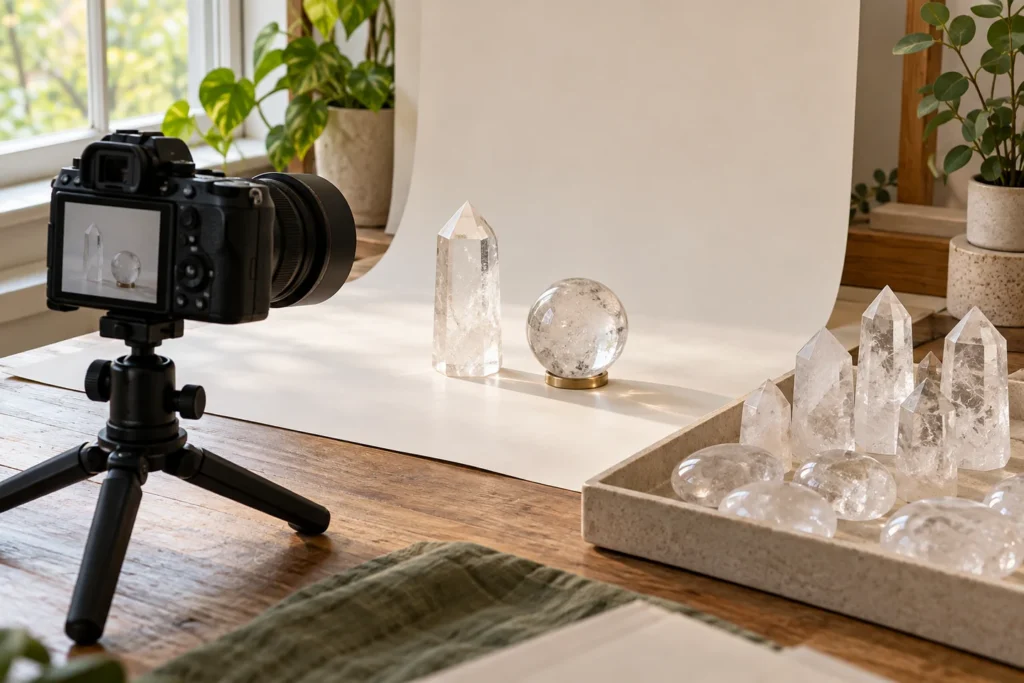
What Batch Photos Reveal That Listing Photos Don't
Here's a breakdown of the differences between polished single-product shots and honest batch documentation:
| Feature | Polished Listing Photo | Natural-Light Batch Photo/Video |
|---|---|---|
| Transparency | Often exaggerated by backlighting | Visible as it will appear to your customers |
| Internal inclusions | May be hidden by lighting angle | Clearly visible, showing the range across pieces |
| Surface finish | Can be smoothed by editing | Shows actual polish quality and any surface marks |
| Color consistency | Can be white-balanced to look uniform | Shows real variation in warm/cool tones |
| Batch consistency | Shows only the best piece | Shows the full spectrum of the production run |
How to Request Useful Batch Documentation
In our experience working with B2B buyers, the most productive approach is to make specific requests early in the quoting process. Here's what we generally recommend:
- Ask for photos of 10–20 representative pieces from the current batch, not just the top 2–3.
- Request a short video (even shot on a phone) with the pieces spread on a plain background under natural daylight or standard indoor lighting. This is far more informative than a single static image.
- Specify that you want to see the range, not just the best pieces. Most buyers appreciate honesty here — it's much better to know upfront that 70% of a batch is AA grade and 30% is A grade than to discover it upon delivery.
- Compare what you see to the supplier's written description. Does the supplier describe the grade, size range, weight range, and any known inclusions or cloudiness? The alignment between photos and description is a strong indicator of supplier reliability.
Connecting Photos to Procurement Terms
Visual assessment becomes truly useful when it's tied to concrete purchasing terms. When evaluating a clear quartz batch, combine what you see in photos and videos with confirmation of:
- Material declaration: Natural clear quartz, untreated
- Grade or clarity tier
- Size and weight range (e.g., towers 8–10 cm, 80–120 g each)
- Estimated percentage of pieces at each quality level
- Packaging and shipping method (since clear quartz can chip or crack in transit without proper protection)
This combination of visual evidence and written specification is the practical standard for B2B sourcing. It won't replace hands-on inspection or lab testing for every piece, but it dramatically reduces the gap between expectation and reality.
How should B2B buyers evaluate clear quartz for resale suitability?
Knowing what real clear quartz looks like is only the starting point. For a retailer, ecommerce seller, or brand operator, the real question is: will this product satisfy my customers, look good in my listings, and represent fair value at the price I'm paying?
B2B buyers should evaluate clear quartz for resale by combining visual assessment (batch photos, videos, and sample orders) with confirmed material description, consistent grading, and transparent communication about any treatments or enhancements. The goal is not to find "perfect" quartz but to ensure the product matches its description and meets the quality expectations of your end customers.
A Practical Evaluation Workflow
Here is the step-by-step approach we recommend based on our experience supplying clear quartz products to international buyers:
Step 1: Define your quality expectations before inquiring.
Know what your customers want. If you sell "raw, natural-looking" crystals, heavy inclusions may be acceptable. If you sell polished display pieces, you likely need AA grade or above. Write down your criteria before contacting suppliers.
Step 2: Request current batch photos and material confirmation.
Ask for natural-light batch photos or video, and ask the supplier to confirm:
- Whether the material is natural clear quartz
- Whether any treatment (coating, irradiation, heat treatment) has been applied
- The grade, size range, and weight range
Step 3: Order a trial batch.
For first-time sourcing, a small trial order is the most reliable way to assess quality. You can physically inspect the pieces, compare them to photos, and evaluate whether the product is suitable for your market.
Step 4: Evaluate the trial against your criteria.
| Criterion | What to Check |
|---|---|
| Transparency | Does the range match photos and description? |
| Internal features | Are inclusions, veils, or fractures consistent with natural quartz? |
| Surface quality | Are polish, shape, and edges consistent across pieces? |
| Size/weight accuracy | Does the batch fall within the stated range? |
| Customer appeal | Would your customers find these attractive and fairly priced? |
Step 5: Reserve professional testing for high-risk situations.
If you're placing a large order, sourcing a premium-grade product, or have concerns about substitution, consider having a sample tested by a qualified gemological laboratory. This is especially relevant when purchasing high-clarity pieces at unusually low prices, or when a supplier cannot clearly confirm material origin and treatment status.
What to Watch Out For
- Suppliers who refuse to provide batch photos or current-stock images. This is a significant red flag. Historical photos, old sample images, or stock photography should not be treated as a guarantee of what you'll receive.
- Vague material descriptions. "Crystal" or "quartz" without specifying natural, untreated, or the specific variety leaves too much room for misunderstanding.
- Price-grade mismatch. Very low prices for claimed top-grade clarity may indicate glass substitution, synthetic material, or a lower actual grade.
- Unwillingness to discuss MOQ, mixed-batch terms, or packaging. Practical suppliers engage in these details because they understand resale requirements.
Frequently Asked Questions
Can you tell if clear quartz is real just by looking at it?
Visual inspection is a useful first screening step but not a definitive authentication method. Natural clear quartz typically shows internal veils, fractures, or inclusions, while glass often appears uniformly flawless. However, visual checks alone cannot guarantee mineral identity11 — professional gemological testing is recommended for high-value or high-risk purchases.
Is cloudy or included clear quartz still considered real?
Yes. Cloudiness, veils, ice-like fractures, and small inclusions are normal features of natural clear quartz. These characteristics result from the stone's natural formation process. While heavily included pieces may be graded lower, their presence does not indicate a fake product. Grade and transparency vary by batch and source material.
Should B2B buyers always request lab certificates for clear quartz?
Not necessarily for every order, but lab certificates or third-party testing become important for large orders, premium-grade products, or any situation where material authenticity is in question. For standard wholesale orders, combining batch photos, material confirmation from the supplier, and trial orders is a practical and cost-effective quality assurance approach.
How does clear quartz appearance vary between product forms like towers, spheres, and tumbled stones?
Product form affects how clarity and inclusions appear. Spheres tend to magnify internal features, making inclusions and veils more visible. Towers often show clarity variation from tip to base. Tumbled stones, due to their smaller size and rounded surface, can appear more uniformly clear. Evaluating appearance separately for each product form is recommended.
What should I do if a shipment looks different from the supplier's photos?
Communicate the discrepancy to your supplier immediately with comparative photos. Reputable suppliers will discuss the issue openly and may offer solutions such as partial credit, exchange, or adjusted terms for future orders. This situation underscores the importance of requesting current batch photos and ordering trial quantities before committing to large purchases.
Conclusion
Understanding what real clear quartz looks like is essential for any B2B buyer building a resale crystal business. Natural clear quartz can be highly transparent or show internal veils, fractures, wisps, and inclusions; appearance alone cannot confirm natural origin. Perfect, flawless clarity is not a guarantee of authenticity and may actually warrant additional scrutiny. The most practical approach combines visual evaluation through natural-light batch photos and videos, clear material confirmation from your supplier, trial orders, and professional testing when the situation demands it.
At GD Crystal, we work with retailers, ecommerce sellers, and crystal brands to supply clear quartz products — towers, spheres, palm stones, hearts, tumbled stones, and more — with transparent grading, current batch documentation, and straightforward communication about material, size, and quality. If you're sourcing clear quartz and want to see real batch photos or discuss your product requirements, reach out to us for a quote on your next order.
References
- "Synthetic Rock Crystal Quartz Cluster with Natural-Looking …", https://www.gia.edu/gems-gemology/winter-2022-gemnews-synthetic-rock-crystal-quartz. Gemological references describe natural quartz as capable of containing inclusions and fractures and note that glass or synthetic quartz may present a more uniform appearance, supporting the use of flawless clarity as a screening concern rather than proof of authenticity. Evidence role: general_support; source type: institution. Supports: Natural quartz can contain inclusions or fractures, and glass or synthetic quartz can be visually clearer or more uniform, making flawless appearance a reason for further verification.. Scope note: This supports a cautionary inference from appearance; it does not prove that any particular flawless specimen is artificial. ↩
- "Quartz", https://en.wikipedia.org/wiki/Quartz. Mineralogical references identify quartz as crystalline silicon dioxide, SiO₂, and distinguish macrocrystalline quartz varieties from microcrystalline silica, supporting the material definition used here. Evidence role: definition; source type: encyclopedia. Supports: Quartz is crystalline silicon dioxide and clear quartz is a transparent macrocrystalline form of quartz.. ↩
- "Formation mechanisms of quartz veins in orogenic gold …", https://www.usgs.gov/publications/formation-mechanisms-quartz-veins-orogenic-gold-deposits-insights-grass-valley. Geological studies of quartz formation describe crystal growth in hydrothermal and other subsurface environments over variable geological time spans, providing context for the statement that natural quartz forms over long periods underground. Evidence role: historical_context; source type: research. Supports: Quartz crystals can form in geological environments over extended periods, with growth duration depending on temperature, fluid supply, pressure, and geological setting.. Scope note: The evidence is contextual because quartz growth rates and durations differ substantially between deposits and cannot assign one universal formation time to all clear quartz. ↩
- "Unusual Purple Fluid in Quartz", https://www.gia.edu/gems-gemology/fall-2022-microworld-unusual-purple-fluid-in-quartz. Mineralogical literature documents inclusions, fractures, and growth-related features in natural quartz, supporting the article's general statement that internal signatures are common in natural specimens. Evidence role: general_support; source type: research. Supports: Natural quartz commonly contains inclusions, fractures, zoning, or other internal features related to crystal growth and geological history.. Scope note: The evidence supports common occurrence, not the absolute frequency implied by 'almost always' across all specimens and grades. ↩
- "Causes Of Iridescence In Natural Quartz", https://www.gia.edu/dam/migrated-assets/docs/doc1/GG-SP17-Lin-Iridescence-Quartz.pdf. Optical mineralogy sources explain that light reflected and refracted by internal fractures or thin films can produce iridescent color effects, providing a mechanism for rainbow-like reflections in fractured quartz. Evidence role: mechanism; source type: education. Supports: Fractures and thin-film or interference effects in minerals can cause iridescent or rainbow-like reflections when light interacts with internal surfaces.. Scope note: The mechanism supports the visual explanation generally; it does not establish that every rainbow effect in a quartz item is natural. ↩
- "Fluid inclusions in quartz crystals from South-West Africa", https://www.usgs.gov/publications/fluid-inclusions-quartz-crystals-south-west-africa. Studies of quartz-hosted inclusions show that mineral and fluid inclusions, including liquid-vapor cavities, can be trapped during crystal growth, supporting the description of inclusions as natural formation features. Evidence role: mechanism; source type: paper. Supports: Quartz commonly preserves mineral and fluid inclusions, including liquid-vapor inclusions, trapped during crystal growth.. ↩
- "A New Phantom Quartz Imitation: Laser-Engraved Rock …", https://www.gia.edu/gems-gemology/winter-2020-gemnews-phantom-quartz-imitation. Mineralogical studies of crystal growth zoning describe how changes in growth conditions or inclusion deposition can preserve earlier crystal outlines inside quartz, supporting the interpretation of phantom features as records of prior growth stages. Evidence role: mechanism; source type: research. Supports: Growth zoning or inclusion layers in quartz can preserve outlines of earlier crystal surfaces, producing phantom-like internal forms.. Scope note: This supports the geological explanation of phantoms generally; visual identification of a particular phantom feature may still require expert examination. ↩
- "Quartz Assemblage Imitating Emerald", https://www.gia.edu/gems-gemology/summer-2025-lab-notes-quartz-assemblage-imitating-emerald. Gemological sources note that natural quartz may be imitated by glass and also occurs as synthetic quartz, supporting the point that transparent, inclusion-free appearance alone is not conclusive evidence of natural origin. Evidence role: expert_consensus; source type: institution. Supports: Gemological references recognize that quartz can be imitated by glass and produced synthetically, and that visual clarity alone is insufficient for conclusive identification.. Scope note: The citation would support the identification risk in general, not the specific claim that all such materials have no inclusions in every case. ↩
- "Hydrothermal synthesis", https://en.wikipedia.org/wiki/Hydrothermal_synthesis. Technical references on quartz crystal devices describe the industrial production and use of synthetic quartz, particularly in electronic frequency-control applications, supporting the statement that lab-grown quartz has significant industrial use. Evidence role: general_support; source type: institution. Supports: Synthetic quartz is produced for technical uses such as frequency-control devices, optics, or electronic components.. ↩
- "Quartz", https://en.wikipedia.org/wiki/Quartz. Mineralogical and materials-science sources identify both natural quartz and synthetic quartz as crystalline silicon dioxide, supporting the chemical equivalence stated in the article. Evidence role: definition; source type: research. Supports: Synthetic quartz and natural quartz are both crystalline silicon dioxide, although they may differ in growth features, impurities, or defect structures.. Scope note: The chemical equivalence does not mean synthetic and natural quartz are identical in inclusions, trace impurities, or growth structures. ↩
- "Gem Identification Lab Class", https://www.gia.edu/gem-education/gem-identification. Gemological authorities describe gemstone identification as a process using diagnostic physical and optical tests, supporting the statement that visual inspection alone cannot guarantee mineral identity. Evidence role: expert_consensus; source type: institution. Supports: Gem identification typically relies on diagnostic tests such as refractive index, microscopy, spectroscopy, density, or other laboratory methods rather than unaided visual inspection alone.. ↩