If you sell crystals, you have probably fielded this question from a customer: "Which rashi can wear clear quartz?" It sounds simple, but a careless answer can damage your credibility or mislead a buyer. The topic sits at an intersection of personal belief, cultural tradition, and product marketing — and it deserves a thoughtful, responsible response.
Clear quartz is commonly described as a "universal" crystal that many astrology traditions consider suitable for most rashis (Vedic zodiac signs). However, no single authoritative list exists that all practitioners agree on. Retailers and e-commerce sellers should present clear quartz as broadly usable while recommending that customers consult a qualified astrologer for rashi-specific guidance.
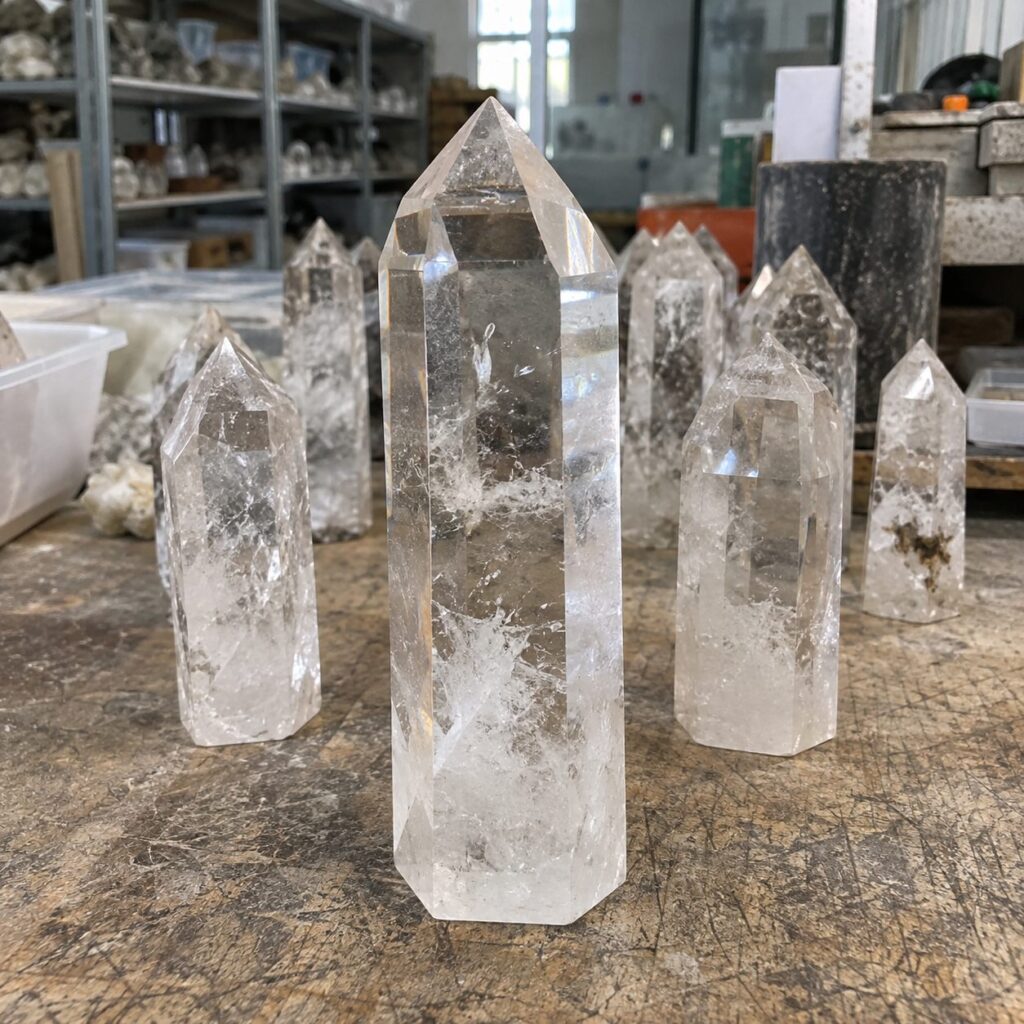
That short answer covers the basics, but if you are building a crystal brand or stocking clear quartz for resale, you need more context. Below, I break down why the question is more nuanced than it appears, what different traditions commonly say, and — most importantly — how to communicate about clear quartz and rashi compatibility without overstepping your expertise.
Why Is Clear Quartz Often Called a Universal Crystal?
Walk into almost any crystal shop worldwide and you will see clear quartz labeled as the "master healer" or "amplifier." But where does this reputation come from, and does it actually mean every rashi can wear it?
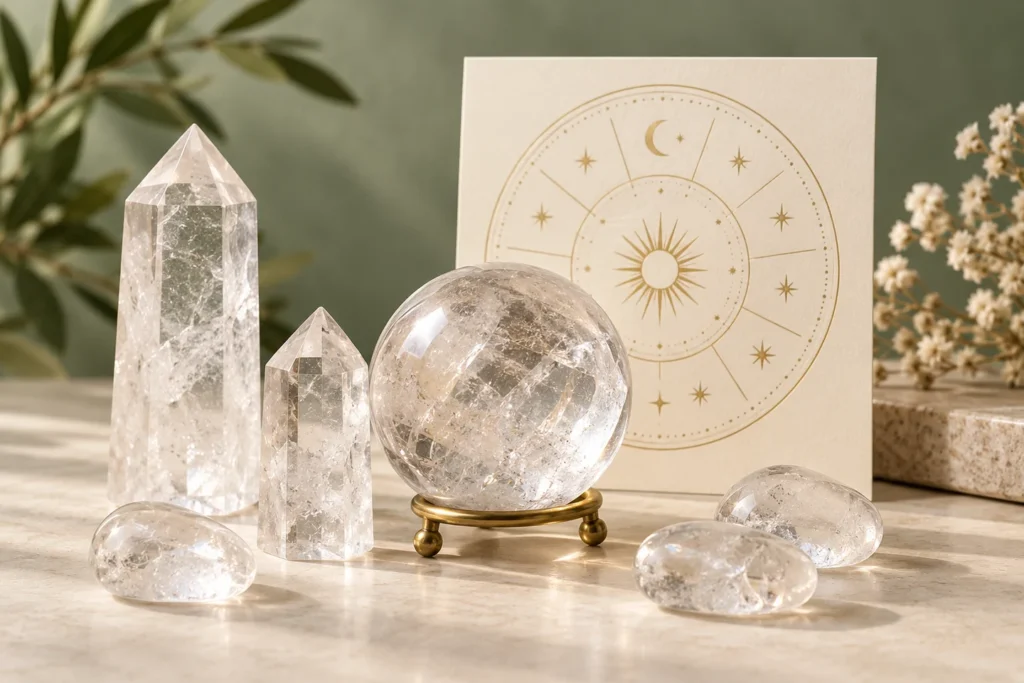
Clear quartz earns its "universal" label primarily because it is one of the most abundant, widely available1, and culturally referenced crystals across many spiritual and metaphysical traditions2. It is commonly believed to amplify energy and intention3 rather than carry a narrowly specific vibration, which is why many sellers describe it as compatible with a broad range of users.
What Traditions Say About Clear Quartz's Broad Compatibility
The idea of clear quartz as universally suitable does not originate from a single source. It draws from multiple cultural and metaphysical frameworks:
- Western crystal healing traditions4 commonly associate clear quartz with all seven chakras and describe it as adaptable to any intention.
- Vedic astrology (Jyotish)5 sometimes associates clear quartz with the planet Venus or the Moon, depending on the practitioner and the specific type of quartz referenced. Some practitioners consider it a substitute for diamond (associated with Venus), while others link it to the crown chakra without tying it to a specific graha (planet).
- Chinese metaphysical traditions often group clear quartz under purifying or balancing stones without strict zodiac restrictions.
The key point for retailers is this: the "universal" label is a market convention, not a verified scientific or astrological rule6. Different practitioners within even the same tradition may disagree on which rashis benefit most or should avoid clear quartz.
Why This Matters for Your Product Listings
If you write "clear quartz is suitable for all rashis" on your product page without qualification, you risk two problems:
- Loss of credibility with customers who follow a specific astrologer's guidance that says otherwise.
- Potential for returns or complaints from buyers who feel misled.
A safer approach is language like: "Clear quartz is widely considered compatible with many rashis and is commonly used as a general-purpose crystal. For personalized astrological recommendations, we encourage consulting a qualified Jyotish practitioner."
Which Rashis Are Most Commonly Associated With Clear Quartz?
Customers want specifics. They want a list. And while I always recommend directing them to a qualified astrologer for personalized advice, it helps to know what is commonly discussed in the market.
In many popular astrology and crystal guides — both online and in print — clear quartz is frequently mentioned as compatible with several rashis, particularly those associated with Venus (Shukra) and the Moon (Chandra). However, these associations vary significantly between sources, and no single list should be treated as definitive.
Commonly Cited Rashi Associations
Below is a summary of what many popular sources describe. I present this as market context, not as verified astrological guidance:
| Rashi (Vedic Sign) | Ruling Planet | Commonly Cited Compatibility | Notes |
|---|---|---|---|
| Vrishabha (Taurus) | Venus | Often mentioned as favorable | Venus connection frequently cited |
| Tula (Libra) | Venus | Often mentioned as favorable | Venus connection frequently cited |
| Karka (Cancer) | Moon | Sometimes mentioned | Moon association with clarity |
| Mithuna (Gemini) | Mercury | Sometimes mentioned | Mental clarity association |
| Kanya (Virgo) | Mercury | Sometimes mentioned | Mercury's analytical energy |
| Mesha (Aries) | Mars | Mixed opinions | Some sources include, others omit |
| Simha (Leo) | Sun | Mixed opinions | Some practitioners recommend, others are cautious |
| Dhanu (Sagittarius) | Jupiter | Mixed opinions | Varies by tradition |
| Makara (Capricorn) | Saturn | Less commonly cited | Some sources advise caution |
| Kumbha (Aquarius) | Saturn | Less commonly cited | Varies by practitioner |
| Vrishchika (Scorpio) | Mars | Less commonly cited | Mixed guidance |
| Meena (Pisces) | Jupiter | Mixed opinions | Some include based on intuition connection |
Important caveat: This table reflects general market trends in popular crystal guides and online sources. It is not a prescription. Different Jyotish practitioners may give completely different advice based on a person's full birth chart (kundali), current dasha period, and other factors far beyond sun sign alone.
Why a Simple List Is Insufficient
Here is what I have learned from years of working with crystal retailers: customers who ask "which rashi can wear clear quartz?" usually want reassurance, not a doctoral thesis on Jyotish. But a flat yes-or-no list creates problems:
- Vedic astrology evaluates gemstones based on full birth charts7, not just rashi. A rashi is one factor among many. A qualified Jyotish astrologer considers planetary periods (dashas), house placements, aspects, and the strength of specific grahas8 before recommending any stone.
- Clear quartz is not a traditional Navratna gemstone. The nine gems (Navratna) of Jyotish are specific: ruby, pearl, coral, emerald, yellow sapphire, diamond, blue sapphire, hessonite, and cat's eye.9 Clear quartz is sometimes marketed as a substitute for diamond or as an "upratna" (secondary stone), but this classification is itself debated among practitioners.
- Regional and lineage-based differences matter.10 A South Indian astrologer may give different guidance than a North Indian one. A practitioner trained in one parampara (lineage) may disagree with another.
The responsible position for a retailer is to share general information while clearly directing customers to qualified professionals for personalized advice.
How Should Crystal Retailers Talk About Clear Quartz and Rashi?
This is where the article shifts from astrology to business communication — and frankly, this section matters most for your bottom line and brand reputation.
Retailers who communicate about clear quartz and rashi compatibility with honest, bounded language build more trust than those who make sweeping metaphysical promises. The goal is to be helpful without being misleading.
Recommended Language Frameworks
Here are practical communication templates I have seen work well for retailers who stock clear quartz:
For product descriptions:
"Clear quartz is one of the most popular crystals worldwide, commonly associated with clarity and amplification. Many crystal traditions consider it broadly compatible, though for rashi-specific or astrological gemstone advice, we recommend consulting a qualified Jyotish practitioner."
For customer service responses:
"Great question! Clear quartz is widely considered a versatile crystal. While many sources describe it as suitable for multiple rashis, personalized astrological recommendations depend on your full birth chart. We suggest speaking with a trusted astrologer for specific guidance."
For social media posts:
"Clear quartz — often called the 'master healer.' Many traditions consider it a universally compatible crystal, but your unique astrological profile matters. Always check with a qualified practitioner for personalized advice."
Language to Avoid
| ❌ Avoid | ✅ Use Instead |
|---|---|
| "Clear quartz is safe for all rashis" | "Clear quartz is commonly considered broadly compatible" |
| "This crystal will bring you clarity and success" | "Many users associate clear quartz with clarity and focus" |
| "Wear this if you are a Taurus for guaranteed results" | "Taurus is one of the rashis often linked to clear quartz in popular guides" |
| "No rashi should avoid clear quartz" | "Specific compatibility may vary; consult a qualified astrologer" |
Why This Communication Strategy Protects Your Business
Beyond ethics, careful language protects you commercially:
- Reduces return disputes from customers who expected guaranteed results.
- Builds authority — you look more knowledgeable by acknowledging complexity than by oversimplifying.
- Broadens your market — you can sell clear quartz to customers of any rashi when positioned as "broadly considered compatible" rather than locked to two or three signs.
- Avoids regulatory risk in markets where health and wellness claims are scrutinized.
What Clear Quartz Product Forms Work Best for Rashi-Conscious Buyers?
Customers who ask about rashi compatibility often have specific wearing or carrying preferences. Understanding these preferences helps you stock the right product forms.
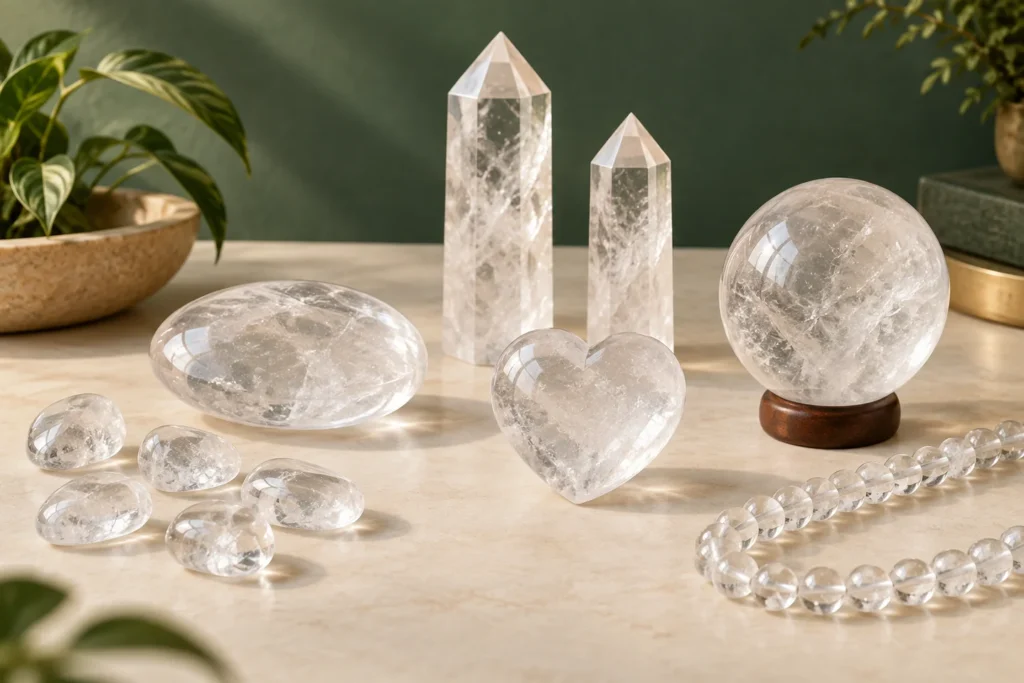
Rashi-conscious buyers typically want wearable or personal-carry items rather than large decorative pieces. The most popular product forms for this segment are pendants, bracelets, tumbled pocket stones, and small spheres — items that stay close to the body.
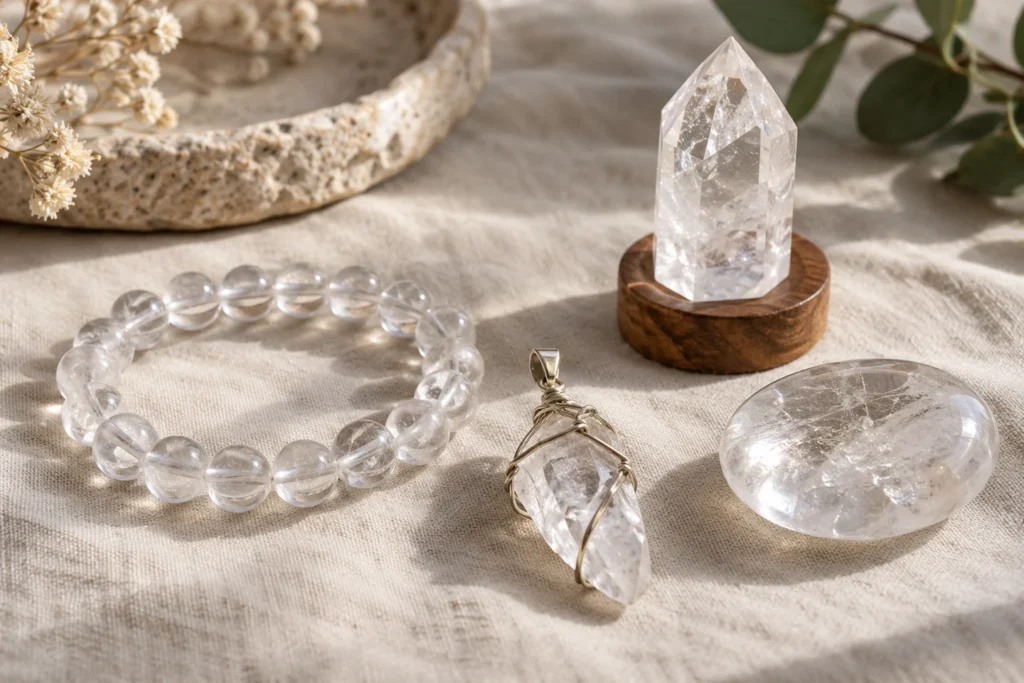
Product Form Recommendations by Use Case
| Product Form | Common Customer Use | Wholesale Notes |
|---|---|---|
| Bead bracelets | Daily wear for rashi compatibility | High demand; 6mm, 8mm, 10mm most popular |
| Pendants / cabochons | Worn against skin for perceived benefit | Often set in silver; customers may ask for specific metal pairings |
| Tumbled stones | Carried in pocket or pouch | Low cost, high volume; good for trial orders |
| Small spheres | Meditation, personal ritual | 20–40mm sizes popular for this segment |
| Faceted rings | Worn on specific fingers per astrological advice | Finger and metal choice often dictated by astrologer |
Metal Pairing Questions
Rashi-conscious customers frequently ask about metal settings. In Jyotish-related markets, silver is the most commonly requested metal for clear quartz settings, as it is traditionally associated with the Moon. Some customers request gold or panchdhatu (five-metal alloy). As a retailer, you can note common preferences without prescribing specific combinations.
Quality Factors That Matter
From a procurement standpoint, clear quartz intended for astrologically motivated buyers tends to require:
- Higher clarity — inclusions may be perceived as reducing effectiveness. Buyers in this segment often prefer water-clear or near-transparent material.
- Natural, untreated material — many astrologically oriented customers specifically ask whether the quartz is natural. Being able to confirm this builds trust.
- Consistent sizing — especially for bracelets and pendants, where bead uniformity affects perceived quality.
At GD Crystal, we process clear quartz into all of these forms and can discuss quality grades, sizing ranges, and minimum order quantities on a per-product basis. If you are sourcing clear quartz for a rashi-conscious customer segment, clear communication about material origin and treatment status is essential.
How Can Sellers Verify Astrological Claims Before Using Them?
You found a blog post or a social media graphic that lists "clear quartz: suitable for Taurus, Libra, Cancer, Gemini." Can you trust it? Should you repost it?
Most online rashi-crystal lists are compiled from popular metaphysical books, other websites, or general tradition — not from rigorous astrological scholarship. Sellers should treat these lists as market reference points, not as verified facts to repeat without context.
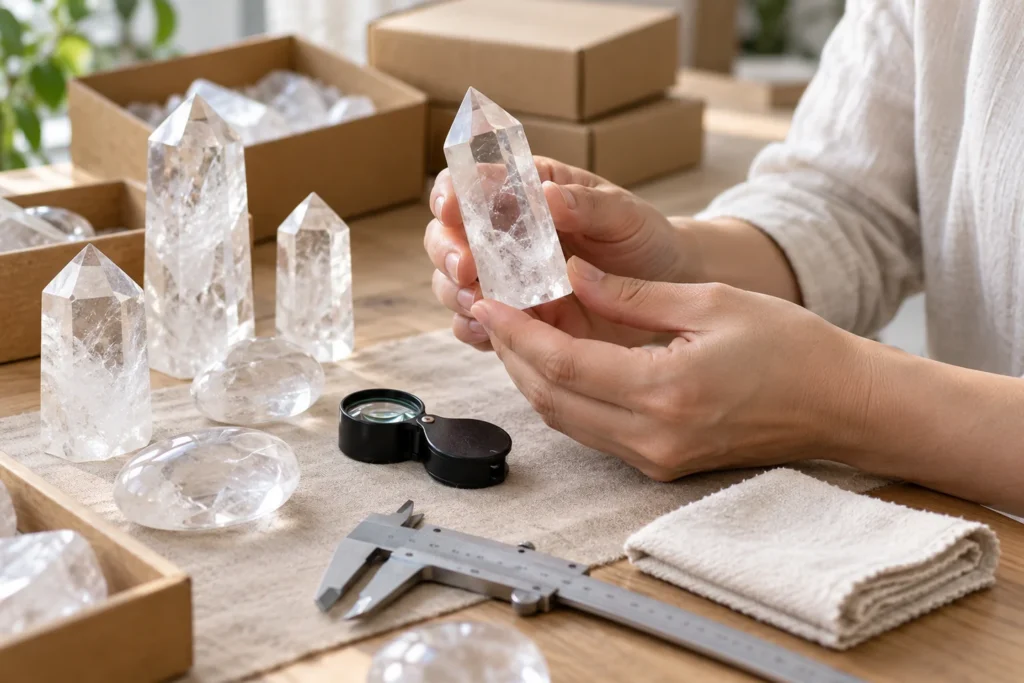
A Practical Verification Checklist
Before using any rashi-crystal claim in your marketing:
- Check the source. Is the author a qualified Jyotish practitioner with credentials, or an anonymous content writer? Treat unattributed claims with caution.
- Cross-reference across traditions. If three different Jyotish-oriented sources give the same guidance, the claim has broader (though still not absolute) support.
- Note the distinction between primary gemstones and substitutes. Diamond is the traditional Jyotish gemstone for Venus.11 Clear quartz is sometimes mentioned as a substitute, but this substitution itself is debated.
- Use hedge language. Even if a claim appears in multiple sources, present it as "commonly believed" or "frequently mentioned" rather than "scientifically proven" or "astrologically guaranteed."
- Consult a practitioner if you want authority. If astrological positioning is central to your brand, consider partnering with a credentialed Jyotish astrologer who can review your product claims.
The Cost of Getting It Wrong
I have seen retailers lose repeat customers over a single overconfident astrology claim that contradicted the buyer's own astrologer. In the crystal business, trust is your most valuable inventory. Bounded, honest language costs nothing and protects everything.
Frequently Asked Questions
Can all 12 rashis wear clear quartz?
Clear quartz is commonly described as broadly compatible, and many popular sources suggest it can be worn by most rashis. However, individual compatibility depends on a person's full birth chart, not just their rashi. For certainty, consult a qualified Jyotish astrologer before making or repeating absolute claims.
Is clear quartz a substitute for diamond in Vedic astrology?
Some practitioners and popular guides describe clear quartz as an affordable substitute (upratna) for diamond, which is associated with Venus. This is a common market claim but not universally accepted among all Jyotish traditions. Always present it as one perspective rather than established fact.
What is the best way to describe clear quartz on a product listing?
Focus on the crystal's physical properties (clarity, size, form, natural origin) and commonly associated qualities (clarity, amplification) using phrases like "commonly believed" or "widely associated with." Avoid guaranteed results and direct customers to qualified astrologers for personalized recommendations.
Does the quality of clear quartz matter for astrological use?
Many astrologically oriented buyers prefer high-clarity, natural, untreated clear quartz. While GD Crystal cannot verify whether quality affects astrological outcomes, we can confirm that higher-clarity material is consistently more sought after in this market segment and commands better retail pricing.
Can retailers safely recommend clear quartz for specific rashis?
Retailers can share common market associations with appropriate disclaimers. A safe approach is: "Clear quartz is frequently associated with [rashi] in popular crystal guides. For personalized astrological advice, please consult a qualified practitioner." This serves the customer without overstepping your expertise.
Conclusion
The question "which rashi can wear clear quartz?" does not have a single, universally agreed-upon answer. What it does have is a practical framework: clear quartz is widely considered one of the most broadly compatible crystals across many traditions, making it a strong product for retailers serving diverse customer bases. The key is communicating about rashi compatibility with honest, bounded language — sharing common associations while directing customers to qualified astrologers for personalized guidance.
If you are a crystal retailer or e-commerce seller looking to stock clear quartz in forms that serve astrologically minded customers — bracelets, pendants, tumbled stones, spheres, or custom items — reach out to GD Crystal for product details, quality grades, and wholesale pricing. We are happy to discuss material specifications, minimum order quantities, and product forms that fit your market positioning. Let us build a supply relationship grounded in the same honesty we recommend you bring to your customers.
References
- "Quartz | U.S. Geological Survey", https://www.usgs.gov/media/images/quartz. A geological source such as the U.S. Geological Survey supports that quartz is one of the most common rock-forming minerals, providing mineralogical context for describing clear quartz as widely available. Evidence role: general_support; source type: government. Supports: Quartz is a very common rock-forming mineral and is abundant in the Earth's crust.. Scope note: This supports quartz abundance generally, not the retail availability of every commercial clear quartz product. ↩
- "Rose Quartz History and Lore", https://www.gia.edu/rose-quartz-history-lore. An encyclopedia or museum source on rock crystal can support that clear quartz has been used and referenced in multiple historical cultural contexts, offering background for its modern metaphysical associations. Evidence role: historical_context; source type: encyclopedia. Supports: Rock crystal or clear quartz has appeared in historical and cultural contexts beyond modern retail crystal healing.. Scope note: Such a source would provide historical context rather than proving any metaphysical property attributed to quartz. ↩
- "nccih – NIH", https://www.nccih.nih.gov/. A neutral source on crystal healing can document that clear quartz is commonly described by practitioners as an energy or intention amplifier, while distinguishing this belief from established scientific evidence. Evidence role: general_support; source type: research. Supports: Crystal-healing literature commonly attributes amplifying or energy-related meanings to clear quartz.. Scope note: The source would support the existence of the belief, not the efficacy of the claimed energetic effect. ↩
- "Clear Quartz Properties, Uses, Benefits & Meaning", https://www.museandmoonstone.com/pages/clear-quartz-meaning?srsltid=AYCX9vJTXbJCW8plRdklpasJp9HkEscU5KW3iJyhNoNf-uo8V5zPdqDi. A scholarly or neutral overview of contemporary crystal healing can support that clear quartz is commonly discussed as a broadly applicable stone in chakra-oriented healing systems. Evidence role: historical_context; source type: research. Supports: Modern crystal-healing sources often connect clear quartz with broad chakra use rather than a single narrow application.. Scope note: This is contextual support for a contemporary belief system and does not validate chakra or crystal-healing mechanisms scientifically. ↩
- "Hindu astrology", https://en.wikipedia.org/wiki/Hindu_astrology. An encyclopedia entry on Jyotisha supports the definition of Jyotish as the Indian astrological tradition used to interpret planetary and zodiacal factors. Evidence role: definition; source type: encyclopedia. Supports: Jyotish, or Jyotisha, is the Indian/Vedic astrological tradition within which rashi and planetary considerations are interpreted.. Scope note: The source defines the tradition and its context, but it would not establish a specific clear-quartz recommendation. ↩
- "The role of performance in enhancing the effectiveness …", https://pubmed.ncbi.nlm.nih.gov/23206175/. A government health-information source can support that healing-crystal claims lack established scientific evidence, helping distinguish the retail term “universal crystal” from a verified scientific rule. Evidence role: expert_consensus; source type: government. Supports: Scientific or health-information sources do not recognize crystal-healing claims as proven medical or physical effects.. Scope note: This supports the scientific-evidence caveat, not the internal validity of any astrological classification. ↩
- "Dasha (astrology)", https://en.wikipedia.org/wiki/Dasha_(astrology). An educational source on Indian astrology can support that Jyotish interpretation is based on a horoscope containing planetary placements and other chart factors, giving context for why gemstone advice may not rest on rashi alone. Evidence role: mechanism; source type: education. Supports: Jyotish interpretation considers a horoscope or birth chart with planetary positions and related factors, not only a zodiac sign.. Scope note: This explains the interpretive framework and does not verify the effectiveness of gemstone prescriptions. ↩
- "Dasha (astrology)", https://en.wikipedia.org/wiki/Dasha_(astrology). A university or educational overview of Jyotish terminology can support that dashas, houses, aspects, and grahas are recognized elements of Indian astrological analysis. Evidence role: definition; source type: education. Supports: Dashas, houses, planetary aspects, and grahas are standard concepts in Jyotish interpretation.. Scope note: The source would define the astrological concepts without proving that they have empirical predictive power. ↩
- "GIA Gem Encyclopedia | Complete List Of Gemstones", https://www.gia.edu/gem-encyclopedia. An encyclopedia source on Navaratna can support the traditional identification of the nine gems as ruby, pearl, coral, emerald, yellow sapphire, diamond, blue sapphire, hessonite, and cat's eye. Evidence role: definition; source type: encyclopedia. Supports: Navratna refers to a traditional set of nine gemstones associated with celestial bodies in Indian traditions.. Scope note: This verifies the traditional list, not whether any gem has astrological efficacy. ↩
- "Hindu astrology", https://en.wikipedia.org/wiki/Hindu_astrology. A scholarly history of Indian astrology can support that Jyotish is not monolithic and has developed through multiple textual, regional, and practitioner lineages. Evidence role: historical_context; source type: research. Supports: Indian astrological practice has developed through multiple textual, regional, and practitioner traditions.. Scope note: This gives context for variation among practitioners rather than documenting disagreement over clear quartz specifically. ↩
- "Navaratna", https://en.wikipedia.org/wiki/Navaratna. A reference source on Navratna or Jyotish gemstone correspondences can support that diamond is traditionally linked with Venus, known as Shukra, in Indian astrological gem systems. Evidence role: historical_context; source type: encyclopedia. Supports: Traditional Jyotish/Navratna correspondences associate diamond with Venus, or Shukra.. Scope note: The source would support the traditional correspondence, not the validity of substituting clear quartz for diamond. ↩