If you sell carnelian, you have probably seen the question everywhere: "What should carnelian not be paired with?" Customers ask it. Your product-page comments fill up with conflicting advice. And suddenly, a simple inventory decision feels like a minefield of unverified metaphysical claims that could either confuse your buyers or erode trust in your brand.
Carnelian does not have a scientifically proven "forbidden pairing" list.1 The real question for retailers and brand owners is not which crystals carry conflicting energies, but which combinations may confuse customers, clash with your product positioning, or create communication risks. Pairing decisions should be guided by retail context, color harmony, price logic, and honest product descriptions — not by internet blacklists presented as fact.
That answer might surprise you if you have been reading spiritual blogs that warn against wearing certain stones together. Below, I will break down the most common pairing concerns retailers raise with us, explain why the framing matters more than the combination itself, and offer practical merchandising guidance you can actually use when building carnelian product bundles and writing product descriptions.
Why Do People Believe Carnelian Has Forbidden Pairings?
The idea that certain crystals should never be paired together has become a staple of consumer-facing crystal content. But where does the claim actually come from, and how reliable is it for business decisions?
Many customers associate carnelian with warmth, motivation, and energizing properties. Online content creators then extrapolate that any "calming" or "cooling" stone must conflict with carnelian's energy. This logic sounds intuitive, but it is not based on mineralogical science, controlled studies, or any standardized system2 that suppliers and retailers can verify.
Where the Claims Originate
Most "do not pair" lists trace back to a handful of popular crystal healing books and social media posts, which then get copied and remixed across hundreds of websites. The original sources rarely cite empirical evidence. Instead, they draw on:
- Personal intuition or anecdotal experience from individual practitioners
- Simplified elemental or chakra frameworks that assign fixed properties to each stone
- Color-based associations (warm = energizing, cool = calming) treated as universal rules
- Cultural traditions from various backgrounds, often blended without attribution
None of these are invalid as cultural or personal belief. But they are not the same as verified product data. From a sourcing and merchandising perspective, the key takeaway is this: there is no industry-standard, evidence-based authority that certifies which crystals "conflict" with each other.3
Why This Matters for Your Business
When you present a pairing restriction as a fact on your product page — "Never pair carnelian with amethyst" — you are making a claim your business must stand behind. If a customer disagrees, or finds a contradicting list on another site, it can create disputes, returns, and trust erosion4.
| Source Type | Basis of Claim | Verifiable? | Business Risk |
|---|---|---|---|
| Metaphysical blog | Personal intuition, tradition | No | Moderate — customers may hold you to unverifiable claims |
| Crystal healing book | Author's framework | Rarely | Moderate — conflicting books create confusion |
| Supplier product page | Sourcing and quality data | Yes | Low — factual, defensible |
| Scientific literature | Mineralogical or chemical data | Yes | Low — but rarely covers "energy" claims |
We are often asked by retailers whether carnelian has forbidden pairings. Our standard guidance is: treat pairing preferences as customer-facing positioning choices, not as supplier-verified product specifications. This protects your brand and gives you flexibility.
Which Carnelian Combinations May Create Retail Positioning Problems?
Even without a proven blacklist, some carnelian pairings genuinely create merchandising challenges. The issue is rarely the stones themselves — it is the messaging mismatch.
If your product bundle promises "deep relaxation and restful sleep" but includes carnelian — a stone most consumers associate with energy and motivation — your marketing copy and your product selection are telling two different stories. That disconnect, not any mystical conflict, is the real problem.
Carnelian in Calming or Sleep-Themed Sets
Many customers associate carnelian with vitality, courage, and action. Whether or not these associations are objectively real, they are deeply embedded in consumer expectation. Placing carnelian in a set marketed for sleep, anxiety relief, or deep meditation can:
- Confuse the customer about the set's intended purpose
- Trigger returns or complaints from buyers who feel the product contradicts itself
- Weaken your brand credibility if reviews point out the inconsistency
This does not mean carnelian physically disrupts sleep. It means the customer's expectation and your product's stated purpose should align. If your brand positions carnelian differently — say, as a grounding stone — and your audience accepts that framing, the same combination might work fine.
Carnelian with Premium Minimalist Collections
From a price-band and aesthetic standpoint, carnelian is generally an accessible, mid-range stone. Pairing it with higher-end specimens like moldavite, high-grade labradorite, or large clear quartz points in a premium gift set can create a perceived value mismatch.
Consider these factors before building a bundle:
- Price consistency — Does carnelian's wholesale cost fit the set's overall price tier?
- Visual cohesion — Does the warm orange-red of carnelian complement the other stones' colors?
- Customer segment alignment — Is the buyer expecting an accessible everyday set or a luxury display piece?
Carnelian in Explicitly Medical or Therapeutic Kits
This is a harder boundary. If your brand sells carnelian as part of a "healing kit" with specific health claims — improved circulation, pain relief, hormonal balance5 — you are moving into territory that carries legal and regulatory risk6 in most markets. The pairing problem here is not about which stone sits next to carnelian. It is about the claims attached to the entire package.
Our recommendation: Frame carnelian product descriptions around customer experience and cultural tradition, not health outcomes.7 Phrases like "many customers enjoy carnelian for its warm, uplifting feel" are far safer than "carnelian heals inflammation."
How Should Retailers Frame Carnelian Pairing Advice on Product Pages?
Wording is where most brand damage happens. The difference between a helpful product description and a liability is often just a few phrases.
For crystal retailers and e-commerce sellers, the safest approach is to acknowledge customer interest in pairing without presenting unverified restrictions as facts. This protects your brand, respects your customers' intelligence, and avoids triggering disputes.
Language That Builds Trust
Here is a practical comparison of risky versus safer wording for carnelian product pages:
| Risky Phrasing | Safer Alternative |
|---|---|
| "Never pair carnelian with amethyst — their energies conflict." | "Some customers prefer to use carnelian separately from calming stones like amethyst, as they associate carnelian with energy and motivation." |
| "Carnelian cancels out the healing power of blue lace agate." | "For a calming-themed set, many shoppers gravitate toward cooler-toned stones. Carnelian's warm energy profile may fit better in motivation or creativity bundles." |
| "WARNING: Do not wear carnelian with selenite." | "Carnelian pairs beautifully with other warm-toned stones. If your intention is relaxation, you might explore our calming collection instead." |
Three Principles for Product Copy
- Attribute beliefs, don't assert them. Use "many customers feel," "traditionally associated with," or "often described as" rather than stating metaphysical properties as facts.
- Frame pairings as recommendations, not rules. Suggest what works well together rather than forbidding combinations.
- Align copy with the product's stated purpose. If the set is for energy and creativity, carnelian fits. If it is for calm and rest, consider substituting.
What About Customer Questions?
When a customer asks "Can I wear carnelian with rose quartz?" your customer service team should not say "Absolutely not" or "Of course, they have perfect energy alignment." Both responses overcommit. A better answer:
"Many of our customers enjoy wearing carnelian with rose quartz. Carnelian is often associated with motivation and warmth, while rose quartz is associated with gentleness and comfort. Whether you combine them is really a matter of personal preference and what feels right for you."
This approach is honest, non-prescriptive, and unlikely to generate complaints regardless of the customer's belief system.
What Carnelian Pairings Actually Work Well for Wholesale Bundles?
Instead of focusing on what to avoid, most successful crystal retailers we work with focus on what sells well together. Pairing logic for wholesale purchasing is driven by visual appeal, price consistency, target customer, and narrative coherence.
From a sourcing and merchandising perspective, carnelian's warm orange-red tones8 and accessible price point make it a versatile inclusion in many set types.
High-Performing Carnelian Bundle Themes
Based on common order patterns from our retail customers, these carnelian combinations tend to sell consistently:
| Bundle Theme | Suggested Pairings with Carnelian | Why It Works |
|---|---|---|
| Motivation & Creativity | Citrine, tiger's eye, sunstone | Warm color family, consistent "energy" narrative, similar price band |
| Sacral Chakra Set | Orange calcite, peach moonstone, goldstone | Coherent chakra theme, strong visual warmth, accessible price |
| Confidence & Courage | Red jasper, pyrite, hematite | Earthy tones, grounding narrative, popular with male-oriented retail |
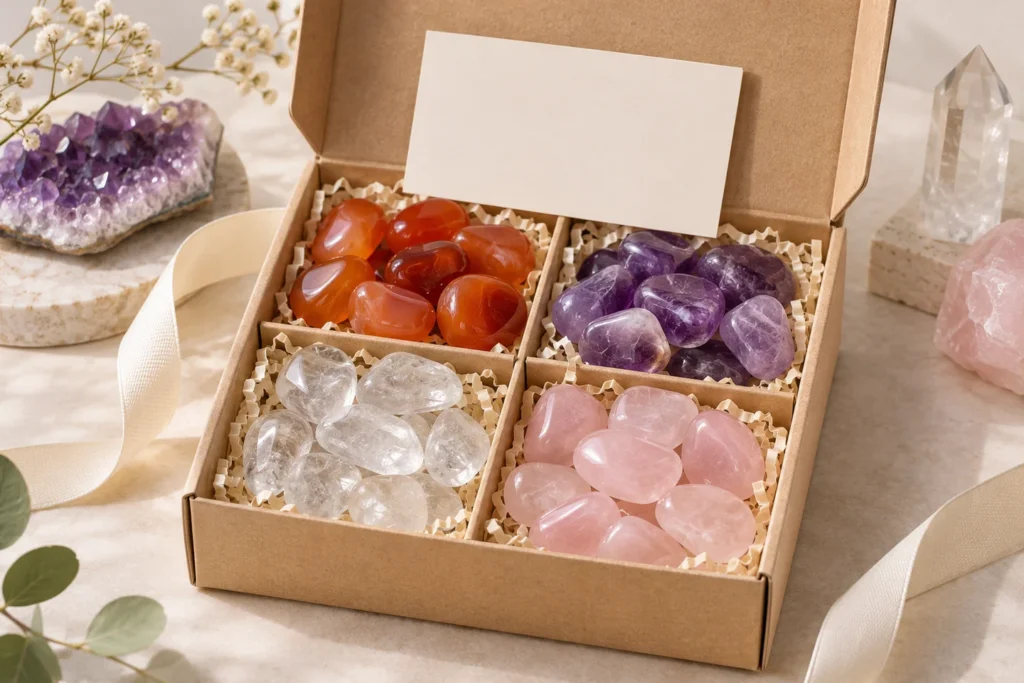
| Warm-Toned Starter Kit | Rose quartz, clear quartz, carnelian, amethyst | Classic beginner set with broad appeal, recognizable stones |
| Autumn/Harvest Collection | Carnelian, moss agate, smoky quartz, bronzite | Seasonal color palette, gift-market friendly |
Practical Bundle-Building Checklist
When deciding whether to include carnelian in a product set, run through these questions:
- Does the bundle have a clear theme? Carnelian fits motivation, warmth, creativity, and courage themes well.
- Is the color palette cohesive? Carnelian's warm tones work best with earth tones, golds, and complementary warm hues.
- Are the stones in a similar price range? Mixing a $0.50 tumbled carnelian with a $40 specimen piece creates perceived imbalance.
- Does the product copy match the stone selection? Every stone in the set should support the stated purpose.
- Will the packaging display them well together? Test how the stones look side by side before committing to bulk production.
A Note on Mixed-Batch Ordering
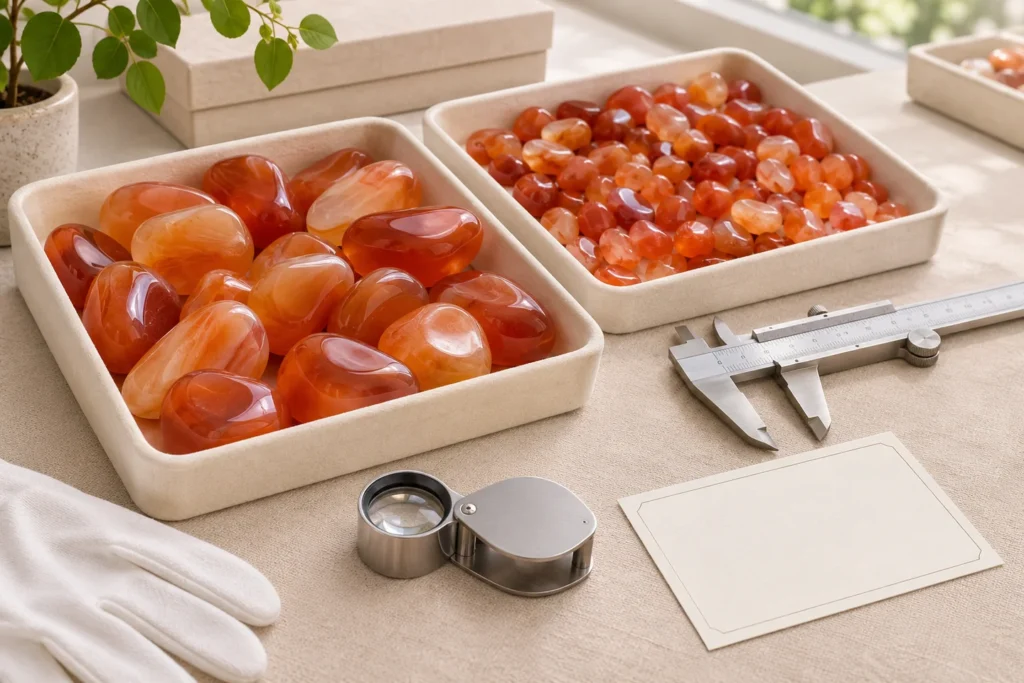
If you are sourcing carnelian for bundles, keep in mind that natural carnelian varies significantly in color saturation, translucency, and banding.9 When you need consistent appearance across hundreds of sets, discuss grading and sorting criteria with your supplier upfront. At GD Crystal, we work with buyers to define acceptable color range, size tolerance, and finish quality before production — this prevents batch-to-batch surprises that could undermine your curated sets.
How Can Suppliers Help Retailers Navigate Carnelian Pairing Concerns?
As a B2B crystal supplier, our role is not to validate or debunk metaphysical beliefs. It is to help buyers make informed product and communication decisions.
A reliable supplier should be transparent about what they can and cannot verify. We can confirm carnelian's material origin, treatment status, size, weight, color grade, and finish quality. We cannot certify its "energy compatibility" with other stones. That distinction matters.
What to Ask Your Supplier
When evaluating carnelian for pairing in retail sets, here are the questions that actually protect your business:
- Is this natural carnelian or heat-treated agate? Much commercial carnelian is heat-treated to enhance its orange-red color.10 Knowing the treatment status lets you write accurate product descriptions.
- What is the color consistency within this batch? If you are building matched sets, you need stones that look similar.
- Can I get sample sets before committing to bulk? Testing pairings visually and physically before a large order prevents costly mismatches.
- What are the MOQ and mixing terms? If you want five stone types in one bundle, can you order mixed batches or must each stone meet a separate minimum?
- How is the carnelian graded? Translucency, color depth, surface polish, and banding pattern all affect which pairings look best.
The Supplier's Responsibility
A responsible supplier will:
- Provide accurate material descriptions without metaphysical marketing language
- Share real product photos of the current batch, not stock imagery
- Discuss treatment and origin honestly so you can make disclosure decisions
- Support sample orders so you can evaluate pairings before scaling
- Respect your brand's positioning rather than pushing generic pairing scripts
Frequently Asked Questions
Can carnelian be paired with amethyst?
There is no verified material reason to avoid this combination. Many retailers sell carnelian and amethyst together successfully, especially in beginner crystal kits. If your product theme is calming or sleep-focused, carnelian may feel inconsistent — but that is a positioning choice, not a proven energy conflict.
Does carnelian clash with blue or cool-toned stones?
From a color-harmony standpoint, warm orange-red carnelian can contrast sharply with cool blues.11 Some retailers use this contrast intentionally for visual impact. Others prefer monochromatic warmth. The decision depends on your brand aesthetic and target customer, not on any universal rule.
Should I warn customers not to wear certain stones with carnelian?
We recommend against publishing absolute "never wear together" warnings. These create unnecessary anxiety, invite disputes, and are difficult to defend. Instead, frame suggestions positively: recommend what pairs well rather than forbidding specific combinations.
Is most commercial carnelian natural or treated?
A significant portion of commercial carnelian is heat-treated agate. Heat treatment deepens the orange-red color and is a standard, widely accepted practice in the industry.12 Retailers should confirm treatment status with their supplier and decide how to disclose this on product pages based on their market's expectations and regulations.
How do I choose carnelian for wholesale bundle sets?
Define your bundle theme, color palette, and price tier first. Then request sorted or graded carnelian from your supplier that matches those criteria. Ask for current batch photos, confirm size and weight ranges, and order samples before committing to bulk quantities.
Conclusion
The question "what should carnelian not be paired with" does not have a single, evidence-based answer — and that is actually good news for retailers. It means you have the freedom to build carnelian pairings based on what genuinely serves your customers: coherent product themes, honest descriptions, visual appeal, and consistent pricing. The risk is not in the stones themselves but in how you present them. Avoid absolute claims, attribute beliefs rather than asserting them, and align your product selection with your stated bundle purpose.
If you are sourcing carnelian for retail sets, bundles, or individual resale and want to discuss grading, batch consistency, treatment disclosure, or custom assortment options, reach out to us at GD Crystal. We are happy to share current batch photos, discuss MOQ and mixing terms, and help you build a carnelian product line that is both commercially sound and honestly presented.
References
- "Crystal healing", https://en.wikipedia.org/wiki/Crystal_healing. A neutral overview of crystal healing describes it as a practice lacking scientific support, which contextualizes the absence of an evidence-based 'forbidden pairing' list for carnelian. Evidence role: general_support; source type: encyclopedia. Supports: Crystal-healing claims are generally not supported by scientific evidence, and no recognized scientific framework establishes carnelian pairing prohibitions.. Scope note: The source would support the broader lack of scientific evidence for crystal-healing claims, not directly test every possible carnelian pairing. ↩
- "Carnelian", https://en.wikipedia.org/wiki/Carnelian. Mineralogical references classify carnelian as a variety of chalcedony according to physical and chemical characteristics, offering no standardized mineralogical criterion for metaphysical 'energy conflicts.' Evidence role: general_support; source type: research. Supports: Mineralogical references describe carnelian by physical and chemical properties, while crystal-healing compatibility claims are outside standardized mineralogical classification.. Scope note: This supports the distinction between mineralogical data and metaphysical compatibility claims, rather than proving that all pairing claims are false. ↩
- "How GIA Analyzes Colored Stones from Start to Finish", https://www.gia.edu/gia-news-research/guide-how-gia-analyzes-colored-stones. Gemological guidance from institutions such as GIA addresses gemstone identification, treatment disclosure, and material characteristics, not certification of metaphysical compatibility between stones. Evidence role: general_support; source type: institution. Supports: Gemological authorities focus on identification, treatments, and disclosure rather than certifying metaphysical compatibility between stones.. Scope note: This provides contextual support about the scope of recognized gemological standards; it does not prove that no informal spiritual authority offers such lists. ↩
- "Determining the Effect of the Returns Management …", https://trace.tennessee.edu/cgi/viewcontent.cgi?referer=&httpsredir=1&article=2592&context=utk_chanhonoproj. Research on expectation-disconfirmation theory indicates that mismatches between promised and experienced product performance can reduce satisfaction and undermine consumer trust. Evidence role: mechanism; source type: paper. Supports: When product claims do not match customer expectations or experience, customer satisfaction and trust can decline.. Scope note: The evidence would support the customer-satisfaction mechanism generally, not crystal-product returns specifically. ↩
- "Health Products Compliance Guidance", https://www.ftc.gov/business-guidance/resources/health-products-compliance-guidance. Regulatory guidance treats representations about pain relief and physiological effects as objective health claims requiring competent and reliable substantiation. Evidence role: definition; source type: government. Supports: Claims about pain relief, circulation, or hormonal effects are objective health-related claims that regulators expect advertisers to substantiate.. Scope note: Regulatory classification can vary by jurisdiction and by the full context of the advertisement. ↩
- "Health Products Compliance Guidance", https://www.ftc.gov/system/files/ftc_gov/pdf/Health-Products-Compliance-Guidance.pdf. Government guidance on health-product advertising requires objective substantiation for health claims and treats disease-related claims as subject to heightened regulatory scrutiny. Evidence role: general_support; source type: government. Supports: Health-related advertising claims generally require competent substantiation, and claims to treat or prevent disease can trigger regulatory scrutiny.. Scope note: The exact legal consequences depend on jurisdiction, wording, product category, and enforcement practice. ↩
- "FTC Policy Statement Regarding Advertising Substantiation", https://www.ftc.gov/legal-library/browse/ftc-policy-statement-regarding-advertising-substantiation. Advertising regulators distinguish objective health-efficacy claims, which require substantiation, from carefully framed subjective descriptions of consumer experience. Evidence role: expert_consensus; source type: government. Supports: Objective health claims in advertising require substantiation, while subjective or experiential descriptions are less likely to imply medical efficacy when carefully worded.. Scope note: The source would not approve any specific carnelian wording; it would support the general compliance principle. ↩
- "Carnelian", https://en.wikipedia.org/wiki/Carnelian. Reference works commonly define carnelian as a reddish-orange to brownish-red variety of chalcedony, supporting the article’s description of its warm color range. Evidence role: definition; source type: encyclopedia. Supports: Carnelian is commonly defined as a reddish-orange to brownish-red variety of chalcedony.. ↩
- "Carnelian", https://en.wikipedia.org/wiki/Carnelian. Mineralogical descriptions identify carnelian as a reddish to orange variety of chalcedony, a material that can vary in translucency and may show agate-like banding. Evidence role: definition; source type: research. Supports: Carnelian is a chalcedony variety whose appearance may range across reddish-orange tones and may show translucency or banding associated with chalcedony/agate.. Scope note: The source would describe natural appearance variation generally, not the grading range of any supplier’s specific batch. ↩
- "An Introduction to Gem Treatments", https://www.gia.edu/gem-treatment. Gemological sources describe heat treatment of chalcedony and agate as a common method for producing or intensifying the reddish-orange color associated with carnelian. Evidence role: general_support; source type: institution. Supports: Carnelian and related chalcedony materials are commonly heat treated to improve or intensify reddish-orange coloration.. Scope note: The source may support common industry practice without quantifying the exact share of commercial carnelian that is treated. ↩
- "Complementary colors", https://en.wikipedia.org/wiki/Complementary_colors. Introductory color-theory materials identify orange and blue as complementary hues on the color wheel, explaining why orange-red carnelian can contrast strongly with cool blue stones. Evidence role: mechanism; source type: education. Supports: Color theory treats orange and blue as complementary or near-opposite hues, producing strong visual contrast.. Scope note: This supports the visual-design mechanism, not consumer preference for any particular crystal pairing. ↩
- "An Introduction to Gem Treatments", https://www.gia.edu/gem-treatment. Gemological treatment references recognize heat treatment as a conventional process that can intensify the color of chalcedony materials, including carnelian-like agate. Evidence role: mechanism; source type: institution. Supports: Heat treatment can alter or intensify chalcedony color and is recognized in gem treatment disclosure frameworks.. Scope note: Industry acceptance does not remove the need for accurate disclosure where local rules or market expectations require it. ↩