Choosing which finger to wear a clear quartz ring on is one of the most common questions crystal sellers hear from their customers. The uncertainty can stall a purchase — buyers hesitate because they worry about "doing it wrong."1 The good news is the answer is more flexible than most people think, and understanding it helps sellers guide customers with confidence.
There is no single correct finger for wearing a clear quartz ring. The choice depends on personal intention, comfort, style preference, and the symbolic meaning the wearer wants to embrace. Common traditions associate different fingers with different qualities — like confidence, balance, or communication — but these are cultural interpretations, not fixed rules. The best finger is the one that feels right and fits the wearer's daily life.
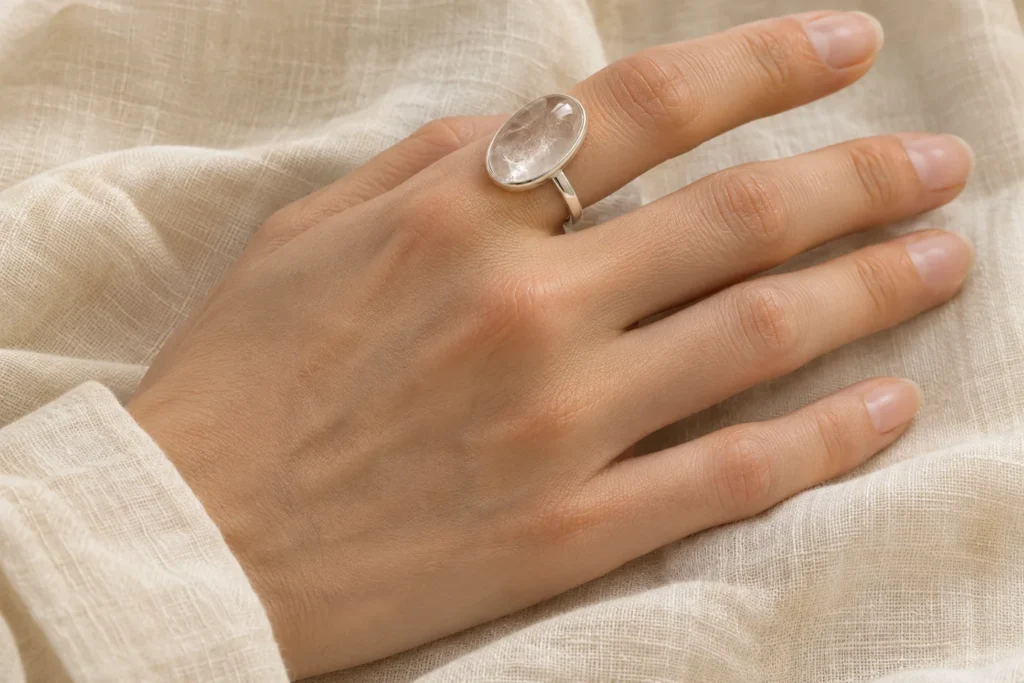
Below, I break down the common finger associations, explain the practical factors that matter just as much as symbolism, and — most importantly — show sellers how to turn this question into a trust-building moment rather than a source of confusion.
What does each finger symbolize for a clear quartz ring?
Customers searching for which finger to wear a clear quartz ring on usually expect a tidy chart of meanings. The risk for sellers is presenting these meanings as absolute rules, which can hurt credibility. A better approach is offering them as optional references.
Different fingers carry different symbolic associations across various cultural and metaphysical traditions.2 These meanings can help a customer choose a finger that resonates with their personal intention, but they are interpretive — not scientifically verified or universally agreed upon. Sellers should present them as common associations rather than instructions.
A Quick Reference Table
Here is a summary of the most commonly cited finger associations. I have seen variations across different traditions, so treat this as a starting point, not a definitive guide.
| Finger | Common Symbolic Association | How Customers Often Frame It |
|---|---|---|
| Thumb | Willpower, individuality, inner strength | "I want to feel grounded and self-assured" |
| Index finger | Confidence, leadership, direction | "I want focus and motivation" |
| Middle finger | Balance, responsibility, personal power | "I want stability and structure" |
| Ring finger | Love, commitment, creativity | "I want to honor a relationship or emotional openness" |
| Little finger (pinky) | Communication, intuition, self-expression | "I want to express myself clearly" |
Where Do These Meanings Come From?
These associations draw from a mix of palmistry traditions, certain metaphysical belief systems, and cultural customs. For example:
- The ring finger's connection to love is arguably the most universal — rooted in Western wedding traditions and the old belief in the vena amoris3 (a vein running directly to the heart).
- The index finger's link to authority appears in historical contexts where signet rings and family crests were worn on the pointer finger4.
- Pinky finger associations with communication partly stem from palmistry, where the little finger corresponds to Mercury5.
None of these are exclusive to clear quartz. They apply to any ring. What makes clear quartz relevant is that many customers view it as an "amplifier" or "master healer" in crystal traditions6 — meaning they believe it can enhance whatever intention the finger represents. Sellers should frame this as a belief some customers hold, not as a product guarantee.
How Should Sellers Present This Information?
From our experience at GD Crystal working with retailers who sell crystal jewelry, the most effective product descriptions and customer responses use soft, flexible language. Compare these two approaches:
❌ "Wear your clear quartz ring on your index finger to activate leadership energy."
✅ "Many people choose to wear a clear quartz ring on their index finger as a personal reminder of confidence and focus."
The first version implies a guaranteed mechanism. The second version respects the customer's autonomy while still providing a meaningful answer. This distinction matters for credibility, customer trust, and — in some markets — advertising compliance7.
Does it matter which hand you wear a clear quartz ring on?
Beyond the finger question, customers often ask whether the left or right hand makes a difference. This is another area where sellers need to balance cultural traditions with practical honesty.
Some metaphysical traditions suggest the left hand is the "receiving" hand (absorbing energy) and the right hand is the "giving" hand (projecting energy).8 However, this is a belief framework, not a measurable rule. In practice, most people wear a clear quartz ring on whichever hand feels comfortable and does not interfere with daily tasks.
The Receiving vs. Giving Framework
This concept appears frequently in crystal community discussions and some energy healing traditions. The basic idea:
- Left hand: Often described as the receptive side. Some customers choose this hand when they want to "invite in" qualities like clarity, calm, or openness.
- Right hand: Often described as the active or projective side. Some customers pick this hand when they want to "send out" confidence, creativity, or intention.
For sellers, the key phrase is "some traditions suggest." This keeps the guidance helpful without making it sound like a product specification.
Practical Considerations That Override Symbolism
In my experience, practical factors often decide which hand wins, regardless of symbolic preference:
- Dominant hand wear and tear: A clear quartz ring on the dominant hand gets bumped, scratched, and exposed to more impact.9 For delicate settings or softer stone finishes, the non-dominant hand may be better for longevity.
- Existing jewelry: Many customers already wear a wedding ring or other significant ring on one hand. They need the clear quartz ring to fit around what they already have.
- Work and lifestyle: Someone who works with their hands — cooking, crafting, typing — will naturally prefer the hand that causes less interference.
Seller Communication Tip
When a customer asks "which hand should I wear it on?" a great response template looks like this:
"There is no wrong hand. Some people follow the tradition of wearing crystals on the left hand for receiving and the right for projecting, but most of our customers simply choose the hand that is most comfortable for daily wear. Either way, the ring looks beautiful and serves as a personal reminder of your intention."
This kind of response closes the hesitation loop without making unsupported claims.
Why do customers ask which finger to wear a clear quartz ring on?
Understanding why people ask this question helps sellers craft better answers, write stronger product descriptions, and reduce pre-purchase hesitation. The question is rarely about strict metaphysical correctness.
Most customers asking about clear quartz ring finger placement want reassurance. They are drawn to the ring and want permission to buy it — they just need to feel like they are making an informed, intentional choice. The question is more emotional than technical.
The Three Real Reasons Behind the Question
Based on the kinds of inquiries we see at GD Crystal from shop owners and online sellers relaying their customer conversations, the question usually stems from one of three motivations:
-
Seeking validation for a purchase. The customer already likes the ring. They want a "reason" to make it feel meaningful, not just decorative. A finger association gives them that narrative.
-
Worry about doing it wrong. Crystal culture online sometimes implies strict rules — "never wear this stone on that finger" or "only the left hand works." Customers absorb these messages and feel anxious about making a mistake. A flexible, reassuring answer calms this anxiety.
-
Looking for personalization. Some customers enjoy choosing a finger that matches their current life focus — maybe they are working on communication skills and like the idea of a pinky ring, or they want confidence and lean toward the index finger. The question is really "help me make this ring feel like mine."
How This Translates to Better Product Listings
If you sell clear quartz rings, consider adding a short section in your product description that addresses the finger question proactively. For example:
How to Wear: This clear quartz ring can be worn on any finger. Many customers choose based on personal intention — the index finger for focus, the ring finger for love, or simply the finger where it fits best. There is no wrong choice.
This approach:
- Answers the question before the customer needs to search for it
- Reduces purchase friction
- Positions your brand as knowledgeable and approachable
- Avoids compliance risk from absolute healing claims
What practical factors should sellers consider beyond symbolism?
Symbolism gets the clicks, but practical details close the sale. A finger meaning is irrelevant if the ring does not fit, feels uncomfortable, or chips within a week. Sellers need to address both layers.
When advising customers on which finger to wear a clear quartz ring, sellers should also consider ring sizing, stone durability, setting style, and daily wear habits. A ring that looks and feels great on the chosen finger will be worn — and recommended to friends. One that does not will be returned.
Ring Sizing Across Fingers
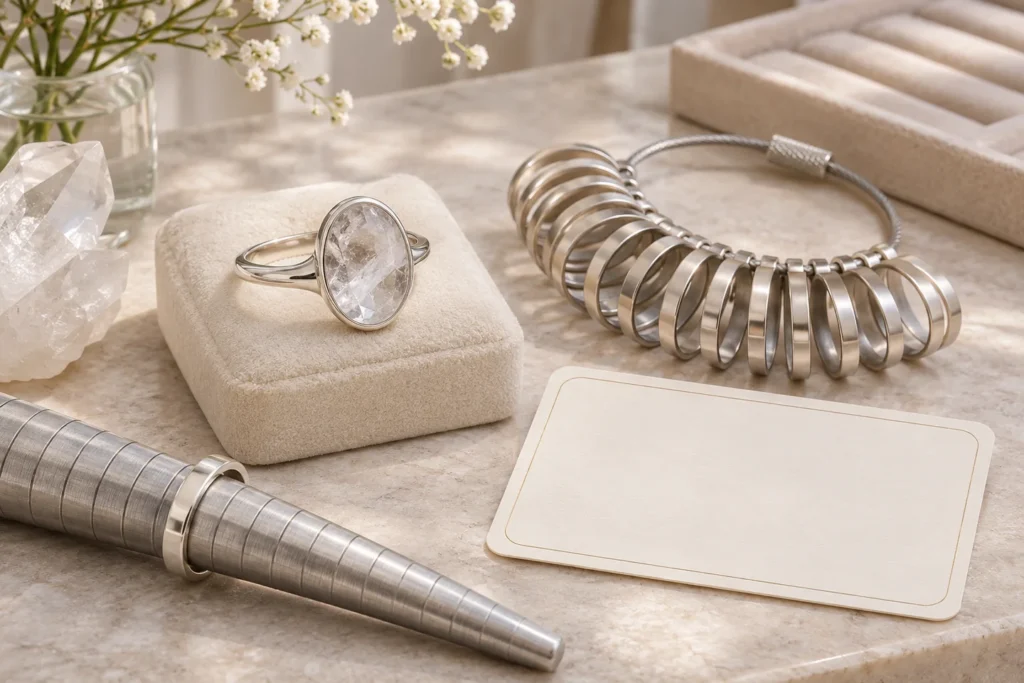
This is surprisingly important for crystal rings, because many customers order based on their "usual" ring size without realizing that different fingers have different circumferences10. Here is a general sizing reality check:
| Finger | Sizing Guidance | Notes |
|---|---|---|
| Thumb | Measure the intended thumb | Check each hand separately and use the supplier’s size chart. |
| Index finger | Measure the intended index finger | Do not infer its size from the ring finger; use the supplier’s size chart. |
| Middle finger | Measure the intended middle finger | Confirm the fit on the actual hand and finger to be worn. |
| Ring finger | Measure the intended ring finger | Check each hand separately; confirm fit for the selected band width. |
| Little finger | Measure the intended little finger | Use the supplier’s size chart and check comfort and proportion. |
For sellers offering clear quartz rings in wholesale quantities, this means carrying a broader size range or clearly communicating that the ring may fit differently depending on the intended finger. At GD Crystal, when retailers ask about ring sizing for their customer base, we recommend confirming the target finger before finalizing sizes in a bulk order.
Stone Durability and Daily Wear
Clear quartz rates a 7 on the Mohs hardness scale11, which is reasonably durable for daily wear. However, certain factors affect longevity:
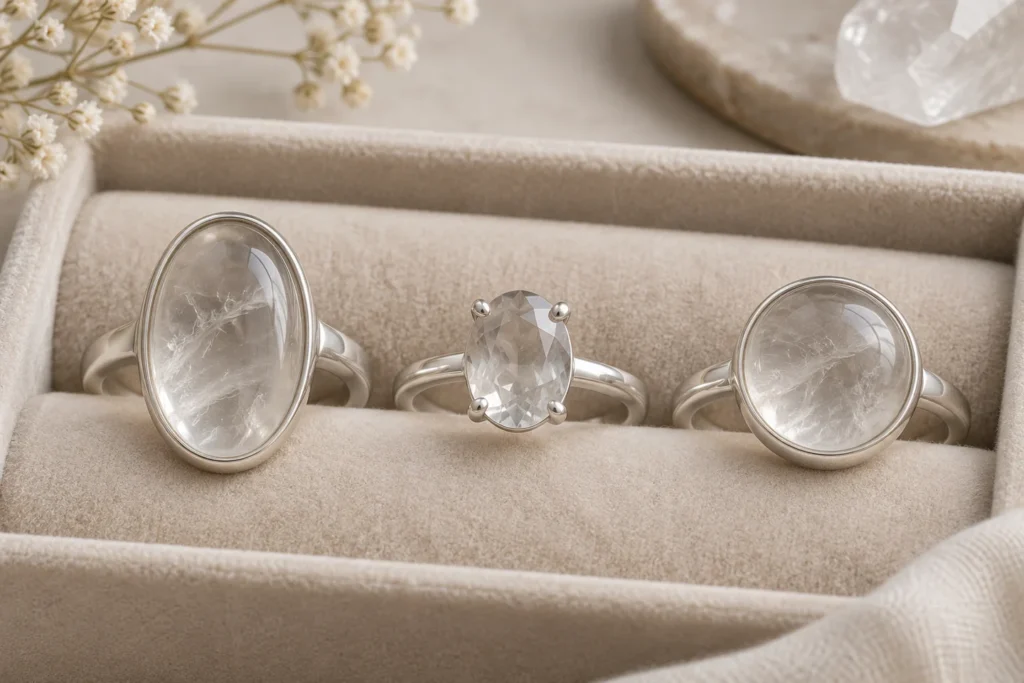
- Prong settings expose more of the stone, which looks stunning but increases vulnerability to knocks — especially on the index finger or thumb, which contact surfaces more often.
- Bezel settings wrap metal around the stone's edges, offering more protection.12 These work well for customers who plan to wear the ring every day.
- Cabochon cuts vs. faceted cuts: Smooth cabochons are less likely to chip on edges. Faceted clear quartz shows more sparkle but can catch on fabrics.
Style and Proportion
A chunky statement clear quartz ring might look dramatic on the index or middle finger but feel overwhelming on the pinky. Conversely, a delicate thin-band design with a small stone might get lost on the thumb. Sellers should help customers match the ring's visual weight to the finger's proportions.
This is where product photography becomes a powerful selling tool. Showing the same ring on different fingers in your listing images can help customers visualize their choice — and reduces "which finger" questions altogether.
How can sellers avoid common mistakes when discussing clear quartz ring placement?
Crystal sellers operate in a space where customer expectations, metaphysical traditions, and advertising regulations intersect. Getting the language wrong can cost credibility or invite compliance issues.
The most common mistake sellers make is presenting symbolic finger associations as factual product benefits. Saying a clear quartz ring "will boost your confidence when worn on the index finger" crosses from suggestion into unsupported claim. Safer language frames the choice as personal, cultural, or traditional.
Five Mistakes to Avoid
-
Stating one finger is "correct." This creates unnecessary anxiety for buyers who prefer a different finger and discourages purchases from people whose preferred finger does not match the recommendation.
-
Using medical or therapeutic language. Phrases like "clear quartz heals anxiety when worn on the middle finger" are unsupported claims. Some advertising platforms flag this language.
-
Ignoring practical fit. A product page full of symbolic meaning but no sizing guide frustrates customers and increases returns.
-
Contradicting other sources. If a customer has read that the left hand is "correct" and your site says the right hand, they lose trust. Better to acknowledge multiple traditions exist.
-
Over-promising energy effects. "This ring will amplify your energy" is a claim. "Many crystal enthusiasts value clear quartz for its traditional association with clarity and amplification" is an observation.
A Language Framework That Works
Here is a simple formula sellers can use in descriptions, social posts, and customer replies:
[People / Some traditions / Many crystal enthusiasts] + [associate / believe / choose] + [finger/hand] + [for / as a symbol of / as a personal reminder of] + [intention].
Example: "Many crystal enthusiasts choose to wear a clear quartz ring on the index finger as a personal reminder of clarity and focus."
This structure is honest, helpful, and safe. It guides the customer without making promises your product cannot keep.
Frequently Asked Questions
Can I wear a clear quartz ring on any finger?
Yes. There is no universally required finger for a clear quartz ring. Choose based on comfort, personal intention, and style preference. Symbolic finger associations are optional references drawn from various cultural traditions, not strict rules that affect how the stone looks or feels.
Is clear quartz durable enough for everyday ring wear?
Clear quartz has a Mohs hardness of 7, which is suitable for regular wear. A bezel setting or cabochon cut offers extra protection. Avoid exposing the ring to harsh chemicals or heavy impact. For everyday durability, consider the setting style as much as the stone itself.
Should I wear my clear quartz ring on my left or right hand?
Some traditions describe the left hand as "receiving" and the right hand as "giving," but there is no proven rule. Most people choose based on comfort and daily habits. Wearing it on your non-dominant hand can reduce wear and tear on the stone and setting.
How should I describe clear quartz ring finger placement in my product listing?
Use flexible, customer-empowering language. Mention common finger associations as optional guidance, include sizing information for different fingers, and avoid absolute claims about energy or healing. A short "How to Wear" section in your listing can reduce customer hesitation.
What makes clear quartz rings popular for retail?
Clear quartz is widely available, visually versatile, and holds broad appeal across metaphysical, fashion, and gift-buying audiences. Its neutral color complements any setting metal. For sellers, it offers reliable demand and pairs well with storytelling about intention and personal meaning.
Conclusion
Choosing which finger to wear a clear quartz ring on is ultimately a personal decision shaped by intention, comfort, and style — not a rigid rule. For sellers, the real opportunity is turning this common question into a moment of trust and guidance. Present symbolic associations as optional references, prioritize practical fit and durability in your product information, and use flexible language that empowers customers without making unsupported claims.
At GD Crystal, we work with crystal retailers and brand owners who want to offer their customers beautiful, well-crafted clear quartz rings with the product knowledge to back them up. If you are looking for a reliable supplier for clear quartz rings or other crystal jewelry components — with flexible order quantities and honest communication about materials and quality — reach out to our team for a quote tailored to your needs.
References
- "The impact of purchase decision confidence on the …", https://trace.tennessee.edu/cgi/viewcontent.cgi?article=13760&context=utk_graddiss. Consumer-behavior research links perceived risk and decision uncertainty with lower purchase intention and greater hesitation, supporting the article's explanation that fear of choosing incorrectly can slow a buyer's decision. Evidence role: mechanism; source type: paper. Supports: A source should support that uncertainty or perceived risk can reduce purchase intention or delay consumer decisions.. Scope note: This would support the general purchasing mechanism rather than crystal jewelry buyers specifically. ↩
- "Ring finger", https://en.wikipedia.org/wiki/Ring_finger. Reference works on the history of finger rings describe rings as objects with social, marital, religious, and status symbolism, providing historical context for the article's statement that finger associations are culturally interpreted. Evidence role: historical_context; source type: encyclopedia. Supports: A source should document that rings and their placement have had symbolic meanings in different historical or cultural settings.. Scope note: Such a source would not validate the specific metaphysical meanings assigned to each finger. ↩
- "Vena amoris", https://en.wikipedia.org/wiki/Vena_amoris. Historical accounts of wedding-ring customs identify the vena amoris belief as a traditional explanation for wearing a wedding ring on the fourth finger, supporting the article's contextual link between that finger and love. Evidence role: historical_context; source type: encyclopedia. Supports: A source should explain the historical belief that a vein in the ring finger led to the heart and its relationship to wedding-ring symbolism.. Scope note: Modern anatomy does not support the literal existence of a unique vein from that finger directly to the heart. ↩
- "A brief history of signet rings", https://thehistorypress.co.uk/article/a-brief-history-of-signet-rings/. Museum and historical jewelry sources describe signet rings as markers of identity, family, and authority and note historical variation in the fingers on which they were worn, giving context for the article's association between the index finger and authority. Evidence role: historical_context; source type: institution. Supports: A museum or historical source should show that signet rings were used to display identity or status and were historically worn on particular fingers including the index finger.. Scope note: The source may show historical usage patterns rather than proving a universal rule for index-finger placement. ↩
- "Palmistry", https://en.wikipedia.org/wiki/Palmistry. References on palmistry identify the little finger, often called the Mercury finger, with Mercury-related symbolism, supporting the article's description of the pinky association as a palmistry-derived convention. Evidence role: definition; source type: encyclopedia. Supports: A source should define the palmistry correspondence between the little finger and Mercury.. Scope note: This supports the existence of the symbolic system, not the factual efficacy of wearing a ring on that finger. ↩
- "Clear quartz: master healer and energy amplifier", https://www.facebook.com/mysticcrystalsandcats/posts/-clear-quartzthe-master-healer-and-amplifier-clear-quartz-is-often-referred-to-a/636606342223601/. Studies and reference discussions of crystal-healing practices note that quartz is commonly assigned broad amplifying or healing symbolism by practitioners, supporting the article's statement about customer beliefs in crystal traditions. Evidence role: general_support; source type: research. Supports: A source should document that clear quartz is described within crystal-healing communities as an amplifier or master healer.. Scope note: This would document the belief tradition and should not be read as evidence that quartz produces measurable healing effects. ↩
- "FTC Policy Statement Regarding Advertising Substantiation", https://www.ftc.gov/legal-library/browse/ftc-policy-statement-regarding-advertising-substantiation. Government advertising guidance requires marketers to substantiate objective health or therapeutic claims and avoid misleading representations, supporting the article's caution that absolute claims about crystal effects can create compliance concerns. Evidence role: expert_consensus; source type: government. Supports: A source should show that advertisers must have evidence for objective health or therapeutic claims and avoid misleading claims.. Scope note: Specific obligations vary by jurisdiction and advertising channel. ↩
- "Is the receiving hand strictly only the left, and giving right?", https://www.reddit.com/r/energy_work/comments/bwogzj/is_the_receiving_hand_strictly_only_the_left_and/. Sources describing contemporary crystal-healing or energy-work practices present the left hand as receptive and the right hand as projective, supporting the article's characterization of this as a metaphysical belief framework. Evidence role: definition; source type: other. Supports: A source should document the left-receptive/right-projective hand framework as a belief used in metaphysical or crystal-healing contexts.. Scope note: This would evidence the existence of the belief, not demonstrate that energy transfer is measurable. ↩
- "Left-hand dominance and hand trauma", https://pubmed.ncbi.nlm.nih.gov/8583055/. Ergonomic and occupational-health studies commonly report greater task use and exposure of the dominant hand, providing a mechanistic basis for the article's claim that jewelry on that hand may encounter more impacts. Evidence role: mechanism; source type: paper. Supports: A source should support that the dominant hand is typically used more often or is more exposed during manual tasks.. Scope note: The evidence would concern hand use generally rather than measuring wear on clear quartz rings directly. ↩
- "Firefighter Hand Anthropometry and Structural Glove Sizing", https://pmc.ncbi.nlm.nih.gov/articles/PMC4681492/. Anthropometric studies of the hand report measurable differences in digit dimensions, including finger breadth or circumference, supporting the article's practical point that a ring size suitable for one finger may not fit another. Evidence role: statistic; source type: paper. Supports: A source should provide anthropometric measurements showing that finger dimensions vary by digit.. Scope note: Population averages vary by sex, age, body size, and measurement method. ↩
- "Mineral Gemstones", https://pubs.usgs.gov/gip/gemstones/mineral.html. Mineralogical references list quartz at 7 on the Mohs hardness scale, supporting the article's durability discussion for clear quartz jewelry. Evidence role: definition; source type: education. Supports: A source should state the Mohs hardness value of quartz.. ↩
- "GIA Guide to Engagement Ring Settings", https://4cs.gia.edu/en-us/blog/guide-to-ring-settings. Gemological education sources define a bezel setting as metal encircling a gemstone, a construction that can protect the stone's edge more than exposed settings. Evidence role: definition; source type: institution. Supports: A source should define a bezel setting and explain that it surrounds or protects the gemstone edge.. Scope note: Actual protection depends on workmanship, metal thickness, stone shape, and wearer activity. ↩