When sourcing crystal products for your store, the difference between quartz and clear quartz can create real confusion at the inquiry stage. A misunderstood term leads to wrong quotes, mismatched samples, and wasted time on both sides. The fix is simpler than most buyers expect — it starts with understanding how these names relate to each other in a purchasing context.
Quartz is the broad mineral family; clear quartz is a commercial product term describing colorless, transparent varieties within that family.1 They are not two different minerals.2 When buyers treat them as separate categories, miscommunication during sourcing becomes almost inevitable. The practical difference lies in product specification — clarity, color, and intended use — not in mineral classification.
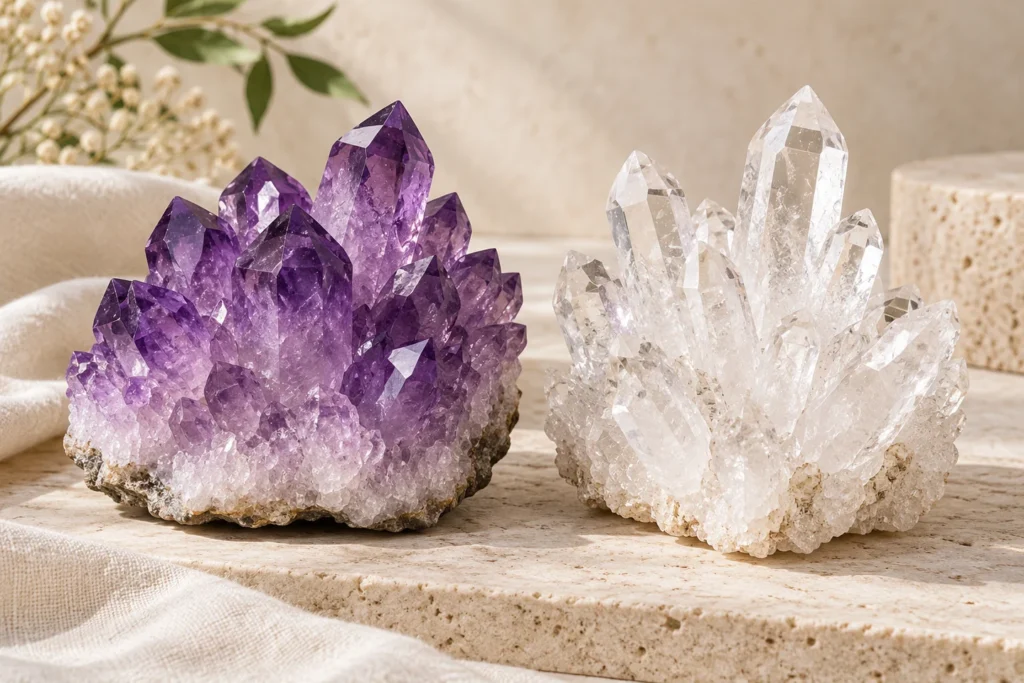
That one-line distinction sounds straightforward, but it generates a surprising number of sourcing mistakes. Below, I'll walk through exactly why these terms overlap, how they show up differently in product catalogs and supplier conversations, and what you should include in your next inquiry to avoid ordering the wrong product entirely.
Why Do Buyers Confuse Quartz and Clear Quartz?
The confusion usually starts with product listings. Suppliers, marketplaces, and even retail competitors use "quartz" and "clear quartz" inconsistently — sometimes interchangeably, sometimes to mean very different products. If you're comparing quotes from multiple suppliers, this inconsistency can derail your entire sourcing process.
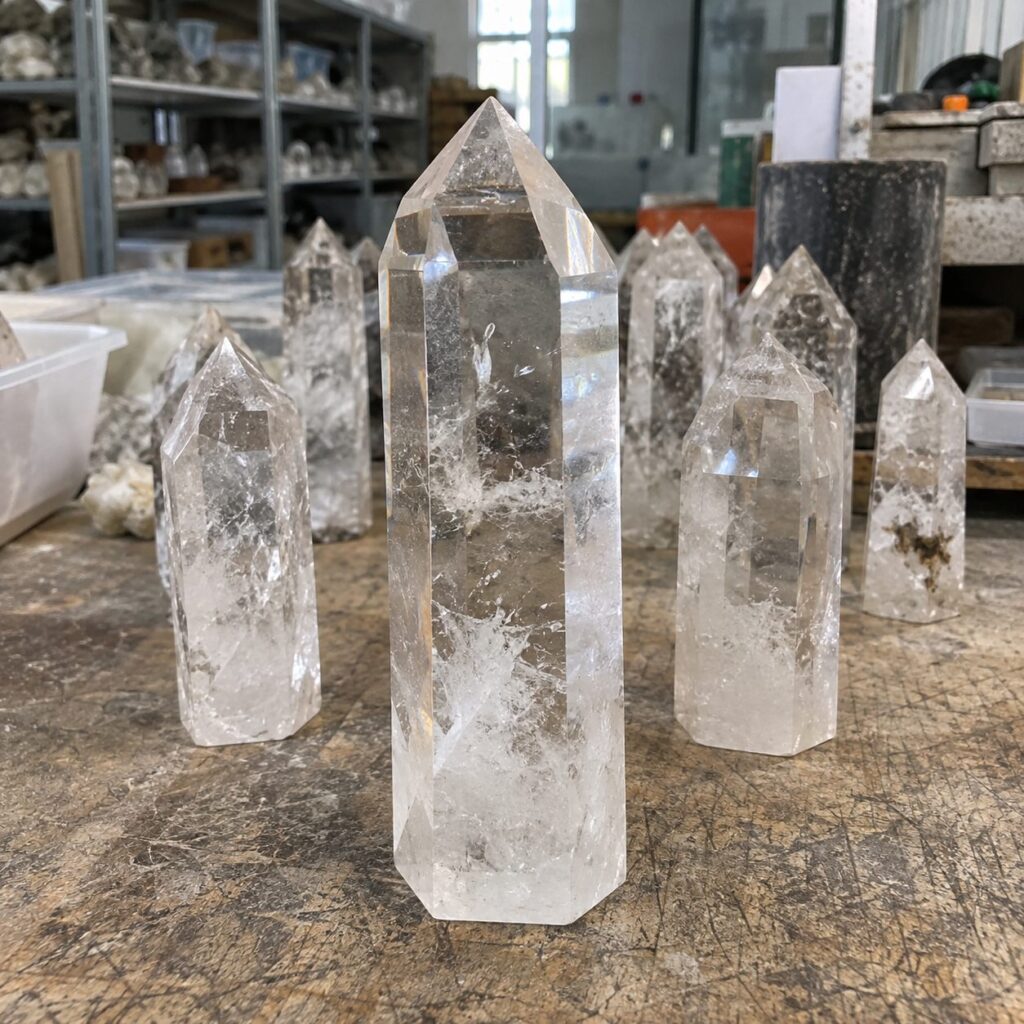
The core reason for the confusion is that "quartz" can refer to dozens of products across a wide spectrum of colors, clarity levels, and treatments3, while "clear quartz" narrows that down to one visual appearance — but without a single universal standard for how clear is "clear." Buyers need to understand this ambiguity before they send their first inquiry.
The Quartz Family Is Enormous
Let me put this in practical terms. In our daily work at GD Crystal, "quartz" shows up in product names across nearly every category we supply. Here's a partial list of quartz-family products that regularly appear in B2B inquiries:
| Product Name | Color/Appearance | Still Quartz? |
|---|---|---|
| Clear quartz points | Colorless, transparent | Yes |
| Rose quartz hearts | Pink, translucent | Yes |
| Smoky quartz spheres | Brown/grey, transparent to translucent | Yes |
| Amethyst clusters | Purple, translucent to transparent | Yes |
| Citrine tumbled stones | Yellow/orange, translucent | Yes |
| Milky quartz palm stones | White, opaque to translucent | Yes |
| Rutilated quartz towers | Clear with golden needle inclusions | Yes |
Every item above belongs to the quartz mineral family.4 When a buyer simply writes "I need quartz" in an inquiry, we genuinely cannot determine which of these — or many others — they mean. I've seen inquiries where a buyer typed "quartz" but attached a reference photo of amethyst. That's not an error in mineral knowledge; it's a naming gap between how buyers and suppliers use the word.
"Clear Quartz" Is a Description, Not a Separate Species
From a mineralogy perspective, clear quartz (sometimes called rock crystal) is silicon dioxide (SiO₂) with minimal impurities and inclusions, resulting in a colorless and transparent appearance.5 It is not a distinct mineral from quartz — it is quartz that happens to be clear.
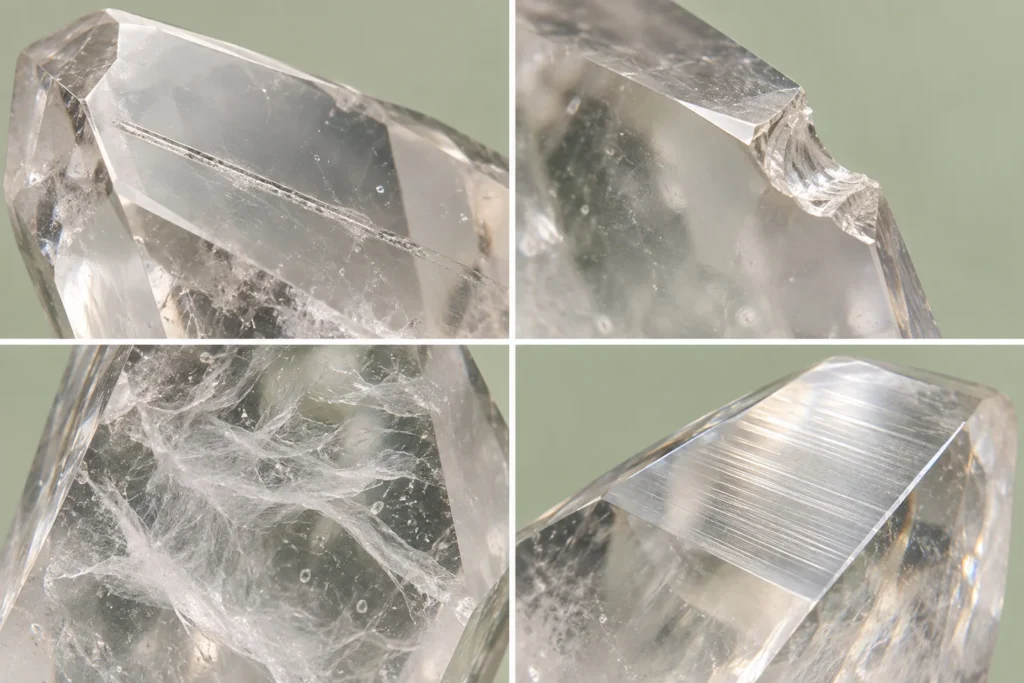
But here's where it matters for purchasing: the word "clear" is relative.6 One supplier's "clear quartz" might be glass-like transparency with no visible inclusions. Another supplier might label slightly cloudy or milky pieces as "clear quartz" because they are predominantly colorless. Without photos and grading criteria, the term alone tells you very little about what you'll actually receive.
Common Terms You'll Encounter
When browsing supplier catalogs or communicating with factories, you may come across several overlapping terms:
- Quartz — the broad mineral name; could refer to any variety
- Clear quartz — typically means colorless, transparent quartz
- Rock crystal — a traditional name for high-clarity colorless quartz7
- White quartz — sometimes used for milky or opaque colorless quartz;8 sometimes used loosely as a synonym for clear quartz
- Natural quartz — indicates natural origin, but does not by itself mean untreated; confirm treatment status with the supplier.
Key takeaway for buyers: Never assume two suppliers mean the same thing by the same term. Always confirm with reference photos and specific clarity expectations.
Does the Quartz vs. Clear Quartz Distinction Actually Affect Your Orders?
Absolutely — and more often than you'd think. When terminology is vague, the downstream consequences hit your inventory, your product listings, and your customer expectations. A naming mismatch at the inquiry stage can cost you an entire order's worth of returns or unsellable stock.
The distinction matters because your end customers see specific products — a crystal-clear tower point, a translucent palm stone, or a milky sphere — and they expect consistency. If you ordered "quartz spheres" without specifying clarity, you might receive a mixed batch ranging from fully transparent to heavily included. That's not necessarily a supplier error; it's an inquiry gap.
Real Sourcing Scenarios Where It Matters
Let me share a few patterns I've observed over our 15+ years of processing and supplying crystal products:
Scenario 1: The vague inquiry.
A buyer emails asking for "quartz towers, 8–10 cm, 200 pieces." We need to ask: do you mean clear quartz? Smoky quartz? Rose quartz? Rutilated quartz? Each has a completely different price range, availability, and lead time. The inquiry stalls until we clarify.
Scenario 2: The assumed clarity level.
A buyer requests "clear quartz palm stones" and expects every piece to be fully transparent, like glass. In reality, natural clear quartz palm stones almost always contain some internal veiling, minor inclusions, or slight cloudiness.9 If the buyer needed premium AAA clarity, that's a different grade with different pricing — and it should have been stated upfront.
Scenario 3: The terminology mismatch across markets.
Some retail markets use "rock crystal" for high-end transparent quartz and "clear quartz" for standard-grade colorless quartz. Other markets reverse these associations. When a buyer uses one term and the supplier interprets another, the delivered product doesn't match expectations.
What This Means for Your Bottom Line
| Risk | Cause | Prevention |
|---|---|---|
| Receiving wrong color/variety | Using "quartz" without specifying variety | Always name the specific variety (clear, rose, smoky, etc.) |
| Receiving unexpected clarity grade | Assuming "clear" means AAA transparency | Provide reference photos and state clarity expectations |
| Price mismatch across quotes | Comparing "quartz" quotes from different suppliers without confirming they mean the same product | Confirm exact product specs before comparing prices |
| Unsellable inventory | Listing products based on assumed quality | Request pre-shipment photos or video for each batch |
How Should Buyers Specify Clear Quartz in a Supplier Inquiry?
This is where the naming question becomes an actionable procurement skill. Knowing that clear quartz is just a subset of quartz is step one. Step two — and the more valuable one — is learning to communicate your product needs precisely so your supplier quotes accurately the first time.
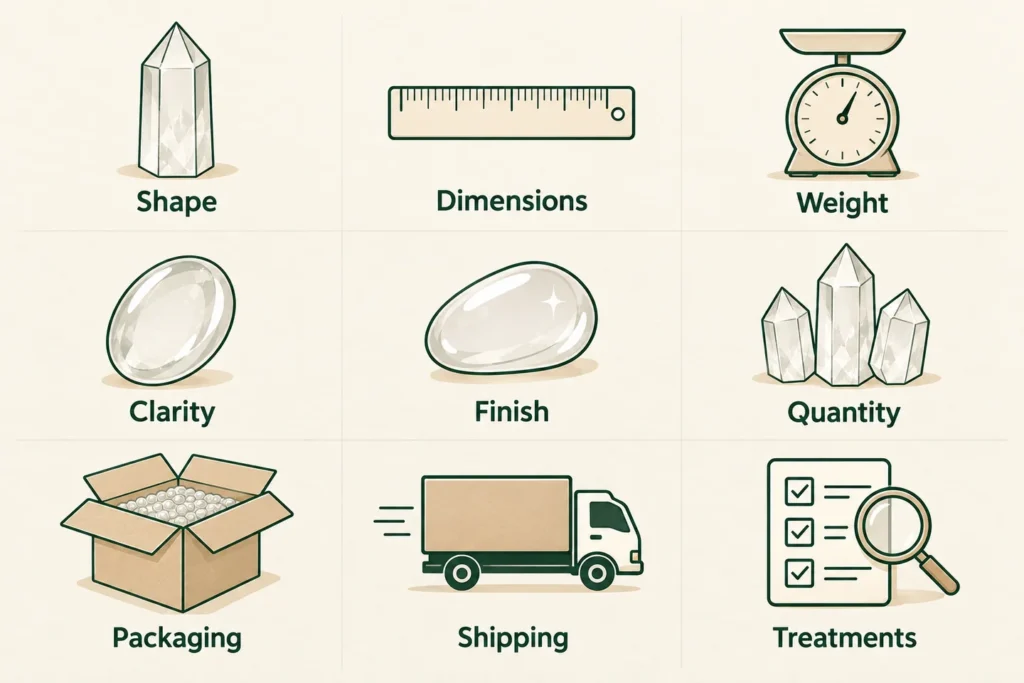
A well-structured inquiry eliminates ambiguity and speeds up the entire sourcing process. At GD Crystal, the inquiries that move fastest from quote to order share a consistent set of details. Here's what we recommend including when you're sourcing clear quartz or any quartz-family product.
Your Clear Quartz Inquiry Checklist
-
Material name and variety — Say "clear quartz" or "colorless transparent quartz," not just "quartz." If you know a more specific term like "rock crystal," include it alongside the common name.
-
Product shape/form — Tower points? Spheres? Palm stones? Hearts? Tumbled stones? Raw points? Each form has different processing requirements and pricing.
-
Size and weight range — Provide specific dimensions (e.g., 6–8 cm height) or weight ranges (e.g., 80–120 g per piece). Avoid vague descriptors like "medium."
-
Clarity and appearance expectations — This is the most commonly omitted detail. State whether you need:
- AAA grade (near-transparent, minimal inclusions)
- Standard grade (mostly clear, some natural veiling acceptable)
- Mixed grade (a range of clarity levels)
-
Reference photos — Even a single photo communicates more than a paragraph of text. If you've seen a product on a competitor's site that matches what you want, share that image.
-
Quantity — Provide your target order quantity and whether you're open to MOQ adjustments.
-
Intended use — Retail resale? Gift sets? Display pieces? This helps the supplier recommend appropriate grades and packaging.
-
Treatment/enhancement preferences — If you need strictly untreated natural clear quartz, say so. If you're open to enhanced material, state that too. Treatment and origin details should always be confirmed per batch.
Why Reference Photos Matter More Than Names
I cannot overstate this: a reference photo resolves more naming confusion than any glossary ever will. When a buyer sends a photo showing exactly the level of transparency, inclusion pattern, and surface finish they want, the conversation skips past all the "what do you mean by clear" back-and-forth.
We regularly guide buyers through photo-based selection. If you're new to sourcing clear quartz products, start by collecting 3–5 images of products that match your desired look. Attach them to your inquiry. This single step can shave days off your sourcing timeline.
What Other Quartz Varieties Should Buyers Know About?
Understanding the quartz family beyond clear quartz helps you diversify your inventory strategically and avoid ordering overlapping products under different names. For B2B buyers building a crystal product line, knowing the major varieties means you can plan assortments, compare pricing across categories, and communicate with suppliers using consistent terminology.
The main quartz varieties exist on a spectrum from colorless to deeply saturated, from transparent to fully opaque.10 Each variety has its own market demand, price bracket, and customer base. Knowing where clear quartz fits in this landscape helps you evaluate it as a product category, not just a mineral name.
Common Quartz Varieties in B2B Crystal Trade
| Variety | Typical Color | Transparency | Relative Price Range |
|---|---|---|---|
| Clear quartz | Colorless | Transparent | Low to moderate (grade-dependent) |
| Rose quartz | Pink | Translucent to opaque | Low to moderate |
| Amethyst | Purple | Transparent to translucent | Moderate to high |
| Smoky quartz | Brown/grey | Transparent to translucent | Low to moderate |
| Citrine | Yellow/orange | Transparent to translucent | Moderate (verify if natural or heat-treated) |
| Milky quartz | White | Translucent to opaque | Low |
| Rutilated quartz | Clear with golden/red needles | Transparent | Moderate to high |
| Phantom quartz | Clear with visible internal "ghost" layers | Transparent to translucent | Moderate to high |
A Note on Treatments and Naming
Some quartz varieties are commonly enhanced through heat treatment or irradiation. For example, much of the citrine on the market is actually heat-treated amethyst.11 Some deep smoky quartz has been irradiated.12 These treatments are widespread and generally accepted in the trade, but buyers who make product claims to their end customers should verify treatment status with their supplier on a per-batch basis.
At GD Crystal, we communicate treatment information as part of the inquiry process. We encourage buyers to ask directly rather than assume — especially for products that will be marketed with specific origin or naturalness claims.
Diversifying with Clear Quartz as Your Anchor
Many of our buyers start their crystal product lines with clear quartz because:
- It's a universal category — clear quartz products sell across spiritual, décor, and gift markets
- It's available in almost every product form — points, spheres, palm stones, hearts, clusters, raw specimens, and more
- It pairs well with other varieties — for curated sets, gift boxes, or mixed-variety displays
- Price entry is accessible — standard-grade clear quartz is among the most cost-effective crystal categories for new buyers
From there, buyers typically expand into rose quartz, amethyst, and smoky quartz as their sales data guides them.
Frequently Asked Questions
Is clear quartz the same mineral as regular quartz?
Yes. Clear quartz is not a separate mineral. It is colorless, transparent quartz — the same silicon dioxide (SiO₂) composition. The name "clear quartz" is a commercial description indicating appearance, not a distinct mineral species. Buyers should treat it as a product specification within the broader quartz category.
Why do suppliers list "quartz" and "clear quartz" separately?
Suppliers separate them for catalog clarity. "Quartz" as a standalone listing could mean any variety, while "clear quartz" signals a specific colorless, transparent product. However, standards vary between suppliers — always confirm what a specific supplier means by their listing terms before comparing prices.
Can I just say "clear quartz" in my inquiry and expect accurate quotes?
It's a good start, but not sufficient on its own. You should also specify the product shape, size range, clarity grade, quantity, and ideally attach reference photos. The word "clear" means different things to different suppliers, so visual references and written specifications prevent mismatched expectations.
What is rock crystal, and is it different from clear quartz?
Rock crystal is a traditional term for high-quality, transparent colorless quartz. In many supplier catalogs, it's used interchangeably with "clear quartz." Some markets use "rock crystal" to imply a higher clarity grade. If you see this term, confirm with the supplier whether they distinguish it from their standard clear quartz offerings.
How do I verify the quality of clear quartz before placing a bulk order?
Request detailed product photos and videos of the current batch before ordering. Ask about clarity grading criteria, inclusion levels, and surface finish. For first-time orders, consider starting with a smaller trial quantity to evaluate the product in hand. For formal identification needs, consult a qualified gemological professional.
Conclusion
The difference between quartz and clear quartz is a naming distinction, not a mineral one. Quartz is the family; clear quartz is a product description for colorless, transparent members of that family. For B2B buyers, the real takeaway isn't about mineralogy — it's about communication precision during sourcing. Use specific variety names, provide reference photos, state your clarity expectations, and confirm terminology with each supplier before comparing quotes.
At GD Crystal, we help wholesale buyers navigate exactly these kinds of product naming and specification questions every day. With over 15 years of crystal processing experience in Suzhou, China, we're set up to guide you from inquiry through order — whether you need clear quartz towers, spheres, palm stones, or custom shapes. Reach out with your product requirements, reference images, and target quantities, and we'll provide a detailed quote tailored to your needs.
References
- "Quartz", https://en.wikipedia.org/wiki/Quartz. Mineralogical references define quartz as crystalline silicon dioxide and describe rock crystal as the colorless, transparent variety of quartz; this supports the distinction between mineral classification and commercial appearance terminology. Evidence role: definition; source type: encyclopedia. Supports: A neutral mineral reference should define quartz and identify rock crystal or clear quartz as a colorless transparent variety rather than a separate mineral.. Scope note: The source may define the mineralogical relationship directly but may not discuss wholesale purchasing terminology. ↩
- "Silica Statistics and Information", https://www.usgs.gov/centers/national-minerals-information-center/silica-statistics-and-information. Gemological and mineralogical references identify rock crystal as colorless transparent quartz, indicating that clear quartz and quartz differ by variety or appearance rather than by mineral species. Evidence role: definition; source type: institution. Supports: The source should show that clear quartz or rock crystal is a variety of quartz, not a separate mineral species.. ↩
- "Quartz", https://en.wikipedia.org/wiki/Quartz. Mineralogical references list numerous quartz varieties, including amethyst, citrine, smoky quartz, rose quartz, milky quartz, and rock crystal, demonstrating that the term quartz encompasses a broad range of colors and appearances. Evidence role: general_support; source type: encyclopedia. Supports: A mineral reference should list major quartz varieties and show that quartz occurs in many colors and transparency levels.. Scope note: Such sources support the mineral diversity of quartz but do not prove how any specific supplier labels products. ↩
- "Quartz – Wikipedia", https://en.wikipedia.org/wiki/Quartz. Reference works on quartz classify amethyst, citrine, rose quartz, smoky quartz, milky quartz, and rock crystal as varieties or common forms of quartz, supporting their inclusion within the quartz family. Evidence role: definition; source type: encyclopedia. Supports: The source should identify the listed materials as varieties or forms of quartz.. Scope note: Rutilated quartz may be described as quartz containing rutile inclusions rather than as a separate quartz variety. ↩
- "Quartz", https://en.wikipedia.org/wiki/Quartz. Mineralogical sources identify quartz as SiO₂ and rock crystal as the colorless, transparent form of quartz, a description consistent with low concentrations of visible coloring impurities and inclusions. Evidence role: mechanism; source type: research. Supports: The source should support quartz composition as SiO₂ and describe rock crystal as colorless transparent quartz with few visible inclusions or coloring impurities.. Scope note: The source may explain the mineralogical basis of transparency but may not define commercial clarity grades. ↩
- "How GIA Analyzes Colored Stones from Start to Finish", https://www.gia.edu/gia-news-research/guide-how-gia-analyzes-colored-stones. Gemological guidance treats clarity as a graded assessment of transparency and inclusions, with expectations varying by material type; this supports the article’s warning that the commercial term clear requires specification. Evidence role: expert_consensus; source type: institution. Supports: A gemological source should explain that clarity assessment for colored stones depends on type, transparency, and visible inclusions rather than one universal threshold.. Scope note: This is contextual support for clarity terminology in gem materials generally, not direct evidence of every supplier’s use of the word clear. ↩
- "Quartz", https://en.wikipedia.org/wiki/Quartz. Reference sources define rock crystal as the colorless and transparent variety of quartz, supporting its use as a traditional term for clear quartz. Evidence role: definition; source type: encyclopedia. Supports: The source should define rock crystal as colorless transparent quartz.. Scope note: The source may not establish that all commercial users reserve the term for higher clarity material. ↩
- "Quartz", https://en.wikipedia.org/wiki/Quartz. Mineralogical references describe milky quartz as a white, translucent to opaque form of quartz, supporting the association of white quartz terminology with non-transparent material. Evidence role: definition; source type: encyclopedia. Supports: The source should describe milky quartz as a white, translucent to opaque variety of quartz.. Scope note: This supports the mineral description of milky quartz but not every marketplace’s naming convention. ↩
- "Unusual Purple Fluid in Quartz", https://www.gia.edu/gems-gemology/fall-2022-microworld-unusual-purple-fluid-in-quartz. Studies of natural quartz commonly describe fluid inclusions, healed fractures, and veil-like internal features, supporting the expectation that many natural clear quartz pieces are not perfectly inclusion-free. Evidence role: general_support; source type: paper. Supports: The source should document that natural quartz often contains fluid inclusions, fractures, veils, or other internal features.. Scope note: This supports the general mineralogical occurrence of inclusions in quartz but does not quantify the frequency in polished palm stones specifically. ↩
- "Collection – All Sorts of Quartz", https://naturalhistory.si.edu/education/teaching-resources/featured-collections/all-sorts-quartz. Mineralogical references describe quartz varieties ranging from colorless rock crystal to colored forms such as amethyst and smoky quartz and white translucent to opaque milky quartz, supporting the stated spectrum of appearance. Evidence role: general_support; source type: encyclopedia. Supports: The source should show that quartz occurs in colorless, colored, transparent, translucent, and opaque varieties.. Scope note: The source supports mineral appearance diversity but not the article’s later commercial price categories. ↩
- "Citrine Gemstone | Natural Citrine Stone", https://www.gia.edu/citrine/buyers-guide. Gemological sources note that commercial citrine is frequently produced by heat treatment of amethyst, supporting the need to verify whether citrine is natural-color or treated. Evidence role: expert_consensus; source type: institution. Supports: The source should state that citrine is commonly produced or represented in the trade by heat-treated amethyst.. Scope note: The source may describe the treatment as common without providing a precise market percentage. ↩
- "An Introduction to Gem Treatments", https://www.gia.edu/gem-treatment. Mineralogical and gemological sources explain that smoky quartz color can result from irradiation-related color centers, and that irradiation treatment may be used to darken quartz. Evidence role: mechanism; source type: research. Supports: The source should explain that irradiation can create or intensify smoky coloration in quartz.. Scope note: This supports the mechanism and possibility of treatment but not the treatment history of any individual batch. ↩