If you've ever stared at a piece of quartz with gold-colored inclusions and wondered whether it holds real value, you're not alone. Many buyers — especially those sourcing for resale — face the same uncertainty. A metallic flash inside clear quartz looks impressive, but without accurate identification, that golden shimmer can become a trust liability rather than a selling point.
Quartz with gold-colored inclusions can absolutely be worth something, but its value depends far more on visual appeal, accurate material description, and resale clarity than on whether the inclusions are actual gold. For B2B buyers, the real question isn't "is there gold inside?" — it's "can I describe this product honestly, merchandise it effectively, and sell it without creating customer trust issues?"
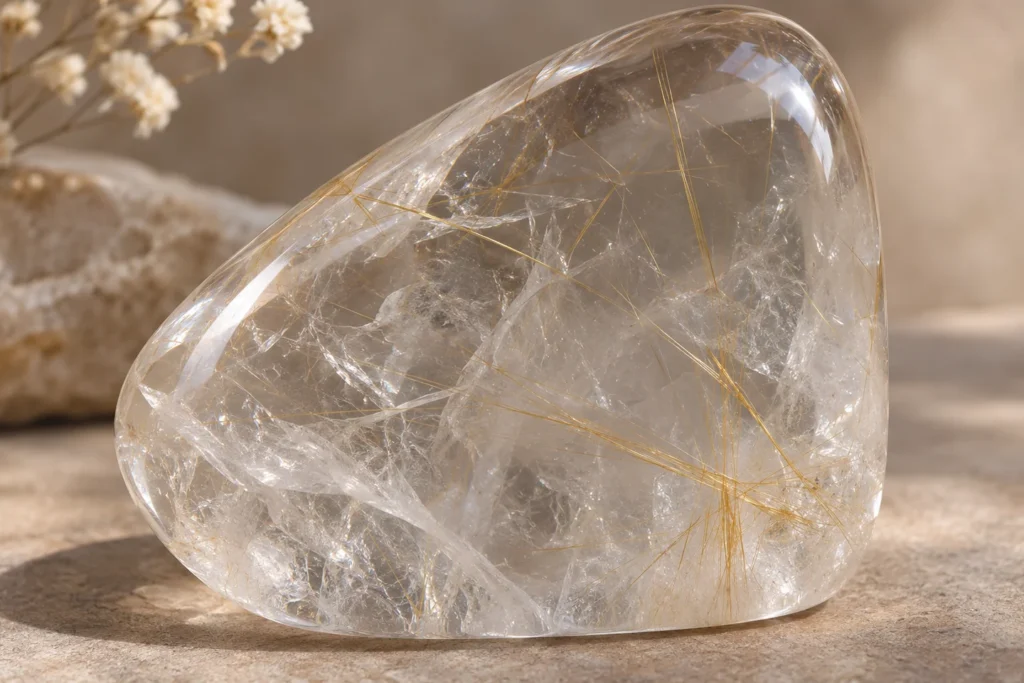
That answer might feel less exciting than a "yes, it's real gold" confirmation. But for anyone purchasing quartz with gold-looking features at wholesale scale, this distinction is what separates a sustainable product line from a return-and-refund headache. Below, I'll break down what creates value in these products, what risks to watch for, and how to approach sourcing and selling them responsibly.
Does gold-colored quartz actually contain real gold?
It's the first question nearly every buyer asks when they see metallic yellow or gold-toned inclusions inside quartz. The assumption is natural: if it looks gold, it might be gold. But this assumption can cost you credibility if it turns out to be wrong.
Gold-colored inclusions in quartz are not automatically real gold. Many minerals — including pyrite, chalcopyrite, rutile, goethite, and iron oxide staining — can produce gold, yellow, or metallic appearances inside quartz.1 Without professional testing, the gold-colored material should not be identified as natural gold based on appearance alone.2
Why appearance alone is unreliable
From my experience communicating with buyers, I've seen dozens of photos sent with the question: "Is this real gold in my quartz?" In almost every case, the buyer had already assumed it was gold before asking. The truth is that several common minerals mimic the look of gold inside quartz:
| Mineral / Material | Appearance in Quartz | Often Mistaken for Gold? |
|---|---|---|
| Pyrite3 | Brassy, metallic, cubic or granular4 | Yes — very commonly |
| Chalcopyrite5 | Iridescent gold-green metallic | Yes |
| Rutile | Golden needle-like threads | Sometimes |
| Goethite / Limonite | Yellowish-brown, earthy metallic | Occasionally |
| Iron oxide staining | Yellow to orange surface coating | Less often, but still confusing |
| Native gold6 | Bright yellow, malleable, high luster7 | Rare in commercial quartz products |
Native gold can occur in quartz — this is well-documented in geology. Gold-bearing quartz veins exist in many mining regions.8 However, the vast majority of quartz products circulating in the crystal and mineral wholesale market are not gold-bearing ore specimens. They are decorative crystal products where the gold-colored appearance comes from other minerals.
What this means for buyers
If you're sourcing quartz with gold-colored inclusions for your shop or online store, the safest approach is to describe what you see, not what you assume. Phrases like "gold-colored inclusions," "metallic-looking mineral threads," or "pyrite-included quartz" are far more defensible than claiming the product "contains gold."
Key principle: If reliable testing has not been performed, do not represent gold-colored inclusions as gold. Qualified gemological or geological testing is the appropriate way to confirm mineral identity — not visual inspection alone.
This isn't about being overly cautious. It's about protecting your brand from a situation where a knowledgeable customer challenges your product description. One bad review claiming "this isn't real gold" can undermine trust across your entire product line.
What actually determines the value of quartz with gold-colored inclusions?
Many sellers fixate on the word "gold" as the primary value driver. But in the B2B crystal market, the factors that determine whether a product sells well — and sells repeatedly — are much more practical.
The value of quartz with gold-colored inclusions depends on a combination of visual appeal, clarity and contrast, material consistency, product form, accurate description, and the ease with which a retailer can explain the product to their customers. These factors matter more than whether the inclusions are chemically gold.
Visual appeal and merchandising potential
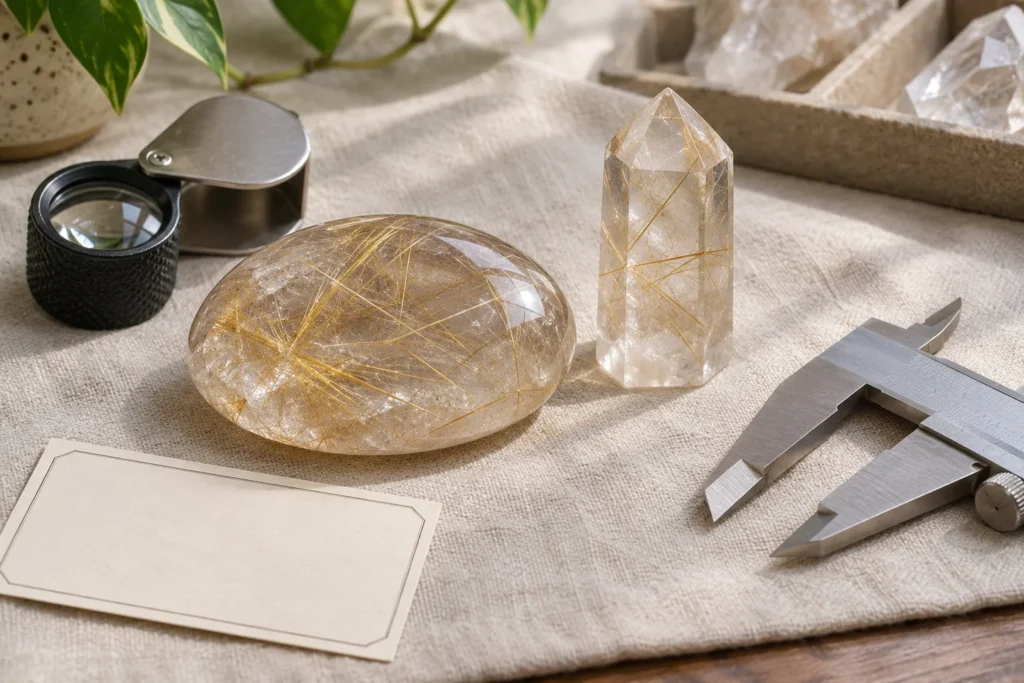
In the retail crystal market, customers buy with their eyes first. A quartz piece with dramatic, high-contrast gold-colored inclusions suspended in clear or smoky quartz will always command more interest than a cloudy specimen with barely visible metallic specks. The visual story is what drives the sale.
Key visual factors that increase resale value:
- Color contrast — bright metallic inclusions against clear or lightly tinted quartz
- Inclusion pattern — visible threads, clusters, or defined shapes are more appealing than diffused staining
- Clarity of the host quartz — transparent or translucent quartz showcases inclusions better
- Surface finish — polished products tend to highlight inclusions more effectively than rough specimens
- Size and proportion — inclusions that are visible without magnification add retail appeal
Product form matters
The same raw material can have very different commercial value depending on how it's processed. A rough chunk of quartz with gold-colored pyrite might sit unsold, while the same material shaped into a polished palm stone, sphere, or tower could move quickly.
| Product Form | Typical Buyer Interest | Notes |
|---|---|---|
| Raw / rough specimen | Collectors, mineral enthusiasts | Niche market; harder to explain to general crystal buyers |
| Polished palm stone | Broad retail appeal | Easy to photograph, ship, and describe |
| Sphere | Gift buyers, display shoppers | Higher perceived value; requires good clarity |
| Tower / point | Crystal shop staples | Works well when inclusions are visible through the form |
| Tumbled stone | Bulk / affordable range | Lower per-unit value, but high volume potential |
Accurate description as a value multiplier
Here's something I've observed working with buyers over the years: products that come with clear, honest descriptions tend to perform better in resale than products marketed with vague or exaggerated claims. When a retailer can confidently tell their customer "this is quartz with pyrite inclusions that create a beautiful gold-colored pattern," that's a stronger sale than nervously hoping nobody asks if it's real gold.
Accurate descriptions reduce return rates, improve customer reviews, and build the kind of trust that leads to repeat purchases. For B2B buyers, this means the supplier who gives you straightforward material information is often more valuable than the one who tells you what you want to hear.
What are the biggest risks when buying "gold quartz" for resale?
The crystal and mineral market has a recurring problem: products described with aspirational language that doesn't hold up under scrutiny. For quartz with gold-colored inclusions, this risk is especially acute.
The biggest risk is purchasing a "gold" story that you cannot defend to your customers. If the product is marketed as containing gold but the inclusions are actually pyrite or another mineral, you face returns, negative reviews, and long-term brand damage. The financial loss from eroded trust typically exceeds the margin on the individual product.
The "real gold" claim trap
I've seen this scenario repeat itself: a buyer finds an attractive quartz product listed as "gold in quartz" or "natural gold quartz." They purchase a batch, list it with similar language, and initially see strong sales. Then a customer — maybe a geologist, a jeweler, or simply someone who does research — pushes back. They point out that the inclusions look like pyrite. The seller has no testing documentation. The reviews start coming in. The damage spreads.
This doesn't mean you can't sell quartz with gold-colored inclusions. It means you need to separate the visual appeal from unverified composition claims.
Common risk factors in supplier sourcing
When evaluating suppliers for this type of product, watch for these red flags:
- Supplier uses "gold" in the product name without specifying the mineral (e.g., "Gold Quartz Crystal" with no mention of pyrite or other identified inclusions)
- No willingness to discuss material composition or acknowledge that testing may be needed
- Historical photos used as current stock representation — batch-to-batch variation is normal; old photos don't guarantee current appearance
- Unusually low prices for claimed gold-bearing specimens — if the product actually contained meaningful gold, the pricing would reflect mineral value, not crystal-decor pricing
- Vague origin information — legitimate gold-bearing quartz specimens from known mining localities are typically documented
How to protect yourself as a buyer
- Ask your supplier directly: What mineral creates the gold color in this quartz? A reputable supplier will either identify the inclusion (e.g., pyrite, rutile) or honestly say they haven't tested it.
- Request current batch photos rather than relying on catalog images.
- Start with a trial order to evaluate the actual product before committing to large quantities.
- Prepare your retail descriptions in advance — if you can't write an honest product listing based on what the supplier tells you, that's a warning sign.
- Consider third-party evaluation if you plan to sell at higher price points or make specific composition claims.
Can quartz with gold-colored inclusions still be commercially useful without claiming real gold?
This is where the conversation becomes most practical for B2B buyers. If you strip away the "is it real gold?" question entirely, is the product still worth stocking?
Yes. Quartz with gold-colored inclusions can be a strong-selling product category when it is marketed for its visual and decorative appeal rather than unverified composition claims. Many crystal shop customers are drawn to the appearance — the sparkle, the contrast, the perceived energy — regardless of whether the metallic material is gold, pyrite, or another mineral.
Reframing the product story
The most successful retailers I've worked with approach these products by focusing on what's verifiable and visually compelling:
- "Quartz with pyrite inclusions" — if the supplier has identified the mineral
- "Quartz with gold-colored metallic inclusions" — if the specific mineral hasn't been confirmed
- "Golden rutilated quartz" — if the inclusions are needle-like and identified as rutile
- "Quartz specimen with metallic mineral inclusions" — a safe general description
None of these descriptions require the word "gold" in a compositional sense. Yet they're all honest, appealing, and searchable by retail customers.
Products that work well in this category
From our experience at GD Crystal, quartz products with metallic or gold-colored inclusions tend to sell well in these forms:
- Polished palm stones and pocket stones — affordable, easy to photograph, high turnover
- Towers and points — display-ready, popular in crystal shops
- Spheres — the polished surface highlights internal inclusions beautifully
- Decorative pieces and carvings — higher price point, gift market potential
- Tumbled stones — bulk pricing for starter collections and mixed bags
The key is matching the product form to the price point your customers expect. A well-polished palm stone with vivid gold-colored pyrite inclusions can retail very well at a moderate price. It doesn't need to be "gold quartz" to justify its shelf space.
Building a defensible product line
If you want to build a product line around visually striking quartz with metallic inclusions, focus on:
- Batch consistency — work with a supplier who can provide similar quality across reorders
- Clear material communication — know what you're selling and be able to explain it
- Photography that shows real product — not enhanced or misleading images
- Pricing that reflects decorative crystal value — not speculative gold content
- Packaging and labeling that uses accurate descriptions
This approach lets you capture the customer's visual interest while building a reputation for transparency. Over time, that reputation is worth far more than any margin boost from a "real gold" claim you can't substantiate.
How should you communicate with suppliers about quartz with gold-colored inclusions?
Supplier communication is where many sourcing mistakes begin. If you don't ask the right questions upfront, you inherit all the risk downstream when it's time to describe the product to your customers.
When sourcing quartz with gold-colored inclusions, ask your supplier to specify the identified mineral (if known), provide current batch photos, clarify whether any treatment or enhancement has been applied, and confirm MOQ, sizing, and consistency expectations. A supplier who avoids these questions or defaults to vague "gold quartz" language may not be the right sourcing partner.
Questions every buyer should ask
Here's a practical checklist I recommend to buyers evaluating this product category:
| Question | Why It Matters |
|---|---|
| What mineral creates the gold color? | Determines how you can describe the product |
| Has the material been tested or identified? | Tells you whether claims are verified |
| Can you provide current batch photos? | Ensures you see what you'll actually receive |
| Has any treatment or coating been applied? | Some metallic effects are surface treatments, not natural inclusions |
| What size and weight range is available? | Critical for pricing and retail positioning |
| What is the MOQ for this product? | Affects your ability to trial before committing |
| Can mixed batches include this product? | Useful for first-time buyers testing market response |
| Where is the material sourced from? | Provides context for your product story |
What good supplier communication looks like
At GD Crystal, when buyers ask us about quartz with gold-colored inclusions, we focus on describing what is visible and what we know about the material based on our processing experience. We don't represent products as containing gold unless there's reliable basis for that claim. We provide current photos of available batches and discuss product forms, sizing, and quantities based on actual inventory — not aspirational catalog listings.
This kind of communication might feel less exciting than a supplier who promises "real gold quartz at amazing prices." But it gives you the information you need to make sound purchasing decisions and write product descriptions you can stand behind.
Frequently Asked Questions
How can I tell if the gold in quartz is real gold or pyrite?
Visual inspection alone is unreliable. Real gold is malleable, doesn't tarnish, and has a distinctive bright yellow luster.9 Pyrite is harder, more brittle, and has a brassy tone. For definitive identification, qualified gemological or geological testing is recommended. Do not assume composition based on appearance, especially when making resale claims.
Is "gold rutilated quartz" the same as quartz with gold in it?
No. Gold rutilated quartz contains needle-like rutile inclusions that appear golden.10 Rutile is titanium dioxide — not gold.11 This is a well-established product category in the crystal market, and the "gold" in the name refers to color, not composition. It can be an excellent resale product when described accurately.
Should I avoid quartz with gold-colored inclusions for my crystal shop?
Not necessarily. These products can be visually striking and commercially successful. The key is purchasing from a supplier who provides honest material information, and describing the product accurately in your listings. Customers appreciate transparency, and attractive quartz with metallic inclusions has genuine decorative appeal without needing unverified gold claims.
What is a fair price for quartz with gold-colored inclusions?
Price varies significantly based on material type, product form, size, clarity, visual impact, processing quality, and order quantity. There is no universal price range. Request quotes based on specific products and current batches rather than relying on general market numbers or historical pricing.
Does GD Crystal test quartz products for gold content?
We do not provide professional gold-content testing or gemological certification. We describe our products based on processing experience and visual characteristics, and we communicate honestly about material identification. For buyers requiring verified composition documentation, we recommend engaging qualified third-party testing services.
Conclusion
So, is quartz with gold worth anything? The answer is yes — but the value lies in visual appeal, accurate description, and responsible merchandising, not in unverified gold content claims. For B2B buyers sourcing quartz with gold-colored inclusions, the products that perform best over time are the ones backed by honest supplier communication and transparent retail descriptions. A metallic flash inside quartz is genuinely attractive. It doesn't need to be real gold to sell well — it just needs to be sold honestly.
If you're exploring quartz products with gold-colored or metallic inclusions for your shop or online store, I'd welcome the conversation. At GD Crystal, we focus on helping buyers understand exactly what they're purchasing, providing current batch photos, and discussing product forms, quantities, and conditions that fit your business. Reach out with your sourcing requirements, and let's find the right products for your market.
References
- "What is "Fool's Gold?"", https://www.usgs.gov/faqs/what-fools-gold. Mineralogical descriptions of pyrite, chalcopyrite, rutile, goethite, and iron oxides document colors and lusters that range from brassy metallic to yellow-brown or golden, supporting the point that gold-colored features in quartz are not necessarily native gold. Evidence role: general_support; source type: research. Supports: A neutral mineralogical source should document that pyrite, chalcopyrite, rutile, goethite, and iron oxides can display yellow, golden, brassy, brownish, or metallic appearances and can occur with quartz.. Scope note: This supports the plausibility of visual confusion but does not prove the identity of inclusions in any particular specimen. ↩
- "What is "Fool's Gold?"", https://www.usgs.gov/faqs/what-fools-gold. Geology teaching materials emphasize that mineral identification relies on multiple diagnostic properties, including hardness, streak, luster, density, and crystal habit, rather than color alone; this supports the caution against labeling gold-colored inclusions as native gold without testing. Evidence role: expert_consensus; source type: education. Supports: An educational geology or gemology source should support that mineral identification depends on diagnostic properties such as hardness, streak, density, crystal form, and tests rather than color alone.. Scope note: The source would establish the general identification principle, not evaluate the specific quartz products discussed in the article. ↩
- "What is "Fool's Gold?"", https://www.usgs.gov/faqs/what-fools-gold. Reference sources commonly describe pyrite as 'fool’s gold' because its brassy metallic appearance has often led observers to confuse it with gold. Evidence role: definition; source type: encyclopedia. Supports: A reference source should identify pyrite as 'fool's gold' and explain that its brassy metallic appearance can lead to confusion with gold.. Scope note: This supports pyrite as a common visual lookalike but does not determine whether pyrite is present in any particular quartz specimen. ↩
- "Pyrite", https://en.wikipedia.org/wiki/Pyrite. Mineralogy descriptions identify pyrite by its brass-yellow color, metallic luster, and frequent cubic crystal habit, supporting the article’s description of its appearance. Evidence role: definition; source type: education. Supports: A mineralogy source should confirm pyrite’s brass-yellow color, metallic luster, and common cubic crystal habit.. ↩
- "Chalcopyrite – Common Minerals – University of Minnesota", https://commonminerals.esci.umn.edu/minerals-f/chalcopyrite. Mineralogical descriptions characterize chalcopyrite as a brass-yellow metallic mineral that can tarnish to iridescent colors, supporting its inclusion among minerals that may look gold-colored in quartz. Evidence role: definition; source type: education. Supports: A mineralogy source should document chalcopyrite’s brass-yellow color, metallic luster, and possible tarnish/iridescence.. Scope note: The source would support chalcopyrite’s appearance generally, not the frequency with which consumers mistake it for gold. ↩
- "Gold Statistics and Information | U.S. Geological Survey", https://www.usgs.gov/centers/national-minerals-information-center/gold-statistics-and-information. Reference works define native gold as naturally occurring elemental gold, supporting the article’s distinction between true native gold and minerals that merely appear gold-colored. Evidence role: definition; source type: encyclopedia. Supports: A neutral reference should define native gold as naturally occurring elemental gold and distinguish it from other gold-colored minerals.. ↩
- "Gold", https://en.wikipedia.org/wiki/Gold. Mineralogy references list native gold as yellow with metallic luster and high malleability, supporting the table’s description of gold’s characteristic physical properties. Evidence role: definition; source type: education. Supports: An educational mineralogy source should confirm gold’s color, metallic luster, and malleability as diagnostic physical properties.. Scope note: These properties help distinguish gold in principle, but specimen-level identification may still require testing. ↩
- "The gold quartz veins of Grass Valley, California", https://pubs.usgs.gov/publication/pp194. Geological survey literature describes gold-bearing quartz veins as a common form of lode-gold mineralization in numerous mining districts, providing context for the article’s statement that such veins exist in many mining regions. Evidence role: historical_context; source type: government. Supports: A government geological survey or university geology source should document gold-bearing quartz vein deposits across recognized mining districts.. Scope note: The evidence is contextual and does not establish the composition of commercial crystal merchandise. ↩
- "Mineral resource of the month: gold | U.S. Geological Survey", https://www.usgs.gov/publications/mineral-resource-month-gold. Chemistry and mineralogy references describe gold as highly malleable, resistant to corrosion or tarnish under ordinary conditions, and characteristically yellow with metallic luster, supporting the FAQ’s comparison with pyrite. Evidence role: definition; source type: institution. Supports: A chemistry or mineralogy institution should confirm gold’s malleability, corrosion resistance, and characteristic yellow metallic appearance.. Scope note: These properties are useful diagnostic context but do not replace formal testing for a specific specimen. ↩
- "Varieties of Rutilated Quartz – Tucson 2014", https://www.gia.edu/gems-gemology/spring-2014-gemnews-tucson-rutilated-quartz. Gemological descriptions of rutilated quartz note that it contains acicular rutile inclusions, often appearing as golden or reddish needle-like crystals within quartz. Evidence role: definition; source type: institution. Supports: A gemological or mineralogical institution should support that rutilated quartz contains acicular or needle-like rutile inclusions that may appear golden.. Scope note: This supports the mineralogical description of rutilated quartz but not any commercial value claim. ↩
- "Rutile", https://en.wikipedia.org/wiki/Rutile. Mineral references define rutile as titanium dioxide, TiO2, confirming that golden rutile inclusions are chemically distinct from native gold. Evidence role: definition; source type: encyclopedia. Supports: A mineral reference should confirm that rutile is titanium dioxide with the chemical formula TiO2.. ↩