If you're evaluating whether black tourmaline and clear quartz belong in the same product set, display case, or retail bundle, you're asking the right question. Many buyers hesitate before pairing two very different-looking stones, worried the combination might confuse customers or clash visually. The good news: this is one of the most natural and commercially proven pairings in the crystal retail space.
Yes, black tourmaline and clear quartz can go together — and they do so exceptionally well. In crystal culture, black tourmaline is commonly associated with protection and grounding1, while clear quartz is often described as amplifying and clarifying2. This complementary narrative, combined with a striking dark-versus-light visual contrast, makes the pair a strong choice for bundled products, curated sets, and retail displays.
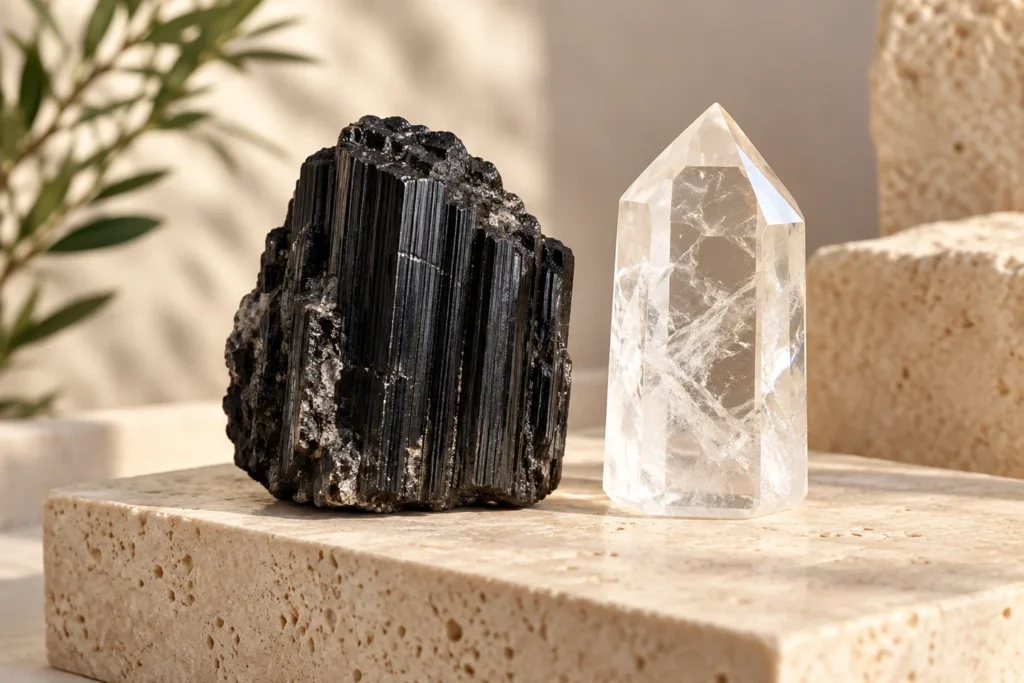
But simply knowing they "can" go together isn't enough if you're a retailer or brand buyer. The real value lies in understanding how to pair them — which product forms work best, how to present them to customers, how to source them consistently, and what selling scenarios generate the strongest margins. Let's break it all down.
Why Are Black Tourmaline and Clear Quartz Considered Complementary?
Crystal shop owners frequently need to justify pairings to their customers. If you can't explain why two stones belong together, the bundle sits on the shelf.
Black tourmaline and clear quartz are considered complementary because their commonly attributed meanings create a natural "protection + clarity" story.3 Many retailers describe black tourmaline as a grounding, protective stone and clear quartz as an energy amplifier or cleanser. Together, they form what customers often perceive as a balanced, complete set.
The Narrative That Sells
In retail crystal culture, effective pairings tell a story. Customers shopping for crystals — whether online or in a physical store — respond to combinations that feel intentional. Here's why this particular pairing resonates:
- Contrast of purpose: Black tourmaline is widely described as absorbing or deflecting negative energy4, while clear quartz is often called a "master healer" or amplifier5. Retailers frame this as "one stone shields, the other enhances."
- Emotional accessibility: Protection and clarity are two of the most universally understood intentions in the crystal market. They don't require specialized knowledge to appreciate.
- Cultural consistency: This pairing appears across crystal blogs, social media influencer content, beginner guides, and bestseller lists. Your customers may already be searching for it.
How Retailers Typically Frame the Pairing
| Framing Approach | Customer-Facing Language | Best For |
|---|---|---|
| Protection + Amplification | "Black tourmaline grounds your energy; clear quartz amplifies your intention." | Intention-setting kits, gift boxes |
| Cleansing + Shielding | "Clear away what doesn't serve you, then shield what matters." | Wellness-adjacent retail, spa gift shops |
| Balance + Harmony | "Dark and light working together for energetic balance." | Display sets, home décor bundles |
| Beginner Essentials | "Two must-have stones for anyone starting a crystal collection." | Starter kits, e-commerce bundles |
Important note: These descriptions reflect common retail and cultural language in the crystal market. They are not medical or scientific claims. As a supplier, I always recommend that retailers use phrases like "commonly believed to," "often associated with," or "many crystal enthusiasts use this for" when describing stone properties.
The point for B2B buyers is straightforward: this pairing has a built-in narrative. You don't have to invent the story — it already exists in your customers' expectations.
Which Product Forms Work Best for This Pairing?
Knowing the stones complement each other conceptually is only half the equation. If you're a crystal retailer, e-commerce seller, or brand founder, you need to think about form factor. Not every product format suits every pairing.
The best product forms for pairing black tourmaline and clear quartz include tumbled stone sets, bracelet combinations, tower-and-stone displays, pocket stone duos, gift boxes, and curated crystal kits. The ideal format depends on your price point, target customer, and selling channel.
Tumbled Stone Sets and Pocket Stones
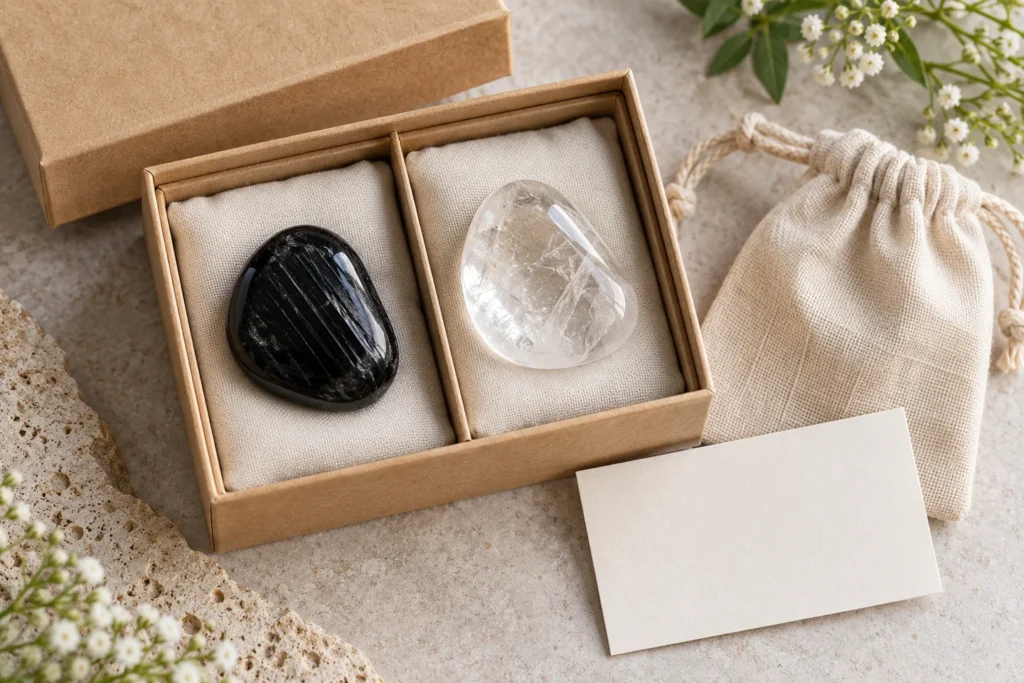
Tumbled stones are the most accessible entry point. They're affordable, easy to package, and perfect for impulse purchases or add-on sales. A simple duo pouch — one black tourmaline tumbled stone and one clear quartz tumbled stone — works for:
- Gift shops and tourist retail where customers want a quick, meaningful purchase
- E-commerce add-ons sold alongside a main product
- Subscription boxes or monthly crystal club shipments
From a sourcing perspective, tumbled stones are relatively easy to size-match across batches. The key considerations are grade consistency (ensuring the clear quartz has acceptable clarity and the black tourmaline has a clean, dark finish) and size range (a 20–30mm range is standard for pocket stones6; keeping both stones in a similar size range looks more intentional).
Bracelet Combinations
Crystal bracelets are one of the highest-margin categories in the retail crystal market.7 For the black tourmaline and clear quartz pairing, there are two main approaches:
- Separate bracelets sold as a set: One black tourmaline bead bracelet and one clear quartz bead bracelet, packaged together. This is popular for "his and hers" or "day and night" marketing.
- Single bracelet with alternating beads: Black tourmaline and clear quartz beads strung together. The visual contrast is immediately striking and photographs well for social media.
For wholesale buyers, bead quality matters enormously here. Clear quartz beads with too many inclusions or a milky, opaque look won't contrast as sharply against black tourmaline. Specify bead grade when ordering.
Tower and Display Combinations
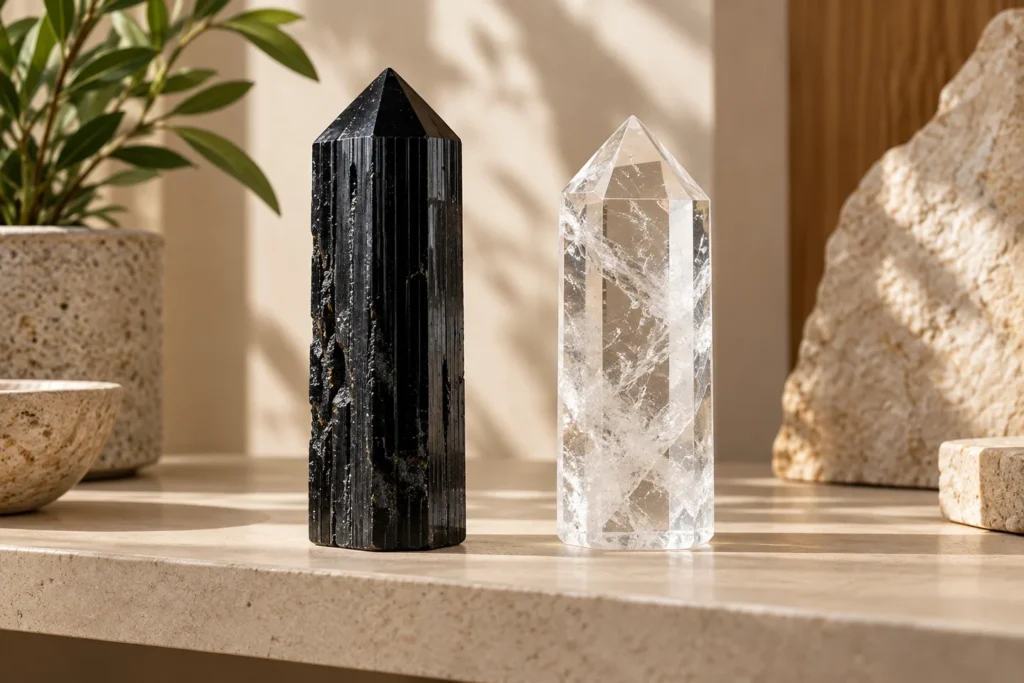
Crystal towers (also called points or obelisks) are popular display items. A black tourmaline tower paired with a clear quartz tower creates a visually dramatic display — dark and light standing side by side. This format works well for:
- Retail shelf displays where height draws the eye
- Photography and social media content (the contrast photographs beautifully)
- Premium gift sets at a higher price point
Gift Boxes and Curated Kits
This is where the pairing really shines for brand-conscious buyers. A curated "Protection & Clarity" kit might include:
- 1 black tourmaline tumbled stone
- 1 clear quartz point or tumbled stone
- A description card explaining the pairing
- A pouch, box, or tray for presentation
These kits command higher perceived value than individual stones and give your brand a story to tell. They're also excellent for seasonal gifting — holiday sets, wellness gift guides, and corporate gift programs.
How Does the Visual Contrast Benefit Retail and E-Commerce?
In crystal retail, visual appeal drives purchasing decisions — especially online8. A pairing that doesn't photograph well rarely sells well, no matter how meaningful the story.
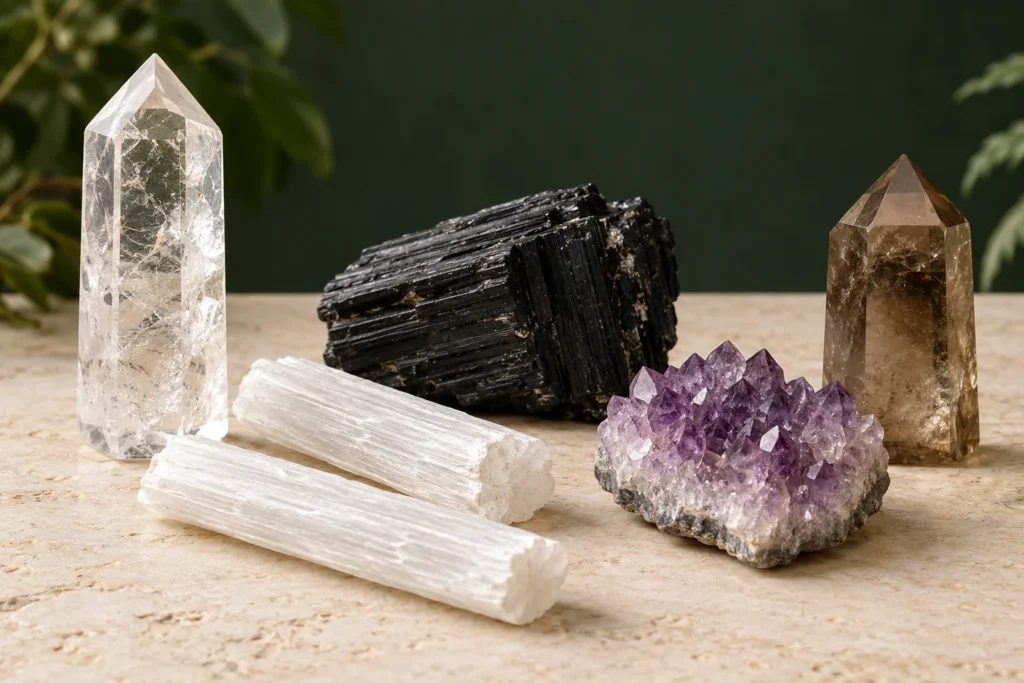
The visual contrast between black tourmaline and clear quartz is one of the strongest in the crystal world. Black tourmaline's deep, opaque, often textured surface against clear quartz's transparent or milky brightness creates immediate visual impact in photography, shelf displays, and flat-lay product shots.
Why Contrast Matters for Selling Crystals
Crystal buyers — both wholesale and retail — are influenced by aesthetics more than almost any other product category in the gift and wellness space. Consider these practical benefits:
- Shelf appeal: Dark-and-light pairings naturally draw the eye in a display case full of similar-toned stones.
- Photography: The contrast makes product photos more dynamic. You don't need complex styling to make the pair look compelling.
- Social media performance: High-contrast images tend to perform better on platforms like Instagram and Pinterest9, where crystal buyers discover new products.
- Perceived intentionality: A visually contrasting pair looks curated, not random. Customers sense that someone thought carefully about the combination.
Texture Adds Another Dimension
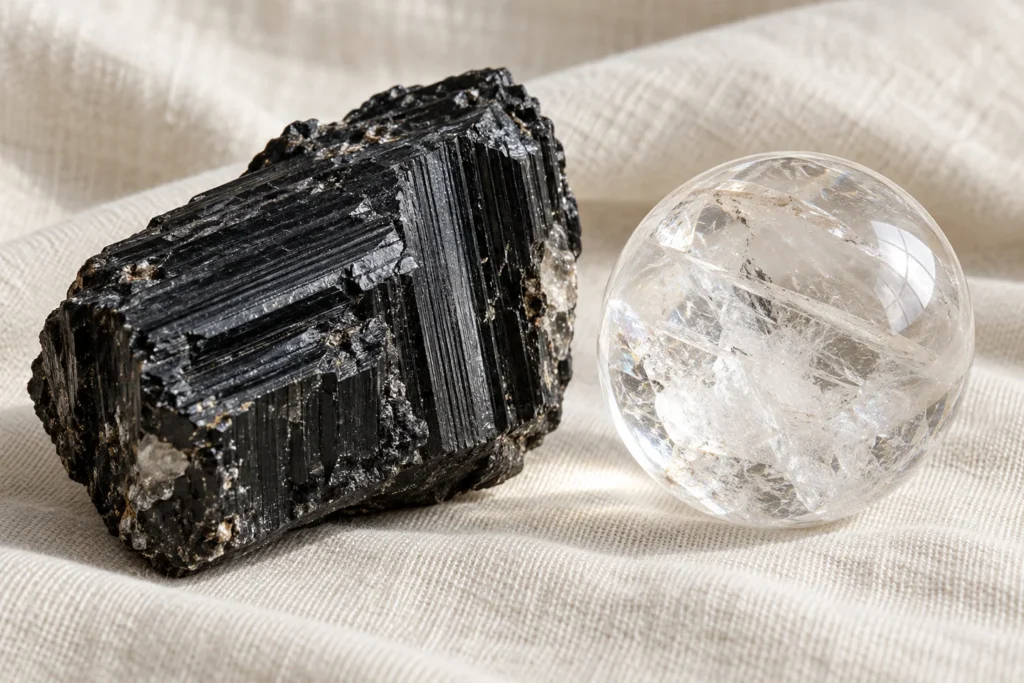
Beyond color contrast, the texture difference adds appeal. Raw or rough black tourmaline has a striated, almost industrial texture.10 Polished clear quartz is smooth and glassy. Mixing finishes — a rough black tourmaline chunk with a polished clear quartz sphere, for example — creates a tactile as well as visual contrast.
For B2B buyers planning product photography or catalog layouts, this is worth considering. A mixed-finish pairing gives you more storytelling material and more visually interesting content for your brand.
What Should Wholesale Buyers Consider When Sourcing This Pairing?
For B2B crystal buyers, the pairing concept is only as good as its execution. A beautiful idea falls apart if the stones arrive in mismatched sizes, inconsistent grades, or packaging that doesn't support the story.
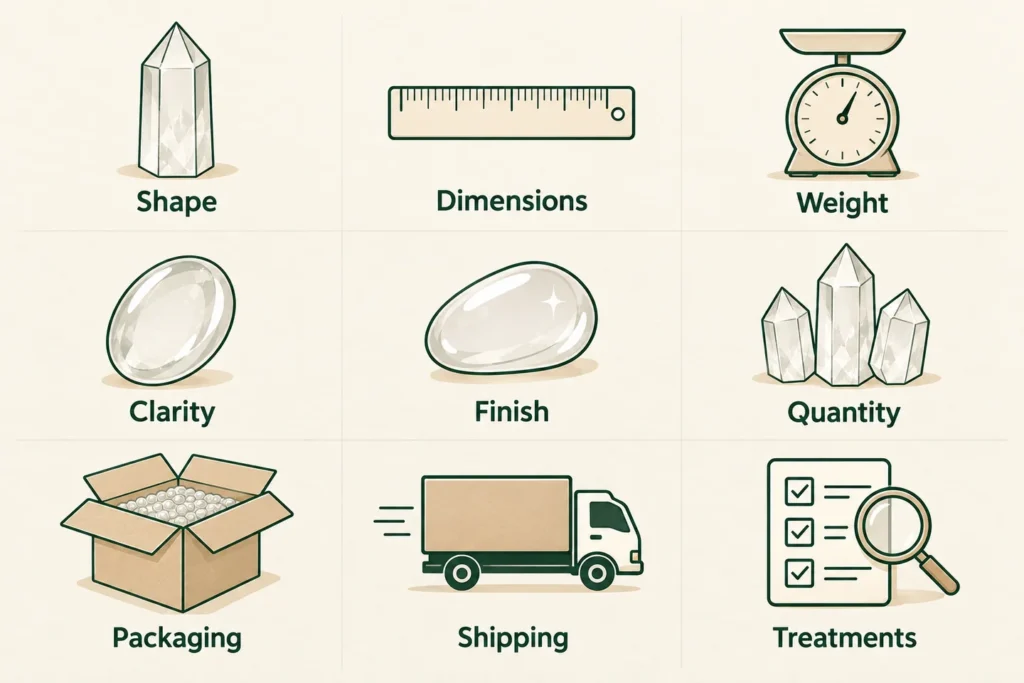
Wholesale buyers sourcing black tourmaline and clear quartz together should evaluate size matching, grade consistency, finish options, batch variation, packaging compatibility, and the supplier's ability to support repeat or mixed orders. These practical factors determine whether a pairing concept becomes a reliable, sellable product line.
Size and Grade Matching
When you order these two materials as a pair, size consistency becomes critical. If your clear quartz tumbled stones average 25mm but your black tourmaline stones average 40mm, the set looks unbalanced. Key questions to ask your supplier:
- Can you sort or grade both materials to a matching size range?
- What is the typical size variation within a batch?
- Are sample photos available for the current batch?
Grade matters too. "Clear quartz" ranges from water-clear AAA grade to heavily included or milky stones. For this pairing, you want enough transparency in the quartz to contrast with the tourmaline's opacity. Be specific about grade expectations during your inquiry.
Finish and Processing Options
Both stones can be processed in multiple forms:
| Material | Common Finishes | Notes |
|---|---|---|
| Black Tourmaline | Raw/rough, tumbled, polished point, carved | Raw is popular for "natural" aesthetics; tumbled is best for sets |
| Clear Quartz | Polished point, tumbled, sphere, faceted, raw cluster | Polished forms show clarity best; raw clusters add drama |
Mixing finishes within a set is a design choice. Just ensure your supplier can consistently produce the specific finish you select.
Batch Variation and Repeat Orders
Natural stones vary. That's part of their appeal — but it's also a sourcing challenge. When you build a product around a specific pairing, you need to know:
- How consistent is color and quality across batches?
- Can the supplier support repeat orders at similar quality?
- What's the lead time for restocking either material?
At GD Crystal, we receive these questions regularly. Our standard practice is to confirm material availability, processing options, and current batch quality at the time of inquiry. We don't treat past batch photos or old pricing as current commitments, because natural stone inventory changes. We encourage buyers to request updated photos and samples before placing orders.
Packaging Considerations
If you're selling pairs or kits, packaging is part of the product. Consider:
- Compartmented boxes that hold each stone separately
- Pouches or bags sized for the pair
- Insert cards with pairing descriptions (using careful, culture-appropriate language)
- Branded packaging if you're building a private-label crystal line
Discuss packaging options and customization possibilities with your supplier early. It affects unit cost, minimum order quantity, and lead time.
How Can Retailers Market the Black Tourmaline and Clear Quartz Pairing?
Sourcing the right product is step one. Selling it effectively is step two. Retailers and e-commerce sellers need marketing angles that resonate without overstepping into health claims.
Retailers can market the black tourmaline and clear quartz pairing as a beginner-friendly essential set, a gift with built-in meaning, a display-ready décor combination, or a themed wellness product — all while using careful, culture-aware language rather than making therapeutic promises.
Proven Marketing Angles
Based on what I've seen from our retail clients and the broader crystal market, here are the marketing approaches that work:
-
"Starter Set" positioning: Market the pair as two essential crystals every beginner should own. This appeals to new crystal enthusiasts who don't know where to start.
-
"Protection & Clarity" theme: Create a themed collection around these two intentions. The naming convention alone — "Protection & Clarity Kit" — communicates value instantly.
-
Gift-ready bundles: Position the pair as a thoughtful, meaningful gift. Add a description card, nice packaging, and you have a product that justifies a premium price.
-
Seasonal campaigns: Tie the pairing to New Year intention-setting, spring cleansing themes, or holiday gifting. The "fresh start" narrative fits both stones.
-
Visual content strategy: Invest in high-quality photography showing the contrast. Flat lays, lifestyle shots, and unboxing videos perform well on Instagram, TikTok, and Pinterest.
Language to Use (and Avoid)
| ✅ Use | ❌ Avoid |
|---|---|
| "Often associated with protection" | "Protects you from negative energy" |
| "Many crystal enthusiasts believe…" | "This crystal will…" |
| "Commonly used for grounding intentions" | "Clinically proven to reduce anxiety" |
| "A popular pairing in crystal culture" | "The ultimate healing combination" |
This careful language protects your brand legally and builds trust with discerning customers who appreciate honesty.
Frequently Asked Questions
Is it safe to place black tourmaline and clear quartz next to each other?
Yes. There is no material or structural reason these stones cannot be placed together. In retail display, storage, and packaging, they coexist without any issue. Quartz has a Mohs hardness of 7, while tourmaline is typically 7–7.5.11 Use separate compartments or padding to reduce abrasion and chipping during storage and shipping.
Can I sell black tourmaline and clear quartz as a bracelet set?
Absolutely. Bracelet sets are one of the most popular formats for this pairing. You can sell them as a matched duo or as a single bracelet with alternating beads. Specify bead grade and size with your supplier to ensure visual consistency.
What is the minimum order for crystal pairing sets?
Minimum order quantities vary by supplier, product form, and customization level. At GD Crystal, MOQ depends on the specific material, size, finish, and packaging requirements. We recommend reaching out with your product concept so we can provide accurate details for your specific needs.
Do customers actually look for this specific pairing?
Yes. "Black tourmaline and clear quartz" is a commonly searched combination in crystal retail.12 Customers encounter this pairing in beginner guides, social media content, and crystal shop recommendations. Stocking it means meeting existing demand, not creating it.
Should I sell them as raw or polished stones?
Both work, but the choice depends on your brand and audience. Polished tumbled stones are the most versatile for sets and kits. Raw specimens appeal to collectors and customers who prefer a natural aesthetic. Mixed-finish sets (one raw, one polished) offer a unique angle.
Conclusion
Black tourmaline and clear quartz can absolutely go together — and for B2B buyers, this pairing represents a proven product opportunity. The combination offers complementary cultural meanings, striking visual contrast, versatile product formats, and built-in customer demand. Whether you're building tumbled stone sets, bracelet duos, curated gift boxes, or tower displays, this is a pairing that translates across retail channels and customer segments.
The key to success lies in thoughtful execution: matching sizes, maintaining grade consistency, choosing the right product forms for your market, and using careful, honest language that respects crystal culture without making unsupported claims.
At GD Crystal, we work with crystal retailers and brand founders to source, process, and customize stone products — including paired sets like black tourmaline and clear quartz. If you're exploring this combination for your product line, reach out with your concept and specifications, and we'll confirm current material availability, processing options, and terms for your specific order.
References
- "Black Tourmaline: Meaning, Healing & How to Wear It", https://chibuntu.com/blogs/life/black-tourmaline-meaning?srsltid=AYCX9vLRbeQ6x7yCgbkvRK09UAgILRSostfD3BYHAQRGSaXhOx1pI7B8. A neutral reference on crystal-healing terminology identifies black tourmaline as a stone commonly described in that tradition as protective or grounding, supporting the article’s statement as a cultural attribution rather than a physical effect. Evidence role: definition; source type: encyclopedia. Supports: A neutral reference should document that black tourmaline is described in crystal-healing culture as protective or grounding.. Scope note: This supports the existence of the belief or usage in crystal culture; it does not validate protective or grounding effects scientifically. ↩
- "Clear quartz symbolizes clarity, focus, and energy …", https://www.facebook.com/12crystalmoons/posts/clear-quartz-symbolizes-clarity-focus-and-energy-amplification-and-it-is-widely-/1162258869657842/. A reference work on crystal-healing concepts describes clear quartz as commonly associated with amplification and clarity, corroborating the article’s use of these terms as cultural descriptors. Evidence role: definition; source type: encyclopedia. Supports: A neutral source should support that clear quartz is commonly characterized in crystal-healing culture as an amplifier or clarity-related stone.. Scope note: The source would document a cultural meaning, not empirical evidence that quartz amplifies intentions or produces clarifying effects. ↩
- "Choosing Between Black Tourmaline and Clear Quartz", https://www.thebodhipress.com/blogs/lifestyle-wellness/protection-vs-clarity-choosing-between-black-tourmaline-and-clear-quartz?srsltid=AYCX9vIcG0BQVSlFAHfQGZyzwtIs-w1pmee9Dcv2Il1wlXd89zi6qQu1. A study or neutral overview of contemporary crystal-healing practice notes that stones are often combined according to attributed symbolic properties, and that tourmaline and quartz are commonly framed through protection, grounding, amplification, or clarity themes. Evidence role: general_support; source type: research. Supports: A source should show that black tourmaline and clear quartz are paired or discussed together through protection, grounding, amplification, or clarity themes.. Scope note: This would support the cultural logic of the pairing, not prove that the pairing has objective energetic properties. ↩
- "Black Tourmaline – The Ultimate Shield of Protection", https://shop.drneetikaushik.com/blogs/crystals/black-tourmaline-the-ultimate-shield-of-protection?srsltid=AYCX9vLv3OfqPJsLis3WFYaCiQvwdVuc9iyb1twTou-oTjfIRaxfnx_3. Research on contemporary crystal-healing discourse documents that black tourmaline is frequently represented as a protective stone associated with absorbing or deflecting negative energy. Evidence role: general_support; source type: research. Supports: A neutral or scholarly source should show that black tourmaline is commonly represented in crystal-healing or New Age contexts as absorbing or deflecting negative energy.. Scope note: The evidence would concern the prevalence of the description in belief systems and retail discourse, not the existence of measurable negative energy absorption. ↩
- "Raw Clear Quartz Crystal, Natural Healing Stone, Master …", https://www.etsy.com/listing/4346156345/raw-clear-quartz-crystal-750-ct-rough. A neutral reference on crystal-healing vocabulary records that clear quartz is commonly described as a 'master healer' or amplifier in that tradition. Evidence role: definition; source type: encyclopedia. Supports: A neutral reference should confirm that clear quartz is commonly labeled a 'master healer' or amplifier within crystal-healing literature.. Scope note: This supports the terminology’s cultural use; it does not establish therapeutic efficacy. ↩
- "Tumbled Stones: Bulk polished stones. Our lowest prices.", https://rocktumbler.com/gemstones/bulk.shtml. A lapidary education source describes common tumbled or pocket-stone sizes in approximately the 20–30 mm range, supporting the article’s sizing statement as a trade convention. Evidence role: general_support; source type: education. Supports: A lapidary or gemology education source should indicate typical size ranges for tumbled or pocket stones and whether 20–30 mm is common.. Scope note: Sizing conventions vary by supplier and market, so the source would contextualize the range rather than establish a universal standard. ↩
- "Industry and Trade Summary: Gemstones", https://www.usitc.gov/publications/docs/pubs/industry_trade_summaries/pub3018.pdf. Retail market analysis of gemstone jewelry indicates that bead bracelets can carry comparatively high markups relative to loose mineral specimens, supporting the article’s claim about margin potential. Evidence role: statistic; source type: research. Supports: A market research or retail benchmarking source should support that gemstone or crystal bracelets have relatively high retail margins compared with loose stones or other crystal products.. Scope note: The evidence may address gemstone or fashion-jewelry margins generally rather than isolating black tourmaline and clear quartz bracelets specifically. ↩
- "Product photography in product attractiveness perception …", https://www.academia.edu/112263912/Product_photography_in_product_attractiveness_perception_and_e_commerce_customer_purchase_decisions. E-commerce consumer-behavior research finds that product-image quality and visual presentation significantly influence perceived value and purchase intention, supporting the article’s emphasis on visual appeal in online sales. Evidence role: general_support; source type: paper. Supports: Research should show that visual presentation and product imagery influence purchase intention in online retail settings.. Scope note: The evidence would apply to online retail broadly and may not be specific to crystals. ↩
- "Study IDs Visual Characteristics That Make People 'Like …", https://news.ncsu.edu/2022/01/what-people-like-on-instagram/. Research on image-based social media shows that visual features such as contrast, brightness, color composition, or aesthetic quality are associated with user engagement, providing contextual support for the article’s claim about high-contrast product imagery. Evidence role: mechanism; source type: paper. Supports: A study should show that image-level visual features, including contrast or related aesthetic measures, are associated with higher engagement or popularity on image-based social platforms.. Scope note: Such studies usually examine engagement correlations across broad image sets and may not directly test crystal-product photographs. ↩
- "Tourmaline", https://en.wikipedia.org/wiki/Tourmaline. Mineralogical references describe tourmaline crystals as commonly prismatic with longitudinal striations, supporting the article’s description of rough black tourmaline texture. Evidence role: definition; source type: encyclopedia. Supports: A mineralogical reference should describe tourmaline crystals as commonly having striated prism faces or a striated habit.. Scope note: The description applies to typical tourmaline crystal habit; individual specimens may be broken, polished, weathered, or otherwise processed. ↩
- "Mohs scale", https://en.wikipedia.org/wiki/Mohs_scale. Mineralogical references list quartz at Mohs hardness 7 and tourmaline at roughly 7 to 7.5, supporting the article’s packaging caution about relative hardness and abrasion risk. Evidence role: definition; source type: encyclopedia. Supports: A mineral reference should verify quartz hardness at 7 on the Mohs scale and give the accepted hardness range for tourmaline.. Scope note: The phrase 'harder than some tourmaline specimens' should be checked carefully, because many tourmaline references list hardness equal to or greater than quartz; scratching risk also depends on surface finish, inclusions, and grit. ↩
- "Tourmaline in Quartz", https://www.etsy.com/market/tourmaline_in_quartz. Search-trend or keyword-volume data show measurable interest in the phrase 'black tourmaline and clear quartz,' supporting the article’s claim that the combination is searched by consumers. Evidence role: statistic; source type: other. Supports: Search trend or keyword-volume data should show measurable consumer search interest in the exact pairing or closely related phrase.. Scope note: Search-volume evidence indicates online interest, not purchase conversion or sustained wholesale demand. ↩