Clear quartz and water — it sounds like a simple question, but the wrong answer on your product page can lead to customer complaints, returns, or even liability concerns. Retailers and wholesalers hear this question constantly from end consumers, yet the real risk depends on far more than just the mineral name. A nuanced, product-specific answer protects both your customers and your brand.
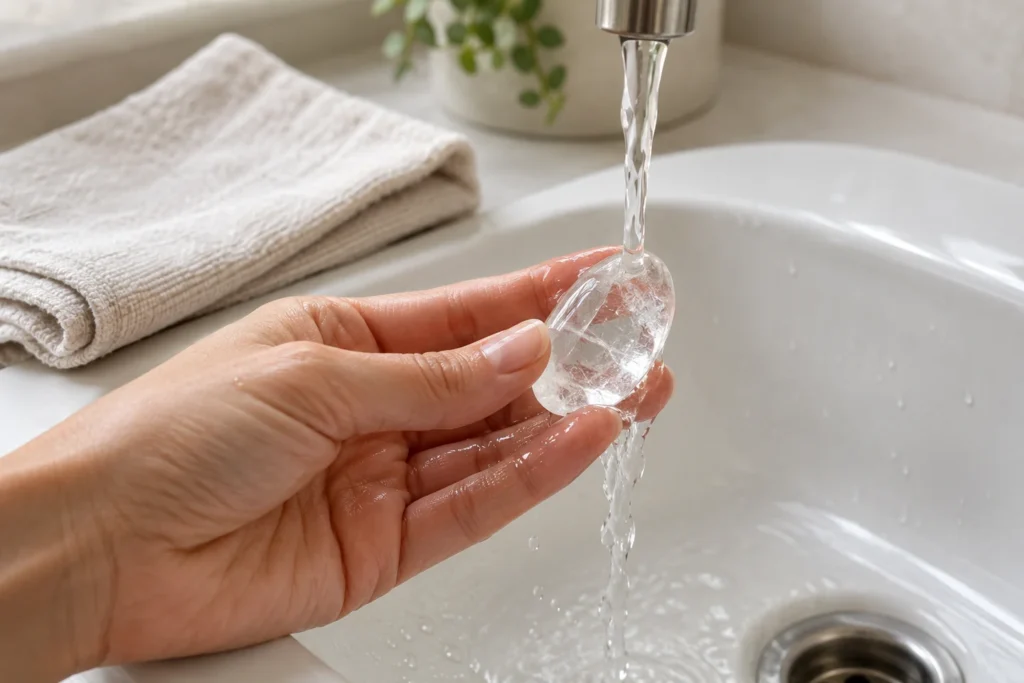
Clear quartz is generally not damaged by brief contact with clean water. A quick rinse to remove dust is widely considered acceptable for solid, uncracked pieces without coatings or glued components. However, "water-safe" is not a blanket label. Long soaking, salt water, hot water, drinking-water infusions, and outdoor water features each carry different risks, especially when the product has cracks, inclusions, dyed surfaces, metal findings, or mixed-material construction.
That single-word answer — "yes" or "no" — is exactly what gets sellers into trouble. Below, I break down the specific water scenarios that matter, explain why finished product form matters more than mineral hardness, and share practical language guidelines for product descriptions. Whether you stock crystal towers, tumbled stones, or beaded bracelets, this guide will help you communicate accurately with your customers.
Why Does the "Clear Quartz in Water" Question Matter for Retailers?
If you sell crystals online, you already know that end consumers search for water-safety information before they buy — and they will hold your product listing responsible if something goes wrong. A cracked tower that splits after soaking or a dyed bead that leaches color in a water bottle generates a return, a negative review, or worse.
The question matters for retailers because it sits at the intersection of product knowledge, customer trust, and legal caution. Knowing what to say — and what not to claim — about clear quartz and water directly affects your return rate, your brand credibility, and your exposure to complaints.
Dive Deeper
The Mineral Basics
Clear quartz (SiO₂) has a Mohs hardness of 7 and is not water-soluble under normal conditions.1 Unlike softer or more chemite-sensitive minerals — such as selenite (Mohs 2, water-soluble) or malachite (copper-bearing, potentially toxic in water)2 — quartz does not dissolve, disintegrate, or release known harmful substances from brief water contact. These basic mineralogical properties are widely documented and publicly available.
This is why most crystal care guides online give a simple "yes" to quartz in water. And for a quick rinse of a solid, unmodified piece, that guidance is broadly reasonable.
Why "Generally Safe" Is Not "Always Safe"
The problem arises when retailers extend that simple mineral fact to every product form and every water scenario. Consider these distinctions:
| Scenario | Risk Level | Key Concern |
|---|---|---|
| Brief rinse with clean water | Low | Minimal risk for solid, uncracked pieces |
| Extended soaking (hours) | Moderate | Water can enter micro-fractures, weaken glued parts |
| Salt water | Moderate–High | Salt crystallization in cracks, corrosion of metal findings |
| Hot water or boiling water | High | Thermal shock can propagate existing fractures |
| Outdoor water features | High | Prolonged exposure, algae growth, freeze-thaw cycles |
| Drinking water / gem water bottles | Very High (liability) | Food-contact safety claims require independent certification |
The Business Risk Angle
From a supplier's perspective — and I say this after over 15 years of communicating with overseas buyers about material properties — the most common complaint scenarios we hear about involve:
- Beaded bracelets that were soaked and whose elastic cord degraded or whose dyed spacer beads bled color
- Towers or points with internal fractures that developed visible cracks after prolonged soaking
- Coated or "aura" quartz pieces where the metallic coating peeled or discolored
- Gem water bottle inserts where the seller implied drinking-water safety without any certification
Each of these is a product-form problem, not a mineral problem. Knowing the difference is how you protect your business.
Does Brief Water Contact Damage Clear Quartz?
Many buyers worry that even a splash of water will harm their quartz. This fear is understandable — they have read warnings about water-sensitive crystals and want to be cautious. But conflating quartz with selenite or halite creates unnecessary anxiety and limits how you describe your products.
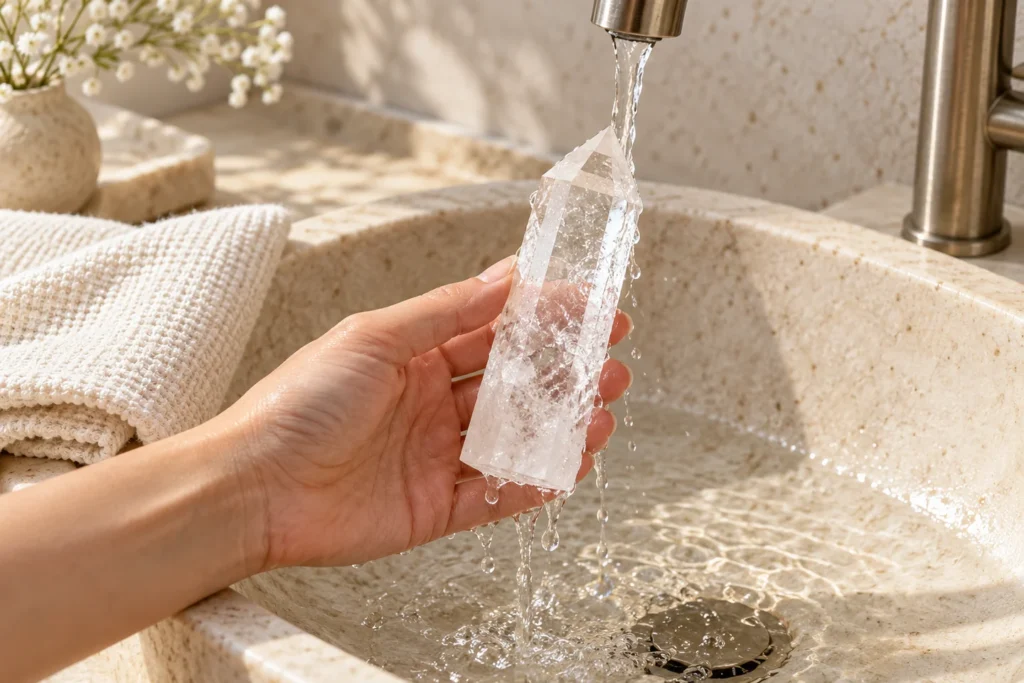
Brief contact with clean, room-temperature water does not damage solid, uncracked clear quartz. A quick rinse to remove dust or fingerprints — lasting seconds to a few minutes — is widely considered safe for quality-finished quartz pieces without surface coatings, dyes, or glued components.
Dive Deeper
Why a Quick Rinse Is Generally Fine
Quartz is one of the most chemically stable common minerals.3 It does not react with water at room temperature in any practically observable way. The silicon-oxygen bonds in the crystal structure are strong and not disrupted by ordinary water contact.4 This is not a proprietary claim — it is basic mineralogy that any geology reference will confirm.
For retailers, this means you can confidently tell customers that a quick rinse for cleaning purposes is generally acceptable for solid clear quartz items.
What "Solid and Uncracked" Actually Means
Here is where seller knowledge matters. "Solid and uncracked" sounds simple, but many natural quartz products have:
- Internal inclusions or veils that may not be visible at first glance
- Natural fracture planes that have been polished over but still exist beneath the surface
- Micro-cracks from cutting and polishing that are invisible until stressed
Water itself may not dissolve the quartz, but water entering micro-fractures can:
- Carry dissolved minerals or impurities deeper into the stone
- Cause discoloration or cloudiness over time
- In freeze-thaw environments, expand and widen existing cracks5
For wholesale buyers evaluating inventory, the takeaway is: inspect pieces for visible fractures before labeling them as suitable for any water contact, even brief rinsing.
Practical Advice for Product Descriptions
When writing product-page copy for clear quartz towers, spheres, palm stones, or similar solid forms, a responsible description might say:
"This piece may be gently rinsed with clean water for cleaning. Avoid prolonged soaking, salt water, and hot water. Not tested for food or drinking-water contact."
This kind of specific, limited language protects you legally and sets realistic expectations.
What About Soaking Clear Quartz in Salt Water or Hot Water?
Salt water and hot water are frequently recommended in consumer crystal-cleansing guides as ways to "purify" or "charge" crystals. For retailers, these practices create real product-risk scenarios that go well beyond the basic mineral question.
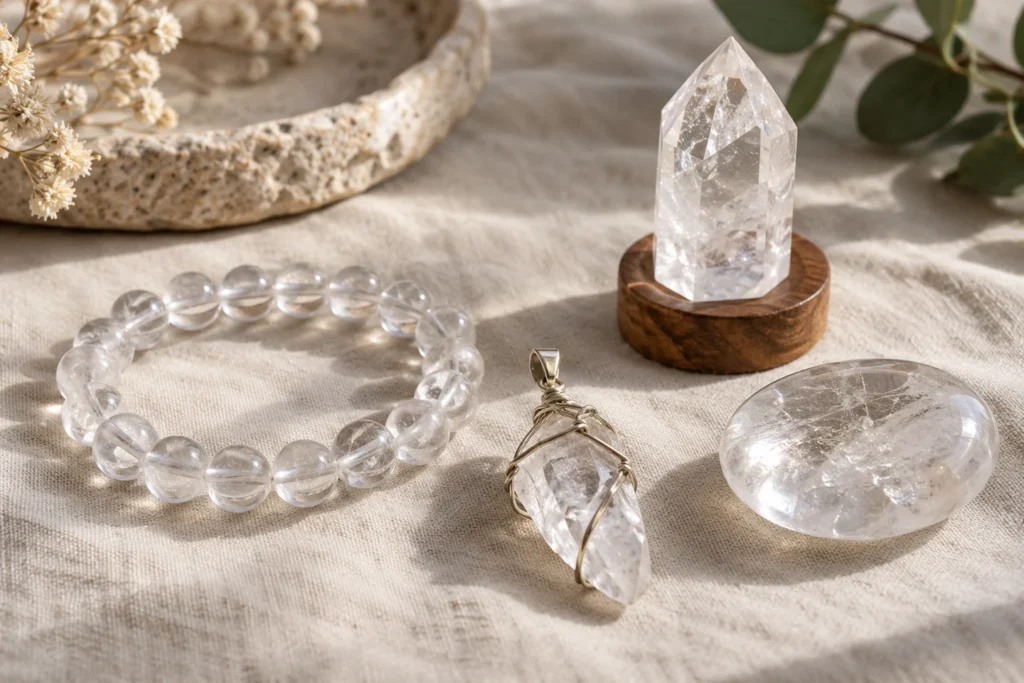
Salt water and hot water each introduce risks that plain water does not. Salt water can crystallize inside cracks, corrode metal components, and degrade adhesives. Hot water can cause thermal shock that propagates fractures.6 Neither scenario should be encouraged in product descriptions or care instructions without explicit caveats.
Dive Deeper
Salt Water Risks
Salt water is a more aggressive environment than fresh water for several reasons:
- Crystal growth in cracks: When salt water enters micro-fractures and evaporates, salt crystals form inside. These crystals exert pressure and can visibly widen cracks over repeated cycles.7
- Corrosion of findings: If your clear quartz product includes metal bails, wire wrapping, chains, or jump rings, salt water accelerates tarnishing and corrosion — especially on plated metals8.
- Adhesive failure: Glued components (e.g., pendants with glued bails, glued bases on spheres) may loosen or separate in salt water.
Hot Water Risks
Clear quartz itself has a relatively low coefficient of thermal expansion compared to many materials, but rapid temperature changes still pose risks:
- Thermal shock can propagate fractures that were previously invisible or stable
- Sudden cracking is more likely in pieces with existing internal inclusions or tension points
- Boiling water should never be used — the risk of catastrophic fracture is real
The "Energy Cleansing" Complication
Many end consumers soak crystals in salt water because popular spiritual and wellness content recommends it. As a retailer, you are not obligated to endorse or recommend these practices. A neutral, helpful approach is:
"We cannot guarantee product integrity after exposure to salt water, hot water, or prolonged soaking. If you choose to cleanse your crystals using these methods, please be aware of the potential for cracking, discoloration, or damage to non-quartz components."
This avoids dismissing the customer's beliefs while clearly limiting your liability. From our experience communicating with B2B buyers at GD Crystal, we find that this kind of balanced language reduces after-sale disputes significantly.
Can Clear Quartz Go in Drinking Water or Gem Water Bottles?
This is arguably the highest-stakes version of the water question. The gem water bottle trend has driven significant retail demand, and sellers face pressure to label their clear quartz as "safe" for infused drinking water. The stakes here are not just product damage — they are health and safety liability.
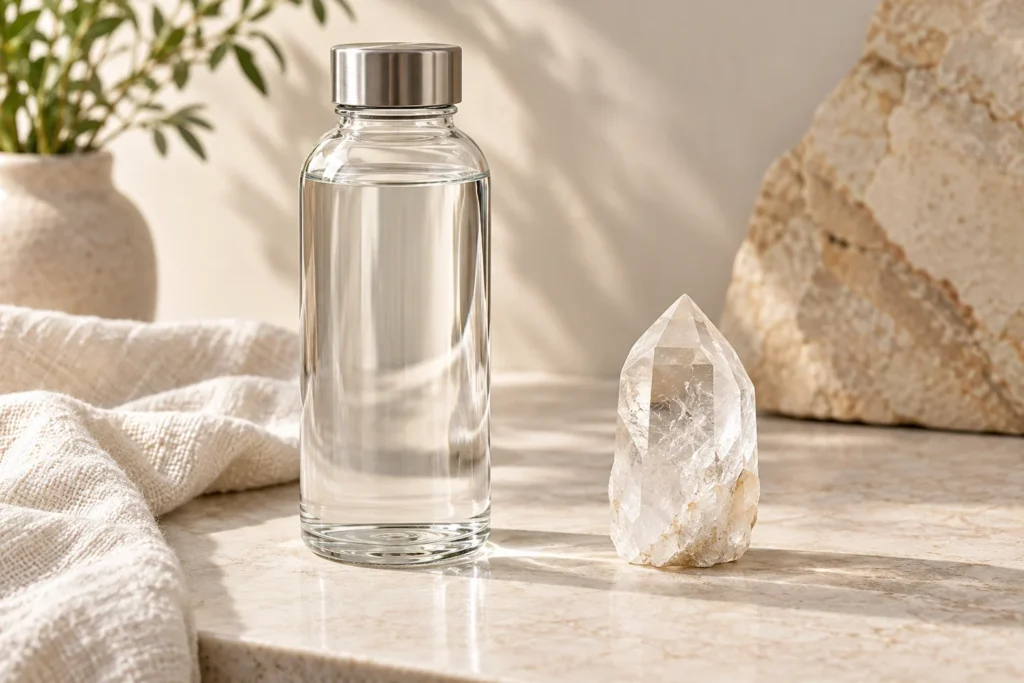
Clear quartz in drinking water is a food-contact safety question, not a crystal care question. Sellers should not describe clear quartz products as safe for drinking-water contact unless the specific product has been independently tested and certified for food-contact use. General mineral hardness or chemical stability does not substitute for proper safety verification.9
Dive Deeper
Why This Is Different From Rinsing
Placing a crystal inside a water bottle that someone drinks from every day introduces concerns that are completely absent from a quick dust-removal rinse:
- Surface treatments and coatings may not be food-safe
- Polishing compounds or residues on the crystal surface may leach into water
- Adhesives or sealants used in production may not be food-grade
- Bacterial growth in cracks, crevices, or rough surfaces is a hygiene concern
- Prolonged contact amplifies any of the above risks
Regulatory and Liability Implications
In many markets — including the EU, US, UK, and Australia — items intended for food or drinking-water contact are subject to specific regulations (e.g., FDA food-contact regulations in the US, EU Regulation 1935/2004 in Europe)10. Simply stating that "quartz is non-toxic" does not satisfy these requirements.
| Claim Type | Risk to Seller |
|---|---|
| "This crystal is water-safe" (general) | Moderate — vague but potentially misleading |
| "Safe for gem water bottles" | High — implies fitness for drinking-water use |
| "Non-toxic, food-safe crystal" | Very High — a regulated claim requiring certification |
| "Not intended for food or drinking-water contact" | Low — protective disclaimer |
What Responsible Sellers Do
The safest approach for retailers and e-commerce sellers is straightforward:
- Do not make drinking-water safety claims unless you have product-specific, independent certification for that exact product (not just the mineral in general).
- Include a disclaimer such as: "This product is sold as a decorative or collectible item and has not been tested or certified for food or drinking-water contact."
- If you sell gem water bottles, work with a bottle manufacturer that provides food-contact certification for the complete assembly — not just the crystal insert.
At GD Crystal, we supply clear quartz in a wide range of product forms, but we do not provide food-safety certifications for our products. We always recommend that buyers who intend to market products for drinking-water use seek independent testing appropriate to their target market's regulations.
How Should Wholesalers and Retailers Describe Clear Quartz Water Safety?
Getting the product description right is the practical outcome of everything discussed above. Too cautious, and you lose sales. Too loose, and you expose yourself to complaints and returns. The goal is language that is accurate, specific, and limited to what you can actually stand behind.
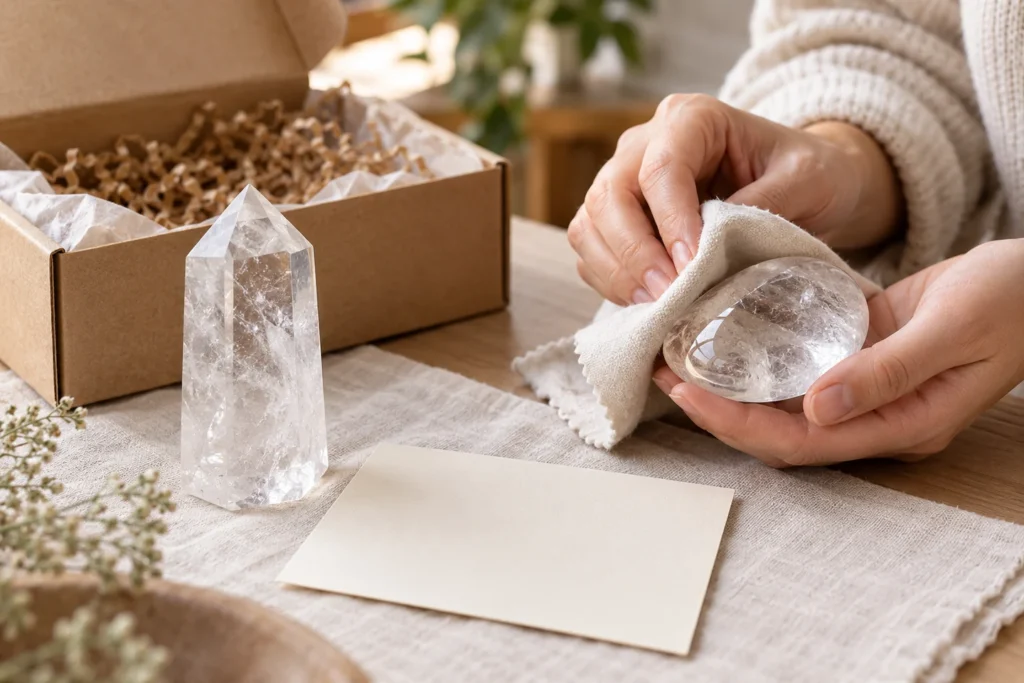
Wholesale and retail product descriptions should separate brief cleaning rinses from prolonged soaking, salt water, hot water, and drinking-water use. State what is generally acceptable, disclaim what is not verified, and avoid blanket "water-safe" labels — especially for products with cracks, coatings, glue, dyes, or mixed materials.
Dive Deeper
Recommended Language by Product Form
Different clear quartz product forms require different care notes. Here is a practical reference based on our supplier experience:
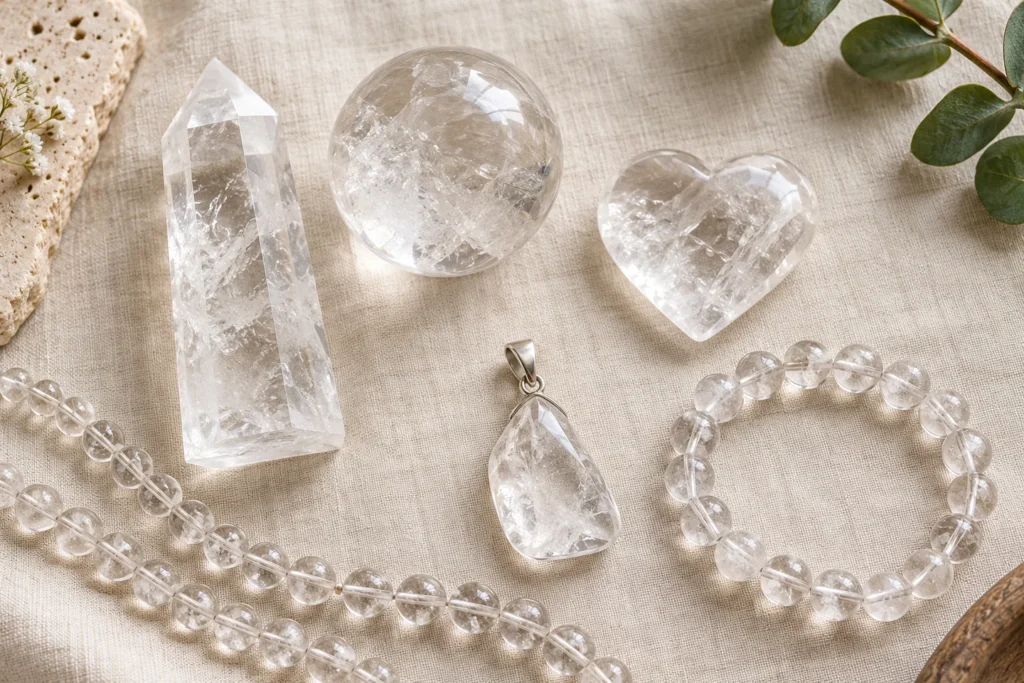
| Product Form | Suggested Water-Care Language |
|---|---|
| Solid towers / points | "May be briefly rinsed with clean water. Avoid soaking, salt water, and hot water." |
| Spheres | "Quick rinse OK. Avoid soaking — especially if base is glued." |
| Palm stones / tumbled stones | "Generally fine for brief rinsing. Inspect for cracks before any water contact." |
| Beaded bracelets | "Avoid water contact — cord, elastic, spacer beads, and dyed elements may be damaged." |
| Coated / aura quartz | "Do not expose to water — coating may discolor, peel, or degrade11." |
| Carved figurines | "Brief rinse only for cleaning. Avoid soaking — detail areas may trap water." |
| Pendants with metal findings | "Avoid water contact — metal components may tarnish or corrode." |
| Raw / rough specimens | "May be rinsed. Expect water to enter natural crevices; dry thoroughly." |
Three Rules for Product-Page Copy
Based on years of working with B2B buyers who sell clear quartz online, I suggest these three principles:
- Be specific about the action. "Brief rinse for cleaning" is better than "water-safe." It tells the customer exactly what to do.
- Name what to avoid. "Avoid salt water, hot water, and prolonged soaking" is more helpful than "use caution with water."
- Disclaim what you have not tested. "Not tested for food or drinking-water contact" is a single sentence that can save you significant trouble.
Handling Customer Questions
When your customers ask "Can I put this in water?" — and they will — train your team (or prepare your FAQ page) to answer with the same specificity:
"Clear quartz can generally be rinsed briefly with clean water for cleaning. We do not recommend prolonged soaking, salt water, hot water, or using this product in drinking water. If your piece has visible cracks, coatings, or glued components, avoid water contact entirely."
This answer is honest, helpful, and protective. It does not over-promise, and it does not treat all clear quartz products as identical.
Frequently Asked Questions
Will clear quartz dissolve in water?
No. Clear quartz (SiO₂) is chemically stable and does not dissolve in water under normal conditions. It has a Mohs hardness of 7 and is one of the most water-resistant common minerals. However, "not dissolving" does not mean all quartz products are safe for all water scenarios — product form and accessories matter.
Can I sell clear quartz as safe for gem water bottles?
You should not market clear quartz products as safe for drinking-water contact unless the specific product has been independently tested and certified for food-contact use in your market. General mineral properties do not replace regulatory food-safety verification. Include a disclaimer on your product page to limit liability.
Does salt water damage clear quartz?
Salt water can cause damage over time. While the quartz mineral itself will not dissolve, salt can crystallize inside micro-fractures and widen them. Salt water also corrodes metal findings, degrades elastic cords, and weakens adhesives on glued components. Advise customers to avoid salt water for any clear quartz product with non-quartz elements.
How should I clean clear quartz products for resale display?
A brief rinse with clean, room-temperature water and gentle drying with a soft cloth is generally sufficient for solid, uncracked pieces. For coated quartz, dyed pieces, or items with glued components, use a dry or slightly damp cloth instead. Always inspect for cracks before using water.
Should I include water-care instructions with clear quartz orders?
Yes. Including a simple care card or product-page note builds customer trust and reduces returns. A brief statement covering acceptable cleaning methods and explicit warnings about soaking, salt water, hot water, and drinking-water use helps customers care for the product appropriately.
References
- "Quartz", https://en.wikipedia.org/wiki/Quartz. A mineralogical reference identifies quartz as crystalline SiO₂ with Mohs hardness 7 and describes it as effectively insoluble under ordinary environmental conditions. Evidence role: definition; source type: encyclopedia. Supports: A neutral mineral reference should verify quartz composition, Mohs hardness, and low solubility in normal water exposure.. Scope note: This supports the mineral property of quartz generally, not the water safety of every finished quartz product. ↩
- "Selenite (gypsum)", https://en.wikipedia.org/wiki/Selenite_(gypsum). Mineralogical references describe selenite as a gypsum variety with low hardness and appreciable water sensitivity, and malachite as a copper carbonate mineral, providing context for why these minerals are treated differently from quartz in water-care advice. Evidence role: general_support; source type: encyclopedia. Supports: A mineral reference should support selenite/gypsum softness and solubility and malachite's copper-carbonate composition and toxicity context.. Scope note: The source would provide mineral-property context rather than product-specific evidence about consumer crystal use. ↩
- "Weathering", https://www.columbia.edu/~vjd1/weathering.htm. Geology teaching and reference sources commonly describe quartz as relatively resistant to chemical weathering, supporting the statement that it is chemically stable among common minerals. Evidence role: expert_consensus; source type: education. Supports: A geology or geochemistry source should describe quartz as resistant to chemical weathering and relatively stable at Earth's surface.. Scope note: This is contextual support for mineral stability and does not prove that all commercial quartz products withstand every water exposure. ↩
- "Silicon dioxide", https://en.wikipedia.org/wiki/Silicon_dioxide. Crystallographic and geochemical literature attributes quartz's low reactivity in ordinary water to its linked SiO₂ framework and the stability of silicon–oxygen bonding. Evidence role: mechanism; source type: paper. Supports: A mineralogy or materials-science paper should explain the stability of the SiO₂ network and the slow dissolution/reactivity of quartz in neutral water at ordinary temperatures.. Scope note: The source would explain the mineral mechanism, not test the exact consumer products described in the article. ↩
- "Deterioration mechanisms of tuff with surface fractures under …", https://pmc.ncbi.nlm.nih.gov/articles/PMC11166979/. Geology references describe frost wedging as a process in which water entering cracks expands on freezing and can enlarge fractures in rock or stone. Evidence role: mechanism; source type: education. Supports: A geology or conservation source should explain that water freezing in cracks can exert pressure and propagate fractures.. Scope note: This supports the physical mechanism generally; it does not quantify the risk for an individual polished quartz item. ↩
- "Thermal shock", https://en.wikipedia.org/wiki/Thermal_shock. Materials-science literature on brittle solids explains that rapid temperature changes can create thermal stresses sufficient to propagate pre-existing flaws or fractures. Evidence role: mechanism; source type: paper. Supports: A materials-science source should support that rapid temperature changes create thermal stresses that can crack brittle materials, including silica-based materials.. Scope note: This supports the general thermal-shock mechanism; the risk for clear quartz depends on existing flaws, piece size, and temperature gradient. ↩
- "The Pressure induced by salt crystallization in confinement", https://pmc.ncbi.nlm.nih.gov/articles/PMC4974634/. Research on salt weathering shows that crystallization of salts within pores and cracks can generate stresses that contribute to fracture growth during repeated wetting and drying cycles. Evidence role: mechanism; source type: paper. Supports: A peer-reviewed source should support the mechanism of salt crystallization pressure causing crack growth or granular disintegration in stone materials.. Scope note: The literature typically concerns porous stone or rock substrates; application to polished quartz is contextual and depends on the presence of cracks or inclusions. ↩
- "Corrosion Mechanisms in Chloride and Carbonate Salts", https://www.osti.gov/servlets/purl/1051732. Corrosion science sources describe chloride-containing salt water as an aggressive environment that can accelerate corrosion of metals and compromise protective or plated surfaces. Evidence role: mechanism; source type: research. Supports: A corrosion science source should explain that chloride ions in salt water increase corrosion risk for many metals and coatings.. Scope note: The source would support the corrosion mechanism broadly, while actual damage depends on the specific alloy, plating, exposure time, and finish quality. ↩
- "Food Packaging & Other Substances that Come in Contact …", https://www.fda.gov/food/food-ingredients-packaging/food-packaging-other-substances-come-contact-food-information-consumers. Food-contact safety guidance treats suitability as a product- and use-specific assessment involving composition, migration, and intended conditions of use, rather than relying on hardness or general chemical stability alone. Evidence role: expert_consensus; source type: institution. Supports: A food-safety institution should support that food-contact suitability depends on material composition, migration, intended use, and compliance testing rather than a single physical property.. Scope note: This provides regulatory and scientific context; it does not evaluate any specific clear quartz product. ↩
- "Food Packaging & Other Substances that Come in Contact …", https://www.fda.gov/food/food-ingredients-packaging/food-packaging-other-substances-come-contact-food-information-consumers. Official food-contact material regulations in the United States and European Union establish requirements for materials intended to contact food or drinking water, including FDA food-contact rules and Regulation (EC) No 1935/2004. Evidence role: general_support; source type: government. Supports: Official regulatory sources should confirm that food-contact materials are subject to FDA requirements in the US and Regulation (EC) No 1935/2004 in the EU.. Scope note: This supports the regulatory context, not whether a particular quartz insert complies with those rules. ↩
- "Adhesion Degradation and Water Diffusion in Nanoporous …", https://dash.harvard.edu/bitstreams/b345100f-c7d8-445f-bd3e-69e0624ffd0d/download. Materials literature on thin-film and decorative coatings shows that moisture exposure, corrosion, adhesion failure, and mechanical wear can contribute to discoloration, peeling, or degradation of coated surfaces. Evidence role: mechanism; source type: paper. Supports: A coatings or materials-science source should support that thin decorative or metallic coatings can fail through poor adhesion, moisture exposure, corrosion, or mechanical wear.. Scope note: This supports coating-failure mechanisms generally; the durability of a specific aura quartz item depends on its coating process and quality control. ↩