If you're wondering whether you can wear clear quartz every day, you're asking the right question — but maybe for the wrong reasons. Many people assume the stone itself is the issue. In reality, daily wearability depends more on the piece's construction, your activities, and your care habits than on the mineral alone.
Yes, most people can comfortably wear clear quartz every day. Quartz is a relatively hard and stable mineral, making it suitable for daily jewelry. However, "every day" should not mean "never taking it off." The real factors that determine whether daily wear is practical include the jewelry's structure, your daily activities, and how well you maintain the piece over time.
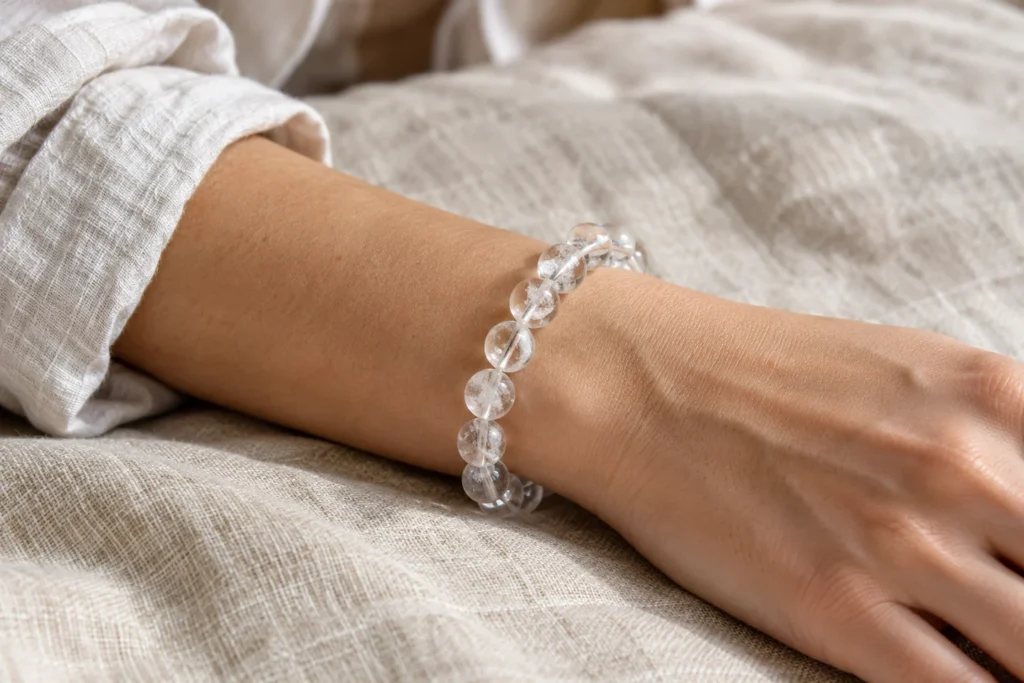
That straightforward answer only scratches the surface. Below, I'll walk through the specific variables — from bead size and pendant shape to real-life scenarios like showering, sleeping, and exercising — so you can make a confident, informed decision about wearing your clear quartz piece every single day.
Is Clear Quartz Durable Enough for Daily Wear?
Durability is usually the first concern people raise. Nobody wants to invest in a piece of jewelry only to watch it crack or cloud within weeks. The good news is that quartz is among the more resilient minerals used in everyday jewelry.
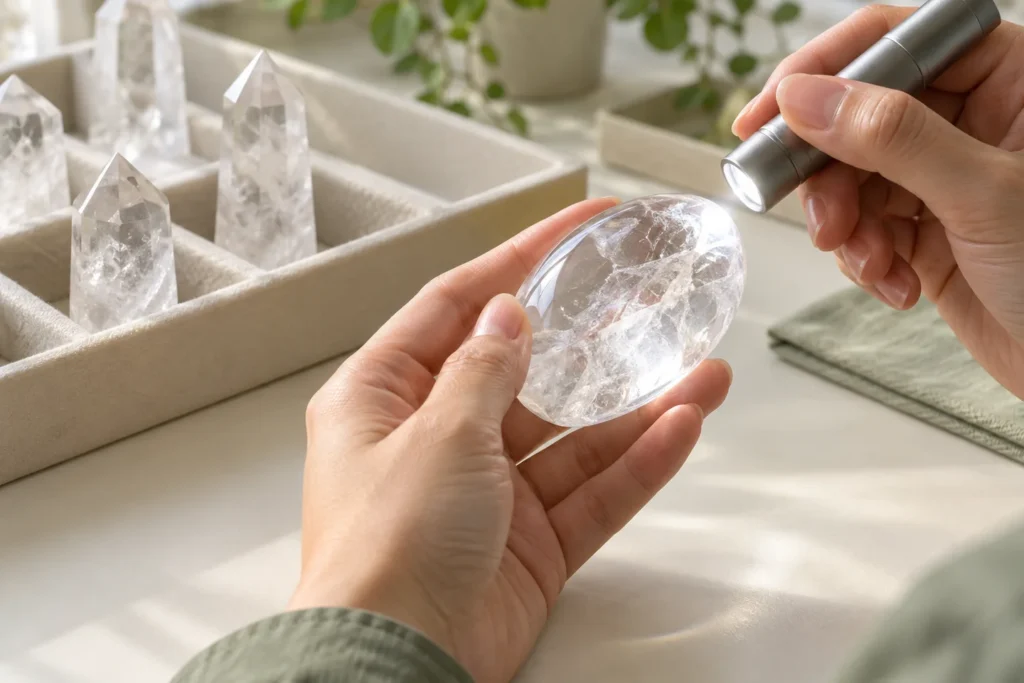
Clear quartz ranks 7 on the Mohs hardness scale1, which means it resists scratches from most common materials you encounter daily — keys, coins, fabric. It is harder than glass and most metals used in casual jewelry findings.2 For context, only minerals like topaz, sapphire, and diamond are significantly harder.
How Hardness Translates to Real Wear
Hardness is not the whole story, though. In my experience working with wearable crystal products, the issue we often look at is not only the stone, but also the structure and use scenario. Here's what I mean:
- Scratch resistance ≠ impact resistance. A quartz bead can resist a key scratch but still chip if you slam your wrist into a granite countertop. Hardness measures resistance to abrasion; toughness measures resistance to impact.3 Quartz has good hardness but only moderate toughness.4
- Natural inclusions matter. Clear quartz is rarely perfectly flawless. Tiny internal fractures, veils, or inclusions — which are completely natural — can become weak points under repeated stress.5 A bead with a visible internal crack is more vulnerable than a clean one.
- Surface polish degrades slowly. Over months of daily wear, quartz will accumulate micro-scratches. These won't destroy the stone, but they can reduce its glassy clarity. Periodic gentle cleaning helps, but some dulling over a year or two of constant wear is normal.
| Factor | Clear Quartz Performance | Daily Wear Implication |
|---|---|---|
| Mohs Hardness | 7 / 10 | Resists most common scratches |
| Toughness | Moderate | Can chip on hard impacts |
| Chemical Stability | High | Resists sweat, water, mild soap |
| Heat Sensitivity | Low risk | Safe in normal temperature ranges |
| Inclusion Sensitivity | Variable by piece | Pieces with visible cracks need more care |
The bottom line: the stone itself is daily-wear friendly for most people. The real risks come from how the piece is built and what you do while wearing it — which I'll cover next.
Does the Jewelry Style Affect Whether I Can Wear Clear Quartz Daily?
Absolutely. Two people can both own clear quartz jewelry, but one piece may be perfect for daily wear while the other is a weekend-only accessory. The difference almost always comes down to style, construction, and fit.
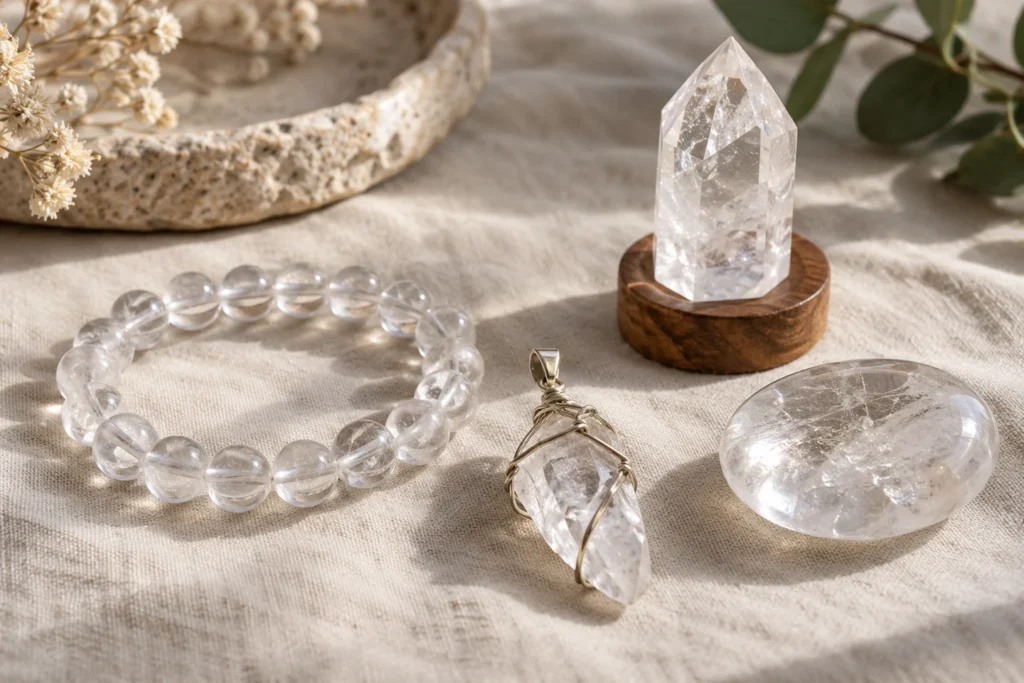
The jewelry's design — bead size, pendant shape, stringing method, metal findings, and setting quality — plays a bigger role in daily wearability than the stone's mineral properties. A well-strung bracelet of smooth round beads is far more practical for everyday use than a wire-wrapped pointed crystal pendant.
Bracelets: Bead Size and Stringing
Bead bracelets are the most popular form of daily-wear clear quartz jewelry. Here's what to evaluate:
- Bead diameter: Beads between 6mm and 10mm generally offer the best balance of visual presence and comfort. Anything above 12mm starts to feel bulky during typing, cooking, or driving. Larger beads also increase the bracelet's total weight on your wrist.
- Stringing material: Most crystal bead bracelets use elastic cord. Quality varies dramatically. A well-made bracelet uses multi-strand elastic that can handle repeated stretching. Cheap single-strand elastic frays and snaps within weeks of daily wear. If you plan to wear your bracelet every day, the cord quality matters as much as the stone quality.
- Fit: A bracelet that's too tight restricts blood flow and presses beads into your skin. One that's too loose catches on doorknobs, zippers, and bag straps. Proper fit means you can slide one finger between the bracelet and your wrist comfortably.
Pendants: Shape and Setting
Pendants introduce different variables:
- Pointed shapes (like natural crystal points or faceted drops) can poke your chest, snag on clothing, or chip if they swing into hard surfaces. For daily wear, smooth polished shapes — tumbled stones, cabochons, or rounded drops — are more practical.
- Setting security: Wire-wrapped pendants can loosen over time. Bezel settings offer more protection but add cost. If you wear a pendant daily, check the setting or wrap every few weeks.
- Chain or cord: Leather cords absorb sweat and degrade. Metal chains can cause skin reactions for some people. Choose a chain based on its alloy composition, clasp security, and your individual sensitivities.
Quick Style Comparison for Daily Wear
| Style | Daily Wear Suitability | Main Risk |
|---|---|---|
| Smooth bead bracelet (6–10mm) | Excellent | Elastic cord wear |
| Large bead bracelet (12mm+) | Moderate | Bulk, snagging, weight |
| Tumbled stone pendant | Good | Setting looseness |
| Pointed crystal pendant | Low–Moderate | Snagging, poking, chipping |
| Wire-wrapped pendant | Moderate | Wire loosening over time |
| Bezel-set cabochon | Excellent | Higher cost |
From a product perspective, I always suggest that customers who plan to wear a piece daily prioritize smooth profiles and secure construction over dramatic shapes. A beautiful pointed quartz tower looks stunning — but it belongs on a display shelf, not dangling from your neck during a morning commute.
When Should I Take Off My Clear Quartz Jewelry?
This is where the "every day" question gets nuanced. Wearing clear quartz daily is fine. Wearing it during every single activity is not. Knowing when to remove your piece protects both the jewelry and your comfort.
Remove your clear quartz jewelry during high-impact exercise, swimming, bathing with chemicals, household cleaning, and sleep if the piece is bulky, pointed, or tight-fitting. These situations expose the stone and its hardware to unnecessary stress, chemical damage, or physical risk.
Activities That Call for Removal
Here's a practical breakdown based on the questions I hear most often from customers:
1. Exercise and Sports
Weightlifting, rock climbing, yoga, and contact sports all put direct pressure or impact on wrist and neck jewelry. A quartz bead can crack against a barbell. An elastic cord can snap mid-deadlift. Even low-impact activities like running create repetitive swinging that stresses pendant settings.
2. Bathing and Swimming
Plain water won't damage quartz, but:
- Shampoo, conditioner, and body wash leave residue that dulls polish over time.
- Chlorinated pool water and hot tub chemicals can corrode metal findings, especially lower-grade alloys.6
- Saltwater accelerates tarnishing on silver components7 and can work its way into micro-fractures in the stone.
3. Household Cleaning
Bleach, ammonia, and acidic cleaners are harsh on both metal findings and elastic cord.8 Even wearing rubber gloves, splashes happen. Remove your jewelry before cleaning the kitchen or bathroom.
4. Sleep
This depends on the piece:
- A smooth, well-fitting bead bracelet? Probably fine for sleep, though you may stretch the elastic by rolling on it.
- A pendant with a point or a heavy chain? Remove it. You risk tangling, poking yourself, or stressing the clasp.
- A tight bracelet? Remove it. Fluid retention during sleep can make a snug bracelet uncomfortable by morning.
5. Chemical Exposure
Perfume, hairspray, sunscreen, and hand sanitizer should be applied before putting on your quartz jewelry, and ideally allowed to dry first. These products won't dissolve quartz, but they build up on the surface and can weaken elastic or corrode metal over time.
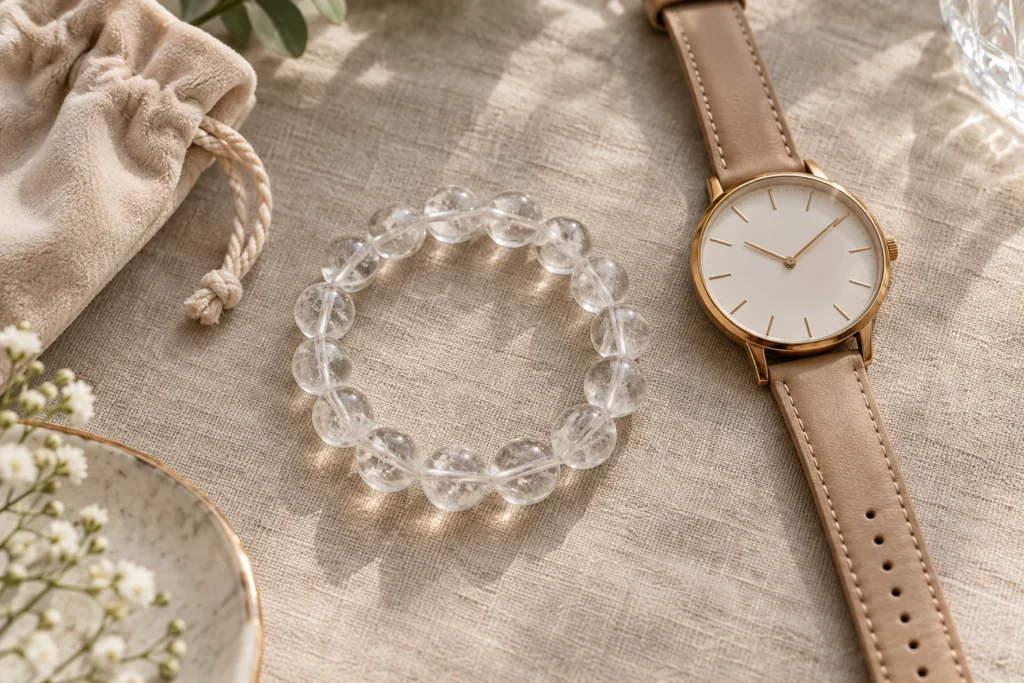
A practical rule: If you wouldn't do the activity wearing a nice watch, don't do it wearing your clear quartz piece.
How Do I Care for Clear Quartz I Wear Every Day?
Even the most durable daily-wear piece needs basic maintenance. Neglecting care is the number one reason clear quartz jewelry loses its appeal — not because the stone "runs out of energy," but because physical grime, cord fatigue, and hardware wear accumulate over time.
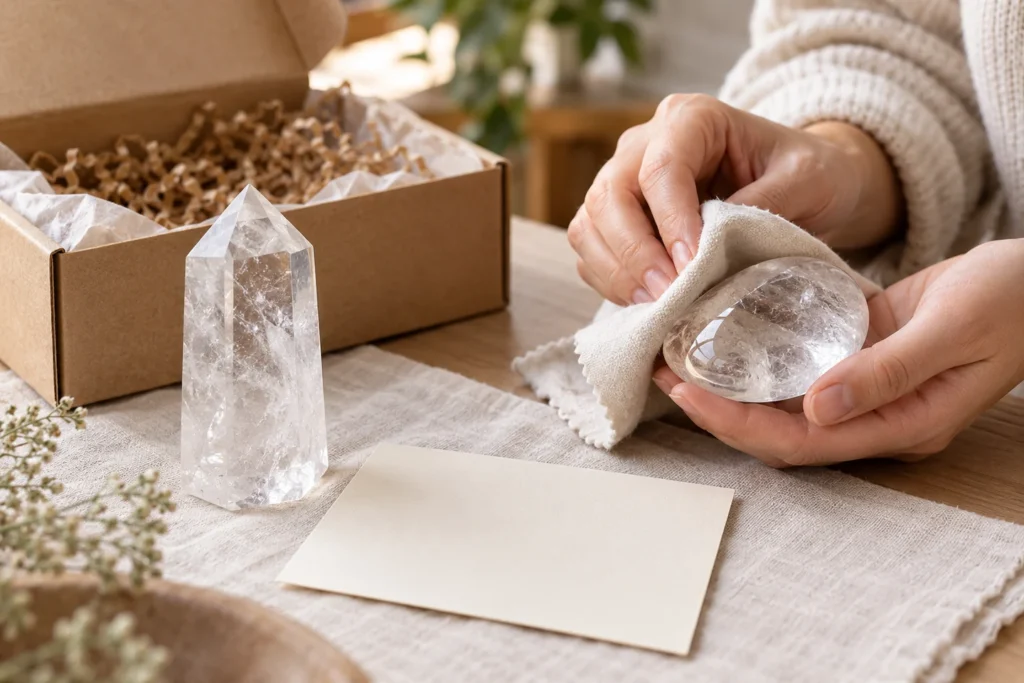
For daily-wear clear quartz, a simple routine works: wipe it gently after each wear, do a deeper clean weekly, inspect the cord and findings monthly, and store it flat and separate from other jewelry when not in use. This keeps the piece looking fresh and structurally sound.
A Simple Care Routine
After each wear (30 seconds):
- Wipe the beads or pendant with a soft, dry microfiber cloth. This removes skin oils, sweat, and surface dust before they build up.
Weekly (5 minutes):
- Soak the piece in lukewarm water with a tiny amount of mild dish soap for 2–3 minutes.
- Gently brush with a soft toothbrush, especially around metal findings or knot gaps.
- Rinse under clean running water.
- Pat dry completely before storing or wearing. Trapped moisture weakens elastic and can tarnish metal.
Monthly (2 minutes):
- Inspect the elastic cord for fraying, thinning, or loss of stretch. If it feels loose or you can see fibers separating, it's time for restringing.
- Check pendant settings, wire wraps, and clasps for looseness.
- Look at the quartz beads for any new chips or deepening cracks. One damaged bead can abrade its neighbors.
What to Avoid
| Do This | Avoid This |
|---|---|
| Use mild soap and lukewarm water | Ultrasonic cleaners (can worsen internal fractures)9 |
| Pat dry with soft cloth | Air-drying in direct sunlight for long periods |
| Store flat in a soft pouch | Tossing into a jewelry box with harder stones or metals |
| Restring elastic before it snaps | Waiting until beads scatter across the floor |
A Note on "Cleansing" vs. Cleaning
Many online sources discuss "cleansing" clear quartz — using moonlight, sound, sage, or salt water to reset its "energy." I want to be straightforward here: from a product care standpoint, physical cleaning is what preserves your jewelry's appearance and longevity. Whether you also practice energetic cleansing is a personal choice. I won't claim it does or doesn't work. What I can say is that salt water, prolonged sunlight, and certain smoke residues can physically affect your jewelry's surface and hardware — so if you cleanse ritually, just be mindful of the materials involved.
What About Skin Sensitivity and Comfort?
Some people worry about whether wearing quartz against the skin all day causes irritation. This is a fair concern, especially for bracelet wearers in warm climates or anyone with sensitive skin.
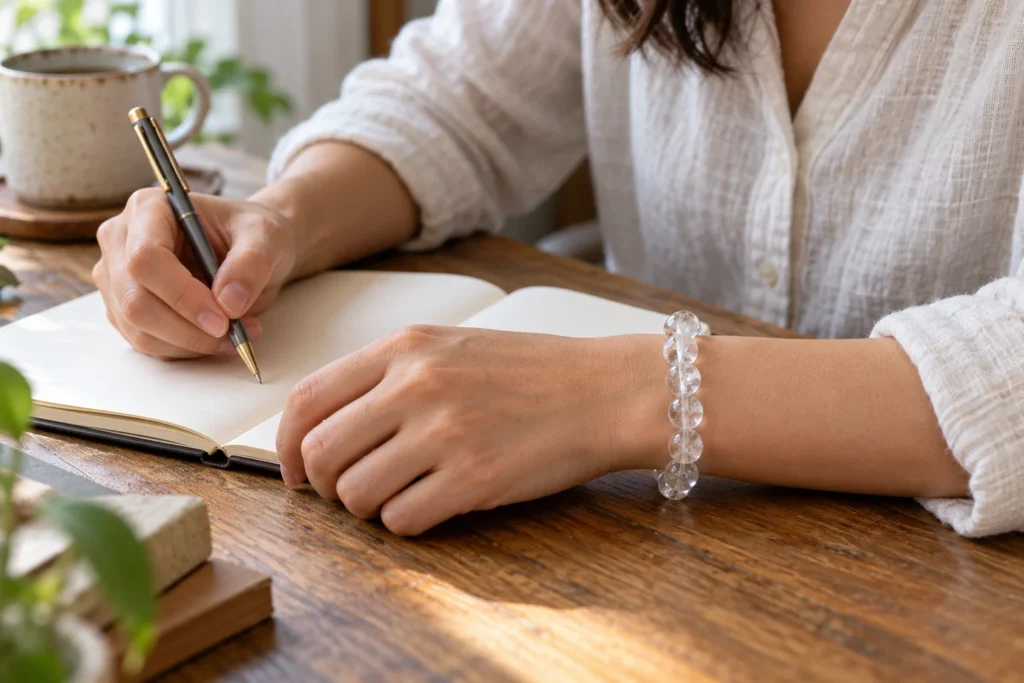
Clear quartz itself is chemically inert and does not typically cause skin reactions.10 Irritation from crystal jewelry almost always comes from the non-stone components: metal findings, elastic cord, glue residue, or moisture trapped between beads and skin.
Common Comfort Issues and Solutions
Metal allergies:
Nickel is the most common culprit.11 If your bracelet has metal spacer beads or your pendant uses plated findings, prolonged skin contact can trigger redness, itching, or a rash. Choose hardware with confirmed composition and suitability for your sensitivities; stainless steel or 925 silver labels alone do not guarantee nickel-free or allergy-free wear. When evaluating a supplier, ask specifically about the metal composition of findings.
Cord friction:
Elastic cords that sit directly against the wrist can cause mild chafing during hot weather or heavy sweating. This is more common with thick multi-wrap bracelets. A single-strand bracelet with smooth beads usually causes no friction issues.
Trapped moisture:
Wearing a bracelet through a workout or on a humid day traps sweat between beads and skin. This can lead to mild irritation or even a faint smell. The simple solution: remove the bracelet, rinse your wrist, and let both skin and bracelet dry before putting it back on.
Tightness:
As I mentioned earlier, fit matters enormously. If you notice indentations on your wrist at the end of the day, your bracelet is too tight. Wrist size can fluctuate throughout the day due to temperature, activity, and hydration. A properly sized crystal bracelet should have a small amount of movement.
Practical tip: If you're ordering a crystal bracelet for daily wear, measure your wrist in the afternoon (when it's slightly larger) and add approximately 0.5–1 cm for comfortable all-day fit.
Frequently Asked Questions
Can clear quartz go in water?
Yes, brief water exposure is fine for cleaning. Clear quartz is water-stable and won't dissolve or degrade from normal washing.12 However, avoid prolonged soaking, especially in salt water or chemically treated water, as this can damage metal findings and elastic cord rather than the stone itself.
Will clear quartz lose its clarity over time?
Slight surface dulling from micro-scratches is normal after months of daily wear. This doesn't mean the stone is damaged internally. A gentle cleaning or professional re-polishing can restore much of the original luster. Storing it separately from harder materials helps slow the dulling process.
Does clear quartz have healing properties I should know about?
Many people value clear quartz for personal intention, mindfulness, or symbolic meaning, and that's a personal choice. However, I don't make claims about healing, energy purification, or medical benefits. If you have a health concern, consult a qualified medical professional. Enjoy your quartz for its beauty and the meaning you bring to it.
How often should I restring a clear quartz bead bracelet?
For daily wear, inspect the elastic monthly and plan to restring every 6–12 months, depending on cord quality and how much stretching the bracelet endures. If you notice the cord no longer snaps back tightly, don't wait — restring it before it breaks unexpectedly.
Can I shower with my clear quartz bracelet on?
You can, but I don't recommend making it a habit. Soap residue builds up between beads, hot water accelerates elastic degradation, and the wet-to-dry cycle repeated daily significantly shortens the bracelet's lifespan. It takes five seconds to slip it off before you step in.
Conclusion
So, can you wear clear quartz every day? Yes — and with some practical awareness, you can do it comfortably for a long time. The key takeaways are straightforward: choose a smooth, well-constructed piece suited to your daily activities; remove it during high-impact, chemical, or wet scenarios; follow a simple cleaning and inspection routine; and pay attention to comfort and fit rather than just the stone itself. Clear quartz is a durable, beautiful mineral that handles daily wear well when the jewelry around it is built and maintained with care.
If you're a retailer or brand owner sourcing clear quartz wearable products for customers who want everyday pieces, we'd be happy to discuss materials, construction details, and styles suited for daily use. Reach out to GD Crystal for a quote — we're glad to help you find the right fit for your product line.
References
- "Mohs scale", https://en.wikipedia.org/wiki/Mohs_scale. Mineralogical references identify quartz as a Mohs hardness 7 mineral, supporting the statement that clear quartz has relatively high scratch resistance; this rating does not by itself establish overall jewelry durability. Evidence role: statistic; source type: encyclopedia. Supports: Quartz is listed at hardness 7 on the Mohs scale.. Scope note: Mohs hardness measures scratch resistance, not resistance to impact, cord wear, or setting failure. ↩
- "Mohs scale", https://en.wikipedia.org/wiki/Mohs_scale. Comparative hardness tables place quartz above common glass and above softer metals such as silver, copper, and gold on the Mohs scale, providing contextual support for the comparison; alloy composition and surface treatments can alter practical wear behavior. Evidence role: general_support; source type: education. Supports: Quartz has a higher Mohs hardness than common glass and several soft jewelry metals or alloys.. Scope note: The comparison is contextual because jewelry findings vary by alloy, plating, and manufacturing process. ↩
- "More than the Mohs Scale | Understanding Gem Durability", https://4cs.gia.edu/en-us/blog/more-than-mohs-scale-gem-durability/. Materials-science and gemological references distinguish hardness from toughness, defining hardness as resistance to scratching or abrasion and toughness as resistance to fracture or impact; these definitions support the article's distinction but do not quantify clear quartz performance in a specific jewelry design. Evidence role: definition; source type: education. Supports: Hardness and toughness are distinct properties, with hardness relating to resistance to scratching or abrasion and toughness relating to resistance to breaking or chipping.. Scope note: The source would define the concepts rather than test the specific jewelry pieces discussed. ↩
- "More than the Mohs Scale | Understanding Gem Durability", https://4cs.gia.edu/en-us/blog/more-than-mohs-scale-gem-durability/. Gemological durability references characterize quartz as hard on the Mohs scale while noting that toughness is a separate property affecting chipping and breakage; this supports the article's caution that quartz can still be damaged by impact. Evidence role: general_support; source type: institution. Supports: Quartz has high scratch resistance relative to many materials but only moderate toughness compared with tougher gem materials.. Scope note: The support is general to quartz as a gem material and may not predict damage risk for every bead, cut, or setting. ↩
- "Stress concentration", https://en.wikipedia.org/wiki/Stress_concentration. Fracture-mechanics literature describes cracks and inclusions as stress concentrators that can lower a material's resistance to fracture, providing a mechanism for why included quartz pieces may be more vulnerable under repeated stress. Evidence role: mechanism; source type: research. Supports: Internal flaws, inclusions, and cracks can concentrate stress and reduce resistance to fracture.. Scope note: The mechanism is broadly applicable to brittle materials and gemstones, but it would not directly measure the failure rate of the specific jewelry described. ↩
- "How chlorine affects gold jewelry in pools and hot tubs", https://www.facebook.com/rebeldiamondsllc/posts/%EF%B8%8F%EF%B8%8Fpossible-affects-of-chlorine-and-chemicals-from-pools-and-hot-tubs%EF%B8%8F%EF%B8%8F-many-may-/1097876392134881/. Corrosion studies and materials references document that chloride-containing and chlorinated environments can accelerate corrosion in susceptible metals and alloys, supporting the warning about pool and hot tub exposure to jewelry findings. Evidence role: mechanism; source type: research. Supports: Chlorinated and chloride-containing waters can contribute to corrosion of susceptible metals and alloys.. Scope note: The evidence concerns metal corrosion generally; actual jewelry damage depends on alloy composition, plating quality, exposure time, and rinsing practices. ↩
- "Atmospheric Corrosion of Silver and Silver Nanoparticles", https://www.mdpi.com/2624-5558/3/2/13. Conservation and corrosion literature shows that chloride exposure can contribute to silver corrosion products and surface alteration, supporting the statement that saltwater can accelerate deterioration of silver components. Evidence role: mechanism; source type: paper. Supports: Chloride-rich environments can promote corrosion products and surface degradation on silver.. Scope note: The evidence supports a chemical mechanism, while the visible rate of tarnish on a particular jewelry item depends on alloy, finish, and duration of exposure. ↩
- "Appendix O: Curatorial Care of Metal Objects", https://www.nps.gov/subjects/museums/upload/MHI_AppO_MetalObjects.pdf. Materials and conservation guidance notes that oxidizing, alkaline, and acidic cleaning agents can corrode susceptible metals and degrade rubber or elastic polymers, supporting the recommendation to remove jewelry before household cleaning. Evidence role: general_support; source type: institution. Supports: Bleach, ammonia, acidic cleaners, and similar household chemicals can corrode metals or degrade polymeric elastic materials.. Scope note: The support is material-specific and general; the degree of damage depends on the exact alloy, elastic formulation, concentration, and contact time. ↩
- "Gems and Ultrasonic Cleaners", https://4cs.gia.edu/en-us/blog/gems-ultrasonic-cleaners/. Gemological care guidance warns that ultrasonic cleaners may damage stones with fractures, inclusions, or structural weaknesses, supporting the caution against using them on clear quartz jewelry with internal flaws. Evidence role: mechanism; source type: institution. Supports: Ultrasonic cleaning can be risky for gemstones that contain fractures, inclusions, or treatments because vibration may worsen existing weaknesses.. Scope note: The guidance is precautionary and applies especially to flawed or treated stones; flawless quartz may tolerate ultrasonic cleaning better than fractured pieces. ↩
- "Silicon dioxide", https://en.wikipedia.org/wiki/Silicon_dioxide. Chemical safety references characterize silicon dioxide, the composition of quartz, as chemically stable and not a typical skin sensitizer in ordinary solid contact, supporting the article's distinction between the stone and other jewelry components. Evidence role: general_support; source type: government. Supports: Silicon dioxide/quartz is chemically stable and not commonly identified as a skin sensitizer in ordinary solid jewelry contact.. Scope note: This does not rule out irritation from trapped moisture, surface contaminants, coatings, or non-quartz components. ↩
- "Management of contact dermatitis due to nickel allergy – PMC", https://pmc.ncbi.nlm.nih.gov/articles/PMC3047925/. Dermatology literature identifies nickel as a leading cause of allergic contact dermatitis and a common source of jewelry-related reactions, supporting the article's statement about nickel sensitivity. Evidence role: expert_consensus; source type: paper. Supports: Nickel is widely recognized as one of the most common causes of allergic contact dermatitis, particularly in jewelry exposure.. Scope note: The evidence supports population-level risk; an individual reaction may also involve cobalt, chromium, adhesives, residues, or moisture. ↩
- "Silicon dioxide – PubChem – NIH", https://pubchem.ncbi.nlm.nih.gov/substance/134987421. Chemical and mineral references describe quartz, crystalline silicon dioxide, as highly stable and effectively insoluble in ordinary water, supporting the statement that brief washing will not dissolve or degrade the stone. Evidence role: general_support; source type: government. Supports: Quartz/silicon dioxide is effectively insoluble and stable in ordinary water exposure.. Scope note: This support applies to the quartz mineral itself and not to elastic cord, adhesives, plating, or metal findings attached to the jewelry. ↩