Clear quartz in water sounds like a simple care question, but I see it become a real B2B risk when sellers turn a short rinse into a broad soaking claim. If customers soak bracelets, glued pieces, or cracked stones repeatedly, complaints can follow. I recommend a more specific, product-based water-care answer.
You can usually rinse plain clear quartz briefly with clean water, but I do not recommend leaving clear quartz in water as a default care instruction. The safer answer depends on the product form, surface finish, cracks, inclusions, glue, cord, metal parts, coatings, and how the item will be sold or explained to end customers.
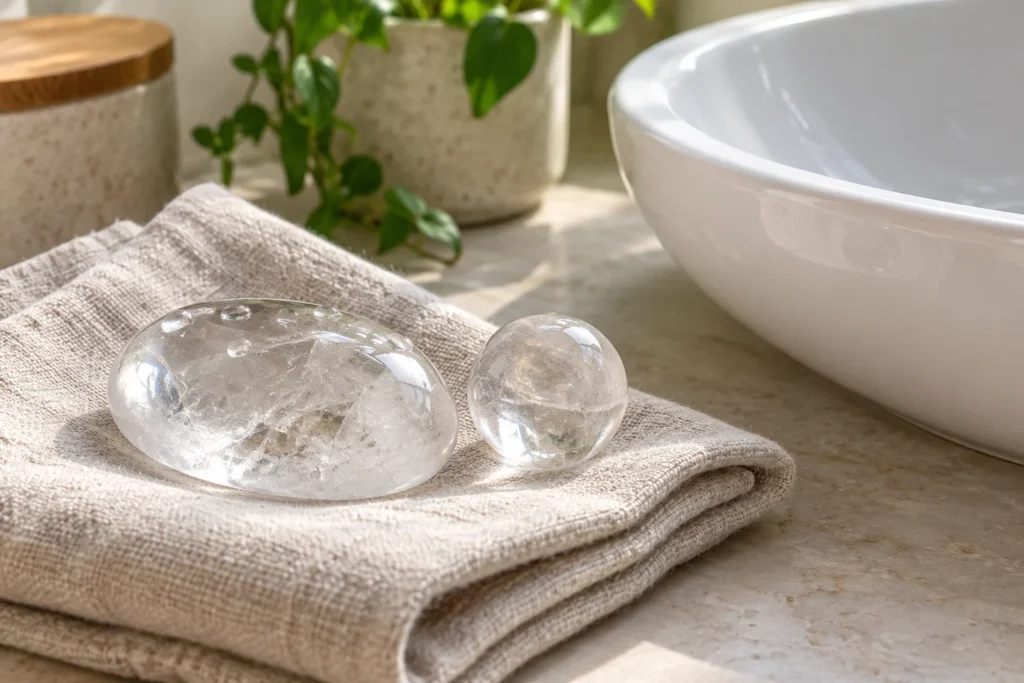
I handle clear quartz as a processed wholesale product, not only as a mineral name. That difference matters. A polished tumble, a carved angel, a bead bracelet, and a glued décor piece can all behave differently after water exposure.
Is it safe to put clear quartz in water for a quick rinse?
A quick rinse seems harmless, but I still treat it as a controlled cleaning step. The problem starts when “rinse” becomes “soak overnight.” Buyers may assume both are the same. That gap can create damaged packaging, dull surfaces, weakened stringing, or customer returns.
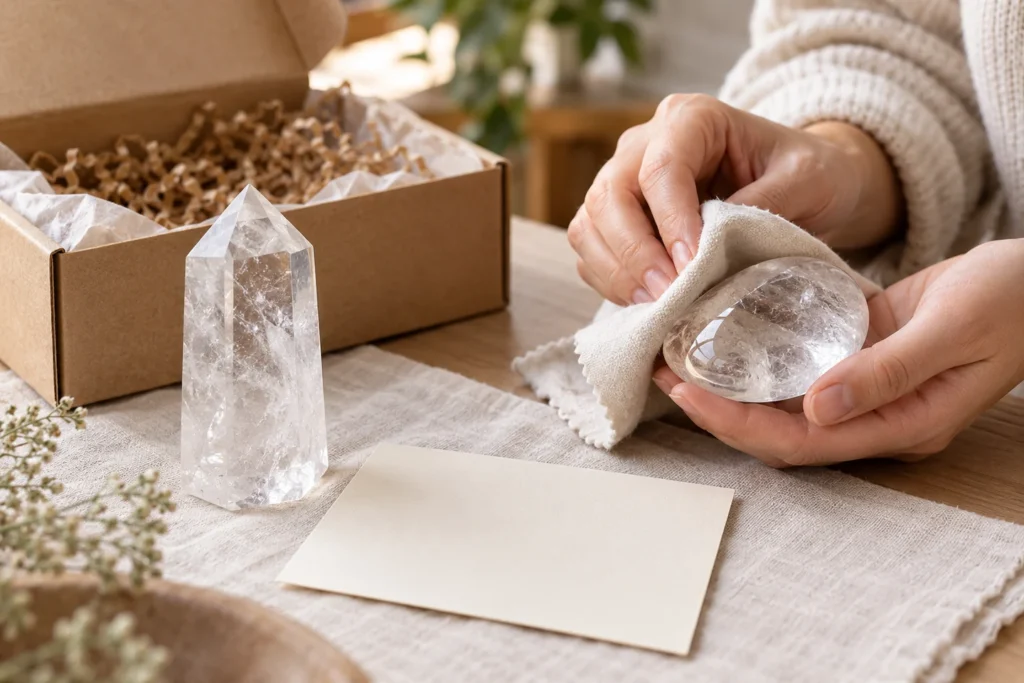
A brief rinse with clean water is generally acceptable for plain clear quartz without glue, coatings, metal parts, or fragile cracks. I still recommend drying it immediately with a soft cloth. For wholesale listings, I would describe this as “wipe clean or briefly rinse and dry,” not “water safe for soaking.”
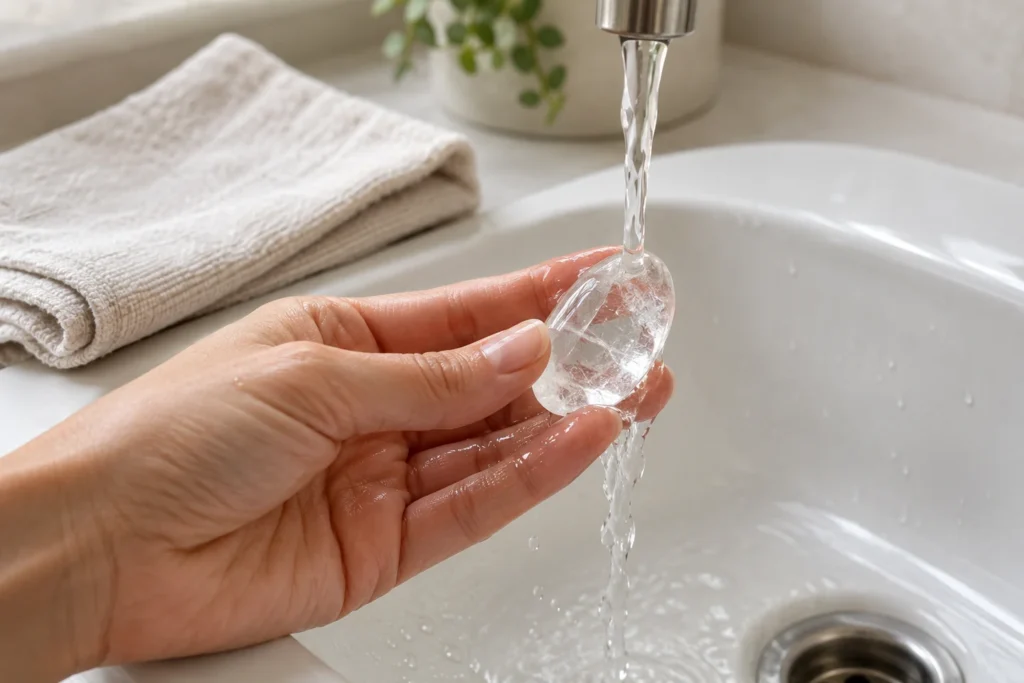
Why a short rinse is different from soaking
Clear quartz is commonly known as a hard mineral, with a Mohs hardness of about 7.1 I mention that because buyers often use hardness as a shortcut. However, hardness mainly describes scratch resistance2. It does not answer every care question.
In my work with crystal products, I separate mineral durability from finished-product durability. A raw mineral specimen and a polished wholesale SKU are not the same thing.
A quick rinse usually involves:
- Short contact time, often under one minute.
- Clean water, not salt water, detergent, perfume, or acidic liquid.
- Immediate drying, especially around drilled holes or carved grooves.
- Limited stress, because the item is not left submerged.
Long soaking creates different conditions:
- Water can enter cracks, pits, and drilled holes.3
- Moisture can affect elastic cord, cotton cord, leather, labels, or packaging.
- Repeated wet-dry cycles can make small surface issues more visible.4
- Customers may add salt, soap, essential oils, or other substances.
I have seen buyers ask for one universal care line for all clear quartz products. I understand why. It saves time. But I prefer a more careful sentence because it protects the seller after the order arrives.
Practical B2B care wording
For a plain polished tower, sphere, palm stone, or tumble, I would usually suggest:
“Clean with a soft dry cloth. If needed, briefly rinse with clean water and dry immediately. Do not soak for long periods.”
That wording gives customers permission for normal cleaning but avoids an unlimited water-safe claim.
Quick rinse checklist for buyers
| Checkpoint | Why I check it | Lower-risk sign | Higher-risk sign |
|---|---|---|---|
| Product form | Shape affects trapped moisture | Smooth stone or sphere | Drilled beads or deep carving |
| Surface finish | Finish affects appearance | Even polished surface | Waxed, coated, or repaired surface |
| Structure | Cracks can hold water | Solid body | Open fractures or many inclusions |
| Components | Non-stone parts may fail | Stone only | Glue, metal, cord, labels |
| Sales channel | Customer use affects claims | Display or occasional handling | Daily wear or repeated cleansing |
I do not treat water contact as a yes-or-no issue. I treat it as a use case. If a retailer sells clear quartz as a decorative item, brief cleaning is the main concern. If an ecommerce seller markets a bracelet for daily wear, the water-care answer must include stringing and metal findings too.
Why is leaving clear quartz in water not the best default instruction?
Leaving clear quartz in water feels easy to explain, especially because many consumers already believe clear quartz is “water safe.” The risk is that simple advice can travel farther than the product details. Once customers soak items repeatedly, small flaws can become visible and turn into after-sales problems.
I do not recommend leaving clear quartz in water as a default instruction because finished crystal products vary. Plain quartz may tolerate brief water contact5, but soaking can affect cracks, inclusions, polish, glue, coatings, elastic string, metal charms, labels, and packaging. Sellers should give care guidance by product type, not by mineral name only.
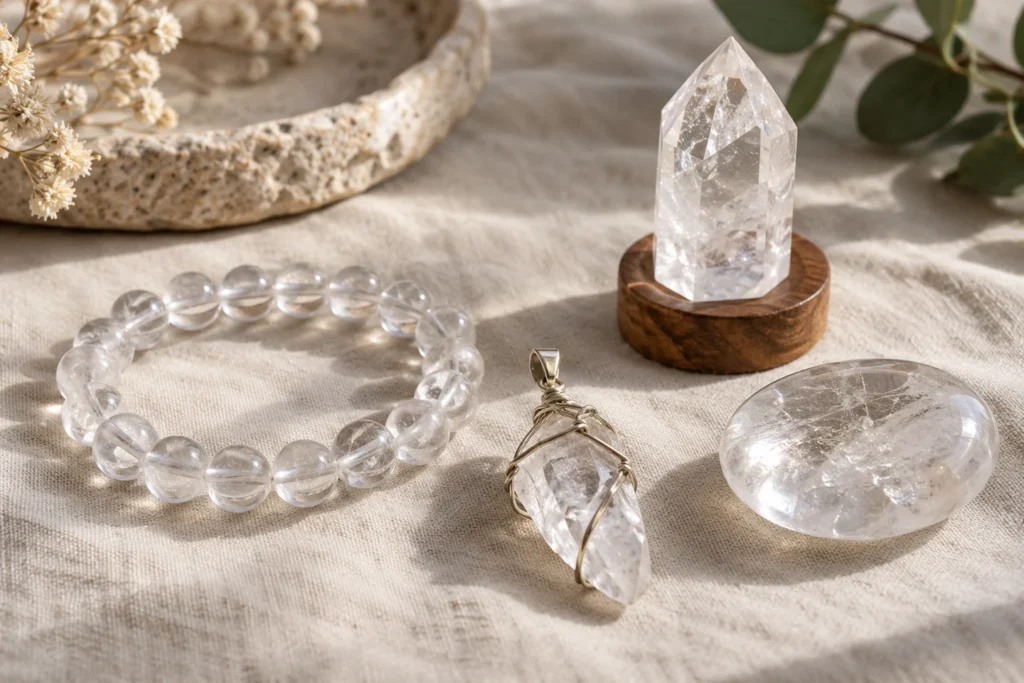
The main risk is not only the quartz
When buyers ask me, “Can you leave clear quartz in water?” I usually ask a second question: Which product are we talking about?
That question matters because water exposure often affects the weakest part of the item, not the hardest part.
For example:
- A plain clear quartz point may rinse well and dry quickly.
- A drilled bead strand may trap water inside holes.
- A bracelet may include elastic cord that weakens over time.
- A glued décor piece may have adhesive that is not meant for soaking.6
- A metal-accent item may tarnish, discolor, or stain nearby surfaces.
- A coated item may lose shine or show uneven patches.7
I have packed many different crystal shapes for wholesale orders. I have learned that two items with the same material name can require different handling. A clean, solid sphere is not the same as a small carved pendant with metal hardware.
Mohs hardness is useful, but incomplete
Clear quartz has good hardness compared with softer minerals such as selenite, calcite, fluorite, or malachite.8 That makes it less prone to scratching from normal handling. However, water-care risk includes more than scratching.
Here is a practical comparison:
| Factor | What buyers often assume | What I check in practice |
|---|---|---|
| Mohs hardness | “Hard means water safe” | Hardness does not protect cord, glue, or coatings |
| Transparency | “Clear means pure” | Inclusions and fractures can still be present |
| Polish | “Shiny means durable” | Some finishes need gentle cleaning |
| Product name | “Clear quartz is one category” | Towers, spheres, beads, carvings, and jewelry differ |
| Customer use | “They will clean it carefully” | Customers may soak it, add salt, or leave it wet |
I prefer to write care instructions that survive real customer behavior. Many end customers will not read a long mineral explanation. They will follow the shortest line on a product page. If that line says “safe in water,” some will soak the item overnight or repeat the process weekly.
Better default care instruction
For most retail product pages, I would not write:
- “Clear quartz is completely water safe.”
- “Leave it in water whenever needed.”
- “Soak overnight to cleanse.”
I would write something like:
“For care, wipe with a soft cloth. Plain clear quartz may be briefly rinsed with clean water, but please dry it immediately and avoid long soaking, especially for bracelets, glued items, coated pieces, or products with metal parts.”
This kind of instruction is not dramatic. It is practical. It gives the consumer enough information without creating an avoidable return reason.
Which clear quartz products should avoid water exposure?
Some buyers want one care card for every clear quartz SKU. I understand the need for efficiency, but I see risk in that approach. Different forms have different weak points. A wholesale order may include towers, beads, carvings, pendants, and décor pieces in the same shipment.
Clear quartz products with glue, metal, elastic cord, leather, coatings, labels, delicate carving, open cracks, or mixed materials should avoid water exposure or receive very limited cleaning instructions. For these items, I recommend dry wiping first. If water is necessary, use minimal moisture and dry every part carefully.
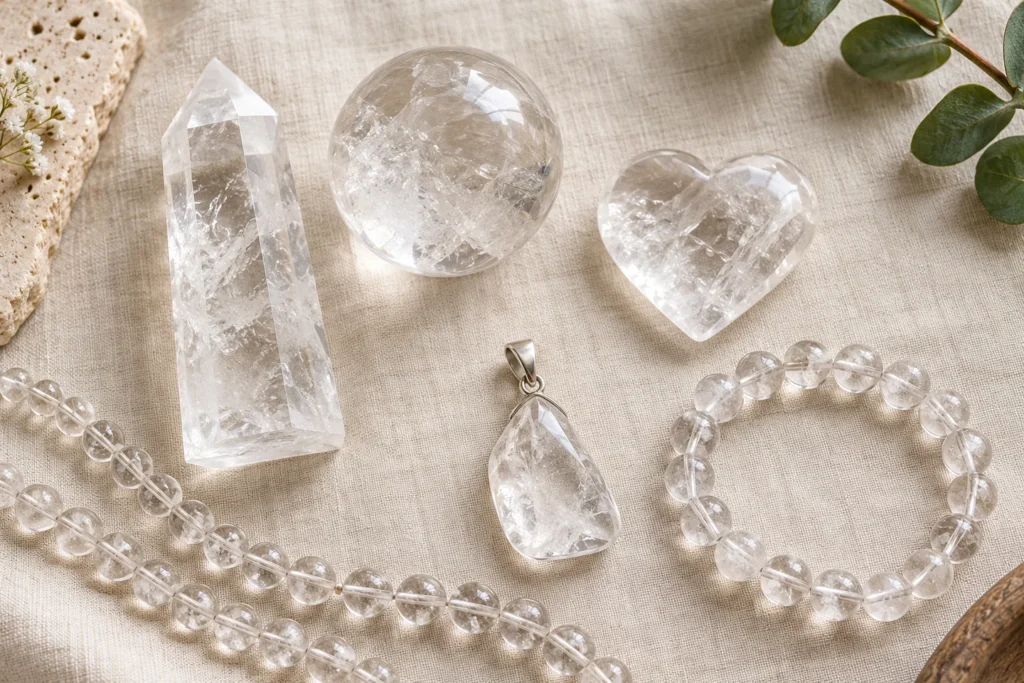
Product form changes the water-care answer
I evaluate clear quartz in water by SKU type. That is the most useful approach for procurement, product descriptions, and customer-service scripts.
| Product type | Brief water contact | Long soaking | My usual B2B care advice |
|---|---|---|---|
| Plain polished tumble | Usually acceptable | Not recommended | Brief rinse and dry, or wipe clean |
| Tower or point | Usually acceptable if solid | Not recommended | Avoid soaking around base chips or cracks |
| Sphere | Usually acceptable | Not recommended | Dry fully to prevent water marks |
| Carving | Depends on detail | Not recommended | Use dry cloth or soft brush for grooves |
| Bracelet | Riskier | Avoid | Protect elastic cord and metal spacers |
| Bead strand | Riskier | Avoid | Keep drilled holes dry when possible |
| Pendant | Depends on bail/wire | Avoid | Check metal, glue, and drilled areas |
| Glued décor item | Avoid | Avoid | Dry clean only unless supplier confirms |
| Coated or treated item | Avoid unless verified | Avoid | Confirm finish before making claims |
Bracelets need special caution
Clear quartz bracelets are popular for retailers and ecommerce sellers because they are easy to display and ship. However, I would not give bracelet buyers the same water advice as tumble buyers.
A bracelet includes more than quartz:
- Elastic cord can weaken from repeated moisture.9
- Metal spacers may tarnish or stain.10
- Drilled bead holes can hold water.
- Customer wear habits vary widely.
- Perfume, soap, sweat, and pool water create extra variables.
If a customer showers with a bracelet and later sees loose stringing, the seller may receive the complaint. The quartz bead may still be fine, but the product has still failed from the customer’s perspective.
Carvings and towers need visual inspection
Clear quartz carvings can include thin edges, small points, hollow areas, or detailed grooves. Water can sit in those details. If the piece has natural fractures, the water may make them more visible. That does not always mean the stone is damaged, but it may look concerning to an end customer.
For wholesale buyers, I suggest checking:
- Are there open cracks or sealed fractures?
- Does the product have glue or repair marks?
- Is the surface fully polished or partly matte?
- Will the customer handle it daily or display it only?
- Will the item be sold with care instructions?
I also suggest taking product photos that show the actual batch condition. In our GD Crystal workflow, we do not treat old product photos as a guarantee of current batch details. Clear quartz varies by batch, especially in clarity, inclusions, shape, and surface condition. Buyers should confirm the current lot when they order.
Mixed-material items need supplier confirmation
If an item includes quartz plus another material, I recommend asking the supplier directly before making any water-related claim. Mixed-material products may include:
- Clear quartz plus metal wire
- Clear quartz plus wood base
- Clear quartz plus resin or glue
- Clear quartz plus dyed cord
- Clear quartz plus coated beads
- Clear quartz plus packaging card or label
In these cases, “Can clear quartz go in water?” is not the correct question. The correct question is: Can the whole finished product handle the customer’s expected water exposure?
That distinction helps buyers reduce disputes. It also helps sellers write more accurate care cards.
How should retailers describe clear quartz in water on product pages?
Product-page wording can create trust or create returns. If sellers write too little, customers fill in the blanks. If sellers write too much, customers may ignore the care section. The goal is to give simple guidance that fits the exact item being sold.
Retailers should describe clear quartz in water with limited, practical wording: plain clear quartz may be briefly rinsed and dried, but long soaking is not recommended. Product pages should add extra warnings for bracelets, glued pieces, coatings, metal parts, carved details, and mixed-material items to reduce customer complaints.
Care wording should match the selling context
A B2B buyer usually needs more than mineral facts. The buyer needs wording for:
- Product listings
- Care cards
- FAQ sections
- Customer-service replies
- Wholesale catalogs
- Marketplace descriptions
- Return-policy communication
I often see sellers use broad lines because they want to keep listings short. The problem is that marketplaces and customers may interpret broad care claims literally. If a product page says “water safe,” customers may assume it is safe for bathing, swimming, soaking, saltwater cleansing, or long-term display in a water bowl.
I recommend using tiered language instead.
Example wording by product type
| Product type | Suggested care line |
|---|---|
| Plain tumble, palm stone, sphere | “Wipe clean with a soft cloth. If needed, briefly rinse with clean water and dry immediately. Do not soak.” |
| Tower or carving | “Clean gently with a dry cloth or soft brush. Avoid long soaking, especially near cracks, points, or carved details.” |
| Bracelet or bead strand | “Keep away from water, perfume, and chemicals when possible. Moisture may affect elastic cord, metal parts, or drilled areas.” |
| Pendant or wire-wrapped item | “Avoid soaking. Moisture may affect metal parts, wire, glue, or attached components.” |
| Coated or treated item | “Dry clean only unless water care has been confirmed for this specific finish.” |
Good product descriptions reduce after-sales risk
I view water-care language as part of quality control. It is not only a customer-service detail. It affects how the buyer evaluates the product before purchase.
For example, a retailer may choose a plain polished clear quartz tumble for a beginner-friendly SKU. That seller can provide simple care instructions. Another retailer may choose a delicate carved pendant with glued parts. That seller needs stricter care language.
A good product page should include:
-
Material name
Example: “Clear quartz.” -
Product form
Example: “Polished tower,” “bracelet,” “sphere,” or “carved heart.” -
Approximate size and weight range
B2B buyers need this for pricing, shipping, and customer expectations. -
Surface notes
Example: “Natural inclusions, internal veils, and small surface variations may be present.11” -
Care instruction
Example: “Brief rinse only if needed; dry immediately; avoid soaking.” -
Component warning
Example: “For bracelets, avoid water exposure to protect elastic cord.”
I avoid absolute claims
I do not like care wording that sounds like a guarantee. Clear quartz is a natural material, and finished products vary. Also, suppliers may process items in different ways. A buyer should verify current batch details, especially for large orders or branded product lines.
Instead of saying:
“This item is waterproof.”
I prefer:
“This item can be wiped clean. For plain quartz surfaces, brief contact with clean water is usually acceptable, but long soaking is not recommended.”
That sentence is longer, but it is safer. It gives customers a clear action and avoids a claim that may not fit every use case.
What should wholesale buyers ask suppliers before selling clear quartz in water-safe categories?
Wholesale buyers often focus on price, size, and MOQ first. Those details matter, but water-care claims can also affect returns and reviews. If a buyer plans to advertise water-safe cleaning, I recommend confirming the product construction before placing a bulk order.
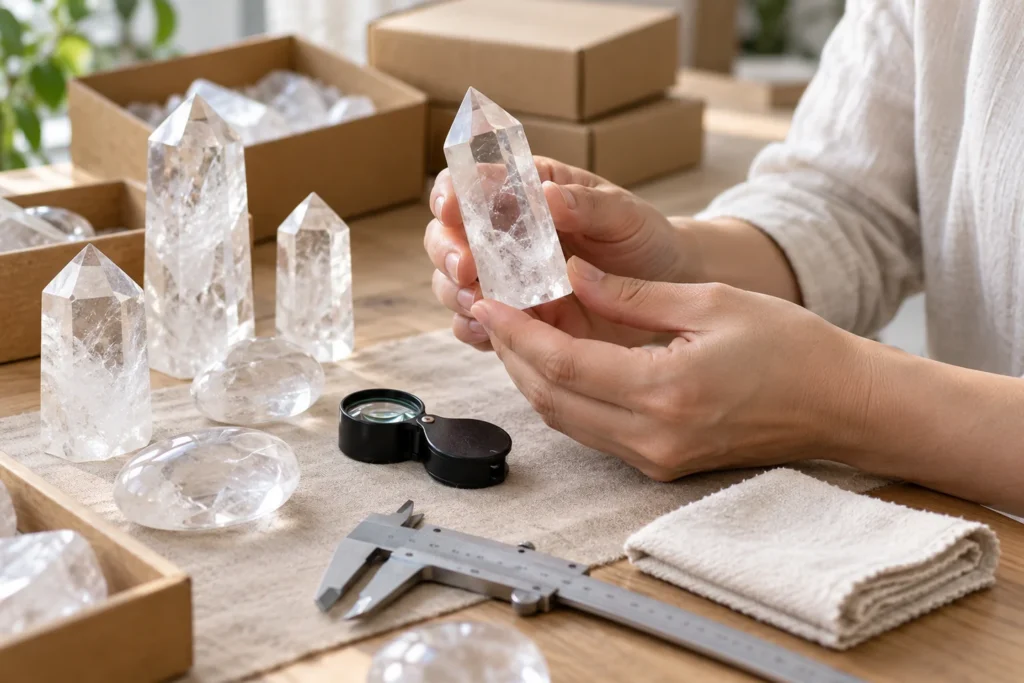
Before selling clear quartz in water-safe categories, buyers should ask suppliers about product form, finish, treatment, glue, coatings, stringing material, metal parts, current batch condition, packaging, and recommended care wording. I also suggest ordering samples when possible and checking how the exact SKU responds to normal cleaning.
Useful questions for supplier evaluation
I suggest asking practical questions rather than only asking, “Is it real clear quartz?” Authenticity matters, but finished-product details also matter.
Here are questions I would use:
- Is the item plain clear quartz, or does it include other materials?
- Does the item have glue, resin, coating, dye, wax, or surface treatment?
- Is it drilled, carved, wire-wrapped, or mounted?
- What stringing material is used for bracelets or beads?
- Are metal parts stainless steel, alloy, brass, plated, or unknown?
- Can you provide current-batch photos or videos?
- What size and weight range should I expect?
- What MOQ applies to this exact product and finish?
- What care wording do you recommend for retail customers?
- Can I start with a sample order or mixed trial order?
At GD Crystal, we usually quote based on material, size, quantity, processing details, packaging, and delivery destination. I do not treat an old photo or old price tag as a promise of current stock or current price. That approach may sound cautious, but it helps both sides avoid misunderstanding.
Sample checks for buyers
When buyers receive samples, I recommend checking them like a future customer would.
Use a simple sample inspection routine:
- Check the surface under normal light.
- Look for open cracks, chips, or repaired areas.
- Wipe with a soft dry cloth.
- If the item is plain quartz, briefly rinse one sample and dry it.
- Do not test water exposure on items with glue, cord, or metal unless that use is intended.
- Photograph the item before and after cleaning.
- Write care wording based on the actual SKU.
This is not laboratory testing. I do not present it as scientific certification. It is a practical procurement check that helps buyers decide how to describe and handle the product.
Supplier selection matters
A good supplier should not only say “yes” to every request. I believe a useful supplier should explain limits clearly. If a buyer asks whether clear quartz in water is safe for all products, the supplier should ask about form, finish, and components.
For wholesale crystal sourcing, I suggest evaluating suppliers on:
| Supplier factor | Why it matters |
|---|---|
| Current-batch photos | Clear quartz varies in clarity, inclusions, and finish |
| Product-form knowledge | Towers, spheres, beads, and carvings need different care |
| Customization ability | Buyers may need size, shape, packaging, or labeling support |
| Clear quotation terms | Material, MOQ, size, and delivery details affect final price |
| Care communication | Better instructions reduce after-sales disputes |
| Realistic claims | Overpromising creates risk for retailers |
As a China-based B2B supplier and processor, we work with buyers who need repeatable communication as much as attractive products. I see water-care guidance as part of that communication. A clear answer before ordering can prevent an unclear complaint after selling.
Frequently Asked Questions
Can clear quartz be washed under running water?
Yes, plain clear quartz can usually be washed briefly under clean running water. I recommend drying it immediately with a soft cloth. I would not use this advice for bracelets, glued items, coated pieces, or products with metal parts unless the whole finished item has been checked.
Can clear quartz sit in water overnight?
I do not recommend leaving clear quartz in water overnight as a general care instruction. The quartz itself may tolerate water better than many softer minerals, but soaking can affect cracks, drilled holes, glue, cord, coatings, and attached components. Retailers should avoid broad overnight soaking claims.
Is clear quartz waterproof?
I would not call clear quartz products “waterproof.” Plain quartz has good mineral durability, but finished products may include weak points such as elastic cord, metal parts, adhesives, coatings, or fractures. “Brief rinse and dry” is safer wording than “waterproof” for most retail listings.
Does water damage the shine of clear quartz?
Clean water from a brief rinse usually should not damage the shine of plain polished clear quartz. However, repeated soaking, harsh cleaners, saltwater, or surface treatments can change appearance.12 I recommend using a soft cloth first and avoiding chemical cleaning unless a qualified professional confirms suitability.
What care instruction should I print on clear quartz packaging?
For most plain clear quartz items, I would print: “Wipe with a soft cloth. If needed, briefly rinse with clean water and dry immediately. Avoid long soaking.” For bracelets, pendants, glued pieces, and mixed-material items, I would add: “Keep away from water when possible.”
Conclusion
Clear quartz in water is not a simple yes-or-no issue for wholesale buyers. Plain clear quartz can usually handle a brief clean-water rinse, but long soaking is not a safe default care instruction. Product form, finish, cracks, glue, cord, metal parts, and customer expectations all matter. If you source clear quartz products for retail or ecommerce, I recommend confirming the exact SKU details before writing care claims. For current-batch options, custom styles, and wholesale supply, you can contact GD Crystal with your material, size, quantity, packaging, and delivery requirements.
References
- "Mineral Gemstones", https://pubs.usgs.gov/gip/gemstones/mineral.html. A standard mineralogical reference lists quartz at 7 on the Mohs hardness scale, supporting the stated hardness value for clear quartz as a quartz variety. Evidence role: definition; source type: encyclopedia. Supports: Quartz is listed as having Mohs hardness 7.. ↩
- "Mohs scale", https://en.wikipedia.org/wiki/Mohs_scale. Geology teaching references define Mohs hardness as a relative measure of resistance to scratching, supporting the distinction between scratch resistance and broader product durability. Evidence role: definition; source type: education. Supports: The Mohs scale measures relative resistance to scratching.. Scope note: The source defines mineral hardness; it does not directly evaluate water exposure of finished quartz products. ↩
- "Capillary Action and Water | U.S. Geological Survey", https://www.usgs.gov/water-science-school/science/capillary-action-and-water. Materials-science and physics references describe capillary action and water ingress in small cracks or pores, supporting the concern that drilled holes, pits, and fractures can retain moisture. Evidence role: mechanism; source type: education. Supports: Small openings, pores, and cracks can retain or draw in water through capillary effects.. Scope note: The mechanism is general and contextual; it is not a direct test of clear quartz jewelry or carvings. ↩
- "Impact of Wetting–Drying Cycles on the Mechanical Properties …", https://pmc.ncbi.nlm.nih.gov/articles/PMC6601005/. Studies of stone and mineral-material weathering report that repeated wetting and drying can promote or reveal surface deterioration, supporting the article’s caution about repeated soaking and drying. Evidence role: mechanism; source type: paper. Supports: Wetting-drying cycles can contribute to visible surface change or deterioration in mineral or stone materials.. Scope note: Such studies often examine building stone or porous rock, so the evidence is contextual rather than direct proof for polished clear quartz SKUs. ↩
- "Quartz – Common Minerals", https://commonminerals.esci.umn.edu/minerals-o-s/quartz. Geology and geochemistry references describe quartz as chemically stable and only sparingly soluble in ordinary water, supporting the limited claim that plain quartz can usually tolerate brief clean-water contact. Evidence role: general_support; source type: education. Supports: Quartz is chemically stable and only sparingly soluble under ordinary water conditions.. Scope note: This supports the mineral behavior of quartz and does not cover adhesives, cords, coatings, metals, or fractured finished products. ↩
- "Water has different effects on adhesive strength during … – PMC", https://pmc.ncbi.nlm.nih.gov/articles/PMC11813564/. Research on adhesive joints reports that moisture or water immersion can reduce bond strength in certain adhesive systems, supporting the caution that glued décor pieces should not be assumed suitable for soaking. Evidence role: mechanism; source type: paper. Supports: Water exposure can reduce adhesive bond performance in some adhesive systems.. Scope note: Adhesive performance is formulation-specific; the evidence supports caution rather than proving failure for every glued quartz product. ↩
- "Dynamic water penetration behavior of top coating color and …", https://bioresources.cnr.ncsu.edu/resources/dynamic-water-penetration-behavior-of-top-coating-color-and-its-effects-on-structure-properties-of-double-coated-layer/. Coatings research documents that water uptake and immersion can alter coating appearance or performance, including gloss changes and surface defects, supporting the warning for coated quartz items. Evidence role: mechanism; source type: paper. Supports: Moisture uptake or water exposure can alter coating appearance, including gloss or surface uniformity, in some coating systems.. Scope note: The evidence applies to coatings generally; it does not identify the exact coating or treatment used on a specific crystal product. ↩
- "MINERALS SORTED BY NAME", https://www.uky.edu/KGS/rocksmineral/minerals-sortby-name.pdf. Mineralogical references place quartz at Mohs 7, above gypsum/selenite, calcite, fluorite, and malachite, supporting the article’s comparative hardness statement. Evidence role: general_support; source type: encyclopedia. Supports: Quartz has a higher Mohs hardness than selenite/gypsum, calcite, fluorite, and malachite.. Scope note: Hardness comparison supports scratch resistance only and does not establish water safety for finished products. ↩
- "Solid State Alkaline Depolymerization of Polyester Elastane …", https://pmc.ncbi.nlm.nih.gov/articles/PMC12944338/. Polymer-aging studies show that elastomeric materials, including polyurethane-based elastics, may lose strength or elasticity through moisture-related degradation mechanisms, supporting caution for water-exposed bracelet cords. Evidence role: mechanism; source type: paper. Supports: Elastic polymer materials can lose mechanical performance through moisture-related aging or hydrolysis, depending on composition.. Scope note: The effect depends on the exact cord material and construction; the evidence is not a batch-specific test of any one bracelet. ↩
- "Corrosivity | U.S. Geological Survey", https://www.usgs.gov/mission-areas/water-resources/science/corrosivity. Corrosion references from public agencies explain that moisture and dissolved substances can promote tarnish or corrosion in susceptible metals, supporting the warning about metal spacers and staining. Evidence role: mechanism; source type: government. Supports: Moisture can contribute to corrosion or tarnishing of susceptible metals and alloys.. Scope note: The source supports the general corrosion mechanism; actual risk depends on whether the spacer is stainless steel, plated alloy, brass, silver, or another metal. ↩
- "Fluid inclusion", https://en.wikipedia.org/wiki/Fluid_inclusion. Mineralogy references describe quartz as commonly hosting inclusions, fractures, and internal growth or fluid features, supporting the article’s product-note language about natural variations. Evidence role: general_support; source type: education. Supports: Quartz specimens may contain inclusions, fractures, veils, and other natural internal or surface features.. Scope note: The source supports natural variability in quartz, not the condition of any particular wholesale batch. ↩
- "Salt mixtures in stone weathering – PMC – NIH", https://pmc.ncbi.nlm.nih.gov/articles/PMC10432528/. Conservation-science literature reports that salts, repeated wetting-drying, and unsuitable cleaning agents can contribute to visible changes or deterioration in stone and mineral surfaces, supporting the article’s caution against harsh or repeated wet cleaning. Evidence role: mechanism; source type: research. Supports: Salts, repeated wetting-drying, and inappropriate cleaning agents can contribute to visible surface changes in stone or mineral materials.. Scope note: The evidence is strongest for stone conservation contexts and treated surfaces; plain, intact quartz may be less affected under brief clean-water exposure. ↩