If you stock crystal jewelry, you've probably hesitated over a simple question: do guys actually wear crystal necklaces, or will a men's selection sit on your shelves collecting dust? The fear of dead stock is real, especially when most crystal jewelry imagery skews feminine1. But male customers are buying — and the real challenge is knowing which materials, styles, and order strategies reduce your risk.
Yes, guys wear crystal necklaces — and the category is growing steadily among independent retailers and e-commerce sellers2. The key for B2B buyers is not whether men's crystal necklaces sell, but which specific materials, pendant shapes, chain styles, and processing choices make them commercially viable to stock. A small, well-chosen test assortment is the safest entry point.
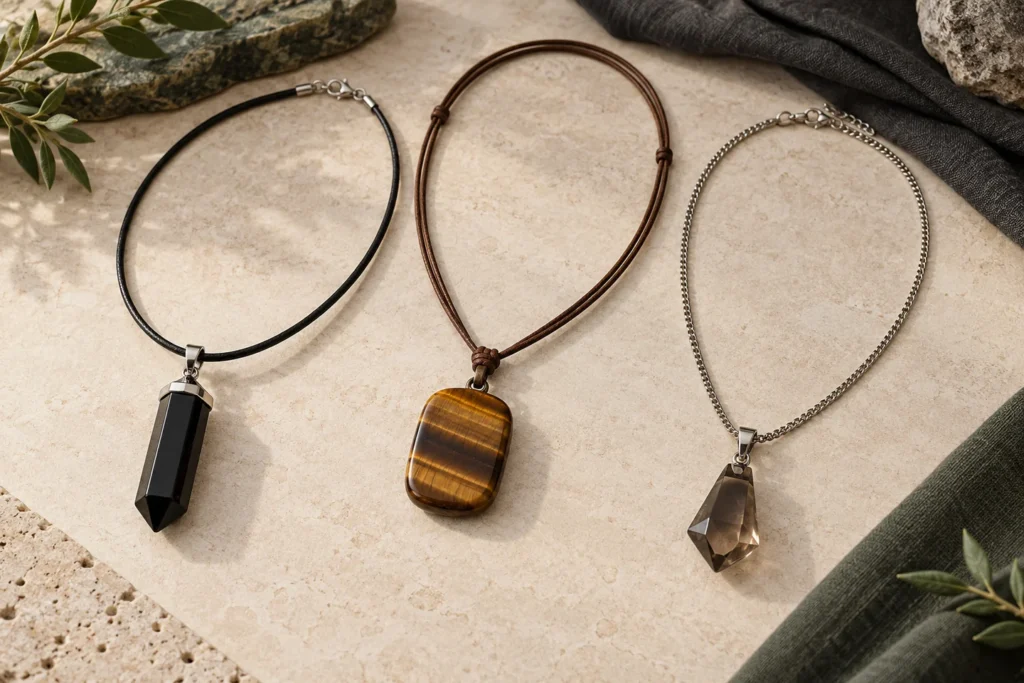
Understanding buyer demand is one thing. Building a profitable, low-risk men's crystal necklace selection is another. Below, I'll break down the materials that move, the processing details that shift a piece from feminine to unisex to masculine, how to structure a test order, and the packaging and presentation choices that matter at the retail level.
Which crystal materials work best for men's necklaces?
Choosing the wrong material is the fastest way to end up with unsold inventory. Many retailers default to black stones only, which limits their appeal. The truth is, several crystal materials perform well in men's necklaces — the deciding factor is tone, texture, and how well the material photographs for your sales channel.
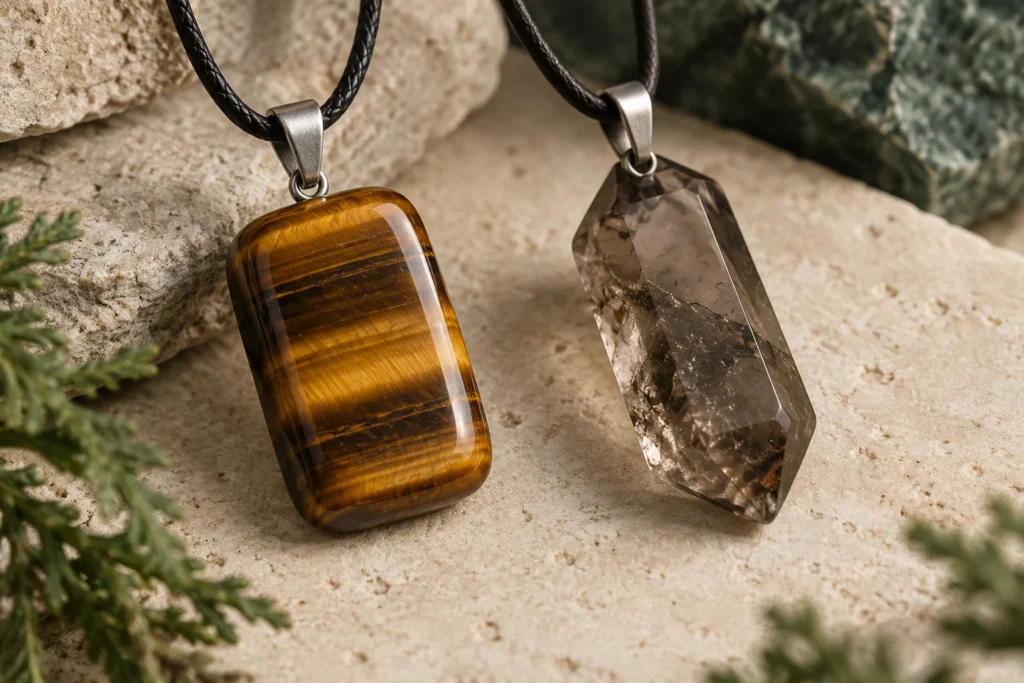
The strongest-performing materials for men's crystal necklaces tend to be darker, neutral, or visually dramatic stones3: obsidian, tiger's eye, smoky quartz, labradorite, black tourmaline, hematite, and lapis lazuli. These work across customer segments because their color palettes feel intuitive for men's accessories without requiring elaborate styling explanations.
Why these materials?
The common thread is visual weight and restrained color. A polished obsidian column or a raw-edge labradorite slab reads as masculine or unisex without effort. Tiger's eye, with its chatoyancy and warm brown-gold tones4, has decades of history in men's jewelry across cultures. Smoky quartz offers a transparent-to-translucent look5 that feels elevated without being flashy.
Here's a quick reference for common men's crystal necklace materials:
| Material | Color Range | Key Appeal | Retail Risk Level |
|---|---|---|---|
| Black Obsidian | Solid black, glossy | Universal, classic, photographs well | Low |
| Tiger's Eye | Gold-brown bands | Warm, natural, cross-cultural appeal | Low |
| Smoky Quartz | Transparent grey-brown | Subtle, upscale feel | Low–Medium |
| Labradorite | Grey with blue/green flash | Eye-catching, unique | Medium |
| Black Tourmaline | Opaque black, raw texture | Popular among crystal-aware buyers | Low |
| Hematite | Metallic dark grey | Industrial, modern feel | Low |
| Lapis Lazuli | Deep blue with gold flecks | Statement piece, slightly bolder | Medium |
| Clear Quartz | Transparent, colorless | Unisex, minimalist | Medium |
Don't overlook lighter or colored stones
A common mistake I see from first-time buyers is assuming men only wear dark crystals. That's a narrow read. Clear quartz points, matte amazonite, and even green aventurine sell in men's lines when the pendant shape is geometric, the size is moderate, and the cord or chain is right. The material itself is less gendered than the total presentation.
That said, if you're testing the category for the first time and want to minimize risk, starting with the top four or five materials in the table above is a sound approach. You can expand into more adventurous stones once you've collected customer feedback from initial sales.
A note on material verification
Every batch of crystal can vary in color, clarity, and texture.6 When you're ordering men's crystal necklaces — or pendants and chains to assemble — always confirm material, treatment status, and current batch appearance with your supplier before committing. Historical product photos don't guarantee what the next shipment looks like. At GD Crystal, we encourage buyers to request current batch images and confirm details per order.
Does pendant shape and size really affect whether men buy crystal necklaces?
Absolutely — and this is probably the most underappreciated variable in men's crystal necklace sourcing. Retailers often focus on material alone and forget that the same stone can look entirely different depending on its shape, dimensions, and finish7. A rose quartz heart on a silk cord reads feminine; a rose quartz faceted column on a leather rope reads unisex or masculine.
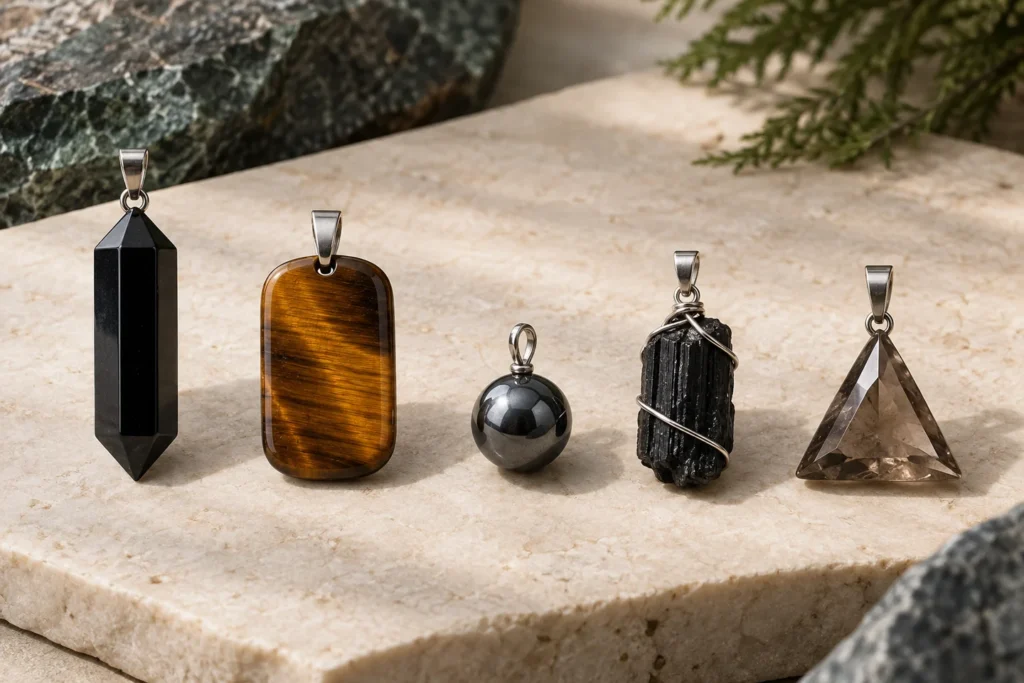
The pendant shape and size are the primary processing decisions that determine whether a crystal necklace appeals to male customers. Simple geometric forms — columns, hexagonal points, flat plaques, dogtag shapes, round beads, and small raw-stone pendants — consistently perform better for men's lines8 than hearts, moons, or ornate carved figures.
Shape categories that work
Here are the pendant forms I've seen move consistently through retailer and e-commerce seller orders:
- Columns / hexagonal points: The classic crystal tower shape scaled down to pendant size (roughly 25–45 mm in length). Clean lines, recognizable as "crystal," and easy to style.
- Flat plaques / dogtag shapes: Minimal, modern, and easy to layer. These work well with stainless steel chains.
- Round beads (single or triple): A single large bead (12–16 mm) or a set of three smaller beads on a cord gives a subtle, everyday look.
- Small raw-stone wraps: A raw or lightly polished stone wrapped in a simple metal cage or wire. This style appeals to the "natural/earthy" customer segment.
- Arrowheads and geometric cuts: Triangles, arrows, and angular faceted pendants attract younger male buyers and streetwear-adjacent audiences.
Size matters more than you think
Oversized pendants are a risky bet. Most men who wear crystal necklaces day-to-day prefer moderate-sized pendants — roughly 20–45 mm in the longest dimension. Statement pieces (50 mm+) can work for specific niches (festival wear, fashion-forward brands), but they're harder to sell consistently.
For test orders, I'd recommend sticking to a middle range:
| Pendant Type | Suggested Size Range | Notes |
|---|---|---|
| Column / point | 25–40 mm length | Smaller reads subtle; larger reads statement |
| Plaque / dogtag | 25×15 mm to 40×20 mm | Thin profile preferred |
| Single bead | 12–16 mm diameter | Larger beads can feel heavy on thinner cords |
| Raw stone wrap | 20–35 mm across | Keep the wrapping minimal |
| Geometric cut | 20–35 mm | Clean edges, not overly ornate |
Finish: polished vs. matte vs. raw
The finish is another lever. High-polish obsidian looks sleek and modern. Matte-finished tiger's eye reads earthy and subdued. Raw-edge labradorite feels artisanal. Each finish attracts a different male customer, so mixing finishes within a small test order gives you broader coverage without increasing your material count.
How do chain and cord choices change the look of men's crystal necklaces?
You've picked the right stone and the right pendant shape — but the wrong cord or chain can undo all of it. This is a detail many first-time buyers overlook. The chain or cord is what the customer sees first, and it carries most of the "gendered" signal in a crystal necklace.
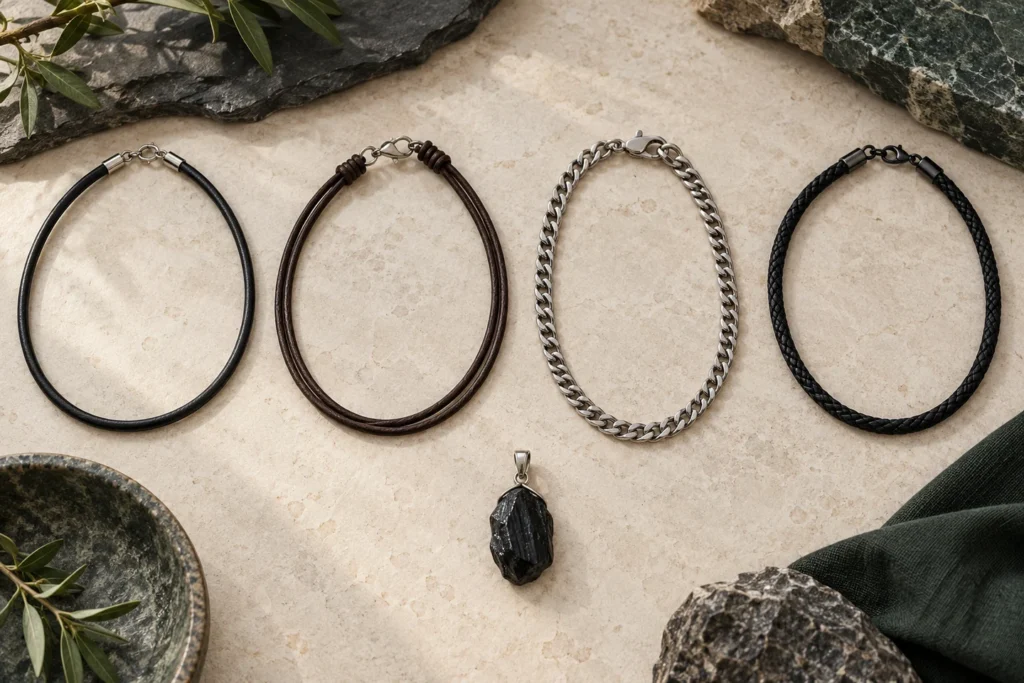
The cord or chain style is the single fastest way to shift a crystal pendant from feminine to masculine or unisex.9 Leather cord, waxed cotton rope, thick stainless steel chain, and braided nylon are the most common choices for men's crystal necklaces. Thin silver chains, silk cords, or delicate link chains generally read as women's jewelry to most retail customers.
Common cord and chain options for men
- Leather cord (2–3 mm): The default "masculine" option. Works with nearly every crystal material. Black and brown are the safest colors.
- Waxed cotton cord (1.5–2.5 mm): Budget-friendly, lightweight, and available in black, brown, or dark green. Good for trial orders.
- Stainless steel chain (3–5 mm links): Modern, durable, and appealing to younger buyers. Pairs well with flat pendants and geometric shapes.
- Braided nylon / paracord: Casual, sporty, and durable. Appeals to the outdoor/adventure segment.
- Bead chain (stainless steel or titanium): Military dogtag aesthetic. Very niche but effective for that customer.
Matching cord to pendant
| Pendant Style | Best Cord/Chain Pairing | Resulting Aesthetic |
|---|---|---|
| Polished obsidian column | Black leather cord | Classic, understated |
| Tiger's eye plaque | Brown leather or waxed cotton | Warm, natural |
| Labradorite raw wrap | Braided nylon or leather | Earthy, artisanal |
| Smoky quartz geometric cut | Stainless steel chain | Modern, minimal |
| Hematite single bead | Stainless steel bead chain | Industrial, urban |
Retailer tip: stock pendants and chains separately
Some of the most successful retailers I've worked with don't stock pre-assembled men's crystal necklaces at all. Instead, they stock pendants and cords/chains as separate components and let customers mix and match. This approach:
- Reduces SKU count
- Lets customers personalize their purchase
- Decreases the risk of being stuck with a "wrong" combination
- Increases average order value (pendant + cord sold separately)
If you're ordering from a supplier like GD Crystal, ask whether pendants can be drilled or bailed for easy cord/chain attachment, and whether simple cords can be included or sourced separately. This is a processing detail worth confirming before you place your order.
How should retailers test men's crystal necklaces without overcommitting?
This is where most purchasing mistakes happen. A retailer sees potential in men's crystal necklaces, gets excited, and orders a full product line — 10 materials, 5 shapes, 3 chain types. That's 150 SKUs before you've sold a single piece. The smarter play is a focused test order that answers your core questions with the least financial exposure.
Start with a small mixed assortment: 3–5 crystal materials, 2–3 pendant shapes, and 2 cord/chain options. This gives you enough variety to gauge customer interest across segments without locking capital into unproven inventory. Evaluate sell-through over 4–8 weeks, collect customer feedback, and reorder or customize based on real data.
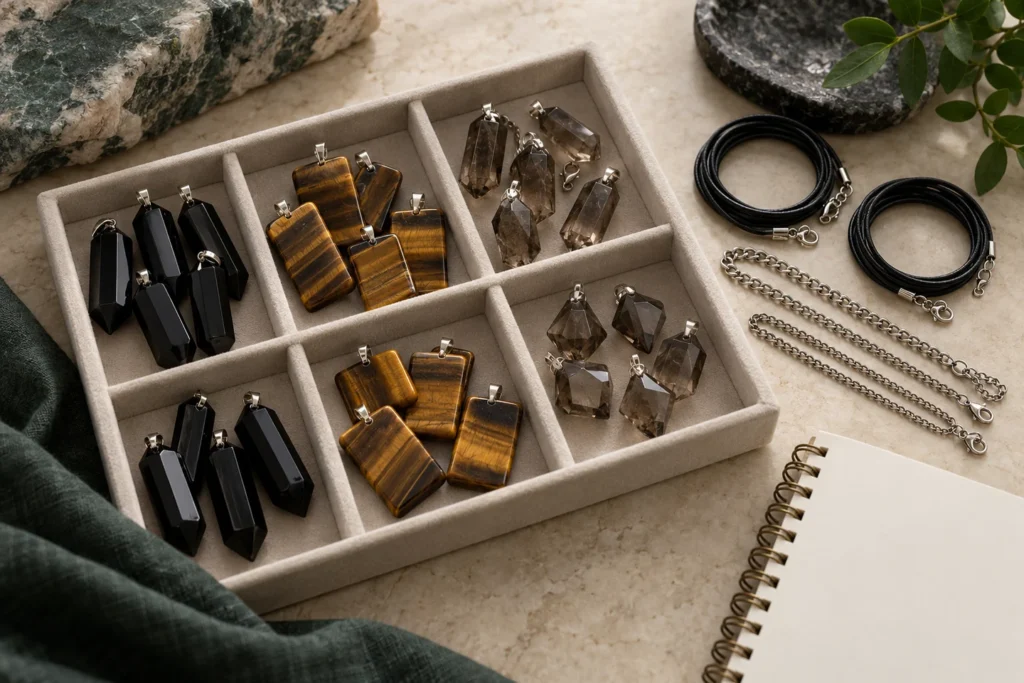
A sample test order framework
Here's a starting structure I typically suggest to buyers who are new to men's crystal necklaces:
| Component | Options | Quantity per Option |
|---|---|---|
| Materials | Black obsidian, tiger's eye, smoky quartz | 10–20 pieces each |
| Pendant shapes | Column/point, flat plaque | Split evenly across materials |
| Cord/chain | Black leather cord, stainless steel chain | Order both; offer as add-on or pairing |
| Sizes | 25–40 mm pendants | Mix of small and medium within range |
Total investment: roughly 30–60 pendants + cords. Enough to fill a display, stock an online listing with photos, and gather meaningful sales data.
What to track during your test period
Don't just count how many units sell. Pay attention to:
- Which material sells first: This tells you what your specific audience gravitates toward.
- Which shape gets handled most (in-store) or which listing gets the most clicks (online): Interest signals, even without conversion, are valuable.
- Customer questions: Are people asking for larger sizes? Different stones? Gift packaging? These questions shape your next order.
- Return or complaint patterns: If a specific cord breaks or a pendant finish scratches easily, that's critical supplier feedback.
MOQ and mixed-order considerations
When working with a factory-direct supplier, ask about:
- Minimum order quantities per material/shape: Some suppliers require MOQs per SKU; others allow mixed orders across styles.
- Mixed batch pricing: Can you combine different materials in one order to hit a price break?
- Sample or trial-order terms: Is there a smaller first-order option for new buyers?
- Lead time for reorders: If a material sells out quickly, how fast can you replenish?
At GD Crystal, we work with many first-time buyers on exactly these questions. We can discuss mixed-order options, confirm current material availability and batch appearance, and help structure a test assortment that makes sense for your market. Every order is quoted based on material, size, quantity, processing, packaging, and shipping destination — so the more specific you are about what you need, the more accurate and useful the quote will be.
Does packaging and presentation affect men's crystal necklace sales?
Yes — and this is an area where many retailers leave money on the table. A beautiful crystal pendant in a generic pink organza bag will not sell to a male customer. Packaging is part of the product, especially for gift purchases and e-commerce unboxing experiences.
Neutral, minimal packaging — matte black boxes, kraft paper pouches, dark velvet bags, or simple branded cards — significantly improves the perceived value and giftability of men's crystal necklaces. Packaging doesn't need to be expensive to be effective. It needs to match the buyer's expectation of a men's accessory.
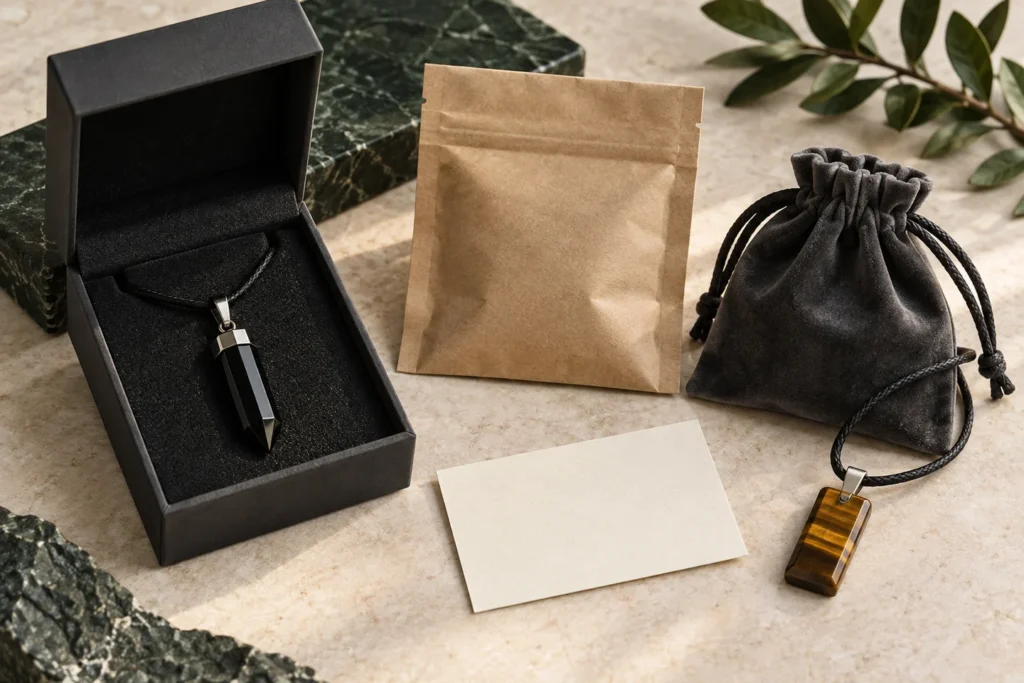
Packaging options to discuss with your supplier
- Velvet pouch (black, dark grey, navy): Low cost, protective, and appropriately masculine.
- Kraft paper box with foam insert: Eco-friendly aesthetic, good for brands that lean natural/sustainable.
- Matte black magnetic closure box: Higher perceived value. Good for gift-oriented retailers.
- Branded card insert: A small printed card with the stone name, origin, and care instructions adds perceived value at minimal cost.
What to confirm before ordering
Packaging is a processing and cost variable. When discussing an order with your supplier, clarify:
- Is packaging included in the unit price, or quoted separately?
- Can you supply custom packaging (branded boxes, printed inserts) at your MOQ level?
- What are the default packaging options if no custom packaging is specified?
- Does packaging choice affect shipping weight and cost? Boxes add weight; pouches don't.
This may seem like a minor detail, but I've seen retailers transform their sell-through rate on men's crystal necklaces simply by switching from a generic clear bag to a black velvet pouch. The product inside was the same. The perception changed.
Frequently Asked Questions
Are men's crystal necklaces just a trend, or is there sustained demand?
Men's crystal necklaces have shown consistent purchasing interest from retailers over recent years, not just seasonal spikes. The category overlaps with broader men's jewelry and wellness accessory growth. However, demand varies by market and customer segment, so a test order is always more reliable than trend reports for your specific business.
Can the same crystal pendant be sold as unisex instead of men's-only?
Absolutely. Many retailers list crystal necklaces as unisex and let the photography, styling, and cord/chain choice signal the intended audience. This approach doubles your addressable market from a single SKU and reduces the risk of gendered inventory sitting unsold.
What's the typical MOQ for men's crystal necklace pendants from a wholesale supplier?
MOQs vary by supplier, material, and processing requirements. At GD Crystal, MOQs depend on the specific product — material, shape, size, and finishing. We recommend reaching out with your target assortment details so we can confirm current MOQs, mixed-order options, and pricing per your requirements.
Should I order pre-assembled necklaces or separate pendants and cords?
Choose pre-assembled necklaces for ready-to-sell convenience, or separate pendants and cords for flexible combinations. Before ordering, confirm attachment compatibility, assembly requirements, and whether cords or chains are included in the quote.
References
- "The impact of advertising on women's self-perception – PMC", https://pmc.ncbi.nlm.nih.gov/articles/PMC11752915/. Research on gendered advertising and fashion-accessory presentation shows that visual cues such as styling, color, model choice, and setting are commonly used to code products as feminine or masculine. Evidence role: general_support; source type: paper. Supports: The source should document how jewelry or fashion-accessory advertising commonly uses gendered visual cues and feminine presentation.. Scope note: Such evidence would substantiate the broader mechanism of gendered presentation, not necessarily quantify imagery across all crystal-jewelry sellers. ↩
- "Men's Jewelry Market 2035-Industry, Size, Share, Growth, …", https://www.marketresearchfuture.com/reports/mens-jewelry-market-26375. Market research on men's jewelry and online jewelry retail indicates rising consumer demand in men's accessory categories, providing contextual support for the claim that men's crystal necklaces may benefit from broader category growth. Evidence role: general_support; source type: research. Supports: The source should support growth in men's jewelry or online jewelry retail, ideally including men's accessories or nontraditional jewelry categories.. Scope note: This would support the broader market context rather than directly proving sales growth for crystal necklaces specifically. ↩
- "The Relationship between Color Preference and …", https://digitalcommons.lindenwood.edu/cgi/viewcontent.cgi?article=1092&context=psych_journals. Consumer-behavior research on color and gendered product perception shows that color palette can influence whether accessories are read as masculine, feminine, or neutral. Evidence role: general_support; source type: paper. Supports: The source should support the relationship between color, gendered product perception, and consumer preference in apparel or accessories.. Scope note: This would provide contextual support for merchandising logic, not direct sell-through data for specific crystal materials. ↩
- "Tiger's-Eye Quartz", https://www.gia.edu/gia-museum-exhibit-tigers-eye-quartz. Gemological references describe tiger's eye as a chatoyant quartz variety whose fibrous structure produces a banded optical effect, typically in golden, yellow-brown, or brown tones. Evidence role: definition; source type: institution. Supports: The source should confirm that tiger's eye is a chatoyant quartz variety commonly showing golden to brown coloration.. ↩
- "Smoky quartz", https://en.wikipedia.org/wiki/Smoky_quartz. Mineralogical and gemological descriptions identify smoky quartz as a brown to gray variety of quartz that can range from transparent to translucent. Evidence role: definition; source type: institution. Supports: The source should describe smoky quartz's typical transparency and color range.. ↩
- "Colored Gemstone Value Factors", https://www.gia.edu/gia-news-research/value-factors-design-cut-quality-colored-gemstone-value-factors. Gemological sources note that natural gemstones and mineral specimens vary in color, clarity, inclusions, and surface characteristics because of differences in geological formation and subsequent treatment or cutting. Evidence role: general_support; source type: institution. Supports: The source should support that natural gemstones and minerals vary in appearance and quality characteristics such as color, clarity, and inclusions.. ↩
- "Colored Stone Cut Quality: What to Look For", https://www.gia.edu/gia-news-research-colored-stone-cut-quality-what-to-look-for. Product-design research shows that perceived character and attractiveness are affected by shape, scale, and surface finish, which can alter how the same material is interpreted by consumers. Evidence role: mechanism; source type: paper. Supports: The source should support that object shape, scale, and surface finish influence visual perception and consumer interpretation.. Scope note: This supports the design principle in context, not the commercial performance of a particular pendant style. ↩
- "The Influence of Femininity and Masculinity", https://www.academia.edu/44756049/The_Influence_of_Femininity_and_Masculinity_A_Phenomenological_Study_on_Gendered_Marketings_Influence_in_the_Purchasing_Behavior_of_Personal_Care_Products_among_Senior_High_School_Students. Consumer-perception research on product form indicates that angular, simple, and restrained shapes are frequently associated with masculine design cues. Evidence role: general_support; source type: paper. Supports: The source should support that geometric, angular, or restrained forms are often perceived as more masculine in product design.. Scope note: This provides contextual support for the design rationale but does not directly prove superior sell-through for the listed pendant shapes. ↩
- "Dress is a Fundamental Component of Person Perception – PMC", https://pmc.ncbi.nlm.nih.gov/articles/PMC10559650/. Research on gendered fashion and product design indicates that material choices and styling details function as cues by which consumers classify accessories as masculine, feminine, or unisex. Evidence role: mechanism; source type: paper. Supports: The source should show that material and styling cues in accessories influence perceived gender fit.. Scope note: This supports the general mechanism; it does not establish that cord or chain style is always the fastest-changing cue for crystal pendants. ↩