If you've ever searched how to activate rose quartz, you've probably encountered dozens of conflicting rituals — moonlight baths, salt circles, elaborate chants — each claiming to be the "right" way. That confusion doesn't just affect individual crystal owners. It creates real communication headaches for retailers who need to guide customers without making promises they can't back up.
Activating rose quartz is best understood as a simple, personal routine: gently clean the stone, set a meaningful intention, and begin using or displaying it with that intention in mind. There is no single required ritual that makes rose quartz "work."1 Many people use the activation process as a mindful starting point for incorporating the stone into daily life, self-care, or home décor2 — not as a guaranteed path to love, healing, or specific emotional outcomes.
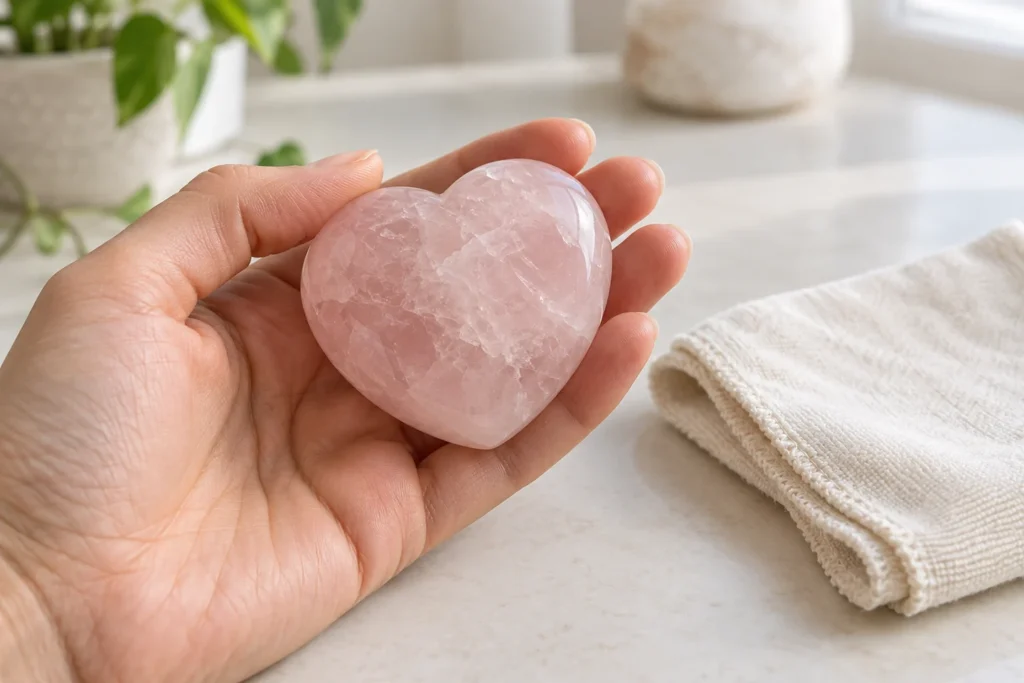
Below, I'll walk through what activation actually means in practice, which methods are commonly recommended (and which carry product-care risks), and how retailers and crystal brands can talk about rose quartz activation with customers in a way that's honest, helpful, and commercially sound. Whether you sell rose quartz or simply want to use it yourself, this guide keeps both product integrity and communication integrity front and center.
What Does It Actually Mean to Activate Rose Quartz?
The word "activation" sounds technical, almost scientific — as if there's a switch inside the stone waiting to be flipped. That framing can create unnecessary anxiety for customers and real liability risk for sellers who imply guaranteed results.
In common crystal culture, activating rose quartz simply means beginning a personal, intentional relationship with the stone. It is often presented as a combination of cleansing (removing residual energy from previous handling), setting a personal intention, and then placing or carrying the stone where it serves as a daily reminder of that intention. There is no industry-standard certification or measurable test for "activation."3
Why the Word "Activation" Persists
The language of activation is deeply embedded in crystal retail culture. Customers search for it, influencers teach it, and product listings reference it. Ignoring the term entirely would mean missing a real customer need — people want guidance on how to start using their new stone. The key is reframing activation from a supernatural event into a practical, personal ritual.
A Simple Framework Anyone Can Follow
Here's a straightforward activation routine that many crystal retailers share with their customers:
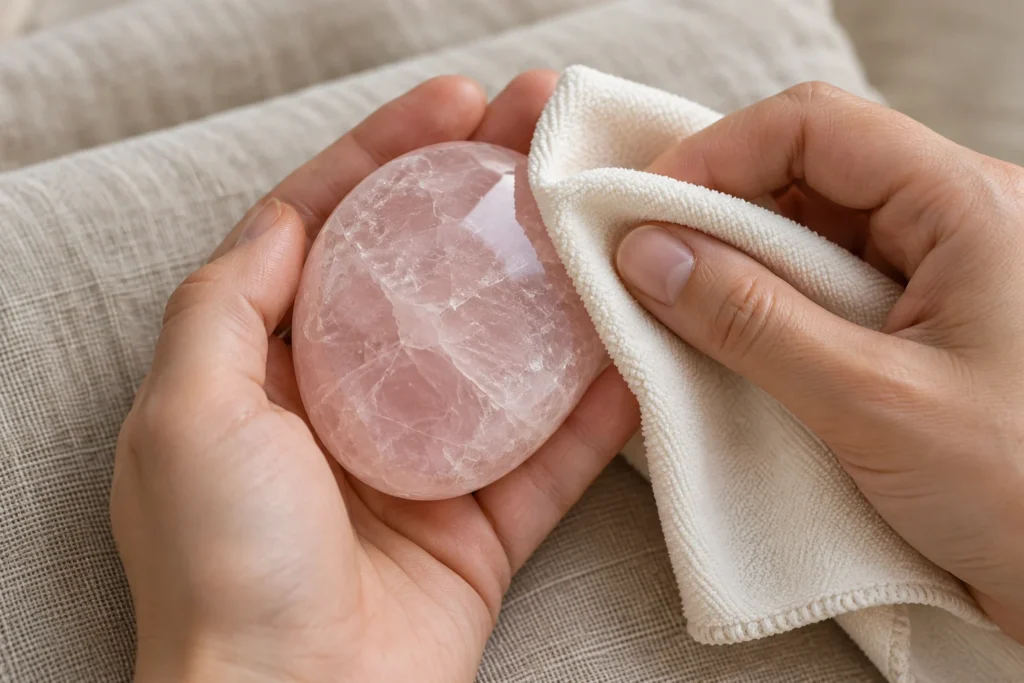
- Gently clean the stone. Use a soft, dry or slightly damp cloth to remove dust, fingerprints, or packaging residue. (More on safe cleaning methods below.)
- Hold the stone and set a personal intention. This can be as simple as thinking, "I'd like this stone to remind me to be kinder to myself." No script or special words are required.
- Place or carry the stone intentionally. Put it on a nightstand, in a pocket, on a desk, or in a display case — wherever it will serve as a visual cue for the intention4.
- Revisit the intention periodically. Some people do this weekly; others do it whenever they notice the stone. There is no fixed schedule.
This framework works because it's inclusive, low-pressure, and makes no claims about the stone producing specific outcomes. It positions rose quartz as a meaningful personal object — similar to how someone might use a journal prompt, a favorite photograph, or a piece of meaningful jewelry.
What Activation Is Not
For the sake of honest communication, it's worth being explicit:
| Activation IS | Activation IS NOT |
|---|---|
| A personal starting ritual | A scientifically verified process |
| A way to set intention | A guarantee of love, healing, or reconciliation |
| Flexible and personal | A rigid, one-correct-method procedure |
| A useful retail communication tool | A medical or therapeutic prescription |
Many customers like to begin using rose quartz by pairing it with a moment of quiet reflection. This is commonly described as "activation" in crystal culture, and it can be a genuinely enjoyable part of the ownership experience — even without any specific metaphysical expectations.
I've found that when we help our retail partners frame activation this way, their customers feel less confused and more connected to the product. It reduces post-purchase questions and returns driven by unmet magical expectations.
Which Common Activation Methods Are Safe for Rose Quartz Products?
A quick internet search will return a long list of rose quartz activation methods — moonlight, sunlight, salt water, smoke, sound, burying in earth, and more. The problem is that not every method is safe for every rose quartz product. Surface finish, treatment, size, and form factor all affect what a piece can tolerate.
The safest general activation methods for rose quartz are gentle wiping with a soft cloth, holding the stone during quiet reflection, and placing it in a personally meaningful location. Methods involving prolonged sunlight, salt water, chemical solutions, or abrasive contact carry varying degrees of risk depending on the specific product's finish, polish, and any applied treatments. When in doubt, retailers should advise customers to confirm care instructions for the specific piece they purchased.
Method-by-Method Risk Assessment
Here's a practical breakdown of commonly suggested activation and cleansing methods, evaluated from a product care perspective:
| Method | Common Claim | Product-Care Risk Level | Notes |
|---|---|---|---|
| Soft cloth wipe | Removes residual energy | Very low | Safe for nearly all rose quartz products |
| Holding and intention-setting | Connects you to the stone | None | Universal; no physical risk |
| Moonlight exposure | Charges the stone overnight | Low | Generally safe; avoid outdoor placement where dew or temperature changes could affect polished surfaces |
| Brief running water rinse | Cleanses energy | Low to moderate | Pat dry immediately; avoid for pieces with fractures, dyed finishes, or metal components |
| Prolonged sunlight | Charges the stone with solar energy | Moderate to high | Extended UV exposure can fade rose quartz color over time5; avoid for display pieces |
| Salt water soak | Deep cleansing | High | Salt can etch polished surfaces, accelerate micro-fractures6, and damage treated or coated finishes |
| Smoke (sage, palo santo) | Smudging to clear energy | Low to moderate | Minimal physical risk to stone, but residue may settle on polished surfaces; ventilation matters for retailers |
| Burying in soil | Earth energy recharge | High | Moisture, minerals, and microorganisms in soil can stain, etch, or damage polished pieces7 |
| Chemical solutions | Deep physical cleaning | High | Most household chemicals are too harsh; can strip polish or react with treatments8 |
Finish and Treatment Matter
This is where B2B product knowledge becomes essential. Not all rose quartz is the same:
- High-polish spheres and hearts are more vulnerable to surface etching from salt or chemicals.
- Rough or raw specimens may tolerate brief water contact better but can trap moisture in crevices.
- Dyed, coated, or treated pieces may react unpredictably to sunlight, water, or heat.
- Small tumbled stones are generally more durable but can chip if handled carelessly during group "activation" rituals.
As a supplier, I always recommend that retailers confirm care instructions based on the specific finish, treatment, and batch rather than applying blanket advice. A care note that says "gentle dry wiping recommended; avoid salt water and prolonged direct sunlight" is both accurate and easy for end customers to follow.
Practical Tip for Retailers
Consider including a small care and intention card with each rose quartz product. A simple insert that says something like:
"Welcome your new rose quartz by gently wiping it with a soft cloth and holding it for a quiet moment. Set a personal intention — something meaningful to you — and place the stone where you'll see it daily. For care, avoid salt water, harsh chemicals, and extended direct sunlight. Enjoy your stone."
This type of card answers the "how do I activate it?" question before the customer even asks, and it does so without making claims that could damage your brand credibility.
How Can Retailers Talk About Rose Quartz Activation Without Overclaiming?
This is arguably the most important section for B2B readers. Crystal retailers face a genuine tension: customers want to hear that rose quartz will help them find love, heal heartbreak, or improve relationships. But making those promises creates trust risk, potential regulatory issues, and disappointed customers.
Retailers can discuss rose quartz activation using experience-based, bounded language — phrases like "many people use rose quartz as a reminder of self-love," "commonly associated with emotional openness in crystal traditions," or "often chosen as a meaningful gift for someone you care about." This approach respects the cultural significance of the stone while avoiding specific outcome promises9.
The Language Spectrum: From Safe to Risky
Here's a practical reference for product descriptions, social media captions, and in-store signage:
| Language Category | Example | Risk Level |
|---|---|---|
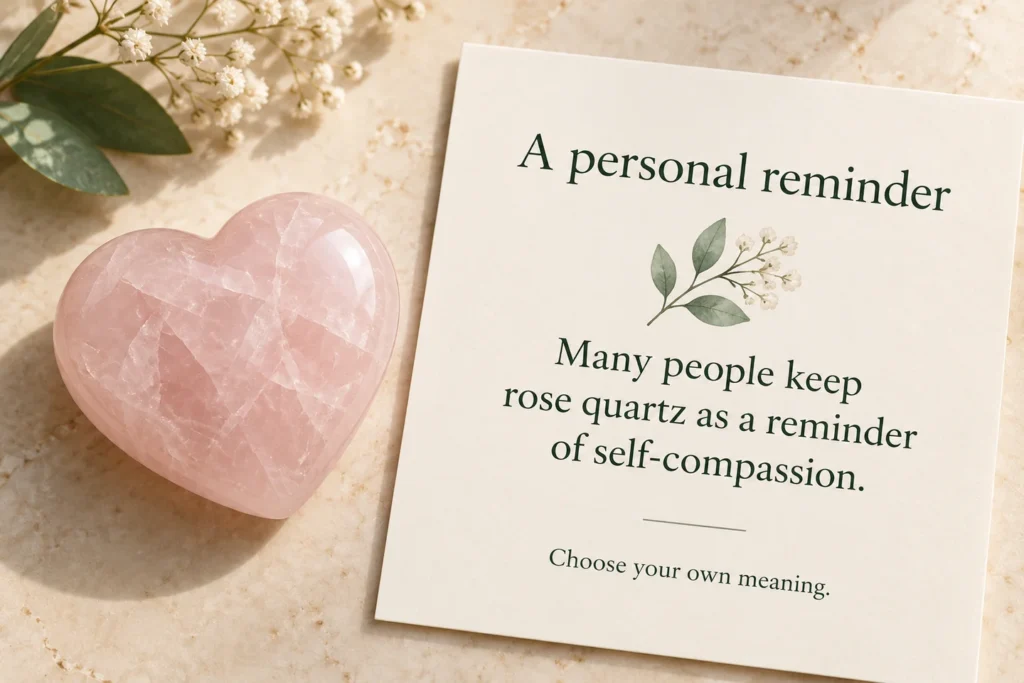
| Personal association | "Many people keep rose quartz as a reminder of self-compassion." | Low — attributes the use to people, not the stone |
| Cultural tradition | "In crystal traditions, rose quartz is often associated with the heart and emotional openness." | Low — frames it as tradition, not fact |
| Experiential | "Customers often tell us they feel calmer when they carry rose quartz." | Low — reports anecdotal experience |
| Unqualified claim | "Rose quartz attracts love into your life." | High — implies a guaranteed, measurable outcome |
| Medical/therapeutic | "Rose quartz heals emotional trauma and anxiety." | Very high — could be interpreted as a health claim10 |
Building a Retail Voice That Works
From our experience helping retailers develop product descriptions and customer-facing content, here are principles that consistently work well:
- Use "reminder" language. A rose quartz sphere is a "beautiful reminder of self-love" rather than a "love magnet."
- Emphasize the ritual, not the result. Describe the activation process as a calming, enjoyable practice — not as a transaction where the customer inputs a ritual and receives a guaranteed outcome.
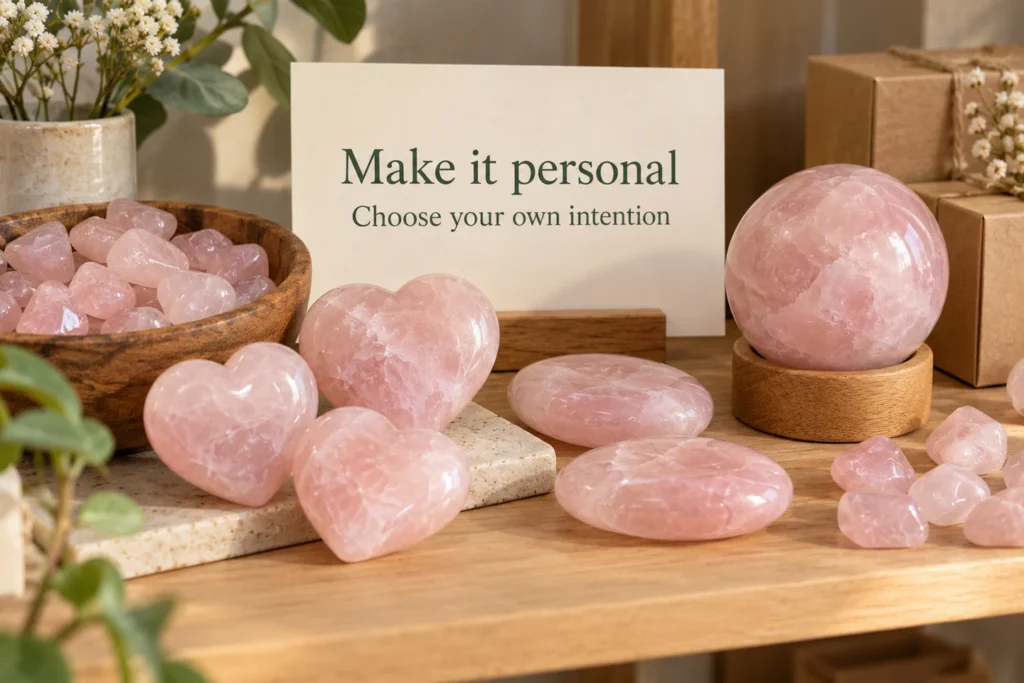
- Let customers define their own meaning. Phrases like "set your own intention" and "make it personal" empower the buyer without the seller making specific promises.
- Pair metaphysical context with product facts. A listing can mention that rose quartz is "traditionally connected to themes of love and compassion" and then immediately describe the stone's size, weight, color range, polish quality, and care instructions.
Packaging Inserts and Display Notes
For crystal brands and retailers who want to create a premium unboxing or in-store experience, a brief activation guide as a printed insert is a powerful tool. It should:
- Be warm and inviting in tone — not clinical, not mystical
- Offer a simple 3–4 step activation suggestion (clean, hold, intend, place)
- Include basic care instructions specific to the product form
- Avoid any language that could be read as a health or outcome promise
- Optionally include a QR code linking to a blog post or video with more detail
This kind of insert turns "how do I activate my rose quartz?" from a post-purchase anxiety into a brand-building moment. It positions the retailer as thoughtful and knowledgeable.
Does Rose Quartz Need to Be "Recharged" After Activation?
Many crystal guides suggest that rose quartz needs periodic recharging — as if the stone runs on a battery. This creates a follow-up question that retailers should be prepared to answer, especially because some popular recharging methods carry the same product-care risks as certain activation methods.
Rose quartz does not have a measurable energy reserve that depletes over time.11 The concept of "recharging" in crystal culture is commonly understood as refreshing your personal connection to the stone and its associated intention. Gentle cleaning, a moment of quiet reflection, or simply noticing the stone and recalling your intention are the simplest and safest ways to maintain that connection.
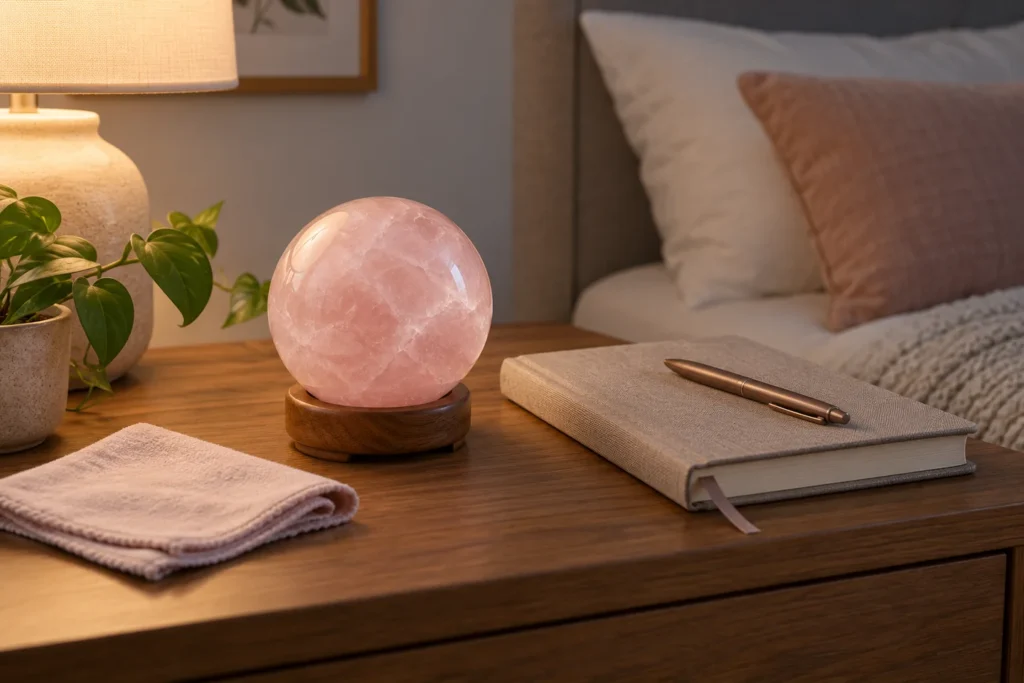
Practical Recharging Guidance
The same caution table from the activation section applies here. If a customer wants to "recharge" their rose quartz:
- Safest options: Gentle wipe, hold and re-set intention, place in a calm spot overnight
- Use with caution: Moonlight (generally safe but monitor outdoor conditions), brief lukewarm water rinse (pat dry, avoid treated pieces)
- Avoid or research first: Prolonged sunlight, salt water, burial, chemical cleaners
Why This Matters for Repeat Business
Here's a subtle but important B2B insight: when a customer feels connected to their rose quartz and has a simple, safe routine for "recharging" it, they're more likely to:
- Continue engaging with the product positively
- Return to buy additional pieces (different forms, sizes, or complementary stones)
- Recommend the retailer to friends
- Leave positive reviews referencing the care guidance they received
In other words, good activation and care communication isn't just about risk mitigation — it's a customer retention tool.
How Should Retailers Handle Customer Questions About Rose Quartz Not "Working"?
This is a question every crystal retailer will eventually face. A customer buys rose quartz, performs an activation ritual, and comes back weeks later saying, "It didn't work — I still haven't found love." How you handle this moment defines your brand.
The best approach is to gently reframe expectations. Remind the customer that rose quartz is commonly used as a personal reminder and a focus for intention — not as a device that produces specific outcomes. Acknowledge their feelings, suggest revisiting their intention or trying a different placement or routine, and emphasize the ongoing, personal nature of working with crystals.

A Response Template Retailers Can Adapt
"Thank you for sharing that with us. Rose quartz is often used as a personal reminder of self-love and emotional openness, and many people find that the experience evolves over time. We'd suggest revisiting your intention — maybe adjusting it to something that feels right for where you are now — and giving yourself permission to enjoy the stone without pressure for a specific result. If you'd like, we can suggest some different ways to incorporate it into your routine."
This response:
- Validates the customer's experience
- Restates bounded language (reminder, often used, personal)
- Avoids admitting the product "failed" (because no specific outcome was promised)
- Offers continued engagement without doubling down on undeliverable promises
Training Staff on This Language
For retailers with in-store teams, brief training on bounded crystal language is a worthwhile investment. Key points to cover:
- Never promise a crystal will produce a specific life result
- Use phrases like "many people find," "commonly associated with," and "often used as"
- Focus on the customer's experience and intention, not the stone's "power"
- Redirect disappointment toward adjusting the personal practice, not toward blaming the product
Frequently Asked Questions
Can rose quartz be activated immediately after purchase?
Yes. There is no required waiting period. Many people simply wipe the stone gently with a soft cloth, hold it for a quiet moment to set a personal intention, and begin using it right away. The process is personal and flexible — there is no single correct timing.
Does the size or shape of rose quartz affect activation?
The concept of activation is a personal, intention-based practice, so it is not dependent on the stone's physical dimensions. However, different forms — towers, spheres, hearts, tumbled stones — may suit different uses and display settings. Choose the form that fits your intended daily routine.
Is it necessary to activate rose quartz in moonlight?
Moonlight activation is a popular suggestion in crystal culture, but it is not a requirement. It is one of many commonly suggested methods. From a product-care standpoint, overnight outdoor exposure is generally low-risk, but monitor for dew, temperature changes, or accidental damage.
Can I sell rose quartz with activation instructions included?
Absolutely. Many successful crystal retailers include a small care-and-intention card with their products. Keep the language warm, simple, and free of specific outcome promises. Focus on a gentle cleaning step, a personal intention-setting suggestion, and basic care instructions for the product form.
Should I avoid the word "activation" entirely in my product listings?
Not necessarily. The term is widely searched and understood by crystal customers. The key is to frame it accurately — as a personal starting ritual, not as a guaranteed mechanism. Pair it with bounded language and product care information to maintain credibility.
Conclusion
Understanding how to activate rose quartz comes down to a simple principle: it's a personal, flexible ritual — not a guaranteed formula. Clean the stone gently, choose a personal intention, and place or carry it in a way that fits your daily routine. For retailers, clear care instructions and thoughtful guidance can help customers enjoy their rose quartz without pressure for a specific result.
References
- "Crystal healing", https://en.wikipedia.org/wiki/Crystal_healing. Reference works on crystal healing describe it as an alternative spiritual practice for which controlled scientific evidence of specific healing effects is lacking, supporting the view that rose quartz activation rituals are cultural practices rather than verified requirements. Evidence role: general_support; source type: encyclopedia. Supports: Crystal healing practices are commonly described as alternative or spiritual practices without scientific evidence establishing specific effects or required procedures.. Scope note: This supports the general evidentiary status of crystal healing, not a direct survey of every rose quartz activation ritual. ↩
- "Effects of Mindfulness on Psychological Health: A Review of …", https://pmc.ncbi.nlm.nih.gov/articles/PMC3679190/. Psychological research on ritual and intention-setting indicates that personally meaningful routines can focus attention and support emotion regulation, which provides a plausible framework for understanding rose quartz activation as a mindful practice rather than as proof of a stone-specific effect. Evidence role: mechanism; source type: paper. Supports: Personal rituals and intention-focused practices can structure attention, create meaning, and support emotion regulation in everyday contexts.. Scope note: The evidence is about rituals and attention generally, not about rose quartz specifically. ↩
- "Rose Quartz Care and Cleaning", https://www.gia.edu/rose-quartz-care-cleaning. Gemological sources identify rose quartz by mineralogical and treatment characteristics and do not define a certified or measurable state of metaphysical 'activation,' indicating that such activation is not a recognized gemological classification. Evidence role: general_support; source type: institution. Supports: Gemological references classify rose quartz by mineral identity, properties, treatments, and care considerations, not by any certified metaphysical activation state.. Scope note: This is contextual evidence from gemological classification; it does not prove that no private retailer has created its own informal certificate. ↩
- "How the environment evokes actions that lead to different goals", https://pmc.ncbi.nlm.nih.gov/articles/PMC10088748/. Research on implementation intentions and environmental cueing shows that external cues can prompt recall of intended actions, supporting the article’s framing of rose quartz as a visual reminder for a personal intention. Evidence role: mechanism; source type: paper. Supports: Environmental cues and reminders can trigger recall of intentions and support goal-directed behavior.. Scope note: This supports the cueing mechanism in general and does not demonstrate that rose quartz has unique psychological effects. ↩
- "Rose Quartz Gem", https://www.gia.edu/rose-quartz. Gemological references note that color in some quartz varieties can be sensitive to irradiation and light exposure, supporting caution that prolonged direct sunlight may alter rose quartz color over time. Evidence role: mechanism; source type: institution. Supports: Rose quartz color can be affected by light or radiation exposure, and gem-care sources caution that some colored gems may fade under prolonged light.. Scope note: The degree of fading varies by specimen, color origin, treatment history, and exposure conditions. ↩
- "Advances in understanding damage by salt crystallization", https://pubmed.ncbi.nlm.nih.gov/20214404/. Conservation research on salt crystallization shows that dissolved salts can crystallize within pores and cracks and generate stresses that contribute to stone deterioration, providing a materials-based rationale for avoiding salt soaks on polished or fractured rose quartz pieces. Evidence role: mechanism; source type: research. Supports: Salt crystallization and salt weathering can stress porous or cracked mineral surfaces and contribute to deterioration in stone materials.. Scope note: The evidence concerns stone deterioration broadly; direct damage to dense, intact rose quartz under brief exposure may be less severe than in porous building stone. ↩
- "New frontiers review of some recent conservation techniques …", https://pmc.ncbi.nlm.nih.gov/articles/PMC10060858/. Conservation literature on buried stone materials documents that soil moisture, soluble salts, mineral deposits, and biological activity can alter or stain stone surfaces, supporting caution against burying polished rose quartz as a routine cleansing practice. Evidence role: mechanism; source type: research. Supports: Soil environments can expose stone objects to moisture, dissolved minerals, salts, organic matter, and biological activity that may affect surfaces.. Scope note: This is contextual conservation evidence and does not quantify the risk for every rose quartz object or short burial period. ↩
- "Tips on Caring for Jewelry", https://www.gia.edu/gia-news-research-tips-caring-jewelry. Gem-care guidance from established gemological institutions cautions that household chemicals can damage gemstones, settings, surface treatments, or polish, supporting the article’s advice to avoid chemical solutions for rose quartz products. Evidence role: general_support; source type: institution. Supports: Gem-care authorities commonly advise avoiding harsh household chemicals on gemstones, especially treated, coated, or polished items.. Scope note: The guidance is general gemstone-care advice; vulnerability depends on the exact treatment, polish, and mounting materials. ↩
- "FTC Policy Statement Regarding Advertising Substantiation", https://www.ftc.gov/legal-library/browse/ftc-policy-statement-regarding-advertising-substantiation. Consumer-protection guidance from the FTC explains that objective advertising claims must be truthful, non-misleading, and substantiated, supporting the article’s warning that specific rose quartz outcome promises carry risk when evidence is lacking. Evidence role: general_support; source type: government. Supports: Objective advertising claims, especially health or wellness outcomes, must be truthful, not misleading, and supported by evidence.. Scope note: This supports the legal principle of substantiation, not a case specifically involving rose quartz. ↩
- "Health Products Compliance Guidance", https://www.ftc.gov/business-guidance/resources/health-products-compliance-guidance. FTC and FDA guidance states that health-related advertising and labeling claims require appropriate substantiation and that therapeutic wording can affect how a product’s intended use is interpreted, supporting caution around claims that rose quartz heals anxiety or trauma. Evidence role: expert_consensus; source type: government. Supports: U.S. regulators require substantiation for health-related advertising claims and may evaluate therapeutic language as evidence of intended medical use.. Scope note: Regulatory interpretation varies by jurisdiction and by the exact wording, medium, and product context. ↩
- "Piezoelectricity", https://en.wikipedia.org/wiki/Piezoelectricity. Mineralogical references define quartz by its chemical and physical properties, and reference works on crystal healing note the lack of scientific evidence for claimed healing energies, supporting the distinction between measurable mineral properties and the cultural idea of recharging. Evidence role: definition; source type: encyclopedia. Supports: Quartz is described in mineralogical terms such as chemical composition, crystal structure, hardness, and physical properties, while crystal-healing energy claims are not established scientific properties.. Scope note: Quartz can exhibit measurable physical phenomena such as piezoelectricity under specific conditions; that is distinct from the article’s discussion of a depleting metaphysical reserve. ↩