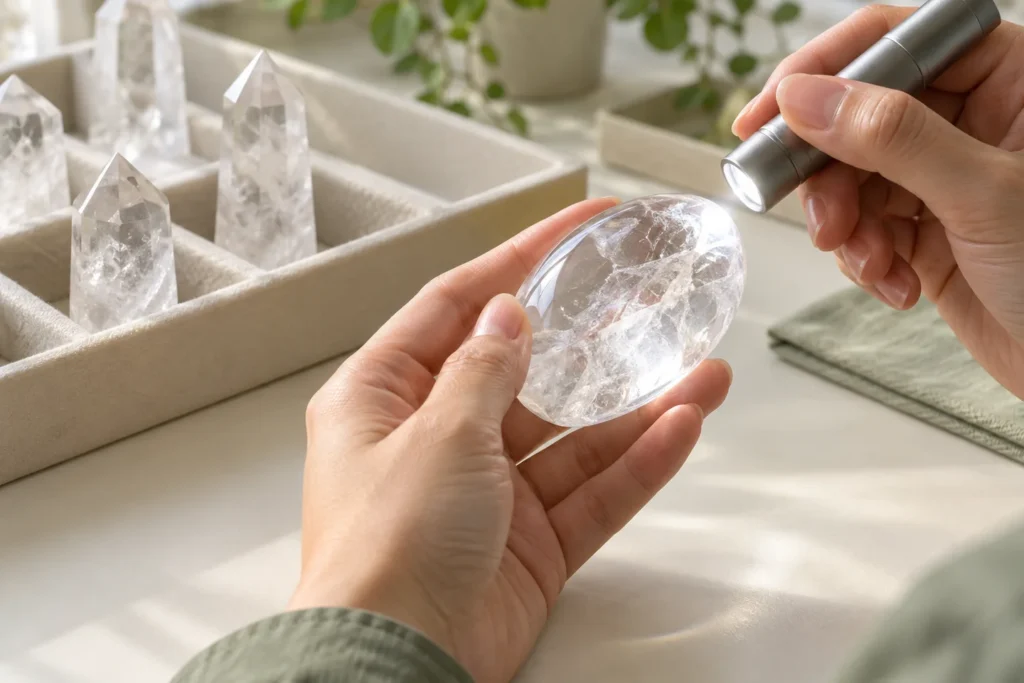
Figuring out how to tell if a quartz tower is real is one of the most common concerns we hear from new wholesale buyers. A single bad batch — glass sold as quartz, dyed material passed off as natural — can trigger customer complaints, refund requests, and lasting brand damage. The solution is not one magic test; it is a layered evaluation process that covers material, treatment, supplier transparency, and batch consistency.
A real quartz tower is a product cut and polished from natural quartz crystal, not from glass, resin, or synthetic substitutes. To verify authenticity, B2B buyers should combine basic physical checks (hardness, temperature, inclusions) with supplier-level verification: clear material disclosure, treatment confirmation, batch photos, sample orders, and — when stakes are high — third-party gemological testing. No single home test guarantees a quartz tower is genuine.1
Before diving into specific tests, it helps to define what "real" actually means in the quartz tower trade. Buyers often use the word to describe very different concerns — natural versus glass, untreated versus dyed, high-grade versus low-grade. Each concern requires a different kind of check. Below, I break down the practical steps that matter most for procurement decisions.
What Does "Real" Actually Mean When Buying Quartz Towers?
The word "real" sounds simple, but in wholesale crystal procurement it hides at least four separate questions. Using the wrong definition can lead to rejecting perfectly natural material — or accepting a convincing fake.
When buyers ask if a quartz tower is real, they usually want to know one or more of the following: (1) Is it natural quartz rather than glass, resin, or synthetic material? (2) Has the color been artificially dyed, coated, or heat-treated? (3) Is the material correctly labeled — is what's called "smoky quartz" actually smoky quartz? (4) Is the quality consistent with the price grade?
Natural Quartz vs. Glass and Synthetic Substitutes
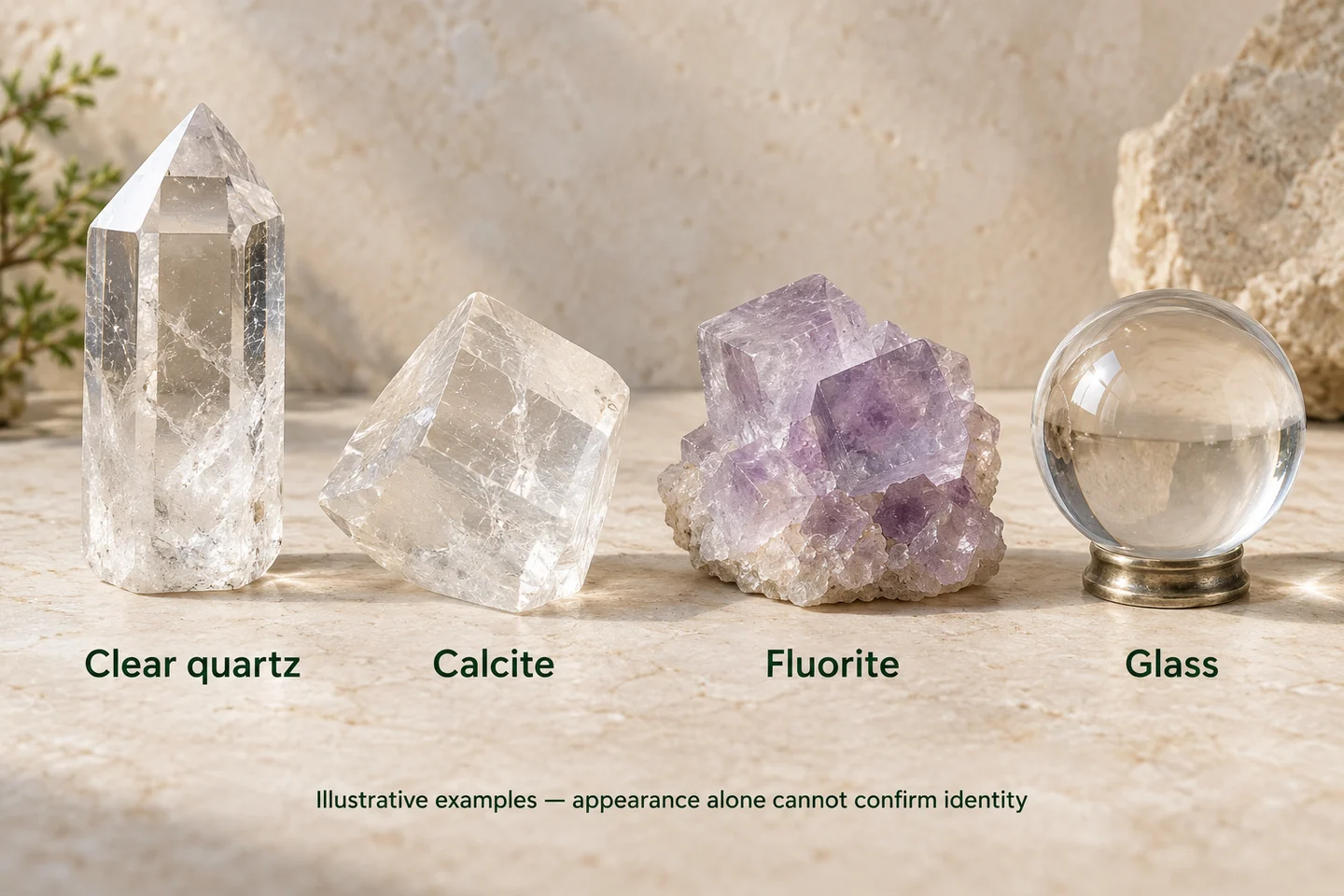
The most basic authenticity question is whether the tower is made from natural silicon dioxide crystal2 or from an imitation material. Glass and resin are the most common substitutes in the low-cost market. Synthetic quartz does exist — it is grown in autoclaves for industrial and electronic applications3 — but it is rarely shaped into decorative towers because the economics do not favor it. The bigger risk for most wholesale buyers is glass or smelted quartz (a reconstituted material made by melting quartz powder and recasting it).
Key differences between natural quartz and common substitutes:
| Feature | Natural Quartz | Glass / Smelted Quartz | Resin |
|---|---|---|---|
| Hardness (Mohs) | 7 | ~5.5 (glass) | ~2–3 |
| Temperature feel | Cool to the touch, slow to warm | Warms quickly | Warms very quickly |
| Internal features | Inclusions, veils, phantoms, fractures, color zoning | Round bubbles, swirl lines, uniform clarity | Bubbles, possible discoloration |
| Weight | Heavier for size (SG ~2.65) | Similar weight (SG ~2.5) | Noticeably lighter |
| UV reaction | Varies by type | Often fluoresces differently | May fluoresce brightly |
Glass imitations are the trickiest because their weight and appearance can be close to real quartz. I have seen buyers accept clear glass towers as "AAA clear quartz" because the pieces looked flawless — which is itself a warning sign. Perfectly clear, inclusion-free, large towers at unusually low prices warrant closer inspection.
Dyed, Coated, or Heat-Treated Quartz
A quartz tower can be made from genuine quartz and still be misleadingly presented. Common treatments include:
- Dyeing: Porous or fractured quartz may be dyed to produce vivid colors; dye can concentrate in cracks. Aqua aura is a surface-coated quartz, not an example of dyeing.
- Coating: Metallic vapor deposition (e.g., titanium coating) creates iridescent "aura" quartz.4 This is not fake quartz, but it must be disclosed as treated.
- Heat treatment: Some amethyst is heat-treated to produce citrine.5 Color alone cannot reliably establish whether citrine is natural-color or heat-treated.
For B2B buyers, the issue is not whether treatment is acceptable — many treated products sell well — but whether the supplier clearly discloses the treatment so you can label and sell accurately.
Mislabelled Material
We occasionally encounter towers marketed under mineral names that do not match the actual stone. For example, "blue quartz" towers that are actually dyed quartzite, or "strawberry quartz" that is man-made glass with metallic inclusions. Mislabelling is especially common with trade names and fantasy names that do not correspond to standard mineralogical terms.
Grade vs. Authenticity
Finally, some buyers confuse low grade with fake. A cloudy quartz tower with visible internal fractures and rough polish is not necessarily fake — it may simply be C-grade natural quartz. Understanding grade expectations for the price point prevents unnecessary disputes.
Can Simple Home Tests Tell If a Quartz Tower Is Real?
Online guides are full of quick tests: scratch a glass bottle, feel the temperature, shine your phone flashlight through the stone. These tests circulate widely, and buyers sometimes rely on them as definitive proof. The problem is that each test has significant limitations — especially at scale.
Simple home tests like hardness scratching, temperature checks, and visual inspection can serve as rough screening tools. They help flag obvious glass or resin fakes. However, they cannot reliably distinguish natural quartz from high-quality glass imitations, smelted quartz, or treated material in every case. For B2B purchasing decisions involving hundreds or thousands of pieces, these tests alone are insufficient.
The Scratch Test (Hardness Check)
Quartz ranks 7 on the Mohs hardness scale.6 It should scratch glass (Mohs ~5.5) easily. This test does help eliminate soft materials like resin. However:
- Smelted quartz can also scratch glass, since it is still largely silicon dioxide.
- Scratching damages the product, making it unsuitable for testing finished towers you intend to sell.
- Some coated glass products have harder surfaces that complicate results.
Verdict: Useful as a one-piece spot check on a sample, not practical for batch inspection.
The Temperature Test
Natural quartz feels cool to the touch and warms slowly in your hand, while glass and resin warm up faster. This test is easy to perform and non-destructive. Its limitations:
- The difference between quartz and glass temperature response is subtle, especially in warm environments.
- It requires comparing against a known reference piece.
- It tells you nothing about treatment or labelling accuracy.
Verdict: A helpful first impression, but not conclusive on its own.
The Light Test (Phone Flashlight)
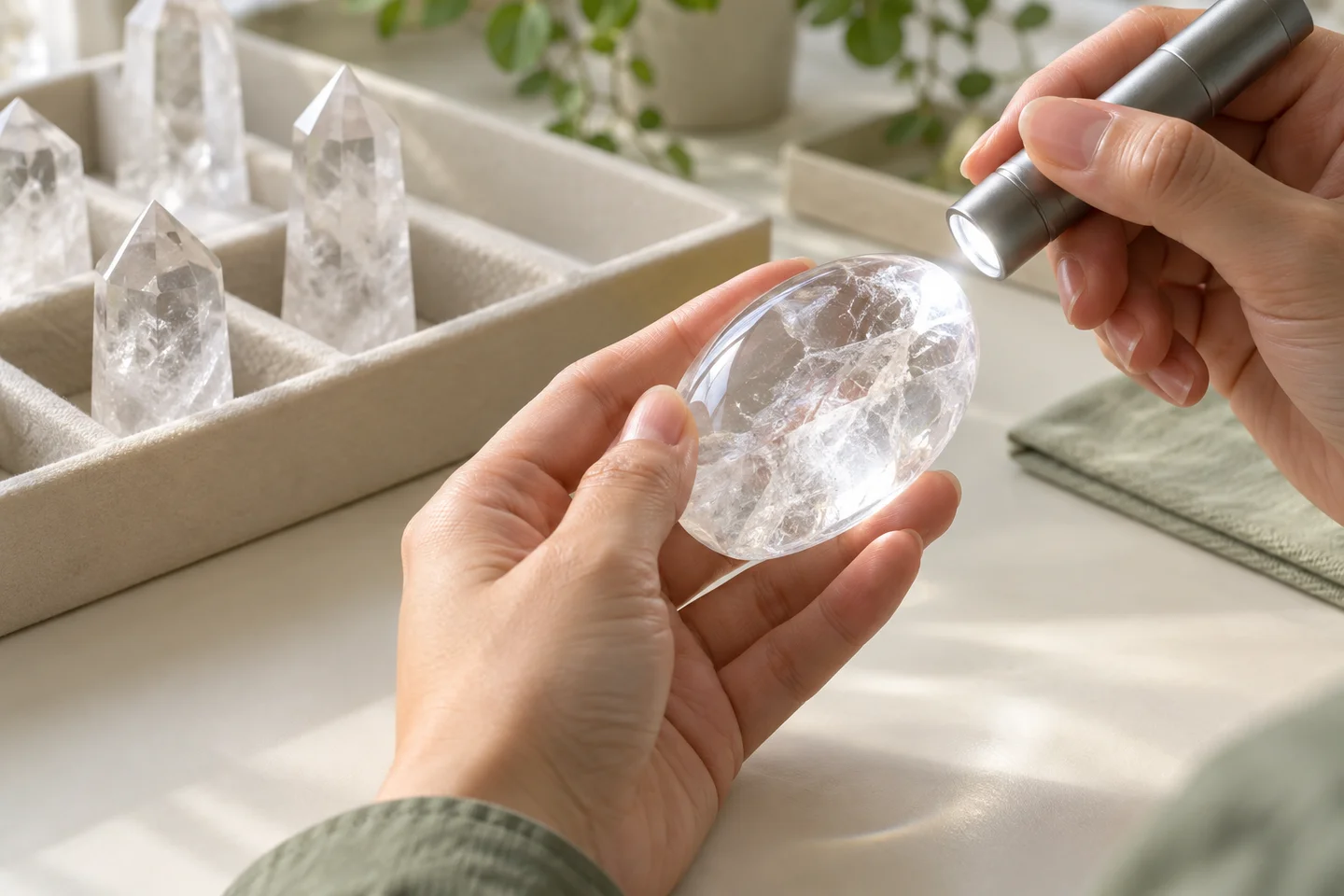
Shining a light through a quartz tower can reveal internal structures: natural inclusions, veils, phantoms, and fractures suggest natural origin. Perfectly uniform clarity with round bubbles may suggest glass.
- Many natural quartz towers are quite clear internally — the absence of inclusions does not automatically mean fake.
- Round bubbles are a strong indicator of glass7, but they can also occur in smelted quartz products.
- Photos and videos of the light test can help in pre-purchase evaluation with a supplier, but interpreting what you see requires experience.
Verdict: One of the more informative home tests, but interpretation is subjective. I have personally seen buyers mistake natural rainbow fractures for "signs of glass," which led to unnecessary disputes with suppliers.
The Weight Test
Quartz has a specific gravity of approximately 2.65, while glass is around 2.5 and resin is significantly lighter.8 For a buyer who handles quartz frequently, an unusually light piece may feel wrong. But without a scale and known volume, this remains an imprecise gut check.
Verdict: Useful for experienced handlers; unreliable for newcomers.
Summary Table of Home Test Reliability
| Test | Can Detect Glass? | Can Detect Smelted Quartz? | Can Detect Dye/Treatment? | Practical for Batch QC? |
|---|---|---|---|---|
| Scratch test | Partially | No | No | No |
| Temperature test | Partially | No | No | Partially |
| Light test | Partially | Partially | Sometimes | Partially |
| Weight test | Partially | No | No | Partially |
The bottom line: combine multiple screening methods, but do not rely on any single test as proof.
What Should B2B Buyers Look for in Batch Inspection?
Individual piece authentication matters, but wholesale buyers face a different challenge: evaluating consistency and honesty across an entire batch. A single test piece might be genuine, while the rest of the shipment is not. Or the entire batch might be real quartz, but the grade, size range, or color treatment does not match what was discussed.
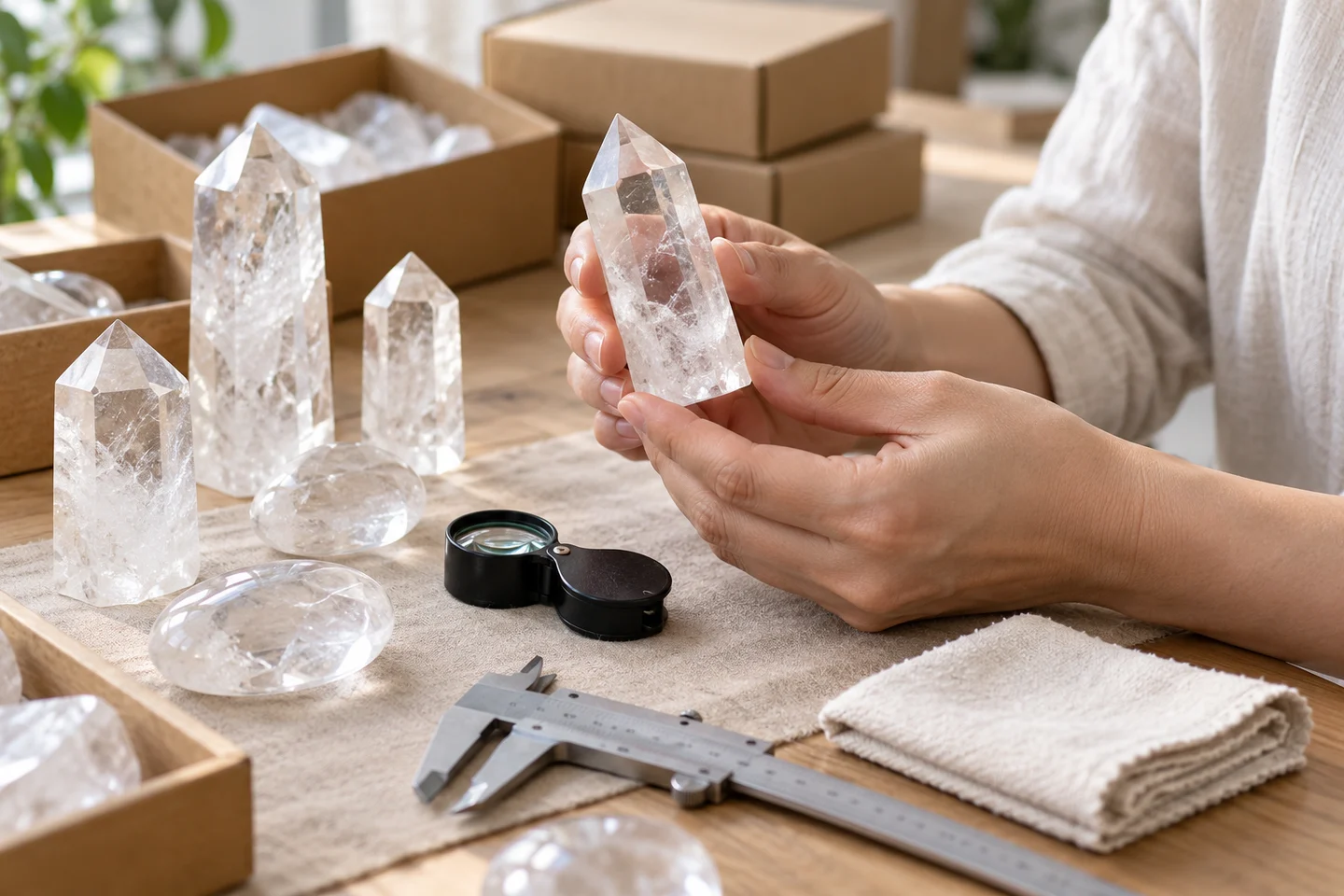
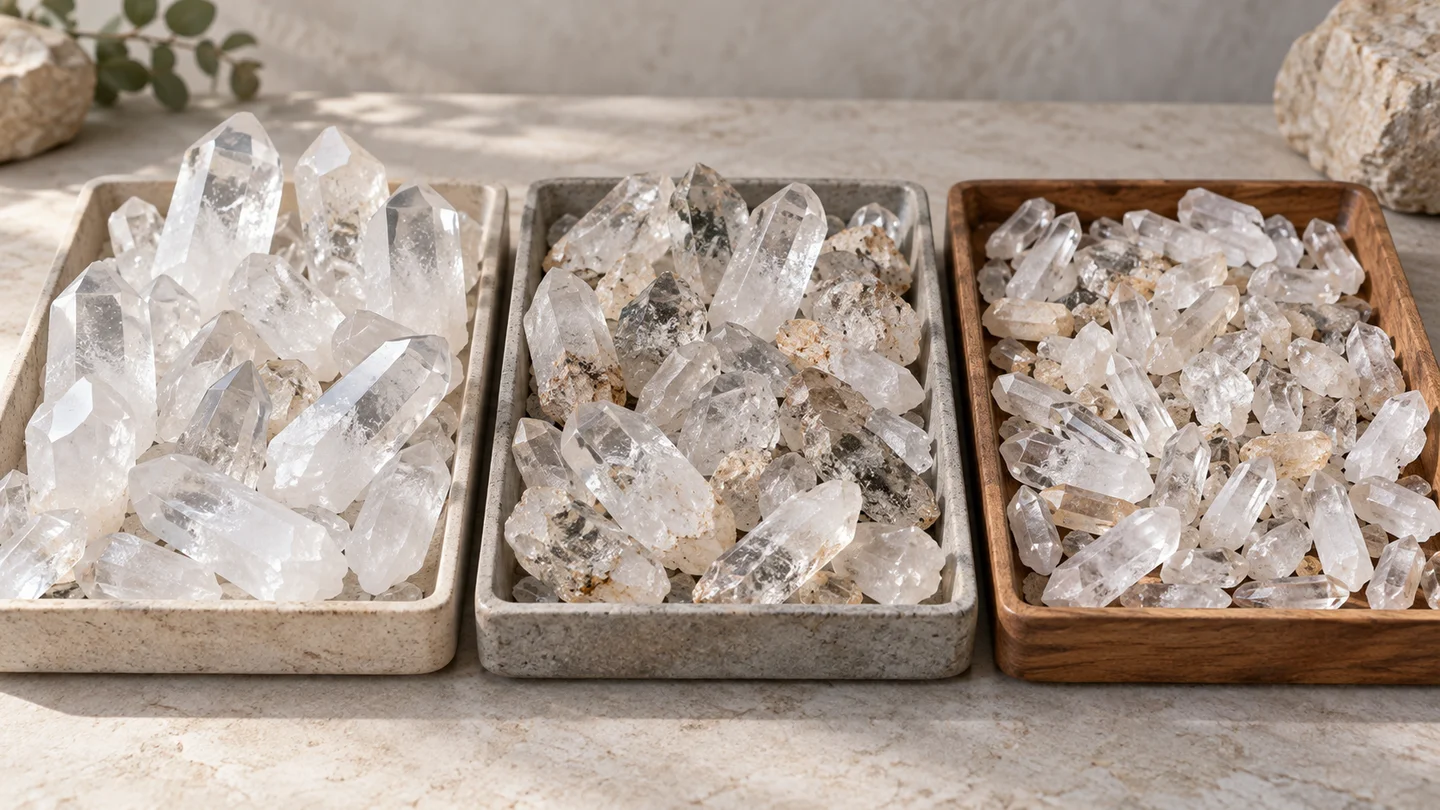
For B2B quartz tower procurement, batch inspection should focus on five areas: material consistency across pieces, size and weight conformity to agreed specifications, visual match to pre-order photos or samples, polish and processing quality, and packaging condition. These checks reduce resale risk more effectively than testing individual pieces for hardness.
Material Consistency
When you receive a batch of quartz towers, check a random sample from different parts of the shipment — not just the top layer. Look for:
- Uniform material type: All pieces should be the same variety (e.g., all clear quartz, all rose quartz). Mixed materials in a single SKU shipment suggest a problem.
- Similar inclusion patterns: Natural quartz will show variation, but the general "look" should be consistent within a grade. If half the pieces have dramatic phantoms and the other half are dead clear, clarify whether this is intentional grading or a mixed lot.
- Color consistency: Slight color variation is normal in natural stone. Dramatic color shifts — some pieces pale pink, others deep magenta — may indicate dye treatment or mixed sourcing.
Size and Weight Conformity
Agree on size ranges (e.g., 8–10 cm height) and weight ranges before ordering. On arrival, spot-check dimensions. Undersized or oversized pieces affect your retail pricing and customer expectations. We typically communicate size as a range rather than an exact number, because natural material inherently varies. The key is whether the actual range matches the agreed range.
Visual Match to Pre-Order Materials
Before placing a wholesale order, request:
- Batch photos (not just stock or historical photos)
- Video showing multiple pieces from the current production run
- Sample pieces if the order volume justifies it
Compare received goods against these references. Perfect matching is unrealistic for natural products, but gross mismatches — different color tone, different clarity grade, different surface finish — are legitimate grounds for discussion.
Polish and Processing Quality
A "real" quartz tower that is poorly processed still creates problems for resale. Check for:
- Consistent facet angles on tower points
- Smooth polish without visible tool marks or pitting
- Stable flat bases that allow towers to stand upright
- No chips on tips or edges from careless handling
Processing quality is separate from material authenticity, but it directly affects sellability. At GD Crystal, we consider processing consistency to be part of product quality communication — a buyer should know the expected finish level before ordering.
Packaging Condition
This is often overlooked. Quartz towers are heavy and fragile at the tip. Inadequate packaging leads to breakage during shipping, which can look like a material defect on arrival. Confirm packaging standards — individual wrapping, foam compartments, box fill — before shipment.
How Can Supplier Communication Reduce Authenticity Risk?
Here is a truth that most "how to spot fake quartz" articles miss entirely: for B2B buyers, the most effective authenticity check is not a physical test — it is supplier transparency. A supplier who clearly communicates material origin, treatment status, grading standards, and batch variation is far less likely to send misrepresented products.
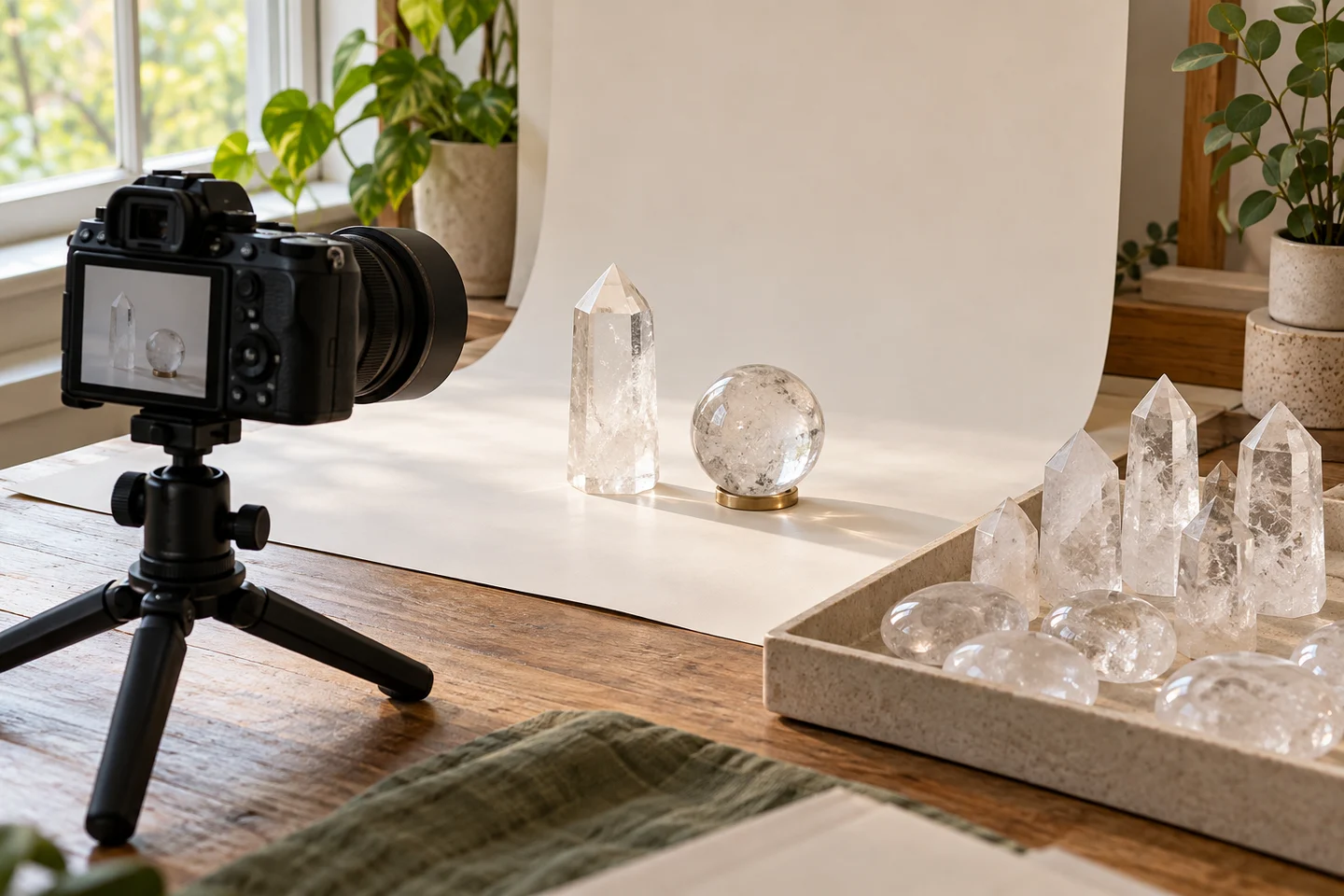
The best way to reduce quartz tower authenticity risk in wholesale is to work with suppliers who provide clear, upfront information about material type, any treatments applied, grading criteria, available batch photos, sample options, minimum order quantities, and expected piece-to-piece variation. Transparent communication before ordering prevents more problems than any post-delivery test.
Questions to Ask Before Ordering
Before placing a quartz tower order, I recommend buyers ask their supplier the following:
- What is the exact material? Natural clear quartz? Natural smoky quartz? Heat-treated amethyst sold as citrine? The supplier should give a straight answer, not a vague trade name.
- Has the material been treated? Dyed, coated, heated, stabilized, or enhanced in any way? If yes, how?
- Can you send current batch photos and/or video? Not stock photos from two years ago. Current production images.
- What is the grade and what does that grade mean? Different suppliers define A, AA, AAA differently. Ask for their grading criteria.
- What is the expected variation in size, color, and clarity? Natural products vary. The question is whether the variation is acceptable for your retail presentation.
- Can I order a sample first? A trial order of 5–20 pieces is a reasonable way to evaluate material and processing before committing to a large batch.
- What happens if the received goods do not match the agreed description? Understanding the resolution process upfront protects both sides.
Red Flags in Supplier Communication
Watch for these warning signs:
- Refusal to answer material or treatment questions directly. A trustworthy supplier should be comfortable explaining what they sell.
- Only stock photos available, never batch-specific images. This suggests the supplier may not control their own inventory.
- Prices dramatically below market average. Natural quartz has real material and processing costs. If a price seems impossibly low, the material may be glass, synthetic, or heavily treated.
- Vague or shifting product descriptions. If the same product is called "natural citrine" in one conversation and "heated quartz" in another, the supplier may not know — or may not want you to know.
- No willingness to offer samples or trial orders. Legitimate suppliers understand that new buyers need to verify quality before scaling up.
When to Request Third-Party Testing
For high-value orders, rare varieties, or any situation where you have doubts after visual inspection and supplier communication, consider sending a sample to an independent gemological laboratory. Labs such as GIA, Gübelin, or regional gemological institutes can confirm:
- Material identity (natural quartz vs. glass vs. synthetic)9
- Treatment detection (dyeing, coating, irradiation, heating)
- Origin information (in some cases)
Third-party testing adds cost and time, but it provides documentation that protects your business and your customers. We view this as a reasonable step for large or high-stakes orders, and a responsible supplier will not object to a buyer independently verifying material.
Why Do Natural Inclusions Not Mean a Quartz Tower Is Fake?
One of the most common misconceptions we encounter is buyers treating visible inclusions, clouds, or internal fractures as evidence that a quartz tower is not "real." In fact, the opposite is often true. Natural quartz grows in geological environments that produce a wide range of internal features.
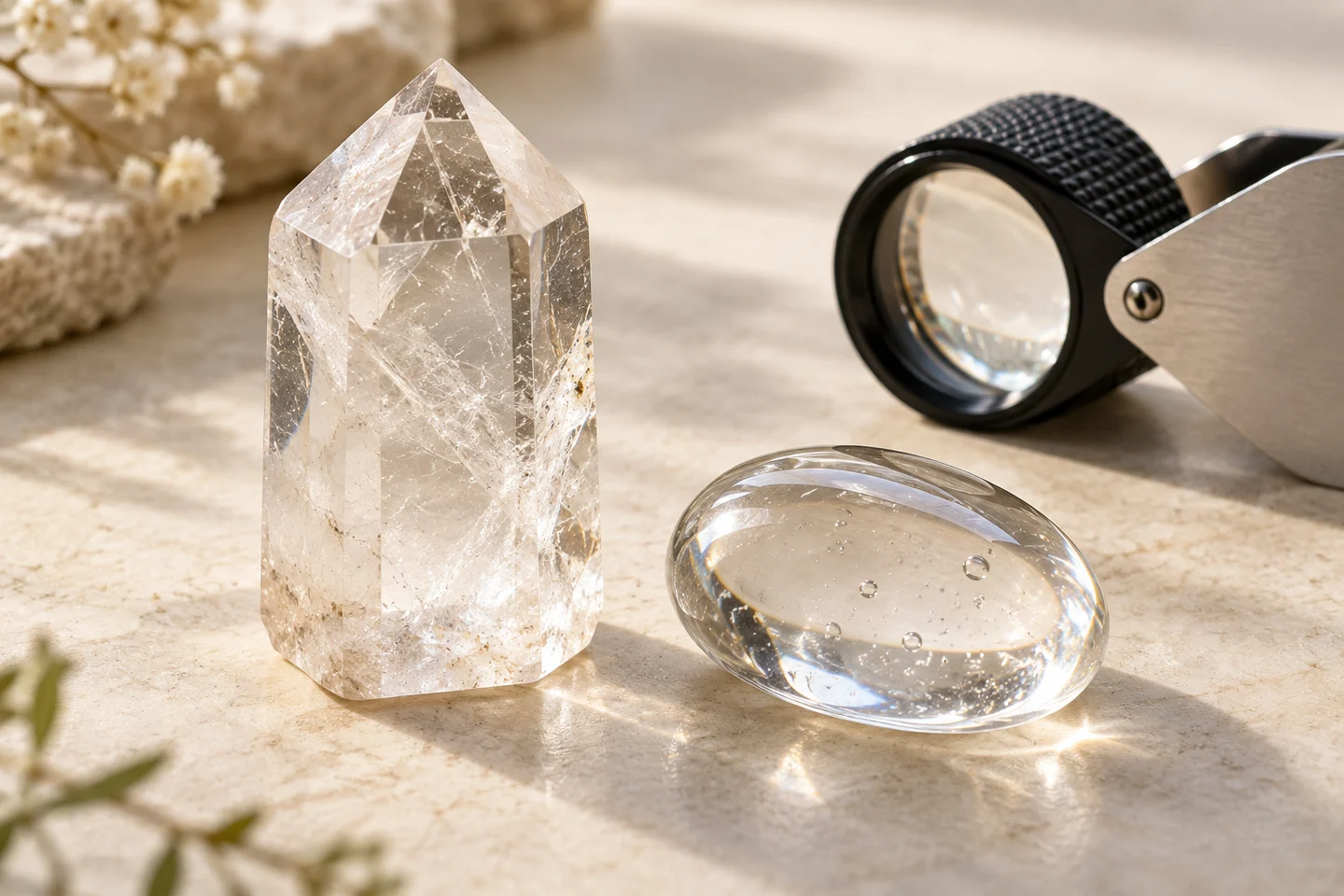
Natural quartz towers frequently contain inclusions (mineral deposits, fluid pockets, needle-like rutile), veils, phantoms (ghost-like internal layers), rainbow fractures, and cloudy zones.10 These features are evidence of natural formation, not defects that indicate a fake product. Perfectly clear, flawless towers — especially in large sizes — are actually rarer and should prompt closer scrutiny, not automatic trust.
Common Natural Features and What They Mean
- Phantoms: Layered ghost shapes inside the crystal, formed by growth interruptions over geological time. Highly collectible and a strong indicator of natural origin.
- Rutile needles: Fine golden or silver-colored needle-like inclusions. These are natural titanium dioxide crystals that grew alongside or inside the quartz.
- Rainbow fractures: Internal fractures that refract light into rainbow colors. Caused by natural stress during formation. Very popular with retail customers.
- Cloudy or milky zones: Areas where microscopic fluid inclusions or structural irregularities scatter light. Common in natural quartz, especially toward the base.
- Color zoning: Gradual or abrupt color changes within a single piece. Natural amethyst, smoky quartz, and citrine often show visible zones.
How Grade Relates to Inclusions
In the wholesale market, quartz towers are graded partly by clarity. Higher grades (AA, AAA) generally have fewer visible inclusions and better transparency. Lower grades (A, B) may have more clouds, fractures, or surface imperfections. Both grades are real quartz — the difference is aesthetic and therefore commercial, not a question of authenticity.
As a supplier, I encourage buyers to match the grade to their retail audience. A crystal shop specializing in collector-grade specimens needs high clarity. A gift shop selling affordable towers can work with mid-grade material at lower cost. Neither shop should confuse grade with genuineness.
The "Too Perfect" Warning
Ironically, a quartz tower that looks too perfect can be the one that deserves suspicion. Very large towers (20+ cm) with absolute water-clear transparency, no inclusions, no color variation, and an extremely low price are worth questioning. Natural quartz of that quality exists, but it commands premium pricing. If the price does not match the apparent quality, ask more questions.
Frequently Asked Questions
Can I tell if a quartz tower is real just from photos?
Photos help with initial screening — you can spot obvious glass bubbles, unnatural color uniformity, or poor processing. But photos alone cannot confirm authenticity, especially compressed or filtered images. Request high-resolution batch photos, video, and samples for a more reliable evaluation before committing to a wholesale order.
Is heat-treated quartz still considered real?
Yes, heat-treated quartz is still natural quartz — the base material is genuine. The treatment changes the color (e.g., amethyst heated to become citrine). The key issue for buyers is disclosure: your supplier should confirm the treatment so you can accurately represent the product to your customers.
What is the difference between smelted quartz and natural quartz?
Smelted quartz is made by melting natural quartz powder and reforming it into shapes. It is silicon dioxide, but it lacks the natural crystal structure, inclusions, and formation features of natural quartz. It is typically very clear, may contain small bubbles, and is usually less expensive. It should be clearly distinguished from natural quartz in product listings.
Should I always order samples before placing a large quartz tower order?
For first-time orders with any supplier, samples are strongly recommended. Even a small trial batch of 10–20 pieces gives you a direct, hands-on understanding of material quality, processing consistency, and packaging. The cost of a sample order is minimal compared to the risk of a mismatched large shipment.
Does GD Crystal provide material and treatment information for quartz tower orders?
We provide material identification and disclose any known treatments for the products we supply. We also offer batch photos and can arrange sample orders so buyers can evaluate quality before committing to larger quantities. For specific certification needs, we recommend independent third-party gemological testing.
Conclusion
Learning how to tell if a quartz tower is real requires more than a single scratch test or a quick glance at a photo. For B2B buyers, genuine authenticity verification combines basic physical screening (hardness, temperature, light inspection) with supplier-level diligence — clear material disclosure, treatment confirmation, current batch photos, sample evaluation, and transparent communication about grading and expected variation. Natural quartz towers show inclusions, color zoning, and surface variation; these are signs of authenticity, not reasons for concern.
At GD Crystal, we approach quartz tower sourcing with the same practical mindset: honest material descriptions, batch-specific visuals, and willingness to support sample orders so you can verify quality firsthand. If you are evaluating quartz tower suppliers for your shop or brand, reach out to our team for current availability, batch photos, and pricing — we are happy to walk you through the details before you commit.
References
- "Gem Identification", https://www.gia.edu/gem-education/course-gem-ident. Gemological education sources describe gemstone identification as a process combining multiple observations and tests, supporting the article's statement that no single home test can guarantee authenticity. Evidence role: expert_consensus; source type: institution. Supports: Reliable gem or mineral identification generally relies on multiple physical, optical, and sometimes instrumental observations rather than one informal test.. Scope note: The support is methodological and general to gem identification, not a controlled study of consumer home tests on quartz towers. ↩
- "Silica Statistics and Information", https://www.usgs.gov/centers/national-minerals-information-center/silica-statistics-and-information. A mineralogical reference such as Encyclopaedia Britannica or Mindat identifies quartz as crystalline silicon dioxide, supporting the article's definition of natural quartz by composition. Evidence role: definition; source type: encyclopedia. Supports: Quartz is a naturally occurring crystalline mineral composed of silicon dioxide.. ↩
- "Hydrothermal synthesis", https://en.wikipedia.org/wiki/Hydrothermal_synthesis. Materials-science references on hydrothermal quartz growth describe synthetic quartz production in autoclaves and its use in electronic frequency-control applications; this supports the production method and application context rather than the market claim about decorative towers. Evidence role: mechanism; source type: research. Supports: Synthetic quartz can be grown by hydrothermal methods in autoclaves and is used in industrial or electronic contexts.. Scope note: The source would support synthetic quartz production and uses, but not directly prove that synthetic quartz is rarely made into decorative towers. ↩
- "Metal-coated crystal", https://en.wikipedia.org/wiki/Metal-coated_crystal. Gemological references on coated quartz describe iridescent 'aura' effects as surface treatments produced by depositing thin metallic films such as titanium on quartz, supporting the article's treatment description. Evidence role: mechanism; source type: institution. Supports: Iridescent aura quartz is produced by applying thin metallic coatings, including titanium, to quartz surfaces.. ↩
- "Is citrine treated?", https://www.gia.edu/FAQ/gia-faq-treated-citrine. Gemological sources note that amethyst and other quartz materials may be heat treated to produce yellow to orange citrine-like colors, supporting the article's discussion of heat-treated quartz sold as citrine. Evidence role: mechanism; source type: institution. Supports: Heating can change the color of some quartz varieties, and heat-treated amethyst is a known source of citrine-like material.. Scope note: The source would support the treatment mechanism and known trade practice, but not quantify how common such material is in the market. ↩
- "Mohs scale", https://en.wikipedia.org/wiki/Mohs_scale. University mineral-identification tables and mineralogical databases list quartz at Mohs hardness 7, supporting the article's use of quartz hardness in the scratch-test discussion. Evidence role: definition; source type: education. Supports: Quartz is listed at hardness 7 on the Mohs scale.. ↩
- "Quartz Assemblage Imitating Emerald", https://www.gia.edu/gems-gemology/summer-2025-lab-notes-quartz-assemblage-imitating-emerald. Gemological identification references describe rounded gas bubbles as characteristic inclusions in glass imitations, supporting the article's use of bubbles as a warning sign when evaluating quartz-like objects. Evidence role: general_support; source type: institution. Supports: Round gas bubbles are commonly associated with glass imitations in gem identification.. Scope note: The finding is indicative rather than conclusive, because bubble-like features may require magnification and expert interpretation. ↩
- "Quartz", https://en.wikipedia.org/wiki/Quartz. Mineral and materials references report quartz specific gravity at about 2.65 and typical glass densities around 2.5 g/cm³, supporting the article's weight-comparison rationale; resin density varies by formulation, so the support for resin is contextual. Evidence role: general_support; source type: research. Supports: Quartz has a specific gravity close to 2.65, common glass densities are often near 2.5, and many resins are lower-density materials.. Scope note: Resin density depends on the polymer and filler content, so a source can support a general comparison but not every resin imitation. ↩
- "How GIA Analyzes Colored Stones from Start to Finish | GIA Research", https://www.gia.edu/gia-news-research/guide-how-gia-analyzes-colored-stones. Gemological laboratory service descriptions and education materials state that gem identification can distinguish natural, synthetic, and imitation materials, supporting the article's claim that independent testing can verify material identity. Evidence role: expert_consensus; source type: institution. Supports: Gemological laboratories use established testing methods to identify gem materials and distinguish natural, synthetic, and imitation materials.. Scope note: The source supports laboratory capability in general; the exact scope, reporting language, and treatment determinations may vary by laboratory and submitted specimen. ↩
- "Quarterly Crystal: Wurtzite Phantom in Quartz | Gems & …", https://www.gia.edu/gems-gemology/summer-2018-microworld-quarterly-crystal-wurtzite-phantom-in-quartz. Mineralogy and gemology references describe quartz as commonly containing fluid and mineral inclusions, fractures, growth zoning, and phantom structures, supporting the article's explanation of natural internal features. Evidence role: general_support; source type: education. Supports: Natural quartz can contain mineral inclusions, fluid inclusions, fractures, growth zoning, and phantom growth structures.. Scope note: The source would support these features in natural quartz generally, not their frequency in commercially cut quartz towers specifically. ↩