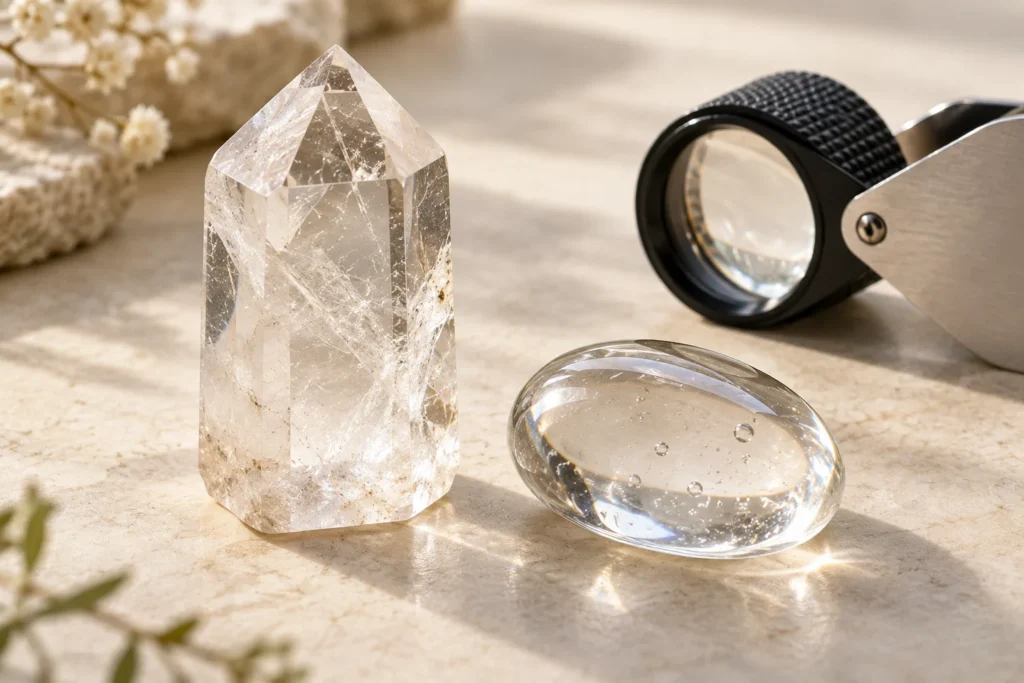
Figuring out how to tell if it's clear quartz or glass is one of the most common sourcing questions I hear from buyers placing their first wholesale orders. The uncertainty is real — mislabeling a product can damage your brand, trigger refunds, and erode customer trust. The good news: a structured approach combining visual inspection, practical tests, and supplier verification dramatically reduces that risk.
Clear quartz and glass can look nearly identical to the naked eye, but they differ in internal characteristics, thermal properties, hardness, and weight.1 No single test is 100% conclusive on its own. The most reliable approach for B2B buyers is to combine visual screening with supplier-confirmed material details, real batch photos or video, and — when stakes are high — third-party gemological verification.
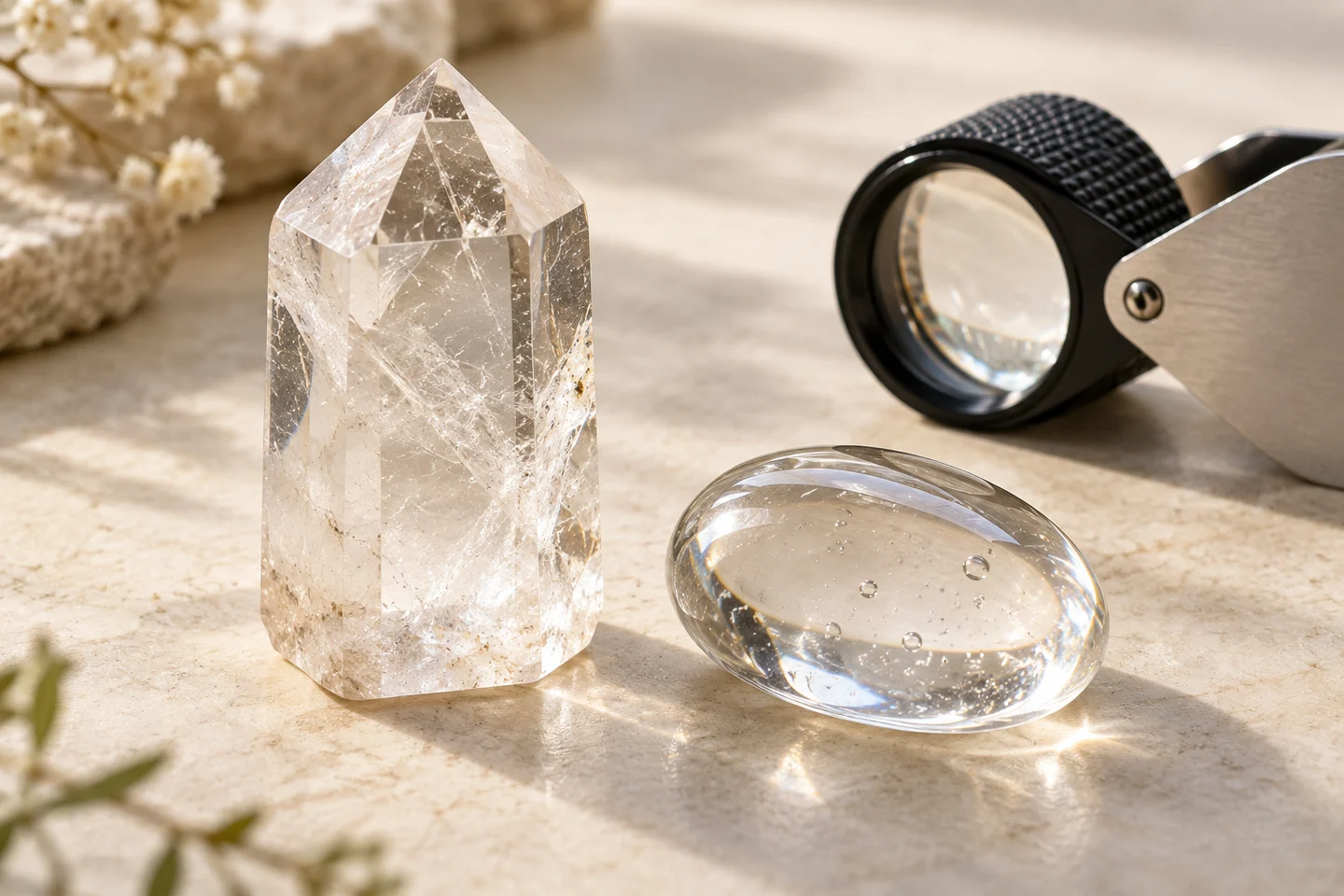
Below, I'll walk through the most practical identification clues, common misconceptions that trip up even experienced buyers, and the verification workflow I recommend from years of processing and shipping clear quartz products. Whether you're evaluating a new supplier or double-checking inventory before listing, these sections will help you make more confident decisions.
What Are the Key Visual Differences Between Clear Quartz and Glass?
Visual inspection is most buyers' first instinct — and it is a useful starting point. But relying on looks alone is where many sourcing mistakes begin, especially when you're working from product photos rather than holding pieces in hand.
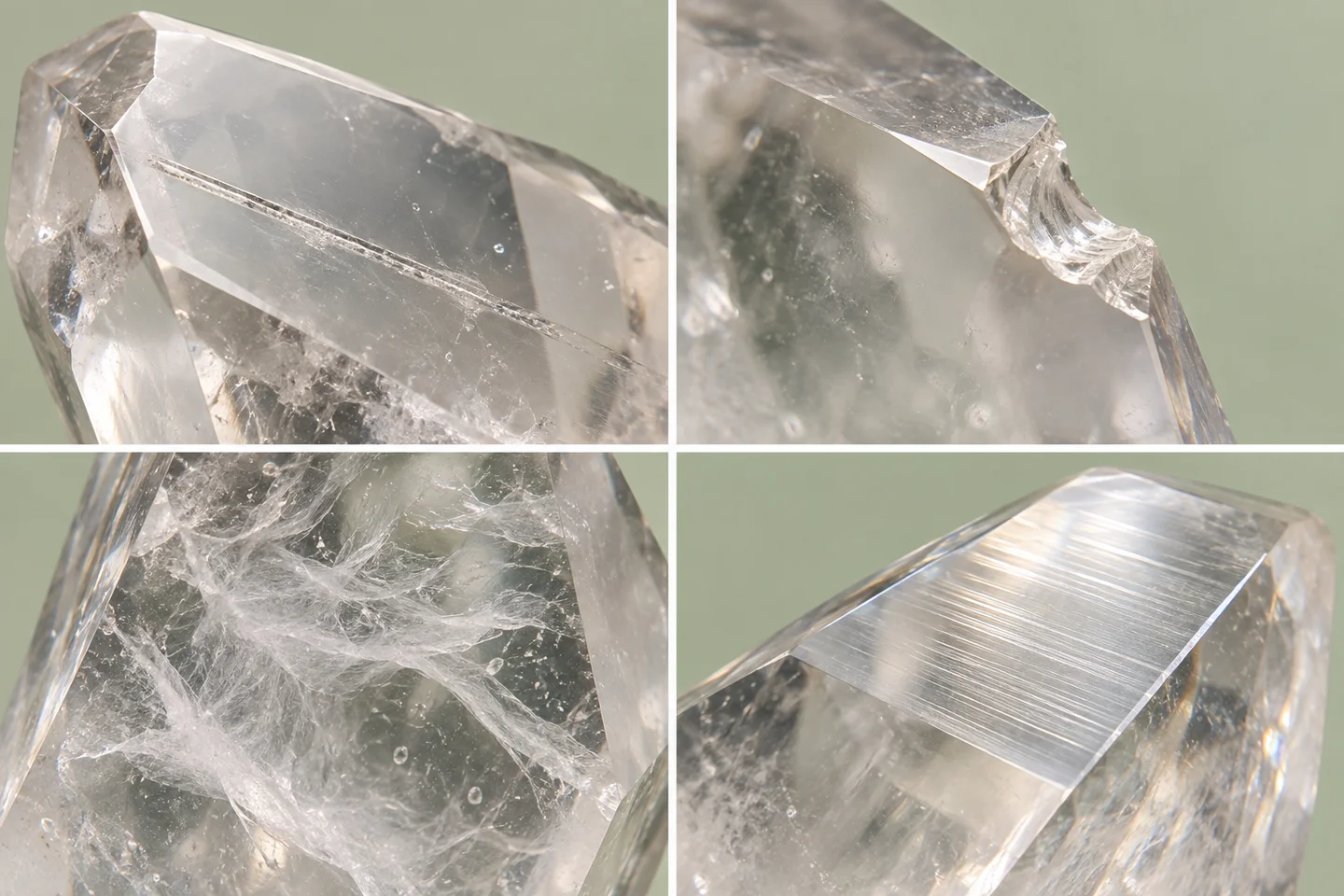
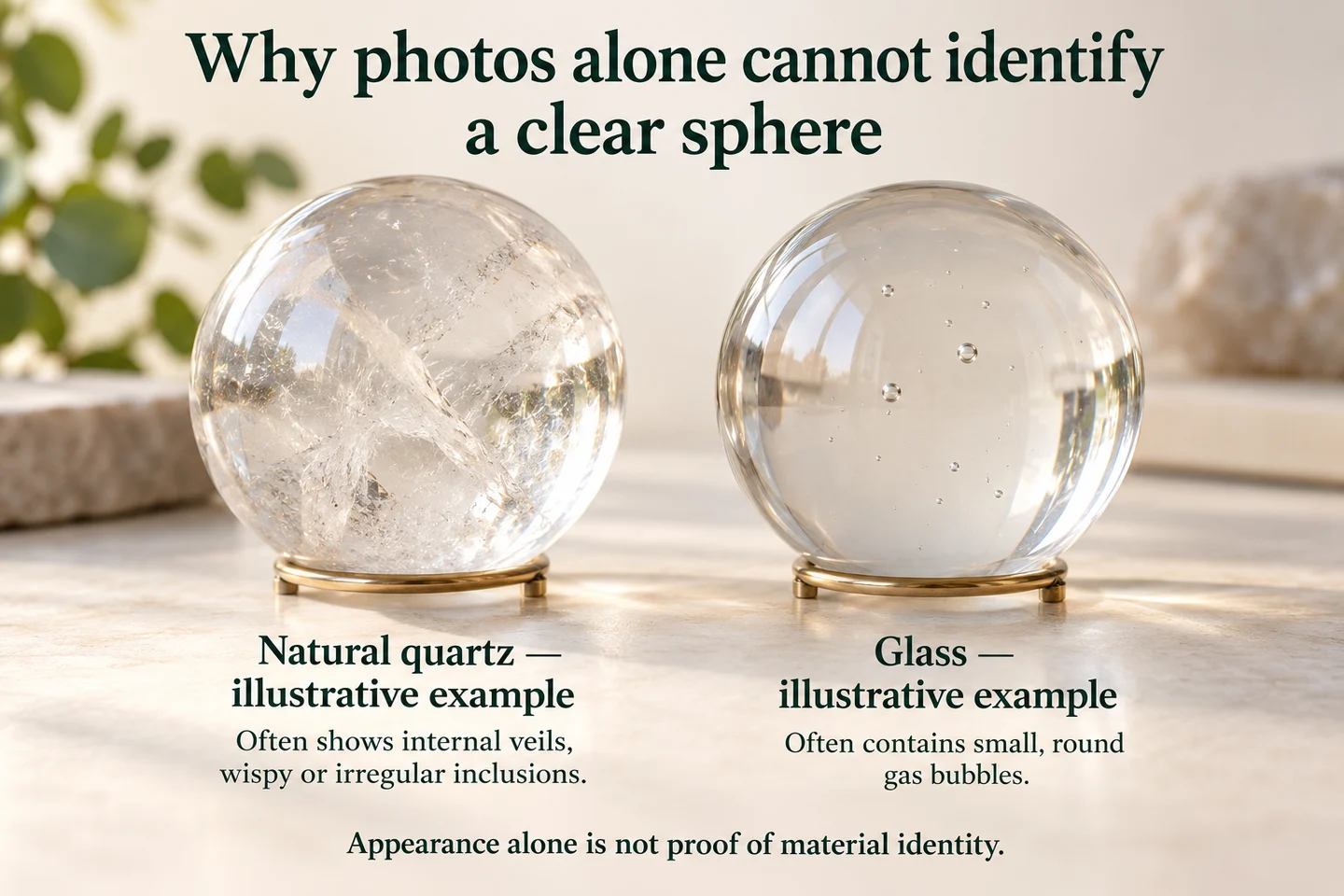
The most telling visual clues involve internal features: natural clear quartz frequently contains inclusions, cotton-like veils, internal fractures (sometimes called "rainbows"), or slightly cloudy zones.2 Glass, by contrast, tends to appear uniformly clear and may contain round air bubbles.3 However, neither perfect clarity nor the presence of inclusions is an absolute identifier.
What to Look for Inside the Piece
When you examine a piece of clear quartz or glass under good lighting, hold it up and look through it slowly, rotating it to catch light at different angles. Here's what each material typically shows:
| Feature | Natural Clear Quartz | Glass |
|---|---|---|
| Internal inclusions | Veils, wisps, needle-like rutile, phantom layers, small mineral inclusions | Rarely present |
| Air bubbles | Extremely rare; almost never perfectly round | Round or elongated bubbles are common |
| Clarity | Can range from water-clear to slightly cloudy | Often uniformly transparent |
| Internal fractures | Natural stress fractures, sometimes producing rainbow effects | Typically absent unless damaged |
| Surface texture (unpolished areas) | Conchoidal fracture with a vitreous luster | Smooth, sometimes with mold marks or seams |
Why "Too Perfect" Isn't Always a Red Flag
One misconception I encounter regularly from buyers: "This piece is too clear — it must be glass." In reality, high-grade natural clear quartz can be extremely transparent with minimal inclusions.4 Mines in Brazil, Madagascar, and parts of China produce gem-quality clear quartz that looks almost flawless.5 The absence of inclusions does not automatically mean the piece is glass.
Conversely, some lower-grade glass products can be made with deliberate imperfections to mimic the look of natural quartz. So the visual test is a screening tool, not a verdict.
A Practical Tip for Photo-Based Evaluation
If you're evaluating product photos from a supplier, pay attention to:
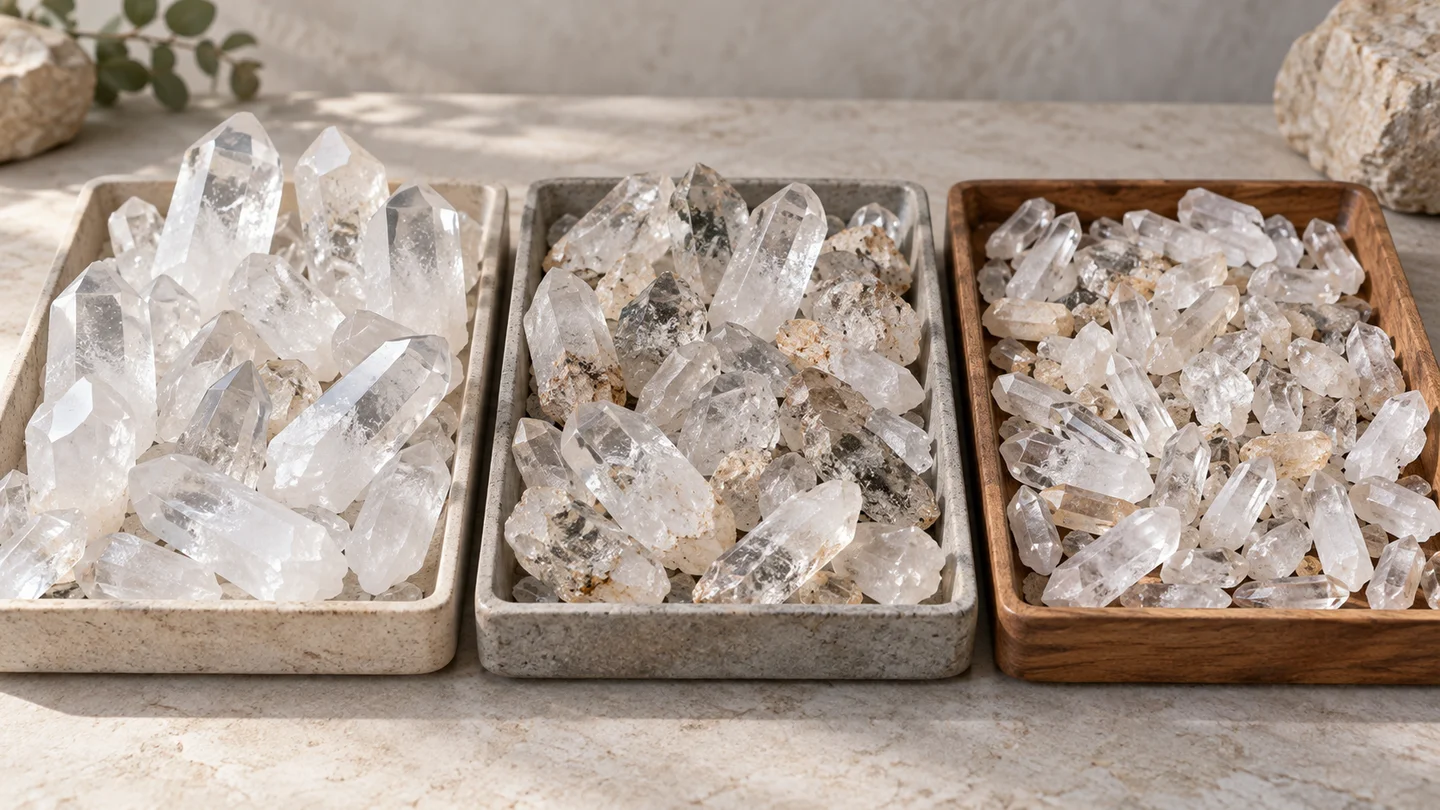
- Batch photos vs. single hero shots — real batch photos showing slight variation between pieces are a stronger indicator of natural material than a single overly polished studio image.
- Close-ups of internal features — ask for macro photos or short videos that show the inside of representative pieces.
- Consistency across the batch — a tray of 50 spheres that all look absolutely identical in clarity and color warrants more questions.
I always recommend buyers request real batch images before ordering, rather than relying on catalog photos alone. At GD Crystal, we encourage this kind of communication because it sets accurate expectations and reduces disputes later.
Can the Touch or Temperature Test Reliably Identify Clear Quartz?
You may have read that "real quartz feels cold to the touch." This advice is everywhere — on social media, in crystal community forums, and in quick identification guides. But how reliable is it for a buyer making procurement decisions?
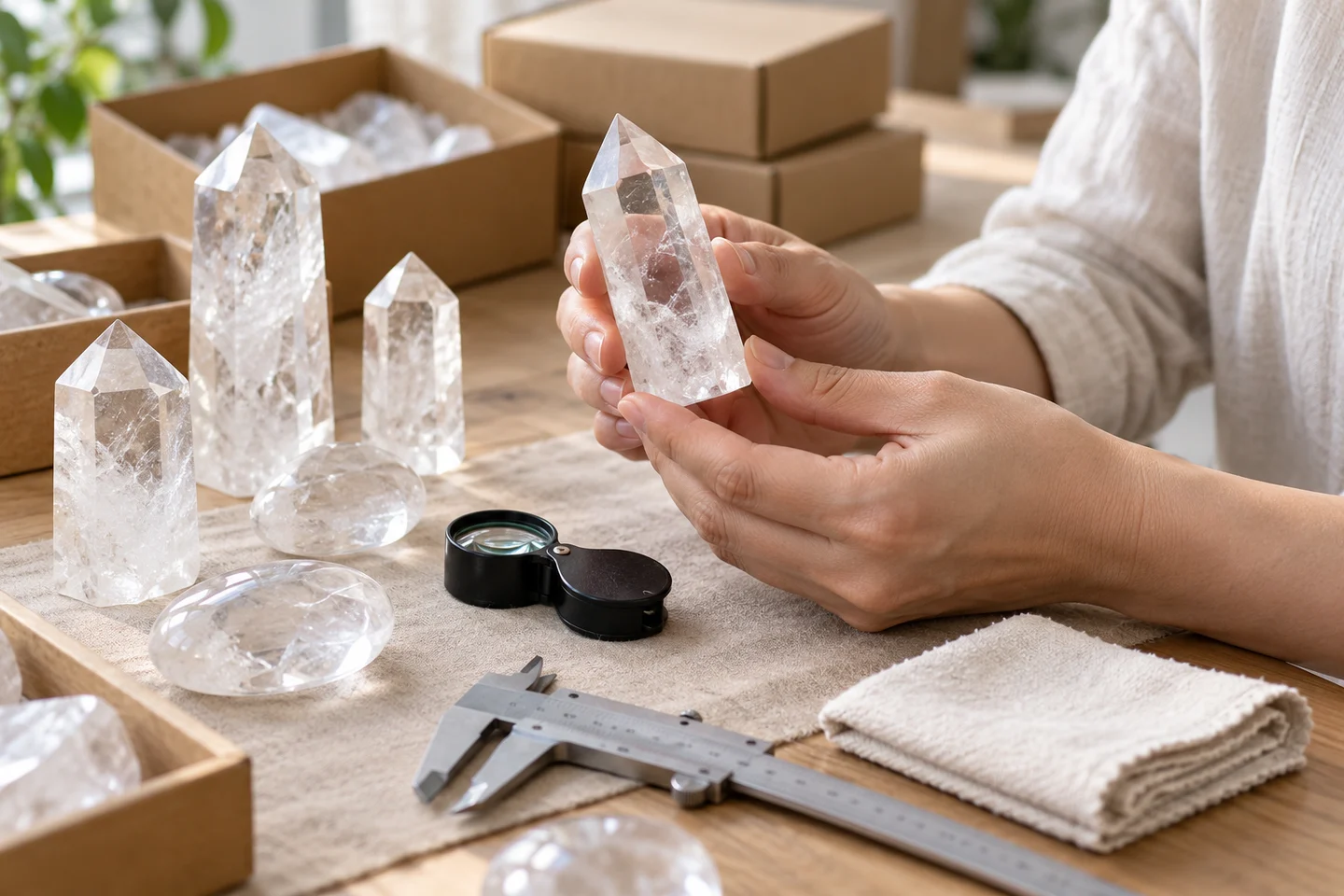
Natural clear quartz does feel noticeably cooler when you first pick it up compared to glass at the same ambient temperature. This is because quartz has higher thermal conductivity — it pulls heat from your skin faster, creating a brief sensation of coldness.6 Glass warms up in your hand more quickly. However, this test is subjective, environmental, and unreliable on its own, especially in warm rooms or when pieces are small.
Why This Test Has Limits
The temperature test works best under controlled conditions:
- Both pieces must start at the same ambient temperature. If one has been sitting in sunlight or under a display lamp, the comparison is meaningless.
- Size matters. A large sphere retains its cool feel longer than a small tumbled stone, regardless of material.
- Your own hand temperature affects perception. On a cold day, you may not notice any difference at all.
- Certain types of glass (such as borosilicate or lead crystal glass) can also feel relatively cool initially.
For B2B buyers evaluating a shipment, touching each piece individually isn't a scalable quality control method. I mention this not to dismiss the test entirely — it can confirm a suspicion if you already have doubts — but to discourage anyone from using it as a standalone purchasing decision tool.
When the Touch Test Is Most Useful
In my experience, the touch test works best as a quick triage tool during in-person inspection. If you visit a supplier's warehouse or receive samples, picking up a piece and noting how quickly it warms in your hand can be one data point among several. Pair it with visual inspection and the hardness test below, and you have a much more complete picture.
Key takeaway: The cold-touch test is a helpful clue, not a definitive answer. It should never be the sole basis for accepting or rejecting a wholesale order.
Does the Hardness Test Work for Telling Quartz From Glass?
The scratch test — based on the Mohs hardness scale — is one of the more scientifically grounded methods buyers use. Quartz sits at 7 on the Mohs scale, while most common soda-lime glass falls around 5 to 5.5.7 This means quartz can scratch glass, but glass cannot scratch quartz.8
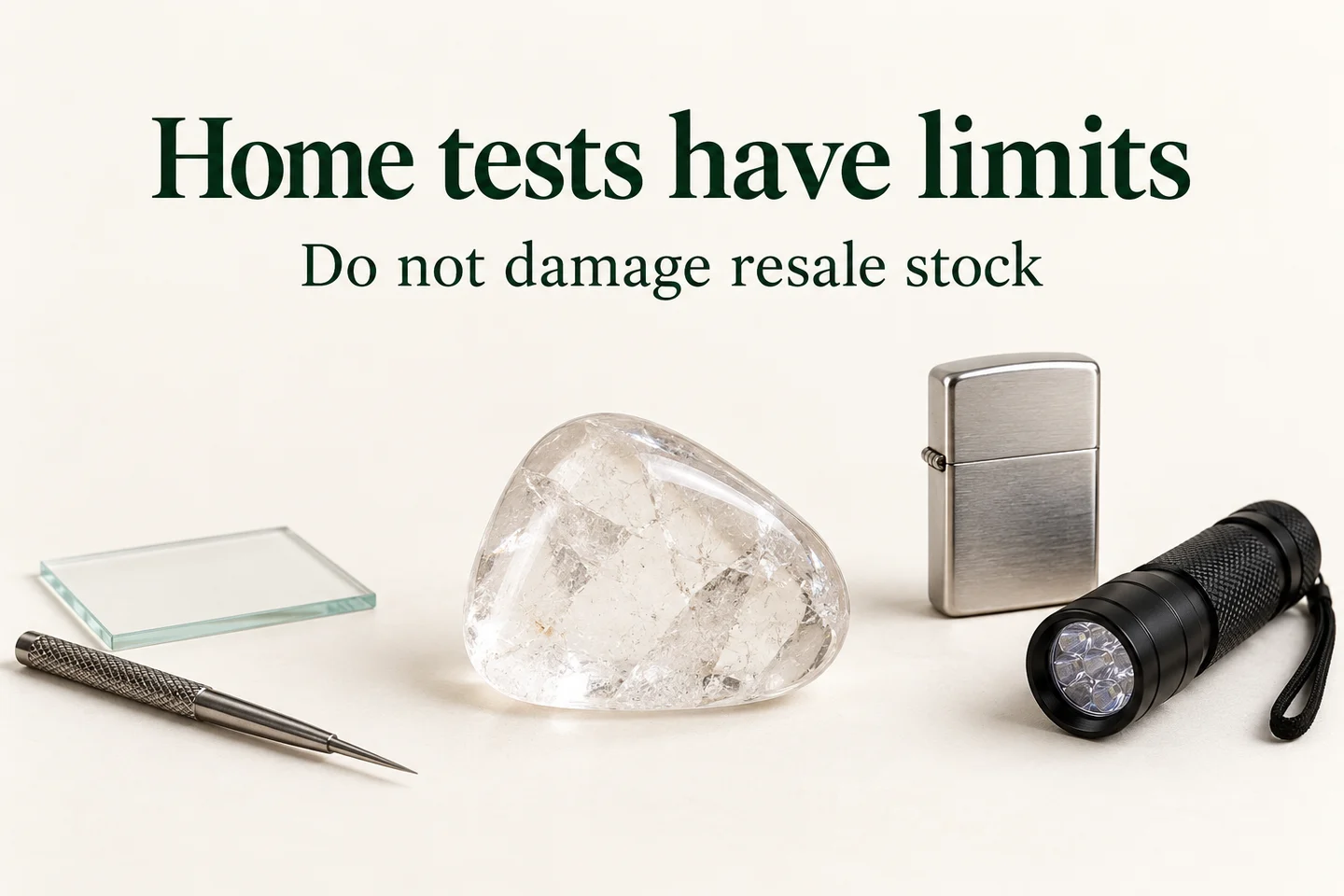
In practical terms, if you take a piece of clear quartz and try to scratch a glass surface (like a spare glass plate), real quartz will leave a visible scratch. If the piece itself gets scratched by the glass, it's likely not quartz. This is a more objective test than visual or temperature checks, but it still comes with caveats for buyers.
How to Perform the Test Properly
Here's a simple step-by-step:
- Use a piece of flat, ordinary glass — a spare glass tile or old picture frame glass works well.
- Choose an inconspicuous edge or point on the crystal piece to avoid damaging a display surface.
- Press firmly and drag across the glass — use moderate, consistent pressure.
- Check the glass surface. A genuine quartz piece should leave a visible scratch. Wipe away any powder residue and confirm the scratch is etched into the glass, not just surface dust.
- Check the crystal piece. If the tested edge shows a scratch or chip from the glass, the material is softer than 7 and may be glass or another softer mineral.
Important Caveats
- This test can damage the product. For polished spheres, towers, or carvings meant for retail, scratching them is not ideal. I recommend performing it on samples or spare pieces, not on finished inventory.
- Some specialty glass is harder than standard glass.9 Tempered glass or certain industrial glasses can have higher hardness, which could confuse results.
- Other minerals at Mohs 7 (like smoky quartz or amethyst) would produce similar results. The test confirms hardness, not specifically quartz identity.
- Coated or treated surfaces may behave differently — a glass piece with a hard coating might resist scratching in unexpected ways.
For B2B Buyers: Use This on Samples
When I'm discussing material with buyers at GD Crystal, I suggest performing the scratch test on a representative sample from the batch, not on every piece. Combined with visual inspection and supplier confirmation, it forms a strong part of a three-point verification approach: look, test, verify.
Why Do Bubbles Not Always Mean Glass?
"If you see bubbles, it's glass" — this is one of the most repeated identification rules, and it's mostly true. But the word "mostly" matters a great deal in B2B sourcing, where being almost right can still lead to costly mislabeling.
Round, spherical air bubbles trapped inside a piece are a classic sign of manufactured glass. They form when molten glass cools and traps air. Natural clear quartz virtually never contains perfectly round, isolated gas bubbles.10 However, quartz can contain fluid inclusions — tiny pockets of liquid, gas, or a mix of both that formed during the crystal's geological growth.11 These can sometimes look like bubbles to an untrained eye.
How to Tell the Difference
| Characteristic | Glass Air Bubbles | Quartz Fluid Inclusions |
|---|---|---|
| Shape | Perfectly round or elongated oval | Irregular, angular, or flattened |
| Distribution | Random, sometimes clustered near center | Often along growth planes or fracture lines |
| Content | Empty (gas) | May contain liquid, gas, or both; sometimes a visible meniscus |
| Size consistency | Often varied sizes randomly scattered | Usually very small, may need magnification |
| Surrounding features | Clean, uniform glass around them | Often accompanied by veils, fractures, or other inclusions |
What This Means for Purchasing Decisions
If you inspect a batch and see multiple perfectly round bubbles scattered throughout otherwise flawless, uniformly clear material, that's a strong glass indicator. But don't reject a piece simply because you see a small, irregularly shaped pocket deep inside — it could be a natural fluid inclusion that actually confirms the piece is genuine quartz.
For online purchasing, ask your supplier to photograph or video any visible internal features. At GD Crystal, when we process clear quartz towers or spheres, we see these natural inclusions regularly. We explain them to buyers upfront, because understanding material characteristics prevents misidentification in both directions: mistaking quartz for glass, or mistaking glass for quartz.
What Is the Safest Verification Process for B2B Buyers?
All the physical tests above — visual inspection, temperature, hardness, bubble analysis — are screening tools. For a B2B buyer placing a wholesale order worth hundreds or thousands of dollars, screening tools alone may not be sufficient. The safest process is a layered one.
For B2B purchasing, the most reliable method is combining your own physical screening with clear supplier communication and, when necessary, third-party gemological testing. This layered verification approach protects your inventory accuracy, your product listings, and your brand reputation.
Step 1: Visual and Physical Screening
Use the techniques described above on samples before committing to a full order:
- Request real batch photos and video from the supplier
- Look for natural internal features (inclusions, veils, fractures)
- Perform the scratch test on a sample piece
- Note the weight and thermal feel compared to a known reference
Step 2: Supplier Communication and Confirmation
This step is where most sourcing risk is actually managed. Ask your supplier directly:
- "Is this natural clear quartz?" — A reputable supplier will confirm material identity clearly, not dodge the question.
- "What is the origin/source of this batch?" — Knowing the mine or region adds traceability.
- "Has this material been treated or enhanced in any way?" — Heat treatment, coating, or irradiation should be disclosed.
- "Can you provide real photos and video of the current batch?" — Not stock photos from previous orders.
- "Do you have any supporting documentation?" — Some suppliers can provide test reports, certificates of material, or third-party lab results upon request.
At GD Crystal, we handle these questions routinely. We confirm material, batch, and treatment details during the quoting and order confirmation process. We find that buyers who ask these questions upfront have far fewer disputes after delivery.
Step 3: Third-Party Verification (When Warranted)
For high-value orders, new supplier relationships, or product lines where authenticity is critical to your brand positioning, consider sending a sample to a qualified gemological laboratory. Labs such as GIA, local gem testing centers, or university mineralogy departments can provide definitive identification using refractive index measurement, specific gravity testing, and spectroscopic analysis.12
This step costs money and time, so it's not necessary for every order. But it's the gold standard when the stakes justify it.
A Practical Decision Framework
| Scenario | Recommended Verification Level |
|---|---|
| Small reorder from trusted supplier | Visual screening + supplier confirmation |
| First order from a new supplier | Samples + physical tests + detailed supplier communication |
| High-value order (large volume or premium grade) | All of the above + third-party lab test on sample |
| Product line marketed as "certified natural" | Third-party lab certification required |
Frequently Asked Questions
Can I identify clear quartz vs. glass from photos alone?
Photos alone are not sufficient for definitive identification. However, real batch photos showing natural variation, visible inclusions, and internal features are far more informative than polished studio shots. Always request close-up images and videos of the actual batch, and follow up with direct supplier confirmation of the material.
Is clear quartz always more expensive than glass?
Generally, yes. Natural clear quartz involves mining, grading, and careful processing. Glass is manufactured at lower cost. However, price alone isn't a reliable indicator — some sellers price glass products as if they were natural quartz. Unusually low prices for "clear quartz" should prompt further verification, not automatic acceptance.
Do natural inclusions in clear quartz reduce its resale value?
Not necessarily. Minor inclusions, cotton-like veils, and internal rainbows are normal characteristics of natural clear quartz. Many retail customers actually appreciate these features as proof of authenticity. The key is accurately describing what buyers will receive, so expectations are set correctly.
Should I test every piece in a wholesale order?
Testing every individual piece isn't practical for wholesale. Instead, test a representative sample — typically several pieces chosen randomly from the batch. If the sample passes screening and your supplier has confirmed the material, that provides reasonable confidence for the full order.
Can a supplier guarantee material identity without a lab certificate?
An experienced, reputable supplier can confirm material identity based on their processing experience and sourcing records. This is standard practice in the industry. However, supplier confirmation is not the same as a laboratory certificate. For situations requiring formal documentation, request third-party testing.
Conclusion
Learning how to tell if it's clear quartz or glass requires more than a single trick — it takes a combination of visual inspection, practical physical tests, and structured supplier communication. No individual method is foolproof, but layering them together gives you strong protection against mislabeled inventory. Remember: look for natural internal features, use the scratch test on samples, ask your supplier direct questions about material and batch details, and invest in third-party testing when the order value or brand commitment warrants it.
At GD Crystal, we work with buyers every day to confirm material details, provide real batch photos and videos, and answer sourcing questions before orders ship. If you're evaluating clear quartz products for your store or brand and want straightforward communication from a supplier with over 15 years of processing experience, reach out to us with your product requirements — we're happy to discuss material, pricing, and samples for your next order.
References
- "Quartz", https://en.wikipedia.org/wiki/Quartz. A mineralogical reference identifies quartz as crystalline SiO2 with characteristic hardness, density, and optical properties, while glass is an amorphous material, supporting the article's general distinction between visually similar but physically different materials. Evidence role: general_support; source type: encyclopedia. Supports: A neutral mineralogical source should support that quartz is crystalline silicon dioxide with defined physical properties, while glass is amorphous and has different material characteristics.. Scope note: This supports the material distinction generally; it does not prove that any individual item is quartz or glass. ↩
- "Unusual Purple Fluid in Quartz", https://www.gia.edu/gems-gemology/fall-2022-microworld-unusual-purple-fluid-in-quartz. Gemological descriptions of quartz note that natural specimens may contain internal inclusions, veils, fractures, and cloudiness, supporting the article's use of these features as common visual clues. Evidence role: general_support; source type: institution. Supports: A gemological source should document that natural quartz commonly contains inclusions, veils, fractures, and other internal growth features.. Scope note: These features are contextual indicators rather than definitive proof of natural origin in every specimen. ↩
- "TIE-28: Bubbles and Inclusions in Optical Glass", https://wp.optics.arizona.edu/optomech/wp-content/uploads/sites/53/2016/10/tie-28_bubbles_and_inclusions_us.pdf. Materials references on glass manufacture describe bubbles as gas inclusions that may remain trapped in molten glass during forming and cooling, supporting their use as a common indicator of manufactured glass. Evidence role: mechanism; source type: research. Supports: A materials source should explain that bubbles can be trapped during glass production and appear as rounded inclusions.. Scope note: The presence or absence of bubbles alone is not a conclusive identification test. ↩
- "Quarterly Crystal: Panasqueira Quartz", https://www.gia.edu/gems-gemology/fall-2022-microworld-quarterly-crystal-panasqueira-quartz. Gemological references describe rock crystal as the colorless, transparent variety of quartz and recognize that gem-quality material may show high transparency, supporting the article's warning that clarity alone does not identify glass. Evidence role: expert_consensus; source type: institution. Supports: A gemological institution should support that colorless quartz, or rock crystal, can occur as transparent, gem-quality material.. Scope note: This establishes that clear natural quartz exists; it does not authenticate any particular commercial batch. ↩
- "Quartz crystal in Brazil", https://pubs.usgs.gov/publication/70215038. Geological and gemological source listings identify Brazil, Madagascar, and China among countries that produce quartz specimens, providing context for the article's reference to these sourcing regions. Evidence role: historical_context; source type: institution. Supports: A geological or gemological source should identify Brazil, Madagascar, and China as notable sources of quartz or rock crystal.. Scope note: Country-level production information does not verify that all material from these regions is flawless or gem grade. ↩
- "Thermal Conductivity Measurement of Soda-Lime-Silica …", http://ui.adsabs.harvard.edu/abs/2020IJT….41..100P/abstract. Published materials-property data report higher thermal conductivity for quartz than for common soda-lime glass, which is consistent with faster heat transfer from skin and the resulting transient cool sensation. Evidence role: mechanism; source type: research. Supports: A materials-property source should provide thermal conductivity values for quartz and glass and explain heat flow from skin to material.. Scope note: Tactile perception also depends on object size, ambient temperature, surface condition, and the user's skin temperature. ↩
- "Mohs scale", https://en.wikipedia.org/wiki/Mohs_scale. Mineralogical hardness tables place quartz at Mohs hardness 7, and materials references commonly list soda-lime glass near Mohs 5 to 5.5, supporting the article's hardness comparison. Evidence role: definition; source type: encyclopedia. Supports: A mineralogical reference should confirm quartz's Mohs hardness and a materials reference should confirm typical glass hardness.. Scope note: Glass hardness varies by composition and processing, so the value is typical rather than universal. ↩
- "Mohs scale", https://en.wikipedia.org/wiki/Mohs_scale. Educational geology sources define the Mohs scale by relative scratch resistance: a material of higher Mohs hardness can scratch one of lower hardness, supporting the article's explanation of why quartz can scratch common glass. Evidence role: mechanism; source type: education. Supports: An educational geology source should explain that Mohs hardness is based on relative scratching ability and that harder minerals scratch softer ones.. Scope note: The inference assumes ordinary glass and an uncoated quartz surface; surface treatments or unusual glass compositions can alter the result. ↩
- "Glass Hardness: Predicting Composition and Load Effects …", https://arxiv.org/abs/2301.08073. Materials-science studies report that glass hardness depends on composition and processing, including aluminosilicate and chemically strengthened glasses, supporting the article's caution that specialty glass may not behave like ordinary soda-lime glass. Evidence role: general_support; source type: paper. Supports: A materials-science paper should show that glass hardness varies with composition, structure, or strengthening treatment.. Scope note: This supports the possibility of harder specialty glass but does not specify the hardness of any tested consumer item. ↩
- "Quarterly Crystal: “Ball Bearing” in Quartz | Gems & … – GIA", https://www.gia.edu/gems-gemology/fall-2019-microworld-quarterly-crystal-ball-bearing-in-quartz. Gemological identification references commonly treat rounded gas bubbles as characteristic of glass imitations rather than natural quartz, supporting the article's use of such bubbles as a strong glass indicator. Evidence role: expert_consensus; source type: institution. Supports: A gemological source should distinguish gas bubbles in glass from natural inclusions in quartz and explain their diagnostic value.. Scope note: This is an expert diagnostic guideline, not an absolute rule for every specimen or synthetic material. ↩
- "Unusual Purple Fluid in Quartz", https://www.gia.edu/gems-gemology/fall-2022-microworld-unusual-purple-fluid-in-quartz. Geological references define fluid inclusions as small pockets of trapped fluid, commonly liquid and/or vapor, that may be enclosed in minerals such as quartz during crystal growth or subsequent healing of fractures. Evidence role: definition; source type: education. Supports: A geology source should define fluid inclusions and explain their occurrence in quartz during crystal growth or later geological processes.. Scope note: The definition supports the phenomenon generally; microscopic examination may be needed to distinguish fluid inclusions from bubbles in a specific specimen. ↩
- "Analysis of Gemstones at GIA Laboratories", https://www.gia.edu/gems-gemology/winter-2024-gemstone-analysis. Gemological laboratory references describe refractive index measurement, specific gravity determination, and spectroscopic examination as standard diagnostic methods for identifying gemstones and minerals, including quartz. Evidence role: mechanism; source type: institution. Supports: A gemological institution should describe refractive index, specific gravity, and spectroscopy as standard tools for gemstone or mineral identification.. Scope note: The cited methods support laboratory capability in general; the exact test suite used may vary by laboratory and specimen. ↩