Figuring out how to tell if quartz is valuable becomes surprisingly complicated when you're buying for resale rather than personal use. A stunning specimen in a supplier's photo might arrive inconsistent, hard to describe to customers, or impossible to reorder. For business buyers, "valuable" means much more than "beautiful."
Valuable quartz, from a wholesale purchasing perspective, is quartz that matches a clear resale use case, can be accurately described by variety and specs, comes from a consistent and replenishable batch, and carries manageable procurement risk.1 Visual appeal matters, but it is only one factor among many — including product form, size grading, processing quality, batch consistency, and supplier communication.
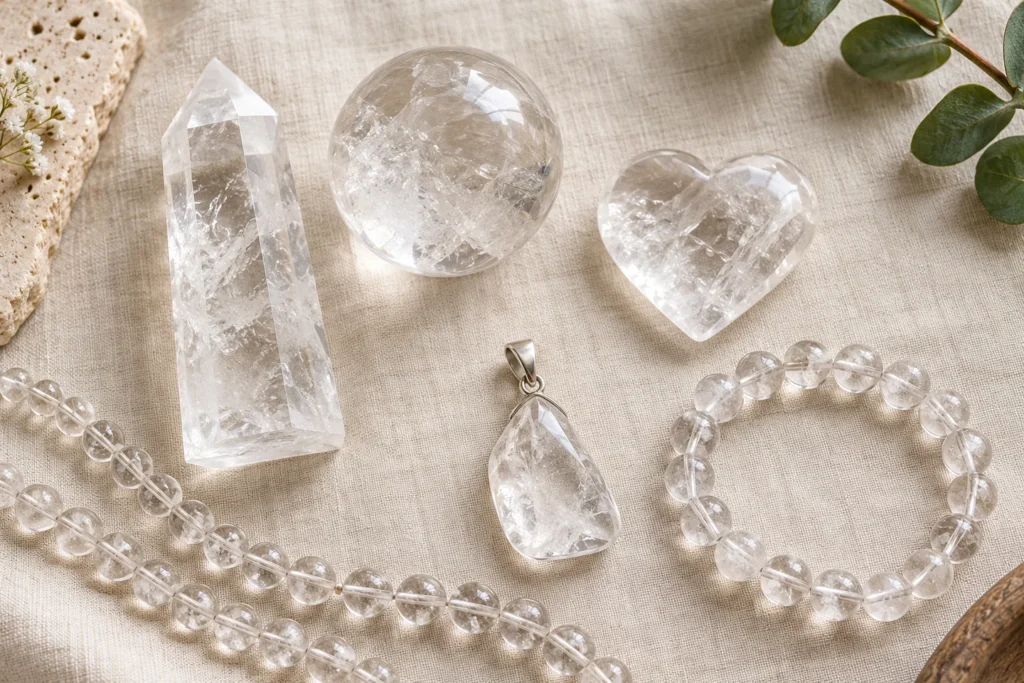
The question "Is this quartz valuable?" sounds simple, but the answer changes dramatically depending on whether you're a collector, a jeweler, a gift shop owner, or a live-selling ecommerce seller. Below, I'll break down the practical factors that determine quartz value for business buyers — drawing from years of real wholesale inquiries and sourcing conversations.
What makes quartz valuable for resale purposes?
Many new buyers start by asking "Is this quartz good quality?" But quality without context doesn't help you sell. The real question is whether a specific quartz product fits your market, your price point, and your customer expectations.
The value of quartz for resale depends on the intersection of variety, product form, visual appeal, specification accuracy, batch consistency, and market positioning. A clear amethyst tower sells differently than a milky quartz tumble stone — and both can be "valuable" when matched to the right retail context.
Start with variety and market demand
Not all quartz is equal in the market. Clear quartz, rose quartz, smoky quartz, amethyst, citrine, rutilated quartz, strawberry quartz, and garden quartz each have distinct buyer pools and retail price ranges. Some varieties trend seasonally; others remain staples.
Before evaluating any individual piece, I always recommend buyers ask: Who is your customer, and what are they looking for? A retailer serving wellness-oriented shoppers may prioritize rose quartz hearts and palm stones. An online seller targeting collectors may need high-clarity rutilated quartz towers with visible inclusions. A gift shop might need affordable tumble stones in bulk.
Here's a simplified framework for thinking about quartz value by market segment:
| Buyer Type | Typical Product Forms | Key Value Drivers |
|---|---|---|
| Independent crystal shop | Towers, spheres, palm stones, clusters | Visual appeal, unique inclusions, variety range |
| Gift retailer | Tumble stones, hearts, small carvings | Price consistency, batch uniformity, packaging |
| Ecommerce seller | Towers, spheres, raw specimens | Photo-readiness, clear specs, unique pieces |
| Live-selling seller | Mixed lots, individual standout pieces | Visual variety, story potential, competitive price |
| Brand builder | Custom shapes, branded sets | Consistency, MOQ flexibility, private labeling |
Don't confuse "rare" with "resaleable"
In wholesale inquiries, buyers sometimes ask about rare minerals or unusual varieties. Rarity can add value — but only if your customers know the variety and will pay a premium. A rare inclusion pattern means nothing if your end customer can't see or appreciate the difference. For most B2B buyers, reliable demand and clear description outweigh rarity2.
Does clarity always determine quartz value?
It's tempting to assume that clearer quartz is always more valuable. This is one of the most common misconceptions I encounter, especially from buyers new to wholesale sourcing.
Clarity is one factor in quartz value, but it is not universally the most important one.3 Some varieties — like garden quartz, rutilated quartz, or phantom quartz — derive their entire appeal from inclusions.4 Even in clear quartz, slight natural variations in transparency are normal across production batches, and "100% flawless" is rarely a realistic or necessary standard for commercial products.
When clarity matters most
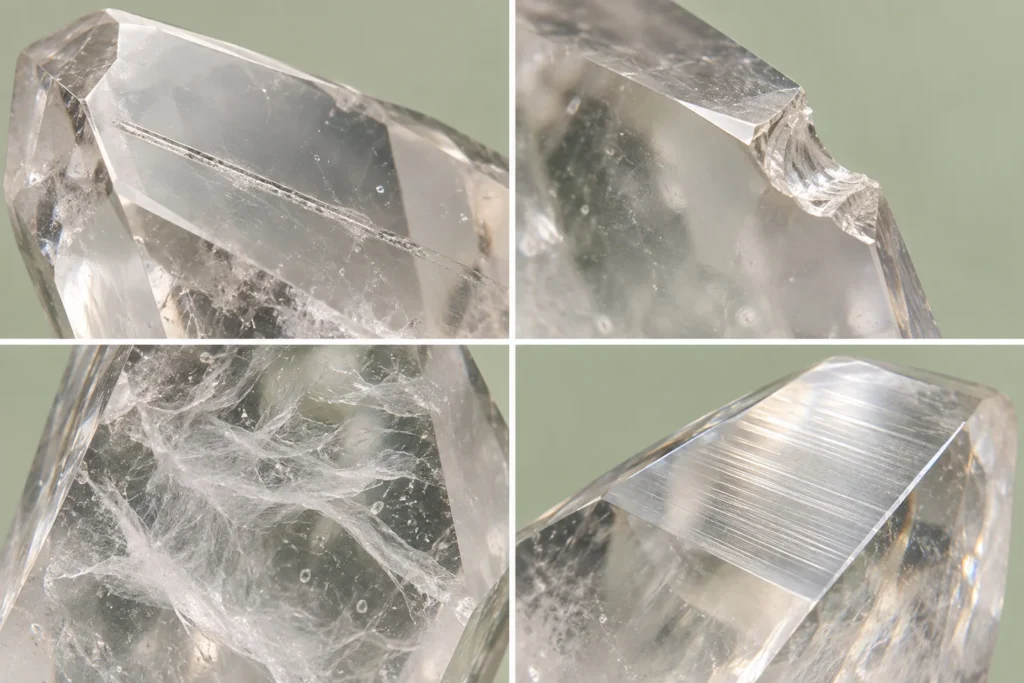
For products where transparency is the core selling point — like clear quartz spheres, polished points, or crystal balls — clarity does significantly impact value and retail pricing. Buyers in this segment should pay close attention to:
- Internal cracks and fractures: Small internal fractures are common in natural quartz. The question is whether they affect the visual presentation or structural integrity of the finished product.
- Cloudiness or milkiness: Some degree of milkiness near the base of a tower or within a sphere is typical. Full water-clear pieces command higher prices but are less common in large sizes.
- Surface blemishes after polishing: A well-polished surface without visible scratches or pitting indicates better processing quality — which is separate from the material's natural clarity.
When inclusions add value
For varieties like rutilated quartz, the value lies in the density, color, and pattern of the rutile needles. A heavily included rutilated quartz tower with golden needles arranged in a sunburst pattern can be far more valuable than a perfectly clear piece of the same size. Similarly:
- Phantom quartz is valued for visible growth layers inside the crystal.
- Garden quartz (lodolite) is prized for its scenic, landscape-like inclusions.
- Tourmalinated quartz gets its appeal from black tourmaline needles contrasting against clear matrix.
The lesson here is straightforward: evaluate clarity relative to the variety and product form, not as an absolute scale. In my experience, buyers who understand this make much better sourcing decisions because they stop chasing a single definition of "quality" and start matching product characteristics to what their customers actually want.
How important is size and weight in quartz valuation?
Bigger quartz pieces are often assumed to be proportionally more valuable. While size does play a role, the relationship between size and value is not linear5 — and for wholesale buyers, size grading introduces its own set of procurement challenges.
Size and weight affect quartz value, but the relationship depends on product form, variety, and retail context.6 Larger pieces typically carry higher per-unit costs, but they also carry higher risk if they don't sell. For most B2B buyers, the most valuable size is the one that matches their price point, display space, and customer expectations — not simply the largest available.
Size grading in wholesale
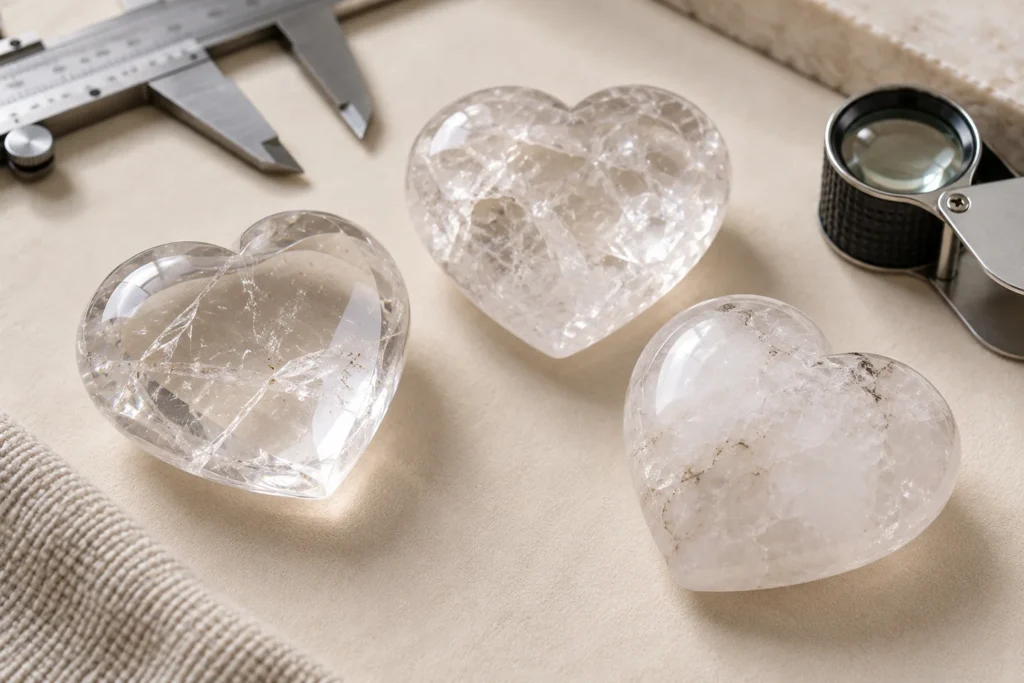
In wholesale, quartz products are typically sold within a size or weight range rather than as exact measurements. For example, a listing for rose quartz hearts might specify "5–6 cm" or "80–120 grams per piece." This range reflects the natural variation in raw material and the realities of batch processing.
Key points for buyers evaluating size:
- Always confirm the sales unit. Is the price per piece, per kilogram, or per lot? Misunderstanding this is one of the most common mistakes in quartz wholesale.
- Request the weight range, not just a single weight. A "100g palm stone" could mean anything from 80g to 130g across a batch. Knowing the actual range helps you plan retail pricing.
- Understand that larger sizes often have more natural variation. A batch of 3 cm tumble stones will look more uniform than a batch of 15 cm towers, simply because larger pieces expose more of the stone's natural character.
When smaller is more valuable
Some of the strongest resale margins in quartz come from smaller, well-processed products:
- Tumble stones in the 2–3 cm range sell in high volumes at accessible price points.
- Small hearts and stars (3–5 cm) are popular impulse-buy items in retail shops.
- Bracelet beads are valued by strand weight and bead diameter, with 8 mm and 10 mm being the most popular sizes.
For many independent retailers, a box of 50 well-graded rose quartz hearts at 4 cm each generates more revenue and faster turnover than a single large sphere. Value is ultimately measured in resale potential, not size alone.
Why do photos alone not determine quartz value?
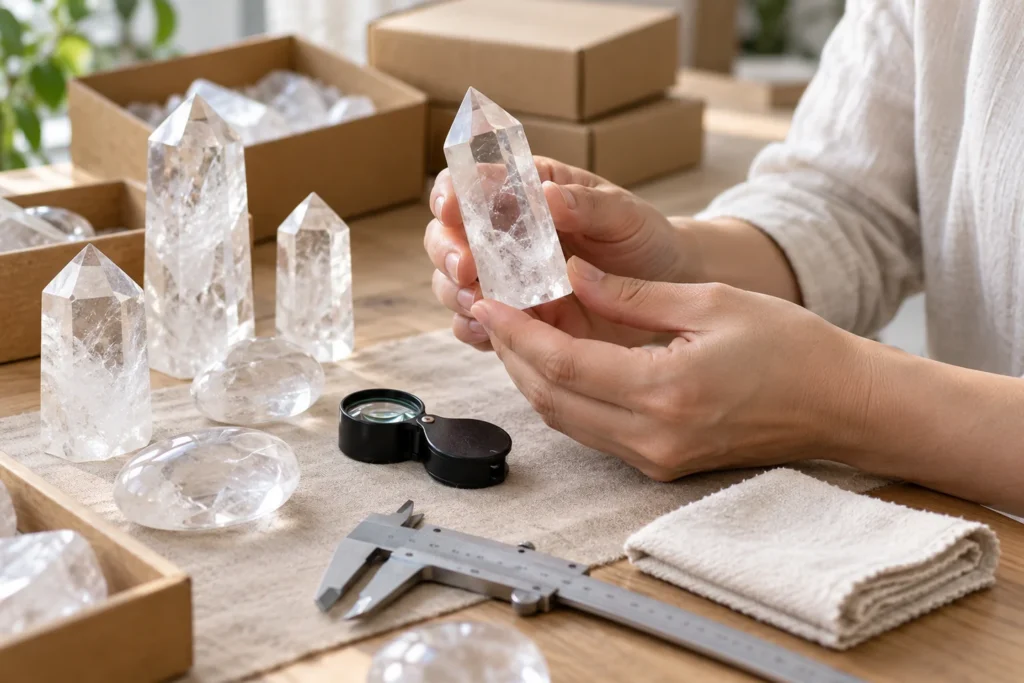
This is perhaps the most important point for online buyers. In wholesale inquiries, buyers often focus first on photos or product names. Photos are essential — but they can also mislead if you don't know what you're looking at or what questions to ask.
Photos show appearance but not full value. Without current batch photos or videos, dimensional specs, weight range, clarity of sales unit, MOQ, and packaging details, a beautiful photo can lead to a disappointing delivery. Natural stone varies by batch, and past photos should never be treated as a guarantee of future product.7
What photos can tell you
Good product photos reveal:
- General color and color range of the variety
- Surface finish quality — polish, smoothness, luster
- Inclusion patterns (especially for rutilated, phantom, or garden quartz)
- Product form and proportions — is the tower well-shaped? Is the sphere truly round?
- Obvious defects — large cracks, chips, flat spots on spheres
What photos cannot tell you
Even excellent photos have limitations:
- Color accuracy varies by screen, lighting, and photography setup.8 Warm lighting can make citrine appear deeper than it is. Cool lighting can mute the pink of rose quartz.
- A single "best piece" photo does not represent the batch. In wholesale, you're typically buying a range. The photo of the nicest piece in the lot is not what every piece will look like.
- Treatment and processing history is invisible in photos. Whether citrine is heat-treated from amethyst9, whether a surface has been coated or enhanced — these details require supplier disclosure, not visual inspection.
- Dimensions and weight cannot be judged from photos alone. A sphere looks the same at 5 cm and 10 cm in a photo without a size reference.
What to request instead
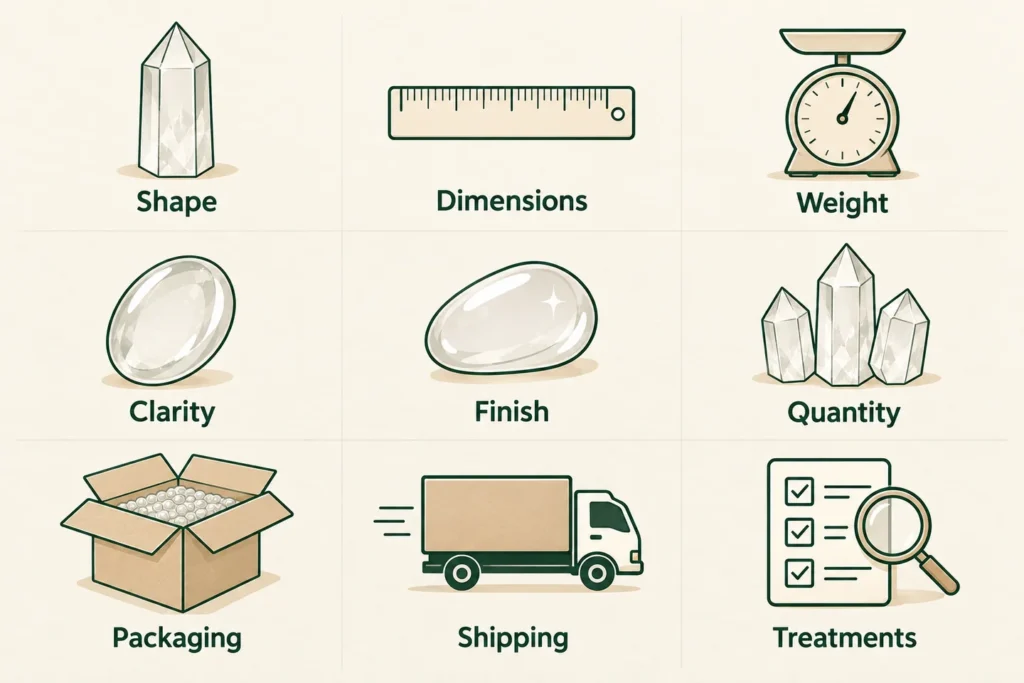
When evaluating quartz value for wholesale, I always suggest buyers provide or request the following:
- Current batch photos or videos — not old catalog images
- Size range (e.g., 6–8 cm height for towers)
- Weight range per piece (e.g., 150–250g)
- Sales unit (per piece, per kg, per lot)
- MOQ and mixed-batch conditions
- Material variety and any known treatments
- Packaging and shipping arrangement
This level of detail turns a vague "How much for quartz towers?" into a conversation that actually leads to the right product at the right price.
Is cheap quartz always a good deal?
Low price is the most seductive factor in wholesale — and the most dangerous when it's the only factor. I've seen buyers chase the lowest price per piece only to end up with product they can't sell, can't describe, or can't reorder.
Cheap quartz is not the same as valuable quartz. A low per-unit cost can hide inconsistent quality, unclear material descriptions, unstable supply, or poor processing.10 True wholesale value comes from the combination of fair pricing, batch consistency, accurate specs, reliable replenishment, and a product you can confidently explain to your customers.
Hidden costs of cheap quartz
Here are the real risks that a low price tag can obscure:
- Inconsistent grading: If a batch mixes A-grade and C-grade pieces at one price, you're subsidizing the low-quality stock with your margin on the better pieces.
- Unclear material identity: A vague label like "aura quartz" or "rare crystal" without specific mineral identification makes it hard to market honestly to informed buyers.
- Poor processing quality: Rough polish, uneven cutting, chips on edges, or poorly drilled bead holes all reduce retail value and increase return rates.
- Unstable replenishment: If you sell out and can't reorder a similar product at a similar quality level, you lose repeat customers.
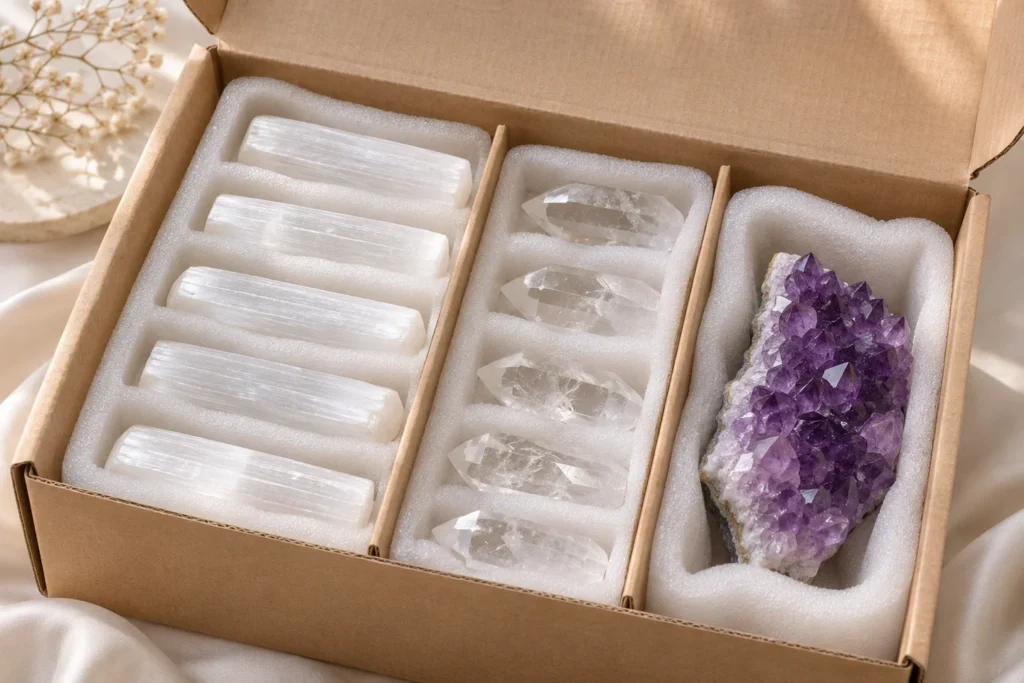
- No packaging or grading support: Loose, unpadded product arriving with chips and scratches costs you time and money in sorting and damage.
How to evaluate price fairly
Rather than simply choosing the cheapest option, consider these metrics:
| Evaluation Metric | What to Ask |
|---|---|
| Price per piece vs. per kg | Which unit makes sense for your retail model? |
| Quality grading included? | Are pieces sorted by grade, or is it a mixed lot? |
| Defect tolerance | What percentage of pieces might have minor chips or cracks? |
| Sample availability | Can you order a small trial batch before committing to larger MOQ? |
| Replenishment reliability | Can the supplier provide similar quality in the next order? |
A slightly higher cost per piece from a supplier who provides clear grading, accurate batch photos, and reliable communication almost always results in better resale outcomes than the cheapest quote from an unverified source.
How does product form affect quartz value?
The same raw quartz material can become a tower, a sphere, a palm stone, a heart, a carving, a bracelet, or stay as a raw specimen. Each product form serves a different buyer and a different retail price point. Choosing the right form is as important as choosing the right material.
Product form significantly affects quartz value because it determines the retail category, price range, display appeal, and target customer.11 A kilogram of rose quartz rough might yield tumble stones, palm stones, or a single sphere — each with different processing costs, retail prices, and sell-through rates.
Common product forms compared
| Product Form | Typical Retail Use | Key Value Factors | Processing Complexity |
|---|---|---|---|
| Tower / Point | Display, collection | Height, symmetry, clarity, tip condition | Medium |
| Sphere | Display, collection, gifts | Roundness, clarity, size, no flat spots | High |
| Palm stone | Personal use, retail impulse buy | Smoothness, size consistency, comfort in hand | Low–Medium |
| Heart | Gifts, retail display | Symmetry, polish, batch uniformity | Medium |
| Tumble stone | Bulk retail, starter sets | Color consistency, smooth finish, size grading | Low |
| Carving | Specialty retail, collection | Detail quality, design appeal, material match | High |
| Bracelet | Jewelry retail, fashion | Bead size uniformity, color match, stringing quality | Medium |
| Raw / Specimen | Collectors, display | Natural formation, aesthetic appeal, uniqueness | None (selection only) |
Matching form to business model
For a retailer with limited shelf space, a curated selection of small palm stones and towers in 3–5 varieties may generate better returns than a few large statement pieces. For an ecommerce seller who photographs and lists individual items, unique spheres or carvings with distinct inclusion patterns justify higher per-piece pricing.
The key question is: What form does your customer expect, and what are they willing to pay for the processing? A well-cut, beautifully polished tower adds real value over rough material. But that processing cost needs to be justified by the retail margin it enables.
In my experience, the buyers who succeed long-term are those who develop a clear product form strategy — they know which shapes their customers prefer, which sizes sell fastest, and which varieties to offer in which forms. This clarity makes every sourcing conversation more efficient and every batch more valuable.
Frequently Asked Questions
How can I tell if quartz is real before buying wholesale?
Requesting detailed batch photos, videos, and clear material identification from your supplier is more practical than attempting visual authentication alone. For high-value purchases, ask whether the supplier can provide third-party testing documentation. A qualified gemological lab is the appropriate authority for authentication — not a product photo.
Does treated quartz have less resale value?
Not necessarily. Many popular quartz varieties on the market involve heat treatment (such as most commercial citrine) or surface coatings (such as aura quartz). What matters for resale is honest disclosure. Buyers who clearly describe treatments to their customers build trust and avoid returns. Undisclosed treatment is the real value risk.
What is the best quartz variety to stock for a new crystal shop?
Clear quartz, rose quartz, and amethyst are the most universally recognized and requested varieties. They offer strong starting points because customers already know and look for them. After establishing these staples, you can add trending or niche varieties based on your specific customer feedback and local market demand.
Should I always buy the highest grade quartz available?
Not always. Your grade selection should match your retail positioning. A shop selling $3 tumble stones doesn't need premium AAA-grade material. A curated online store selling individual collector-grade towers does. Buy the grade your customer will pay for — stocking above or below that level wastes margin or inventory space.
What information should I provide a supplier to get an accurate quartz quote?
Specify the quartz variety, desired product form, size or weight range, quantity or target order value, quality grade expectations, packaging preferences, and shipping destination. The more specific you are, the more accurate and useful the quote will be. Vague inquiries lead to vague pricing.
Conclusion
Learning how to tell if quartz is valuable is fundamentally different for a business buyer than for an individual collector. Value isn't just about beauty, clarity, or size — it's about whether a product can be accurately described, consistently sourced, matched to your market, and sold at a sustainable margin. The most valuable quartz in your inventory is the quartz your customers want to buy and you can confidently reorder.
Before your next sourcing decision, take time to define your product form strategy, understand the specs that matter for each variety, and ask the right questions of your supplier. If you're evaluating quartz products for wholesale and want current batch details, specifications, or trial order conditions, feel free to reach out to our team at GD Crystal — we're happy to walk through the details that matter for your business.
References
- "Assessing the Best Supplier Selection Criteria in Supply …", https://pmc.ncbi.nlm.nih.gov/articles/PMC9102987/. A procurement or supply-chain management source should support that purchasing value is evaluated through conformance to specifications, supplier reliability, continuity of supply, and risk management; this provides a business context rather than a quartz-specific valuation formula. Evidence role: general_support; source type: research. Supports: Procurement value is commonly assessed through specification conformance, supplier reliability, replenishment capability, and risk, not only product attractiveness.. Scope note: Contextual support; it would not directly prove the resale value of any particular quartz batch. ↩
- "15.1 The Problem of Imperfect Information and Asymmetric …", https://pressbooks.oer.hawaii.edu/microeconomics2019/chapter/15-1-the-problem-of-imperfect-information-and-asymmetric-information/. A marketing or economics study should support that scarcity affects value only in relation to consumer demand and information, so rarity alone does not ensure resale value. Evidence role: mechanism; source type: paper. Supports: Consumer value depends on both scarcity and demand, and product information affects willingness to pay.. Scope note: General market-behavior support; it would not be specific to quartz unless the source studies gemstones or collectibles. ↩
- "Colored Gemstone Value Factors", https://www.gia.edu/gia-news-research/value-factors-design-cut-quality-colored-gemstone-value-factors. A gemological authority should support that clarity is one among several valuation factors and that inclusions can either reduce or enhance desirability depending on the gem material and variety. Evidence role: expert_consensus; source type: institution. Supports: Gem value is evaluated through multiple factors, and clarity is not the sole criterion across all gem varieties.. Scope note: General gemological support; it may not rank clarity for every quartz product form discussed in the article. ↩
- "Well-Formed Rutile Star in Quartz", https://www.gia.edu/gems-gemology/summer-2025-microworld-rutile-star-in-quartz. A mineralogical or gemological encyclopedia should support that rutilated quartz, phantom quartz, and garden quartz are distinguished by visible inclusions or internal growth features, explaining why inclusions may be central to their appeal. Evidence role: definition; source type: encyclopedia. Supports: Rutilated, phantom, and garden quartz are identified by internal inclusions or growth features.. Scope note: Definition-level support; it would not quantify how much inclusions increase resale price. ↩
- "Colored Gemstone Value Factors", https://www.gia.edu/gia-news-research/value-factors-design-cut-quality-colored-gemstone-value-factors. An educational gemology or appraisal source should support that gemstone value does not increase in a simple linear proportion to size or weight because other quality and market variables affect price. Evidence role: mechanism; source type: education. Supports: Gem prices do not scale purely in proportion to weight or size because quality, rarity, and demand interact with size.. Scope note: Contextual valuation support; the source may discuss gemstones broadly rather than commercial quartz specifically. ↩
- "Diamond Quality Factors", https://www.gia.edu/diamond-quality-factor. A gem appraisal or gemological source should support that size and weight are valuation factors only when considered together with material type, quality, and market demand. Evidence role: general_support; source type: institution. Supports: Gem and mineral valuation considers size or weight alongside quality, type, and market demand.. Scope note: General gemstone-appraisal support; it may not address wholesale quartz product categories directly. ↩
- "Dimension Stone Statistics and Information", https://www.usgs.gov/centers/national-minerals-information-center/dimension-stone-statistics-and-information. A natural-stone standards or industry-institution source should support that stone is inherently variable in color, texture, and other characteristics, so representative samples or photos have limits when applied to future batches. Evidence role: general_support; source type: institution. Supports: Natural stone products commonly show variation in color, texture, or other characteristics between pieces and lots.. Scope note: Contextual support from natural-stone standards; it may not be specific to quartz towers, spheres, or crystal retail lots. ↩
- "A Standard for Lighting Color Preference? – NIST", https://www.nist.gov/news-events/news/2017/03/standard-lighting-color-preference. A color-science source should support that perceived and reproduced color varies with illumination, camera capture, display calibration, and viewing conditions, explaining why mineral photos may not perfectly represent actual color. Evidence role: mechanism; source type: research. Supports: Lighting conditions, capture devices, display calibration, and viewing environment influence color appearance and reproduction.. Scope note: Technical support for color perception and reproduction; it would not evaluate the accuracy of any specific quartz photograph. ↩
- "Is citrine treated?", https://www.gia.edu/FAQ/gia-faq-treated-citrine. A gemological source should support that amethyst may be heat treated to produce citrine or citrine-like yellow-to-orange quartz, making treatment disclosure relevant to quartz identification and valuation. Evidence role: mechanism; source type: institution. Supports: Amethyst can be heat treated to produce yellow-to-orange citrine-like material, and such treatment is recognized in gemology.. Scope note: Supports the existence of the treatment; it would not prove that any photographed item has been treated. ↩
- "EFFECTIVE METHODOLOGIES FOR SUPPLIER SELECTION …", https://etda.libraries.psu.edu/files/final_submissions/419. A procurement research paper should support that low purchase price alone can be misleading when supplier quality, specification accuracy, delivery reliability, and total cost of ownership are considered. Evidence role: mechanism; source type: paper. Supports: Procurement decisions based only on low unit price can increase total cost or risk when quality, delivery reliability, and supplier performance are poor.. Scope note: General procurement support; it would not document the defect rate of quartz lots from any particular supplier. ↩
- "Colored Gemstone Value Factors", https://www.gia.edu/gia-news-research/value-factors-design-cut-quality-colored-gemstone-value-factors. A lapidary or gemology education source should support that cutting, polishing, and finished form affect gemstone presentation and value, providing context for why quartz towers, spheres, beads, and rough specimens occupy different retail categories. Evidence role: mechanism; source type: education. Supports: Cutting, polishing, and product form can change how a gem material is categorized, displayed, and valued.. Scope note: Contextual support; it may not provide comparative sell-through rates for each quartz form. ↩