Searching for the side effects of clear quartz is one of the most common questions crystal shop owners receive from their customers. The concern is understandable — people want to know if a stone they wear, carry, or place in their home could cause harm. But the framing itself can lead retailers into risky territory if product descriptions start sounding like medical advice.
Clear quartz does not have clinically documented "side effects" in the medical sense. It is a silicon dioxide mineral, not a pharmaceutical substance.1 The real risks for retailers and brands lie in making unverified health claims, providing inaccurate material descriptions, and overlooking practical safety considerations related to product form — such as sharp points, breakage, or choking hazards from small pieces.
So where does this leave you as a buyer sourcing clear quartz for resale? Below, I break down what "side effects" actually means in a retail and product context, how to handle customer questions responsibly, and what practical safety and material concerns should genuinely be on your radar.
Why Do People Ask About Clear Quartz Side Effects?
If you sell crystals online, you have probably seen this question in customer messages, product reviews, or social media comments. Consumers encounter a wide range of claims about clear quartz — from emotional cleansing and energy amplification to detox effects and anxiety relief. When the language around crystals sounds therapeutic, people naturally start wondering about the flip side.
The question about clear quartz side effects typically comes from consumers who have read wellness or metaphysical content that describes crystals in language borrowed from health and medicine. When a product is said to "clear negative energy," "amplify healing," or "detoxify the body," it is reasonable for a buyer to ask: could it also cause unwanted reactions?
The Gap Between Belief and Clinical Evidence
The crystal wellness space exists at the intersection of personal belief, cultural tradition, and consumer product marketing. Some people believe that clear quartz can influence mood, energy levels, or even physical wellbeing. These beliefs are widely held and deeply personal. However, there is no peer-reviewed clinical evidence that clear quartz produces measurable physiological effects — positive or negative — through proximity or contact with the body2.
This distinction matters enormously for B2B buyers and brand owners. Here is why:
- If you describe clear quartz as having healing effects, customers may logically ask about side effects, contraindications, and interactions — questions you are not qualified to answer unless you are a licensed health professional.
- If you describe clear quartz accurately as a natural mineral product, customer expectations align with what you can actually verify and stand behind.
What Consumers Actually Report
When consumers describe "side effects" of clear quartz online, the reported experiences typically include:
| Reported Experience | Likely Context |
|---|---|
| Feeling overwhelmed or anxious | Often attributed to "energy amplification" in metaphysical frameworks |
| Vivid dreams or disrupted sleep | Commonly discussed in crystal healing communities |
| Headaches or dizziness | Sometimes reported when wearing crystal jewelry for extended periods |
| Emotional release or mood shifts | Frequently described after meditation with crystals |
These experiences are real to the people who report them. I am not dismissing anyone's subjective experience. But as a supplier that has handled thousands of B2B inquiries over 15 years, I can tell you that the responsible approach is to distinguish between subjective personal experience and verifiable product properties. Phrases like "some people believe" or "in some traditions" are far safer than definitive cause-and-effect statements.
Key takeaway for retailers: You can acknowledge customer experiences respectfully without positioning your product listings as health guidance.
How Should Retailers Handle Customer Questions About Crystal Side Effects?
This is a communication challenge, not a product defect issue. Many crystal shop owners feel caught between two extremes: making bold metaphysical claims that attract buyers, or being so cautious that their listings feel sterile and disconnected from the crystal community. Neither extreme serves your business well.
The best approach for retailers handling questions about clear quartz side effects is to respond with respect, use bounded language, and redirect the conversation toward verifiable product information. Acknowledge the customer's concern, clarify that your products are natural mineral items (not health devices), and recommend consulting a qualified professional for any health-related questions.
Building a Responsible Product Description Framework
At GD Crystal, we regularly work with buyers who ask how to write product descriptions that are both appealing and responsible. Here is a practical framework:
1. Lead with material facts:
- Mineral type: natural silicon dioxide (SiO₂)3
- Hardness: 7 on the Mohs scale4
- Origin and treatment status (natural, polished, coated, irradiated, etc.)
- Dimensions, weight range, and batch variation notes
2. Use bounded language for metaphysical references:
- ✅ "Clear quartz is traditionally associated with clarity and focus in many cultures."
- ✅ "Some people use clear quartz during meditation practices."
- ❌ "Clear quartz will heal your anxiety and detoxify your body."
- ❌ "This crystal amplifies your immune system."
3. Include a standard disclaimer:
A simple line such as "Our products are sold as natural mineral specimens and decorative items. They are not intended to diagnose, treat, cure, or prevent any disease." protects your brand and sets appropriate expectations.
Why This Matters for Your Business
In several markets — including the United States, European Union, United Kingdom, and Australia — consumer protection regulations restrict health claims on products that are not registered medical devices or therapeutic goods5. Crystal retailers who make specific health claims risk regulatory action, platform listing removal, and loss of customer trust6 when those claims cannot be substantiated.
From a brand-building perspective, honest communication actually builds stronger customer relationships. Buyers who trust your product descriptions are more likely to return and recommend your shop.
What Are the Real Safety Concerns with Clear Quartz Products?
While "energy side effects" are difficult to verify, there are genuine, practical safety concerns associated with clear quartz products that every retailer and sourcing buyer should take seriously. These relate to product form, handling, and packaging — areas where your decisions as a buyer directly affect customer safety.
The real safety concerns with clear quartz center on physical hazards from product form: sharp points on towers and wands, chipping and breakage during shipping, small tumbled stones that pose choking risks for young children7, and silica dust exposure during cutting or polishing. These are tangible, preventable issues that responsible sourcing and packaging can address.
Sharp Points and Edges
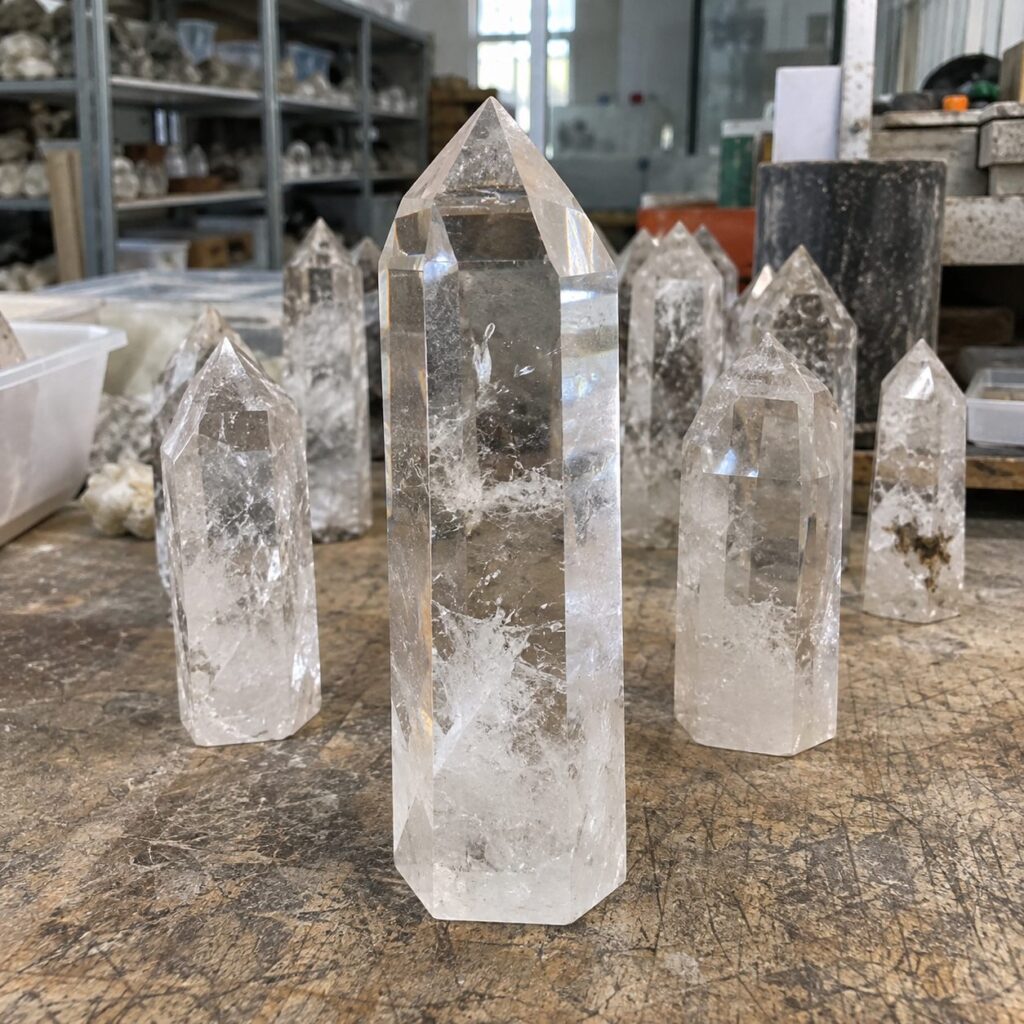
Clear quartz towers, generator points, and raw crystal clusters often have naturally sharp tips or fractured edges. These can cause cuts during unpacking or handling. For retailers:
- Consider tip protectors or foam caps for pointed products in shipment
- Note sharp edges in product listings so customers handle items with care
- Inspect incoming shipments for chipped or cracked pieces that could have exposed sharp surfaces
Breakage and Fragmentation
Despite a Mohs hardness of 7, clear quartz can chip or fracture on impact — especially thinner pieces, delicate carvings, or items with natural internal fractures (which are common and not defects). Broken crystal pieces can create sharp fragments.
| Product Form | Breakage Risk Level | Packaging Recommendation |
|---|---|---|
| Tumbled stones | Low | Bulk bags with padding between layers |
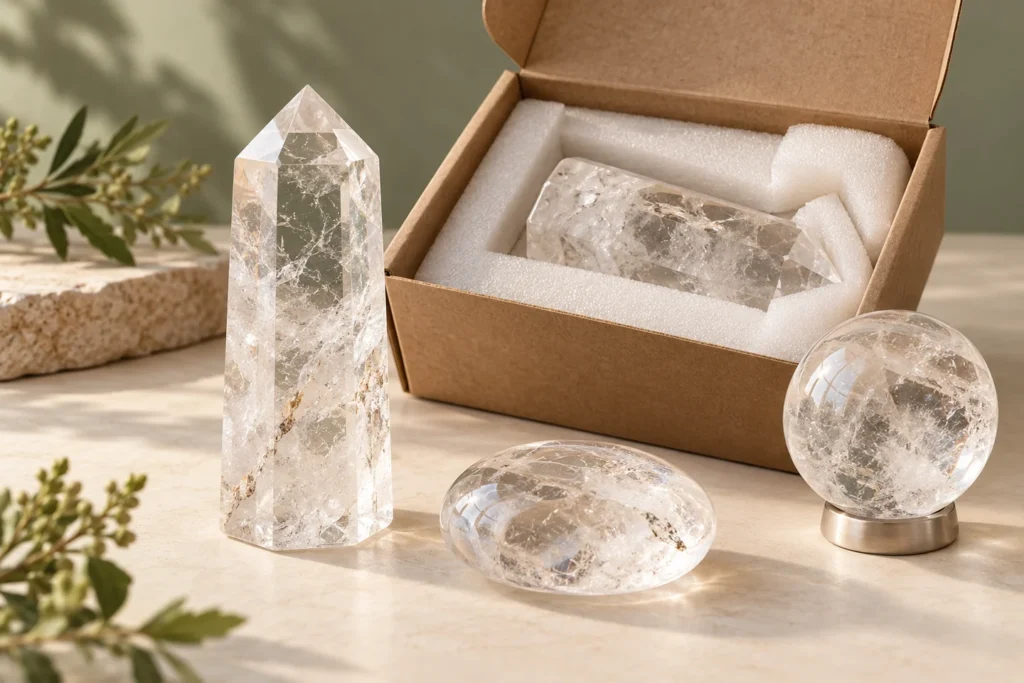
| Spheres | Medium | Individual foam-lined boxes |
| Towers / Points | Medium-High | Individual wrapping + tip protection |
| Raw clusters | High | Heavy padding, rigid outer box |
| Thin carvings | High | Custom foam inserts |
At GD Crystal, packaging discussions are part of every order conversation. We have seen too many cases where beautiful products arrive damaged because packaging was treated as an afterthought. For B2B buyers, specifying packaging requirements upfront is not an extra cost — it is risk prevention.
Choking Hazards
Small tumbled clear quartz, crystal chips, and gravel-size pieces can pose choking hazards for children under three. If you sell crystal products in retail environments where children may have access, or if your products are marketed as gifts:
- Include appropriate age warnings on packaging
- Follow the consumer safety labeling standards for your target market
- Consider whether product size meets small-parts testing requirements in markets like the US (CPSC) or EU (EN 71)
Silica Dust
This is primarily a concern for anyone involved in cutting, grinding, or polishing clear quartz — not for end consumers handling finished products. Crystalline silica dust is a recognized occupational health hazard.8 Responsible manufacturers use wet cutting methods and dust extraction systems to protect workers.9
As a buyer, you can ask your supplier about their workshop safety practices. This is not just a compliance issue; it reflects the ethical standards of your supply chain.
How Can Buyers Verify That Their Clear Quartz Is Actually Clear Quartz?
One of the less obvious "side effects" of the clear quartz market is the risk of material confusion. Not every transparent stone sold as clear quartz is natural clear quartz. Misidentified or misrepresented material undermines your brand credibility and can trigger customer disputes, returns, and negative reviews.
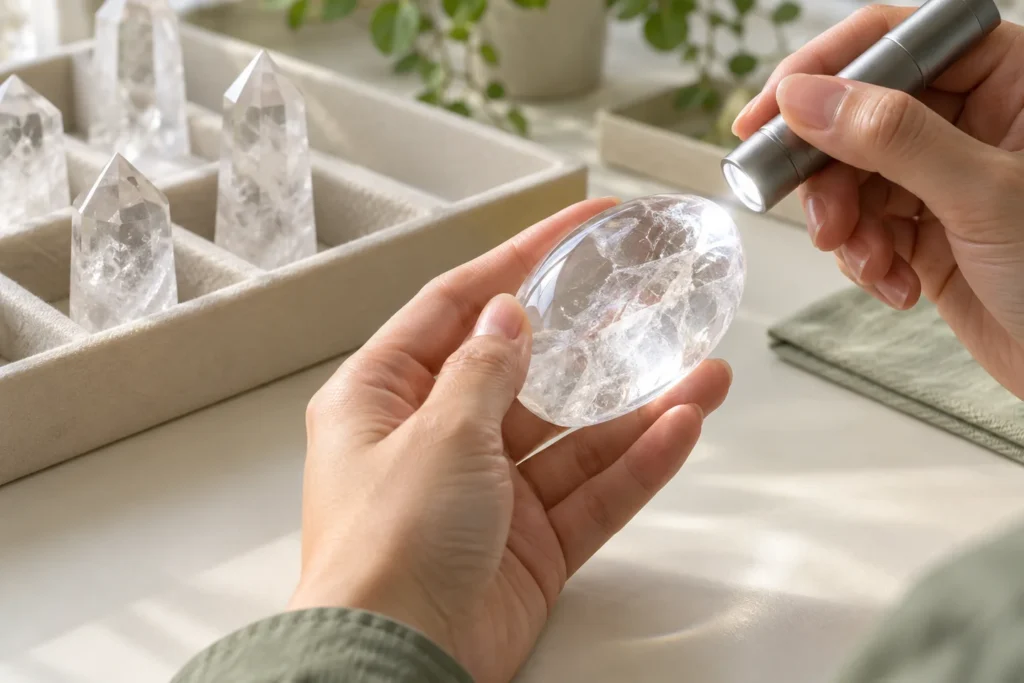
To verify that your clear quartz is genuine, buyers should confirm the material type, natural versus treated status, and origin details with their supplier before placing orders. Request recent batch photos, ask about any treatments (coating, irradiation, heat treatment), and consider third-party testing for high-value or large-volume orders.
Common Material Confusions
Here are the most frequent issues we encounter in buyer conversations:
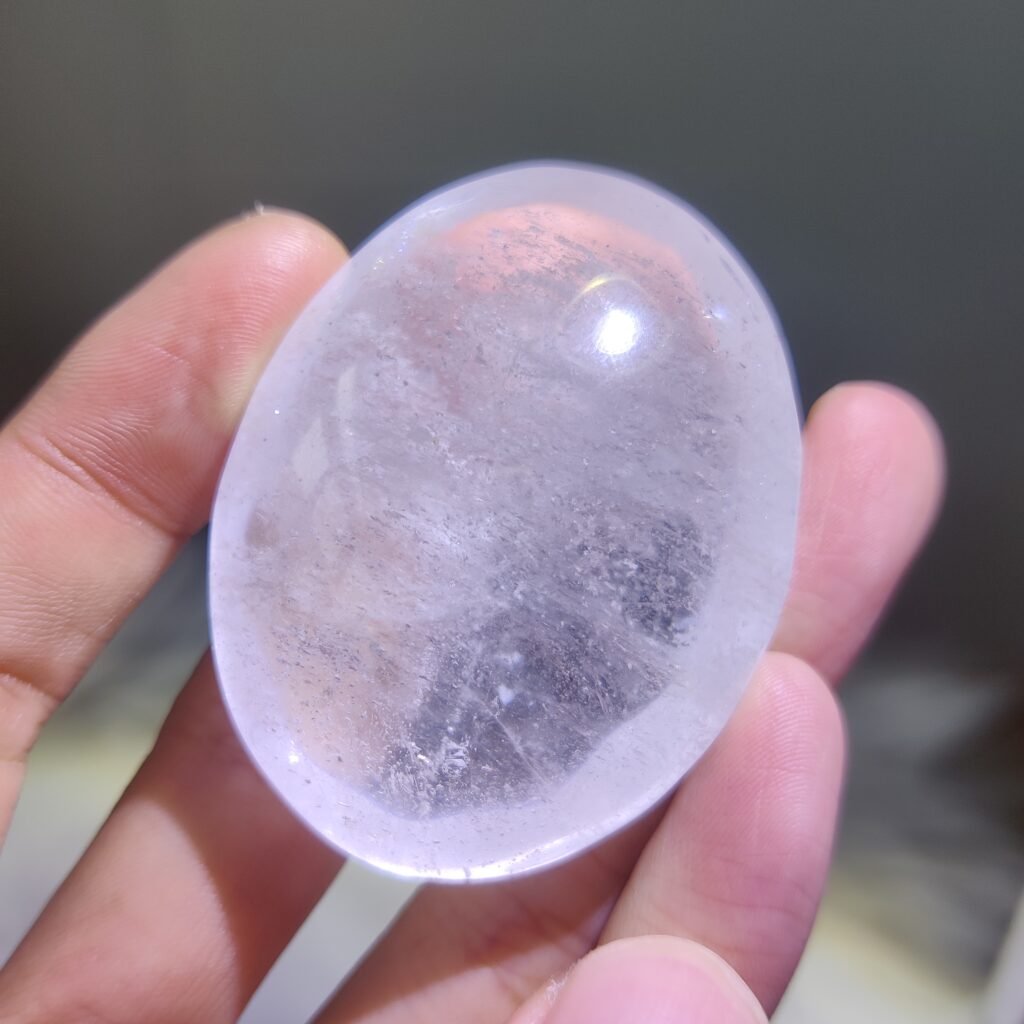
- Glass vs. natural clear quartz: High-clarity glass can closely resemble polished clear quartz. Glass is typically more uniform, lacks natural inclusions, and may show mold lines or bubbles under magnification.10
- Synthetic quartz vs. natural quartz: Lab-grown quartz is chemically identical to natural quartz but is produced in controlled environments.11 It tends to be extremely clear with few inclusions. For many retail applications, the distinction matters to customers who expect a natural product.
- Treated quartz: Some clear quartz may be irradiated, coated (aura quartz), or heat-treated to alter its appearance. These treatments should always be disclosed in product listings.
- Other minerals: Occasionally, stones like white topaz, white sapphire, or even optical calcite may be confused with clear quartz by less experienced buyers.
What to Ask Your Supplier
When sourcing clear quartz, I recommend discussing these points before your first order:
- Is this natural clear quartz (SiO₂)? A straightforward question, but one that should be asked explicitly.
- Has this batch received any treatment? Coating, irradiation, heat treatment, and surface polishing should all be disclosed.
- Can you provide current batch photos and videos? Historical photos may not represent your actual shipment.
- What is the expected range of clarity, inclusions, and size variation? Natural products vary. Understanding the range helps you set accurate customer expectations.
- Do you offer sample orders or trial quantities? At GD Crystal, we understand that first-time buyers want to evaluate product quality before committing to larger volumes. Discussing sample or small-batch options is a normal part of the sourcing process.
A note on certifications: Some buyers ask about gemological certificates for clear quartz. These are available through labs like GIA, but are typically reserved for high-value individual specimens. For standard wholesale batches, direct material discussion with your supplier and visual inspection of samples is the more practical verification path.
Should Retailers Include Disclaimers on Clear Quartz Product Listings?
Many crystal sellers skip disclaimers, either because they seem unnecessary for a "natural product" or because they feel disclaimers undermine the mystical appeal of crystals. But in a market where customers actively search for "clear quartz side effects," having clear, professional disclaimers is a sign of brand maturity — not weakness.
Yes, retailers should include concise disclaimers on clear quartz listings. A well-written disclaimer protects your business from liability, sets appropriate customer expectations, and demonstrates professionalism. It does not need to be long or legalistic — a few clear sentences addressing health claims, product variation, and intended use are sufficient.
What a Good Disclaimer Covers
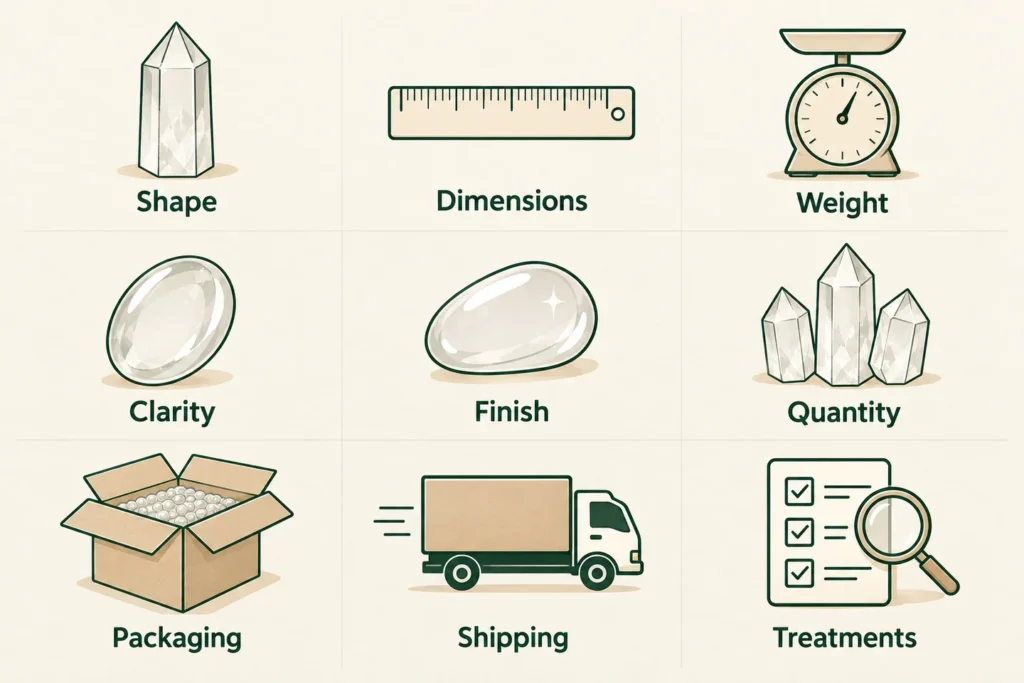
A practical disclaimer for clear quartz products should address:
- Health and healing claims: State that the product is not intended for medical use, diagnosis, or treatment. Redirect health concerns to qualified professionals.
- Metaphysical references: If your listing references traditional beliefs about crystal properties, clarify that these are cultural or traditional associations, not guaranteed outcomes.
- Product variation: Natural clear quartz varies in clarity, size, inclusion patterns, and shape. Note that photos represent the general appearance but each piece is unique.
- Safety: Mention any relevant hazards (sharp points, small parts, fragility) and recommend keeping products away from young children if applicable.
Sample Disclaimer Template
Here is a starting point you can adapt for your brand:
"This product is a natural clear quartz mineral specimen sold for decorative, collectible, and personal enjoyment purposes. It is not a medical device and is not intended to diagnose, treat, cure, or prevent any health condition. References to traditional crystal properties reflect cultural beliefs and are not guaranteed outcomes. Natural variations in color, clarity, size, and inclusions are normal. Please keep small items away from children under 3."
This type of language costs you nothing but can save significant headaches down the road.
Frequently Asked Questions
Can clear quartz cause headaches or anxiety?
There is no clinical evidence that clear quartz directly causes headaches or anxiety. Some individuals report subjective experiences they associate with crystal use, but these are not medically documented side effects. If customers report discomfort, recommend they consult a healthcare professional rather than attributing symptoms to the crystal.
Is clear quartz safe to touch or wear daily?
Yes, clear quartz is a stable, non-toxic mineral that is safe for skin contact and everyday wear in finished product forms like polished jewelry, tumbled stones, and carvings. The main practical caution is with rough or pointed pieces that may have sharp edges. Always inspect products for chips or damage before selling.
How do I know if my clear quartz is real or glass?
Natural clear quartz typically contains minor inclusions, veils, or internal fractures visible under magnification, while glass tends to be more uniform and may contain bubbles or mold marks. For wholesale verification, request current batch photos from your supplier, ask directly about material composition, and consider ordering samples before committing to volume.
Do I need to disclose if clear quartz has been treated?
Yes. Treatments such as irradiation, coating, or heat treatment should be disclosed in product listings.12 Transparency about treatments builds customer trust, reduces return disputes, and aligns with consumer protection standards in most markets. Ask your supplier about treatment status for every batch.
Can I legally sell clear quartz with healing claims?
This depends on your market's regulations, but in general, making specific health or healing claims about crystal products without clinical evidence carries legal and platform compliance risks. Use bounded language like "traditionally associated with" rather than definitive statements. Consult a legal professional familiar with your local consumer protection laws for specific guidance.
Conclusion
The question "what are the side effects of clear quartz" reflects a growing consumer awareness that deserves a thoughtful, honest response from retailers and brands. Clear quartz, as a natural mineral, does not produce medical side effects. The real risks lie in misleading product claims, inaccurate material descriptions, and overlooked physical safety issues like sharp edges, breakage, and choking hazards.
As a B2B crystal supplier with over 15 years of processing and wholesale experience, we at GD Crystal see these questions come up regularly in buyer conversations. Our recommendation is straightforward: lead with accurate product information, use respectful and bounded language around metaphysical beliefs, and take practical safety and packaging seriously.
If you are sourcing clear quartz for your retail business and want to discuss material options, product forms, packaging requirements, or trial order terms, reach out to GD Crystal. We are happy to walk through the details — product by product, batch by batch.
References
- "Placebo effects in alternative medical treatments for anxiety", https://pmc.ncbi.nlm.nih.gov/articles/PMC13064771/. Mineralogical references identify quartz as crystalline silicon dioxide, while clinical literature does not establish quartz contact or proximity as a source of pharmacological side effects; this supports treating clear quartz as a mineral product rather than a medical substance. Evidence role: general_support; source type: research. Supports: A neutral source should support that quartz is silicon dioxide and that crystal healing claims lack clinical evidence of physiological effects.. Scope note: This supports the material classification and absence of established clinical evidence, but it cannot prove that no individual has ever reported symptoms while using quartz. ↩
- "Placebo effects in alternative medical treatments for anxiety", https://pmc.ncbi.nlm.nih.gov/articles/PMC13064771/. Controlled research on crystal healing has not demonstrated measurable physiological effects attributable to crystals themselves, supporting the article’s distinction between subjective experience and clinically evidenced effects. Evidence role: expert_consensus; source type: paper. Supports: A peer-reviewed study or review should support that crystal healing effects have not been demonstrated beyond placebo or expectation effects.. Scope note: The evidence is contextual to crystal healing generally and may not test every commercial form of clear quartz. ↩
- "Silicon dioxide", https://en.wikipedia.org/wiki/Silicon_dioxide. Standard mineralogical references define quartz as a crystalline form of silicon dioxide (SiO₂), supporting the article’s recommended material description for clear quartz. Evidence role: definition; source type: encyclopedia. Supports: A mineralogical reference should identify quartz as silicon dioxide with the formula SiO₂.. ↩
- "Mineral Gemstones", https://pubs.usgs.gov/gip/gemstones/mineral.html. Geology references list quartz at 7 on the Mohs hardness scale, supporting the article’s statement about its relative scratch resistance. Evidence role: definition; source type: education. Supports: A geology or mineralogy source should confirm that quartz is rated 7 on the Mohs hardness scale.. ↩
- "Structure/Function Claims", https://www.fda.gov/food/nutrition-food-labeling-and-critical-foods/structurefunction-claims. Regulatory guidance in major markets requires health-related product claims to be substantiated and may treat claims to diagnose, treat, cure, or prevent disease as regulated medical or therapeutic claims, supporting the article’s caution to avoid unsupported crystal health claims. Evidence role: general_support; source type: government. Supports: Official guidance should show that disease-treatment or therapeutic claims can trigger regulatory requirements or substantiation obligations.. Scope note: The exact legal consequences depend on jurisdiction, wording, product presentation, and enforcement context. ↩
- "Health Products Compliance Guidance", https://www.ftc.gov/business-guidance/resources/health-products-compliance-guidance. Consumer-protection and health-product regulators have taken action against unsupported therapeutic claims, supporting the article’s warning that specific health claims for crystal products can create compliance risk. Evidence role: general_support; source type: government. Supports: A regulatory source should support that unsupported health claims can lead to enforcement or compliance action.. Scope note: Marketplace listing removal and customer trust effects are business consequences inferred from compliance risk rather than directly proven by the regulatory source. ↩
- "Small Parts Ban and Choking Hazard Labeling", https://www.cpsc.gov/Business–Manufacturing/Business-Education/Business-Guidance/Small-Parts-for-Toys-and-Childrens-Products. Consumer product safety regulations identify small parts as choking hazards for children under three, supporting the article’s caution about small tumbled stones, chips, and gravel-size crystal pieces. Evidence role: general_support; source type: government. Supports: A consumer safety source should support that small objects accessible to children under three can present choking hazards.. Scope note: Whether a specific stone product is legally classified as a regulated children’s product depends on its dimensions, labeling, and intended use. ↩
- "SILICA, CRYSTALLINE, MIXED RESPIRABLE (QUARTZ, …", http://www.osha.gov/chemicaldata/278. Occupational health authorities recognize respirable crystalline silica, including dust generated from quartz during cutting or grinding, as a serious workplace hazard, supporting the article’s warning for manufacturing and polishing contexts. Evidence role: expert_consensus; source type: government. Supports: An occupational health authority should confirm that respirable crystalline silica from quartz-containing materials is hazardous when inhaled.. Scope note: This evidence concerns inhaled respirable dust during processing, not ordinary handling of finished polished quartz items. ↩
- "1926.1153 – Respirable crystalline silica.", http://www.osha.gov/laws-regs/regulations/standardnumber/1926/1926.1153. Occupational safety guidance recommends engineering controls such as wet methods and local exhaust ventilation to reduce respirable crystalline silica exposure, supporting the article’s description of safer quartz-processing practices. Evidence role: mechanism; source type: government. Supports: An occupational safety source should explain that wet methods and local exhaust ventilation reduce airborne silica dust exposure.. Scope note: The effectiveness of controls depends on equipment design, maintenance, work practices, and exposure monitoring. ↩
- "Artificial Glass Imitating a Paraíba Tourmaline | Gems & …", https://www.gia.edu/gems-gemology/winter-2020-labnotes-glass-imitating-tourmaline. Gemological identification guides note that glass imitations may contain bubbles or manufacturing features and that natural quartz commonly shows internal inclusions or growth-related features, supporting the article’s practical comparison. Evidence role: general_support; source type: education. Supports: A gemology source should support that bubbles and manufacturing features are indicators of glass, while natural quartz often contains inclusions or internal features.. Scope note: Visual inspection is preliminary and may not conclusively identify all specimens without gemological testing. ↩
- "Quartz", https://en.wikipedia.org/wiki/Quartz. Technical references describe synthetic quartz as silicon dioxide grown under controlled conditions, supporting the article’s distinction between chemical identity and natural origin. Evidence role: definition; source type: research. Supports: A scientific or technical source should explain that synthetic quartz is SiO₂ grown by laboratory or hydrothermal methods.. Scope note: Chemical identity does not address market value, ethical labeling, or consumer preference, which depend on retail context. ↩
- "An Introduction to Gem Treatments", https://www.gia.edu/gem-treatment. Consumer-protection and gemstone-trade guidance generally require disclosure of treatments that materially affect a stone’s appearance, durability, value, or care requirements, supporting the article’s advice to disclose irradiation, coatings, and heat treatment. Evidence role: general_support; source type: government. Supports: A consumer protection or gem-trade standard should support disclosure of treatments that affect gemstone appearance or value.. Scope note: Specific disclosure obligations vary by jurisdiction and by whether the treated quartz is marketed as jewelry, a mineral specimen, or a decorative item. ↩