If you've ever searched "what color quartz is most valuable," you've likely found contradictory answers — collector forums say one thing, retail guides say another, and wholesale price sheets tell a different story entirely. The confusion is real, and it can lead to costly sourcing mistakes. The truth is that value depends on far more than color alone, and understanding why will make you a sharper buyer.
No single quartz color is universally "most valuable."1 While certain colors like rutilated quartz, high-grade rose quartz, and natural citrine often command higher wholesale prices, the actual value of any quartz product is determined by the interplay of color saturation, clarity, treatment status, product form, size, grade consistency, and current batch availability — not color name alone.
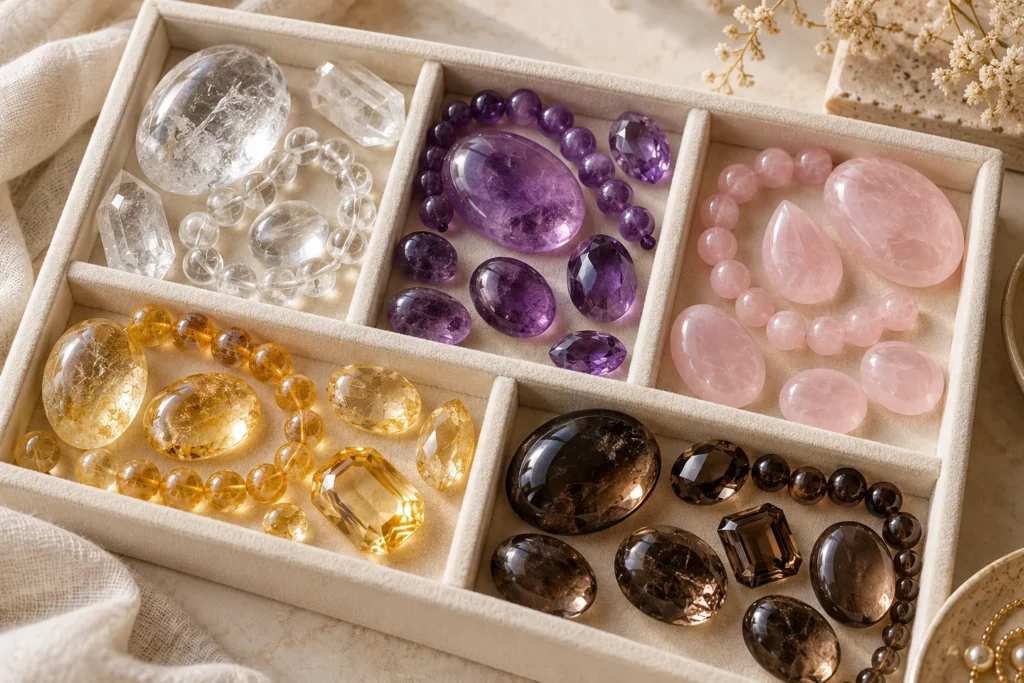
That answer might seem complicated, but it reflects how wholesale quartz pricing actually works. Below, I'll break down the specific factors that shift quartz value from one color to another — and more importantly, from one batch to another. Whether you're stocking a crystal shop or building an ecommerce brand, these details will help you source smarter and avoid overpaying.
Why Doesn't Color Alone Determine Quartz Value?
It's tempting to assume a simple color hierarchy exists — that amethyst always beats clear quartz, or smoky quartz is always budget-friendly. But if you've ever compared quotes from different suppliers, you know the pricing picture is far messier than that. The problem is treating "color" as the only variable when quartz value is actually a multi-factor equation.
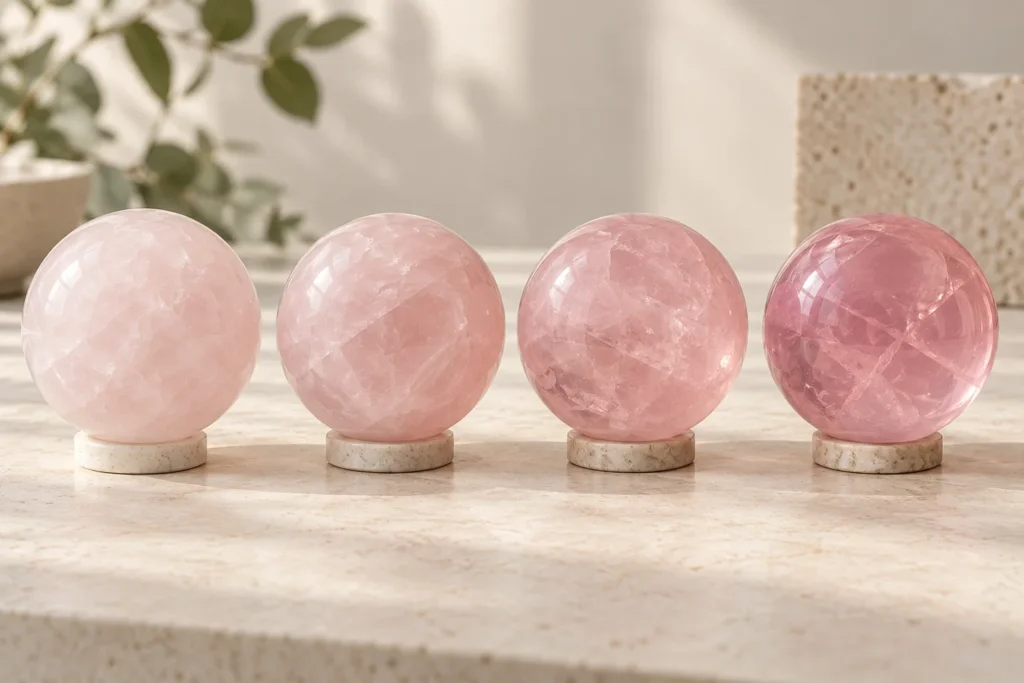
Color is the starting point of a quartz product's appeal, but it is never the sole price driver at the wholesale level. Two batches of "rose quartz spheres" can differ by 3–5x in price depending on clarity, color depth, treatment, diameter, surface finish, and origin. Buyers who source by color name alone risk mismatched expectations and inconsistent inventory.
The Multi-Factor Reality of Wholesale Pricing
In my experience working with B2B crystal buyers over the past 15 years, I've seen the same pattern again and again: a buyer sends a reference photo and asks, "How much for this color?" That question is understandable, but it skips several steps that affect the final price. Here's what actually matters:
| Factor | How It Affects Value |
|---|---|
| Color saturation | Deeper, more vivid tones generally command higher prices, but "deeper" must be confirmed by current batch photos, not old images. |
| Clarity | Transparent or translucent quartz with fewer inclusions usually costs more than opaque material of the same color.2 |
| Treatment status | Natural color is typically more expensive than heat-treated, dyed, or coated quartz.3 Buyers should verify treatment status before comparing prices. |
| Size & weight | Larger pieces cost more per unit and often disproportionately more per kilogram due to raw material scarcity and higher processing waste. |
| Product form | A tower, sphere, heart, or carving made from the same rough material can have vastly different prices due to processing yield and labor. |
| Batch availability | Some colors and grades are seasonal or mine-dependent; a color that was affordable last quarter may be scarce and expensive now. |
| Origin | The same color from different mines or regions may vary in quality, inclusion patterns, and market reputation. |
Why This Matters for Your Purchasing Decisions
When you understand that quartz value is a composite score rather than a color label, you make better decisions. You stop chasing a color name and start evaluating actual product quality against your resale market. A "less valuable" color in premium grade and the right form can outsell a "rare" color that arrives cloudy, inconsistent, or overtreated.
We often receive buyer questions that start with color, but accurate quotation usually requires confirming form, size, quantity, grade, and treatment. Skipping those details leads to mismatched expectations on both sides.
Which Quartz Colors Tend to Command Higher Wholesale Prices?
Every buyer wants a shorthand — some sense of which colors trend higher in the market. The risk is turning a general guideline into a rigid rule and making sourcing decisions without checking the specifics. Let's look at the landscape honestly, with the caveat that these tendencies shift with supply, demand, and batch quality.
Broadly, natural citrine, high-clarity rutilated quartz, deep-toned amethyst, and gem-grade rose quartz tend to sit at the higher end of wholesale pricing. However, "tends to" is doing heavy lifting in that sentence. Pricing within each color category can vary enormously based on grade, treatment, and form.
A General Pricing Landscape (Not a Fixed Ranking)
Here's how common quartz colors typically position in the wholesale market. This is not an investment guide — it's a general sourcing reference based on patterns I've observed across years of processing and supplying quartz products.
| Quartz Color | Typical Price Position | Key Value Drivers | Common Pitfalls for Buyers |
|---|---|---|---|
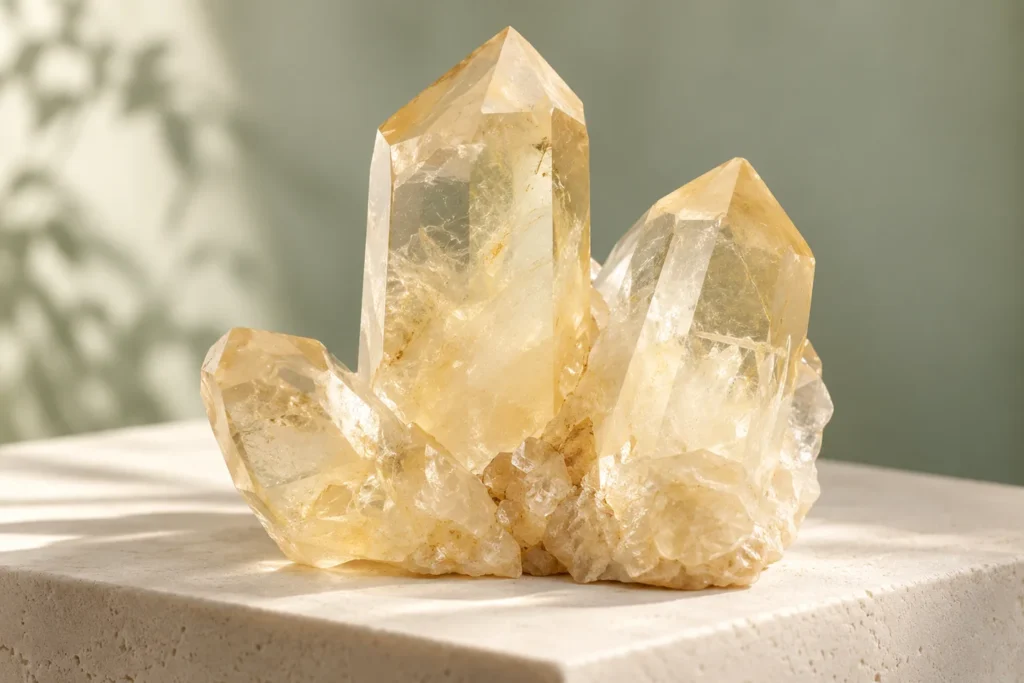
| Natural citrine | Higher | Genuine natural citrine is relatively rare; most "citrine" on the market is heat-treated amethyst.4 | Mistaking treated material for natural; price should reflect treatment status. |
| Rutilated quartz | Higher (varies widely) | Quality depends heavily on needle density, color of inclusions, and transparency of the host crystal. | Huge grade variation; low-grade rutilated quartz can be very affordable while gem-grade is expensive. |
| Amethyst | Mid to Higher | Deep, saturated purple with good transparency commands premiums.5 Pale or heavily included material is budget-level. | Assuming all amethyst is premium; entry-level amethyst is one of the most affordable colored quartz varieties. |
| Rose quartz | Mid to Higher | Star rose quartz and highly translucent material with strong pink color fetch the best prices.6 | Most commercial rose quartz is opaque and affordable; only top grades are truly "high value." |
| Smoky quartz | Mid | Natural smoky quartz with warm, even tones prices higher than irradiated or very dark material. | Some very dark smoky quartz is irradiated; treatment should be confirmed.7 |
| Clear quartz | Lower to Mid | High optical clarity in large sizes can be valuable; common milky quartz is budget-level. | Assuming clear quartz is always cheap — large, flawless clear quartz points or spheres can be expensive. |
| Dyed or coated quartz | Lower | Aura quartz, dyed quartz, and coated varieties generally sit at the lower end of material value. | Confusing surface treatments with natural color; should be sold transparently. |
The "Natural vs. Treated" Price Gap
One of the biggest factors that separates expensive quartz from affordable quartz is treatment status. This is especially critical for citrine and smoky quartz:
- Natural citrine — genuinely rare, typically pale to honey-yellow, commands premium prices.
- Heat-treated amethyst sold as citrine — much more common, deeper orange tones, significantly less expensive. This is a legitimate product, but buyers and their customers should know what they're getting.
- Natural smoky quartz — evenly toned, warm brown. Often priced higher than irradiated clear quartz that has been darkened artificially.
The lesson for B2B buyers: always ask about treatment status before comparing quotes. Two products listed as "citrine towers" could differ by 200–400% in price based solely on whether the material is natural or treated.
How Does Product Form Change Quartz Color Value?
This is where many first-time wholesale buyers get surprised. You might assume that a kilogram of rose quartz rough and a kilogram of rose quartz spheres should be priced similarly — after all, it's the same material. But product form introduces processing costs, yield rates, labor, and market demand that can dramatically change the per-unit price.
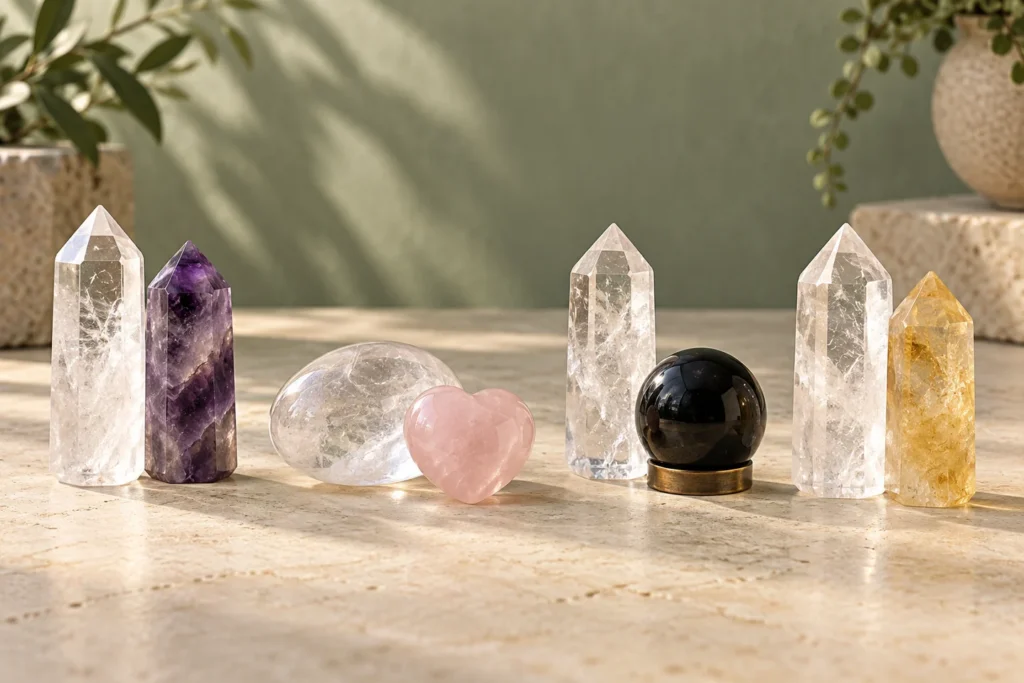
The same quartz color can be priced very differently depending on whether it's sold as raw rough, tumbled stones, towers, spheres, hearts, carvings, beads, or specimen pieces.8 Spheres and detailed carvings typically carry the highest processing premiums, while rough and tumbled stones are generally more affordable per kilogram.
Processing Yield and Waste
When a factory cuts a sphere from rough quartz, the material waste can exceed 60–70% of the original stone.9 That waste gets factored into the price of the finished sphere. Towers have better yield but still require skilled cutting and polishing. Tumbled stones have the best yield because they use smaller, irregular pieces.
Here's a simplified view of how form affects pricing for the same grade of material:
| Product Form | Relative Price per Unit | Why |
|---|---|---|
| Raw rough / mineral specimens | Lower (unless collector-grade) | Minimal processing; sold by weight |
| Tumbled stones / chips | Lower | High yield from small material; low labor |
| Palm stones / worry stones | Mid | Moderate shaping and polishing labor |
| Hearts | Mid to Higher | Symmetrical cutting increases waste and labor |
| Towers / points | Mid to Higher | Height and taper require suitable rough; polishing is labor-intensive |
| Spheres | Higher | Highest waste rate; requires large, quality rough |
| Detailed carvings | Higher to Highest | Skilled labor, design complexity, high waste |
Matching Form to Your Retail Market
Understanding form-based pricing helps you optimize your product mix for margins. For example:
- If your retail customers love statement pieces, investing in high-color amethyst spheres or rose quartz towers may justify the premium because of strong sell-through.
- If you need volume at accessible price points, tumbled stones, chips, or palm stones in popular colors offer better margin-per-dollar on purchasing.
- Carvings can command excellent retail margins but often require higher MOQs per design and longer lead times.
I always suggest new buyers think about product form early in the sourcing conversation. A buyer who says "I want rose quartz" gets a very different quote depending on whether they need 500 tumbled stones or 50 polished spheres.
What Should Buyers Check Before Comparing Quartz Color Quotes?
Here's where sourcing mistakes happen most often. A buyer sees a great price for "smoky quartz towers" from Supplier A and a higher price from Supplier B. They assume Supplier A is the better deal. But Supplier A's material might be irradiated, smaller in size, lower in clarity, or rougher in finish. Comparing quotes without aligning specifications is like comparing apples to geology textbooks.
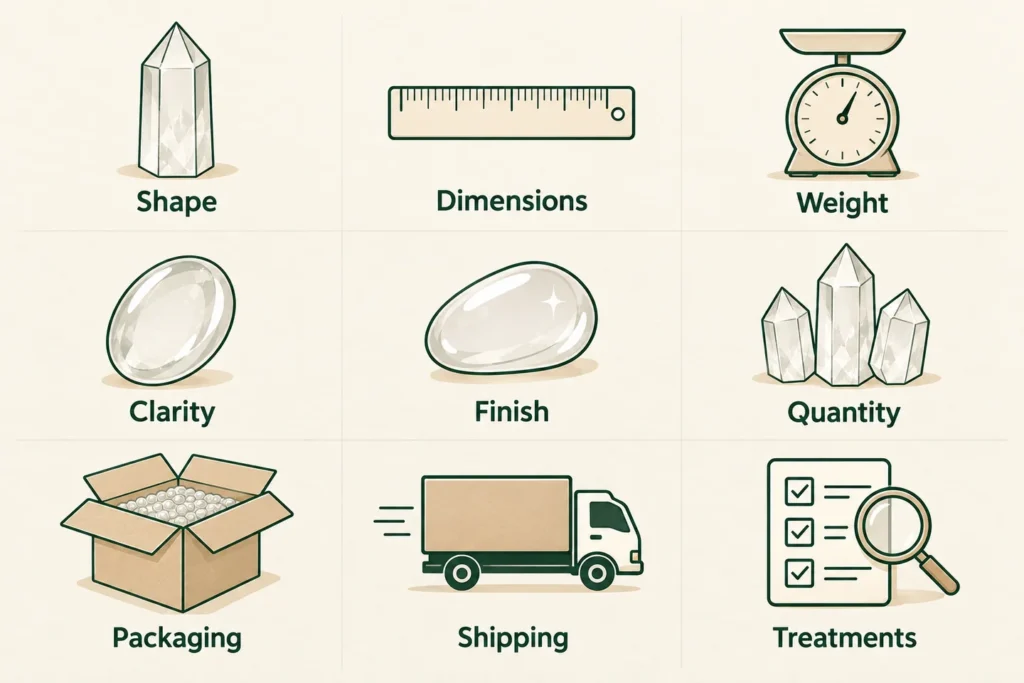
Before comparing any two quotes for quartz products, buyers should confirm the exact material name, treatment status, size range, weight range, grade or quality tier, finish quality, MOQ, packaging, and delivery terms. Only when these variables are aligned can you make a meaningful price comparison.
A Practical Pre-Quote Checklist
I recommend going through this checklist before requesting or evaluating any wholesale quartz quote:
- Material identification — Is this natural citrine or heat-treated amethyst? Natural smoky quartz or irradiated? The name on the invoice should reflect reality.
- Color and grade — Ask for current batch photos, not catalog images from a previous year. Color can vary significantly between mining batches.
- Treatment disclosure — Heat treatment, dyeing, coating, irradiation — all should be disclosed.10 This protects both your buying decision and your downstream customers.
- Size and weight range — "Small towers" means different things to different suppliers. Get specific: height in centimeters, weight in grams.
- Finish quality — Polished? Matte? Are chips or surface scratches acceptable at this price point?
- MOQ and mixing — Can you mix colors or forms within a single order? What's the minimum per SKU?
- Packaging — Individual boxes, bulk bags, foam inserts? Packaging affects both cost and product safety during shipping.
- Delivery terms — FOB, CIF, DDP? The shipping method and destination change your landed cost significantly.
Why Old Photos and Color Names Are Not Enough
One pattern I've seen repeatedly: a buyer sends a photo from a social media post or a competitor's listing and says, "I want this exact color." The challenge is that:
- Screen colors vary depending on monitor calibration, lighting in the original photo, and editing.11
- Batch colors vary because natural quartz is, by definition, not manufactured to a color specification.
- Old reference photos may represent material that's no longer available or priced differently.
The solution is straightforward: request current batch photos or videos under neutral lighting before placing an order. Any reputable supplier will provide these. At GD Crystal, we consider this standard practice — it saves both sides from misunderstandings.
How Can Buyers Identify the Most Valuable Quartz Color for Their Market?
This is the question that actually matters for B2B purchasing. "Most valuable" shouldn't mean "most expensive per carat in a gemological reference book." It should mean most profitable and reliable for your specific retail channel and customer base. A color that's expensive to source but slow to sell is not valuable to your business.
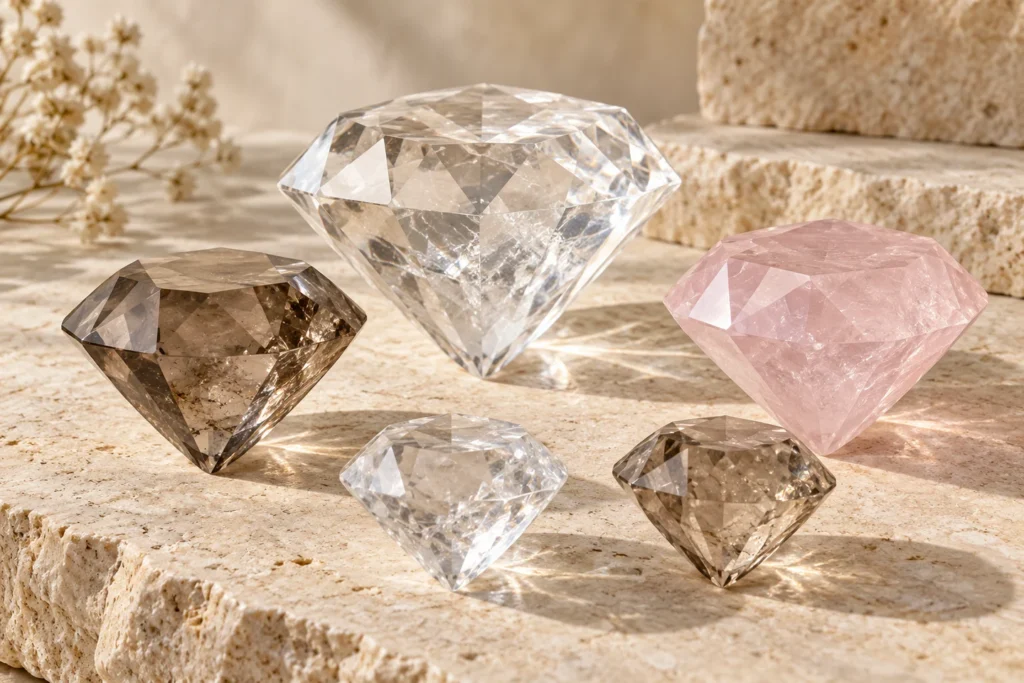
The most valuable quartz color for your business is the one that matches your customer demand, offers reliable supply in your needed form and grade, fits your price-point targets, and delivers consistent batch quality for repeat orders. This varies by market, season, and retail channel.
Matching Color to Customer Demand
Before investing in what the internet calls the "most valuable" quartz, do your homework:
- Review your sales data. Which quartz colors and forms sell fastest? Which generate the best margins? Double down on proven performers.
- Study your competitors. What are successful shops in your market segment stocking? Are there gaps you can fill?
- Consider trends carefully. A trending color can spike in demand — and in supply price. Late entrants may buy high and sell into a saturated market.
- Talk to your supplier early. A good supplier can tell you what's currently available in quality and quantity, helping you plan around actual supply rather than wishful thinking.
Building a Balanced Product Mix
Experienced crystal retailers don't bet everything on one color. They build a balanced assortment that includes:
- Anchor colors — reliable sellers like amethyst, rose quartz, and clear quartz that form the foundation of inventory.
- Premium pieces — higher-priced items like natural citrine, gem-grade rutilated quartz, or large statement spheres that drive average order value.
- Discovery items — smaller quantities of unusual or trending colors that attract attention and encourage exploration.
- Volume SKUs — tumbled stones, chips, and beads in popular colors that sell in high volume at accessible prices.
This approach hedges risk and ensures your cash isn't tied up in slow-moving "valuable" material that your actual customers don't want.
Frequently Asked Questions
Is natural citrine really more valuable than heat-treated citrine?
In most wholesale contexts, yes. Natural citrine is significantly rarer than heat-treated amethyst sold as citrine. However, "more valuable" depends on your use case — heat-treated citrine is a legitimate, affordable product that sells well at lower price points. Always confirm treatment status with your supplier before comparing prices.
Does quartz color affect wholesale MOQ?
Indirectly, yes. Rarer colors or higher grades may have higher MOQs because suppliers batch-process limited material. Common colors like clear quartz or standard amethyst typically offer more flexible minimum quantities. At GD Crystal, MOQ varies by product form, size, and material, so we recommend confirming per SKU.
How can I tell if quartz color is natural or treated?
Visual inspection alone is unreliable for most buyers.12 Heat-treated amethyst (sold as citrine) often has a deeper orange tone compared to natural citrine's softer honey color, but this isn't definitive. Ask your supplier for treatment disclosure, and for high-value purchases, consider independent gemological testing. Reputable suppliers should be transparent about treatments.
Should I always buy the most expensive quartz color?
Not necessarily. The most profitable quartz for your business depends on your retail market, customer preferences, and sell-through rate. An affordable quartz color with high demand and fast turnover may generate better returns than a premium color that sits in inventory. Let your sales data guide your purchasing.
Can I request specific quartz color grades when ordering wholesale?
Yes, most experienced suppliers offer grading tiers. At GD Crystal, we can discuss grade selection based on your needs, though exact availability depends on current batches. Providing reference photos and specifying your acceptable color range, clarity, and size helps us quote accurately and match expectations.
Conclusion
So, what color quartz is most valuable? The honest answer is that no single quartz color holds universal top value — and anyone who tells you otherwise is oversimplifying a complex sourcing question. For B2B buyers, quartz value emerges from the intersection of color quality, treatment status, product form, grade, size, batch consistency, and fit with your retail market. The most valuable quartz in your inventory is the product that your customers want to buy, sourced at a price that protects your margins, from a supplier who delivers consistent quality.
If you're evaluating quartz colors and forms for your next wholesale order, I'd encourage you to start with your market data, confirm specifications before comparing quotes, and always request current batch photos. At GD Crystal, we're happy to walk through material options, treatment details, and pricing based on your specific product and quantity needs. Reach out for a quote — let's find the right quartz for your business, not just the most expensive one.
References
- "Diamond Quality Factors", https://www.gia.edu/diamond-quality-factor. A gemological reference on quartz valuation supports the view that color is only one of several factors affecting value, alongside clarity, size, cutting, treatment, and market demand. Evidence role: general_support; source type: education. Supports: A neutral gemology source should explain that gemstone or quartz value depends on several quality and market factors, not on color alone.. Scope note: This would support the general valuation principle rather than prove prices for any specific wholesale batch. ↩
- "Colored Gemstone Value Factors", https://www.gia.edu/gia-news-research/value-factors-design-cut-quality-colored-gemstone-value-factors. Gemological education materials describe clarity and transparency as quality factors in gemstones, supporting the claim that clearer quartz material is generally valued more highly than opaque or heavily included material. Evidence role: mechanism; source type: education. Supports: The source should describe how transparency and inclusions affect perceived quality and value in gemstones, including quartz where available.. Scope note: The source may discuss gemstones generally rather than wholesale quartz products specifically. ↩
- "An Introduction to Gem Treatments", https://www.gia.edu/gem-treatment. Gemstone treatment disclosure guidance recognizes treatments such as dyeing, irradiation, and heat treatment as material facts for commerce, supporting the article’s distinction between natural-color and treated quartz. Evidence role: expert_consensus; source type: government. Supports: The source should support that gemstone treatments are material facts for buyers and commonly affect value or consumer expectations.. Scope note: Disclosure rules establish commercial relevance of treatment status but may not quantify the exact price premium for natural quartz. ↩
- "Citrine Gemstone | Natural Citrine Stone", https://www.gia.edu/citrine. Gemological references describe natural citrine as uncommon and note that much commercial citrine is produced by heat-treating amethyst, supporting the article’s warning about treatment status. Evidence role: general_support; source type: education. Supports: The source should state that natural citrine is uncommon and that heat-treated amethyst is widely sold as citrine.. ↩
- "Amethyst Quality Factors", https://www.gia.edu/amethyst-quality-factor. Gemological sources identify strong purple coloration and good clarity as important quality factors for amethyst, supporting the claim that deep, transparent material commands a premium. Evidence role: expert_consensus; source type: education. Supports: The source should identify color saturation and clarity or transparency as key quality factors for amethyst.. Scope note: The source may address gemstone quality rather than wholesale decorative forms such as towers or spheres. ↩
- "Rose Quartz Gem", https://www.gia.edu/rose-quartz. Gemological references describe rose quartz quality in relation to color and translucency and identify asterism in star rose quartz as a distinctive optical phenomenon, supporting the article’s emphasis on these higher-grade traits. Evidence role: general_support; source type: education. Supports: The source should explain rose quartz quality factors and the gemological phenomenon of asterism in star rose quartz.. Scope note: This supports why the traits are valued but may not provide current wholesale price comparisons. ↩
- "Ametrine with Layers of Smoky Quartz | Gems & Gemology", https://www.gia.edu/gems-gemology/ametrine-smoky-quartz. Mineralogical and gemological sources describe irradiation as a mechanism that can create or intensify smoky coloration in quartz, supporting the article’s caution that very dark smoky quartz may require treatment verification. Evidence role: mechanism; source type: research. Supports: The source should explain that smoky color in quartz can be associated with irradiation and that artificial irradiation is used to alter quartz color.. Scope note: The source may explain the color mechanism without determining whether a particular commercial item has been irradiated. ↩
- "Value-Factors-Design-Cut-Quality-Colored-Gemstones- …", https://www.gia.edu/dam/migrated-assets/docs/doc1/Value-Factors-Design-Cut-Quality-Colored-Gemstones-Gem-Market-News-GIA.pdf. Lapidary and gem-manufacturing references explain that shaping, cutting, polishing, and carving add labor costs and material loss, supporting the article’s claim that finished quartz forms can be priced differently from the same material sold as rough. Evidence role: mechanism; source type: institution. Supports: The source should explain that cutting, polishing, carving, and other lapidary processes add labor, waste, and production costs to mineral products.. Scope note: This supports the cost mechanism but may not list prices for the exact product forms named in the article. ↩
- "How It's Made: A Stone Sphere", https://www.youtube.com/watch?v=MoV-emestnA. A lapidary technical source documenting sphere-cutting yield would support the statement that producing stone spheres can involve substantial material loss from the original rough. Evidence role: statistic; source type: other. Supports: The source should provide data or a technical explanation of yield loss when cutting spheres from rough stone.. Scope note: If the source gives only geometric or workshop examples, it would contextualize the waste estimate rather than prove that all quartz spheres lose 60–70% of the rough. ↩
- "In the Loupe: Advertising Diamond, Gemstones and Pearls", https://www.ftc.gov/business-guidance/resources/loupe-advertising-diamond-gemstones-pearls. The FTC Jewelry Guides treat gemstone treatments as material information when they affect value, care, or durability, supporting the article’s statement that heat treatment, dyeing, coating, and irradiation should be disclosed. Evidence role: expert_consensus; source type: government. Supports: The source should show that gemstone treatments are considered material information requiring disclosure in jewelry or gem commerce.. Scope note: The legal scope depends on jurisdiction and product presentation, so the citation supports the disclosure principle rather than a universal global rule. ↩
- "CIE 1931 color space", https://en.wikipedia.org/wiki/CIE_1931_color_space. Color-science sources explain that image color appearance depends on illumination, capture processing, and display calibration, supporting the article’s caution that screen images may not reliably represent quartz color. Evidence role: mechanism; source type: research. Supports: The source should explain that lighting conditions, capture settings, editing, and display calibration affect perceived or displayed color.. Scope note: This supports the imaging mechanism generally, not the color accuracy of any particular supplier photograph. ↩
- "Analysis of Gemstones at GIA Laboratories", https://www.gia.edu/gems-gemology/winter-2024-gemstone-analysis. Gemological education sources note that treatment identification often requires specialized observation, instrumentation, or laboratory testing, supporting the article’s warning that visual inspection alone is unreliable for most buyers. Evidence role: expert_consensus; source type: education. Supports: The source should state that identifying treatments often requires gemological expertise or laboratory testing rather than ordinary visual inspection.. Scope note: The level of testing needed varies by treatment type and material quality. ↩