If you've ever searched "what crystal should not be in the bedroom," you've likely encountered lists of stones labeled as too energizing, too dangerous, or outright forbidden near a sleeping area. For retailers and e-commerce sellers, this question comes up constantly from customers — and a careless answer can spread misinformation or create after-sales headaches. The real answer requires a more practical, product-informed approach.
There is no universal rule that forbids a specific crystal species from the bedroom. Instead, the crystals that deserve caution near beds, nightstands, and sleeping areas are those that pose practical risks: sharp or pointed shapes, fragile specimens that shed dust or chips, heavy unstable pieces, and items with unclear treatment or coatings. "Energy" preferences are subjective and should be communicated as personal experience, not verified fact.
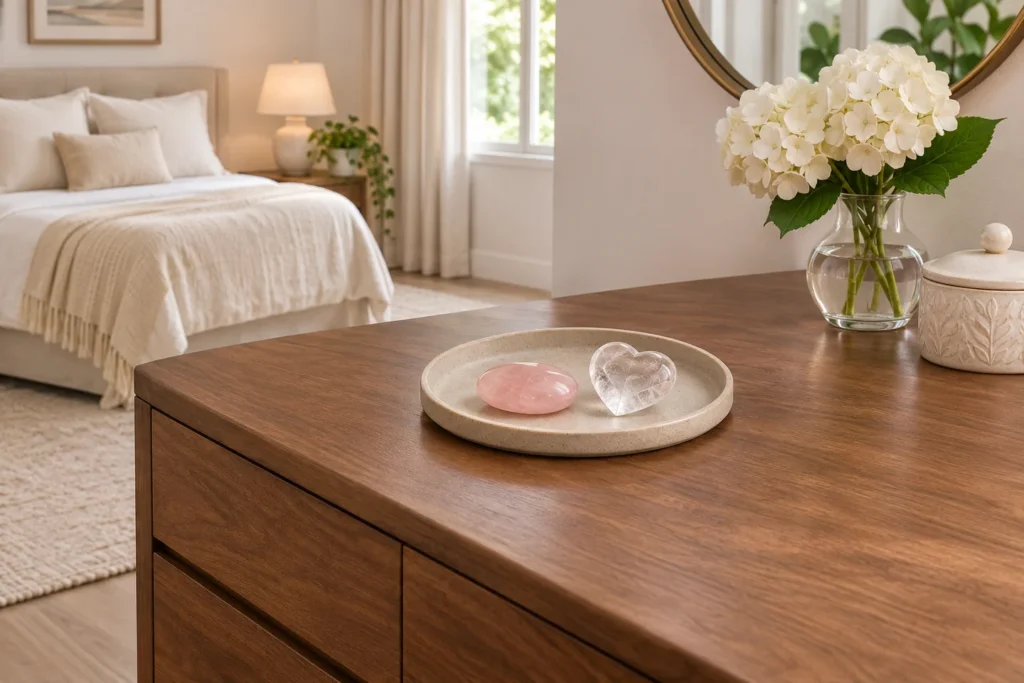
Most online advice frames this topic through mystical "bad energy" claims. But from a product and retail communication perspective, the real risks are physical safety, material integrity, customer trust, and after-sales disputes. Let's break down exactly what crystal sellers need to know — and how to guide customers responsibly.
Why Is There No Universal "Forbidden Bedroom Crystal" List?
Crystal sellers often feel pressure to give customers a definitive yes-or-no answer. The truth is, the crystal industry has no standardized safety classification for bedroom placement1, and claims about specific stones disrupting sleep remain unverified2.
The idea that certain crystals should never enter a bedroom usually originates from energy healing traditions, feng shui schools, or popular social media content. These perspectives vary widely and often contradict each other. One source may warn against amethyst in the bedroom; another may recommend it as the ultimate sleep stone. For retailers, repeating any of these claims as fact creates credibility risk and potential customer disappointment.
The Real Basis for Bedroom Crystal Caution
From my experience as a supplier working with crystal shop owners and e-commerce brands over the past 15 years, the questions that actually matter for bedroom placement are:
- Is the shape safe? Towers, points, clusters, and raw specimens with sharp edges pose a genuine risk on nightstands, especially in households with children or pets.3
- Is the piece physically stable? Heavy spheres, tall towers, or top-heavy carvings can fall, break, or cause injury.4
- Does the material shed, flake, or produce dust? Some mineral specimens — particularly raw or unpolished pieces — release particles over time.5
- Is the treatment or coating clearly disclosed? Dyed, coated, or heat-treated pieces may have care limitations that buyers need to understand.
- What does the customer expect? If a customer buys a crystal "for better sleep" based on an unverified claim and it doesn't deliver, that's an after-sales problem for the retailer.
A Better Framework for Retailers
Rather than maintaining a "never sell this for bedrooms" list, I recommend sellers think in terms of risk categories:
| Risk Category | Examples | Why It Matters |
|---|---|---|
| Sharp or pointed shapes | Raw clusters, tower points, broken geodes | Injury risk, especially at night or around children |
| Fragile or shedding specimens | Raw selenite, kyanite blades, fibrous minerals | Dust, chips, mess on bedding and surfaces |
| Heavy or unstable pieces | Large spheres, tall towers on smooth surfaces | Fall risk near sleeping areas |
| Unclear treatment / coatings | Dyed agate, coated quartz, reconstituted pieces | Customer trust issues, color transfer, care confusion |
| "Energy" or subjective preference | Any stone a customer personally finds stimulating | Varies entirely by individual; not a product defect |
This framework keeps the conversation grounded in things you can actually observe, explain, and stand behind.
Which Crystal Shapes Should Be Avoided Near the Bed?
Shape is one of the most overlooked factors in bedroom crystal advice. Many guides focus only on the stone name while ignoring that the same mineral can be perfectly safe or genuinely risky depending on its form.
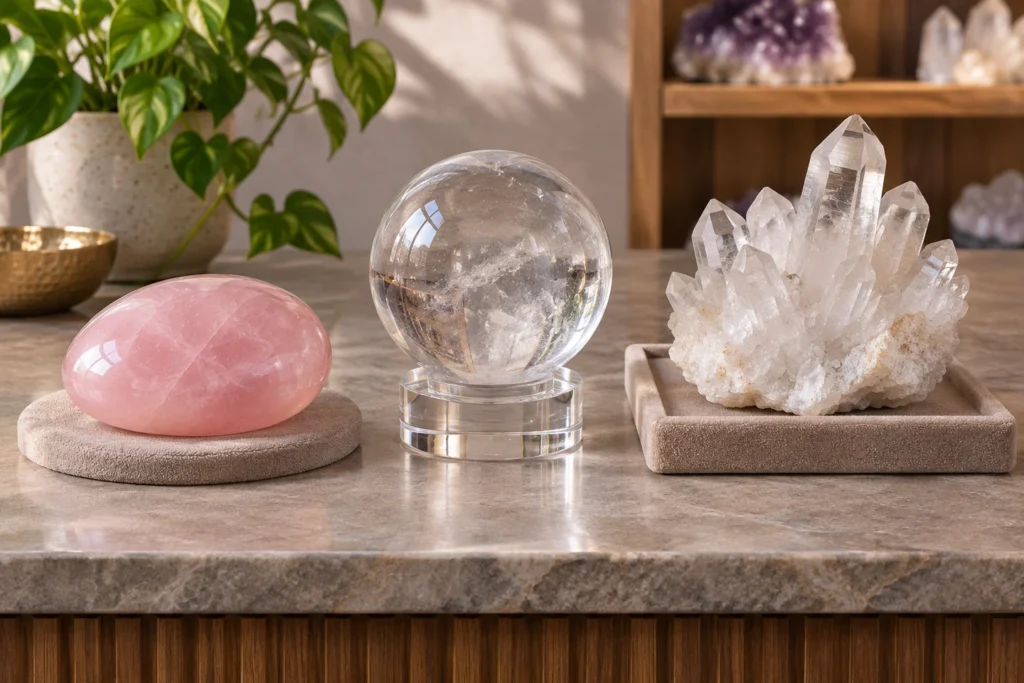
A polished rose quartz palm stone on a nightstand is very different from a raw rose quartz cluster with jagged points. For retailers advising customers on bedroom crystals, shape and finish matter far more than the mineral species in most cases.
Sharp Points and Tower Tips
Crystal towers and points are among our most popular product categories. They're beautiful display pieces. But a tall, narrow tower on a nightstand next to where someone sleeps — especially if they reach for a phone or glass of water in the dark — presents a real puncture or scratch risk. I've had retail customers mention receiving complaints about this exact scenario.
Raw Clusters and Geode Fragments
Raw crystal clusters, particularly amethyst, quartz, and citrine cathedral pieces, have irregular edges and protruding points. These are best suited for shelves, display areas, or locations that aren't within arm's reach of a sleeping person.
Recommendations by Shape
| Shape | Bedroom Suitability | Notes |
|---|---|---|
| Polished spheres (small to medium) | Generally suitable | Use a stable stand; avoid heavy pieces on high surfaces |
| Palm stones / worry stones | Very suitable | Smooth, small, no sharp edges |
| Hearts and polished carvings | Generally suitable | Check stability on flat surfaces |
| Towers and points | Use with caution | Keep away from bed edges; avoid tall/narrow pieces |
| Raw clusters | Not ideal for nightstands | Better on shelves or display tables |
| Tumbled stones | Very suitable | Small, smooth, low risk |
| Raw mineral specimens | Generally not recommended near bed | May shed, have sharp edges, or be fragile |
What I Tell Retail Buyers
When crystal shop owners ask me which products to recommend for bedroom use, I steer toward polished forms: palm stones, tumbled stones, small spheres, and smooth carvings. These are the shapes where material safety, stability, and customer satisfaction overlap most reliably. It's not about banning a crystal type — it's about matching the right form to the right placement.
Are Treated or Dyed Crystals a Problem in Bedrooms?
Treatment and dyeing are common in the crystal industry. From a retail communication perspective, the concern isn't that treated crystals are automatically unsafe. The concern is that unclear disclosure creates trust, care, and after-sales problems — and bedrooms amplify these issues because of direct skin contact, fabric proximity, and customer sensitivity about sleeping environments.
A dyed agate slice on a living room shelf is one thing. The same piece on a white nightstand next to white bedding, where a customer later discovers color transfer, is a different conversation entirely.
Common Treatments to Be Aware Of
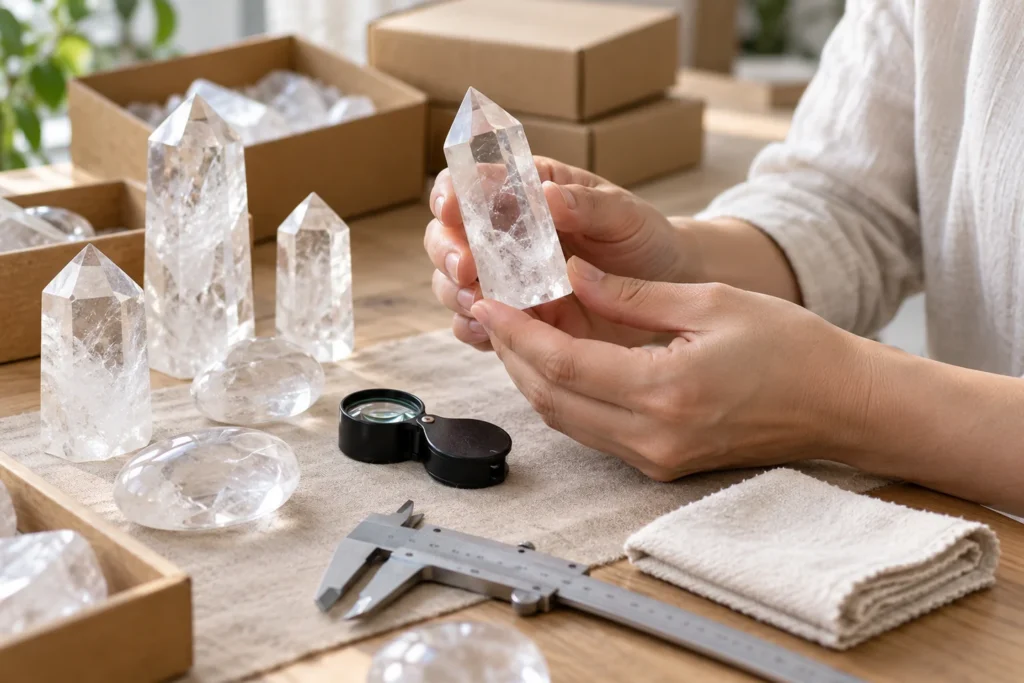
As a processing-side operator, I see the following treatments regularly:
- Dyeing: Very common with agate, howlite (sold as "turquoise"), and some quartz varieties. Dyed pieces can transfer color to porous surfaces or fabrics, especially when wet.6
- Coating: Aura quartz, titanium-coated pieces, and some "angel aura" products have metallic coatings that can chip or wear over time, leaving small metallic flakes.7
- Heat treatment: Widely used for amethyst-to-citrine conversion and to enhance color in various quartz types.8 Generally stable, but should still be disclosed.
- Reconstitution or bonding: Some products are made from crushed material bonded with resin. These can react to heat, humidity, or cleaning products differently than natural stone.9
Why This Matters for Bedroom Placement Specifically
Bedrooms involve:
- Skin contact — Customers may hold stones before sleeping or place them under pillows
- Fabric proximity — Nightstands sit next to bedding, curtains, and clothing
- Humidity and temperature changes — Bathrooms attached to bedrooms create variable conditions
- Higher customer sensitivity — People are more particular about what they place in their sleeping environment
If a retailer sells a coated or dyed crystal without clear care instructions and treatment disclosure, and the customer discovers chipping, color bleed, or unexpected wear in their bedroom, the resulting complaint is harder to resolve than for a decorative shelf piece.
What Retailers Should Do
- Always confirm treatment status with your supplier. At GD Crystal, we encourage buyers to ask about treatment for each product line. Material, treatment method, current batch details, and care notes should be verified per order.
- Provide simple care cards with treated products, especially for bedroom-recommended items.
- Don't market treated crystals as "natural" or "raw" when they aren't. Transparency protects your brand long-term.
From a product and retail communication perspective, the safest approach is: disclose treatment, explain care, and let the customer make an informed decision about where they place the piece.
What About Crystals That Are "Too Energizing" for Sleep?
This is the part of the conversation where most online guides go off the rails. You'll find confident lists claiming moldavite, black tourmaline, carnelian, or tiger's eye will cause nightmares, insomnia, or restlessness. For crystal sellers, it's important to handle this topic carefully.
Some customers genuinely report that certain stones feel stimulating or uncomfortable near their sleeping area. This subjective experience is real to the individual. But it varies enormously from person to person, and no controlled study has verified that a specific crystal species disrupts sleep.
How to Frame "Energy" Preferences Responsibly
As a supplier, I don't position myself as an energy healing or sleep science authority — and I'd encourage retailers to adopt a similar stance. Here's a communication framework that respects customer experience without making unverifiable claims:
Instead of saying:
"Never put carnelian in your bedroom — it will keep you awake."
Consider saying:
"Some customers prefer not to keep carnelian near their bed, as they personally find it stimulating. Others love it on their nightstand. It's a matter of individual preference — we recommend trying different placements and seeing what feels right for you."
This approach:
- Acknowledges customer experience without making medical or scientific claims
- Avoids creating a "forbidden" product category that limits your sales
- Reduces the risk of a customer returning a product because "it didn't help me sleep" or "it gave me bad dreams"
- Positions your brand as thoughtful and honest
Crystals Commonly Flagged as "Too Stimulating"
For reference, here are stones frequently mentioned in this context, along with how I'd frame the conversation:
| Crystal | Common Claim | Practical Retail Framing |
|---|---|---|
| Moldavite | "Too intense for sleep" | Rare and high-value; personal response varies widely |
| Carnelian | "Too energizing" | Some prefer it in workspaces; others keep it bedside |
| Tiger's Eye | "Overstimulating" | No verified basis; frame as personal preference |
| Black Tourmaline | "Absorbs too much energy" | Very popular as a bedroom stone by other customer segments |
| Malachite | "Releases toxic dust" | Raw/unpolished malachite does contain copper; polished pieces are generally handled safely for display |
| Pyrite | "Too active" | Oxidation and sulfur smell are the real practical concerns |
The Malachite and Pyrite Note
These two deserve special mention because they involve actual material considerations, not just energy claims:
- Raw malachite contains copper compounds. Unpolished pieces should not be handled excessively or placed where dust could be inhaled over long periods. Polished, sealed malachite is generally considered safe for display, but retailers should note the distinction.
- Pyrite can oxidize over time, especially in humid environments, producing a faint sulfur smell. In a closed bedroom, this may be noticeable. This is a real material behavior, not an energy claim.
For both, the recommendation is straightforward: if selling for bedroom placement, recommend polished or sealed forms and include a brief care note.
How Should Crystal Sellers Handle Bedroom Placement Questions?
Every crystal shop owner and e-commerce seller will face this question. How you answer it shapes customer trust, return rates, and brand reputation. The goal is to be helpful without overstepping into health claims or unverifiable guarantees.
From a supplier perspective, I see the downstream effects of how retailers communicate about crystal placement. When sellers make strong claims — "this crystal will improve your sleep" or "never put this stone near your bed" — it sets up expectations that the product can't reliably meet. The result is disappointed customers and avoidable returns.

A Practical Communication Checklist
Here's what I recommend for retailers building their bedroom crystal guidance, whether for in-store staff training or product descriptions:
- Lead with shape and safety. Recommend smooth, polished, stable forms for bedroom use. Note that sharp or fragile pieces are better suited to display shelves.
- Disclose treatment clearly. If a product is dyed, coated, or heat-treated, say so. Provide care instructions.
- Frame energy claims as personal preference. Use language like "some customers find" or "many people enjoy" rather than definitive statements.
- Never claim health or sleep benefits.10 This protects your business legally and ethically.
- Offer practical placement tips. Suggest stable surfaces, out of reach of children and pets, away from bed edges.
- Anticipate after-sales questions. If you recommend a crystal for the bedroom, be prepared to answer questions about dust, color changes, or chipping over time.
What This Looks Like in Product Descriptions
Weak example:
"Amethyst tower — place on your nightstand for deep, restful sleep and protection from negative energy."
Stronger example:
"Polished amethyst tower (12 cm) — a popular choice for bedroom display. We recommend placing it on a stable surface away from bed edges. Many customers enjoy amethyst as a calming presence, though individual experiences vary. This piece is natural and untreated — ask us for batch details."
The second version is informative, honest, and much less likely to generate a complaint or return.
Frequently Asked Questions
Is it true that black tourmaline should never be in the bedroom?
There is no verified basis for this claim. Black tourmaline is actually one of the most popular stones customers choose for bedrooms. Whether someone finds it comfortable to keep nearby is a matter of personal preference. Retailers can present it as a common bedroom choice without making energy guarantees.
Can dyed crystals be dangerous in the bedroom?
Dyed crystals are not automatically dangerous, but they can transfer color to fabrics and surfaces, especially when wet or in humid environments. For bedroom placement, retailers should disclose dyeing, recommend care precautions, and suggest keeping dyed pieces on protective surfaces rather than directly on bedding or white furniture.
Should I avoid selling crystal clusters for bedroom use?
Crystal clusters are beautiful display pieces but may have sharp, protruding points and fragile edges. For bedroom recommendations, suggest placing clusters on stable shelves away from the bed rather than on nightstands. Polished shapes like spheres, palm stones, and hearts are generally safer choices for bedside placement.
Is raw malachite unsafe to keep in a bedroom?
Raw, unpolished malachite contains copper compounds and should not be handled excessively or placed where it can produce inhalable dust over time. Polished and sealed malachite is generally considered safe for display. Retailers should recommend polished forms for bedroom use and include a brief material care note.
How do I answer customers who ask which crystals help with sleep?
Avoid claiming any crystal has a proven effect on sleep. Instead, share which stones are popular choices among bedroom buyers — such as amethyst, rose quartz, and lepidolite — and frame the recommendation as customer preference, not a health benefit. This approach is honest, reduces return risk, and protects your brand from unverifiable claims.
Conclusion
The question "what crystal should not be in the bedroom" doesn't have a simple forbidden list. The most responsible answer focuses on shape safety, material stability, treatment disclosure, and honest communication — not on unverified energy claims or fear-based rules. For crystal retailers and e-commerce sellers, this approach builds customer trust, reduces after-sales issues, and positions your brand as knowledgeable and credible.
If you're selecting crystals for your shop's bedroom category and want to discuss shapes, materials, treatment details, or product suitability, feel free to reach out to us at GD Crystal. With over 15 years of crystal processing and wholesale experience, we're happy to help you choose the right products for your customers — and give you the product details you need to communicate confidently.
References
- "CIBJO Blue Book and “Do's and Don'ts” Guide on …", https://www.gia.edu/gems-gemology/spring-2019-gemnews-cibjo-blue-book-and-dos-and-donts-guide-on-responsible-sourcing. CIBJO's gemstone guidance addresses trade nomenclature, treatment disclosure, and related commercial standards, providing context that formal gemstone standards do not normally classify minerals by bedroom placement. Evidence role: general_support; source type: institution. Supports: Industry guidance for gemstones focuses on nomenclature, treatment disclosure, grading, and trade practices rather than room-specific placement rules.. Scope note: This would support the claim contextually; absence from a major standards framework does not prove that no informal retailer policy exists anywhere. ↩
- "The Impact of Complementary and Alternative Medicine … – PMC", https://pmc.ncbi.nlm.nih.gov/articles/PMC9509538/. Government and medical evidence summaries on complementary health and sleep hygiene do not report controlled evidence that specific crystal species cause sleep disruption. Evidence role: expert_consensus; source type: government. Supports: Reliable health sources do not identify crystals as evidence-based causes of insomnia or as validated sleep interventions.. Scope note: This supports lack of established evidence, not proof that no individual could report a subjective response. ↩
- "CPSC Proposes Guidelines For Sharp Points And Edges …", https://www.cpsc.gov/Newsroom/News-Releases/1977/CPSC-Proposes-Guidelines-For-Sharp-Points-And-Edges-On-Toys. Consumer safety guidance on home injury prevention identifies accessible sharp objects as a preventable injury hazard, supporting caution with pointed mineral specimens placed within reach near beds. Evidence role: general_support; source type: government. Supports: Sharp household objects can cause injury and should be kept away from children or unstable locations.. Scope note: The evidence is general household-safety guidance rather than crystal-specific injury data. ↩
- "Product Instability or Tip-Over Injuries and Fatalities …", https://www.cpsc.gov/s3fs-public/2022_Tip_Over_Report_Final.pdf. Consumer product safety materials on falling household objects support the general principle that heavy or unstable items should be secured or placed to minimize fall-related injury risks. Evidence role: general_support; source type: government. Supports: Heavy or unstable household items can create injury risks if they fall from surfaces.. Scope note: The source would support the hazard mechanism generally, not provide incident rates for crystal spheres or towers specifically. ↩
- "Exposure Assessment | Silica", https://www.cdc.gov/niosh/silica/exposure/index.html. Museum conservation guidance for mineral collections describes friable specimens as vulnerable to shedding, abrasion, and particulate loss during handling and display. Evidence role: mechanism; source type: institution. Supports: Friable or fragile mineral specimens can shed particles and require careful handling or display.. Scope note: This is specimen-condition dependent and does not mean all raw minerals shed meaningful dust. ↩
- "An Introduction to Gem Treatments", https://www.gia.edu/gem-treatment. Colorfastness and gem-treatment references describe dye transfer and wet crocking as recognized mechanisms by which colorants can migrate to fabrics or porous surfaces. Evidence role: mechanism; source type: institution. Supports: Dyes can transfer from treated materials to adjacent surfaces, with moisture increasing transfer risk.. Scope note: The risk depends on the dye, substrate, sealant, moisture level, and surface contact time. ↩
- "An Introduction to Gem Treatments", https://www.gia.edu/gem-treatment. Gemological references on coated stones note that surface coatings are treatment layers that may be vulnerable to abrasion, wear, or damage compared with the underlying mineral. Evidence role: mechanism; source type: institution. Supports: Surface-coated gemstones can lose or damage their coating through abrasion or wear.. Scope note: This supports coating vulnerability generally; the amount of flaking varies by coating process and handling conditions. ↩
- "Is citrine treated?", https://www.gia.edu/FAQ/gia-faq-treated-citrine. Gemological references describe heat treatment as a common process by which amethyst or other quartz varieties may be altered to produce yellow to orange citrine-like colors. Evidence role: mechanism; source type: institution. Supports: Heating can change the color of amethyst and is used in producing citrine-colored quartz.. ↩
- "Volumetric polymerization shrinkage of resin composites under simulated …", https://pubmed.ncbi.nlm.nih.gov/16382592/. Materials-science literature on polymer composites shows that resin matrices can undergo moisture uptake, thermal softening, or chemical degradation, explaining why resin-bonded stone products may require different care than natural mineral specimens. Evidence role: mechanism; source type: paper. Supports: Polymer or resin binders can be affected by heat, moisture, solvents, or cleaning chemicals in ways that differ from crystalline mineral material.. Scope note: The exact response depends on the resin formulation, filler material, curing method, and exposure conditions. ↩
- "Health Products Compliance Guidance", https://www.ftc.gov/business-guidance/resources/health-products-compliance-guidance. FTC advertising guidance states that health-related product claims must be truthful, not misleading, and supported by competent and reliable scientific evidence. Evidence role: expert_consensus; source type: government. Supports: Health-related marketing claims require adequate substantiation, typically competent and reliable scientific evidence.. Scope note: This supports the compliance rationale for avoiding unsupported health claims; it is not specific to crystals unless the claim is made in advertising. ↩