Raw clear quartz is one of the most searched-for crystals online1 — and one of the most misunderstood. Shoppers expect magical guarantees. Retailers struggle to describe it honestly without losing sales appeal. The real answer lies somewhere practical: raw clear quartz serves as a versatile, naturally beautiful material for display, gifting, collecting, and building a well-rounded product line.
Raw clear quartz doesn't "do" one guaranteed thing. It functions as a foundational natural stone product valued for its visual clarity, organic texture, broad customer familiarity, and adaptability across retail categories — from impulse-buy bins to premium display specimens. Its real role depends on how you merchandise, describe, and source it for your specific customer base.
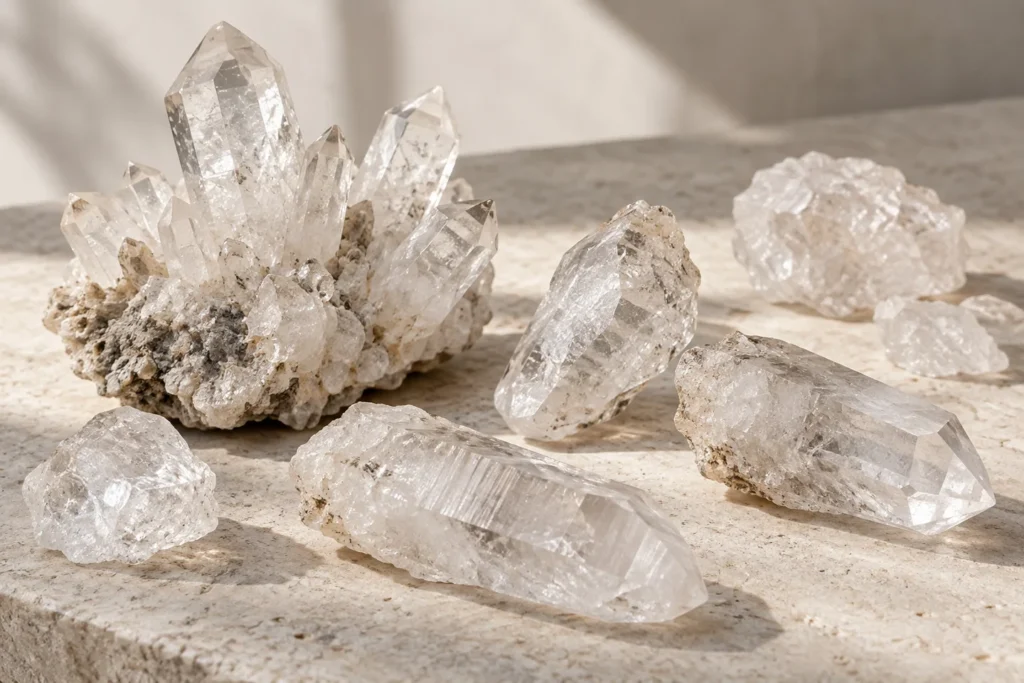
But understanding what raw clear quartz can do for your business requires going deeper than surface-level crystal descriptions. Below, I'll break down its practical roles, natural variation, responsible product language, and buying considerations — all from a supplier's perspective after over 15 years of handling this material.
Why Is Raw Clear Quartz So Popular Among Crystal Retailers?
Every crystal shop owner eventually asks the same question: which products should anchor the collection? The pressure to stock trendy stones is real, but trend-chasing alone creates inventory risk. Raw clear quartz solves this because it never goes out of style.
Raw clear quartz remains a top-selling crystal category because of its universal name recognition2, accessible price range, and ability to complement virtually any other stone in a product assortment. It appeals to first-time buyers, experienced collectors, gift shoppers, and spiritual-community customers simultaneously.
A Stone Every Customer Already Knows
Unlike niche minerals that require lengthy explanations at the point of sale, raw clear quartz benefits from massive existing awareness. Most people walking into a crystal shop — or browsing an online store — already have some idea of what quartz is. This pre-existing familiarity lowers the barrier to purchase dramatically.
From a merchandising standpoint, this matters. Products that require zero introduction convert faster, especially for:
- Impulse purchases at checkout counters or live sales
- Gift sets where the recipient may not be a crystal enthusiast
- Starter kits marketed to beginners entering the crystal world
- Event or market booths where you have seconds to capture attention
Versatility Across Product Formats
Raw clear quartz isn't limited to one shape or size. As a supplier, I see orders spanning an enormous range of product formats:
| Product Format | Typical Use Case | Customer Appeal |
|---|---|---|
| Small raw points (2–5 cm) | Impulse buys, gift bags, bulk bins | Low price point, collectible |
| Medium clusters (5–12 cm) | Shelf display, home décor | Visual impact, natural beauty |
| Large specimen pieces (12+ cm) | Statement display, premium gifting | Wow factor, collector value |
| Raw chips and small rough | Craft supply, terrarium filling, jewelry components | Functional, creative use |
| Mixed rough batches | Assorted bins, mystery bags, subscription boxes | Volume sales, variety |
This format flexibility means a single material — raw clear quartz — can serve multiple price tiers and customer segments within the same shop. Few other crystals offer this range so naturally.
Compatibility With Other Crystals
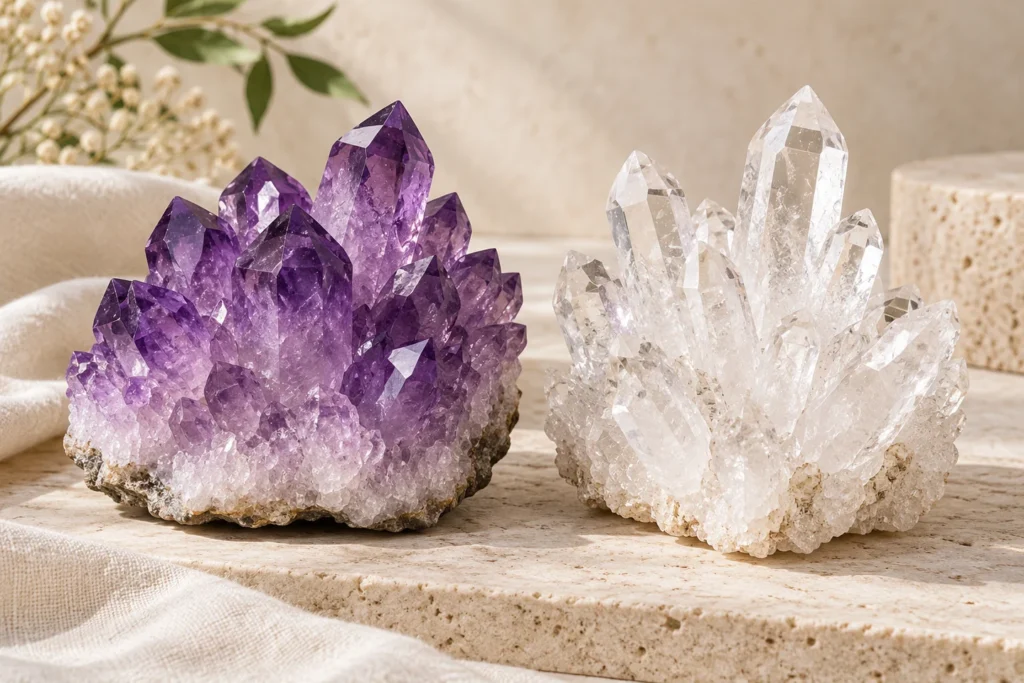
Raw clear quartz pairs well visually and thematically with nearly every other crystal product. I've seen buyers use it as a "connector" in curated collections — placing clear quartz alongside amethyst, rose quartz, citrine, and smoky quartz to create cohesive displays. The neutral, clean appearance of clear quartz ties diverse colors and textures together without competing for attention.3
For brand owners building curated boxes or subscription sets, this compatibility is a real asset. Raw clear quartz fills the "essential anchor" role that justifies including more unusual or expensive specimens alongside it.
What Does Raw Clear Quartz Actually Look Like in Bulk?
Here's where expectations and reality diverge sharply. Online images of raw clear quartz often show the most pristine, water-clear, photogenic pieces. Buyers ordering their first wholesale batch sometimes expect every piece to look like that. They don't — and understanding this prevents costly misunderstandings.
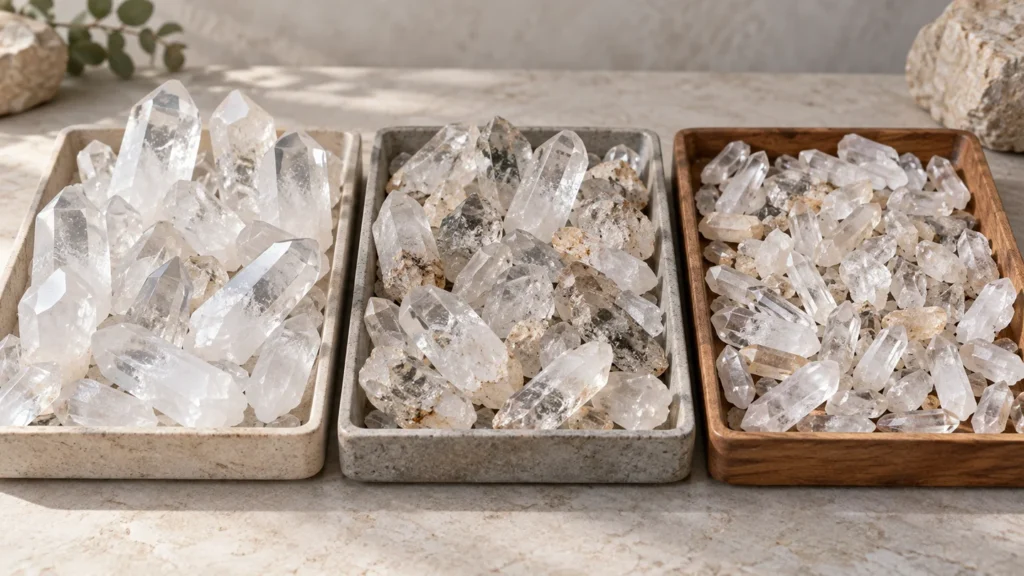
Raw clear quartz in bulk shipments varies significantly in transparency, surface texture, inclusion density, size, and shape4. No two pieces are identical. Honest sourcing means reviewing current batch photos, discussing grading criteria with your supplier, and setting clear expectations about natural variation before placing an order.
Natural Variation Is the Norm
As someone who has sorted and packed thousands of raw clear quartz pieces, I can tell you that natural variation is not a defect — it's inherent to the material. Here's what varies across pieces within a single batch:
- Transparency: Ranges from near-water-clear to heavily milky or cloudy
- Inclusions: Internal fractures (rainbows), mineral inclusions, phantoms, veils
- Surface texture: Some pieces have smooth facets; others show rough growth surfaces, contact marks, or matrix remnants
- Size and shape: Even within a stated size range (e.g., 4–6 cm), individual shapes differ significantly
- Damage: Minor chips, dings, or edge wear are common in bulk rough material
Why This Matters for Your Business
If you're selling online — especially through platforms like Etsy, Shopify, or live-selling on social media — your product photos set the expectation. Mismatched expectations are the number-one driver of customer complaints and returns in the crystal resale business.
Practical tip: When sourcing raw clear quartz, always request photos of the current batch, not archived images. Ask your supplier about the typical range of clarity within that batch. Discuss whether pieces are hand-selected or randomly packed. This single conversation saves enormous headaches downstream.
Grading Isn't Standardized
Unlike gemstones with established grading systems (like diamonds), raw clear quartz has no universal grading standard in the wholesale market5. Terms like "A grade," "AA grade," or "premium" mean different things from different suppliers. I always recommend asking for specific visual references rather than relying on grade labels alone. What one supplier calls "AA" might correspond to another supplier's "A" — or vice versa.
| Common Label | What It Usually Means | What to Verify |
|---|---|---|
| A grade | Average clarity with visible inclusions | Percentage of cloudy vs. clearer pieces |
| AA grade | Above-average clarity, fewer surface marks | Whether hand-selected or bulk-sorted |
| Premium / AAA | High transparency, minimal damage | Photos of actual batch, not best-case samples |
| Mixed / B grade | Unsorted or lower clarity, more variation | Suitability for your specific use case |
How Should Retailers Describe Raw Clear Quartz to Customers?
This is the question that trips up even experienced sellers. The crystal market sits at the intersection of natural products, spiritual beliefs, and decorative home goods. Language that resonates with spiritual buyers can also cross into problematic health or outcome claims6. Getting this balance wrong risks legal issues, platform policy violations, and customer distrust.
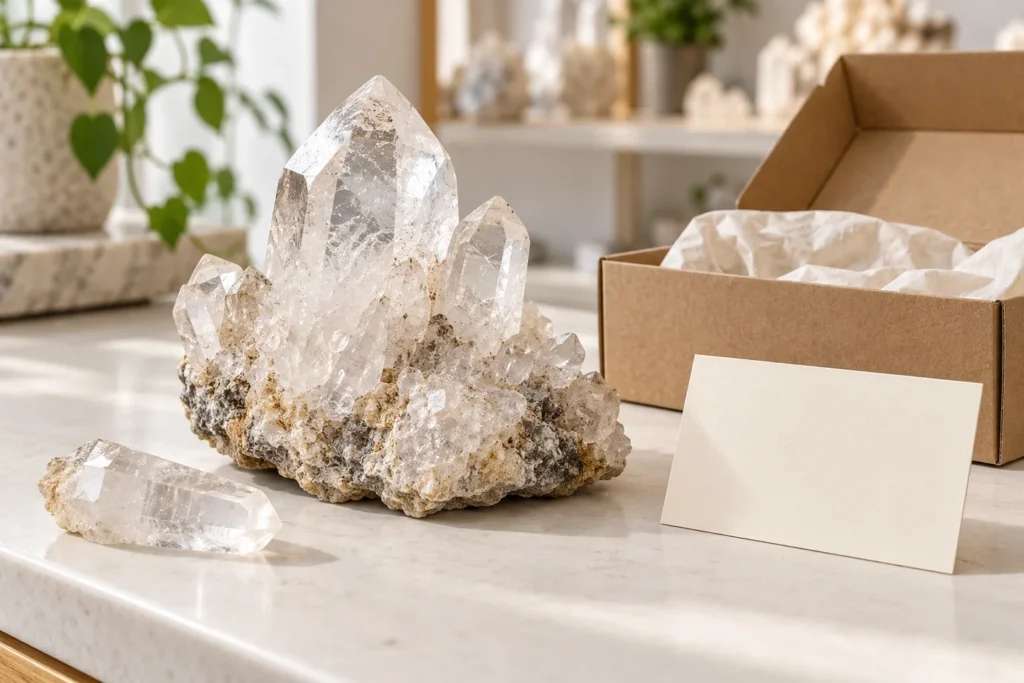
Retailers should describe raw clear quartz using language that highlights its natural beauty, cultural significance, and symbolic meaning — while clearly separating personal-belief traditions from guaranteed outcomes. Position it as decorative, collectible, and meaningful rather than medically or financially effective.
What You Can Safely Say
There's a wide space for compelling product descriptions that don't cross ethical or legal lines. Here are approaches I've seen work well for our retail and brand customers:
- "Traditionally associated with…" — Frames any spiritual or energetic claims as cultural tradition, not fact
- "Often used in meditation and mindfulness practices" — Acknowledges real customer use without promising results
- "Valued for its natural clarity and visual appeal" — Focuses on the aesthetic, which is objectively true
- "A popular choice for crystal collections and home décor" — Positions the product by its practical role
- "Considered a symbol of clarity and intention in many traditions" — Symbolic language is honest and evocative
What to Avoid
Certain types of claims create real risk — not just ethically, but commercially. Marketplace platforms like Amazon, Etsy, and eBay have policies against unsubstantiated health claims.7 Social media advertising on Meta and Google also restricts healing-related product language.8
Avoid describing raw clear quartz as something that:
- Heals specific conditions or general illness
- Purifies water, air, or energy in measurable ways
- Guarantees wealth, luck, love, or specific life outcomes
- Amplifies energy as a proven scientific mechanism
- Replaces medical treatment, therapy, or professional advice
My approach as a supplier: I describe materials factually — mineral type, origin when known, visual characteristics, processing details, size, weight. How the end retailer positions the product to their customer base is their decision, but I always encourage honest, defensible language.
The Business Case for Honest Descriptions
Ironically, restrained product language often builds more trust and higher customer lifetime value than exaggerated claims. Buyers who feel deceived don't return. Buyers who appreciate honest, beautiful descriptions of natural materials become repeat customers.
I've noticed that our most successful retail buyers — the ones who reorder consistently — tend to use descriptive language focused on aesthetics, craftsmanship, and natural uniqueness rather than metaphysical guarantees. Their customers trust them, and that trust translates into sustainable business.
How Should Buyers Choose Raw Clear Quartz for Their Specific Needs?
Not all raw clear quartz orders should look the same. A shop selling premium home décor needs a different product from a seller running $5 mystery bags. The buying decision should start with your end use case, not just unit price. Ordering without considering your customer and sales channel leads to unsold inventory.
Buyers should select raw clear quartz based on their target customer, sales channel, price point, and display method. Small rough pieces suit bulk and impulse sales. Larger, cleaner specimens fit premium retail. Mixed batches work for value-oriented or variety-focused offerings. Every order should be matched to a specific selling strategy.
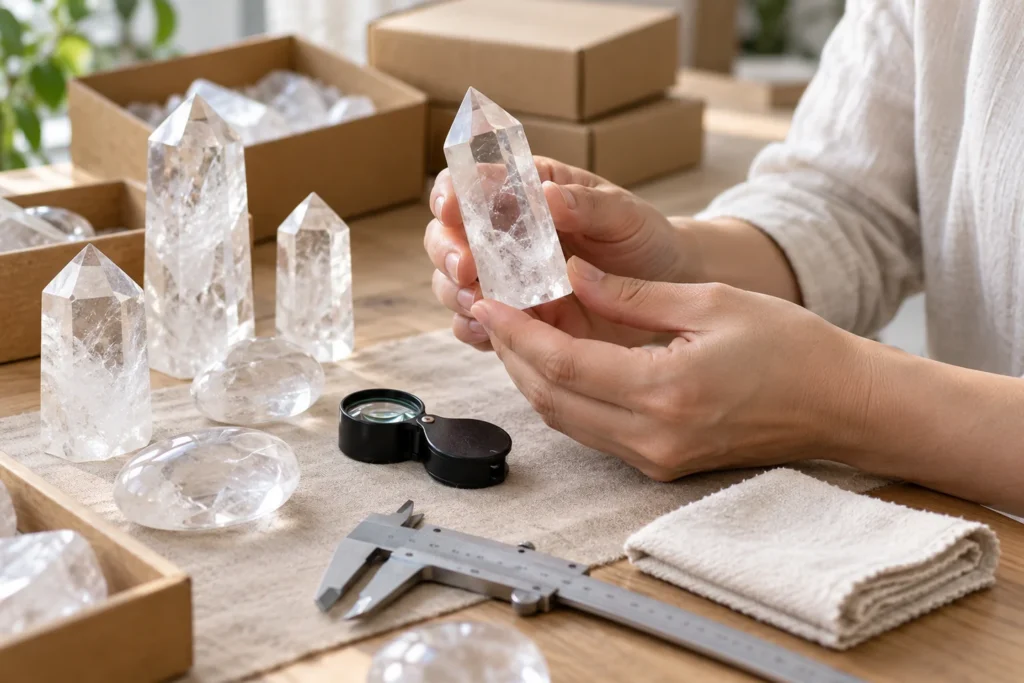
Match the Product to the Sales Channel
Here's a framework I often share with first-time buyers:
| Sales Channel | Best Raw Clear Quartz Format | Key Sourcing Priority |
|---|---|---|
| Brick-and-mortar shop display | Medium to large clusters, individual points | Visual appeal, hand-select option |
| Etsy / Shopify (photo-driven) | Individual pieces with consistent appearance | Batch consistency, per-piece photography feasibility |
| Live selling (TikTok, Instagram) | Mixed sizes, variety within lots | Volume, surprise factor, reasonable per-piece cost |
| Gift sets / curated boxes | Small points, uniform-ish sizing | Size consistency, packaging compatibility |
| Market booths / pop-ups | Full range, with emphasis on impulse sizes | Portability, price-point variety, eye-catching specimens |
Consider Reorder Consistency
One of the questions I get most often from returning buyers: "Can I get the same look as last time?" With natural materials, exact replication is impossible. But good communication helps. I always recommend:
- Saving reference photos from previous orders you liked
- Specifying the clarity range you need (e.g., "mostly clear with some milky pieces acceptable" vs. "all pieces must be largely transparent")
- Discussing batch availability before finalizing quantities — sometimes a particular mine source or processing batch has limited stock
- Ordering samples or trial quantities before committing to large volumes, especially for a new product format
Packaging and Shipping Considerations
Raw clear quartz is relatively hard (7 on the Mohs scale)9, but points and cluster tips are fragile during transit10. Broken tips are a common issue in wholesale crystal shipping. When discussing an order with your supplier, ask about:
- Individual wrapping for premium pieces
- Bulk packing methods for rough batches (foam, paper, dividers)
- Weight-based vs. piece-count pricing and how it affects your landed cost
- Insurance and damage policies for international shipments
I've found that a brief upfront conversation about packaging saves both sides from disputes later. It's a small detail that makes a real difference in the condition of your received goods.
Frequently Asked Questions
Does raw clear quartz actually have healing properties?
Raw clear quartz is widely used in spiritual and mindfulness communities, and many traditions attribute symbolic or energetic significance to it. However, there are no scientifically verified healing properties11. Retailers should present such associations as cultural beliefs or personal practices rather than guaranteed outcomes.
How do I know if raw clear quartz is real or fake?
Natural raw clear quartz typically shows internal inclusions, slight cloudiness, natural surface irregularities, and cool-to-the-touch feel. Glass imitations tend to be perfectly clear with uniform bubbles.12 For definitive identification, consult a qualified gemologist. As a supplier, I recommend discussing material sourcing and visual verification with your supplier before ordering.
What's the difference between raw clear quartz and polished clear quartz?
Raw clear quartz retains its natural crystal shape, surface texture, and unpolished finish — often with visible growth lines, facets, and matrix. Polished clear quartz has been cut, shaped, and buffed to a smooth surface. The choice depends on your customer preference: raw appeals to collectors and nature-oriented buyers, while polished suits décor and gift markets.
Can I mix raw clear quartz with other crystals in a product set?
Absolutely. Raw clear quartz is one of the most versatile pairing stones in the crystal retail market. Its neutral, clean appearance complements colorful stones like amethyst, rose quartz, and citrine. Many of our buyers create curated sets or starter kits featuring raw clear quartz as the anchor piece alongside three to five other varieties.
What MOQ should I expect when ordering raw clear quartz wholesale?
Minimum order quantities vary by supplier, product format, and processing requirements. For standard raw clear quartz points or rough, many suppliers — including us — can discuss flexible MOQs depending on the item. I recommend contacting your supplier with your target size range, quantity, and use case to get an accurate quote for the current batch.
Conclusion
So what does raw clear quartz do? It serves as one of the most practical, recognizable, and versatile natural materials in the crystal retail market. Its value isn't in guaranteed metaphysical outcomes — it's in broad customer appeal, format flexibility, honest visual beauty, and reliable demand across nearly every sales channel.
For retailers and brand builders, the key is sourcing with clear expectations: understand natural batch variation, use responsible product descriptions, match your order to your specific selling strategy, and communicate openly with your supplier about photos, grading, sizing, and packaging.
If you're building or expanding a crystal product line and want to explore raw clear quartz options — including current batch availability, sizing, and custom assortment possibilities — reach out to us at GD Crystal for current photos and a quote tailored to your needs. We're happy to walk through the details before you commit to an order.
References
- "Collection – All Sorts of Quartz", https://naturalhistory.si.edu/education/teaching-resources/featured-collections/all-sorts-quartz. Google Trends data can document relative search interest for “clear quartz” and related crystal terms over time; because Trends reports indexed interest rather than absolute search volume, it contextualizes online popularity but does not by itself prove retail sales demand. Evidence role: statistic; source type: other. Supports: A source should show relative search interest for clear quartz compared with other crystal-related search terms.. Scope note: Contextual support only, because search interest is not the same as purchase volume or market share. ↩
- "Quartz | U.S. Geological Survey", https://www.usgs.gov/media/images/quartz. Mineralogical references describe quartz as one of the most abundant and commonly encountered minerals in Earth’s crust, which provides context for its broad public familiarity; this does not directly measure consumer name recognition in crystal retail settings. Evidence role: general_support; source type: encyclopedia. Supports: A neutral mineral reference should support that quartz is one of the most common and widely recognized minerals.. Scope note: Contextual support only, because geological abundance does not directly prove customer awareness. ↩
- "Color Theory: A Complete Guide for Artists and Designers", https://www.sessions.edu/notes-on-design/a-guide-to-color-theory/. Color-theory sources describe neutral colors and low-saturation elements as useful for balancing compositions and allowing stronger colors to remain visually prominent; this supports the merchandising rationale but does not specifically test clear quartz displays. Evidence role: mechanism; source type: education. Supports: A design or color-theory source should explain that neutral or low-saturation elements can balance and unify compositions containing stronger colors.. Scope note: Contextual support only, because the evidence concerns general visual design rather than crystal retail displays specifically. ↩
- "Quartz", https://en.wikipedia.org/wiki/Quartz. Mineralogy references note that quartz crystals can contain fluid or mineral inclusions, internal fractures, cloudy zones, and variable crystal habits, supporting the expectation of visible variation in rough quartz lots. Evidence role: general_support; source type: education. Supports: A mineralogy source should support that quartz crystals may contain inclusions, fractures, cloudy zones, and varied crystal habits or surface features.. ↩
- "GIA Diamond Grading Scales: Universal Quality Measure", https://4cs.gia.edu/en-us/blog/gia-diamond-grading-scales/. Gemological sources identify the diamond 4Cs as a widely used grading framework and note that grading practices for many non-diamond gem materials are less standardized, supporting caution about supplier-specific quartz grade labels. Evidence role: expert_consensus; source type: institution. Supports: A gemological institution should support that diamonds have widely used grading criteria while many other gem materials lack a single universal grading standard.. Scope note: Contextual support only, because the source may discuss colored stones or gems generally rather than wholesale raw clear quartz specifically. ↩
- "FTC Policy Statement Regarding Advertising Substantiation", https://www.ftc.gov/legal-library/browse/ftc-policy-statement-regarding-advertising-substantiation. FTC guidance states that health-related advertising claims should be supported by competent and reliable scientific evidence, supporting the article’s caution about unsubstantiated healing or outcome claims in product descriptions. Evidence role: general_support; source type: government. Supports: A government consumer-protection source should support that health-related advertising claims require competent and reliable substantiation.. ↩
- "Misleading and prohibited claims", https://sellercentral.amazon.com/help/hub/reference/external/G202024200?locale=en-US. Marketplace policy documents from Amazon, Etsy, and eBay identify medical, disease-treatment, or otherwise unsupported health claims as restricted or prohibited in listings, supporting the compliance concern for crystal sellers. Evidence role: general_support; source type: other. Supports: Platform policy pages should show that Amazon, Etsy, and eBay restrict medical, disease-treatment, or unsupported health claims.. Scope note: Platform policies change over time, so the cited policy pages should be checked for the current wording and effective date. ↩
- "Health Claims | Federal Trade Commission", https://www.ftc.gov/business-guidance/advertising-marketing/health-claims. Meta and Google advertising policies restrict certain health-related, misleading, or medically unsupported claims in ads, supporting the article’s warning about healing-related language in paid promotion. Evidence role: general_support; source type: other. Supports: Advertising policy sources should show that Meta and Google restrict certain health, medical, or misleading claims in ads.. Scope note: The support is policy-based rather than scientific, and exact restrictions depend on the wording of the ad, the product category, and the jurisdiction. ↩
- "Mineral Gemstones", https://pubs.usgs.gov/gip/gemstones/mineral.html. Mineralogical references list quartz at 7 on the Mohs hardness scale, supporting the article’s statement about the material’s relative hardness. Evidence role: definition; source type: encyclopedia. Supports: A mineral reference should confirm that quartz is rated 7 on the Mohs hardness scale.. ↩
- "Conchoidal fracture", https://en.wikipedia.org/wiki/Conchoidal_fracture. Geology references describe quartz as a hard mineral that commonly breaks with brittle, conchoidal fracture, supporting the practical point that sharp crystal tips may chip or break in transit. Evidence role: mechanism; source type: education. Supports: A mineralogy source should explain that quartz is hard but brittle and can fracture, which helps explain tip breakage.. Scope note: This supports the mechanism of breakage but does not quantify shipping damage rates for wholesale quartz. ↩
- "Placebo effects in alternative medical treatments for anxiety", https://pmc.ncbi.nlm.nih.gov/articles/PMC13064771/. Controlled research on crystal healing has reported effects consistent with suggestion or placebo rather than a verified healing mechanism, supporting the statement that clear quartz should not be presented as scientifically proven medicine. Evidence role: expert_consensus; source type: paper. Supports: A peer-reviewed paper should support that reported effects of crystal healing are consistent with suggestion or placebo rather than verified healing mechanisms.. Scope note: The evidence addresses crystal healing claims generally and does not test every possible claim about raw clear quartz specifically. ↩
- "Glass Imitation of Star Sapphire – GIA", https://www.gia.edu/gems-gemology/fall-2021-glass-imitation-star-sapphire. Gemological references identify rounded gas bubbles as a common feature of glass imitations, supporting the use of bubbles as a visual clue when distinguishing glass from natural quartz. Evidence role: mechanism; source type: institution. Supports: A gemological source should support that gas bubbles are a common diagnostic clue in glass imitations.. Scope note: The clue is not definitive on its own; professional gemological testing may be required for reliable identification. ↩