Choosing the best clear crystal for your retail inventory sounds simple — until you realize that "best" means something completely different depending on your shop, your customers, and your margins. Maximum transparency can mean maximum cost, and the most flawless piece might not be the most profitable one to resell. The real answer lies in matching clarity to your specific business needs.
The best clear crystal for B2B buyers is not necessarily the most transparent or inclusion-free specimen available. It is the clear quartz option that best fits your selling channel, product form, target price point, acceptable level of natural inclusions, and batch consistency requirements. A crystal that looks stunning in a single photo may disappoint at wholesale scale if clarity expectations, sizing, and finish are not confirmed per batch.
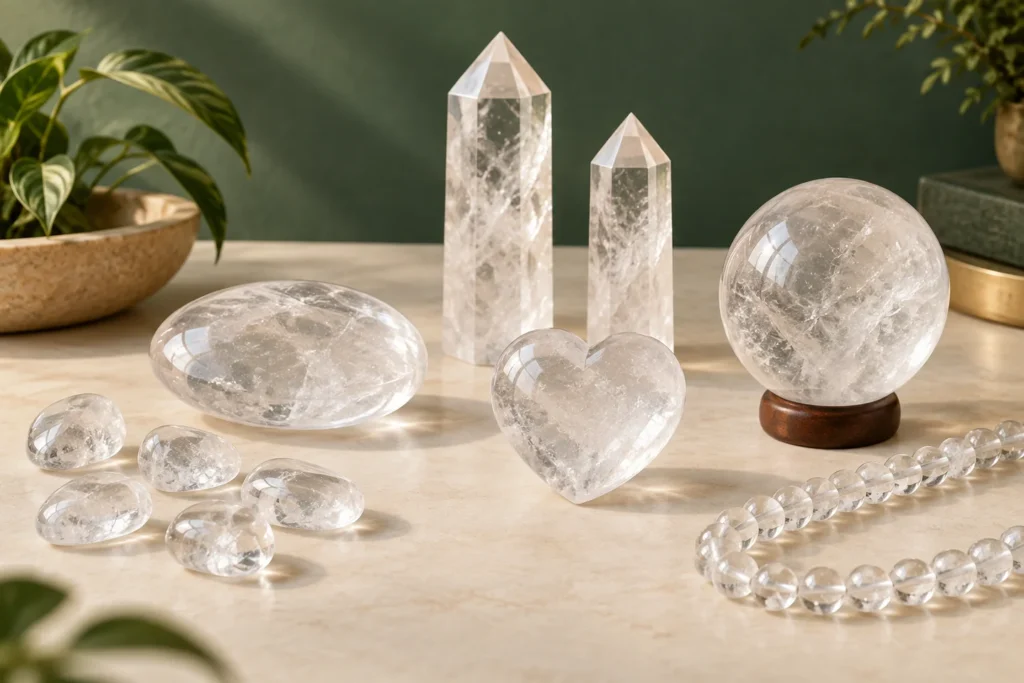
That realization — that "best" is context-dependent — changes how smart buyers approach sourcing. Below, I will walk through what defines clear crystal quality, how different product forms and sales channels shift the definition of "best," and what to confirm with your supplier before placing an order.
What Exactly Is Clear Crystal and Why Does Quality Vary So Much?
When buyers ask about the "best clear crystal," they almost always mean natural clear quartz — rock crystal. Yet natural formation means every piece carries its own story in the form of inclusions, veils, and structural characteristics.
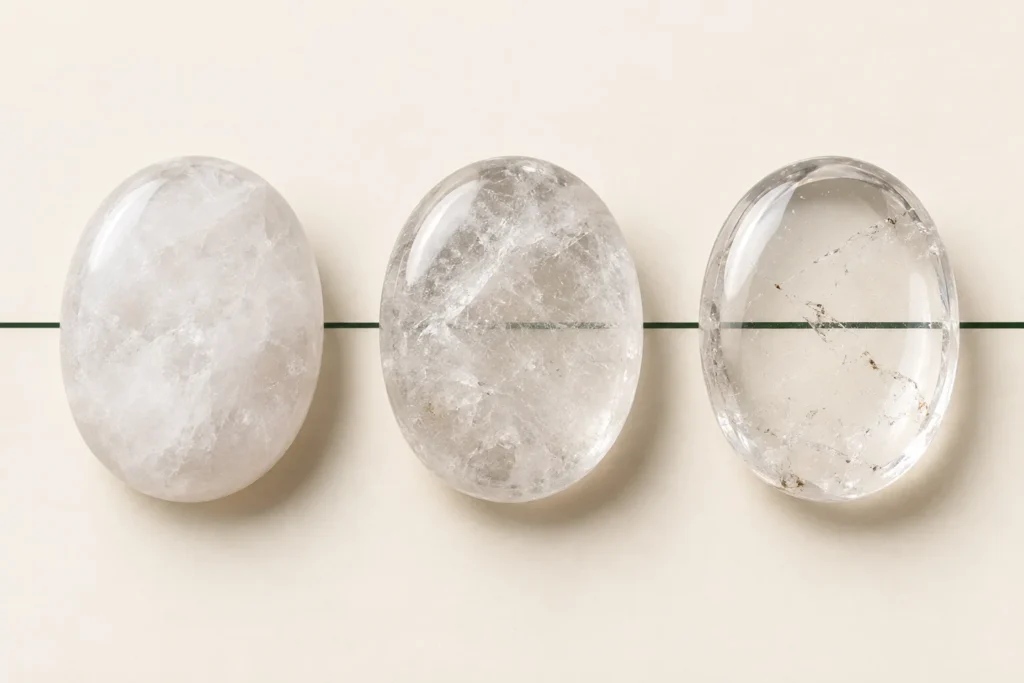
Clear quartz (SiO₂) is one of the most abundant minerals on Earth1, and its quality varies enormously depending on the geological conditions under which it formed, the mining location, and how it was processed after extraction2. A truly water-clear specimen with no visible inclusions is relatively rare3 compared to pieces that contain cotton-like wisps, rainbow fractures, cloudy zones, or internal cracks.
What Causes Clarity Differences in Clear Quartz?
Understanding what affects clarity helps buyers set realistic expectations:
- Cotton and veils: These are internal wispy formations, often appearing white or milky. They are a natural feature of quartz growth.4 Some buyers consider light cotton acceptable; others want none.
- Internal fractures and cracks: Stress during geological formation or during mining and transport can produce visible fractures.5 Surface-reaching cracks differ from internal rainbow fractures, which some end customers actually find attractive.
- Cloudiness and milky zones6: Portions of a crystal may transition from clear to milky white. In some product forms (like larger towers), a gradient can be visually interesting. In others (like spheres), buyers expect uniform transparency.
- Surface finish and polish quality: Even a naturally clear piece can appear dull if the polish is poor. Conversely, an excellent polish can make a slightly included piece look more appealing.
| Clarity Factor | Impact on Wholesale Value | Buyer Expectation Level |
|---|---|---|
| Water-clear, no inclusions | Highest price tier | Premium retail, collectors |
| Light cotton or minor veils | Mid-to-high price | Crystal shops, ecommerce |
| Visible inclusions, rainbow fractures | Mid price | Gift shops, livestream sales |
| Cloudy zones, mixed clarity | Lower price | Bulk/entry-level retail |
In my experience handling wholesale inquiries, many first-time buyers begin by requesting "the clearest, best quality" — which is understandable. But once they see the price difference between AAA water-clear pieces and those with light natural inclusions, the conversation shifts quickly toward "what level of clarity will my customers accept at this price point?" That is the real sourcing question.
Does Origin Matter for Clear Crystal Quality?
Clear quartz is mined globally — Brazil, Madagascar, China, the United States, and many other locations.7 Origin can influence the general characteristics of the material (Brazilian quartz, for instance, is widely regarded for large, clean specimens8), but origin alone does not guarantee quality9. Two pieces from the same mine can look entirely different. For B2B buyers, the practical approach is to evaluate actual samples or detailed batch photos rather than relying solely on origin claims.
How Does the "Best" Clear Crystal Change by Product Form?
The product form you source — towers, spheres, palm stones, carvings, tumbled stones, or rough specimens — dramatically shifts what "best" means in terms of clarity, finish, and acceptable inclusions.
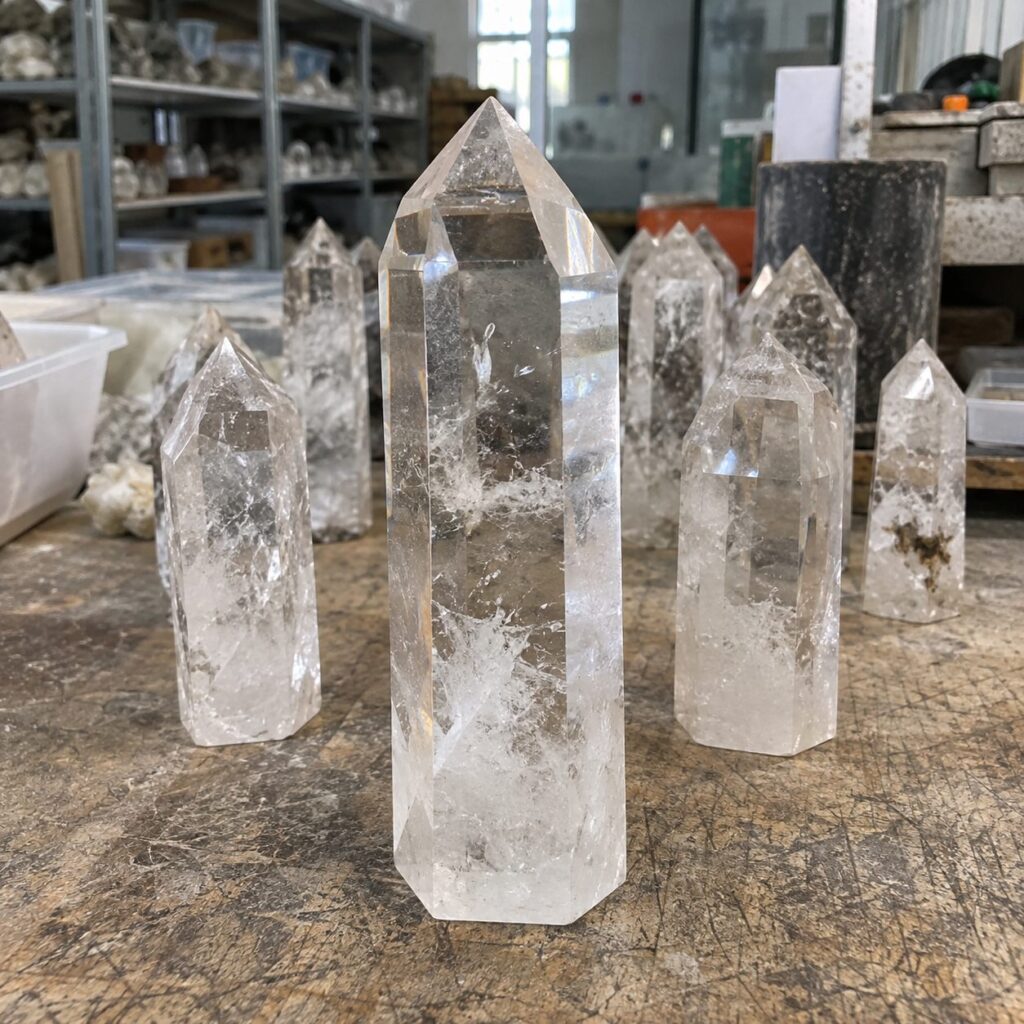
A clear crystal sphere demands near-uniform transparency because every angle is visible. A clear quartz tower, on the other hand, can carry some natural inclusions in the base while still presenting a stunning clear tip. Understanding these differences prevents over-spending on clarity grades that your product form does not require.
Product-Form Clarity Guide
Here is how clarity expectations typically break down across the product forms we process and supply most frequently:
| Product Form | Clarity Expectation | Why |
|---|---|---|
| Spheres | High — uniform transparency preferred | All angles visible; inclusions are magnified |
| Towers / Points | Medium-to-high — clear tip is key | Base can be slightly included if tip is clean |
| Palm Stones | Medium — smooth finish matters most | Hand feel and surface polish carry visual weight |
| Hearts & Carvings | Medium — shape and detail compete with clarity | Customers focus on form; light inclusions are acceptable |
| Tumbled Stones | Lower — batch consistency matters more | Sold in volume; slight cloudiness is expected |
| Rough / Specimens | Variable — natural character is valued | Collectors appreciate natural formations, not perfection |
Why This Matters for Your Budget
If you are sourcing clear crystal spheres for a premium ecommerce listing, you will need to pay for high-clarity material and accept that waste during the cutting and polishing process is significant — not every piece of raw quartz yields a flawless sphere10. That cost gets passed along.
But if you are sourcing clear quartz tumbled stones for a retail bin priced at $3–$5 per piece, investing in AAA transparency would destroy your margins. In that context, the "best" clear crystal is a consistent batch of nicely polished tumbles with acceptable light inclusions that your customers will still love.
I often tell buyers: match your clarity grade to your price tag, not the other way around. Starting with the most expensive material and then trying to figure out how to sell it profitably is a much harder path than starting with your target retail price and working backward to the right quality tier.
Why Do Photos Alone Fail to Define the Best Clear Crystal?
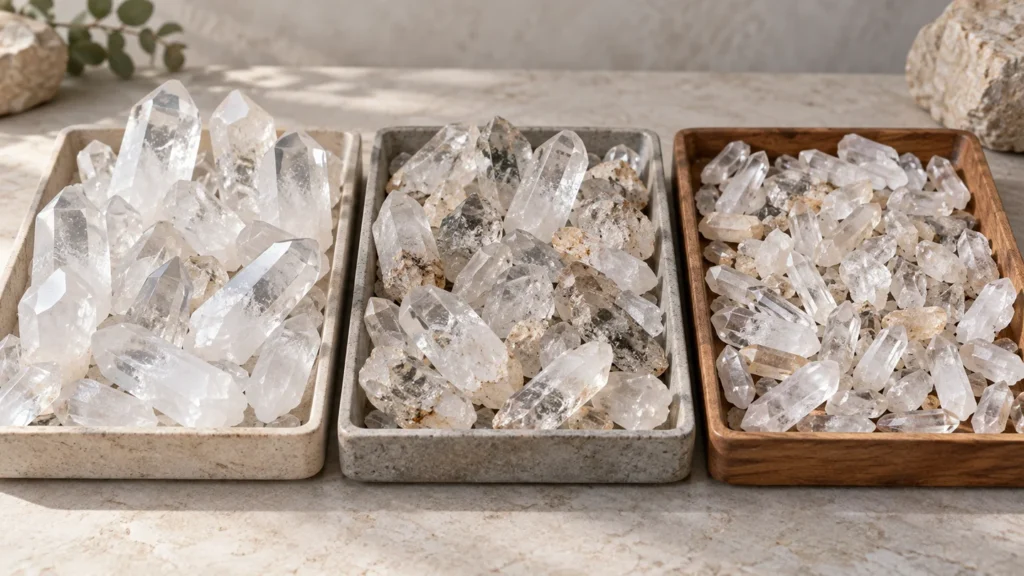
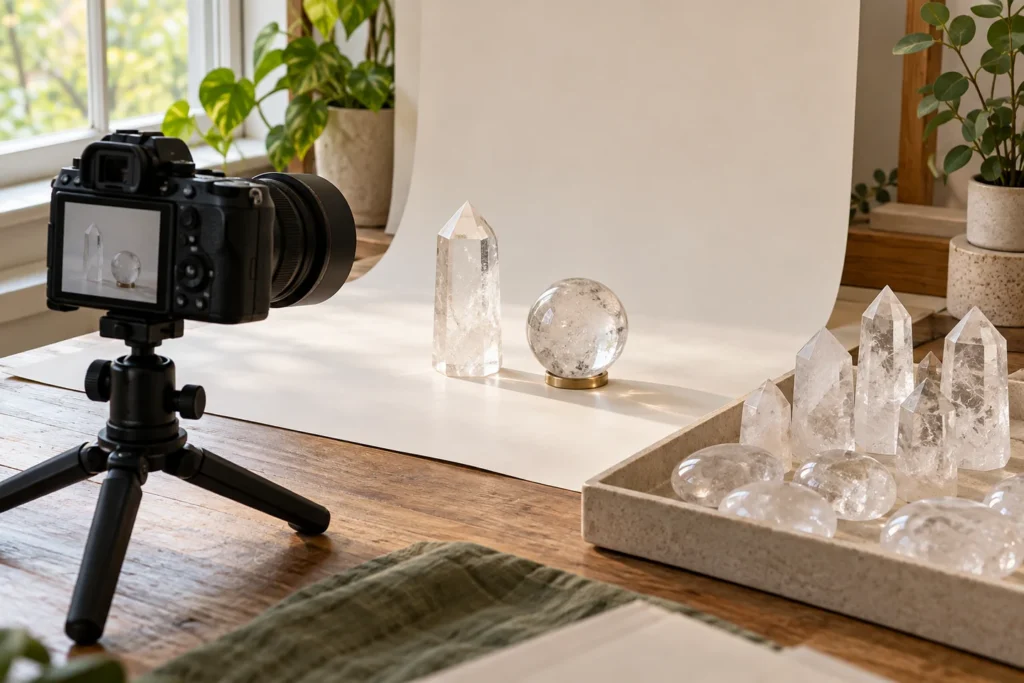
This is one of the biggest pain points in wholesale crystal sourcing. A single stunning photo can set expectations that an entire batch simply cannot meet. Clear crystal is especially tricky because transparency, reflections, and lighting play enormous roles in how a piece photographs.
Photos are a starting point, never the full story. For clear crystal specifically, the gap between a carefully lit hero shot and the reality of a 50-piece wholesale batch can be significant. Buyers who rely only on photos — without confirming batch standards, inclusion tolerance, and sizing — risk disappointment and return requests from their own customers.
The Photo-to-Batch Gap: What Causes It?
Several factors contribute to the disconnect:
- Lighting: Professional backlighting makes clear quartz look more transparent. Natural daylight or overhead fluorescent light in a warehouse tells a very different story.
- Angle: A single photo captures one angle. In a sphere, one side may be water-clear while the opposite side has a cloudy patch.
- Sample vs. batch: A supplier's product photo may show the best piece from a previous batch. The current batch may differ in material quality, size distribution, or surface finish.
- Screen differences: Your phone, your laptop, and your customer's monitor all display color and transparency differently.11
How to Reduce Photo-Related Risk
From years of handling wholesale inquiries, I have seen a few practices that consistently help buyers avoid disappointment:
- Request batch-specific photos and videos. Ask your supplier for images of the actual current batch, not catalog shots. Video is particularly useful for clear crystal because it shows how light passes through the material from multiple angles.
- Define your inclusion tolerance in writing. Saying "I want good quality" is vague. Saying "light cotton acceptable, no surface-reaching cracks, no cloudy zones larger than 20% of the piece" gives your supplier a workable standard.
- Order a sample or trial batch first. Before committing to a large order, a small trial lets you physically evaluate clarity, polish, and consistency. This is especially important for clear crystal, where transparency is the primary selling feature.
- Confirm grading criteria with your supplier. Quality grading (AAA, AA, A, etc.) is not standardized across the crystal industry.12 What one supplier calls AAA, another might call A-grade. Always align on specific, observable criteria rather than letter grades alone.
Pro tip: When we communicate with buyers about clear crystal, we encourage them to share photos of products they have sold successfully before. This gives us a concrete visual reference to match against available batches — much more effective than abstract quality labels.
What Makes a Clear Crystal the "Best" for Your Sales Channel?
A crystal shop in a tourist district, an ecommerce brand with curated listings, and a TikTok livestream seller all serve different customers with different expectations. The best clear crystal for each of these channels is not the same product.
Understanding your sales channel's dynamics — average order value, customer tolerance for natural variation, return rate sensitivity, and visual presentation format — is the real key to choosing the right clear quartz to stock.
Channel-by-Channel Breakdown
Independent Crystal Shop
- Customer expectation: Shoppers can pick up and inspect each piece. They see inclusions, feel the polish, and compare pieces side by side.
- Best clear crystal strategy: Stock a range of clarity grades. Keep a few premium water-clear display pieces to attract attention, and offer mid-grade pieces at accessible price points for everyday sales.
- Key risk: Over-investing in top-tier clarity that sits unsold because the price is too high for walk-in traffic.
Ecommerce (Etsy, Shopify, Amazon)
- Customer expectation: Buyers rely entirely on photos and descriptions. They expect the piece they receive to match the listing closely.
- Best clear crystal strategy: Prioritize consistency and accurate photography. Mid-to-high clarity pieces with minimal inclusions photograph well and reduce return rates.
- Key risk: Using stock photos or best-of-batch images that do not represent the typical piece shipped. This is the fastest path to negative reviews.
Livestream / Social Selling
- Customer expectation: Impulse-driven. Viewers see the piece on camera in real time. Moderate inclusions or natural features can actually create storytelling opportunities ("look at this rainbow inside!").
- Best clear crystal strategy: Source clear quartz with interesting features — rainbows, phantom inclusions, or natural points — at mid-range prices. Volume and variety matter more than flawless clarity.
- Key risk: Over-paying for premium clarity when the sales format favors personality and story over perfection.
Growing Crystal Brand
- Customer expectation: Brand consistency. Customers expect every order to reflect the brand's aesthetic and quality standard.
- Best clear crystal strategy: Define a clear quality specification and find a supplier who can deliver against that spec batch after batch. Consistency matters more than getting the absolute cheapest price.
- Key risk: Switching suppliers frequently to chase lower prices and ending up with inconsistent quality that damages brand trust.
How Should You Evaluate a Clear Crystal Supplier?
Finding the best clear crystal is only half the equation. The supplier you work with determines whether you actually receive what you expected, batch after batch.
A reliable clear crystal supplier is not just a source of pretty stones. They are a communication partner who helps you navigate material availability, quality grading, batch variation, and logistics — especially when you are buying from overseas.
What to Look for in a Supplier
Based on what I see working well in long-term buyer-supplier relationships, here are the factors that matter most:
- Willingness to show current batch photos/videos. Suppliers who only show polished catalog shots may not be transparent about what is actually available.
- Clear communication about inclusions and grading. Can they explain what level of inclusions you should expect? Do they have a system for separating grades?
- Trial order flexibility. A supplier confident in their quality will allow a smaller initial order so you can evaluate before scaling up.
- Honest conversation about limitations. Natural crystal is not manufactured to spec. A good supplier will tell you when a batch does not meet your requirements rather than shipping substandard material.
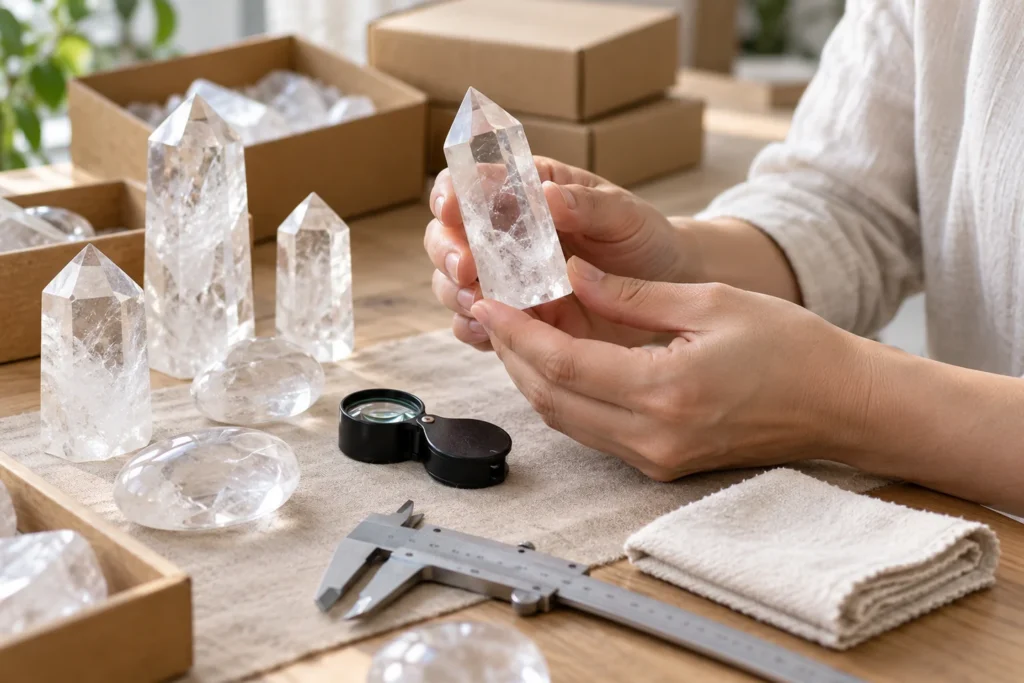
- Processing and finishing capability. For clear crystal, polish quality is crucial. Ask about their polishing process and whether they inspect for surface scratches, flat spots, or uneven finishes.
Red Flags to Watch For
| Red Flag | Why It Matters |
|---|---|
| Only shows best-of-batch photos | Sets unrealistic expectations for the full order |
| Uses non-standard grading with no explanation | AAA means nothing without defined criteria |
| Refuses trial orders or samples | May indicate inconsistent quality |
| Promises "all pieces will be perfect" | Natural crystal always has variation; perfection promises are unrealistic |
| Cannot discuss material, processing, or inclusions in detail | Suggests limited quality-control knowledge |
At GD Crystal, we approach these conversations practically. With over 15 years of crystal processing experience, we know that managing expectations honestly is the foundation of a lasting buyer-supplier relationship. We would rather lose a sale by being upfront about a batch's characteristics than win a sale and face a disappointed customer.
Frequently Asked Questions
Is the most transparent clear crystal always the best for resale?
Not necessarily. The most transparent pieces command the highest wholesale price, which compresses margins. For many retail channels, mid-grade clarity with good polish and consistent sizing offers better profitability. The "best" resale crystal balances appearance, cost, and customer expectations for your specific market.
How do I tell if clear quartz has been treated or enhanced?
Some clear quartz on the market may be synthetic or treated to enhance transparency. As a buyer, ask your supplier directly about material origin and any treatments. For definitive verification, consult a qualified gemological professional. Reputable suppliers should be willing to discuss material characteristics openly.
What is a reasonable MOQ for clear crystal wholesale orders?
MOQ varies by product form, size, and material grade. Clear crystal spheres in larger sizes may have lower MOQs per piece but higher per-order minimums. Tumbled stones typically require higher volume. Always confirm MOQ, mixed-batch options, and pricing with your supplier based on the specific products you need.
Can I mix different clear crystal product forms in one order?
Many suppliers, including GD Crystal, can accommodate mixed orders across product forms — for example, combining towers, spheres, and palm stones in a single shipment. This is especially useful for new buyers building initial inventory. Confirm mixing conditions, per-item minimums, and pricing with your supplier.
How much batch-to-batch variation should I expect with clear quartz?
Clear quartz is a natural material, so some variation between batches is normal and expected. Clarity levels, inclusion patterns, and even slight size differences can shift between batches depending on material availability. Confirming batch details before each order — rather than assuming consistency with a previous purchase — is the most reliable approach.
Conclusion
The best clear crystal is not a single, universally perfect specimen. For B2B buyers, it is the clear quartz product that aligns with your sales channel, product form requirements, margin targets, and your customers' expectations. Water-clear perfection has its place — and its price — but the smartest sourcing decisions balance clarity with cost, consistency, and commercial reality.
Before your next order, define your clarity tolerance, request current batch photos or videos, and start with a trial quantity. If you are looking for a supplier who will walk you through these decisions honestly, reach out to GD Crystal for a quote tailored to your specific clear crystal needs. We are happy to discuss material options, product forms, and batch details — one inquiry at a time.
References
- "Quartz | U.S. Geological Survey", https://www.usgs.gov/media/images/quartz. A geological reference such as the U.S. Geological Survey identifies quartz as crystalline silicon dioxide and describes it as a very common rock-forming mineral, supporting the article’s identification of clear quartz and its broad abundance. Evidence role: general_support; source type: government. Supports: Quartz is silicon dioxide and is widely described as one of Earth's most abundant minerals.. Scope note: This supports the mineral identification and general abundance, not the commercial grading of clear crystal. ↩
- "Inclusions in Gemstones", https://www.gia.edu/gems-gemology/summer-2022-colored-stones-unearthed. Gemological and mineralogical sources explain that quartz may contain inclusions and growth features and that cutting and polishing influence its final appearance, supporting the article’s claim that quality reflects both natural formation and processing. Evidence role: mechanism; source type: education. Supports: Quartz appearance and clarity are affected by inclusions, growth history, locality, and cutting or polishing quality.. Scope note: Such sources generally explain mechanisms rather than quantify quality variation across wholesale batches. ↩
- "Synthetic Rock Crystal Quartz Bangle with Unusual …", https://www.gia.edu/gems-gemology/winter-2015-labnotes-synthetic-rock-crystal-quartz-bangle-unusual-inclusions. Gemological references describe rock crystal as the transparent variety of quartz while noting that natural quartz commonly contains inclusions or internal features, supporting the contextual claim that completely water-clear pieces are less common. Evidence role: expert_consensus; source type: education. Supports: Natural rock crystal can be highly transparent, but inclusions and internal features are common in quartz specimens.. Scope note: The source may not provide a numerical rarity rate for wholesale-grade material. ↩
- "Unusual Purple Fluid in Quartz", https://www.gia.edu/gems-gemology/fall-2022-microworld-unusual-purple-fluid-in-quartz. Mineralogical studies of quartz inclusions describe fluid inclusions, healed fractures, and growth-related internal features, supporting the statement that veil-like structures can be natural features of quartz formation. Evidence role: mechanism; source type: paper. Supports: Veils, wisps, and inclusion trails in quartz can originate from natural crystal growth or fluid inclusion processes.. Scope note: The terminology used in scientific literature may differ from trade terms such as “cotton.” ↩
- "Deformation of Rock", https://www2.tulane.edu/~sanelson/eens1110/deform.htm. Geology and mineralogy references describe quartz as a brittle silicate mineral that fractures under stress, supporting the article’s explanation that visible fractures may arise from natural deformation or later mechanical handling. Evidence role: mechanism; source type: education. Supports: Quartz is a brittle mineral that can preserve natural fractures and can also fracture under mechanical stress during extraction or handling.. Scope note: The source is likely to support the general fracture mechanism, not the specific frequency of transport-related damage in wholesale crystal shipments. ↩
- "Unusual Purple Fluid in Quartz", https://www.gia.edu/gems-gemology/fall-2022-microworld-unusual-purple-fluid-in-quartz. Mineralogical references identify milky quartz as a common quartz variety and attribute its cloudy appearance to microscopic inclusions or internal light scattering, supporting the article’s description of cloudy zones in clear quartz. Evidence role: definition; source type: encyclopedia. Supports: Milky quartz is a recognized quartz variety whose white or cloudy appearance is associated with microscopic inclusions or internal scattering.. Scope note: This supports the existence and cause of cloudiness, not the commercial acceptability of such zones. ↩
- "Quartz crystal in Brazil", https://pubs.usgs.gov/publication/70215038. A mineral occurrence database such as Mindat documents quartz localities across numerous countries, including Brazil, Madagascar, China, and the United States, supporting the article’s statement that clear quartz is globally sourced. Evidence role: general_support; source type: research. Supports: Quartz has documented occurrences in many countries, including the regions named in the article.. Scope note: Occurrence records do not necessarily indicate current commercial mining volume or wholesale export availability. ↩
- "How to Travel Brazil: Gemstones Edition", https://www.gia.edu/gia-news-research/how-to-travel-brazil-gemstones-edition. Gemological and mineralogical references identify Brazil as a notable source of rock crystal and large quartz specimens, providing historical context for the trade view that Brazilian quartz can be associated with sizable, clean material. Evidence role: historical_context; source type: education. Supports: Brazil has a documented history as an important source of rock crystal and large quartz specimens.. Scope note: This contextual support does not prove that any individual Brazilian quartz batch is high quality. ↩
- "Analysis & Grading – GIA.edu", https://www.gia.edu/gem-lab. Gemological guidance emphasizes evaluating individual specimens by observable properties such as clarity, color, cut, and condition rather than relying solely on geographic origin, supporting the article’s caution that origin alone does not guarantee quality. Evidence role: expert_consensus; source type: education. Supports: Gemological evaluation focuses on observable characteristics of an individual stone, and origin is not a stand-alone guarantee of quality.. Scope note: The support is based on broader gemological evaluation principles rather than a quartz-only wholesale study. ↩
- "An Introduction to Gem Treatments", https://www.gia.edu/gem-treatment. Lapidary references explain that cutting and polishing gemstones require removal of rough material and avoidance of fractures or inclusions, supporting the article’s claim that flawless quartz spheres require selective material and entail yield loss. Evidence role: mechanism; source type: education. Supports: Lapidary production removes material and must work around fractures or inclusions, so not all rough material can become a flawless sphere.. Scope note: The source may describe lapidary yield generally rather than provide quartz-sphere-specific waste percentages. ↩
- "Color Management for Creators: ICC Profile", https://www.eizo.com/library/management/color-management_icc-profiles/. Color-management authorities explain that displays differ in calibration, gamut, and rendering behavior, supporting the article’s point that product images may appear differently on phones, laptops, and customer monitors. Evidence role: mechanism; source type: institution. Supports: Device displays vary in calibration, color gamut, brightness, and rendering, which can change how product images appear.. Scope note: This supports screen-display variation generally, not a measured effect specifically for clear quartz transparency. ↩
- "16 CFR Part 23 — Guides for the Jewelry, Precious Metals, …", https://www.ecfr.gov/current/title-16/chapter-I/subchapter-B/part-23. Gemological education sources note that colored stones lack a single universal grading system comparable to diamond grading, supporting the article’s warning that trade labels such as AAA, AA, and A may vary by seller. Evidence role: expert_consensus; source type: education. Supports: Unlike formal diamond grading systems, many colored-stone and crystal trade grades are not governed by a universal standard.. Scope note: This supports the general absence of universal grading standards, not the practices of any specific supplier. ↩