Figuring out what not to pair with amethyst is a real concern for crystal retailers building product sets, gift boxes, and curated collections. The wrong combination won't just confuse your customers — it can damage inventory in transit and expose your brand to misleading claims. The solution starts with reframing "forbidden pairings" as a practical retail-risk question.
Most amethyst pairing problems aren't caused by proven energy conflicts between crystals. They come from three tangible retail risks: unverifiable healing claims attached to the combination, physical damage when stones of different hardness or texture are packed together, and confusing product messaging that weakens customer trust. Retailers should evaluate every amethyst pairing through the lens of brand safety, packaging logistics, and honest communication — not spiritual rules.
If you've searched for a definitive "never pair amethyst with…" list, you've probably found dozens of contradictory answers. That's because most of those lists are built on unverifiable metaphysical assumptions. Below, I'll walk through the real risks I've seen in over 15 years of working with crystal shop owners and e-commerce sellers — and give you a practical framework for making pairing decisions that protect your brand and your margins.
Why do most "forbidden amethyst pairings" lists miss the point?
Search for amethyst pairing advice and you'll find long lists of stones that supposedly "cancel out" amethyst's energy. These lists create anxiety for retailers, but they rarely cite verifiable sources. The real problem? They distract from the risks that actually cost you money and reputation.
The reason most "forbidden amethyst pairings" lists miss the point is that they treat unproven energetic conflict as fact. No peer-reviewed study or gemological authority has confirmed that two crystals cancel each other's properties when placed together.1 The genuine risks for retailers lie in misleading product claims, physical product damage, and incoherent brand messaging — not in spiritual incompatibility.
Where do these lists come from?
Most "do not pair" lists circulate through consumer-facing blogs and social media posts. They borrow language from various metaphysical traditions, but the specific pairings flagged as "forbidden" vary wildly from source to source. One blog says amethyst and citrine should never be combined; another sells ametrine (a natural amethyst-citrine blend) as a premium product. The contradiction should tell you something.
What this means for your business
As a retailer, the moment you publish an absolute claim — "never pair amethyst with tiger's eye" — you're making a promise you can't verify. Worse, you might be contradicting what your own customers have read elsewhere, creating confusion instead of trust.
Here's how I think about it when advising wholesale buyers:
| "Forbidden List" Approach | Retail-Risk Approach |
|---|---|
| Claims certain stones energetically conflict | Evaluates whether the pairing creates unverifiable promises |
| Based on unattributed metaphysical traditions | Based on packaging safety, sales clarity, and brand consistency |
| Gives absolute rules | Gives decision-making frameworks |
| Confuses customers who read different lists | Builds trust through honest, bounded product descriptions |
The shift is simple: stop asking "which stones conflict with amethyst?" and start asking "does this pairing create a risk I can't manage?"
What are the real physical risks of pairing amethyst with other stones?
When crystal sellers pack amethyst alongside other minerals in sets or gift boxes, physical damage during shipping and storage is a genuine, costly risk. Scratches, chips, and surface abrasion reduce perceived product quality and trigger returns.2 This is the most concrete amethyst pairing risk — and the easiest to prevent.
Amethyst sits at approximately 7 on the Mohs hardness scale3, which means it can scratch softer stones and be scratched by harder ones. Pairing amethyst directly against rough-surfaced, sharp-edged, or significantly harder minerals without protective packaging can cause visible damage. Buyers should always verify the specific hardness of each mineral in a product set before finalizing packaging design.
Common physical pairing concerns
Here are the scenarios where I've seen damage occur most often in wholesale shipments and retail displays:
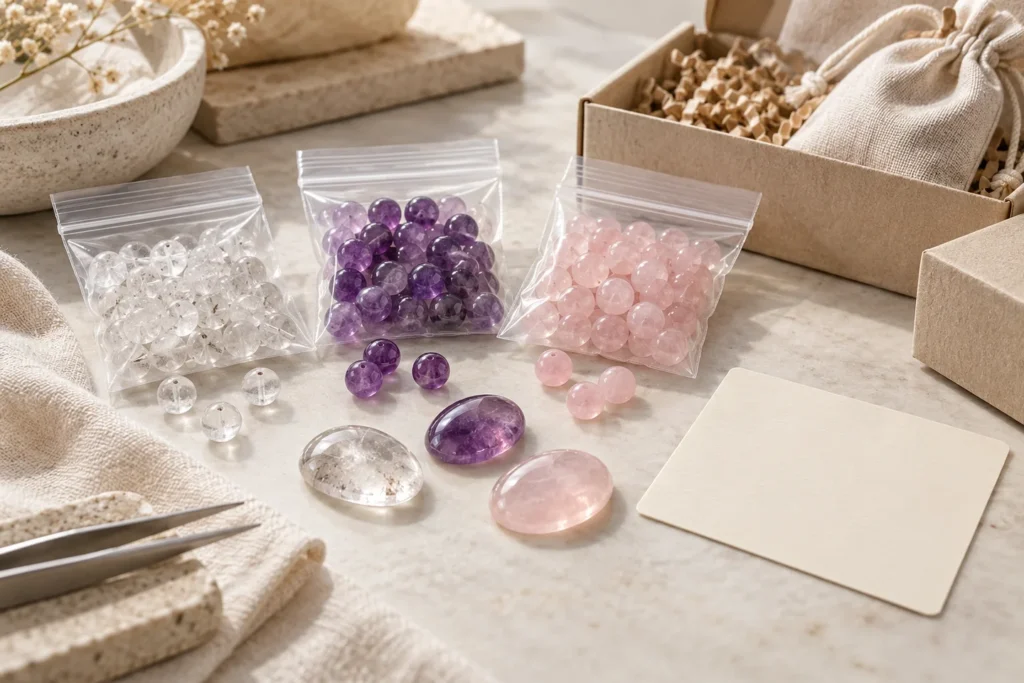
- Softer stones paired with amethyst tumbles: Stones like selenite (~2 Mohs), fluorite (~4 Mohs), or calcite (~3 Mohs)4 can develop scratches when they shift against polished amethyst during transit. This is especially problematic in bulk bags or loosely packed gift sets.
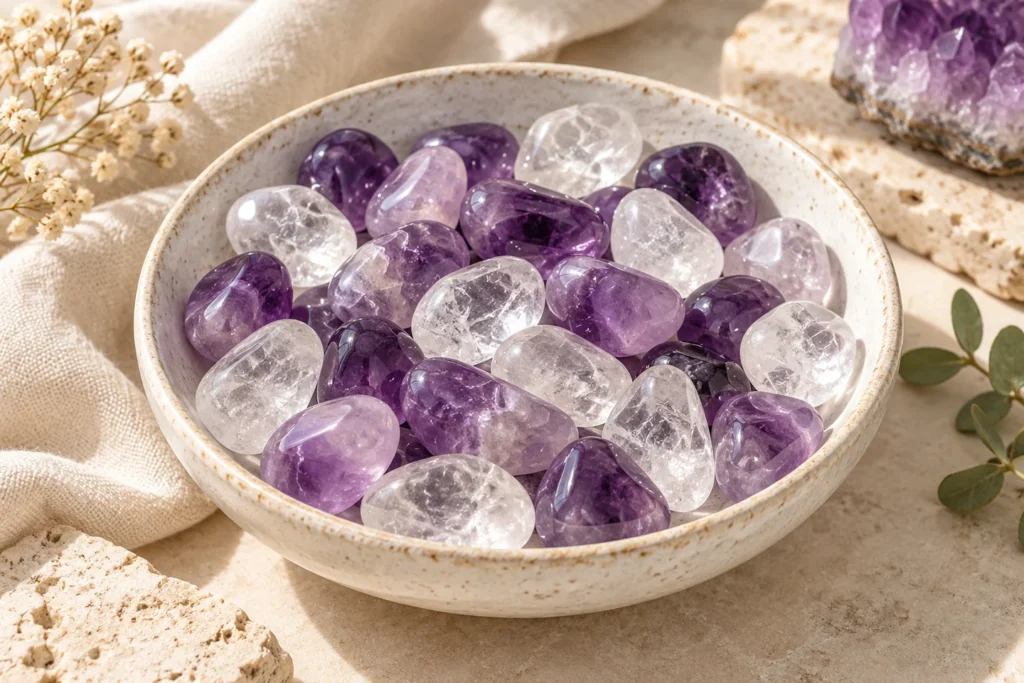
- Rough or druzy surfaces against polished pieces: Pairing a raw amethyst cluster with a polished sphere of any material invites surface scratches. The crystal points on druzy and cluster specimens act like tiny abrasives.
- Sharp-edged specimens in the same compartment: Amethyst points packed alongside other pointed specimens can chip each other. Even stones of similar hardness will chip at contact points under shipping vibration.
A quick hardness reference
| Stone | Approximate Mohs Hardness | Risk When Paired with Amethyst (7) |
|---|---|---|
| Selenite | ~2 | High — amethyst will scratch selenite easily |
| Fluorite | ~4 | Moderate — contact abrasion likely |
| Apatite | ~5 | Moderate — surface marks possible |
| Quartz varieties | ~7 | Low hardness risk, but point-to-point chipping possible |
| Topaz | ~8 | Moderate — topaz may scratch amethyst |
| Corundum (sapphire/ruby) | ~9 | High — will scratch amethyst |
Note: Hardness values are approximate and can vary by specimen. Always verify with your supplier for the specific batch and mineral form before designing packaging.
Practical packaging solutions
The fix isn't to avoid these pairings entirely. It's to pack them properly:
- Use individual fabric pouches, foam inserts, or tissue dividers between stones.
- Avoid loose bulk bags for mixed-hardness sets.
- Test your packaging by shaking a sample box — if stones shift and contact each other, add padding.
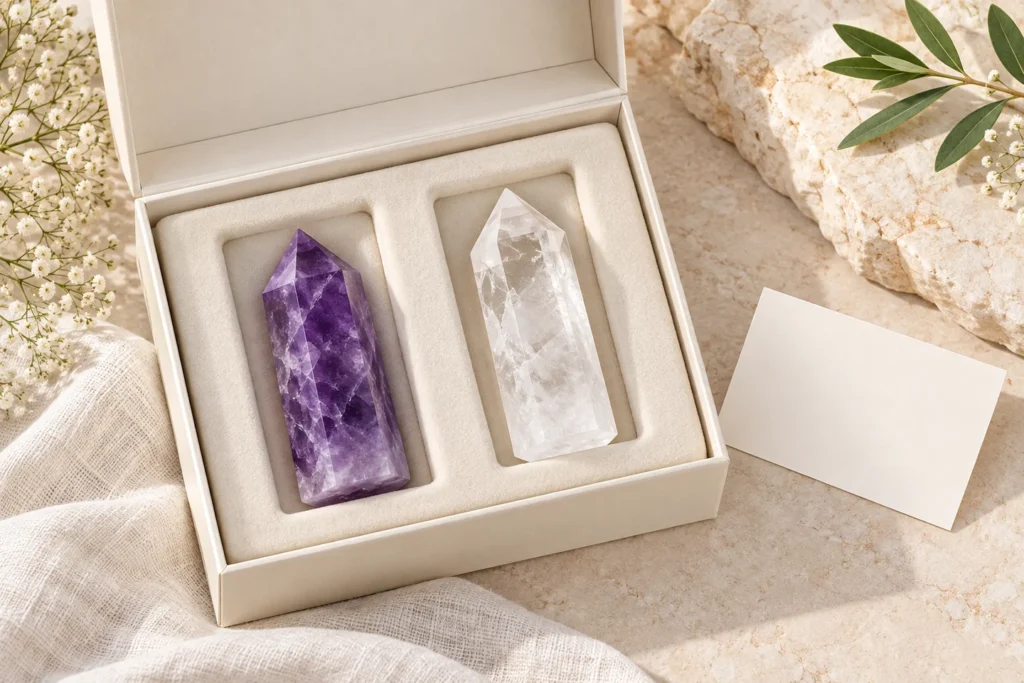
- For display sets, use velvet-lined trays with individual compartments.
Physical pairing risk is the most straightforward amethyst pairing problem to solve. It just takes intentional packaging, not a "forbidden" list.
Why should you avoid pairing amethyst with strong healing claims?
The biggest brand risk when pairing amethyst with other crystals isn't physical — it's narrative. When a product set promises specific emotional, spiritual, or health outcomes, retailers expose themselves to regulatory scrutiny, customer disappointment, and eroded trust. This is where "what not to pair with amethyst" becomes a marketing question.
Retailers should avoid pairing amethyst (or any crystal) with claims that the combination will guarantee sleep improvement, emotional healing, anxiety relief, spiritual protection, or energy cleansing. These claims are unverifiable, may violate consumer protection standards in many jurisdictions, and create expectations your product cannot reliably meet. The safest approach is bounded, honest language.
The claims trap in curated sets
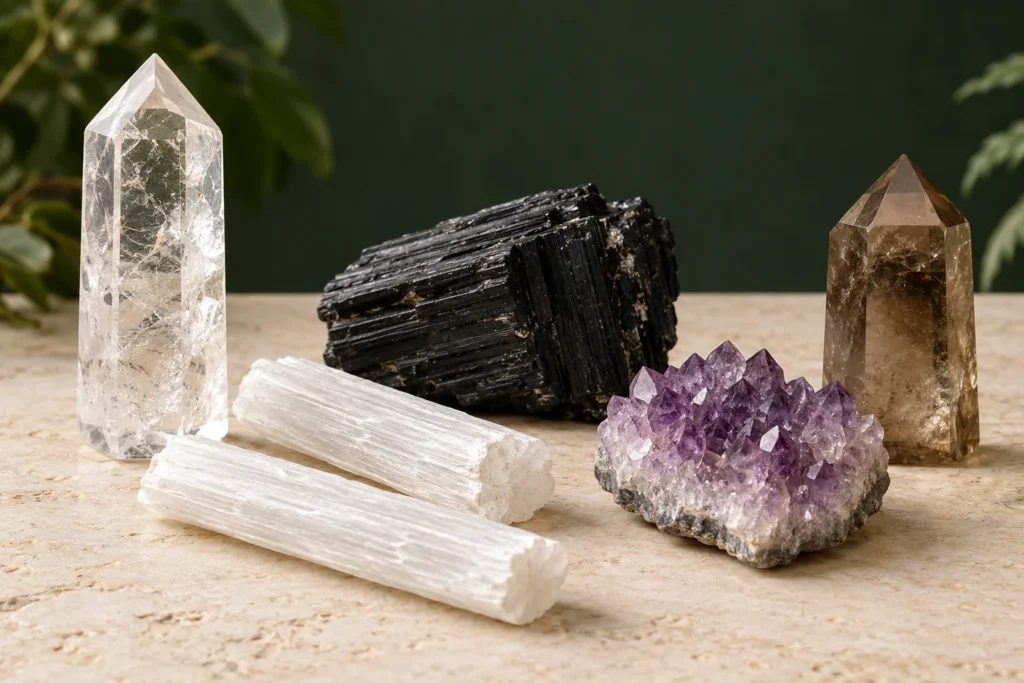
I've noticed a pattern when working with crystal shop owners and e-commerce sellers building amethyst product sets. The temptation is to create a compelling story: "This Calm & Protection Set combines amethyst for peace with black tourmaline for shielding and rose quartz for heart healing." It sounds appealing. It also makes three unverifiable promises in one sentence.
Here's the problem breakdown:
- Regulatory exposure: In markets like the US, EU, UK, and Australia, implying that a product provides health benefits without evidence can violate consumer protection and advertising standards5.
- Customer expectations: When a customer buys a "Sleep & Calm" amethyst set and still has insomnia, you've set yourself up for a return, a negative review, or both.
- Brand credibility: The more absolute your claims, the more fragile your reputation becomes. One skeptical review can undermine an entire product line.
What "pairing risk" looks like in product descriptions
| Risky Pairing Description | Lower-Risk Alternative |
|---|---|
| "Amethyst + Lepidolite: Guaranteed anxiety relief" | "Amethyst + Lepidolite: A calming color palette popular with collectors" |
| "This set protects you from negative energy" | "This set features stones traditionally associated with grounding and calm" |
| "Amethyst and selenite will cleanse your aura" | "Amethyst and selenite — a classic combination for crystal display collections" |
The pattern is clear: describe the tradition, the aesthetics, and the customer experience — not the guaranteed outcome. Use phrases like "traditionally associated with," "often chosen for," and "popular among collectors who value…"
A framework for claim-safe amethyst pairings
Before adding any pairing to your product line, run it through these four questions:
- Can I verify this claim with a credible, published source? If not, soften or remove it.
- Would I be comfortable if a regulatory body reviewed this product listing? If not, rewrite it.
- Does the pairing story make sense to a first-time crystal buyer, not just an enthusiast? If it requires elaborate metaphysical explanation, simplify.
- Am I selling the product or the promise? Always lead with the product.
How should you evaluate amethyst pairings for visual and sales coherence?
Beyond physical safety and claim risk, there's a subtler pairing question: does this combination actually make sense as a product? Confused product sets — stones thrown together with no clear visual or thematic logic — don't sell well, don't photograph well, and don't build brand recognition. This is the merchandising side of "what not to pair with amethyst."
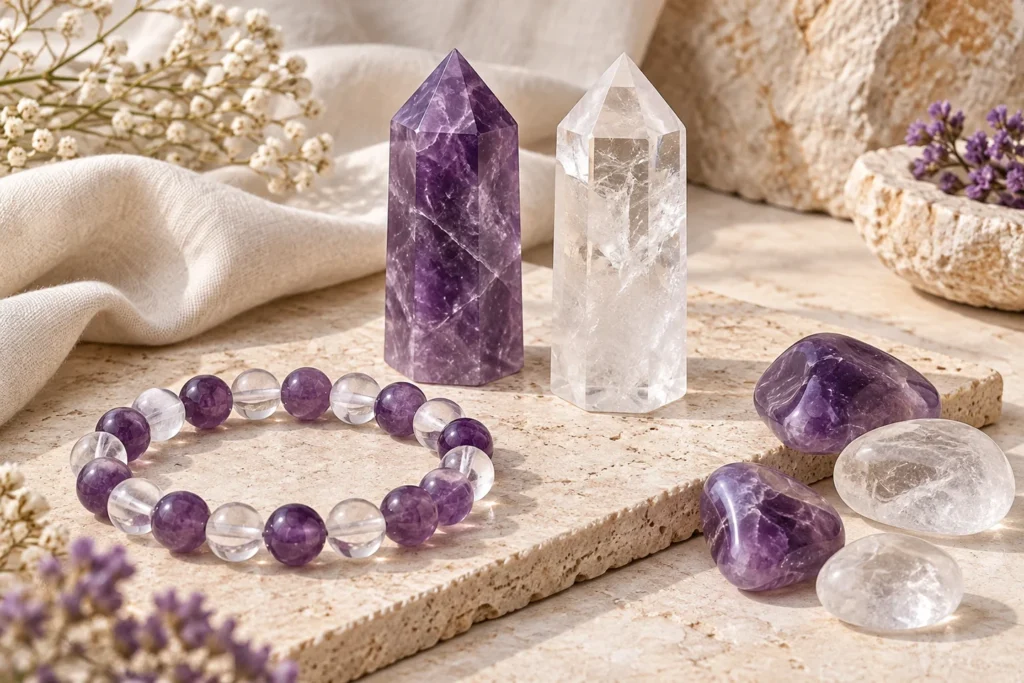
A strong amethyst pairing for resale should be visually coherent, easy to explain in one sentence, and appropriate for the target customer's use case (display, gifting, collection). If you can't quickly articulate why these stones belong together, your customer won't understand it either — and confused customers don't buy.
What makes a pairing visually coherent?
Color harmony is the first filter. Amethyst's purple tones pair naturally with:
- Cool tones: Clear quartz, labradorite, fluorite, moonstone
- Complementary warm accents: Citrine, carnelian (in small proportion)
- Neutral tones: Smoky quartz, black tourmaline, white howlite
Combinations that clash visually — for example, a vivid amethyst tower paired with a heavily dyed bright-green stone of uncertain origin — can look chaotic on a shelf or in a product photo. Online sellers especially need to think about how the set photographs, since the image is the entire shopping experience6.
The "one sentence" test
I advise wholesale buyers to apply a simple rule: if you can't describe the set's theme in one clear sentence, reconsider the pairing. Examples:
- ✅ "A purple and clear quartz tower trio for minimalist crystal displays" — clear, easy to visualize.
- ✅ "An amethyst and smoky quartz meditation set in earth and purple tones" — coherent theme and color story.
- ❌ "Amethyst, orange calcite, malachite, and pyrite wellness bundle" — four unrelated colors, vague theme, no visual logic.
Sizing and form consistency
Pairing also includes product form. A polished amethyst sphere next to a raw chunk of a different mineral can look intentional or accidental depending on your brand's aesthetic. Consider these factors:
- Match polish levels: Polished with polished, raw with raw — or mix intentionally with clear visual contrast.
- Scale proportion: A 3-inch amethyst tower next to a tiny 0.5-inch tumbled stone looks unbalanced. Keep pieces in a similar size range.
- Product form: Hearts with hearts, towers with towers, or a deliberate variety with a theme (e.g., "five crystal shapes in purple tones").
These decisions matter because product returns, weak sell-through, and poor reviews often trace back to a set that looked random rather than curated. The pairing itself isn't "wrong" — the lack of retail logic is.
What should B2B buyers ask their supplier about amethyst pairings?
When you're planning amethyst sets for your store, the conversation with your supplier matters as much as the product concept. Many pairing problems — wrong sizes, inconsistent colors, packaging damage — start at the sourcing stage. Knowing the right questions to ask prevents costly mistakes down the line.
B2B buyers should ask their supplier about material availability by batch, size and weight tolerances for each stone in the set, recommended packaging for mixed-hardness combinations, and minimum order quantities for custom pairing sets. Don't assume that a pairing you saw in a catalog photo is available in the same form, color, or price today.
Key questions to ask before ordering
Here's a practical checklist I recommend to buyers building amethyst sets:
- "Is this specific amethyst shade available in the current batch?" Amethyst color varies significantly by mine and batch.7 A deep Uruguayan purple and a lighter Brazilian lavender serve very different product concepts.
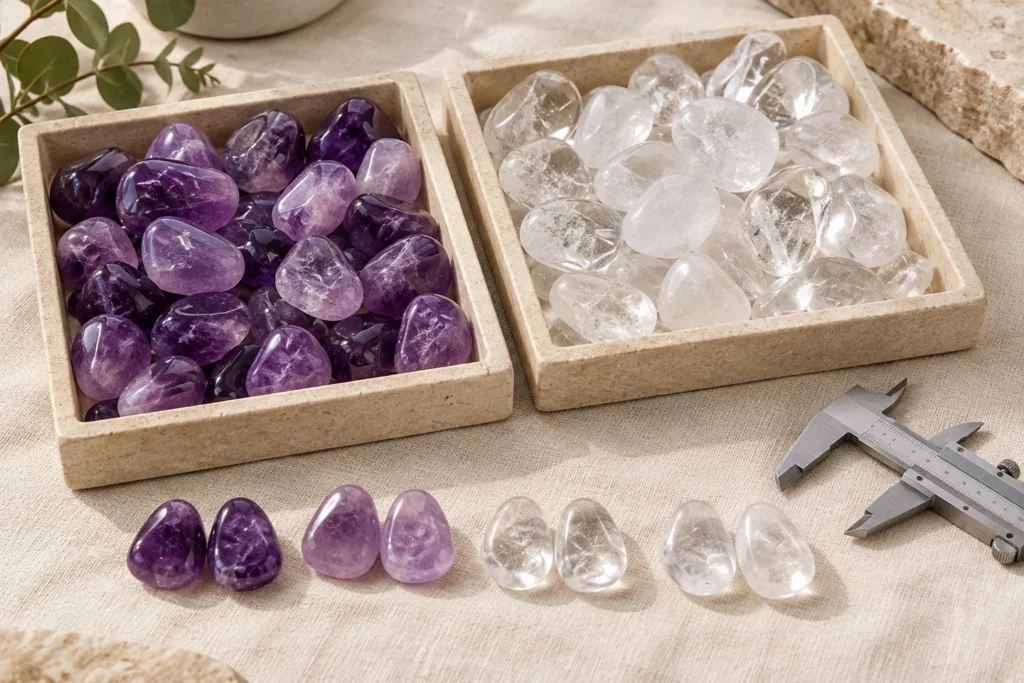
- "What are the size and weight ranges for each stone in the set?" Consistency matters. If your listing shows five stones of similar size but the shipment arrives with wide variation, your product photos become misleading.
- "Can you pack these stones separately within the set packaging?" Mixed-hardness sets need internal dividers. Confirm whether your supplier offers this or if you need to repackage on arrival.
- "What is the MOQ for this custom combination?" Custom sets often have higher minimums than individual stone orders. Get this number early before investing time in product photography and listings.
- "Are any of the stones in this set treated, dyed, or heat-treated8?" Disclosure matters. If your rose quartz is dyed or your citrine is heat-treated amethyst9, your customers deserve to know — and in some markets, you're required to disclose it.
Supplier communication as brand protection
The best defense against bad amethyst pairings is clear, detailed communication with your supplier at the sourcing stage. At GD Crystal, we work through material specs, packaging needs, and batch availability before confirming orders — because a pairing that looks great in concept but arrives damaged or inconsistent is worse than no pairing at all.
Pro tip: Request sample sets before committing to a large order. Evaluate the physical quality, color match, and packaging durability before building your product listings around a specific combination.
Frequently Asked Questions
Can amethyst and citrine be sold together?
Yes. Amethyst and citrine are commonly sold together and even occur naturally in the same stone (ametrine)10. The pairing is visually appealing and easy to explain. Just avoid claiming the combination produces specific guaranteed effects. Focus your product description on the color contrast and collector appeal.
Does amethyst scratch easily when packed with other crystals?
Amethyst is approximately 7 on the Mohs hardness scale, so it resists scratches from softer stones but can be marked by harder minerals like topaz or corundum11. The bigger risk is chipping at contact points during shipping. Use individual pouches or padded dividers when packing mixed sets.
Should I avoid pairing amethyst with black tourmaline for resale?
There's no verified reason to avoid this combination. Amethyst and black tourmaline are one of the most popular pairings in retail crystal sets. The key is to describe the pairing honestly — as a popular collector combination or display set — rather than promising "protection" or "energy shielding" as guaranteed outcomes.
How do I describe amethyst pairings without making health claims?
Use language like "traditionally associated with," "often chosen for," or "a popular combination among crystal collectors." Describe the visual appeal, the cultural tradition, and the display or gifting use case. Avoid words like "guaranteed," "heals," "cures," or "protects"12 in your product descriptions.
What's the safest way to ship amethyst sets with mixed stones?
Use individual compartments, foam inserts, or fabric pouches for each stone. Avoid loose packing in a single bag or box. Test your packaging by shaking a sample — if stones move and contact each other, add more padding. Confirm with your supplier whether they can pack sets with internal dividers before shipping.
Conclusion
Understanding what not to pair with amethyst is less about memorizing a spiritual "forbidden" list and more about making smart retail decisions. The real risks are unverifiable healing claims that expose your brand, physical damage from careless packaging, and incoherent product sets that confuse customers. Evaluate every amethyst pairing through four lenses: Can I verify the claims? Is it safely packable? Does it look intentional? Can I explain it in one sentence?
If you're planning amethyst product sets for your crystal shop or e-commerce store, start the conversation with your supplier early. At GD Crystal, we work with retailers and growing crystal brands to source amethyst and companion stones with clear material specs, batch-specific availability, and packaging guidance. Reach out to our team to discuss your next amethyst collection — we'll help you build sets that are honest, well-made, and ready to sell.
References
- "National Center for Complementary and Integrative Health", https://www.nccih.nih.gov/. Government and medical evidence summaries describe crystal-healing claims as lacking established scientific support; this supports skepticism toward alleged crystal-energy conflicts, although it does not directly test every claimed amethyst pairing. Evidence role: expert_consensus; source type: government. Supports: A source should support that crystal-healing or energy-effect claims lack established scientific evidence, making specific claims about crystals canceling each other contextual rather than verified.. Scope note: Contextual support only; absence of direct studies on every crystal pairing cannot prove that no such study exists. ↩
- "The Effect Of Perceived Quality, Brand Image On Customer …", https://www.academia.edu/49834314/The_Effect_Of_Perceived_Quality_Brand_Image_On_Customer_Satisfaction_And_Brand_Awareness_Toward_Repurchase_Intention. Retail-return research identifies damaged or defective merchandise as a recurring driver of returns and customer dissatisfaction, supporting the article's claim that scratches and chips can create commercial risk. Evidence role: general_support; source type: research. Supports: Research or retail-return data should support that damaged or defective goods are a common reason for returns and reduce perceived quality.. Scope note: Contextual support; general retail-return evidence may not be specific to crystal or mineral products. ↩
- "Amethyst Care and Cleaning Guide", https://www.gia.edu/amethyst-care-cleaning. Gemological references identify amethyst as a quartz variety with a Mohs hardness of approximately 7, supporting its placement in the article's hardness-risk discussion. Evidence role: definition; source type: institution. Supports: A gemological source should confirm that amethyst, as a quartz variety, is approximately 7 on the Mohs hardness scale.. ↩
- "Mohs scale", https://en.wikipedia.org/wiki/Mohs_scale. Mineralogy references list gypsum/selenite near Mohs 2, calcite near Mohs 3, and fluorite near Mohs 4, supporting the article's claim that these minerals are vulnerable to abrasion from amethyst. Evidence role: definition; source type: education. Supports: A university or mineralogy reference should confirm the approximate Mohs hardness values for gypsum/selenite, fluorite, and calcite.. ↩
- "FTC Policy Statement Regarding Advertising Substantiation", https://www.ftc.gov/legal-library/browse/ftc-policy-statement-regarding-advertising-substantiation. Consumer-protection and advertising regulators require health-related claims to be truthful and supported by adequate evidence; this supports the article's caution about unsupported crystal health claims, although exact legal duties vary by jurisdiction. Evidence role: general_support; source type: government. Supports: Official guidance should show that health-related marketing claims generally require adequate evidence and must not mislead consumers.. Scope note: Contextual support; the source may address health advertising generally rather than crystal products specifically. ↩
- "The Impact of Online Product Presentation on Consumers' …", https://www.academia.edu/84997772/The_Impact_of_Online_Product_Presentation_on_Consumers_Perceptions. Studies of online retailing find that product-image quality and visual presentation influence perceived product quality and purchase intention, supporting the article's emphasis on photography for e-commerce listings. Evidence role: general_support; source type: paper. Supports: Academic research should support that online product images influence perceived quality, trust, or purchase intention.. Scope note: Contextual support; the evidence concerns online retail generally rather than amethyst product sets specifically. ↩
- "Amethyst Gemstone | Amethyst Stone", https://www.gia.edu/amethyst. Gemological references describe amethyst as occurring across a range of purple hues and color distributions, supporting the article's claim that batch and source differences can affect retail consistency. Evidence role: general_support; source type: institution. Supports: A gemological source should support that amethyst occurs in a range of purple colors and that origin and geological conditions can affect appearance.. Scope note: Contextual support; a source may discuss locality and color variation generally rather than the specific supplier batches discussed in the article. ↩
- "In the Loupe: Advertising Diamond, Gemstones and Pearls", https://www.ftc.gov/business-guidance/resources/loupe-advertising-diamond-gemstones-pearls. The FTC Jewelry Guides require disclosure of certain gemstone treatments when they are not permanent, require special care, or significantly affect value, supporting the article's emphasis on treatment disclosure for dyed or heat-treated stones. Evidence role: general_support; source type: government. Supports: An official jewelry guide should support that certain gemstone treatments must be disclosed when they affect value, care, durability, or are not permanent.. Scope note: Directly supports U.S. disclosure standards; requirements may differ in other markets. ↩
- "Is citrine treated?", https://www.gia.edu/FAQ/gia-faq-treated-citrine. Gemological sources describe heat treatment of amethyst as one method used to produce citrine colors, supporting the article's example that some citrine may originate as treated amethyst. Evidence role: mechanism; source type: institution. Supports: A gemological source should explain that heat treatment of amethyst can produce citrine-like yellow to orange colors.. Scope note: This does not imply that all citrine is heat-treated amethyst. ↩
- "Natural Ametrine Stone", https://www.gia.edu/ametrine. Gemological references define ametrine as a bicolored quartz containing amethyst and citrine zones, supporting the article's statement that the two can occur naturally in one stone. Evidence role: definition; source type: institution. Supports: A gemological source should define ametrine as a quartz variety combining amethyst and citrine color zones.. ↩
- "Mohs scale", https://en.wikipedia.org/wiki/Mohs_scale. Standard Mohs hardness references place quartz at 7, topaz at 8, and corundum at 9, supporting the article's statement that topaz and corundum are capable of scratching amethyst. Evidence role: mechanism; source type: education. Supports: A mineralogical source should confirm that quartz is Mohs 7, topaz is Mohs 8, and corundum is Mohs 9, explaining the scratch-risk mechanism.. ↩
- "Health Products Compliance Guidance", https://www.ftc.gov/business-guidance/resources/health-products-compliance-guidance. Advertising regulators treat claims of healing, curing, protection, or guaranteed health outcomes as claims requiring substantiation, supporting the article's advice to avoid such terms in unsupported crystal-product descriptions. Evidence role: general_support; source type: government. Supports: A regulator source should support that absolute health or disease-related claims such as cure, heal, or guaranteed results require substantiation and can be misleading if unsupported.. ↩