Figuring out what rock is mistaken for quartz matters far more than mineral trivia — especially when you're sourcing products for resale. A wrong material name on a purchase order can snowball into misleading product listings, customer disputes, and quotation mismatches. The good news: understanding the most common lookalikes helps you ask better questions before placing an order.
Several rocks and minerals are commonly mistaken for quartz, including calcite, fluorite, selenite (gypsum), white feldspar, and even man-made glass or smelted material. Within the quartz family itself, naming confusion between clear quartz, chalcedony, agate, and other varieties also causes sourcing errors. Appearance alone is rarely enough to confirm identity — hardness, texture, weight, supplier documentation, and sometimes lab testing are needed.
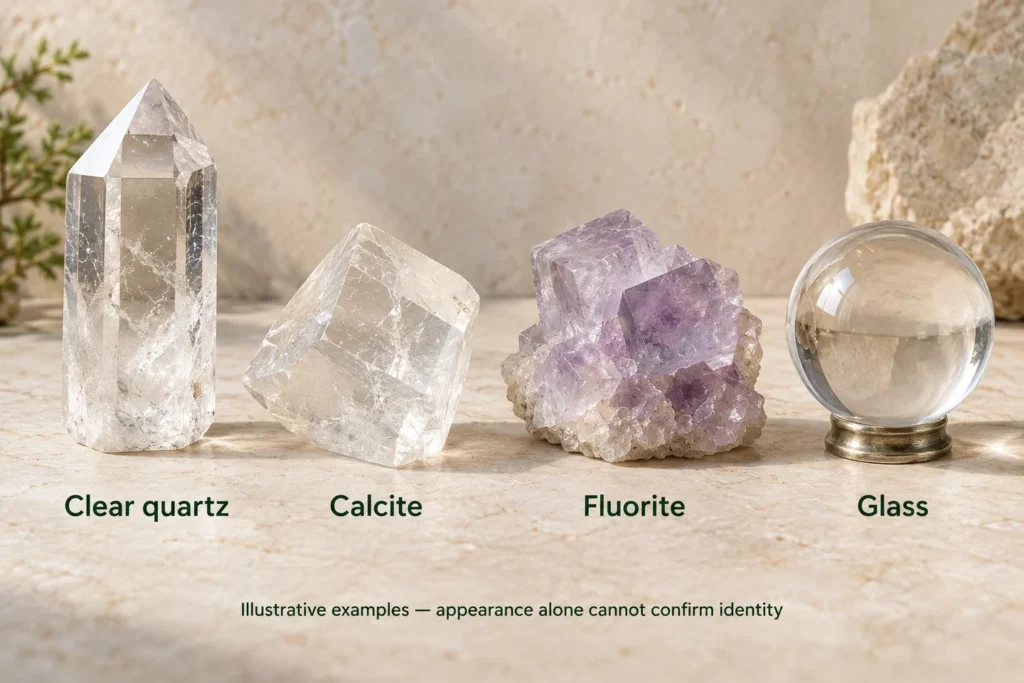
In my experience working with wholesale crystal buyers over the past fifteen-plus years, the question "what looks like quartz?" almost always comes back to a purchasing decision. Buyers need to know whether they can safely describe, quote, stock, and resell a product as quartz. Let me walk you through the most common confusion groups, practical first-check clues, and the business risks that come with getting it wrong.
Why Does It Matter If a Rock Is Mistaken for Quartz in Wholesale?
Misidentification might seem harmless at the hobby level, but in B2B crystal sourcing it creates real financial and reputational exposure. When a buyer lists a product as "clear quartz tower" and the material turns out to be calcite or smelted glass, the consequences ripple outward.
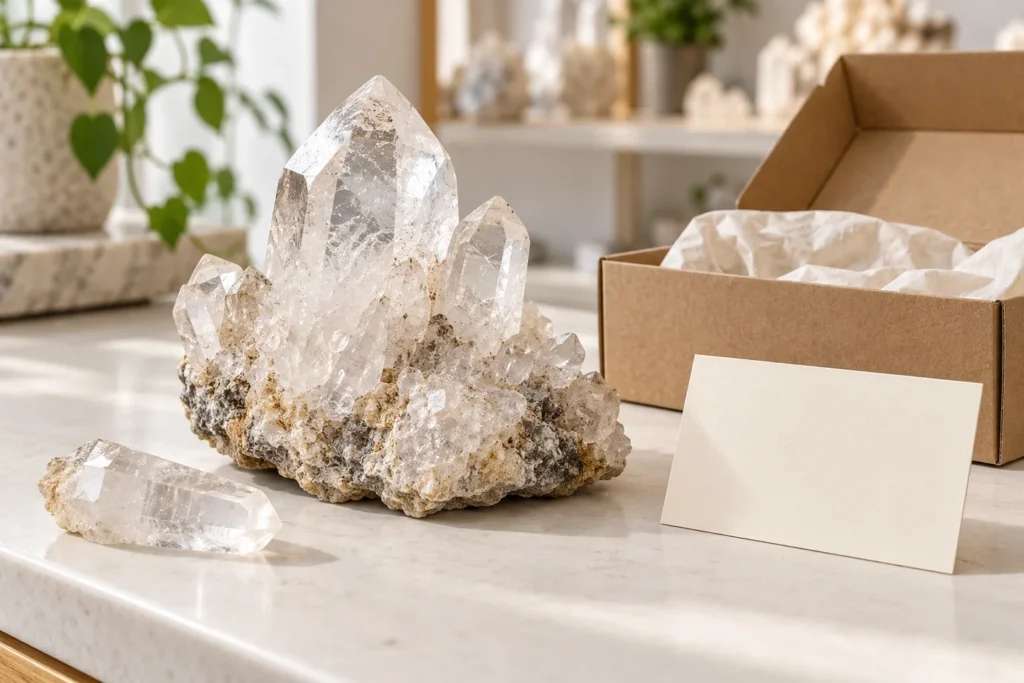
Mistaking another rock for quartz in a wholesale context can lead to inaccurate product listings, customer returns, damaged brand trust, and even breakage during shipping if the material is softer or more fragile than expected. For e-commerce sellers especially, accurate material naming is a baseline requirement for sustainable business.
Listing Accuracy and Customer Trust
Online marketplaces increasingly penalize misleading product descriptions. If you sell a calcite sphere labeled as "quartz," a knowledgeable customer will notice the difference — and may leave a negative review or open a dispute. Over time, these small errors erode the credibility you've built with your audience.
Quotation and Handling Mismatches
Different minerals have different hardness, fragility, and processing characteristics. Quartz sits at 7 on the Mohs hardness scale. Calcite is only a 3, and fluorite a 4.1 If your supplier quotes a "quartz" product but ships calcite, the material may chip or scratch during normal handling and transit. Packaging designed for quartz's durability won't necessarily protect a softer stone.
Two Distinct Problems Worth Separating
From my daily communication with buyers, I've noticed that material confusion falls into two separate categories, and it helps to keep them apart:
| Problem Type | What It Means | Example |
|---|---|---|
| Not quartz at all | A completely different mineral is labeled or sold as quartz | Calcite tower sold as "clear quartz tower" |
| Quartz-family naming confusion | The material is genuinely quartz, but the specific variety name is imprecise or wrong | Chalcedony listed as "agate," or milky quartz called "white jade" |
Both problems cause business issues, but they require different solutions. The first is a material identification problem. The second is a naming and communication problem. I'll cover both below.
What Non-Quartz Minerals Are Most Often Mistaken for Quartz?
Several natural minerals closely resemble quartz in color, transparency, or crystal shape — enough to confuse even experienced buyers when they're evaluating products from photos alone. The risk increases when product names are translated across languages or when suppliers use informal trade names.
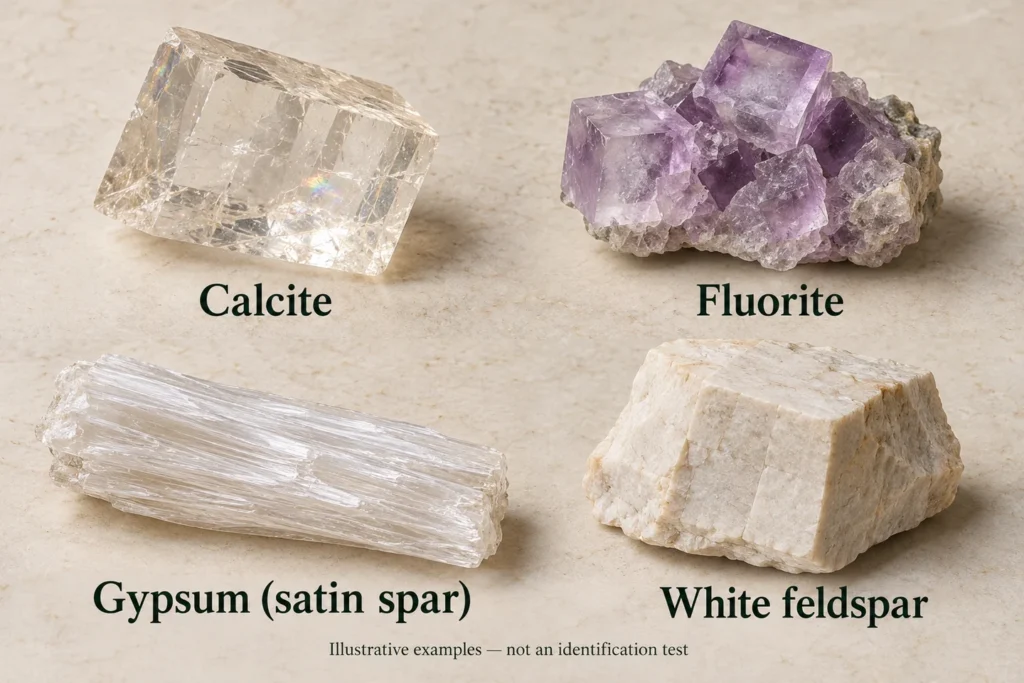
The most commonly confused minerals include calcite, fluorite, selenite (gypsum), and white feldspar. Each shares at least one visual trait with quartz — such as transparency, white color, or pointed crystal form — but differs significantly in hardness, cleavage, weight, and durability.
Calcite vs. Quartz
This is probably the single most common mix-up I see in wholesale crystal product communication. Clear or white calcite can look remarkably similar to clear quartz, especially in polished forms like towers, spheres, and palm stones. Some optical calcite (Iceland spar) even has striking transparency that buyers assume must be quartz.
Key differences buyers can check:
- Hardness: Calcite is 3 on the Mohs scale; quartz is 7. A steel blade (about 5.5) will scratch calcite but not quartz.2 This is a useful first clue, though scratching a finished product isn't always practical.
- Double refraction: Hold a piece of clear calcite over text and you'll often see doubled letters. Quartz does not show this effect as prominently.
- Weight and feel: Calcite and quartz have similar densities, so weight in the hand is not a reliable way to distinguish them.
- Acid reaction: Calcite fizzes in contact with dilute hydrochloric acid.3 This is a definitive test but not something you'd do on a finished product you plan to sell.
Practical note: In product photos, calcite towers and quartz towers can look nearly identical. I always recommend that buyers ask their supplier to confirm the material name explicitly — and, when accuracy matters for your listings, request a hardness confirmation or third-party test report.
Fluorite vs. Quartz
Fluorite is another frequent source of confusion, especially when it appears in clear, purple, or green hues. Purple fluorite can be mistaken for amethyst (a quartz variety), and green fluorite sometimes gets confused with green quartz or prasiolite.
- Hardness: Fluorite is 4 — significantly softer than quartz. This makes fluorite products more prone to chipping and scratching.
- Cleavage: Fluorite has perfect octahedral cleavage, meaning it tends to break along flat planes. Quartz has no true cleavage and fractures with a conchoidal (shell-like) pattern.4
- Luster and feel: Fluorite often has a slightly glassy, waxy feel compared to quartz's vitreous luster.
For retailers stocking both materials, the handling and packaging requirements are different. Fluorite products need more protective packaging and should not be stored loosely alongside harder stones.
Selenite (Gypsum) vs. White Quartz
Selenite towers and wands are popular products in the crystal retail market. Their translucent white appearance can overlap with milky quartz or white quartz products, especially in photos.
- Hardness: Selenite is only 2 on the Mohs scale — you can scratch it with a fingernail.5 This makes it extremely fragile for shipping.
- Water sensitivity: Selenite is water-soluble over time.6 This matters for packaging and storage.
- Texture: Selenite often has a fibrous, satiny texture, while milky quartz feels smoother and glassier.
White Feldspar vs. Quartz
In some product batches — especially rough stones, tumbles, or mixed lots — white feldspar can be mixed in with or substituted for white quartz. The two can look similar in color and opacity.
- Hardness: Feldspar is 6–6.5, close to quartz but slightly softer.7
- Cleavage: Feldspar shows cleavage planes; quartz does not.
- Surface: Feldspar often shows a slightly pearly or chalky surface compared to quartz's glassy fracture.
Can Man-Made Glass or Smelted Material Be Mistaken for Natural Quartz?
Yes — and this is one of the most commercially significant confusion points in wholesale crystal products. Man-made glass and smelted (melted) quartz or glass products circulate widely in the market, sometimes without clear labeling.
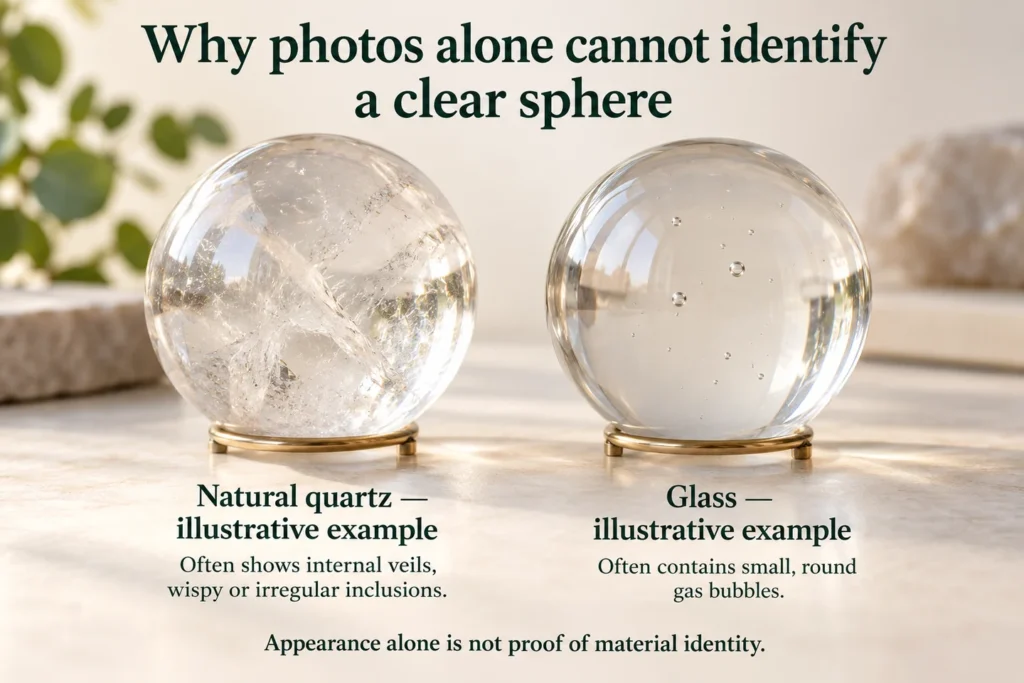
Glass, smelted quartz, and synthetic crystal materials are frequently mistaken for natural quartz, particularly in polished forms like spheres, towers, and skulls. These materials may look flawless and perfectly clear, often lacking the inclusions, veils, and natural irregularities found in genuine natural quartz.
How to Spot Potential Glass or Smelted Material
No single visual check is definitive, but several clues can raise a flag:
- Too perfect: Natural quartz almost always contains some inclusions, veils, cloudiness, or growth lines. A perfectly clear, flawless sphere at an unusually low price may warrant further questions.
- Bubbles: Tiny round bubbles visible inside the material are a strong indicator of glass or smelted origin. Natural quartz does not typically contain spherical air bubbles.8
- Temperature feel: Glass and smelted materials may warm up in the hand faster than natural quartz, though this is subtle and not reliable on its own.
- Price: Extremely low pricing for large, flawless clear "quartz" products is often a signal. Natural clear quartz of high clarity in large sizes commands a premium.9
Why This Matters for Your Business
If you're sourcing products to resell as "natural clear quartz," accidentally purchasing glass or smelted material creates serious listing accuracy problems. Many online platforms and informed customers expect "natural" to mean just that.
From my supplier-side experience: When buyers send inquiry photos showing perfectly clear, large quartz spheres at very low prices, I often suggest they confirm with the original supplier whether the material is natural quartz, synthetic quartz, smelted quartz, or glass. These are four different things, and each should be labeled accordingly.
| Material | Origin | Typical Appearance | Approximate Price Level |
|---|---|---|---|
| Natural clear quartz | Mined | Contains inclusions, veils, growth features | Higher, especially for high clarity |
| Synthetic quartz | Lab-grown | Very clear, may have subtle growth patterns | Moderate |
| Smelted quartz / glass | Melted from quartz sand or other glass | Often flawless, may contain bubbles | Lower |
| Ordinary glass | Industrial glass production | Flawless, may contain bubbles | Lowest |
What Quartz-Family Naming Confusion Should Buyers Watch For?
Beyond completely different minerals, there's a whole category of confusion that happens within the quartz family itself. Quartz is a large mineral group, and trade names, regional names, and informal terms overlap in ways that cause real sourcing problems.
Common quartz-family naming confusion includes: chalcedony vs. agate vs. jasper (all forms of microcrystalline quartz), milky quartz vs. "white crystal," smoky quartz vs. morion, citrine vs. heat-treated amethyst, and various trade names like "strawberry quartz" or "cherry quartz" that may or may not refer to natural quartz materials.
Chalcedony, Agate, and Jasper
All three are forms of microcrystalline quartz (also called cryptocrystalline quartz).10 Technically, they're all quartz — but the naming distinctions matter for product listings and customer expectations:
- Chalcedony generally refers to translucent, solid-colored microcrystalline quartz.
- Agate typically has banding or visible patterns.
- Jasper is opaque and often richly colored.
In wholesale product naming, these terms are sometimes used interchangeably or inconsistently. A product listed as "blue agate" might be dyed chalcedony. A "flower jasper" might technically be a rhyolite, not a quartz at all. These naming habits are not necessarily intentional fraud — they often reflect trade conventions that have drifted from strict mineralogical definitions.
Citrine and Heat-Treated Amethyst
This is one of the most discussed naming issues in the crystal retail world. Much of the deep orange or golden "citrine" on the market is actually heat-treated amethyst.11 Natural citrine tends to be paler, more subtle in color, and less uniformly saturated.
For sourcing purposes, the key is to ask your supplier directly: is this natural citrine, or heat-treated amethyst sold as citrine? Both are real quartz, but your customers may care about the distinction, and your listings should reflect what you're actually selling.
Trade Names and Fantasy Names
Names like "strawberry quartz," "cherry quartz," "angel aura quartz," and "titanium quartz" are widely used in the crystal market. Some refer to genuine quartz with natural inclusions or coatings. Others refer to man-made glass, dyed materials, or heavily treated stones.
A practical rule for buyers: If a product name sounds unfamiliar or unusually appealing, ask the supplier what the base material is, whether it's natural, and what treatments or coatings (if any) have been applied. This information should go into your product listing.
What Practical Steps Can Buyers Take Before Ordering?
Knowing which rocks are mistaken for quartz is only half the equation. The other half is building sourcing habits that reduce the risk of receiving — and reselling — the wrong material.
Buyers can reduce misidentification risk by requesting explicit material confirmation from suppliers, asking for current batch photos (not just catalog images), clarifying natural vs. treated vs. synthetic status, and performing basic checks upon receiving goods. For high-value orders or unfamiliar materials, third-party testing provides the most reliable confirmation.
Questions to Ask Your Supplier
Before placing an order, especially with a new supplier or for a material you haven't sourced before, consider asking:
- What is the exact material name? (Not just "crystal" or "quartz" — ask for specifics like "natural clear quartz," "natural amethyst," "dyed blue agate," etc.)
- Is this material natural, synthetic, treated, or coated? (Heat treatment, dyeing, irradiation, and coating are all common in the crystal market.12)
- Can you provide current batch photos and/or video? (Historical catalog photos may not represent the current available stock.)
- What is the product form, size range, and weight range?
- What is the MOQ, and is mixing across materials or sizes possible?
- How is the product packaged for shipping? (Especially important for softer materials that need extra protection.)
Basic Receiving Checks
When goods arrive, a few simple checks can help flag obvious problems:
- Scratch test (on an inconspicuous area): A steel point should not scratch quartz. If it does, the material may be calcite, fluorite, or something else.
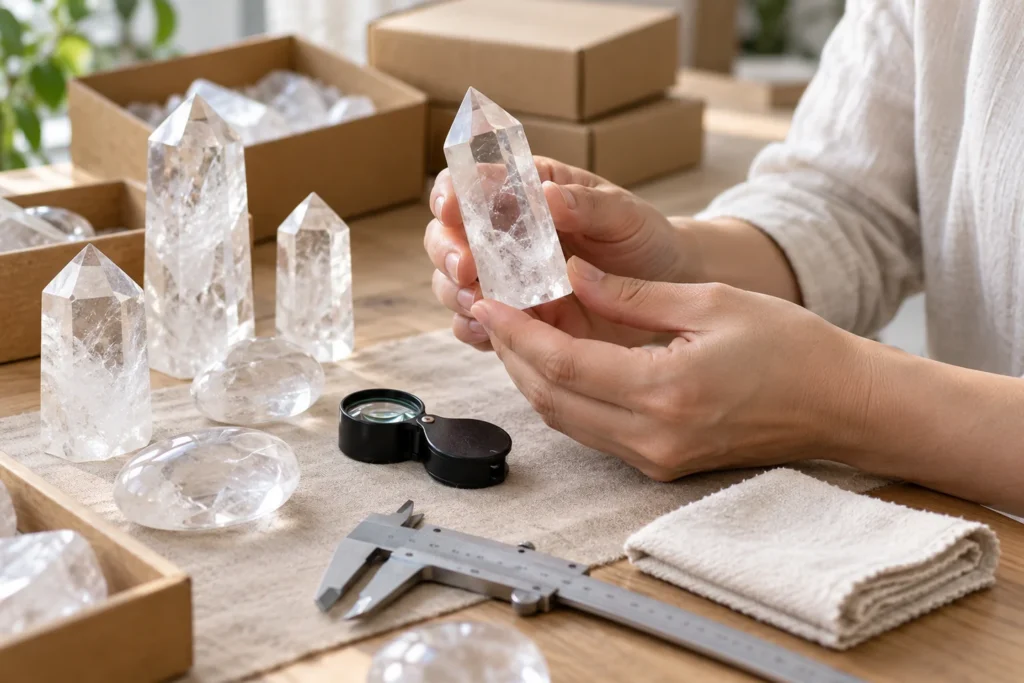
- Visual inspection with a loupe: Look for bubbles (glass indicator), banding, inclusions, and surface texture.
- Weight comparison: If you have known quartz samples of similar size, compare by hand. Significant differences in heft may indicate a different material.
- Consistency within the batch: Check whether all pieces in a batch appear to be the same material.
Important: These checks can be useful first clues, but they are not substitutes for professional gemological testing. When material identity is critical — for example, if you're making claims about "natural" origin on a product listing — a lab test provides the definitive answer.
Frequently Asked Questions
Is calcite the most common rock mistaken for quartz?
In my experience with wholesale crystal products, calcite is indeed one of the most frequently confused materials, especially in polished towers and spheres. Its transparency and crystal form mimic quartz closely. A hardness check is the most accessible way to tell them apart — calcite is much softer at 3 on the Mohs scale versus quartz's 7.
Can you tell quartz from glass just by looking at photos?
Not reliably. Product photos alone cannot confirm whether a material is natural quartz or glass. Perfectly clear, flawless pieces at unusually low prices should prompt further questions. Ask your supplier to confirm the material origin and look for round air bubbles upon receiving goods, which are a strong glass indicator.
Is heat-treated amethyst the same as citrine?
Both are quartz, so the base mineral is the same. However, natural citrine and heat-treated amethyst are distinct in origin and appearance. Many buyers and end customers care about this distinction. It's best practice to ask your supplier and label your products accurately — for example, "heat-treated amethyst citrine" rather than simply "natural citrine."
Should I always request lab testing for quartz products?
Lab testing is not necessary for every order, but it's worth considering for high-value purchases, unfamiliar materials, or situations where your product listings make specific natural-origin claims. For routine reorders of familiar products from trusted suppliers, consistent batch quality and clear supplier communication are usually sufficient.
What does "smelted quartz" mean?
Smelted quartz refers to material made by melting quartz sand or silica at high temperatures and then shaping it into products like spheres or skulls. It is not the same as naturally formed quartz crystal. Smelted quartz should be clearly labeled as such and not sold as "natural quartz."
Conclusion
Understanding what rock is mistaken for quartz is a practical sourcing skill, not just a geology exercise. The most common culprits — calcite, fluorite, selenite, glass, and smelted materials — each carry distinct risks for product accuracy, handling, and customer trust. Within the quartz family itself, imprecise naming around agate, chalcedony, citrine, and trade-named products creates its own set of listing and communication challenges.
The most effective protection is clear, specific communication with your supplier: confirm material names, ask about treatments, request current batch photos, and don't rely on appearance alone. When accuracy matters for your brand, professional testing is always an option.
If you're sourcing quartz products or quartz-family materials for your retail business and want straightforward answers about what you're buying, feel free to reach out to us at GD Crystal. We're happy to walk through material details, current availability, and product specifications — one inquiry at a time.
References
- "Mohs scale", https://en.wikipedia.org/wiki/Mohs_scale. A mineralogical reference lists quartz at Mohs hardness 7, calcite at 3, and fluorite at 4, supporting the hardness comparison used for preliminary mineral identification. Evidence role: definition; source type: education. Supports: A standard mineralogical source should confirm the Mohs hardness values for quartz, calcite, and fluorite.. ↩
- "Mineral Gemstones", https://pubs.usgs.gov/gip/gemstones/mineral.html. Educational mineral-identification guides describe the Mohs test as a relative scratch test and commonly place a steel knife blade near 5.5, which explains why it can scratch calcite but not quartz under ordinary testing conditions. Evidence role: mechanism; source type: education. Supports: The source should explain that harder materials scratch softer ones and that a steel blade is harder than calcite but softer than quartz.. Scope note: The result can vary with blade composition, surface weathering, pressure, and whether the test is performed on a polished or rough surface. ↩
- "The "Acid Test" – Reaction of Calcite", https://serc.carleton.edu/NAGTWorkshops/video/minutevids/91609.html. Geology teaching materials identify effervescence in dilute hydrochloric acid as a standard diagnostic reaction for calcite, caused by acid reacting with calcium carbonate to release carbon dioxide. Evidence role: mechanism; source type: education. Supports: The source should confirm that calcite reacts with dilute hydrochloric acid and produces visible effervescence.. ↩
- "Fluorite – Common Minerals – University of Minnesota", https://commonminerals.esci.umn.edu/minerals-f/fluorite. Mineralogy references describe fluorite as having perfect octahedral cleavage and quartz as lacking true cleavage while commonly breaking with conchoidal fracture, supporting cleavage as a distinguishing property. Evidence role: definition; source type: education. Supports: The source should document fluorite's octahedral cleavage and quartz's lack of cleavage with conchoidal fracture.. ↩
- "Selenite (gypsum)", https://en.wikipedia.org/wiki/Selenite_(gypsum). Mineral-identification references list gypsum, including selenite, at Mohs hardness 2 and note that it can be scratched by a fingernail, supporting its distinction from harder quartz. Evidence role: definition; source type: education. Supports: The source should confirm that gypsum/selenite has Mohs hardness 2 and is scratchable by a fingernail.. ↩
- "Gypsum – Mineral Commodity Summaries 2026 – USGS.gov", https://pubs.usgs.gov/periodicals/mcs2026/mcs2026-gypsum.pdf. Geoscience references describe gypsum as a slightly soluble calcium sulfate mineral, which supports the caution that selenite can be damaged by prolonged contact with water. Evidence role: mechanism; source type: education. Supports: The source should confirm that gypsum is soluble in water to a measurable extent and can be affected by prolonged moisture exposure.. Scope note: The source may support gradual solubility rather than rapid dissolution under ordinary retail handling conditions. ↩
- "Mohs scale", https://en.wikipedia.org/wiki/Mohs_scale. Mineralogical references commonly place feldspar minerals near Mohs hardness 6 to 6.5 and quartz at 7, supporting the statement that feldspar is close to but softer than quartz. Evidence role: definition; source type: encyclopedia. Supports: The source should confirm the typical hardness range for feldspar and quartz's hardness of 7.. ↩
- "Inclusions in Gemstones", https://www.gia.edu/gems-gemology/summer-2022-colored-stones-unearthed. Gemological identification materials describe rounded gas bubbles as characteristic evidence for glass or melted materials, whereas natural quartz more often contains mineral inclusions, fractures, veils, or fluid inclusions rather than simple spherical air bubbles. Evidence role: mechanism; source type: institution. Supports: The source should support that rounded gas bubbles are diagnostic or suggestive of glass and are not typical inclusions in natural quartz.. Scope note: This supports the visual clue as contextual evidence, not as a definitive standalone test for every specimen. ↩
- "Colored Gemstone Value Factors", https://www.gia.edu/gia-news-research/value-factors-design-cut-quality-colored-gemstone-value-factors. Gemological references explain that the value of transparent quartz is influenced by clarity, size, and quality, providing contextual support for the claim that large, high-clarity natural clear quartz generally carries a premium. Evidence role: general_support; source type: institution. Supports: The source should support that quartz value is influenced by clarity, size, and natural quality, making large flawless natural pieces comparatively more valuable.. Scope note: Such sources usually describe value factors rather than documenting wholesale prices for specific crystal-product forms. ↩
- "Chalcedony – Gemstones – USGS Application Service", https://apps.usgs.gov/minerals-information-archives/gemstones/sp14-95/chalcedony.html. Mineralogical references classify chalcedony, agate, and jasper as microcrystalline or cryptocrystalline forms of quartz, supporting the article's distinction between quartz-family naming and non-quartz misidentification. Evidence role: definition; source type: encyclopedia. Supports: The source should confirm that chalcedony, agate, and jasper are microcrystalline or cryptocrystalline varieties of quartz.. ↩
- "Citrine Gemstone | Natural Citrine Stone", https://www.gia.edu/citrine. Gemological sources note that amethyst is commonly heat-treated to produce yellow to orange quartz marketed as citrine, supporting the article's warning that some commercial citrine originates as treated amethyst. Evidence role: general_support; source type: institution. Supports: The source should support that amethyst is commonly heat-treated to produce citrine-like yellow to orange quartz sold as citrine.. Scope note: The source may establish common practice without quantifying the exact share of citrine products in the wholesale crystal market. ↩
- "An Introduction to Gem Treatments", https://www.gia.edu/gem-treatment. Gemological treatment references identify heating, dyeing, irradiation, and surface coating as recognized enhancement methods for gem materials, supporting the article's advice to ask suppliers about treatment status. Evidence role: general_support; source type: institution. Supports: The source should support that these treatment categories are recognized and used in the gem and mineral trade.. Scope note: The evidence supports the general use of these treatments in gem materials, not the frequency for every specific crystal product category. ↩