Clear quartz and diamonds sit on opposite ends of the gemstone and mineral world, yet their shared transparency causes real confusion — especially in wholesale sourcing conversations. When buyers mislabel or misposition either material, the consequences range from lost customer trust to serious legal liability. Understanding the actual differences is the foundation for honest product naming, accurate pricing, and confident selling.
Clear quartz is a silicon dioxide mineral (SiO₂) valued in the crystal and décor market, while diamond is a carbon crystal (C) valued primarily as a gemstone and industrial abrasive.1 They differ fundamentally in hardness, optical behavior, market value, sourcing channels, and end-use categories. For B2B crystal buyers, knowing the difference is not about gemology trivia — it's about correctly labeling, pricing, and communicating your products to avoid misleading customers.
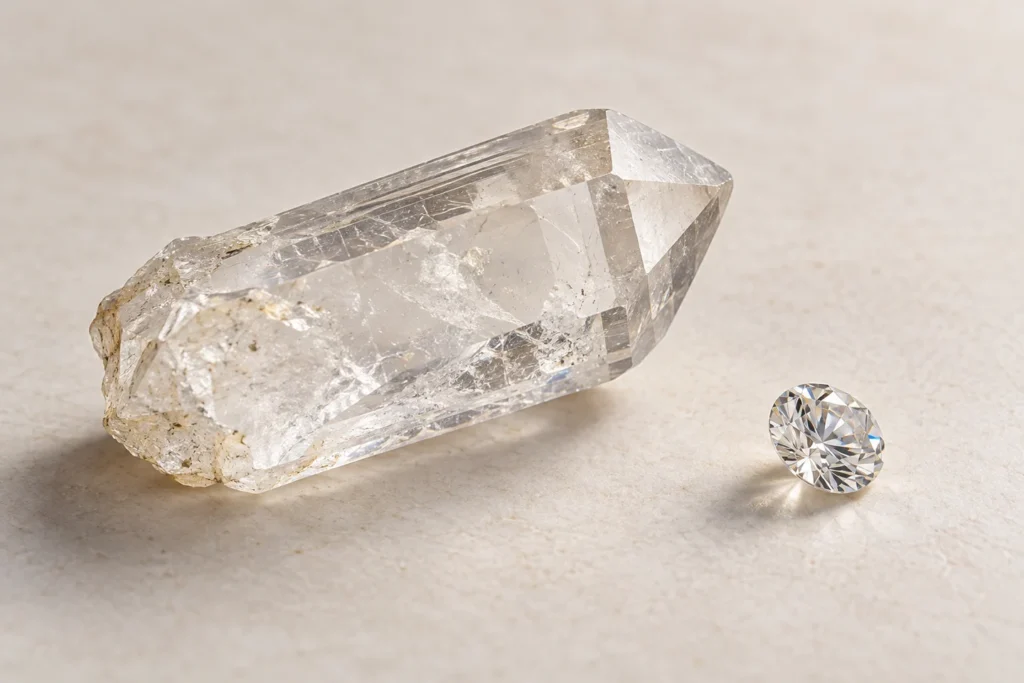
Both materials can look stunning under the right lighting. But the similarities end at surface-level transparency. Below, I break down the practical differences that matter most to wholesale buyers, retailers, and brand owners who need to source, describe, and sell clear quartz with confidence.
What are the key material differences between clear quartz and diamonds?
If you have ever handled both a polished clear quartz point and a faceted diamond, you already know something feels different — the weight, the warmth, the way light moves through each stone. But many first-time crystal buyers have not handled both side by side, and that's where confusion begins.
Clear quartz is composed of silicon dioxide (SiO₂) with a Mohs hardness of 7, while diamond is pure crystallized carbon (C) with a Mohs hardness of 10 — the hardest known natural material.2 They form under completely different geological conditions, have distinct crystal structures, and behave differently when light passes through them.
Composition and Formation
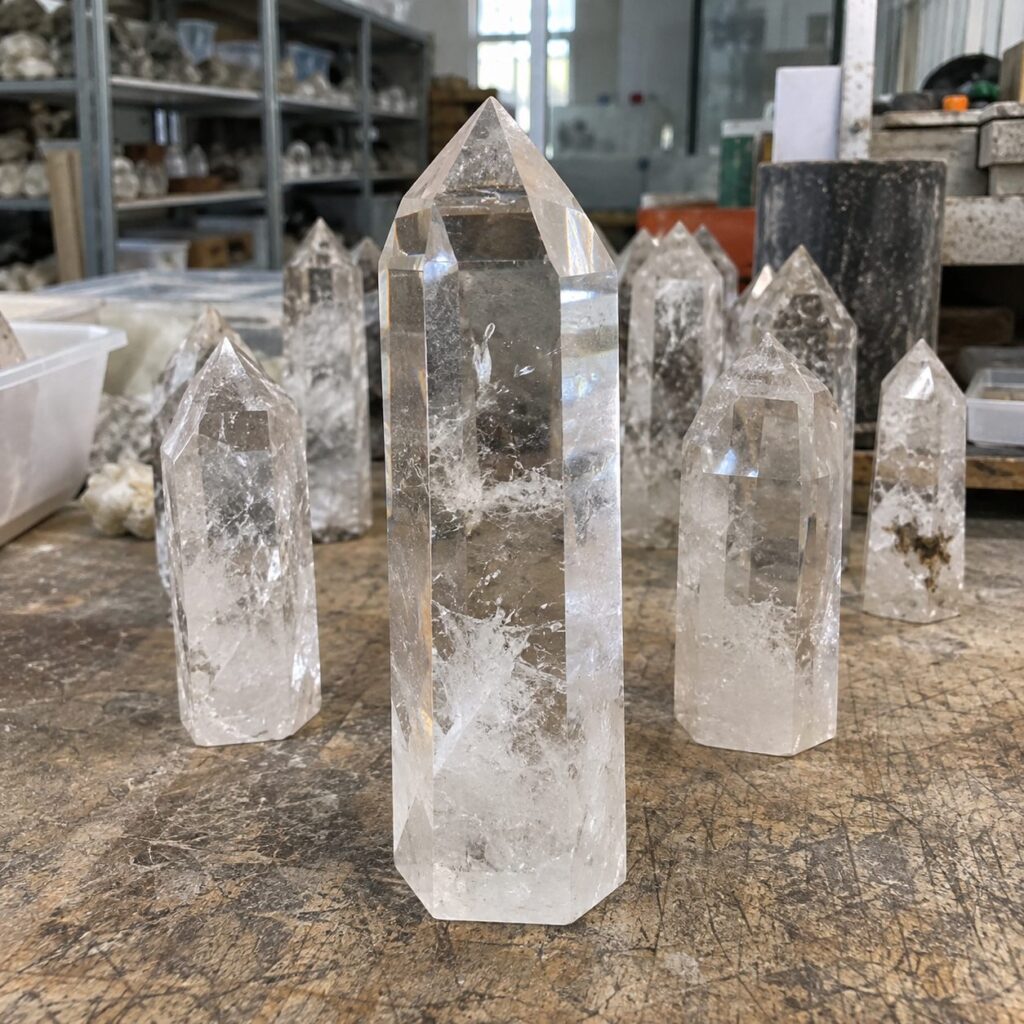
Clear quartz forms in a wide range of geological environments — from hydrothermal veins to pegmatites — at relatively moderate temperatures and pressures.3 It belongs to the trigonal crystal system and grows as hexagonal prisms commonly seen in natural points and clusters.
Diamonds, by contrast, form deep in the Earth's mantle under extreme pressure (approximately 45–60 kilobars) and high temperatures (900–1,300°C).4 They belong to the cubic crystal system. This extreme formation process is a major reason for diamonds' rarity and high market price.5
Key Property Comparison
| Property | Clear Quartz | Diamond |
|---|---|---|
| Chemical formula | SiO₂ | C |
| Mohs hardness | 7 | 10 |
| Crystal system | Trigonal | Cubic |
| Refractive index | 1.544–1.553 | 2.417 |
| Specific gravity | ~2.65 | ~3.52 |
| Dispersion | 0.013 | 0.044 |
| Typical transparency | Transparent to translucent | Transparent |
| Common formation | Hydrothermal, pegmatitic | Mantle-derived kimberlites |
Why This Matters for Sourcing
The refractive index gap is significant. Diamond's refractive index of 2.417 creates that characteristic "fire" and brilliance — the intense light return and spectral flashes that make diamonds visually distinctive.6 Clear quartz, with a refractive index around 1.55, has a softer, gentler light behavior. It is beautiful, but it does not produce diamond-like sparkle.
In my experience communicating with wholesale crystal buyers, some newcomers describe their quartz products as having "diamond-like clarity" in product listings. While clear quartz can certainly be very transparent, using diamond-adjacent language creates unrealistic expectations and can mislead end consumers. The optical behavior is simply different, and honest product descriptions should reflect that.
Specific gravity also matters at the practical level: diamond is noticeably denser than quartz.7 A diamond and a piece of clear quartz of the same visible size will differ in weight. For buyers who handle large volumes of product, this difference becomes intuitive over time.
Why does the clear quartz vs. diamond confusion matter for wholesale buyers?
The risk for B2B crystal buyers is not really "Can I tell them apart?" — most experienced handlers can. The real risk is downstream: how your product descriptions, labels, and pricing communicate what the material actually is to your retail customers.
For wholesale crystal sourcing, the clear quartz vs. diamond distinction is fundamentally a product naming, labeling, and positioning issue. Mislabeling quartz with diamond-related terminology — even unintentionally — can result in customer disputes, marketplace listing removals, and in some jurisdictions, legal consequences for misleading product claims.
The Labeling Risk
In crystal wholesale communication, buyers sometimes ask us whether their clear quartz can be marketed as a "diamond alternative" or described with phrases like "diamond clear." I always recommend against this. Here's why:
- Consumer protection regulations in most markets (the U.S. FTC Jewelry Guides, EU consumer law, etc.) require accurate material identification. Describing quartz with diamond-adjacent terms can trigger compliance issues.
- Marketplace platforms like Amazon, Etsy, and eBay have product listing policies that penalize misleading material descriptions. A quartz product flagged as a "diamond" or "diamond-like" product risks removal.
- Customer trust erosion is the longest-term cost. If your end customer buys a "diamond clear" product expecting diamond-like optical performance and receives quartz, even an honest intention reads as deception.
The Pricing Disconnect
The market value gap between clear quartz and diamonds is enormous. High-quality clear quartz is typically priced by the kilogram in wholesale crystal markets. Gem-quality diamonds are priced by the carat, often at thousands of dollars per carat.8 Mixing or blurring these categories in pricing or positioning does not elevate quartz — it confuses your buyers and undermines your credibility.
A practical rule for crystal retailers: If you need to explain what your product is not, you may be positioning it incorrectly. Clear quartz should be sold for what it is — a beautiful, versatile natural mineral — not defined by its relationship to diamond.
What Honest Positioning Looks Like
Clear quartz has its own strong market identity. It is one of the most popular minerals in the crystal retail, metaphysical, décor, and gift categories worldwide. Its value comes from:
- Natural crystal forms (points, clusters, geodes)
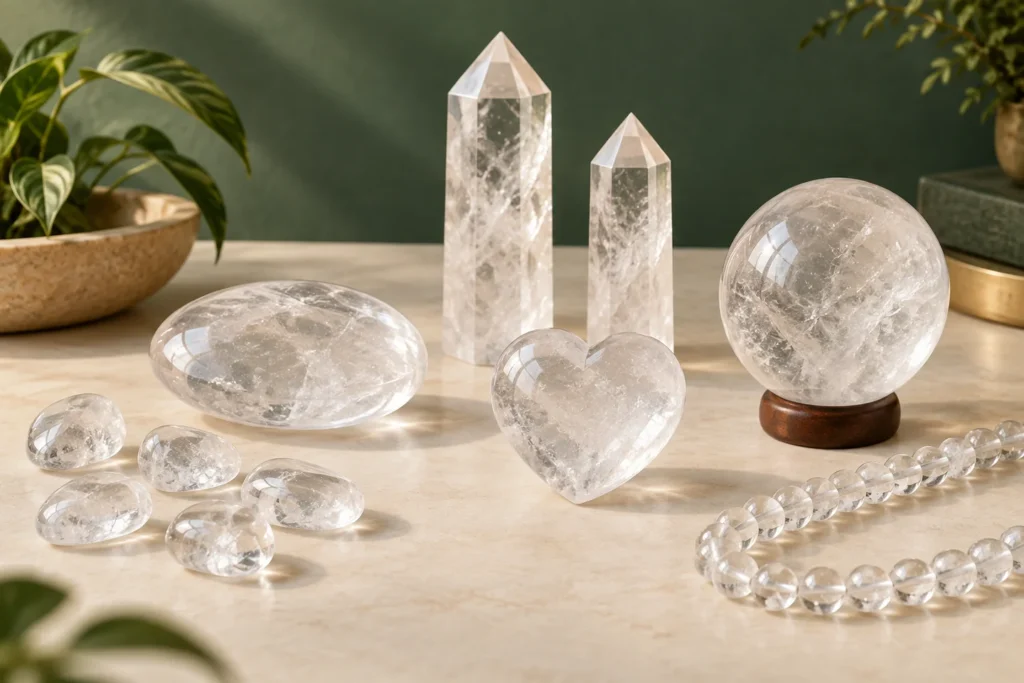
- Polished decorative shapes (spheres, towers, hearts, palm stones, carvings)
- Versatility in product lines (tumbled stones, chip bags, jewelry beads, display specimens)
- Wide price accessibility for retailers building inventory at different price tiers
There is no need to borrow from diamond vocabulary. Clear quartz stands on its own.
How should B2B buyers evaluate clear quartz for wholesale sourcing?
New crystal buyers sometimes approach clear quartz sourcing with a diamond grading mindset — asking about "4Cs" (cut, color, clarity, carat) as if the same framework applies. It doesn't. Applying diamond grading logic to wholesale quartz sourcing leads to miscommunication with suppliers and unrealistic expectations for batch consistency.
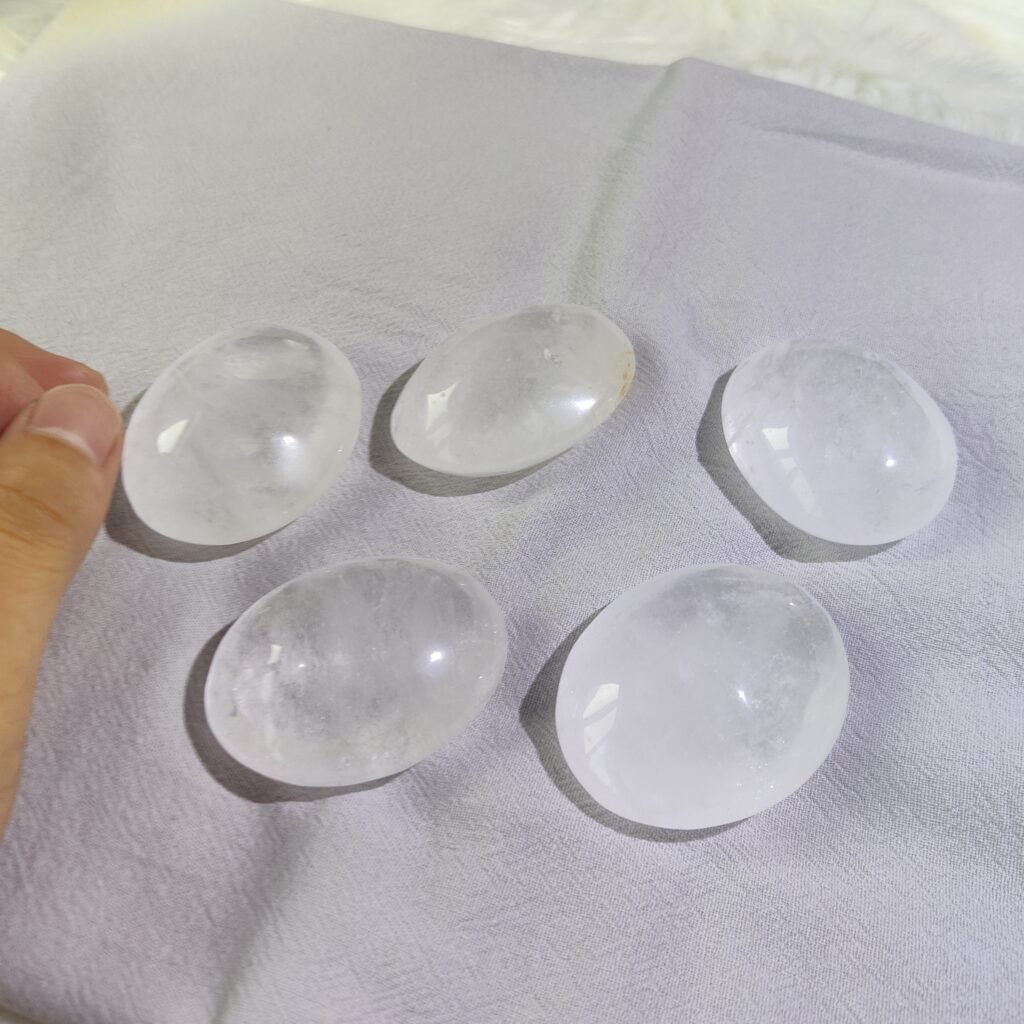
For wholesale clear quartz purchasing, the practical evaluation criteria are: material identification, product shape/form, size range, surface finish quality, clarity variation within the batch, batch consistency, quantity, packaging, MOQ, and current product photos. These are the questions that lead to successful sourcing — not gemological grading scales designed for faceted precious stones.
The Right Questions to Ask Your Supplier
Here is a framework I recommend for buyers sourcing clear quartz from any supplier, including us:
- Material confirmation: Is this natural clear quartz? Has it been treated, coated, or enhanced in any way? (Some quartz products on the market are coated, irradiated, or heat-treated. Honest suppliers disclose treatment.)
- Product form: What shape — towers, spheres, hearts, tumbled, rough, carved figures, beads? Each has different production processes and pricing structures.
- Size and weight range: What is the size spread in this batch? Wholesale crystal products are typically sold in size ranges (e.g., 5–7 cm towers, 40–50 mm spheres), not exact dimensions.
- Clarity and inclusion level: What is the typical clarity in this batch? Natural clear quartz ranges from water-clear to milky or included. "AAA" or similar grades are not standardized across the crystal industry — always request current batch photos.
- Finish quality: Is the polish consistent? Are there visible scratches, chips, or flat spots?
- Batch consistency: How uniform are the pieces within the batch in terms of size, clarity, and shape? This matters enormously for retailers who sell individual pieces online with photos.
- MOQ and mixed ordering: What is the minimum order per item? Can you mix different shapes or sizes within one order?
- Packaging: How are pieces packed for shipping? Quartz is hard (Mohs 7) but can still chip. Adequate padding and individual wrapping matter.
- Current photos: Can you see photos of the actual current batch, not historical images from a previous production run?
Why "Grade" Terminology Is Unreliable
Unlike the diamond industry, which uses standardized grading systems (GIA, AGS, etc.) with defined criteria, the crystal wholesale market has no universal grading standard. Terms like "AAA," "gem grade," or "top quality" mean different things from different suppliers. I have seen "AAA clear quartz" from one source that would be considered "A grade" by another.
| Evaluation Method | Diamond Industry | Crystal Wholesale (Clear Quartz) |
|---|---|---|
| Grading system | Standardized (GIA, AGS, etc.) | No universal standard |
| Quality terminology | Defined (VVS1, IF, etc.) | Subjective ("AAA," "gem grade") |
| Pricing unit | Per carat | Per piece, per kg, or per lot |
| Certification | Third-party lab certificates | Rarely certified; buyer-verified |
| Batch consistency | Individual stone grading | Batch-level evaluation |
The takeaway: always evaluate clear quartz by looking at current batch photos and requesting samples when possible, rather than relying on grade labels alone. This is standard practice in responsible crystal wholesale sourcing.
Can clear quartz ever be mistaken for diamonds in practice?
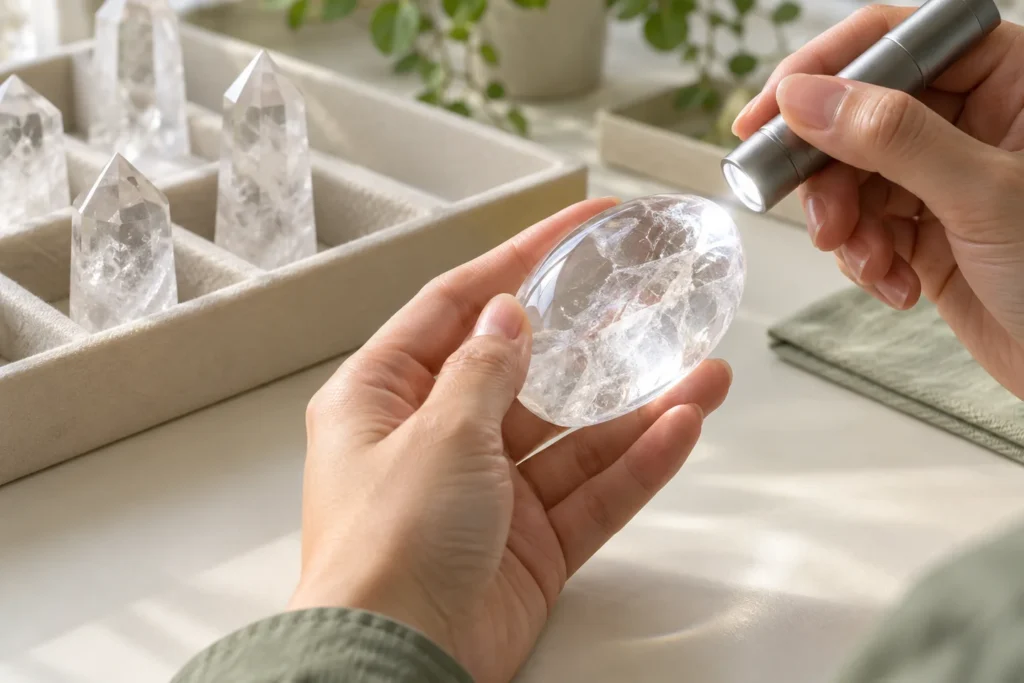
In a controlled retail environment with proper labeling, no — the two materials look and behave differently enough that confusion shouldn't happen. But in uncontrolled situations — online photos, poorly lit marketplaces, or unlabeled loose stones — visual confusion is possible, especially for buyers without material handling experience.
In practice, clear quartz is unlikely to be confused with diamond by anyone who handles both materials regularly. The optical behavior (brilliance, fire, light return), density, hardness, and surface feel are noticeably different. However, photos taken under strong lighting can make many transparent materials appear more brilliant than they are in person9, which is where misidentification risk increases in ecommerce.
Common Confusion Scenarios
In our B2B customer conversations, the confusion typically arises in a few specific patterns:
- New ecommerce sellers who source clear quartz and photograph it under LED spotlights, producing images with exaggerated brilliance that prompt their customers to ask "Is this real diamond?"
- Gift and souvenir retailers who want a "diamond-look" product at a crystal price point and ask if quartz can fill that role.
- Buyers unfamiliar with mineral categories who group all transparent natural stones together and assume similar value.
What About Glass, Crystal Glass, and Synthetic Materials?
It's worth noting that the confusion landscape is wider than just quartz vs. diamond. Buyers also need to distinguish clear quartz from:
- Glass (amorphous SiO₂, no crystal structure, lower hardness at ~5.5 Mohs)
- Lead crystal glass (glass with lead oxide for higher refractive index, used in decorative "crystal" ware — this is not a mineral)
- Cubic zirconia (ZrO₂, a synthetic diamond simulant, Mohs 8–8.5)
- Synthetic quartz (lab-grown SiO₂, same composition as natural quartz but grown in controlled conditions)
For wholesale crystal buyers, the most important distinctions are: Is this natural clear quartz? Is it treated? Is it actually glass? A reputable crystal supplier should be able to answer these questions directly and provide material disclosure for each product line.
Professional tip: If you are ever uncertain about a material's identity in a sourcing context, consult a qualified gemological professional or request third-party testing. Simple at-home tests circulated online (scratch tests, fog tests, etc.) are unreliable for definitive identification and should not replace professional evaluation.
How should crystal retailers describe clear quartz to their customers?
Even after sourcing correctly, the challenge continues at the point of sale. How you describe clear quartz to your end customers shapes their expectations, satisfaction, and trust in your brand.
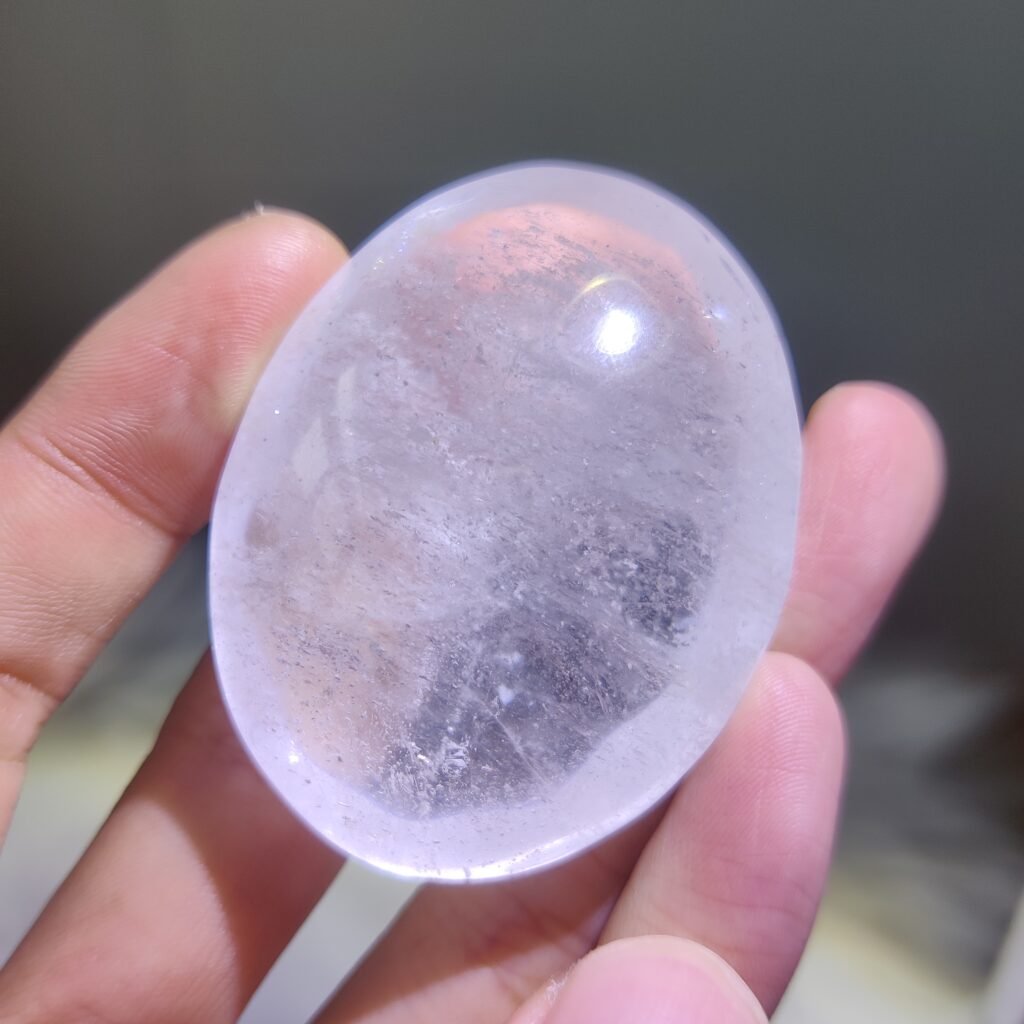
Crystal retailers should describe clear quartz accurately as a natural silicon dioxide mineral, specify its product form (tower, sphere, tumbled stone, etc.), note any known treatments, and provide realistic photos showing actual clarity and inclusion levels. Avoid diamond comparisons, exaggerated brilliance claims, and unstandardized grade labels without context.
Product Description Best Practices
Here are description guidelines I share with our wholesale customers who resell to end consumers:
- Name the material accurately: "Natural Clear Quartz" or "Rock Crystal" (the traditional mineralogical name). Avoid "diamond quartz" or "diamond-clear quartz" as product names.
- State the product form: "Clear Quartz Tower," "Clear Quartz Sphere," "Clear Quartz Tumbled Stones." This sets the right product category expectation.
- Describe clarity honestly: Instead of "flawless" or "perfect clarity," use descriptions like "high clarity with minor natural inclusions" or "water-clear with some internal veiling." Natural quartz almost always has some inclusions, rainbows, or internal features — and many customers value these as signs of natural origin.
- Disclose treatments: If quartz has been treated (coated, irradiated, heated, or bonded), say so. This is both an ethical best practice and a regulatory requirement in many markets.
- Use realistic photography: Photograph products under consistent, moderate lighting. Over-lit photos create returns and complaints.
- Include dimensions and weight: Provide actual size ranges rather than vague descriptions.
Language to Avoid
| ❌ Avoid | ✅ Use Instead |
|---|---|
| "Diamond-like brilliance" | "Natural transparency with soft luster" |
| "Gem-grade clear quartz" (without context) | "High-clarity natural clear quartz" |
| "Flawless crystal" | "Clear with minor natural inclusions typical of natural quartz" |
| "AAA quality" (unqualified) | Describe actual clarity level and provide photos |
| "Diamond alternative" | Do not position quartz as a diamond substitute |
Accurate language protects your brand reputation and reduces post-sale disputes. It also builds the kind of customer trust that generates repeat business — which, for crystal retailers, is far more valuable than a one-time sale driven by inflated descriptions.
Frequently Asked Questions
Is clear quartz valuable like diamond?
Clear quartz and diamonds occupy completely different value categories. Wholesale clear quartz is typically priced per kilogram or per piece at accessible price points, while gem-quality diamonds are priced per carat at significantly higher values. Clear quartz is valued for its versatility, natural beauty, and wide product range — not for diamond-level rarity or market pricing.
Can I sell clear quartz as a diamond substitute?
No. Selling or marketing clear quartz as a diamond substitute is misleading and can violate consumer protection regulations in most markets. Clear quartz should be positioned and sold as what it is — a natural mineral product for crystal retail, décor, gifts, and metaphysical markets. Each material has its own market category and customer base.
How do I know if my clear quartz is real and not glass?
Natural clear quartz is harder than glass (Mohs 7 vs. ~5.5), typically feels cooler to the touch initially, and often contains natural inclusions, veils, or internal fractures that glass lacks. However, visual inspection alone is not conclusive. For sourcing decisions, request material disclosure from your supplier and consult a qualified gemological professional or independent laboratory if the material’s identity is uncertain.
References
- "Silica Statistics and Information | U.S. Geological Survey", https://www.usgs.gov/centers/national-minerals-information-center/silica-statistics-and-information. A mineral commodity or mineralogical reference identifies quartz as crystalline silicon dioxide and diamond as crystalline carbon, and describes diamond's established use in jewelry and industrial abrasive applications. Evidence role: general_support; source type: government. Supports: A source should verify quartz as silicon dioxide, diamond as carbon, and diamond's recognized use as both a gemstone and industrial abrasive.. Scope note: Such sources support the material and use-category distinction, but may not address the article's specific B2B crystal-market framing. ↩
- "Mohs scale", https://en.wikipedia.org/wiki/Mohs_scale. Standard mineralogical references list quartz at Mohs hardness 7 and diamond at Mohs hardness 10, the top position on the Mohs scale of mineral hardness. Evidence role: definition; source type: education. Supports: A source should confirm the Mohs hardness values for quartz and diamond and describe diamond as the hardest natural material on the Mohs scale.. Scope note: This supports comparative hardness on the Mohs scale, not broader measures of toughness or resistance to breakage. ↩
- "Pegmatite", https://en.wikipedia.org/wiki/Pegmatite. Geological references describe quartz as a common mineral in igneous, metamorphic, sedimentary, hydrothermal, and pegmatitic environments, supporting its broad range of formation settings. Evidence role: mechanism; source type: education. Supports: A source should explain that quartz is common in hydrothermal and pegmatitic settings and forms across a broad range of geological environments.. Scope note: This contextual support does not quantify the exact temperature and pressure ranges for every quartz-forming environment. ↩
- "The Extraordinary Backstory of Natural Diamonds", https://www.gia.edu/gems-gemology/fall-2024-diamond-reflections. Geoscience sources place natural diamond formation in the Earth's mantle under high-pressure, high-temperature conditions broadly consistent with about 45–60 kbar and 900–1,300°C. Evidence role: mechanism; source type: research. Supports: A source should verify the mantle depth, pressure, and temperature range associated with natural diamond formation.. Scope note: The ranges are approximate because diamond formation conditions vary by locality, host rock, and geological model. ↩
- "How Do Diamonds Form in the Deep Earth?", https://www.gia.edu/gems-gemology/winter-2018-how-do-diamonds-form-in-the-deep-earth. Gemological and commodity references describe natural diamond formation as dependent on unusual mantle conditions and supply constraints, factors that contribute to rarity and value in gem markets. Evidence role: general_support; source type: institution. Supports: A source should explain that natural diamonds require uncommon geological conditions and that scarcity contributes to their market value.. Scope note: This is contextual support; diamond prices are also affected by grading, demand, branding, distribution, and market controls. ↩
- "OPTICAL PROPERTIES OF DIAMOND", https://secwww.jhuapl.edu/techdigest/content/techdigest/pdf/V14-N01/14-01-Thomas.pdf. Gemological references list diamond's refractive index at about 2.417 and explain that high refractive index and dispersion contribute to the brilliance and spectral fire seen in cut diamonds. Evidence role: mechanism; source type: institution. Supports: A source should verify diamond's refractive index and explain how refractive index and dispersion relate to brilliance and fire.. Scope note: The visual effect also depends on cut quality, lighting, and viewing conditions, so optical constants alone do not fully determine appearance. ↩
- "Mineral Gemstones", https://pubs.usgs.gov/gip/gemstones/mineral.html. Mineralogical data list quartz at a specific gravity of about 2.65 and diamond at about 3.52, supporting the practical density distinction between pieces of similar volume. Evidence role: definition; source type: encyclopedia. Supports: A source should provide specific gravity values for quartz and diamond showing that diamond is denser.. Scope note: The comparison assumes similar volume and does not account for mounting, inclusions, cavities, or cutting differences. ↩
- "Diamond Quality Factors", https://www.gia.edu/diamond-quality-factor. Gemological pricing references describe carat weight as a central unit in diamond valuation and show that gem-quality diamonds can reach prices of thousands of dollars per carat depending on quality factors. Evidence role: statistic; source type: institution. Supports: A source should confirm that diamonds are priced per carat and that high-quality gem diamonds can command prices in the thousands per carat.. Scope note: Prices fluctuate by cut, color, clarity, carat weight, certification, market conditions, and retail channel. ↩
- "Don't Point a Light at Shiny Objects, Understand How to …", https://www.youtube.com/watch?v=WfmXHxsLMKA. Photography and optics references explain that lighting angle, intensity, specular reflection, refraction, and exposure can substantially change how transparent objects appear in photographs. Evidence role: mechanism; source type: education. Supports: A source should explain how lighting, specular highlights, exposure, and refraction affect the photographed appearance of transparent objects.. Scope note: This supports the general mechanism but does not prove that any specific quartz listing image is misleading. ↩