If you've been searching for where to find clear quartz, the answer depends entirely on what you plan to do with it. Casual collectors and B2B buyers live in different worlds. For retailers, e-commerce sellers, and brand owners, knowing that clear quartz exists somewhere on a map is only the beginning — the real challenge is securing a reliable supply channel that delivers resale-ready products on your terms.
For B2B buyers, finding clear quartz is less about geographic deposits and more about identifying a sourcing channel that provides the right product form, current-batch quality, consistent replenishment, clear communication, and commercially viable purchasing terms. Mines produce raw material, but factories, wholesale markets, online platforms, and direct suppliers each offer different advantages depending on your order volume, product specifications, and resale model.
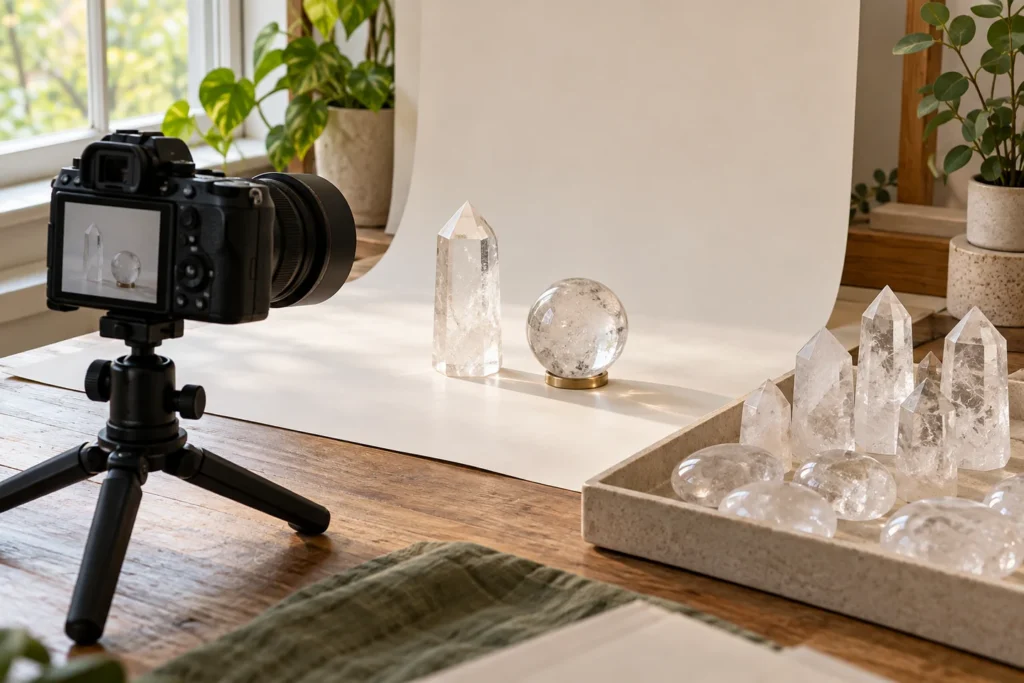
That distinction — between knowing where quartz comes from and knowing where to source it profitably — shapes every decision a buyer makes. Below, I'll walk through the major sourcing channels, explain what each one actually offers, and share what I've learned from 15+ years of handling buyer inquiries on the factory side. Let's reframe this question the way a purchasing professional would.
What are the main sourcing channels for clear quartz products?
Most buyers start their search with a simple Google query or a browse through Alibaba. But different sourcing channels serve fundamentally different needs — and mixing them up leads to wasted time, mismatched expectations, and costly reorders.
Clear quartz sourcing channels for B2B buyers generally fall into five categories: mining regions and rough material suppliers, physical wholesale markets, processing factories, online B2B platforms, and trading companies or consolidated suppliers. Each offers a different combination of product readiness, pricing transparency, minimum order flexibility, and communication depth.
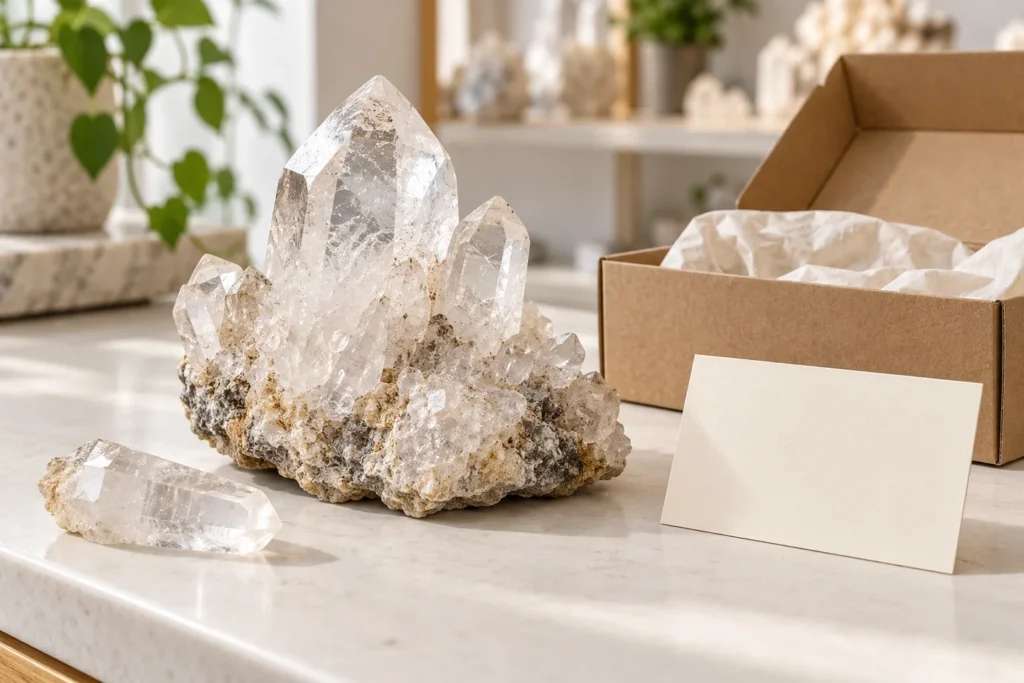
Mining regions and rough material suppliers
Clear quartz occurs in numerous locations worldwide — Brazil, Madagascar, the Himalayas, Arkansas (USA), and various provinces in China are commonly cited.1 However, for B2B buyers seeking finished products, knowing the mine location is only marginally useful. Rough material must be sorted, cut, shaped, polished, and packaged before it becomes inventory you can sell.2 If you're buying rough specimens or raw chunks for resale, a mining-region supplier may work. But most retailers need finished forms: towers, spheres, palm stones, tumbled stones, or carvings.
Key takeaway: Mining regions are the origin of raw material, not the origin of resale-ready product. Unless you operate your own cutting and polishing facility, this channel alone won't solve your sourcing needs.
Physical wholesale markets
Cities like Donghai and parts of Guangzhou in China host large crystal wholesale markets.3 Visiting in person lets you touch products, assess quality firsthand, and negotiate face-to-face. The downsides? Travel costs, language barriers, limited time per vendor, and the fact that what you see in a showroom may not represent what ships in bulk. Wholesale markets are excellent for discovery and initial supplier contact, but ongoing replenishment typically requires a remote communication workflow anyway.
Processing factories
This is where I operate. A factory with clear quartz processing capability handles the steps between rough material and finished product — cutting, shaping, polishing, drilling, carving, and sometimes packaging. Buying from a factory often means:
- More control over product specifications (size range, finish quality, shape tolerance)
- Custom processing for unique product forms or branded items
- Direct communication about batch variation and material sourcing
- Potentially lower per-unit cost at scale (though not guaranteed for every SKU)
The trade-off is that factories typically have MOQ requirements, lead times for production, and may not carry every crystal type — their strength is depth in the materials they specialize in, not breadth across hundreds of stone types.
Online B2B platforms
Alibaba, Made-in-China, Global Sources, and similar platforms aggregate thousands of suppliers. They lower the barrier to initial contact but raise the burden of verification.4 Listings may show old photos, outdated prices, or generic product images that don't reflect current batch availability.5 I've seen buyers receive quotes based on a listing photo, only to learn the actual batch looks different in clarity, size, or color tone.
Trading companies and consolidated suppliers
Some suppliers don't own factories but source from multiple processors, offering a wider product range under one point of contact. This can simplify purchasing for buyers who need many stone types. The risk is reduced transparency about where each product actually comes from and less control over batch consistency.
| Channel | Product Readiness | Price Transparency | Replenishment Reliability | Communication Depth |
|---|---|---|---|---|
| Mining regions | Raw/rough only | Variable | Low for finished goods | Limited |
| Wholesale markets | High (in-person) | Moderate | Requires remote follow-up | Face-to-face initially |
| Processing factories | High (made to spec) | Quote-based | High for core materials | Direct and detailed |
| Online platforms | Appears high | Often outdated | Unverified until tested | Varies widely |
| Trading companies | High (aggregated) | Markup likely | Depends on sub-suppliers | Single point of contact |
Is clear quartz a single standard product for wholesale?
Many first-time buyers assume clear quartz is clear quartz — that sourcing is just about finding the lowest price per kilogram or per piece. This assumption leads to more purchasing problems than almost anything else I encounter in daily inquiries.
Clear quartz is not a single standard product.6 It spans dozens of finished forms — towers, spheres, palm stones, hearts, carvings, tumbled stones, chips, rough pieces, mineral specimens, bracelets, and decorative items — each with its own size tolerance, clarity grading, inclusion characteristics, cutting precision, polishing quality, and packaging requirements.7 Treating them interchangeably makes accurate price comparison impossible.

Why product form matters for sourcing
Let me illustrate with a concrete example. A buyer asks: "How much for clear quartz towers?" Before I can quote, I need to know:
- Height range — 5–6 cm towers and 10–12 cm towers are completely different products in terms of material consumption, processing difficulty, and market value.
- Base width and weight range — A "tower" that weighs 30g and one that weighs 150g serve different retail price points.
- Clarity expectation — Are visible inclusions, clouds, or rainbows acceptable? Or does the buyer want near-water-clear pieces?
- Point quality — Is a naturally terminated point required, or is a polished/cut point acceptable?
- Quantity — 50 pieces and 5,000 pieces involve different production planning and pricing structures.
Each of these variables changes the quote. Comparing a $1.20 tower from Supplier A to a $0.80 tower from Supplier B is meaningless without matching these specifications.
Common product forms and their sourcing considerations
| Product Form | Key Spec Variables | Replenishment Difficulty | Typical Buyer Concern |
|---|---|---|---|
| Towers / Points | Height, base width, clarity, point quality | Moderate | Size consistency across batches |
| Spheres | Diameter, clarity, surface finish | Higher (material waste) | Diameter tolerance, visible flaws |
| Palm stones | Length, thickness, weight | Lower | Weight range consistency |
| Hearts | Size, symmetry, polish | Moderate | Shape consistency |
| Tumbled stones | Size grade, finish, mixed or single stone | Lower | Color/clarity mix in bulk |
| Rough / Specimens | Weight, visual interest, origin | Variable | Uniqueness vs. consistency trade-off |
| Bracelets | Bead diameter, clarity, stretchability | Moderate | Bead quality uniformity |
| Carvings | Design complexity, size, detail quality | Higher (skilled labor) | Carving precision, batch uniformity |
The consistency question
For resale businesses, batch consistency is arguably more important than the first order's quality. I've seen buyers who received a beautiful trial order, then found the second batch looked noticeably different in clarity or size distribution. This isn't always a supplier failing — clear quartz is a natural material, and no two rough lots are identical.8 The question is whether your supplier communicates these variations proactively and helps you manage expectations.
How should B2B buyers evaluate a clear quartz supplier before ordering?
Supplier evaluation is where most sourcing mistakes happen. Buyers often rely on platform ratings, old product photos, or a single low price to make a decision. Then they're surprised when the delivered product doesn't match, the follow-up batch is unavailable, or the total landed cost is higher than expected.
Before comparing quotes on clear quartz, B2B buyers should confirm current-batch photos or videos, material description and treatment disclosure, size and weight ranges, order quantity and mixed-batch options, packaging details, delivery destination, shipping method, and estimated lead time. A quote without these confirmed parameters is not a real quote — it's a guess.
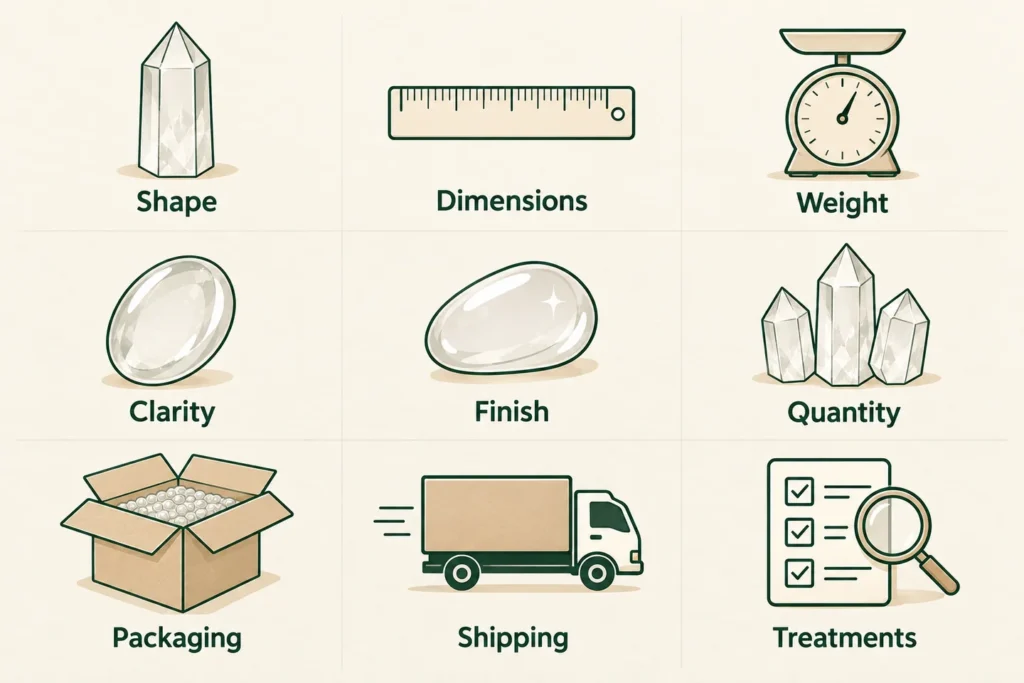
What to confirm before requesting a quote
From the supplier side, here's what I typically need from a buyer before providing an accurate quotation:
- Product form and specifications — What shape? What size range? Any clarity preference?
- Quantity — Per SKU and total order. This determines whether the order fits within MOQ and affects unit pricing.
- Material and treatment expectations — Natural untreated? Is the buyer aware that some clear quartz on the market may be treated or enhanced9? (Buyers should verify treatment status for anything they market as "natural.")
- Packaging requirements — Bulk packed? Individually wrapped? Gift boxed? Packaging significantly affects cost and preparation time.
- Delivery destination — Shipping costs and logistics options vary dramatically between a door-to-door delivery to Ohio and a port shipment to Sydney.
- Timeline — When does the buyer need the goods? Stock items ship faster; custom processing requires production lead time.
Red flags in supplier communication
Not every supplier interaction is equal. Here are warning signs I'd encourage any buyer to watch for:
- Refusal to provide current-batch photos or videos. If a supplier can only show you catalog images from two years ago, the actual product may look different.
- Prices quoted without any specification confirmation. A suspiciously fast, suspiciously low quote often means the supplier hasn't actually checked what they can deliver.
- Vague or absent treatment disclosure. If a supplier can't or won't tell you whether the material is natural, heated, coated, or otherwise treated, that's a problem — especially if your customers care about authenticity.
- No discussion of size or weight ranges. Natural stone products are inherently variable. A professional supplier will quote within a range (e.g., "6–8 cm, 80–120g") rather than promising exact dimensions.
- Identical photos used across many different listings. This is common on platforms and usually means the photos are generic, not representative of available stock.
The total cost perspective
Price comparison in clear quartz wholesale is frequently misleading. Consider this scenario:
| Cost Factor | Supplier A | Supplier B |
|---|---|---|
| Unit price (8 cm tower) | $1.50 | $1.10 |
| Weight range | 100–130g | 60–90g |
| Clarity | Mostly clear, some inclusions | Heavy inclusions, cloudy |
| Packaging | Individual bubble wrap | Bulk packed, no protection |
| Shipping to USA | Included in quote | Separate, adds $0.40/pc |
| Breakage rate (estimated) | 2% | 8% |
| Effective cost per sellable piece | ~$1.53 | ~$1.62 |
Supplier B looked cheaper at first glance. But after accounting for lighter weight (lower perceived value for retail), lower clarity, higher breakage from poor packaging, and separate shipping costs, the effective cost per sellable piece is actually higher. This is the kind of comparison that matters for resale margins.
What are the biggest purchasing risks when sourcing clear quartz wholesale?
Every experienced buyer has at least one sourcing horror story. In clear quartz wholesale, the risks aren't exotic — they're practical and predictable. Understanding them upfront saves significant time and money.
The three biggest purchasing risks in clear quartz wholesale are product mismatch (receiving something different from what you expected), unstable follow-up batches (the second order doesn't match the first), and misleading price comparisons (choosing a supplier based on incomplete cost analysis). All three risks can be reduced through better communication and clearer specification agreements before ordering.

Product mismatch
This happens when the buyer's expectation and the supplier's delivery aren't aligned. Common causes include:
- Relying on old or generic photos. The product in a two-year-old listing may no longer be available, or the current batch may differ in clarity, color, or size.
- Ambiguous size descriptions. "Medium" means different things to different suppliers. Always request specific centimeter and gram ranges.
- Unconfirmed treatment status. A buyer may assume "clear quartz" means natural and untreated, while the supplier's product has been enhanced. This distinction matters enormously for resale credibility.
Mitigation: Request current-batch photos and videos. Confirm specifications in writing before paying. For first orders, consider a smaller trial quantity to verify quality before scaling up.
Unstable follow-up batches
Clear quartz is a natural material. Even the same mine or rough lot can produce variation. For resale businesses that promise their customers a certain "look" — whether on a website, in a livestream, or on a retail shelf — batch-to-batch consistency is a core concern.
A reliable supplier will:
- Inform you when a new rough lot is being used
- Send updated photos for each production batch
- Discuss acceptable variation ranges
- Offer to hold or reserve material for repeat orders when possible
No supplier can promise perfectly identical natural stone products across every batch. But a good supplier will communicate variations proactively rather than letting you discover them after unpacking a shipment.
Misleading price comparison
I covered the cost analysis above, but it's worth emphasizing: the lowest unit price is not always the best sourcing decision. Factors that often get overlooked in price comparison include:
- Size and weight differences between similarly named products
- Finish quality — rough polish vs. high-gloss finish
- Packaging quality — bulk vs. individual protection
- Shipping terms — FOB, CIF, DDP, or door-to-door pricing
- Payment terms and order flexibility — Can you mix SKUs? Is there a rigid MOQ per item?
- Communication responsiveness — How quickly and clearly does the supplier answer questions?
A slightly higher per-piece cost from a supplier who communicates well, ships consistent quality, and solves problems quickly is often cheaper in the long run than a "bargain" supplier who creates returns, customer complaints, and reorder headaches.
Frequently Asked Questions
What is the typical MOQ for clear quartz products in wholesale?
MOQ varies by product form, supplier, and order structure. Some suppliers set MOQ per SKU (e.g., 50 pieces per size), while others allow mixed-batch orders across shapes and sizes. There is no universal standard — always confirm MOQ during the inquiry process rather than assuming.
Can I request custom sizes or shapes for clear quartz products?
Yes, many processing factories offer custom work — specific height ranges, custom carvings, branded packaging, or non-standard shapes. Custom orders typically require higher MOQ and longer lead times than stock items. Discuss your requirements early so the supplier can confirm feasibility and pricing.
How do I verify that clear quartz is natural and untreated?
Ask your supplier directly about treatment status and request written confirmation. For high-value claims, independent gemological lab testing is available but adds cost. Treat origin and treatment labels as claims to verify, not as guaranteed facts.10 For application-specific certification needs, consult a qualified gemological professional.
Should I visit China to source clear quartz in person?
Visiting wholesale markets and factories gives you firsthand quality assessment and face-to-face negotiation. However, it's not required for successful sourcing. Many B2B buyers establish productive relationships through video calls, current-batch photos and videos, trial orders, and detailed specification discussions conducted remotely. In-person visits are most valuable when you're establishing a new relationship or planning large custom orders.
How long does production and shipping take for clear quartz wholesale orders?
In-stock items can typically ship within days. Custom or made-to-order products may require 1–4 weeks of production depending on complexity and quantity. International shipping adds 3–7 days by air or 20–40 days by sea.11 Always confirm lead time and shipping method before finalizing an order.
Conclusion
So, where can you find clear quartz? The honest answer is that the material itself is abundant12 — but finding a reliable sourcing channel for clear quartz products that meet your resale specifications, arrive consistently, and fit your business economics is the real work. Whether you source through a factory, a wholesale market, an online platform, or a trading company, the quality of your purchasing outcome depends on how well you specify your needs, verify current-batch reality, and communicate with your supplier.
I've spent over 15 years processing and supplying crystal products from our facility in Suzhou, China. The buyers who get the best results are the ones who treat sourcing as a conversation, not a transaction. If you're looking for clear quartz towers, spheres, palm stones, tumbled stones, or any other product form for your retail or wholesale business, reach out with your specifications — product type, size range, quantity, packaging needs, and destination. We'll confirm what's currently available and provide an honest quote based on the actual batch, not a stock photo from three years ago.
References
- "Quartz crystal in Brazil", https://pubs.usgs.gov/publication/70215038. A mineralogical locality reference documenting quartz occurrences across multiple countries supports the article's broad geographic framing, although it does not verify current commercial production from each named region. Evidence role: general_support; source type: encyclopedia. Supports: Quartz occurs widely and is documented from multiple countries and regions, including several named in the article.. Scope note: The source would support geological occurrence, not the reliability or availability of commercial supply from those locations. ↩
- "Lapidary", https://en.wikipedia.org/wiki/Lapidary. A lapidary-process reference explaining that rough gemstones are cut, shaped, and polished before use supports the article's description of the processing chain, though packaging is a commercial step outside the mineral-processing discussion. Evidence role: mechanism; source type: education. Supports: Lapidary production commonly involves cutting, shaping, and polishing rough gem material into finished objects.. Scope note: The source would directly support cutting, shaping, and polishing, but only contextually support packaging as part of resale preparation. ↩
- "Donghai Crystal", https://baike.baidu.com/en/item/Donghai%20Crystal/40421. Official market or local-government descriptions identifying Donghai and Guangzhou-area jewelry districts as wholesale centers support the article's location examples, although such sources may not independently measure market size or product mix. Evidence role: historical_context; source type: government. Supports: Official or trade-development sources identify Donghai and Guangzhou-area markets as centers for crystal, jewelry, or gemstone wholesale activity.. Scope note: The support is strongest for the existence and commercial role of the markets, not for comparative scale or supplier quality. ↩
- "INFORMATION ASYMMETRY – DigitalCommons@URI", https://digitalcommons.uri.edu/cgi/viewcontent.cgi?article=5618&context=oa_diss. Research on B2B electronic marketplaces supports the mechanism that online platforms can reduce supplier-search costs while leaving buyers to manage trust and information-asymmetry risks; the evidence is general to e-marketplaces rather than specific to clear quartz. Evidence role: mechanism; source type: paper. Supports: Research on B2B electronic marketplaces discusses reduced search costs alongside trust, quality, and information-asymmetry problems.. Scope note: The source would contextualize the sourcing mechanism but would not prove conditions on any individual platform or listing. ↩
- "The Evolution of Product Search", https://babur.people.clemson.edu/research/Evolution_of_Product_Search.pdf. E-commerce information-quality research supports the general claim that online listings can contain inaccurate or outdated product information, although it does not specifically document clear-quartz batch photography practices. Evidence role: general_support; source type: paper. Supports: E-commerce research documents product-information quality issues, including inaccurate, incomplete, or outdated listing information.. Scope note: The evidence would be contextual and general to e-commerce or online marketplaces. ↩
- "GIA Gem Encyclopedia | Complete List Of Gemstones", https://www.gia.edu/gem-encyclopedia. Gemological references on quartz support the article's point that clear quartz products vary by form and quality characteristics, although they do not define wholesale SKUs or commercial categories. Evidence role: expert_consensus; source type: institution. Supports: Gemological references describe quartz as a material used in multiple forms and subject to variation in clarity, inclusions, and cutting.. Scope note: The source would support material and quality variation, not the author's specific wholesale taxonomy. ↩
- "Diamond Quality Factors", https://www.gia.edu/diamond-quality-factor. Gemological quality-assessment guidance supports the relevance of clarity, inclusions, cut, polish, and dimensions when evaluating quartz products, while packaging remains a commercial specification rather than a gemological criterion. Evidence role: expert_consensus; source type: institution. Supports: Gemological quality assessment commonly considers clarity, inclusions, cut, polish, and dimensional factors.. Scope note: The source would directly support gem-quality variables and only indirectly support packaging requirements. ↩
- "Inclusions in Gemstones", https://www.gia.edu/gems-gemology/summer-2022-colored-stones-unearthed. Educational geology or gemology sources describing variation in quartz inclusions and clarity support the article's explanation of batch variability, although they do not quantify variation between commercial rough lots. Evidence role: general_support; source type: education. Supports: Educational geology or gemology sources describe natural quartz as variable in inclusions, clarity, and formation conditions.. Scope note: The source would support the underlying natural variability, not any specific supplier's batch consistency. ↩
- "An Introduction to Gem Treatments", https://www.gia.edu/gem-treatment. Gemological treatment references support the article's statement that quartz-family materials can be treated or enhanced, though the source may address quartz varieties broadly rather than clear quartz alone. Evidence role: expert_consensus; source type: institution. Supports: Gemological sources describe treatments or enhancements applied to quartz or quartz-family gemstones.. Scope note: The source would establish treatment possibility, not prevalence in the clear-quartz wholesale market. ↩
- "In the Loupe: Advertising Diamond, Gemstones and Pearls", https://www.ftc.gov/business-guidance/resources/loupe-advertising-diamond-gemstones-pearls. Government jewelry-marketing guidance on gemstone treatment and origin disclosures supports treating such labels as verifiable claims rather than assumptions, although it addresses advertising compliance more than wholesale purchasing practice. Evidence role: expert_consensus; source type: government. Supports: Government jewelry-marketing guidance treats gemstone treatment and origin representations as material claims requiring truthful disclosure.. Scope note: The source would support disclosure and truthfulness standards, not provide a verification method for each transaction. ↩
- "Navigate Shipping and Logistics", https://www.trade.gov/navigate-shipping-and-logistics. Freight-logistics references indicating that air freight commonly takes days while ocean freight commonly takes several weeks support the article's transit-time comparison, although actual timing varies by route, customs clearance, season, and service level. Evidence role: statistic; source type: institution. Supports: Freight-logistics sources give typical international air and ocean transit ranges consistent with days for air and several weeks for sea.. Scope note: The source would support typical ranges, not guarantee transit times for any specific order. ↩
- "Quartz", https://en.wikipedia.org/wiki/Quartz. Mineralogical references describing quartz as one of the most abundant minerals in Earth's crust support the article's statement that the material is abundant, though mineral abundance does not by itself establish availability of finished wholesale products. Evidence role: statistic; source type: encyclopedia. Supports: Mineralogical references describe quartz as one of the most abundant minerals in Earth's crust.. Scope note: The source supports geological abundance, not commercial inventory availability or supply reliability. ↩