Choosing the best place to put smoky quartz can feel surprisingly stressful. You want it to look right, feel right, and not accidentally break some spiritual rule you read about online. The truth is, there is no single "correct" spot. The best placement depends on what you want your smoky quartz to do in that space — decorate, create atmosphere, drive retail sales, or photograph well.
The best place to put smoky quartz is wherever it serves your specific purpose: a living room shelf for home décor, a desk for a calming workspace accent, a store display for customer engagement, or a styled flat-lay for e-commerce photography. Product form, lighting, stability, and setting matter far more than any fixed directional rule. There is no universally "wrong" spot.
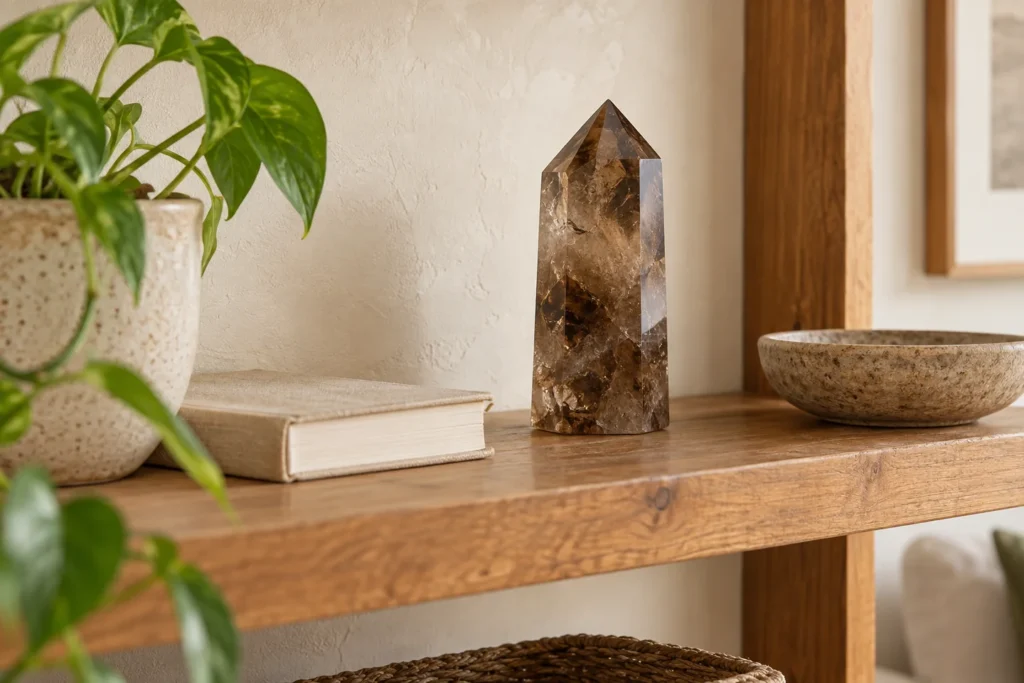
Below, I break down practical smoky quartz placement by real-world scenario — home, office, retail store, and e-commerce display. I also cover how product form (towers, spheres, raw specimens, tumbles) shapes your placement decisions. Whether you are a crystal shop owner deciding how to merchandise smoky quartz or a consumer wondering where to set yours, this guide gives you practical logic instead of rigid rules.
What does smoky quartz placement really depend on?
Most online guides jump straight to room corners and compass directions. But if you have ever held a 2-kilogram smoky quartz raw cluster and a tiny tumbled stone side by side, you already know the real answer: placement depends on the piece itself and your goal.
The right placement for smoky quartz depends on three practical factors: the product form and size, the intended purpose of the display, and the physical conditions of the space (lighting, surface stability, foot traffic, and visibility). Traditional or spiritual preferences can guide your choice, but they should not override common sense.

Product form is your first filter
From years of supplying smoky quartz in dozens of shapes and sizes, I have noticed that customers who ask "where should I put this?" almost always get a better answer when we start with what they bought rather than where they read it should go.
Here is a quick reference:
| Product Form | Typical Size Range | Best Placement Considerations |
|---|---|---|
| Tower / Point | 5–25 cm | Upright display on flat, stable surfaces; shelves, desks, mantels. Visually directional — draws the eye upward. |
| Sphere | 4–15 cm diameter | Needs a stand or concave base. Coffee tables, display cases, windowsills with no vibration risk. |
| Raw Cluster / Specimen | Varies widely | Heavier pieces need sturdy surfaces. Best as centerpieces or statement pieces. Not ideal for narrow shelves. |
| Tumbled Stone | 2–4 cm | Bowls, trays, pockets, small accent groupings. Extremely versatile — almost any location works. |
| Heart / Palm Stone | 4–8 cm | Bedside tables, desk corners, retail checkout counters. Comfortable to handle and display flat. |
| Carved / Decorative | Varies | Treat like any decorative object — match scale to the space. |
Notice that none of these placements require a compass. They require a flat surface, appropriate lighting, and enough visual breathing room for the piece to be noticed.
Purpose drives position
Ask yourself one question: What do I want this smoky quartz to do here?
- Decorate a room? Place it where guests naturally look — mantels, entry consoles, bookshelves.
- Create a calming atmosphere? Many people choose bedside tables, meditation corners, or home office desks.
- Sell to customers? Eye-level retail displays with good lighting and context cards.
- Photograph for online sales? Styled backgrounds with consistent lighting and scale references.
Each of these scenarios has its own placement logic, and I walk through them in detail below.
Where should you put smoky quartz in your home?
Home placement is the most common search intent behind this question. People want their smoky quartz to look good and "feel" right, but they also worry about getting it wrong — especially after reading conflicting advice about which room or corner is "required."
In a home setting, the best places to put smoky quartz are living room shelves, bedroom nightstands, entryway consoles, home office desks, and meditation or reading corners. Choose locations with stable surfaces, some natural or ambient light, and enough space for the piece to be visually appreciated. Avoid high-humidity areas like bathrooms and direct prolonged sunlight that may cause fading over time.

Living room and common areas
The living room is where most people place statement pieces. A smoky quartz tower or raw cluster on a bookshelf, mantel, or console table creates a natural focal point. The deep, translucent brown tones of smoky quartz1 pair well with wood, neutral textiles, and warm-toned interiors.
A few practical tips:
- Towers look best at slightly above or at eye level when standing. Placing them too low (like on a floor) reduces their visual impact.
- Spheres on coffee tables can be conversation starters, but make sure they are on a secure stand — you do not want a heavy quartz sphere rolling off during a dinner party.
- Small groupings of tumbles or hearts in a decorative bowl add texture without dominating a space.
Bedroom
Many people like to place smoky quartz on a bedside table or dresser. The common association is that smoky quartz supports a grounding, calming atmosphere — I hear this frequently from customers who stock it for that specific retail story. Whether you personally feel a calming effect is subjective, but from a purely aesthetic standpoint, smoky quartz's muted earth tones make it a natural fit for bedrooms.
Palm stones and hearts are the most popular bedroom forms. They are flat, stable, and small enough to fit on a nightstand without taking over the space.
Entryway
Placing a piece of smoky quartz near a front door or entryway is popular among people who associate the stone with grounding energy or protection. Practically speaking, an entryway console is a great spot for a medium tower or carved piece because guests see it immediately. It works as a subtle design statement and a conversation piece.
Where to avoid in the home
- Direct sunlight for extended hours. Smoky quartz can fade with prolonged UV exposure.2 A windowsill that gets afternoon sun for six hours a day is not ideal for long-term display.
- High-humidity rooms.3 While quartz itself is durable4, metal stands, wooden bases, and surrounding materials may degrade.
- Unstable surfaces near edges. A heavy raw specimen on a narrow shelf above a walkway is a safety concern, not a spiritual one.
Where is the best place to put smoky quartz in an office?
Offices — both home offices and commercial workspaces — are the second most common placement scenario I hear about. The goal is usually to create a professional but personal atmosphere without the space looking like a crystal shop.
For office placement, smoky quartz works best on a desk corner, a bookshelf at eye level, or a reception area display. Choose smaller, polished forms like towers or palm stones for desks, and reserve larger specimens for lobby or waiting area displays where they can serve as conversation pieces.

Desk placement
A single smoky quartz tower (8–15 cm) on the corner of a desk adds character without cluttering a workspace. Many customers tell me they like having something natural and tactile nearby — something to look at during a long call or to pick up during a break. A palm stone or heart tucked near a monitor works the same way.
Key considerations for desk placement:
- Stability matters. A polished tower on a flat base is far more practical than a rough-bottomed raw piece that wobbles every time you bump the desk.
- Size should match the desk. An oversized cluster on a small desk feels crowded. A tiny tumble on a large executive desk disappears.
- Keep it out of the "active work zone." Do not place your smoky quartz where your mouse, keyboard, or papers need to go. A corner or a small shelf riser works well.
Reception and common areas
For retail store owners who also run a physical office or studio, placing a larger smoky quartz piece in a reception area does double duty: it decorates the space and subtly signals what your business is about. A raw cluster or large sphere on a dedicated stand works well here.
How should crystal retailers display smoky quartz in-store?
This is where placement stops being about personal preference and starts being about selling product. If you are a crystal shop owner or gift retailer, how you place smoky quartz in your store directly affects whether customers pick it up, ask about it, and buy it.
Retailers should display smoky quartz at eye-to-hand level5, under warm or neutral lighting, grouped by product form, and paired with simple informational signage6. Avoid placing dark-toned stones like smoky quartz in poorly lit corners — they need light to show their translucency and color depth.

Lighting is critical for smoky quartz
Smoky quartz's beauty comes from its translucency and depth of color. Under poor lighting, it just looks like a dark brown rock. Under warm LED spotlights or a backlit shelf, the crystal's internal clarity and smoky gradients become visible. This is the single biggest factor I discuss with retailers who wonder why smoky quartz "does not sell well" in their store.
- Warm white LEDs (2700K–3000K)7 bring out golden-brown undertones.
- Neutral white LEDs (4000K) emphasize clarity and any natural inclusions.
- Backlighting works especially well for thin or translucent towers and polished points.
Grouping by form, not just by stone type
I often suggest that retailers display smoky quartz towers together, spheres together, and tumbles in a separate bowl or tray — rather than mixing all forms in one pile. This helps customers compare sizes and choose confidently. A jumbled mix of raw chunks, polished hearts, and tumbles at different price points confuses the buying decision8.
Include a placement card
One practical retail tactic: place a small card near your smoky quartz display that says something like "Popular for desks, bedside tables, and living room shelves. Many customers choose smoky quartz for its calming, grounded aesthetic." This pre-answers the "where do I put it?" question, which reduces purchase hesitation9 and gives customers confidence.
From our experience working with independent crystal retailers, a short placement suggestion near the display consistently helps customers move from "it's pretty" to "I'll take one."
How do you display smoky quartz for e-commerce photography?
If you sell smoky quartz online — whether through your own website, Etsy, or a marketplace — placement during photography is arguably the most important placement decision you make. The product photos are the entire buying experience.10
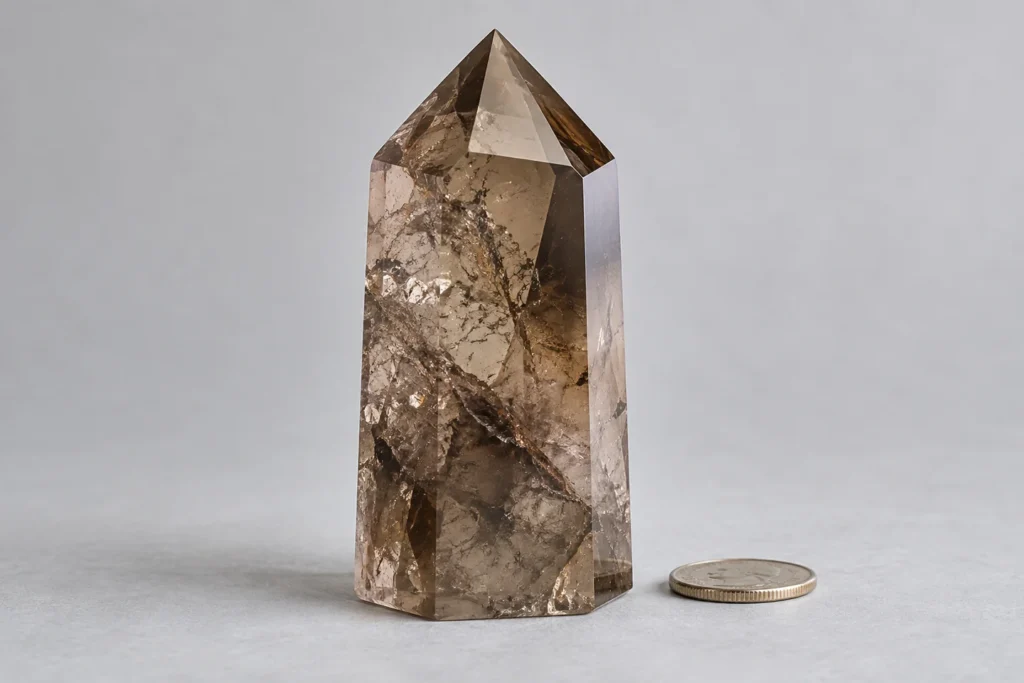
For e-commerce, place smoky quartz on a clean, light-to-neutral background with soft, diffused lighting from one or two angles. Always include a size reference.11 Use styled lifestyle shots alongside clean product-only images so buyers can imagine the stone in their own space.
Product-only shots
For your primary listing images:
- Use a white or light gray background. This makes the smoky brown color read accurately.
- Diffuse your light source. Hard shadows under a dark crystal look messy. A softbox or natural window light with a diffuser sheet gives clean, even illumination.
- Include a size reference. A coin, ruler, or hand holding the piece. Smoky quartz can look dramatically different depending on size — buyers need context.
- Show the base. Customers want to know if the piece stands upright on its own.
Lifestyle shots
Styled photos that show smoky quartz in a real setting — on a nightstand, next to a book and candle, or on a desk — answer the placement question visually. These images sell not just the product but the idea of how to use it.
A few tips from processing and photographing crystal products:
- Natural wood and linen textures complement smoky quartz's earthy tone.
- Avoid cluttered backgrounds. The crystal should be the clear subject.
- Warm-toned props (dried botanicals, brass trays, neutral ceramics) enhance the stone's aesthetic without competing for attention.
Does smoky quartz need to face a specific direction?
This is the anxiety question. Many readers arrive at articles like this one because they read somewhere that smoky quartz "must" face north, or sit in the southwest corner, or point toward a door. They worry they have been doing it wrong.
There is no universally proven rule that smoky quartz must face a specific direction. Some traditions (including certain feng shui practices) suggest placing grounding stones in specific areas of a home. These are cultural preferences, not physical requirements of the mineral. If a directional practice feels meaningful to you, follow it — but do not stress about violating a rule that has no single agreed-upon standard.
Common traditional associations
Here is what I commonly hear from customers and in market discussions. I present these as popular associations, not guaranteed effects:
| Association | Common Placement Suggestion | Source Tradition |
|---|---|---|
| Grounding / stability | Lower shelves, near the floor, bedroom | Various crystal healing communities |
| Protection | Near the front door or entryway | General spiritual practice |
| Stress relief | Office desk, bedside table | Wellness lifestyle content |
| Wealth / abundance corner | Southeast or back-left corner of a room | Some feng shui interpretations |
These vary widely depending on which practitioner, book, or website you consult. My honest recommendation: if a placement feels right and the piece is safe and visible, it is a good placement.
The retailer's perspective
If you sell smoky quartz and a customer asks, "Where should I put this?", the most helpful response is to ask what they are looking for — a decorative accent, a calming presence in their bedroom, a desk companion — and then suggest a placement based on the product's form and their space. This is more useful (and more honest) than prescribing a single "correct" answer.
Frequently Asked Questions
Can I put smoky quartz in direct sunlight?
Brief exposure is fine, but prolonged direct sunlight — especially strong afternoon UV — can gradually fade smoky quartz over months or years. For long-term display, choose a spot with indirect natural light or use artificial lighting instead.
Is it okay to put smoky quartz in a bedroom?
Yes. Bedrooms are one of the most common places people display smoky quartz. Many people associate it with a calming, grounding atmosphere. Bedside tables and dressers are popular choices, especially for palm stones and small towers.
Should smoky quartz be placed on the floor or elevated?
It depends on the piece. Large raw clusters or geode-style specimens can work on the floor with a stable base. Polished towers, spheres, and smaller decorative forms are best elevated on a shelf, desk, or table for visibility and safety.
How do I keep smoky quartz stable on a shelf?
Use museum putty or gel for any piece that does not sit perfectly flat. For spheres, always use a fitted stand or ring base. Avoid placing heavy pieces on glass shelves without verifying the weight capacity.
Does smoky quartz placement affect its value?
Placement does not change the mineral's value, but display conditions matter for preservation. Avoid prolonged UV, high humidity, and unstable surfaces. For retailers, good placement with proper lighting directly affects perceived value and sellability.
Conclusion
The best place to put smoky quartz is wherever it matches your purpose — whether that is decorating a home, creating a calming workspace, driving retail sales, or photographing products for your online store. Product form, lighting, surface stability, and visual context matter far more than any single directional rule. Traditional associations are worth knowing as common customer preferences, but they should inform your choice, not create anxiety about getting it wrong.
If you are a retailer or brand owner sourcing smoky quartz in various forms — towers, spheres, raw specimens, or tumbled stones — contact us to discuss your product needs.
References
- "Smoky quartz", https://en.wikipedia.org/wiki/Smoky_quartz. Mineralogical encyclopedias describe smoky quartz as a brown to gray variety of quartz that may be transparent or translucent, supporting the article's description of its deep smoky tones. Evidence role: definition; source type: encyclopedia. Supports: Smoky quartz is a brown-to-gray variety of quartz that can be transparent or translucent.. ↩
- "Smoky quartz", https://en.wikipedia.org/wiki/Smoky_quartz. Mineralogical research on smoky quartz attributes its brown-to-gray color to radiation-induced color centers and documents that such color centers can be affected by exposure conditions, supporting the caution against prolonged direct sunlight. Evidence role: mechanism; source type: research. Supports: Smoky quartz color is associated with radiation-induced color centers and may be altered by light, heat, or prolonged exposure conditions.. ↩
- "Appendix N: Curatorial Care of Wooden Objects", https://www.nps.gov/subjects/museums/upload/MHI_AppN_WoodObjects.pdf. Museum conservation guidance notes that elevated relative humidity can promote metal corrosion and affect wood stability, supporting the warning that humid rooms may harm stands, bases, or surrounding display materials rather than the quartz itself. Evidence role: mechanism; source type: government. Supports: High relative humidity can accelerate corrosion of metals and dimensional change or deterioration in wood and related display materials.. Scope note: This supports the preservation rationale for accessories and nearby materials, not a claim that quartz is damaged by ordinary indoor humidity. ↩
- "Mineral Gemstones", https://pubs.usgs.gov/gip/gemstones/mineral.html. Standard mineral references list quartz at Mohs hardness 7 and describe it as a hard silicate mineral, which supports the article's characterization of quartz as durable for display purposes. Evidence role: definition; source type: encyclopedia. Supports: Quartz has a Mohs hardness of about 7 and is commonly described as a hard, resistant mineral.. ↩
- "BRAND PLACEMENT AND CONSUMER CHOICE – PMC – NIH", https://pmc.ncbi.nlm.nih.gov/articles/PMC2741065/. Retail merchandising studies find that shelf position and visual accessibility affect shopper attention and product choice, providing contextual support for placing smoky quartz at eye-to-hand level. Evidence role: general_support; source type: paper. Supports: Shelf position and visibility influence consumer attention and product choice in retail settings.. Scope note: The evidence is general to retail merchandising and may not measure smoky quartz or crystal-shop displays specifically. ↩
- "Display signs and involvement: the visual path to purchase …", https://www.academia.edu/173127872/Display_signs_and_involvement_the_visual_path_to_purchase_intention. Research on point-of-purchase communication indicates that in-store informational signage can shape shopper attention and product evaluation, supporting the article's recommendation to add simple placement or product cards. Evidence role: general_support; source type: paper. Supports: In-store signage and point-of-purchase information can influence shopper attention, evaluation, or purchase decisions.. Scope note: The support is based on general retail settings and does not directly test smoky quartz displays. ↩
- "Color temperature", https://en.wikipedia.org/wiki/Color_temperature. Lighting references classify correlated color temperatures around 2700K to 3000K as warm white, supporting the article's use of that range for warm-toned display lighting. Evidence role: definition; source type: institution. Supports: Correlated color temperatures around 2700K to 3000K are commonly classified as warm white lighting.. Scope note: This verifies the lighting terminology; it does not directly prove that these LEDs maximize smoky quartz sales or aesthetic appeal. ↩
- "future research directions in choice overload and its moderators", https://pmc.ncbi.nlm.nih.gov/articles/PMC11111947/. Consumer-choice research on assortment complexity and choice overload shows that poorly structured or excessive options can increase decision difficulty, supporting the article's caution against jumbled smoky quartz displays. Evidence role: general_support; source type: paper. Supports: Large or poorly structured assortments can increase choice difficulty and reduce decision confidence in some consumer contexts.. Scope note: Choice-overload effects vary by category and shopper expertise, so the evidence is contextual rather than a direct test of crystal retailing. ↩
- "Product Uncertainty in Online Markets", https://scholarspace.manoa.hawaii.edu/bitstreams/1d745463-ff2c-40b4-9efc-864e7f2fde15/download. Studies of consumer information and perceived risk find that relevant product information can reduce uncertainty and support purchase confidence, providing contextual support for the claim that placement cards may reduce hesitation. Evidence role: general_support; source type: paper. Supports: Providing relevant product information can reduce consumer uncertainty or perceived risk and improve purchase confidence.. Scope note: The evidence supports the mechanism generally and does not quantify the effect of smoky quartz placement cards. ↩
- "How product images influence online purchase decisions …", https://www.tilburguniversity.edu/current/news/more-news/how-product-images-influence-online-purchase-decisions-and-when-they-dont. E-commerce research shows that product image quality and visual presentation affect online consumer evaluation and purchase intention, supporting the article's emphasis on photography for online smoky quartz listings. Evidence role: general_support; source type: paper. Supports: Product image quality and visual presentation influence consumer evaluation, trust, and purchase intention in online shopping.. Scope note: The cited evidence should be framed as support for the importance of images, not as literal proof that photos are the entire buying experience. ↩
- "The effect of visual presentation on purchasing behaviour …", https://research.tilburguniversity.edu/en/publications/the-effect-of-visual-presentation-on-purchasing-behaviour-in-e-co/. Research on online product presentation indicates that visual scale cues and explicit size information help consumers assess product dimensions, supporting the recommendation to include a size reference in smoky quartz listings. Evidence role: general_support; source type: paper. Supports: Scale cues and size information in online product presentations help consumers judge product dimensions and reduce uncertainty.. Scope note: The support is general to e-commerce product perception and may not be specific to minerals or crystals. ↩