Buyers ask me this question more often than almost any other. Clear quartz comes from dozens of countries, prices vary wildly, and a bad batch can sit on your shelf for months. The real problem is not geography — it is knowing what visual and physical qualities actually drive resale, and how to evaluate them before you commit.
There is no single best country for clear quartz. Origin is a market reference, not a quality guarantee.1 Brazil, Madagascar, China, and other major sources all produce clear quartz across a wide range of grades2 — from gem-quality transparent pieces to heavily clouded or fractured stock. For resale buyers, the more useful question is: does this specific batch, in this product form, meet the appearance standard your customers expect?
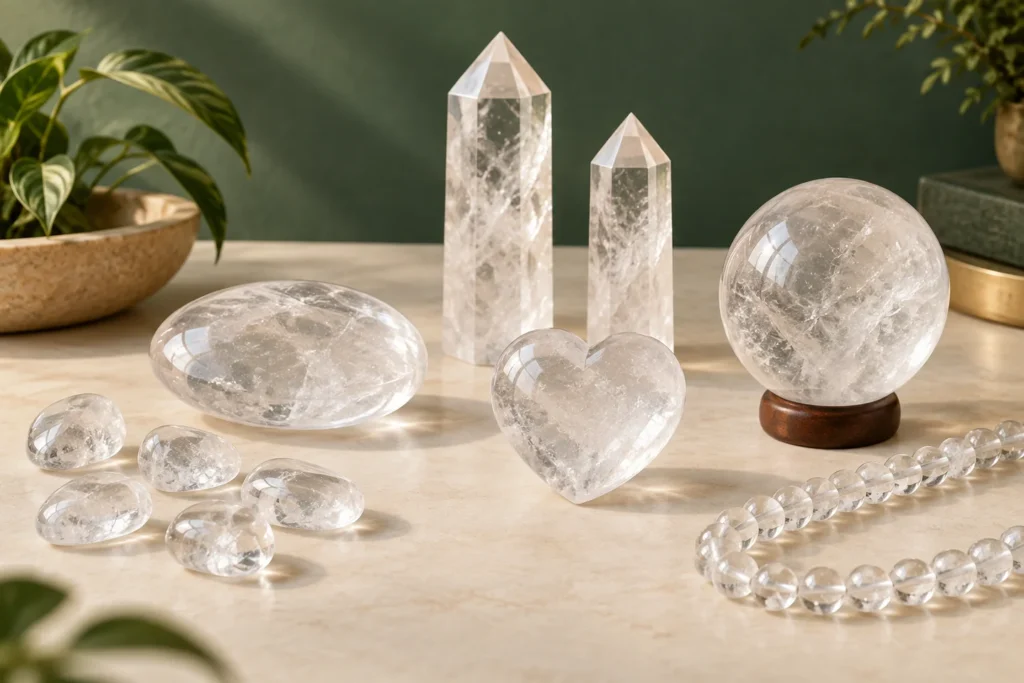
That reframe changes how you shop. Instead of filtering by country label, you start filtering by transparency, fracture level, polish quality, and batch consistency — the factors that actually determine whether your customers pull out their wallets.
Why Does Country of Origin Matter to Clear Quartz Buyers?
Buyers often ask us whether one origin is always better, and in supplier conversations, that question usually signals something more specific: they received a cloudy or heavily cracked shipment, or they saw a competitor selling visually superior pieces at a similar price. Country becomes a shorthand for quality expectations — a way to anchor a standard.
Origin labeling in the wholesale crystal market reflects where material was mined or processed, but it does not guarantee grade consistency within that origin. The same country — even the same region — ships material across multiple quality tiers.
What Origin Labels Actually Tell You
In practice, origin claims in the crystal wholesale trade serve several functions:
- Market positioning — Certain origins carry a reputation premium (Brazilian clear quartz, for example, is widely cited in retail marketing).
- Trade documentation — Country of origin appears on customs and shipping paperwork, not as a quality grade.3
- Rough material sourcing — For tumbled stones and carved pieces, the processing country and the mining country are often different.
- Price anchoring — Some buyers use origin to justify retail pricing to their customers.
None of these functions confirms that a specific shipment will photograph well, sell quickly, or satisfy your store's visual standard. Two pallets labeled with the same origin can look completely different in hand.
The Reputation Gap
Brazil has a strong global reputation for clear quartz, and that reputation is not without reason — large, well-formed crystals with good transparency do come out of Brazilian mines4. But Brazil also produces plenty of milky, heavily veiled material. Madagascar produces exceptional large points and clusters5, but also heavily included stock. China processes enormous volumes of clear quartz for carved and shaped products6, at a range of grades from display-quality to budget gift items.
The takeaway: Origin tells you where material came from, not which shelf it belongs on in your store.
What Visual Qualities Should Retail Buyers Actually Judge?
This is the question behind the question. When buyers ask about country, they are really trying to avoid pieces that look disappointing, photograph poorly, or prompt customer complaints. The quality variables that matter at resale are visible — you do not need lab equipment to screen them.
Transparency, internal features, surface finish, color tone, and shape integrity are the practical checklist. Together, they determine whether a piece looks like a premium product or a budget filler.
Transparency and Cloudiness
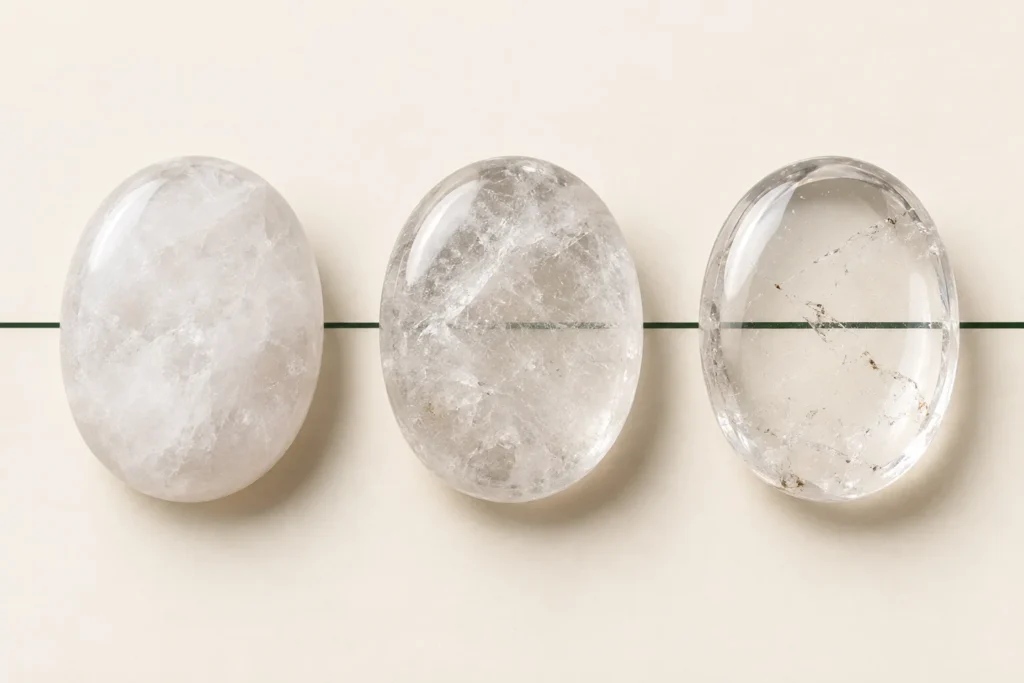
The most immediately visible quality variable is how transparent the piece is. Clear quartz exists on a spectrum7:
- Gem-clear or high clarity — Interior is visibly transparent, light passes cleanly through. Commands higher retail prices, performs well in photography and display.
- Partially cloudy with clear zones — Common in towers and points; the cloudy base with a clear tip is a widely sold and accepted form. Buyers should know their customers' expectations.
- Milky quartz — Fully opaque white. This is technically a separate material. Not poor quality, but it should not be sold as "clear quartz" in retail contexts where transparency is implied.
Ask your supplier to confirm which tier applies to the batch you are evaluating. Request current photos or videos in natural light, not just catalog images.
Internal Fractures, Veils, and Inclusions
Internal features are the second major variable. Some are acceptable to most buyers; others reduce sellability significantly.
| Feature | Description | Resale Impact |
|---|---|---|
| White veil (cloud) | Wisps or layers of milky material inside | Acceptable if consistent and attractive; problematic if dominant |
| Rainbow fractures | Internal fractures that catch light and produce rainbow effect8 | Often a positive selling feature for retail |
| Ice-like cracks | Flat, dry-looking fractures near surface | Can signal fragility; reduces visual appeal |
| Black inclusions | Carbon or mineral inclusions | Collectible in some contexts; screen for customer fit |
| Phantoms | Ghost-like growth zones | Specialty value; not standard clear quartz quality |
For products like spheres, palm stones, and faceted towers, buyers should pay particular attention to fractures near the base or edges — those areas are most visible in retail display and most likely to draw customer questions.
Surface Polish and Shape Integrity
For carved and shaped products — towers, spheres, hearts, eggs — polish quality is as important as internal clarity9. A well-polished piece with modest internal clouds will often outsell a scratchy piece with superior transparency.
Check for:
- Flat spots on spheres (should roll smoothly)
- Chipping on tower tips or carved edges
- Scratch marks visible in angled light
- Uneven facets on tower sides
- Base stability — does it stand without assistance?
These are processing quality issues, not origin issues.10 They reflect the skill and equipment of the manufacturer, not the mining country.
Size and Weight Consistency Within a Batch
For ecommerce and live selling, batch consistency is arguably the most underrated quality variable. If your product listing shows a 400g tower and your shipment contains pieces ranging from 180g to 650g, you face either customer complaints, manual sorting time, or both.
Before ordering, clarify:
- Stated size range (height in cm, weight in grams)
- Whether sizing is approximate or graded
- Whether mixed-grade batches are offered versus single-grade runs
- How the supplier handles pieces outside the stated range
How Should Ecommerce and Live Sellers Evaluate a Clear Quartz Batch?
Online sellers — whether listing on Etsy, Amazon, Shopify, or selling on TikTok Live or Instagram — have a specific visibility problem: their customers cannot hold pieces before buying11. The appearance standard for their channel is therefore higher than for a physical store where a customer picks up what they like.
For these sellers, the practical evaluation process looks different from a showroom visit.
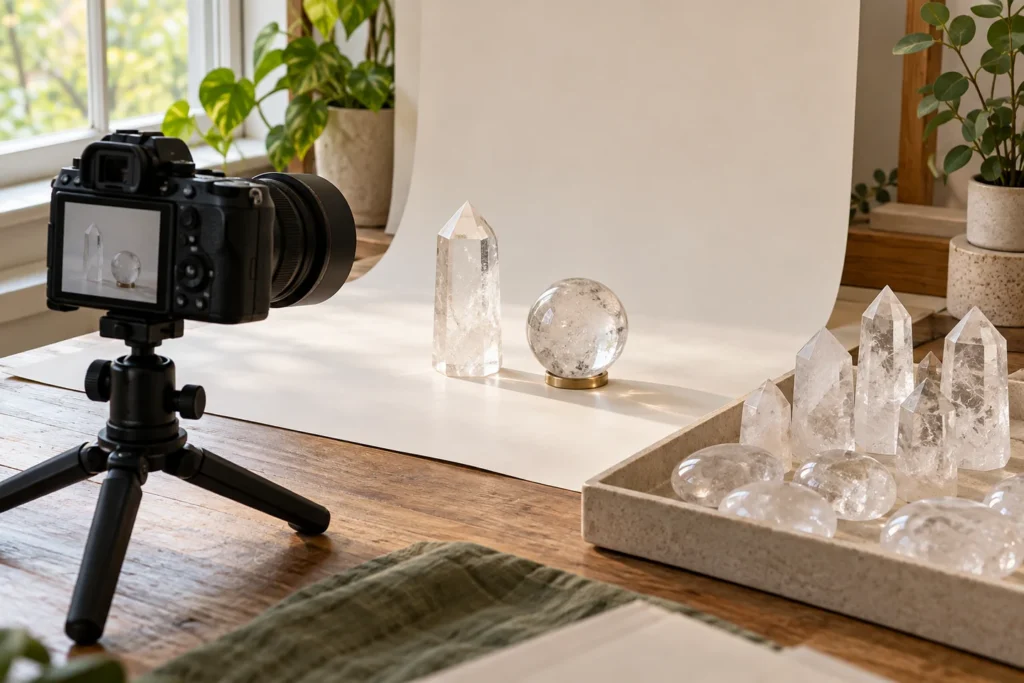
Request current batch media, not catalog photos. Ask the supplier for photos or short videos of the actual batch you are purchasing, shot in natural daylight or a neutral light box. This single step removes most visual surprises. At GD Crystal, we routinely share batch photos on request for exactly this reason — what ships should look like what you approved.
Test with a trial order before scaling. A trial order allows you to photograph the actual pieces in your own light setup, handle the polish and weight, and check size consistency against your listing copy. The cost of a trial order is lower than the cost of a disputed shipment or a wave of return requests.
Match the grade to the price point and channel. A live-selling channel where products move at $8–$15 per piece has different appearance requirements than a boutique crystal shop selling at $45–$80 per piece. Neither is wrong — but buying gem-clear stock for a volume live-sale channel is a margin problem, and buying heavily clouded stock for a premium boutique is a credibility problem.
Consider the product form relative to your selling style. Towers photograph well for still listings. Palm stones and tumbled pieces perform well in flat-lay and hand-scale shots. Spheres require careful photography to show their clarity. Choose the product form that suits how you sell, not just the material.
A Practical Pre-Order Checklist
Use this before confirming any clear quartz wholesale order:
- ✅ Request current batch photos in natural light
- ✅ Confirm size and weight range (not just approximate)
- ✅ Ask whether the batch is single-grade or mixed-grade
- ✅ Check whether any treatment or enhancement is present (heat, dye, coating)
- ✅ Confirm MOQ and whether a trial quantity is available
- ✅ Ask about packaging — will pieces arrive protected from contact damage?
- ✅ Clarify lead time and shipping method for your destination
Frequently Asked Questions
Is Brazilian clear quartz always better than quartz from other countries?
No. Brazil produces high-quality clear quartz with strong market recognition, but also ships material across multiple grades. Origin does not guarantee transparency, polish, or batch consistency. Evaluate the specific batch you are being offered, not the country label.
How can I tell if clear quartz has been treated or enhanced?
Some clear quartz on the wholesale market is heat-treated, coated, or otherwise processed to improve appearance. Ask your supplier directly about treatments on the specific batch. For resale transparency, knowing what you are selling allows you to represent it honestly to your customers.
What size clear quartz sells best for retail?
This depends heavily on your channel and price point. In our experience working with wholesale buyers, medium towers (8–12 cm) and palm stones (50–100g) tend to have broad retail appeal. Larger display pieces sell more slowly but at higher margins. Confirm size expectations with your supplier before ordering.
Can I mix clear quartz from multiple origins in one retail display?
Yes, and many retailers do this. Visual consistency matters more than origin consistency for most display contexts. If your pieces look similar in transparency, color tone, and polish, origin mixing is unlikely to be noticed by most retail customers.
What is a reasonable MOQ for a trial order of clear quartz?
MOQ varies by supplier, product form, and grade. For initial evaluation, it is reasonable to ask whether a supplier offers a smaller trial quantity before a full production run. Confirm this directly — MOQ and trial order conditions should be established before finalizing product selection.
Conclusion
Clear quartz quality is determined by transparency, internal features, surface finish, size consistency, and batch reliability — not by country of origin alone. As a B2B crystal supplier with over 15 years of processing experience, I see buyers improve their sourcing decisions significantly when they shift focus from "which country is best" to "does this batch meet my resale standard." Request current batch photos, start with a trial order, match the grade to your channel, and clarify specifications before committing. If you are evaluating clear quartz for your store or brand, contact GD Crystal to discuss available product forms, current batch conditions, and trial order options.
References
- "Marking of Country of Origin on U.S. Imports", https://www.cbp.gov/trade/rulings/informed-compliance-publications/marking-country-origin-us-imports. U.S. Customs and Border Protection guidance describes country-of-origin marking as an import identification requirement, supporting the distinction between provenance and product quality; this is contextual support because it does not address clear quartz grading specifically. Evidence role: general_support; source type: government. Supports: A government customs source should explain that country-of-origin marking identifies where goods originate for import purposes, not their commercial quality grade.. Scope note: Contextual support from customs regulation rather than a quartz-specific grading source. ↩
- "Quartz crystal in Brazil", https://pubs.usgs.gov/publication/70215038. Mineralogical locality references document quartz occurrences in Brazil, Madagascar, and China and describe quartz as a widespread mineral with variable appearances, supporting the claim that origin alone does not imply a uniform grade. Evidence role: general_support; source type: encyclopedia. Supports: A mineralogical reference should document quartz occurrences in Brazil, Madagascar, and China and show that quartz is a widespread mineral occurring in many forms and localities.. Scope note: Such references support geographic occurrence and mineral variability, but may not directly classify wholesale commercial grades. ↩
- "Marking of Country of Origin on U.S. Imports", https://www.cbp.gov/trade/rulings/informed-compliance-publications/marking-country-origin-us-imports. Customs authorities define country of origin as a regulatory classification used for import marking, tariff, and documentation purposes, supporting the point that it is not itself a quality grade. Evidence role: general_support; source type: government. Supports: A customs or trade authority should confirm that country of origin is a regulatory and documentation category for imported goods.. ↩
- "Blue quartz in Brazil: the Rio dos Remédios occurrence", https://www.academia.edu/84454997/Blue_quartz_in_Brazil_the_Rio_dos_Rem%C3%A9dios_occurrence_preliminary_study. Mineralogical locality references record Brazilian occurrences of quartz, including transparent rock crystal specimens, supporting the claim that Brazil can produce well-formed clear quartz crystals. Evidence role: case_reference; source type: encyclopedia. Supports: A mineralogical locality source should document Brazilian quartz occurrences, including transparent rock crystal specimens.. Scope note: The source would support occurrence and specimen character, not guarantee the quality of any current wholesale shipment. ↩
- "New Find of Petroleum-Included Quartz from Madagascar", https://www.gia.edu/gems-gemology/spring-2023-gemnews-petroleum-included-quartz-madagascar. Mineralogical locality references document Madagascar quartz occurrences and specimen-producing localities, providing contextual support for the statement that Madagascar can supply notable quartz points and clusters. Evidence role: case_reference; source type: encyclopedia. Supports: A mineralogical reference should document Madagascar localities known for quartz crystals, points, or clusters.. Scope note: The reference may document mineral occurrence and specimens rather than verify the commercial descriptor “exceptional.” ↩
- "GIA Team Documents the Chinese Gem and Jewelry Industry", https://www.gia.edu/research-news-team-documents-chinese-gem-jewelry. International trade statistics on worked precious and semi-precious stones can support the claim that China is a major processor or exporter of carved stone products; this is contextual if the trade category aggregates quartz with other stones. Evidence role: statistic; source type: institution. Supports: An international trade database or institutional report should show China’s significant exports of worked precious or semi-precious stones, ideally including quartz or relevant HS categories.. Scope note: Trade categories may combine quartz with other semi-precious stones, so they may not isolate clear quartz specifically. ↩
- "Quartz – Common Minerals", https://commonminerals.esci.umn.edu/minerals-o-s/quartz. Mineralogy references describe quartz as ranging from transparent to translucent or opaque, with milky appearances commonly associated with internal inclusions or microscopic features, supporting the article’s use of a transparency spectrum. Evidence role: definition; source type: education. Supports: A university or mineralogy reference should explain that quartz may be transparent, translucent, or opaque and that milky appearance can result from inclusions or structural features.. ↩
- "Thin-film interference", https://en.wikipedia.org/wiki/Thin-film_interference. Optical and gemological literature explains that light interacting with fractures or thin films can produce iridescent colors, supporting the mechanism behind rainbow effects seen in fractured quartz. Evidence role: mechanism; source type: paper. Supports: A gemology or optics source should explain how internal fractures or thin films can produce iridescent or rainbow-like effects through light interference or reflection.. Scope note: The mechanism applies generally to fracture-related iridescence and may not verify every rainbow effect in an individual quartz specimen. ↩
- "Diamond Quality Factors", https://www.gia.edu/diamond-quality-factor. Gemological education sources identify polish, finish, and workmanship as recognized factors in assessing fashioned stones, supporting the article’s claim that surface finish affects perceived quality. Evidence role: expert_consensus; source type: institution. Supports: A gemological institution should identify polish, finish, or workmanship as a recognized factor in evaluating cut or fashioned stones.. Scope note: This is contextual support from gemological evaluation principles and may not quantify resale outcomes for wholesale clear quartz carvings. ↩
- "GEM CUTING TERMS", https://www.qcc.cuny.edu/biologicalSciences/faculty/RScal/gems/cutting.html. Lapidary education materials describe scratches, chips, uneven facets, and polish quality as outcomes of cutting, shaping, polishing, and handling, supporting the classification of these defects as processing-related. Evidence role: mechanism; source type: education. Supports: A lapidary education source should explain that cutting, shaping, polishing, and handling can create or prevent scratches, chips, and uneven surfaces.. ↩
- "Purchasing in the digital age: A meta-analytical perspective on …", https://pmc.ncbi.nlm.nih.gov/articles/PMC11044045/. Consumer-behavior research on online shopping finds that the inability to physically inspect products before purchase contributes to information asymmetry and perceived risk, supporting the article’s explanation of why online visual presentation matters. Evidence role: mechanism; source type: paper. Supports: A consumer-behavior paper should show that inability to physically inspect or touch products online increases information asymmetry or perceived purchase risk.. Scope note: The evidence is general ecommerce research and does not specifically study clear quartz buyers. ↩